Category: Climate

Essence of wisdom, page three.

A genuine leader is not a searcher for consensus but a molder of consensus.

My concluding essay on the subject of wisdom starts off with this quotation by Martin Luther King, Jr.  That he was best known for using nonviolent civil disobedience to achieve political aims in the 1950’s and 60’s may not be inappropriate today.

I started with looking at our brain in recognition of the strange ways in which we humans make sense of the world, then yesterday looked at how we confuse what we do with what is best for us, surely the essence of wisdom.  Today, I want to conclude with a reflection on the gap between the new wisdom of millions of citizens and the failure of so many leaders to recognise this wisdom.  When I use the word wisdom in this context, it’s probably more in the sense of awareness.  The growing awareness by millions of us that something isn’t right and that our democratic representatives and leaders are way behind.

I will support my argument by referring to a number of media items that have surfaced in recent days.

Let’s start with this weather forecasting chart from the Australian Bureau of Meteorology.

art-weather-620x349

Australia’s “dome of heat” has become so intense that the temperatures are rising off the charts – literally.

The air mass over the inland is still heating up – it hasn’t peaked

The Bureau of Meteorology’s interactive weather forecasting chart has added new colours – deep purple and pink – to extend its previous temperature range that had been capped at 50 degrees.

The range now extends to 54 degrees – well above the all-time record temperature of 50.7 degrees reached on January 2, 1960 at Oodnadatta Airport in South Australia – and, perhaps worryingly, the forecast outlook is starting to deploy the new colours.

“The scale has just been increased today and I would anticipate it is because the forecast coming from the bureau’s model is showing temperatures in excess of 50 degrees,” David Jones, head of the bureau’s climate monitoring and prediction unit, said.

Just reflect on that!  54 degrees Centigrade is 129 degrees Fahrenheit!

On January 4th, just 5 days ago, Bill Moyers held an interview with climate change communication expert Anthony Leiserowitz who explained why climate change gets the silent treatment, and what we should do about it.  Here’s a trailer to that programme.

I very strongly recommend you put an hour to one side and watch the full programme available here.

Next comes a recent item on Christine’s fantastic blog 350 or bust.  I forgot to ask Christine for permission to reproduce her article but am confident that republishing it on Learning from Dogs carries her full support.

New Report Connects Dots Between Political Inaction & Growing Cost Of Climate Change

ucs-cartoon

This is a reposting from The Earth Story’s Facebook page:

“The cost of living is going up and the chance of living is going down. “ –Flip Wilson

A new publication issued by the International Institute for Applied Systems Analysis (IIASA) in the journal “Nature” has reported that the chances of keeping temperatures below a 2 degree rise is now largely in the hands of policy makers.

The challenge of a changing climate can now only be fought with the backing of political agenda – and as most people will agree, this seems bleak.

Of all the uncertainties with regard the effects of climate change, including geophysical and social uncertainties; political uncertainty ranked as the number 1 factor in determining the fate of our species and our planet.

What went wrong? Maybe we have been advertising climate change in an ineffective manner, considering how politically charged the world is?

The burdens of climate change are often communicated in relation to extreme weather events, melting ice caps, lives lost, loss of biodiversity, endangered species etc., but it would appear that to some this doesn’t seem to ring a bell; probably as the bell doesn’t chime as “cha ching cha ching”.

So what happens if we try to communicate climate change in relation to cost?

In 2012, in the United States alone, there were 11 natural disasters that cost over $1 billion – and this does not yet include the almost country wide drought or hurricane sandy, and let’s not forget the multiple other disasters which did not make the 1 billion benchmark. It is predicted that events, like the ones that swept the entire globe in 2012, will increase in frequency and in destructive force if we do not keep temperatures below the 2 degree rise on pre-industrial temperatures.

If we do not change our ways by 2020, the research group have found that the probability of keeping the temperature within the assigned two degree window drops below 50% (best case) or 20% (worst case) – no matter how much money is spent in the effort.

It is predicted that money will not matter; it’s almost bittersweet.

2012 was an eye opening year in terms of our natural environment. From here on out, let’s try change our ways; not our climate. The clock is ticking.

“… the chances of keeping temperatures below a 2 degree rise is now largely in the hands of policy makers.”  Further comment by me is pointless – the message is already crystal clear.

The implications of the changes that are being imposed on all of us were picked up in a recent article in the British newspaper The Telegraph: Rising food prices will reap a bitter harvest.  Here’s a flavour (sorry!) of the article.

British shoppers should brace themselves for “massive” food price rises in 2013, says the aptly named Mark Price, managing director of Waitrose. Is he correct, or is this just another retailer trying to soften up public opinion before imposing price hikes?

Liam Halligan goes on to write (my emphasis):

It strikes me that Price most certainly is right and his statement deserves more comment and consideration. For it is almost inevitable that many crucial foodstuffs will become considerably more expensive during 2013, not least due to recent weather patterns. More fundamentally, the food price rises we’ll see over the coming year will also reflect longer-term non-cyclical trends, not least the burgeoning world population.

During 2013, in fact, rising food prices are likely not only to have a serious impact on the global economy, but could well spark violence and political upheaval, not least in the Middle East.

The importance of the trend Price has highlighted, then, goes way beyond the tills of upmarket British supermarkets. It’s certainly the case, though, that UK food production looks weak, as heavy rainfall in 2012 meant many crops were ruined and farmers couldn’t plant as much as they wanted for 2013. Despite a very dry first quarter, 2012 was this country’s second-wettest year since records began in 1910.

I don’t want to quote any more from the article but read it and realise how the world in 2013 may be unrecognisable beyond our wildest imaginations.

OK, going to round this off.

Firstly, by asking you to read a recent item in Democracy Journal.  This is how the article starts.

Everyone’s Fight: The New Plan to Defeat Big Money

The 2012 campaign is by now mercifully out of our systems, but it remains worth reflecting on some of the dubious firsts that occurred during this election. This was the first presidential campaign to cost more than $2 billion. It was also the first time neither candidate accepted any public financing or the limits that come with it. Finally, it was the first presidential election after Citizens United, the Supreme Court decision that allowed around $600 million in super PAC donations this cycle, and many millions more to nonprofit “social welfare” groups that aren’t required to disclose their donors.

But even these bleak facts don’t do justice to the problem of Big Money. Campaign spending isn’t even our most dire money-in-politics problem. That would be the thousands of lobbyists and many millions of their dollars that are devoted to the warping of our public policy. These powerful lobbies control most outcomes on Capitol Hill, and the problem is far worse than it was 20 years ago.

Read the rest here.

Lastly, by returning to another recent item from Bill Moyers.

Citizens, Not Consumers, Are Key to Solving Climate Crisis

January 4, 2013

by Lauren Feeney

Annie Leonard spent 20 years working for environmental organizations, studying where our stuff comes from and where it goes. She followed waste from industrialized countries to apartheid-era South Africa, where it was dumped in black townships, to Haiti, where it was disguised as fertilizer and dumped on a beach, to Pakistan, Indonesia and the Philippines where we sent everything from e-waste to used car batteries for recycling in a process too dirty for our own backyard.

Then, in 2007, she made a short animated film about our consumer culture and the damage it does to the environment. The Story of Stuff went viral (chances are you’ve seen it — more than 15 million people have) and spawned a whole series of videos that explain complicated environmental and political concepts in an irresistibly simple and engaging way. We reached Annie via email to talk about the latest installment, The Story of Change. This one’s a bit of a departure — instead of looking at the problem, it proposes a solution.

It included this video:

Can shopping save the world? The Story of Change urges viewers to put down their credit cards and start exercising their citizen muscles to build a more sustainable, just and fulfilling world.

I shall close with another quotation from Martin Luther King, Jr.

“The ultimate measure of a man is not where he stands in moments of comfort and convenience, but where he stands at times of challenge and controversy.”

Change, as far as the eye can see.

Of the matters of man for the coming year.

Like countless others, when we look back 12 months and recall what we thought 2012 had in store, we now realise that we didn’t have a clue!  As the silly expression goes, “I can predict anything except those things that involve the future!

So repeating the process is stupid; I have no doubt that 2013 will be brim full of surprises.  At all levels: personal, local, national and global.  But ….. (You knew there was a ‘but’ coming, didn’t you!)

But a conversation that I had with Peter McCarthy on the 27th December resonated with me to such a degree that I felt the urge to pen some thoughts.  I worked with Peter some years ago at Clevedon Hall, we shared an interest in flying a TB20 and both of us studied for our CAA Instrument Rating.  We became good friends.

Clevedon Hall, Somerset, England.
Clevedon Hall, Somerset, England

So come with me today for a stroll around the grounds of change, possibly an epochal period of change.

Let’s start with what may be the biggest catalyst of change heading our way – our broken political system.

Christine of 350orbust fame published this yesterday.

it-is-not-a-just-society-quote

The view that many western societies are a very long way from being fair is growing.  If you want to dig a little deeper into the appalling statistics of the USA, for example, dip into a recent essay written by Charles Hugh Smith that appeared on Chris Martenson’s Peak Prosperity blog.

It’s a long essay packed full of powerful facts and statistics.  Try this one:

6.  The assets that generate unearned income are highly concentrated, and as a result so is the unearned income.  The top 1% owns twice as much stock-market wealth as the bottom 90%.  This income-producing wealth enables the top 1% to act as a financial aristocracy, buying influence and favors from equivalently concentrated political Elites.

stock market wealth

Let me go to Charles’ conclusion:

What few dare admit, much less state publicly, is that the Constitutional limits on the financial Aristocracy and the Tyranny of the Majority have failed.  This guarantees a future Constitutional crisis as each political class – the financial Aristocracy, the top 24% who pay most of the taxes, the dwindling middle class and the bottom 50% who depend on Federal transfers – will battle for control as the Status Quo collapses under the weight of its unsustainable promises.

H’mmm!

Back to the conversation with Peter.  He felt that there was a massive failure of the democratic process in the UK, and by implication in the USA.

Peter continued by saying that many elected politicians, especially at the level of local politics,  weren’t smart people.  Smart, innovative, entrepreneurial people chose not to go into politics.  Those that were elected had too much power and too many vested interests for the good of the societies that they were meant to represent.  In the USA the involvement of private money in politics is nothing short of corruption of the highest order; my personal opinion, no less and no more.

In moderation, Churchill’s saying comes to mind. “It has been said that democracy is the worst form of government except all the others that have been tried.

Let’s move on.

No-one can deny that in so many areas of our lives, the degree of change seems unprecedented.  Whether we are speaking of the huge social changes at work, enormous technological changes, such as the way that we communicate with each other, medical practises, and on and on.  Then add in the consequences of the change in the Earth’s climate, whether or not one sees this as the outcome of man’s activities and …. well, you get the idea!

Here’s a lovely perspective from Alex Jones who writes the blog, The Liberated Way.  Just a few days ago, Alex wrote this:

As hard and gloomy as some of my blog posts on the future of humanity have been, I thought it time to offer good news as to where we are heading.  I shall call this the global realignment.  Few will disagree that the current activities and ideas of humanity in relation to the environment are unsustainable and point to our self-destruction.  History also shows that whenever a crisis occurs traumatic events and the ideas of new thinkers causes a paradigm shift in attitudes and thinking.

Contrary to the fantasy of many people, there will be no celestial champion on a white horse riding forward to save humanity from itself.  The change will come from a series of traumatic events and individual thinkers which will plant the seeds of change, which will ripple forward as a tsunami of changes of ideas and attitudes on a global scale.

So much change.  So much uncertainty.  Such a feeling of being lost in unfamiliar lands.

Or have we been here before?

Have you heard of the Kondratieff Wave?

The Kondratieff Wave (Kondratiev Wave or K-wave) theory is proposing the existence of the extra-long, 50+ years long cycles of growth in the modern market (capitalist) economy. The theory was proposed in 1920s by Russian economist Nikolai Kondratiev.

Wikipedia has a good summary available here.  A Google search will find much more material, such as this chart:

kwave

The Wikipedia entry has a simpler diagram, see below, that shows the four stages of each cycle.

Kondratieff_Wave.svg

So how to draw this to a close?

In a sense, in a very real sense, there isn’t a close.  The future has always been uncertain and as history shows change is the only constant.

Peter concluded that a better society was ahead and hoped that he would live sufficiently long to witness it.  That gets my vote!

Happy New Year to you.

Thank you for taking an interest in Learning from Dogs.

Will the New Year be a profound ‘wake-up’ call?

2013 may be the year that ends any uncertainty about what we are doing to our planet.

Introduction

Regular readers of Learning from Dogs will be familiar with the occasional posts that are presented here, courtesy of Tom Engelhardt of Tom Dispatch.  I am so grateful to Tom’s blanket permission to republish essays from a Tom Dispatch author.  So it is that today sees the republishing of a recent essay on Tom Dispatch by Rebecca Solnit.  It articulates beautifully what 2013 might represent.  So without further ado, here’s Rebecca’s essay prefaced by Tom’s introduction.

oooOOOooo

Tomgram: Rebecca Solnit, 2013 as Year Zero for Us — and Our Planet

[Note for TomDispatch Readers:  It’s that time again.  Another year-ending moment for this website, which began as a no-name listserv in October 2001 and went online as TomDispatch in December 2002, thanks to Ham Fish of the Nation Institute.  It’s been plugging away ever since as a “regular antidote to the mainstream media,” doing its best to connect the unconnected dots in our world.  (Click here to check out a little piece I wrote for the Moyers & Company website this week about what I call “isolation journalism” in the mainstream media where connections are seldom made.) 

With today’s post, we’re closing down for 2012, but expect us back on January 3rd renewed and ready for a new year full of surprises.  In the meantime, profuse thanks are due to the stalwart crew who keep TD going: Managing Editor Nick Turse, who will continue to follow the U.S. military as it garrisons the planet in 2013 and will have a remarkable new book on the Vietnam War published as well; Associate Editor Andy Kroll, who will again be on the economic beat for us; Dimitri Siavelis and Joe Duax, who keep the site miraculously shipshape and ready to roll; Christopher Holmes, proofer-extraordinaire who holds error eternally at bay (or at least to a surprising minimum) in our dispatches; and Erika Eichelberger, our maestro of social media, who has brought TD Facebook page and Twitter feed alive this year.  (Check us out there if you haven’t yet!)  Special thanks are due as well to Andy Breslau, Taya Kitman, and the rest of the staff of the Nation Institute, who continue to stick with us through thick and thin, and finally to Lannan Foundation, which may be last in this list but is certainly first in what it’s done for TomDispatch.  Surrounded by such a crowd, life couldn’t be better. 

Finally, of course, my deepest thanks to TomDispatch readers all over this country and around the world, whose readership and support make all the difference. Your emails to this site offer tips, catch errors, offer criticism, and reveal unknown worlds to me.  They are always read (even when, hard as I try, I’m too busy to answer).  What more could I ask? Have a good holiday. See you all in 2013! Tom]

In weather terms, 2012 in New York City began for me with crocuses.  On an early February day in a week in which the temperature hit 60 degrees, I spotted their green shoots pushing up through the bare ground of a local park on a morning walk — just as if it were spring.  The year was ending last weekend as I wandered with a friend past a communal garden in the same park and noticed that, in a December week in which the temperatures were in the mid-50s, the last few roses were still in bloom.

In between, in that park on a dark night in late October I watched a white-capped Hudson River roiling like some enraged beast, preparing for a storm surge that would flood lower Manhattan, plunging it into darkness and so turning it into “little North Korea,” briefly making true islanders out of New Yorkers and flooding out whole communities.  That, of course, was Hurricane Sandy, the Frankenstorm surprise of New York’s year (though anything but a worst case scenario).  And then, there was the American 2012 in which heat eternally set records and we experienced something close to an “endless summer.”

If climate change had a personality in this year of so many grim records — wildfiresdroughtheatcarbon dioxide emissions — it would definitely be saying: “I’m not the thing your grandchildren will have to deal with, I’m yours!”

In such a new world of upheaval, tradition matters.  And there is one inviolable tradition at TomDispatch: Rebecca Solnit has the last word — as she has for years, peering into the future, sizing up the past, weighing alternatives to what is, and last year considering a season of being Occupied.  Now, for the first time in a long while, weather and climate change are a growing American preoccupation.  Of course, climate change is an area long occupied by the giant energy companies whose compassion extends no further than their bottom lines (which, like the heat, continue to set historical records).  Solnit in her year-ending, TomDispatch-closing piece suggests that it’s time for us to occupy the topic ourselves, and do our best to ensure that this planet, 2013 and beyond, remains a habitable place for us, our children, and our grandchildren.  There could be no more powerful New Year’s wish. Tom

The Sky’s the Limit 
The Demanding Gifts of 2012
By Rebecca Solnit

As this wild year comes to an end, we return to the season of gifts. Here’s the gift you’re not going to get soon: any conventional version of Paradise. You know, the place where nothing much happens and nothing is demanded of you. The gifts you’ve already been given in 2012 include a struggle over the fate of the Earth. This is probably not exactly what you asked for, and I wish it were otherwise — but to do good work, to be necessary, to have something to give: these are the true gifts. And at least there’s still a struggle ahead of us, not just doom and despair.

Think of 2013 as the Year Zero in the battle over climate change, one in which we are going to have to win big, or lose bigger.  This is a terrible thing to say, but not as terrible as the reality that you can see in footage of glaciers vanishing, images of the entire surface of the Greenland Ice Shield melting this summer, maps of Europe’s future in which just being in southern Europe when the heat hits will be catastrophic, let alone in more equatorial realms.

For millions of years, this world has been a great gift to nearly everything living on it, a planet whose atmosphere, temperature, air, water, seasons, and weather were precisely calibrated to allow us — the big us, including forests and oceans, species large and small — to flourish. (Or rather, it was we who were calibrated to its generous, even bounteous, terms.) And that gift is now being destroyed for the benefit of a few members of a single species.

The Earth we evolved to inhabit is turning into something more turbulent and unreliable at a pace too fast for most living things to adapt to. This means we are losing crucial aspects of our most irreplaceable, sublime gift, and some of us are suffering the loss now — from sea snails whose shells are dissolving in acidified oceans to Hurricane Sandy survivors facing black mold and bad bureaucracy to horses starving nationwide because a devastating drought has pushed the cost of hay so high to Bolivian farmers failing because the glaciers that watered their valleys have largely melted.

This is not just an issue for environmentalists who love rare species and remote places: if you care about childrenhealthpovertyfarmersfoodhunger, or the economy, you really have no choice but to care about climate change.

The reasons for acting may be somber, but the fight is a gift and an honor. What it will give you in return is meaning, purpose, hope, your best self, some really good company, and the satisfaction of being part of victories also to come.  But what victory means needs to be imagined on a whole new scale as the news worsens.

Unwrapping the Victories

“Unhappy is the land that needs a hero,” Galileo famously says in Bertold Brecht’s play about that renegade scientist, but at least, the hero has the possibility of doing something about that unhappiness, as, for instance, the Sierra Club has. It’s led the fight against big coal, helping prevent 168 coal-powered plants from opening and retiring 125 dirty coal plants.  The aim of its Beyond Coal campaign is to retire all 522 such plants in the United States, which would be a colossal triumph.

Its’ victories also capture what a lot of our greenest gifts look like: nothing. The regions that weren’t fracked, the coal plants that didn’t open, the mountaintops that weren’t blasted by mining corporations, the children who didn’t get asthma or mercury poisoning from coal emissions, the carbon that stayed in the Earth and never made it into the atmosphere.  The Keystone XL tar sands pipeline bringing the dirtiest of dirty energy from Canada to the Gulf Coast might have already opened without the activists who ringed the White House and committed themselves across the continent.

In eastern Texas, for instance, extraordinary acts of civil disobedience have been going on continuously since August, including three blockaders who this month crawled inside a length of the three-foot-in-diameter pipeline and refused to leave. People have been using their bodies, getting in the way of heavy equipment, and going to jail in an effort to prevent the pipeline from being built. A lot of them are the same kind of robust young people who kept the Occupy encampments going earlier in 2012, but great-grandmothers, old men, and middle-aged people like me have been crucial players, too.

Meanwhile in British Columbia, where pipeline profiteers were looking into alternate routes to transport their climate-destroying products abroad, members of the Wet’suwet’en nation evicted surveyors and politely declared war on them. In Ohio and New York, the fight against fracking is going strong. Across the Atlantic, France has banned fracking, while Germany has made astounding progress toward using carbon-neutral energy sources. If solar works there, we have no excuse. And as Ellen Cantarow wrote at TomDispatch of the anti-fracking movement in New York State, “Caroline, a small hamlet in Tompkins County (population 3,282), is the second town in the state to get 100% of its electricity through wind power and one of the most recent to pass a fracking ban.”

Everywhere people are at work to build a better world in which we — and some of the beauty of this world — will be guaranteed to survive. Everywhere they are at war with the forces threatening us and the planet. I usually avoid war metaphors, but this time it’s barely a metaphor. Our side isn’t violent, but it is engaged in a battle, and people are putting their bodies on the line and their lives behind the cause. The other side is intent on maximizing its profit at the cost of nearly everything.

My father, a high-school student during the Second World War, followed the campaigns closely with pins on a wall map to represent troops and battles. You could map North America that way now and see, when you added up the struggles against drilling in the Arctic, fracking, mountaintop removal, and the various other depredations of big coal and big oil, that remarkable things are already being done. In this war, resistance has been going on for a long time, so overlooked by the mainstream media it might as well be as underground as the French Resistance back then.

A lot of it is on a small scale, but if you connect the pieces you get a big picture of the possible, the hopeful, and the powerful. Think of each of those small acts of defending the Earth as a gift to you. And think of your own power, a gift always latent within you that demands you give back.

If you’re reading this, you’re already in the conversation. No matter who you are, or where, there is something for you to do: educate yourself and others, write letters, organize or join local groups, participate in blockades and demonstrations, work on divestment from oil corporations (if you’re connected to a university), and make this issue central to the conversations and politics of our time.

I’ve started working directly on various projects with 350.org, whose global impact and reinvention of activist tactics I’ve long admired.  Its creator Bill McKibben has evolved from a merely great writer to a pivotal climate organizer and a gift to all of us.

The world you live in is not a given; much of what is best in it has been built through the struggles of passionate activists over the last centuries.  They won us many freedoms and protected many beauties. Count those gifts among your growing heap.

Drawing the Line

Here’s another gift you’ve already received: the lines in the battle to come are being ever more clearly drawn. Clarity is a huge asset. It helps when you know where you stand, who stands with you — and who against you.

We have returned to class war in conflicts around the world — including the Chicago Teacher’s Strike of 2012 and the Walmart protests in this country (which led to 1,197 actions nationwide in support of that company’s underpaid workers on Black Friday), as well as the great student uprisings in Quebec and Mexico City.

There has, of course, been a war against working people and the poor for decades, only we didn’t call it “class war” when just the rich were fighting hard. We called it corporate globalization, the race to the bottom, tax cuts and social-service cuts, privatization, neoliberalism, and a hundred other things.  Now that the poor are fighting back, we can call it by its old name. Perhaps what the conservatives have forgotten is that if you return us to the grim divides and dire poverty of the nineteenth century, you might also be returning us to the revolutionary spirit of that century.

This time, though, it’s not only about work and money.  The twenty-first century class war is engulfing the natural world on which everything rests. We can see how clearly the great environmental battle of our time is about money, about who benefits from climate destruction (the very few) and who loses (everyone else for all time to come and nearly every living thing). This year, Hurricane Sandy and a crop-destroying, Mississippi-River-withering drought that had more than 60% of the nation in its grip made it clear that climate change is here and it’s now and it hurts.

In 2012, many have come to see that climate change is an economic issue, and that economics is a moral and ecological issue.  Why so little has been done about the state of the climate in the past three decades has everything to do with who profits. Not long ago, too many Americans were on the fence, swayed by the oil company propaganda war about whether climate change even exists.

However, this month, according to the Associated Press, “Four out of every five Americans said climate change will be a serious problem for the United States if nothing is done about it.” That widespread belief suggests that potentially broad support now exists and may be growing for a movement that makes climate change — the broiling of the Earth — central, urgent, and everybody’s business.

Ten years ago too, many people thought the issue could be addressed, if at all, through renunciatory personal virtue in private life: buying Priuses, compact fluorescents, and the like. Now most people who care at all know that the necessary changes won’t happen through consumer choice alone.  What’s required are pitched battles against the most powerful (and profitable) entities on Earth, the oil and energy companies and the politicians who serve them instead of us.

That clarity matters and those conflicts are already underway but need to grow.  That’s our world right now, clear as a cold winter day, sharp as broken glass.

Putting Aside Paradise

When I remember the world I grew up in, I see the parts of it that were Paradise — and I also see all the little hells. I was a kid in California when it had the best public education system in the world and universities were nearly free and the economy was not so hard on people and the rich paid a lot of taxes. The weather was predictable and we weren’t thinking about it changing any time before the next ice age.

That was, however, the same California where domestic violence was not something the law took an interest in, where gays and lesbians were openly discriminated against, where almost all elected officials were white men, where people hadn’t even learned to ask questions about exclusion and racism.

Which is to say, paradises are always partial and, when you look backward, it’s worth trying to see the whole picture. The rights gained over the past 35 years were fought for, hard, while so much of what was neglected — including public education, tuition, wages, banking regulation, corporate power, and working hours — slid into hell.

When you fight, you sometimes win; when you don’t, you always lose.

Here’s another gift we have right now: the young. There are quite a lot of heroes among them, including the Dreamers or Dream Act activists standing up for immigrants; the occupiers who challenged Wall Street in its home and elsewhere around the country, became the unofficial first responders who aided the victims of Hurricane Sandy, and have camped out on the doorstep of Goldman Sachs’s CEO these last few months; the young who blockaded that tar-sands pipeline, supplied the tremendous vitality of 350.org globally, and have just begun to organize to pressure universities to divest from fossil fuel companies on 192 campuses across the country.

In 2012, they rose up from Egypt and Russia to Canada and Chile. They are fighting for themselves and their future, but for us, too. They have remarkably few delusions about how little our world is prepared to offer most of them. They know that the only gifts they’ll get are the ones they can wrestle free from the powers that be.

Paradise is overrated. We dream of the cessation of misery, but who really wants a world without difficulty? We learn through mistakes and suffering. These are the minerals that harden our bones and the milestones on the roads we travel. And we are made to travel, not to sit still.

Take pleasure in the route. There is terrible suffering of many kinds in many places, but solidarity consists of doing something about it, not being miserable. In this heroic age, survival is also going to require seeing what fragments of paradise are still around us, what still blooms, what’s still unimaginably beautiful about rivers, oceans, and evening skies, what exhilaration there is in witnessing the stubbornness of small children and their discovery of a world we think we know. All these are gifts as well.

Ice Breaking Up

As you gear up for 2013, don’t forget that 2012 has been an extraordinary year. Who ever thought we’d see Aung San Suu Kyi elected to office in her native Burma and free to travel after so many years of house arrest? Who expected that the United Nations would suddenly vote to give Palestine observer state status? Who foresaw that the silly misinterpretations of Mayan prophesy would be overtaken by the Mayan Zapatistas, who rose once again last Friday? (Meanwhile, Canada’s Native people started a dynamic movement around indigenous rights and the environment that has led to everything from flash-mob dances in an Edmonton Mall to demonstrations in Ottawa.)

Who thought that Occupy Wall Street, roundly dismissed by the mainstream on its one-year anniversary, would spawn two superhero projects, Occupy Sandy and Strike Debt? (Who among the police officers clubbing and tear-gassing the young Occupiers in 2011 thought that a year later these would be the people with the power and the generosity to come to their aid when a climate-fed storm wrecked their homes?) Keep it in mind: the future is not predictable.  Sometimes, the world changes suddenly and in profound ways. Sometimes we make it do so.

Steven Spielberg’s new film Lincoln is a reminder about what it means to fight for what matters most. Permanently freeing five million slaves and abolishing slavery forever meant renouncing a cheap power source in use for more than 200 years. Doing so was initially inconceivable and then a matter of indifference except to the slaves themselves and small groups of abolitionists.  Next, it was daringly radical, then partisan, with the whole nation taking sides, the fuel for a terrible war.  Finally, it was the law of the land. Today, we need to give up on, or at least radically reduce our reliance on, another set of power sources: oil, coal, and natural gas.

This is, among other things, a war of the imagination: the carbon profiteers and their politicians are hoping you don’t connect the dots, or imagine the various futures we could make or they could destroy, or grasp the remarkably beautiful and complex ways the natural world has worked to our benefit and is now being sabotaged, or discover your conscience and voice, or ever picture how different it could all be, how different it will need to be.

They are already at war against the wellbeing of our Earth. Their greed has no limits, their imagination nothing but limits. Fight back. You have the power. It’s one of your gifts.

Rebecca Solnit has seen salmon migrate and polar bears nap, and she’s seen blockaders defend foreclosed homes and shut down oil refineries: all of it was beautiful. She is the author of A Paradise Built in Hell, among many other works. She has been writing TomDispatch’s year-end essays since 2004 and she hopes to see you in the streets in 2013 and at the White House on February 17th.

Follow TomDispatch on Twitter @TomDispatch and join us on Facebook.  Check out the newest Dispatch book, Nick Turse’s The Changing Face of Empire: Special Ops, Drones, Proxy Fighters, Secret Bases, and Cyberwarfare.

Copyright 2012 Rebecca Solnit

oooOOOooo

A fascinating look at the coming New Year.  What interesting times we live in.

End of power!

Not the end of the world but …!

Dear readers of Learning from Dogs.  I started writing this blog on July 15th, 2009.  Up until today I hadn’t missed a daily post for you.  However, there was none for today!

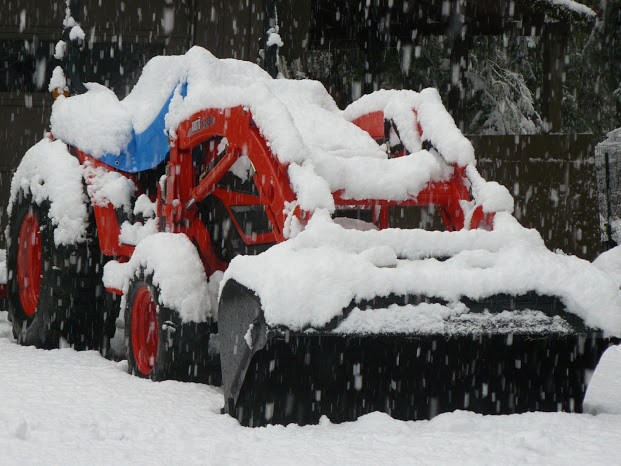
On Thursday it started snowing here in Southern Oregon and by the evening such was the accumulation on the grid that the power went out around 6pm local time (Pacific Standard Time – PST).  The power is still out as I write this at 5pm on Saturday evening.  I managed to get our generator hooked up yesterday but then ran out of fuel earlier today.  Our very kind neighbours, Clarence and Margo, brought over 10 gallons a short while ago so we are back in business.

snow1


Not the best of photos but it showed some 3 or 4 inches laying on the ground as of yesterday.  The snow was very wet and has brought down a number of trees including one that blocked our driveway.  Thanks goodness for my new toy, our tractor, so that the tree could be dragged clear.

snow2


So apologies for the break in service but as they say, it is due to circumstances beyond our control.  We have now had about 10 inches of snow and there are still flurries coming through very regularly.

Until we are back on mains power and everything has settled down, I shall not be adding any more ramblings to Learning from Dogs.

Meanwhile the season’s greetings wherever you are in the world.

Be that change!

A most beautiful message from Paul Chefurka This republication of a recent item on The Permaculture Research Institute website comes with the written permission of their editor, for which I am very grateful.  Nothing from me will add to this very personal essay, so with no more ado here it is.

oooOOOooo

Enough!

Society — by Paul Chefurka December 20, 2012

Meditation_on_rock

Whenever I contemplate the spectacular mischief that we humans have wreaked on our world, I am compelled to ask how this could have possibly happened. The despoilment of our planet seems to be the exact opposite of how I would expect a thinking, feeling, caring creature to treat their home. What could have driven us to this, and what perverse qualities could have allowed us to ignore the consequences of our actions for so very long?

At first blush, our problems seem decidedly physical. Dangerous gases drift in the air; acidity rises slowly in the ocean as the fish disappear from its depths; garbage and detritus of all kinds fouls the land where lush forests and grasslands once ruled. All these disturbances point back to human actions.

The proximate causes of this planet-wide distress include economics, politics, and personal and corporate greed – all facilitated by a technological cleverness that rests on a bed of dispassionate science.

I have spent over 50 years of my life trying in vain to understand our environmental problems as purely physical problems. When I viewed them in those terms, the fact that such problems even existed in a rational, scientific culture seemed nonsensical. However, when I recently began to understand them as consequences of a rupture in the human spirit they finally began to make sense to me. Yes, they are compounded by political and economic forces, but in my view even politics and economics are simply consequences of the same qualities of the human psyche.

Since the dawn of consciousness, human societies have been driven by a complex web of factors with their roots embedded deep in our evolved human nature. Power relationships and hierarchies, kinship and xenophobia, selfishness and altruism, competition and cooperation, curiosity and apathy, and countless other polarities mingle together to form the infinite variety of human dynamics.

Underneath it all, though, lurks our self-awareness. Human self-awareness is the root of our sense of separation from the natural world, and from each other for that matter. It’s the crowning paradox of the human condition – at once both our greatest glory and our fatal flaw. It is behind the dualism – the perceptual split into subject and object – that gave us science. It’s the source of our ability to see others as “different yet the same”, giving us the power to act altruistically. It’s also behind the sense of self and other that has allowed us to assume dominion over all we survey, whether animal, vegetable, mineral or human. Our sense of separation is the rupture of the human spirit that has allowed our current predicament to develop.

If this is the case, then no physical, political or economic remediation will heal the wound. The solution to our predicament is not – cannot be – material, political, economic, or simply philosophical. If a “solution” exists at all, it’s orthogonal to all those domains. Only by healing our belief in our separateness will we be able to finally and fully restore our balance with Nature.

When I began to view the situation like this, I was finally able to see that there are in fact solutions, where none had previously been visible. These new solutions don’t attack the predicament directly as a series of material, political, economic or technological problems. Instead, they seek to effect change from the center, by encouraging people to mature into an inter-connected adulthood and assume personal responsibility for their actions.

This approach follows Gandhi’s dictum, “Be the change you wish to see in the world.

The mischievous idea of science and technology as a post-modern “religion of salvation” with Ray Kurzweil’s transhuman singularity playing the role of the Rapture and an economist making a cameo appearance as the Devil (think infinite growth on a finite planet…) resonates very strongly with me.

But to be a little more precise, it’s not exactly science that has failed us. We have been undone by a toxic stew of classical economics, technological cleverness, love of progress, an attitude of Manifest Destiny and an unwillingness to accept any limits on our growth.

Technology lets us use scientific discoveries to satisfy human desires of all kinds. When we harness scientific knowledge to human ends, the outcomes we choose to implement are based on our wishes. If our wish is dominion over nature, we will use scientific principles to invent technology like mining machinery, continental energy grids, factory farming and the automobile.

Of course, each of those inventions is presented within our cultural narrative as an obvious, irrefutable boon. One of the points of having a cultural narrative is to put a positive spin on human activity. The spin is always in line with the narrative – or more precisely, in line with the wishes of those who create and sustain the narrative. The fact that these inventions, the technological expressions of science, have a subtext of dominion over nature is carefully camouflaged, and the idea that this might possibly be a bad idea is thoroughly discouraged.

None of this would have been so damaging if people didn’t have such a natural ability to delude themselves into believing that whatever they wish for hard enough is possible. It’s kind of like clapping for Tinkerbell. “The future is always going to be better than the past,” and “My kids will have better jobs, bigger houses and faster cars than I did,” are examples of such magical thinking at its finest.

Those two kinds of wishing – the wish to improve the human condition and the wish to see the human milieu keep growing forever – are not inherently different. I see them more as two points on a continuum. On one end is simple desire; on the other end is unreasonable desire. They are distinguished less by any intrinsic difference than by the attitude and realism of the one doing the wishing.

It can be very difficult to tell when the reasonable morphs into the unreasonable.”I wish to own a small piece of land” becomes “I wish to own an entire island” which inflates into “I wish to claim a continent for my King” and eventually becomes “I wish to rule the world.” The underlying desire is the same; it’s just the scale and reasonableness of the wish that changes.

Whether or not a wish is realistic or deluded depends very much on the one doing the wishing. There are people who wish for our (and by extension, their own) material wealth to continue growing forever. There is no shortage of economists who will tell them that such a strange thing is possible. Are the dreamers deluded? Are the economists deluded? What laws of nature would need to be violated for such a delusion to become reality? How is the worship of the Charging Bull of Wall Street materially different from worshiping the Golden Calf of the Bible, when both imply a violation of the laws of nature?

The world changes only when enough people have made a choice to change themselves. At what point will we each say, “Enough!” and choose a different path? Is anything keeping you from making that choice right now?

As you finish reading this article I invite you to say it quietly to yourself.

Enough!

If you listen closely with your heart, you may be able to hear the life that shares our planet say, “Thank you.

oooOOOooo

You can read more of Paul Chefurka’s writings on the PRI website here. Do, also, visit Paul’s website here.  You will not be disappointed.

Finally, let me do two things before closing.

The first is to highlight a sentence towards the end of this beautiful essay. This one. “The world changes only when enough people have made a choice to change themselves.

The second is to highlight on Paul’s website his Public Domain Notice statement: Any article on this web site may be reproduced by anyone, in whole or in part , in any manner and for any purpose whatsoever, with no restrictions.

Spread the word about you, me and all of us being the change the world needs – and needs now.  Thank you.

Lighting the future

A really clever and innovative idea – the gravity light.

Saw this item on the Australian Permaculture Research website on the 18th.

Lighting in much of the ‘developing’ world is provided via expensive and polluting kerosene. Kerosene lamps are dangerous, require constant replenishment, and come with significant negative health impacts.

So, for the potential benefit of millions of people, London based designers, Martin Riddiford and Jim Reeves, have spent four years working on an inexpensive, safe and health-neutral alternative — a gravity powered LED light! It’s clever, and well intentioned. Nice!

Martin and Jim initially looked at creating a light that would be powered by solar, as would most of us. But the idea of utilising gravity took hold of them — where the end user can do away with the need for expensive solar panels and batteries, which use a lot of resources in their manufacture — and the gravity light was born. The gravity light will work whether it’s day or night, sunny or cloudy.

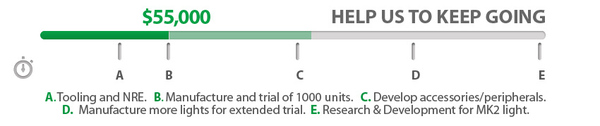
At time of writing, Martin and Jim’s Indiegogo campaign to raise funds has already surpassed its basic goal of $55,000, but if you wish to donate it’ll help them further their goal of refining the design to make it even more useful, efficient and inexpensive.

Then it was only a moment to track down the project on a website called Indiegogo, from which one reads,

20121214100413-fill_bar2

GravityLight is a revolutionary new approach to storing energy and creating illumination. It takes only 3 seconds to lift the weight which powers GravityLight, creating 30 minutes of light on its descent. For free.

Following the initial inspiration of using gravity, and years of perspiration, we have refined the design and it is now ready for production. We need your help to fund the tooling, manufacture and distribution of at least 1000 gravity powered lights. We will gift them to villagers in both Africa and India to use regularly. The follow-up research will tell us how well the lights met their needs, and enable us to refine the design for a more efficient MK2 version. Once we have proved the design, we will be looking to link with NGOs and partners to distribute it as widely as possible. When mass produced the target cost for this light is less than $5.

Why GravityLight?

Did you know that there are currently over 1.5 billion people in the World who have no reliable access to mains electricity? These people rely, instead, on biomass fuels (mostly kerosene) for lighting once the sun goes down.

Go here and read the information in full and admire the photographs.  But I will include this from the end of the item.

Credentials

We are Martin Riddiford and Jim Reeves, London based designers who have spent 4 years developing GravityLight as an off-line project. We work for therefore.com, which has over 20 years of experience in designing and developing hand held computing and communication products for a host of pioneers including Psion, Toshiba, NEC, TomTom, Inmarsat, ICO, Sepura, Racal Acoustics, Voller Energy, FreePlay and SolarAid.

We’re using a tried and tested manufacturer who has the right expertise to make GravityLight. We have some links to partner organisations in Africa and need to do the same for India. If you’re part of an organisation and would like to get involved then please contact us. We are particularly looking for contacts in South America.

Visit our skunk-works website here www.deciwatt.org.

Our movie soundtrack kindly created by Belinda from the bush the tree and me.

Check out John Keane’s great Solar For Africa blog.

I am sure all who read this will wish Martin and Jim the very best of luck.


The saga of Bummer Ck, part Two!

Our bridge repairs continue.

Last Friday, I posted part One about how the floods had swept away our bridge supports and how the remaining steel deck had been removed.

Unfortunately, when the deck was lifted clear of the concrete supports, further damage to those supports became visible.  Thus repairs had to be made, as the photo below illustrates.

Brpt21

Once the concrete had cured for a couple of days, then it was time to install a steel frame.  This frame will take the weight of the steel platform when it’s time to re-install that.

Brpt22

Below there’s a picture of Wade welding the cross joists to the main longitudinal girders.

Brpt23

Plus another shot that demonstrates the ease with which these guys work on girders!

P1120087

So no access to our front entrance road just now but by Friday the steel platform should be back in place.  Then before the required earth works are started on Monday we will have a week-end of being able to drive in and out of our property.

Utter madness!

The very strange ways of man!

I am incredibly grateful to be living in the USA as a legal resident.  The circumstances that lead to Jeannie and me living here in Merlin, Southern Oregon are the stuff of dreams.  Which is why writings on Learning from Dogs that could be seen as critical of a US administration leave me rather uncomfortable.

However, a recent news item on the BBC website struck me as so utterly incongruous that I couldn’t resist today’s post.  As is said, “I can resist anything except temptation!”  Here’s that item.

US Congress bans word ‘lunatic’ in federal legislation

6 December 2012

"Lunatic" is derived from the Latin word for moon, and the belief that it could affect mental health
“Lunatic” is derived from the Latin word for moon, and the belief that it could affect mental health

The sharply divided US Congress has been able to agree on one thing at least – that the word “lunatic” should be banned.

The House of Representatives voted 398-1 on Wednesday to strike the term from all federal legislation, after the Senate did the same in May.

The measure is designed to remove language that has become outdated or demeaning from the US code.

The bill will now go to President Barack Obama for his signature.

Senator Kent Conrad, one of the sponsors of the measure, said: “Federal law should reflect the 21st Century understanding of mental illness and disease, and that the continued use of this pejorative term has no place in the US code.”

The only “no” vote came from Texas congressman Louie Gohmert, who said it was madness for lawmakers to waste time on such a measure when more high-profile issues loomed, such as the federal debt.

“Not only should we not eliminate the word ‘lunatic’ from federal law when the most pressing issue of the day is saving our country from bankruptcy,” said Rep Gohmert in a statement.

“We should use the word to describe the people who want to continue with business as usual in Washington.”

Now don’t get me wrong.  In and of itself that measure is fabulous removing, as it does, any official labeling of those with mental health problems.

However, surely the following demonstrates that madness is still alive and well.

LAW PROHIBITS UNFAIR EU TAXATION OF U.S. AVIATION

November 27, 2012

Washington, DC – The President today signed into law a measure to stop the United States’ participation in a costly European Union (EU) scheme to impose an emissions tax on American and other nations’ aircraft operators and air carriers. Transportation and Infrastructure Committee Chairman John L. Mica (R-FL) and Aviation Subcommittee Chairman Tom Petri (R-WI) were among the primary sponsors of the bipartisan companion bill in the House of Representatives.

In 2011, Mica first led a Congressional delegation to the European Union to convey opposition to the EU’s plan. Mica also led a subsequent delegation to Montreal to meet with International Civil Aviation Organization (ICAO) leaders, representatives of the EU, and other officials regarding U.S. opposition to the ETS. The original “European Union Emissions Trading Scheme Prohibition Act of 2011,” authored by Mica, Petri, and other House leaders, overwhelmingly passed the House on October 24, 2011.

John Mica was quoted as saying “The law signed today is a clear signal that the United States will not accept the EU’s go-it-alone attempt to impose emissions taxes on other nations for activities far outside the EU’s own borders. This European emissions trading scheme is an unlawful infringement upon U.S. sovereignty, and the sovereignty of numerous other nations.

Now I don’t know the rights and wrongs of this but one thing is clear to me.  If trying to reduce carbon emissions represents ‘unlawful infringement upon U.S. sovereignty‘ then don’t even ponder on the infringement that not trying to reduce emissions would risk!

Which neatly leads to the Yale forum on Climate Change & The Media that recently reported,

Forget About That 2-Degree Future

SAN FRANCISCO, CA, Dec. 5, 2012 — Renowned British climate scientist Sir Robert Watson pulled few punches today during a talk about the warmer world humans will face in coming decades.

Watson, who was IPCC chair from 1997 to 2002, all but dismissed the possibility of keeping the rise in average global temperatures to 2 degrees Celsius above pre-industrial levels — a temperature rise that corresponds to an atmospheric concentration of CO2 of 450 parts per million. It now stands at about 390 ppm.

“Fundamentally, we are not on a path toward a 2 degree world,” Watson told a packed hall at Moscone Center for a talk entitled: “A World Where the Atmospheric Concentration of Carbon Dioxide Exceeds 450 ppm.”

If the international community wanted a world in which the rise in average global temperatures this century peaked at 2 degrees C above pre-Industrial levels, CO2 emissions in the developed world should have peaked in 2010, Watson said. Globally, they would need to peak by 2014.

Instead, CO2 emissions in 2010 were up 5.9 percent relative to 2009 — and that was in the midst of an economic downturn for most industrialized countries. Total carbon emissions as well as carbon intensity (often described as the amount of CO2 emitted per unit of a nation’s GDP) have gone up.

“It’s totally clear we’re changing the composition of the atmosphere …” [but] “politicians have not listened to the scientific message,” Watson said. [my emphasis]

Average global temperatures could rise 2 to 7 degrees C by the end of the century, driving a litany of environmental changes, Watson said. Already, the climate of the 2020s and 2030s is locked in, or as Watson put it, “pre-ordained.” “Therefore, we must adapt,” he said.

You can read the full report here.

As Isaac Newton is recorded as saying: “I can calculate the motion of heavenly bodies, but not the madness of people.

The dirt beneath our feet.

A film about dirt that opens eyes!

dirt-splsh

I have mentioned the website of the Permaculture Research Institute of Australia before.  It’s a fabulous resource for many aspects of moving towards a more sustainable lifestyle, and not just for Australians.

A few days ago, their regular posting included a link to this:

Dirt: The Movie

DIRT! The Movie — directed and produced by Bill Benenson and Gene Rosow — takes you inside the wonders of the soil. It tells the story of Earth’s most valuable and underappreciated source of fertility — from its miraculous beginning to its crippling degradation. The opening scenes of the film dive into the wonderment of the soil. Made from the same elements as the stars, plants and animals, and us, “dirt is very much alive.” Though, in modern industrial pursuits and clamor for both profit and natural resources, our human connection to and respect for soil has been disrupted. “Drought, climate change, even war are all directly related to the way we are treating dirt.”

DIRT! the Movie — narrated by Jaime Lee Curtis — brings to life the environmental, economic, social and political impact that the soil has. It shares the stories of experts from all over the world who study and are able to harness the beauty and power of a respectful and mutually beneficial relationship with soil.

DIRT! the Movie is simply a movie about dirt. The real change lies in our notion of what dirt is. The movie teaches us: “When humans arrived 2 million years ago, everything changed for dirt. And from that moment on, the fate of dirt and humans has been intimately linked.” But more than the film and the lessons that it teaches, DIRT the Movie is a call to action.

Here’s the trailer to the film.

And here’s the movie’s website.

The link to the film on the PRI Australia’s website is here: Dirt: The Movie.

So plan on sitting down somewhere and enjoying a full-length film about dirt.  It will hold you spellbound.

To nurture a garden is to feed not just on the body, but the soul.  Alfred Austin

The power of the bleedin’ obvious!

Musings for a Monday morning!

Let me start with this:

A self-affirmation

For today, I am in charge of my life.

Today, I choose my thoughts.

Today, I choose my attitudes.

Today, I choose my actions and behaviours.

With these, I create my life and my destiny

I hasten to add that I am not the author of these wonderful words; just been aware of them for many years.

OK, to the muse!

I subscribe to Christine’s excellent blog 350 or bust.  Last Friday, Christine published a post that she called: Despite Pleas In Doha, Our Governments Have Failed Us & Our Children.

In that post, Christine included this video,

The lead negotiator for the Philippines at the Climate Conference in Doha, Naderev Saño, could not keep back the tears as he made a passionate appeal for real action on climate change.

“I appeal to all, please, no more delays, no more excuses. Please, let Doha be remembered as the place where we found the political will to turn things around…

The outcome of our work is not about what our political masters want. It is about what is demanded of us by 7 billion people…

I ask of all of us here, if not us, then who? If not now, then when? If not here, then where?”

Christine also included a short video of 19-year-old Syrian-American student Munira Sibai addressing the delegates.

“So let me now speak beyond the negotiators in this room to the people who I represent. Your governments are failing you. They are afraid that offering visionary pathways to low-carbon economies will make them look foolish, that taking responsibility will make them look weak, that standing up to the money and power of polluters will cost them political support. Unchecked, this cowardice will cost lives. Here in the halls of the United Nations, the voices of global citizens are limited, regulated and relegated to these short, symbolic statements. Outside these walls, these walls, there is a global movement, growing up from the grassroots, calling for climate justice. Join us.”

So young Munira Sibai offered the answer to Naderev Saño’s plea, “I ask of all of us here, if not us, then who? If not now, then when? If not here, then where?”  That answer being so beautifully encompassed in the opening self-affirmation.  Stay with me a little longer.

Many of you readers know that a little over 5 weeks ago Jean and I and our 11 dogs and 5 cats moved from Payson in Arizona up to Merlin, Southern Oregon.  The reason I refer to Payson is that not long before we left, a group concerned about the environment and climate change decided to form Transition Town Payson.

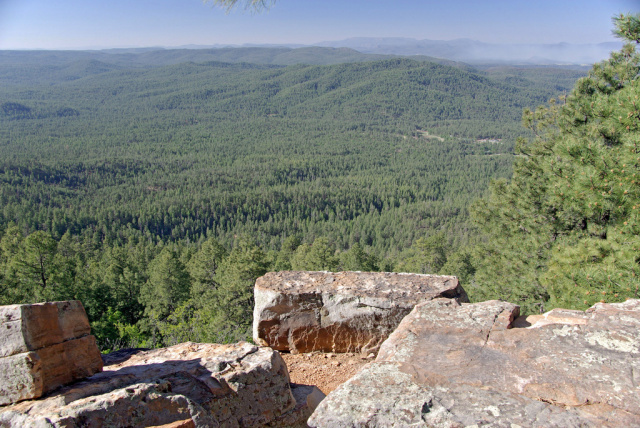
If you go to the ‘About‘ page of their website, you will see this beautiful photograph.

TTPvista

It’s a view from the Mogollon Rim Trail that would inspire anyone to want to care for our planet.  The trail passes close to Payson and is a very popular walking area.

Back to TTP.  If you go to their website and start browsing the articles and seeing what information is already there, you get a clear idea of what a group of people can do.  That key word ‘DO‘!

Last Thursday, I offered a reflection on Learning from Dogs about what feels like a new world order.  The penultimate paragraph offered this:

I sense that we, as in the peoples on this planet, are well into a period of such change that even by the end of 2013, a little over 50 weeks away, the precipice for humanity will be within sight.  I hold out zero hope that any time soon our leaders and politicians will stop ‘playing games’ and focus on doing what’s right.  The time for truth, for integrity, for sound debate is NOW!

However, all the truth, integrity and debate in the world comes to nothing without ACTION.

It really is the bleedin’ obvious!