I must share the feelings of millions of others across the world when I admit to going through periods of quiet despair about where ‘modern man’ has got himself. (I don’t intend to be gender specific!)
It goes way beyond the disbelief at some of the things happening today; way beyond the anger that is generated by so many examples of greed and corruption. It goes to a point where I just want to snuggle down with Jean, curl up with the dogs and kiss the rest of the world good-bye!
The expression that comes to mind is the one about the last person to leave the planet please switch the lights off!
(As if to demonstrate how sensitive dogs are to the feelings of us humans, Cleo just came into the room where I am writing this and laid her head across my left thigh. I stroked her head and then she wandered back to our bed next door – I then took the following photograph)
So what’s feeding my feelings?
Well, as many of you know yesterday and Sunday had posts about saving the Ecuadorian Jaguar and the African Lion. In the case of the former, it’s:
The president of Ecuador claims to stand for indigenous rights and the environment, but he has just come up with a new plan to bring oil speculators in to 4 million hectares of jungle. (That’s 9.9 million acres in old money!)
In the case of the African Lion, it’s:
In the past fifty years, the African lion population declined by as much as 90%. Many of the lion prides that do exist today are so genetically weak from being small and isolated by international borders that they can’t promise a future for African lions ….. two thirds of the African lions killed by trophy hunters end up in the U.S. That’s thousands of lions!
Last Friday I wrote about how community living for wolves and dogs had given those species “group survival and well-being“ that we humans couldn’t even dream about.
I attended a lecture at Essex University Colchester last Wednesday on the plight of indigenous indians in Canada, specifically those in Labrador. The Canadian government has embarked on a scheme to disenfranchise the indians of all their land, wipe out all their rights forever, and place them in perpetual bondage. Underlying this horror was what has happened to the indians themselves, a people tainted with mental illness, alcoholism and high suicide rates.
I asked the lecturer why it is that it appears all indigenous people across the globe share this common trait of high levels of abuse, mental illness, suicide and alcoholism. The answer given was that outsiders desired to force their alien world views upon these people destroying their sense of personal identity. For example many of these people see land as a shared resource, the capitalist ideas of land ownership is at odds with their world view. All Native American problem solving is through talking, and everyone has choice, whereas outsiders prefer to impose solutions and intellectualise with clever words.
Just read that last paragraph carefully again and note “outsiders desired to force their alien world views upon these people destroying their sense of personal identity.”
Back closer to home, the struggles of the North American Indians are well-known.
So no nice, neat solution to this place that I’m in just now other than to put down my pen and let the music from the following two videos wash over me.
If you read this far, thank you for suffering the ramblings of this silly old fart!
Please help save the Ecuadorian Jaguar and the Amazon jungle
Today’s article is a complete reposting of what appeared on Lack of Environment last Friday.
oooOOOooo
Please help save the Ecuadorian Jaguar and the Amazon jungle and stop Ecuador’s President from being a total hypocrite!
This courtesy of Avaaz:
———–
Dear friends,
There is one area of the Ecuadorian Amazon that is so pristine that the whole ecosystem has been preserved and even jaguars roam free! But the government is now threatening to go in and drill for oil.
The local indigenous people have been resisting, but they are afraid that oil companies will break up the community with bribes. When they heard that people across the world might stand with them and make a stink to save their land, they were thrilled. The president of Ecuador claims to stand for indigenous rights and the environment, but he has just come up with a new plan to bring oil speculators in to 4 million hectares of jungle. If we can say ‘wait a minute, you’re supposed to be the green president who says no one can buy Ecuador’, we could expose him for turning his back on his commitments just as he is fighting for re-election.
He doesn’t want a PR nightmare right now. If we get a million of us to help this one community defend their ancestral land and challenge the president openly to keep to his word, we could start a media storm that would make him reconsider the whole plan. Sign the petition now and tell everyone — let’s help save this beautiful forest:
After Texaco and other oil companies polluted Ecuadorian waters and irreversibly devastated precious ecosystems, Correa led his country to be the world’s first nation to recognize the rights of “Mother Earth” in its constitution. He announced Ecuador was not for sale, and in Yasuni National Park promoted an innovative initiative where other governments pay Ecuador to keep oil in the ground to protect the rainforest rather than destroy it. But now he’s on the verge of selling out.
Shockingly, the Sani Isla Kichwa land is partly in Yasuni National Park. But even more shocking is Correa’s bigger plan — in days government officials begin a world tour to offer foreign investors the right to drill across 4 million hectares of forest (an area larger than the Netherlands!) Ecuador, as any country, may argue it has the right to profit from its natural resources, but the constitution itself says it must respect indigenous rights and its amazing forests, which bring millions in tourist dollars every year.
Right now, Correa is in a tough fight to win a second term as president. It’s the perfect time to make him honour his environmental promises and make this green constitution come to life. Sign now to stand with the Kichwa people and save their forest:
Our community has fought year after year to protect the Amazon in Brazil and Bolivia, and won many victories standing in solidarity with indigenous communities. Now it’s Ecuador’s turn — let’s respond to this urgent call for action and save their forest.
With hope and determination,
Alex, Pedro, Alice, Laura, Marie, Ricken, Taylor, Morgan and all the Avaaz team
Dogs wouldn’t treat other members of their pack like this.
(I realise how the heading and the sub-heading don’t appear to have any correlation but stay with me please!)
It’s widely known, I’m sure, that the wolf, from which the wild dog and the domesticated dog evolved, lives in packs of around 50 animals. The size of the pack offers a cohesive, stable structure for the wolf, and other pack species, ensuring group survival and well-being. In a very real sense the way that wolves live is a fabulous example of the power of community.
My understanding of early hominids is pretty basic but if ‘Homo habilis‘ represents the evolution of modern man then our species goes back less than 3 million years.
The Dog linage began 37 million years ago in North America in predators that had distinctive pairs of shearing teeth and ran down prey. Early canids reached Europe seven million years ago.
Thirty-seven million years! Now that’s what I call an example of “group survival and well-being“. The power of community.
As stated elsewhere on this blog,
Dogs are part of the Canidae, a family including wolves, coyotes and foxes, thought to have evolved 60 million years ago. There is no hard evidence about when dogs and man came together but dogs were certainly around when man developed speech and set out from Africa, about 50,000 years ago. See an interesting article by Dr. George Johnson.
The ten dogs we have here at home are split into two groups of five. What we call the bedroom group: Pharaoh, Cleo, Sweeny, Hazel and Dhalia, and the kitchen group consisting of Lily, Casey, Ruby, Paloma and Loopy. Both groups are separated by wooden fences so are more than aware of each other.
Something that is clear is that whenever one of the dogs is hurt, all the other dogs take notice. Others in the same group will come up to their hurt ‘buddy’ and offer comfort in a variety of ways. Sadly, I can’t give you a better example than our poor Loopy who is suffering badly from the dog equivalent of dementia.
Here’s a picture taken of Loopy on Wednesday afternoon. You will notice the strange sleeping position that she frequently adopts. That’s an aspect of her dementia.
The other dogs in her group all give her special attention. Such as not grabbing her sleeping bed, not pushing or shoving near her, giving her a wide space in general. The other dogs sense there is something badly awry with Loopy and accommodate that.
So what on earth has this to do with yesterday’s post Who owns the World? Keep hanging in there!
A recent link in Naked Capitalism‘s daily news summary was to a story in the British Guardian newspaper. Written by the Guardian’s Kevin McKenna, it was about the likelihood of Scotland breaking away from the United Kingdom.
Scottish independence is fast becoming the only option
Even to a unionist like me, an Alex Salmond-led government is preferable to one that rewards greed and corruption
It’s an interesting article and I recommend you read it directly. But what jumped off the page at me were these paragraphs. Please focus deeply on the words and ponder on how foreign they are to the concept of community.
Yet we conveniently overlook the fact that London has already broken away from the United Kingdom and now exists as a world super-state governed by the greed of unhindered capitalism and recognisable as British only by its taxis and bad service. As the world’s most newly minted oligarchs continue to colonise the independent state of London, it becomes almost impossible for families on less than £250k to live decently there. Poor London families made homeless by the coalition benefit cuts are being evacuated as far north as Middlesbrough.
Last week, Goldman Sachs, one of the banks with its fingers in the till when global economic meltdown occurred, awarded an average bonus of £250,000 to each of its employees. The gap between the richest in our society and the poorest stretched a little more and we were reminded yet again that the UK government, despite its promises, allows greed, incompetence and corruption to be rewarded. (How many people do you think will go to jail for the Libor rate-fixing scandal?) Meanwhile, Westminster politicians are dividing the poor into categories marked “deserving” and “scum”.
Think a dog is just a cuddly animal that gives you a chance to do some dog-walking? Again, written elsewhere on Learning from Dogs.
value and cherish the ‘present’ in a way that humans can only dream of achieving
are, by eons of time, a more successful species than man.
Now compare that with the last sentence in Noam Chomsky’s essay from yesterday, “As long as the general population is passive, apathetic, diverted to consumerism or hatred of the vulnerable, then the powerful can do as they please, and those who survive will be left to contemplate the outcome.”
“Hatred of the vulnerable“; “those who survive will be left to contemplate the outcome” are not expressions that resonate with the values of loving communities. If we humans want “group survival and well-being” we had better learn from species lupus and canid. Pronto!
Powerful words from President Obama; now we the people must act.
I’m taking the liberty of reproducing in full the item that was published by Bill McKibben of 350.org yesterday. As I wrote on the 17th this year has to be the year that we make a difference, a call to every man, woman and child on the planet. This is a snippet from that post.
With these in mind, Doherty proposes a new grand strategic concept: “The United States must lead the global transition to sustainability.“
What a vision for the United States of America. That this Nation will be the most wonderful example of how man can learn, adapt and change.
Here’s what President Obama said about climate change during his address today:
With words like that, it’s easy to let ourselves dream that something major might be about to happen to fix the biggest problem the world has ever faced.
But we know that even if the President is sincere in every syllable, he’s going to need lots of backup to help him get his point across in a city dominated by fossil fuel interests. And, given the record of the last four years, we know that too often rhetoric has yielded little in the way of results.
That’s why we need you — very badly — to take a trip to our nation’s capital on Feb. 17th. We’ll gather on the National Mall, in what is shaping up to be be the largest environmental rally in many years.
Together we’ll send the message loud and clear: ‘If you’re serious about protecting future generations from climate change, stop the Keystone XL tar sands pipeline. If you can do that, Mr. President, we can all work together to help build a climate legacy that will be a credit to your critical eight years in office.’
Look — numbers count. If 20,000 of us show up on February 17th, it will be noticed. We need you in that number. The President may have given us an opening, but it’s up to us to go through it, and we need to do it together.
Thanks for all you’ve done to bring us this far, friends. Let’s keep it up — this is our chance.
Bill
oooOOOooo
Even if you are unable to be there in person on the 17th., do what you can to circulate this just as far and wide as possible.
Icebergs calved from Jakobshavn Glacier float to sea near Illulissat. This glacier dumps more ice into the global ocean than any other glacier in the Northern Hemisphere, and is thus Greenland’s single biggest contributor to the global sea level rise of one-eight inch per year. Photograph: James Balog/Extreme Ice Survey
When researching material for that article, I came across the official trailer for the film Chasing Ice. The fact that this film is being shown in cinemas and movie theaters across the world is highly relevant.
Because it demonstrates that there is a public appetite for such a film otherwise it would never had made it as a film project.
But not only that, read some of the reviews mentioned on the Chasing Ice website.
Jeff Orlowski’s documentary begins as a straightforward biographical profile, before shifting up into something more urgent, impassioned and compelling. Its subject, James Balog, is a photographer who goes to extremes to prove the existence of global warming: his latest expedition involves descending Arctic cliff faces to fit time-lapse cameras with which to monitor glacial erosion.
The review concludes, thus:
If any film can convert the climate-change sceptics, Chasing Ice would be it: here, seeing really is believing.
Jeff Orlowski’s first-rate documentary begins with complacently smug anti-global-warming clips from Fox News and from the owner of America’s weather channel. It then introduces the persuasive environmentalist James Balog, a celebrated photographer working for National Geographic, who became fascinated with what glaciers can teach us about our changing planet.
In 2007 he set up the Extreme Ice Survey (EIS), a well-funded project to monitor glaciers in Greenland, Iceland, Montana, the Alps, Canada and Bolivia, and the results – photographed using state-of-the-art time-lapse cameras – are sensational in their beauty, terror and the irrefutable evidence they provide of the rapidity with which age-old ice packs are melting away. It’s like watching our world disappear.
“Chasing Ice” aims to accomplish, with pictures, what all the hot air that has been generated on the subject of global warming hasn’t been able to do: make a difference.
The documentary by Jeff Orlowski follows nature photographer James Balog as he documents melting glaciers, beginning in 2007, in Alaska, Iceland, Greenland and Montana. Called the Extreme Ice Survey, the project works like this: Balog sets up still cameras that have been programmed to take a picture, once every hour, for three years, of the same glacier from a fixed spot.
Concluding:
“Chasing Ice” will make an impact, that’s for sure. Whether it can be said to have been effective remains to be seen. This portrait of a man on a mission moves us, not by showing us what we’ve already lost, but what’s still at stake.
My final dip into the review pot is from America Magazine – The National Catholic Review.
Anyone with a desire to preserve our planet has no choice but to see Chasing Ice, the gorgeous, inventive documentary released last month. As of this writing it has been shown to selected audiences but has yet to reach the popularity of a film like “An Inconvenient Truth.” Give it time, however, and hopefully further promotion, because it is truly revelatory. Produced by Paula DuPré Pesmen and Jerry Aronson and directed by Jeff Orlowski, the film is a unique pictorial about global warming, which left me impressed, thoughtful and sad.
Wil Lepkowski closes with these words,
Take the time to see “Chasing Ice,” even if it is not the type of film you would typically see. These are not typical times. We must begin to act. In the wake of a devastating hurricane on the East Coast of the United States, the United States may finally be taking steps to address climate change. Ordinary citizens must take on a greater role too. We cannot dwell on our sadness, but work to provide hope for our children, who will suffer the most if we continue to ignore the disaster on the horizon.
So you get the message!
Here’s that film trailer. And make a note to go to the website of the Extreme Ice Survey and ponder on what you can do to make a difference. That’s the broad ‘you’ by the way. The one that includes you and me and all those on this planet that want to make a difference.
Back on the 10th we had a few days of cold, overcast weather that brought temperatures down below freezing and some snow.
Here’s a scene looking towards the North-East corner of the property, taken just before 11 am.
Then a few days later, on the 14th, the sun was out while the temperatures remained below freezing. Shown clearly as the sunlight catches the frost on the tree.
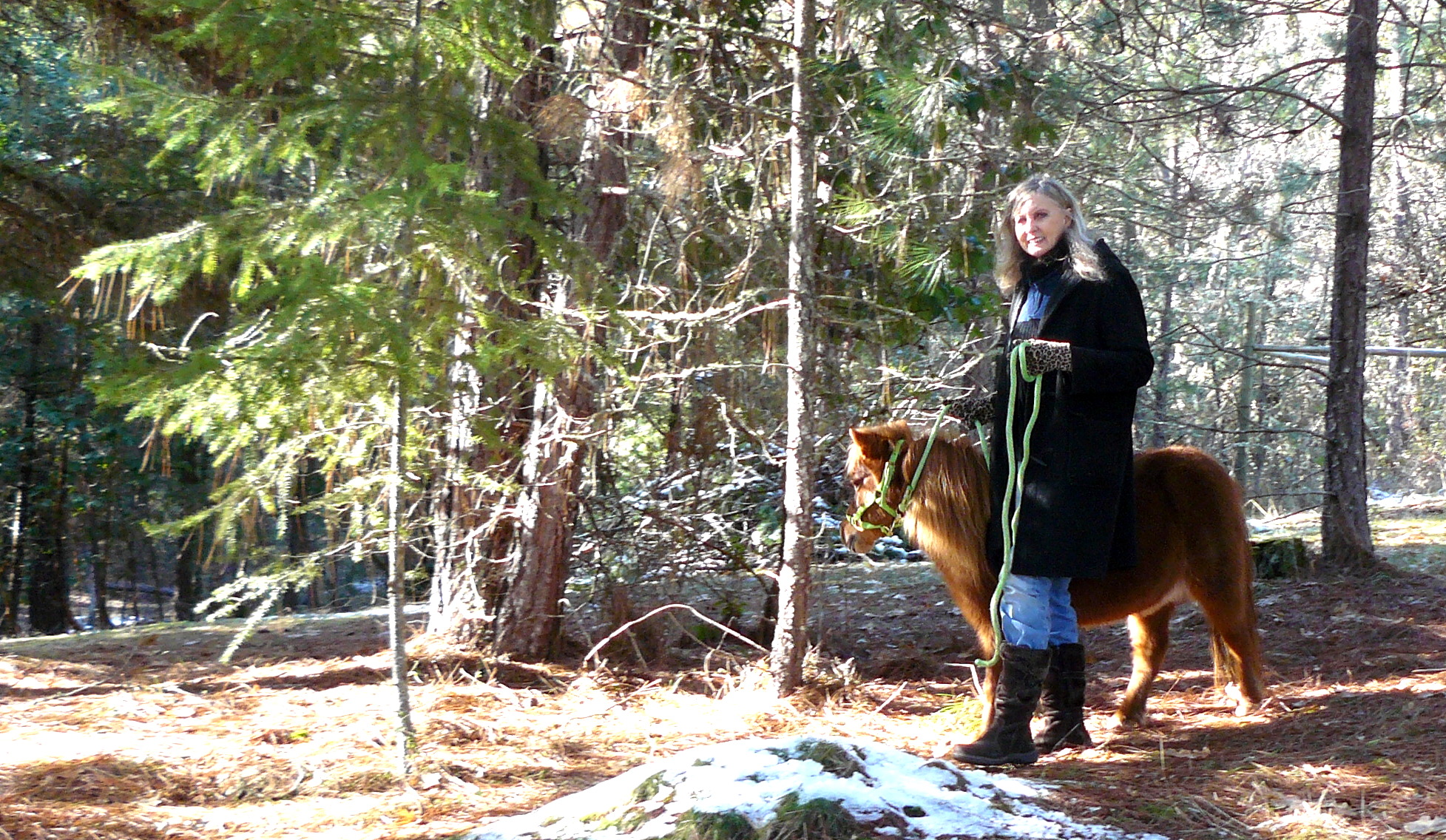
A few minutes later I swung the camera to take a picture of Dancer munching away in the morning sunshine, just a day after we collected her and Grace.
The horses settled in quickly, adapting to the dogs who were very curious.
Grace and Cleo being nonchalant with each other.
Jean unable to get her fill of her new companions.
And in a very different vein, a sneak photograph taken of yours truly who had collapsed in front of the fire early evening last Friday, quickly becoming a cushion for Hazel.
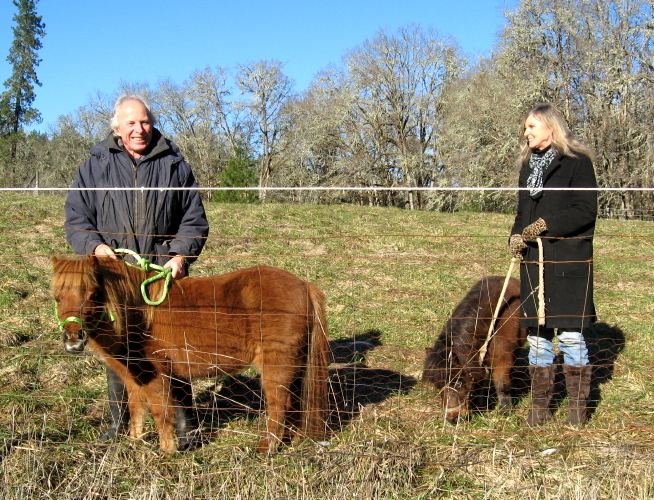
Today’s title came from a recent chat ‘across the garden fence’ with our neighbours, Dordie and Bill. At their request we had walked our two horses over to the fence-line between our two properties so Dordie and Bill could meet and fondle them. The warm afternoon sunshine was beautiful and while the horses munched the newly-found grass, we grown-ups talked about this and that and generally tried to put the world to rights!
Paul with Dancer; Jean with Grace.
We talked about the strangeness of present times. Not just in the USA but across the world. Bill thought 2013 would be the year of separation. I queried what he meant by that.
Bill replied, “I sense that by the end of the year, the vast majority of people will have decided if climate change is or is not a significant issue.” There would be few who remained neither unconcerned nor undecided.
That resonated with me and neatly put the framework to today’s post. Stay with me while I journey to the destination that this year will be the year of hope.
I am one of many who subscribe to the online magazine Grist. They describe themselves, thus:
Laugh now — or the planet gets it.
You know how some people make lemonade out of lemons? At Grist, we’re making lemonade out of looming climate apocalypse.
It’s more fun than it sounds, trust us!
Grist has been dishing out environmental news and commentary with a wry twist since 1999 — which, to be frank, was way before most people cared about such things. Now that green is in every headline and on every store shelf (bamboo hair gel, anyone?), Grist is the one site you can count on to help you make sense of it all.
The weekly Grist digest that arrived in my in-box that same day as when we were chatting with Dordie and Bill included a number of key stories.
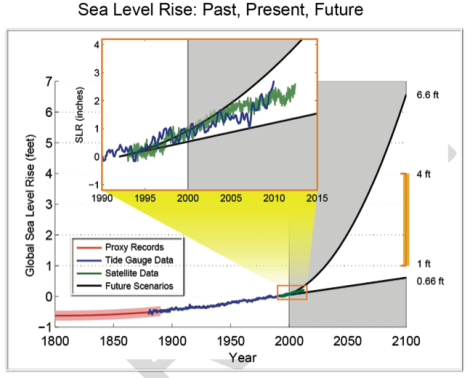
Now I’m not going to republish all 32 charts but will include just these two, because the message is clear.
It’s possible that sea levels could only rise eight inches. It is also possible that they could rise over six-and-a-half feet.
—-
Sea-level rise will affect different areas to different degrees — but note the map at lower right. On the Georgia coast, “hundred year” floods could happen annually.
OK, that first chart takes a while to absorb the full implications. The second one doesn’t!
The full range of charts is chilling. While they refer to the USA, the messages apply to the whole world.
Then in that same Grist weekly summary was this story.
If you aren’t alarmed about climate, you aren’t paying attention
There was recently another one of those (numbingly familiar) internet tizzies wherein someone trolls environmentalists for being “alarmist” and environmentalists get mad and the troll says “why are you being so defensive?” and everybody clicks, clicks, clicks.
I have no desire to dance that dismal do-si-do again. But it is worth noting that I find the notion of “alarmism” in regard to climate change almost surreal. I barely know what to make of it. So in the name of getting our bearings, let’s review a few things we know.
We know we’ve raised global average temperatures around 0.8 degrees C so far. We know that 2 degrees C is where most scientists predict catastrophic and irreversible impacts. And we know that we are currently on a trajectory that will push temperatures up 4 degrees or more by the end of the century.
David then works his way through those ‘things we know’ in a powerful manner. Do read the full article, please! This is his conclusion:
All this will add up to “large-scale displacement of populations and have adverse consequences for human security and economic and trade systems.” Given the uncertainties and long-tail risks involved, “there is no certainty that adaptation to a 4°C world is possible.” There’s a small but non-trivial chance of advanced civilization breaking down entirely.
Now ponder the fact that some scenarios show us going up to 6degrees by the end of the century, a level of devastation we have not studied and barely know how to conceive. Ponder the fact that somewhere along the line, though we don’t know exactly where, enough self-reinforcing feedback loops will be running to make climate change unstoppable and irreversible for centuries to come. That would mean handing our grandchildren and their grandchildren not only a burned, chaotic, denuded world, but a world that is inexorably more inhospitable with every passing decade.
Take all that in, sit with it for a while, and then tell me what it could mean to be an “alarmist” in this context. What level of alarm is adequate?
So am I stark staring mad for having hope in my mind? Stay with me for just a little longer. Then form your own judgment.
Recall the post that I published on Tuesday hitting out at the British newspaper The Daily Mail. Towards the end of that post, in discussing the recently released American National Climate Assessment, I wrote this:
That’s why this report is to be encouraged, nay embraced. Of all the nations in the world, the one that should be setting the lead is the United States of America. As the banner on that globalchange.gov website proclaims: Thirteen Agencies, One Vision: Empower the Nation with Global Change Science
So go and read the report. For your sake and all our sakes.
Because the more informed you and I are, the better the chances of real political leadership taking place in this fine nation.
Let’s just accept it: America’s current political and economic systems are incapable of responding adequately to climate change. As things stand, reducing carbon emissions — or more broadly, shifting to sustainability — is a kind of add-on, a second-tier consideration, bolted onto systems and institutions that were built for other purposes.
A little later, David writes:
So what would a new U.S. grand strategy built around sustainability look like? That’s the question tackled by “A New U.S. Grand Strategy,” a piece in Foreign Policy by Patrick Doherty, director of the Smart Strategy Initiative at the New America Foundation.
It’s a hugely ambitious and wide-ranging piece, far too much to even summarize adequately here. Bookmark it. Instapaper it. Pinterest it to your iCloud, or whatever kids do these days. But let’s take a quick look.
Doherty identifies four central challenges facing the U.S.:
Economic inclusion: People are swarming out of poverty around the world (especially in China). Over the next 20 years, the global middle class will welcome around 3 billion new members. That’s going to put intense stress on natural, economic, and political systems that are already showing signs of strain.
Ecosystem depletion: Pretty sure Grist readers are familiar with this one.
Contained depression: Rather than a recession, the U.S. faces a “constrained depression,” with the full effects of low aggregate demand and high debt being masked by policy. No amount of fiscal or economic stimulus will revive a system that has exhausted itself.
Resilience deficit: Our industrial supply lines and value chains are efficient, but lack redundancy; they are brittle. Our infrastructure is old and crumbling, $2.2 trillion in the hole, and that’s just for the aging Cold War stuff, never mind building water, power, and transportation systems suited to an era of climate disruption.
“These four challenges,” Doherty says, “are the four horsemen of the coming decades.” And they are inter-dependent. They must be solved together. It’s a rough situation.
With these in mind, Doherty proposes a new grand strategic concept: “The United States must lead the global transition to sustainability.“
What a vision for the United States of America. That this Nation will be the most wonderful example of how man can learn, adapt and change. David Roberts concludes:
Here are Doherty’s main suggestions for how to realign the U.S. economic engine:
Walkable communities: More and more Americans want to live in dense, walkable areas; get rid of regulations that hamper them and start building them.
Regenerative agriculture: Farmers can produce “up to three times the profits per acre and 30 percent higher yields during drought” with agricultural techniques that also clean water and restore soils. America must “adopt modern methods that will bring more land into cultivation, keep families on the land, and build regional food systems that keep more money circulating in local economies.”
Resource productivity: “Energy and resource intensity per person will have to drop dramatically.” That imperative can drive “innovation in material sciences, engineering, advanced manufacturing, and energy production, distribution, and consumption.”
Excess liquidity: Channel all the corporate cash that’s sitting around in funds into long-term investments in America by taxing waste and creating regional growth strategies.
Stranded hydrocarbon assets: Figure out how to devalue the immense amount of carbon that’s still sitting underneath the ground without unduly traumatizing the economy.
Obviously the devil is in the details on this stuff, but at a broad level, this is about as eloquent and forward-thinking as it gets. I love the idea of using sustainability in a muscular way, to revive regional economies and nurture the middle class. I recommend reading the whole thing.
I, too, recommend reading “A New U.S. Grand Strategy – Why walkable communities, sustainable economics, and multilateral diplomacy are the future of American power.” (NB: You will have to register with Foreign Policy before access to the report is possible, but it’s free.)
So, the wall-to-wall stream of information that is shouting out how quickly the planet is changing is the fuel that is going to feed the fires of hope.
Let me leave you with the most beautiful words of an ancient philosopher – Aristotle.
My reasoning was that the NCA report was such a stunning indictment of the madness, the myopic madness of mankind these last 100 years, that this appreciation of the wonder of dogs must act as a beacon for us all. I use the word ‘beacon’ because the qualities demonstrated by these nine dogs are just the qualities that we need to adopt.
Every living person on Planet Earth has to embrace the stark choice coming up on us like a runaway train. If we don’t change our values, our behaviours and our relationship with this one, finite planet, in the next ten years, at most, then the consequences will be beyond imagination; a world of unimaginable terror and chaos.
Forgive me if I repeat what the Home page of Learning from Dogs offers:
As man’s companion, protector and helper, history suggests that dogs were critically important in man achieving success as a hunter-gatherer. Dogs ‘teaching’ man to be so successful a hunter enabled evolution, some 20,000 years later, to farming, thence the long journey to modern man. But in the last, say 100 years, that farming spirit has become corrupted to the point where we see the planet’s plant and mineral resources as infinite. Mankind is close to the edge of extinction, literally and spiritually.
On the 30th December, 2012 The Week magazine published an item written by Editor Lauren Hansen. I ask Lauren if I might republish the article in full but that was denied. However, I was given permission to refer extensively to the piece. I will use it to underline just what we have to learn from dogs.
The 9 most newsworthy dogs of 2012
Dogs are the best. Here’s the proof… if you even need it
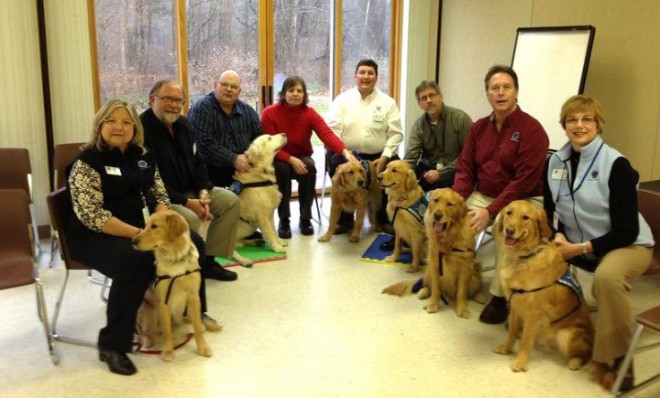
The K-9 Parish Comfort dogs (and their handlers) who helped the residents of Newtown, Conn., through their grief.
If you’re reading this, then you’re probably aware: Dogs rule. This year, a handful of canines rose above the rest, making headlines for their actions — whether facing imminent danger to save lives, enduring unimaginable physical hardships, or simply making us laugh. A look at nine of the year’s most newsworthy pups:
1. Chicago’s comfort dogs After the unimaginable events that befell Newtown, Conn., on Dec. 14 that left 27 people, including 20 children, dead at the hands of suspected gunman Adam Lanza, a team of golden retrievers was deployed from Chicago to the picturesque town. About 10 specially trained dogs, including Chewie, Ruthie, and Luther, made the 800-mile journey to sit with children and adults during masses and funerals. “Dogs are nonjudgmental. They are loving. They are accepting of anyone,” says one handler. “It creates the atmosphere for people to share.” The Chicago comfort dogs are notable not only for this caring venture but also for helping those who suffered through Hurricane Sandy and the tornado that hit Joplin, Mo., in 2011.
The next story was about the puppies that kept a lost boy warm.
That was followed by the hero dog that lost its snout saving two girls.
One dog’s heroism so disfigured her sweet little face that her photo is often preceded by a warning. This canine’s story started with a motorcycle careening through the streets of Zamboanga City, Philippines, earlier this year. Young cousins Dina Bunggal, 11, and Princess Diansing, 3, stepped unknowingly into its path. A mutt named Kabang came out of nowhere and jumped in front of the motorbike, stopping it in its tracks, and saving the little girls from serious injury. The driver and the girls emerged with superficial wounds, but Kabang wasn’t so lucky. Her head landed on the motorcycle’s front wheel and as the wheel rolled forward, Kabang’s upper snout was ripped right off. Her story quickly went viral and when local doctors could do no more to help her, specialty surgeons from the University of California, Davis, flew Kabang to their facilities, where she’ll endure six to eight weeks of treatment to repair her face. The cost of her surgeries, which could top $20,000, will be covered by her many supporters who have started an online fundraising campaign.
Vets at William R. Pritchard Veterinary Medical Teaching Hospital don’t plan to fullyy reconstruct Kabang’s snout, or fit her with a prosthetic. Instead, they are attempting to close the gaping wound on her face, preventing further infections.
Then my last dip into Lauren’s article is dog story eight.
8. The dog that saved its own life by calling the police
We’ve often heard the tale of the puppy that proves its “man’s best friend” status by saving its owner’s life. But this year, there was George, a 2-year-old basset hound in West Yorkshire, England, who reworked the well-worn script a bit, literally calling for help to save himself. Home alone, George had knocked the phone to the floor and was strangling himself with the handset’s cord when he apparently dialed 999 — England’s 911 equivalent — in a panic. The operator heard only frantic gasps and, assuming someone was desperately sick or reeling from an attack, sent police to the house. The dog was found and rescued from the cord. “Incredibly, you could see where his paw print was on the phone,” said the neighbor, “he literally saved his own life.”
Now, what fun-loving toddler can walk past a puddle without stopping for a little splash? Not this one!
Little Arthur was out for a stroll with his best mate, Watson the dog, when he noticed a tempting puddle. So he put down the leash and plunged straight in. And Watson? Well, he’s a more mature 12 years old, so he didn’t partake himself. But he was more than happy to wait while Arthur had his fun.
You know what this video is, don’t you? That’s right. Too. Cute. For. Words.
Here’s the video, seen over 4,800,000 times!
Finally, there’s the beautiful story of the dog befriending a Down’s Syndrome boy.
So what does this all add up to? That the qualities of the dog; integrity, unconditional love, patience, loyalty, and their ability to live in harmony with nature really do send us humans a message for the future.
PUBLISHED: 19:45 EST, 9 January 2013 | UPDATED: 02:56 EST, 10 January 2013
Was there ever a government quango quite so useless as the Met Office?
From its infamous ‘barbecue summer’ washout of 2009 to the snowbound winter it failed to predict in 2010 and the recent forecast-defying floods, our £200 million-a-year official weather forecaster has become a national joke.
But of all its recent embarrassments, none come close to matching the Met Office’s latest one.
Without fanfare — apparently in the desperate hope no one would notice — it has finally conceded what other scientists have known for ages: there is no evidence that ‘global warming’ is happening.
Needless to say the UK Met Office published a detailed rebuttal. One of the comments that I spotted following that rebuttal was this lovely one from MD Dalgleish:
The Daily Mail does not let the facts get in the way of a story! Nothing new there, they’ve been doing that since before the war. What baffles me is why so many people buy this paper.
Quite so!
It would all be a bit of a laugh if it were not for what follows.
Last Friday, Naked Capitalism, the fabulous blog run by Yves Smith published in her set of links this item, “Climate change set to make America hotter, drier and more disaster-prone.” Newly living here in Southern Oregon, that obviously caught my eye!
The item referred to a detailed account in the British Guardian newspaper by Suzanne Goldenberg, the newspaper’s US Environment Correspondent.
Climate change set to make America hotter, drier and more disaster-prone
Draft report from NCA makes clear link between climate change and extreme weather as groups urge Obama to take action
The report says steps taken by Obama to reduce emissions are ‘not close to sufficient’ to prevent the most severe consequences of climate change. Photo: Saul Loeb/AFP
Future generations of Americans can expect to spend 25 days a year sweltering in temperatures above 100F (38C), with climate change on course to turn the country into a hotter, drier, and more disaster-prone place.
The National Climate Assessment, released in draft form on Friday , provided the fullest picture to date of the real-time effects of climate change on US life, and the most likely consequences for the future.
The 1,000-page report, the work of the more than 300 government scientists and outside experts, was unequivocal on the human causes of climate change, and on the links between climate change and extreme weather.
“Climate change is already affecting the American people,” the draft report said. “Certain types of weather events have become more frequent and/or intense including heat waves, heavy downpours and in some regions floods and drought. Sea level is rising, oceans are becoming more acidic, and glaciers and Arctic sea ice are melting.”
Here’s a pithy question for Mr. James Delingpole of The Daily Mail, “Which part of this sentence are you having trouble with – The 1,000-page report, the work of the more than 300 government scientists and outside experts, was unequivocal on the human causes of climate change, and on the links between climate change and extreme weather.?” [my emphasis]
Suzanne goes on to say:
The report will be open for public comment on Monday.
Environmental groups said they hoped the report would provide Barack Obama with the scientific evidence to push for measures that would slow or halt the rate of climate change – sparing the country some of the worst effects.
The report states clearly that the steps taken by Obama so far to reduce emissions are “not close to sufficient” to prevent the most severe consequences of climate change.
“As climate change and its impacts are becoming more prevalent, Americans face choices,” the report said. “Beyond the next few decades, the amount of climate change will still largely be determined by the choices society makes about emissions. Lower emissions mean less future warming and less severe impacts. Higher emissions would mean more warming and more severe impacts.”
As the report made clear: no place in America had gone untouched by climate change. Nowhere would be entirely immune from the effects of future climate change.
One might argue that it won’t be very long before no sane person on this planet would swallow that crap from The Daily Mail. But when we get to that stage of every person being aware of the forces at work upon our fair planet it will be a tad too late.
The only home we have.
That’s why this report is to be encouraged, nay embraced. Of all the nations in the world, the one that should be setting the lead is the United States of America. As the banner on that globalchange.gov website proclaims: Thirteen Agencies, One Vision: Empower the Nation with Global Change Science
So go and read the report. For your sake and all our sakes.
Because the more informed you and I are, the better the chances of real political leadership taking place in this fine nation.
Download Chapters of the NCADAC DraftClimate Assessment Report!
Download the Full Report (warning, 147Mb. Very large file)Between chapters, there are some page numbers that are not used. This is intentional and does not reflect missing pages.or download each chapter separately:
The importance of staying grounded in the face of the oncoming storm.
A few days ago, I exchanged emails with Jon Lavin. In the early days of Learning from Dogs, Jon used to write the occasional post, one of which seems highly relevant some three years later. I will republish it tomorrow.
Jon and I go back a few years and most who know me know that it was Jon’s counselling back in 2007 that opened my eyes to something that, literally, changed my life. For the better, I hasten to add!
In our recent email exchange, Jon wrote this:
Just started back at work today. A bit of a shock to the old system! Am wondering what to set my sanity sights on for this coming year in the middle of almost total uncertainty.
Of course! How obvious! The need to ensure that our lives contain anchors of stability, safe places to curl up in, metaphorically speaking, where we can seek refuge from the winds of change. Otherwise, we run the very real risk of being overcome by the uncertainty of the future.
The resonance with small boats and the sea is obvious, and unavoidable in the case of yours truly.
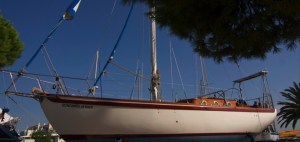
Tradewind 33, Songbird of Kent
For five years I lived on and sailed a Tradewind 33, Songbird of Kent; my base being Larnaca on the island of Cyprus at the Eastern end of the Mediterranean Sea. Contrary to the image of the Mediterranean, it wasn’t uncommon to experience some ‘interesting’ weather; there were times when it could turn very nasty!
The comfort, physical and mental, offered by being tucked up in a small bay, listening to the storm about one, while riding securely to your anchor was beyond imagination.
Jon’s comment underscores the incredible importance of each of us knowing what anchors us to a secure place. So, like any sailor, always keep a weather eye open for those early signs of a storm, and cast your anchor in good time.
Needless to say, having a loving dog or two in one’s life provides a wonderful storm-proof anchor.








 Learning from Dogs