Category: Climate

Nothing to do with dogs!

Unless you can imagine them howling to the storm!

Among my subscription feeds is one to EarthSky News. Thus it was courtesy of yesterday’s update that I saw the link to the following video. It was promoted as follows: “High plains storms. The opening is brilliant … the end is awesome. (You’ll like the rest too.) By Nicolaus Wegner.” Nicolaus Wegner’s own website was easily found here; on which the following photograph was seen. (This actual image was taken from a web search – the full size, breathtaking version, may be seen here.)

storm

So back to the video. (Just note that when I watched it, it seemed unable to spool past the 8-second mark. If this happens to you, just manually drag the progress bar along to 10 seconds, or just past that. It’s worth it!)

High plains storms are some of the most beautiful and wild in the world. I spent May – September 2014 photographing all types of severe weather in Wyoming, Montana, South Dakota, Nebraska, and Colorado. This time lapse project is a result of that effort. From rainbows to tornadoes, there is a little bit of everything in here.

Calm winds wherever you are in the world!

Rivers in the sky!

California’s recent rain storm.

The recent rain storm that has affected much of the Western seaboard of the USA; albeit primarily California.  The BBC News reported online that:

Storm pounds northern California

Streets were heavily flooded in the town of Healdsburg, California.

More than 220,000 people are without power after heavy rains and high winds slammed northern California.

The storm brought rainfall of more than an inch an hour in San Francisco and winds gusts of 140mph (225km/h) in the Sierra Nevada mountains.

Flooding has already closed two major motorways in the area, delayed public transport, cancelled 240 flights and shut ferry services.

The rain is much needed in the drought-hit state but mudslides are a concern.

Power cuts were widespread, from the suburban area south of San Francisco to Humboldt, near the Oregon border.

Thus the morning afterwards, it was wonderful to receive an email from Dan Gomez that put not only this last storm into context but also a long history of very significant deluges.  Bet you will be as surprised as I was when you read it!

ooOOoo

What Is This “Atmospheric River” That Is Flooding California?

By Mark Fischetti | December 11, 2014

The views expressed are those of the author and are not necessarily those of Scientific American.

——————-

SA1The San Francisco Bay Area is getting flooded with relentless rain and strong winds, just like it did a week ago, and fears of rising water are now becoming very serious. Major news stations, weather channels, Web outlets and social media are all suddenly talking about the “atmospheric river” that is bringing deluge after deluge to California, as well as the coast of Washington. What is this thing? How rare is it? And how big of a threat could it be? Here are some answers. And see our graphics, below, taken from a brilliant and prescient feature article written by Michael Dettinger and Lynn Ingram in Scientific Americanin January 2013.

Not interested? In 1861 an atmospheric river that brought storms for 43 days turned California’s Central Valley into an inland sea 300 miles long and 20 miles wide. Thousands of people died, 800,000 cattle drowned and the state went bankrupt. A similar disaster today would be much more devastating, because the region is much more populated and it is the single largest food producer in the U.S.

So maybe 1861 was an oddity. Not really. Geologic core samples show that extreme floods like the one in 1861 have happened in California about every 200 years, since the year 200 A.D. So the next disaster could be coming around the bend. The West Coast has actually been slowly constructing large, specialized, meteorological observatories that can sense atmospheric rivers as they develop, so forecasters can give early warnings.

An atmospheric river is a conveyor belt of vapor that extends thousands of miles from out at sea, carrying as much water as 15 Mississippi Rivers. It strikes as a series of storms that arrive for days or weeks on end. Each storm can dump inches of rain or feet of snow. Meteorologists sometimes call small occurrences “pineapple expresses,” because they tend to flow in a straight line from around Hawaii toward the U.S. West Coast. The graphic below explains the details.

SA2

Several regions of central California have been frequent targets in the past two millennia. Here’s the record from core samples showing that every 200 years or so a catastrophic atmospheric river many times greater than any pineapple express occurs.

SA3

The flow pattern of the atmospheric river now battering the West Coast is classic. The University of Wisconsin at Madison maintains a terrific Web site that shows the flows in real time, updated every five minutes. A snapshot from last night is below. The dark red swath across the equator is the tropical rain band that is usually present; the atmospheric river is the sweeping jet of water vapor (blue in the image) that shoots off towards the U.S.

SA4

If you want to know more about these monster storms, check out the feature articleby Dettinger and Ingram. Dettinger will also be speaking at the American Geophysical Union annual conference in San Francisco next week. I’ll be there, too—with 22,000 scientists, right in the thick of the storms, should they continue.

Top image courtesy of the University of Wisconsin at Madison

ooOOoo

Maybe those fluffy white clouds aren’t quite as innocent looking as one might imagine! Oh, and a cubic metre of water is one tonne! A 1,000 kgs! (Just a little short of a ton in old money.)

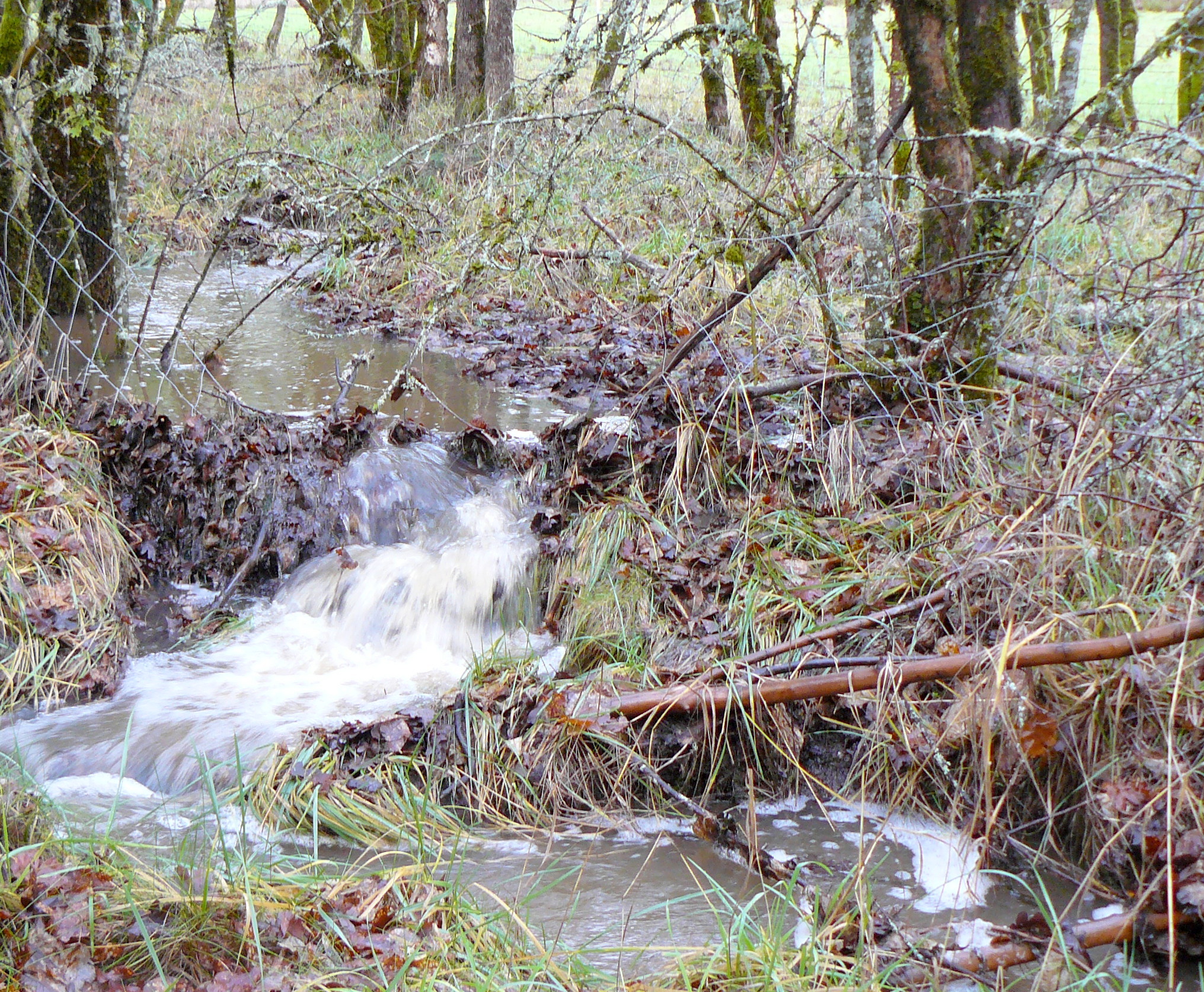
Finally, here in rural Southern Oregon, we received 1.70 inches of rain on Thursday and were grateful that it wasn’t more.  Nonetheless, it had the creek levels raised, as the following pictures reveal.

A small creek that only flows during periods of heavy rain. The creek is on the boundary between our property and our neighbour's to the North.
A small creek that only flows during periods of heavy rain. The creek is on the boundary between our property and our neighbour’s to the North.

oooo

This the raised water flowing over the irrigation dam on Bummer Creek, that flows North-South through the woods on the Eastern part of our land.
The raised water flowing over the irrigation dam on Bummer Creek, that flows North-South through the woods on the Eastern part of our land. Bummer Creek flows year-round.

Towards a new world.

A republication of a fascinating essay.

When I posted yesterday about a ‘growing’ awareness, I had no idea that earlier this morning, Oregon time, I would read an essay over on Rob Hopkin’s Transition Network blog that just had to be shared with you. But such is the wonder of our wired-up world.  The essay is called From dismal science to language of beauty – Towards a new story of economics and is authored by Inex Aponte and is republished in full. (The emboldening is mine.)

ooOOoo

Inez Aponte: From dismal science to language of beauty – Towards a new story of economics

Humans are storytelling beings. In fact one could argue that it is impossible to make sense of the world without story. Storytelling is how we piece together kite1-620x260facts, beliefs, feelings and history to form something of a coherent whole connecting us to our individual and collective past, present and future. The stories that help make meaning of our lives inform how we shape and re-shape our environment. This re-created world, through its felt presence in structures and systems as well as its cultural expressions, in turn tells us its story.

We live in a time of powerful globalised narratives. We no longer (or rarely) sit and listen to tales that were born of places we know intimately and told by people deeply connected to these places. Ours is a world saturated with information from every corner of the planet, voiced by ‘storytellers’ on television, radio, the internet, mobile phones, newspapers, billboards, books and magazines. It would appear that we now have access to a multitude of perspectives and, with that, more understanding of the different options open to human beings to live fulfilling lives. In reality however, the majority of us have to conform to a narrow set of rules not of our own making: the rules of economics.

The way in which our lives have become dominated by the pursuit of financial gain is full of contradictions. We may not be driven by the ‘love of money’ but we still have to ‘make a living’. The fluctuations in the economy have a profound effect on our everyday lives, but very few of us understand how it works, let alone feel we have the power to influence it. This lack of agency fills most of us with a degree of ‘background anxiety’ that drives many of our decisions, consciously or unconsciously. The economic story is possibly the most powerful story being told at this very moment.

So how is this story being told (and sold) to us? How is it being framed?

1- The work/life balance

This term has become so ubiquitous that it is often used in its English form even in non-English speaking countries. It seems to be a concept that needs no translation; it can easily be swallowed whole. But hidden inside this seemingly innocuous phrase are some powerful assumptions.

On one side of the scales we place work, not just any work, but paid labour. On the other side we place life. By life we don’t mean the actual fact of being alive, but our aliveness, our joy, our pleasures. Placing work and life on opposite sides of the balance we are tacitly agreeing that paid work is worth sacrificing our aliveness for, that it is ok to be a little bit ‘dead’ in your job. If you are lucky enough to have a job you love the concept may seem irrelevant, but for people whose work is tedious, soul-destroying or even dangerous this is the perfect frame to diffuse any discontent: ‘We agree that having a degree of aliveness is important, but you cannot have all of it. You have to sacrifice some of your aliveness just to stay alive.’ The framing of paid work as a necessity for ‘earning’ one’s existence remains unquestioned.

2- The economy must grow

Having determined the necessity of jobs it’s no surprise to hear world leaders repeating the growth mantra over and over. The story goes like this: we need growth so we can create jobs so we can pay people money to buy stuff that creates more jobs. Nobody questions whether the jobs that are created are worth giving up their aliveness for or even whether what is being produced or provided adds any further joy or satisfaction to society. The frame of ‘employment for all’ is so sacred that anyone pointing out how many of the businesses providing these jobs destroy the planet we depend upon for our survival is presented with another false dichotomy: people against nature.

When George Bush sr, at the time of the Kyoto protocol, told Americans “I am the one that is burdened with finding the balance between sound environmental practice on the one hand and jobs for American families on the other.” he was setting up a frame that continues to be echoed by world leaders today. Even if in our heart of hearts we know we need the earth more than we need the artificial constructs of jobs and money, by now we have become so dependent on money to stay alive that this kind of language stifles our capacity to imagine a different solution. Fearing for the survival and safety of our loved ones we accept the war declared on nature in our name.

3- Humans are selfish

This experience of fearing for our survival dovetails neatly with our third and perhaps most powerful economic frame: the rational, utility maximising individual – Homo Economicus. This story tells us that given the choice humans will seek to get the most for themselves with the least amount of effort. It’s simply a ‘dog eat dog’ world.

Funnily enough it looks like the people who most fit the stereotype of the selfish utility maximiser are economists themselves. Various studies have repeatedly shown that non-economists are not as selfish or rational as economic theory would have us believe and that economists, or students of economics, consistently score higher on selfishness than ‘ordinary’ people. Despite these insights, the story that humans are by nature selfish and competitive persists.

But are any of these frames telling us the truth about ourselves and the world? Do we have to accept work as a necessary burden? Do we have no choice but to destroy the planet in order to survive? Are we really as selfish as economic textbooks suggest?

Perhaps the first thing we need to ask is: Is any of this about true economics in the first place?

To answer this question we need to travel back to ancient Greece where Aristotle was musing on two distinct practices: Oikonomia and Khrematistika. Oikonomia is where we get the word economics from and is described as ‘the management of the household so as to increase its use value to all members over the long term’. Khrematistika on the other hand (from khrema, meaning money) refers to ‘the branch of political economy relating to the manipulation of property and wealth so as to maximize short-term monetary exchange value to the owner’.

In their book ‘For the Common Good’ economist Herman Daly and theologian John Cobb, Jr distinguish between the two as follows:

Oikonomia differs from chrematistics in three ways. First, it takes the long-run rather than the short-run view. Second, it considers costs and benefits to the whole community, not just to the parties to the transaction. Third, it focuses on concrete use value and the limited accumulation thereof, rather than on an abstract exchange value and its impetus towards unlimited accumulation…. For oikonomia, there is such a thing as enough. For chrematistics, more is always better…

By now you might recognise our current economic system in this description of chrematistics. No wonder we are confused. We believe we are practising economics when we are in fact practising chrematistics. This has far reaching consequences for both the practice of economics and its perception. By allowing chrematistics to masquerade as economics the owning classes have perpetuated the illusion that increasing their financial wealth will be good for all of us and we, in our own misunderstanding of the proper function of an economy, have accepted chrematistics as the dominant form of resource management.

But what if there was another way of thinking and speaking about the economy, one that was in line with the true meaning of the word: the ability to manage the home for all, the art of living? What if we were able to redeem the language of economics so that it might liberate our imaginations and creativity and tell a beautiful story that expresses what we truly value?

Human Scale Development

In the 1970s, after many years of researching poverty in Latin America, Chilean economist Manfred Max-Neef came to the conclusion that conventional economics, in practising chrematistics, did not have the tools to adequately address the experience of poverty and could not serve to alleviate it. What was needed was a language that allowed poverty and wealth to be understood in much broader terms. Together with his colleagues he developed what is now commonly known as Human Scale Development (HSD) or ‘barefoot economics’.

HSD proposes that there are nine fundamental human needs which are universal across time and place (as opposed to wants which are subject to cultural and historical trends). These fundamental needs are: Subsistence, Protection, Identity, Understanding, Participation, Creation, Freedom, Affection and Idleness.

Needs are not the same as the strategies or satisfiers we use to meet those needs. Needs are finite; satisfiers are culturally determined and infinite. In HSD each satisfier is valuated according to its impact on the rest of our own needs, the needs of others and, most importantly, on the conditions for life itself: a living thriving planet.

In this model of economics, you are wealthy when your needs are satisfied and if one or more of your needs are not met you are poor. Whereas our current model has conventionally defined wealth as how much money you possess and poverty as a lack of money – expressed as a poverty of subsistence – in HSD you may suffer from any number of poverties if one or more of your needs are not adequately satisfied. So you may have a full belly and suffer from poverties of affection, understanding or identity. Or you may feel safe and protected by having a secure well-paid job, but work so much you suffer from poverties of creation, participation and idleness. When enough members of a community suffer a particular poverty for prolonged periods it develops into a pathology. It becomes a sickness that is often hard to recognise because it has been normalised. We may ask whether our tendencies towards addictive behaviours, whether they be addictions to work, alcohol, gaming or sex, are expressions of such pathologies.

In HSD the key to living well, and therefore the purpose of a true economy, is to adequately satisfy our fundamental human needs within the Earth’s natural limits. Our role within such an economy is not only to seek to get our needs met, but to use our gifts to meet the needs of others.

This is good news, because here the time you spend playing with your child and meeting their need for creation, affection and participation creates a positive balance in the economy. As does the meal you made for your elderly neighbour, (meeting the needs of subsistence, affection, understanding, and protection) as does joining a community garden, learning a new skill, lying in the grass watching the clouds go by. Framing economics in this manner tells us that we are economic participants regardless of whether we are making financial gains. Other skills, gifts or abilities become our ‘currency’. In fact most things that the conventional (chrematistic) economy ignores create wealth in a Human Scale Economy.

The reverse is also true. Actions that are now considered beneficial for the chrematistic economy – for example, cutting down forests to build roads – soon appear uneconomical through an HSD lens. The destruction of the natural world also destroys opportunities to meet many of our fundamental needs: for idleness (going for walks in nature) identity (these places hold meaning that stretches back over centuries) participation and creation (it is where the community gathers, connects, plays) and understanding (the opportunity to connect with and learn from the more-than-human world).

Economies are created by the people

Economies, large or small, local or global, are created by the people. They depend on our collective efforts, labour and entrepreneurship as well as our songs, our dances, our poetry, our joy, our curiosity, our dreams. The macro economy must be reformed from the inside out, it must start with an understanding of who we are, what is dear to our hearts and from that place radiate our values outwards in order to truly meet our needs. A ‘barefoot’ economy is an economy where people – liberated from wage slavery, and with access to the means by which they can satisfy their fundamental needs – are able to choose adequate satisfiers suitable to their region and culture. It is one where we acknowledge and respect our dependence on a thriving earth. It is a place where we have once again understood the meaning of ‘enough’.

If we are looking for insurance against want and oppression, we will find it only in our neighbors’ prosperity and goodwill and, beyond that, in the good health of our worldly places, our homelands. If we were sincerely looking for a place of safety, (…) then we would begin to turn to our communities – and not the communities simply of our human neighbors but also of the water, earth, and air, the plants and animals, all the creatures with whom our local life is shared.”

“The Earth is what we all have in common.” (Wendell Berry)

I look forward to a time when students of economics are required to study the work of artists, poets and makers. When economic text books, as well as addressing how we manage the earth to provide food, homes, clothing and jobs, also speak of the need for beauty, intimacy, community and love.

The Art of Economics (and may it one day become an art) needs a new story and a new language that doesn’t require us to choose between self and others, work and aliveness, our own lives and the lives of fellow humans or the health of the planet. A language that has the potential to re-frame the story, re-educate our thinking and get us back on the side of community, on the side of the earth and on the side of life.

Inez Aponte is a facilitator, storyteller and activist, and co-founder of the Well & Good Project. You can contact her about talks and workshops on HSD and the Fundamental Human Needs framework at inez_aponte@hotmail.com.

www.somesmallholding.wordpress.com
www.wellandgoodproject.wordpress.com

——————————————-

This article was written based on a talk given in Bonn within a series of REconomy-Events organised by the Bonn Transition-Town Initiative “Bonn-im-Wandel” and supported by the Heinrich Böll Foundation, and was originally published on the website of the recent Degrowth conference in Leipzig.

 ooOOoo

 Don’t know about you but I found this both fascinating and very informative.

A ‘growing’ awareness.

The pun is deliberate!

Just at the moment there seems to be an incredible explosion of awareness about the need to change. Won’t say anymore other than from the day of the Winter Solstice, less that two weeks away, I will be publishing a number of posts about this new awareness and the implications, the positive implications, for the coming years.

To set the tone, I am republishing an article that appeared on the website of the organisation Nature Needs Half. I am grateful for their permission to so do.

ooOOoo

Nature Needs Half in the Earth Island Journal

Originally published in the Earth Island Journal by William H. Funk

Conservation group promoting an ambitious new proposal for wilderness protection

During the last half century conservationists around the world have won some impressive victories to protect wild places. Here in the US, the Wilderness Act preserves some 110 million acres of public land. Private holdings by groups like The Nature Conservancy safeguard tens of millions of additional acres. The idea of protecting ecosystems from industrial development has spread around the world. There’s the Mavuradonha Wilderness in Zimbabwe, the El Carmen ecosystem in northern Mexico, Kissama National Park in Angola, and the Tasmanian Wilderness in Australia, to name just a few stunning parks and preserves; UNESCO’s world heritage list includes 197 sites of special beauty and/or biodiversity.

Photo by Trey Ratcliff Nature Needs Half has set out an unbelievable challenge: to formally, legally set aside one half of Earth’s land and water as interconnected natural areas.

But conservation biologists now recognize that these sanctuaries are limited in what they can accomplish precisely because they are special — which is to say, rare. Parks and preserves are all too often islands of biological integrity in a sea of human development. To really protect natural systems, healthy biomes need to be the rule, not the exception.

To achieve that vision, The WILD Foundation, a multinational NGO based in Boulder, Colorado, is pushing a bold concept called “Nature Needs Half.” In a world in which even the wealthiest governments routinely abdicate their responsibilities toward future generations and the environment, Nature Needs Half has set out an unbelievable challenge: to formally, legally set aside one half of Earth’s land and water as interconnected natural areas.

This is, of course, a hugely ambitious endeavor, opposing as it does the assumption that Earth’s resources are here to be exploited solely by humans. We live in what some have called the “Anthropocene,” the Age of Man, a world in which every aspect of physical being, from the oceanic depths to the troposphere, has been radically altered by humankind. Rivers are being dammed, forests leveled, oceans emptied and wildlife eradicated. It’s not a pretty picture, but as an empiric truth it’s difficult to refute. Consider a few facts:

The long-term acidification of the oceans by our ongoing buildup of industrial carbon dioxide is killing off coral reefs around the world, resulting in the loss of a critical barrier to storm surge and further endangering coastal areas at heightened risk from rising seas and stronger and more frequent storms.

Hydropower is increasingly being developed in South America, South Asia and sub-Saharan Africa, preventing the migration of anadromous fishes and destroying the elaborate flood-regime ecosystems of biomes like the Amazon.

The accelerating rate of animal and plants extinctions under the twin hammers of climate change and habitat loss is being compared to Earth’s five other extinction events that followed catastrophic geophysical change such as meteor impact or sudden tectonic shifts. In the case of the sixth great extinction, however, the root cause is purely biotic: us. Either from directly causing species decline through poaching, habitat conversion and the introduction of competitive exotic species, or by indirectly altering ecosystems through our industrial assault on the planet’s atmosphere, one in eight birds, one in four mammals, one in five invertebrates, one in three amphibians, and half of the world’s turtles are facing the eternal night of extinction.

Given those facts, the Nature Needs Half goal is startling in the grandiosity of its vision and the ambitious range of its projects. It is also, in a word, fair. “Half the world for humanity, half for the rest of life, to make a planet both self-sustaining and pleasant,” is how eminent naturalist E.O. Wilson explains the idea in his book The Future of Life. Other endorsers include marine explorer Sylvia Earle and the Zoological Society of London. And while the scope and scale of Nature Needs Half is unprecedented, conservation groups such as the World Wildlife Fund recognize that connecting biodiverse “hotspots” must guide preservation efforts.

The stated goal of Nature Needs Half is “to ensure that enough wild areas of land and water are protected and interconnected (usually at least about half of any given ecoregion) to maintain nature’s life-supporting systems and the diversity of life on Earth, to ensure human health and prosperity, and to secure a bountiful, beautiful legacy of resilient, wild nature.” Underlying this objective is the assumption that humanity, despite its often destructively “unnatural” behavior, is inescapably a part of life on Earth, and that efforts to preserve and protect untrammeled wilderness areas are ultimately means of assuring that the ecosystem services people depend upon are available to us in the distant future. We’re all in this together, and the sooner H. sapiens gets that through its pointy little head, the better off we’ll all be.

How is “protected” defined? The International Union for the Conservation of Nature defines it quite flexibly: “A protected area is a clearly defined geographical space, recognized, dedicated and managed, through legal or other effective means, to achieve the long term conservation of nature with associated ecosystem services and cultural values.” Thus any number of means may be put into play to preserve land, from conservation easements in Virginia to armed ranger patrols in Namibia; what matters is the end result, namely the retention of naturally functioning ecosystems over time.

During the past two decades scientists have determined that the planet’s ecoregions need at least 50 percent ecological integrity, and in some cases more, to ensure the survival of their biological productivity over the long term. (In plain language, “ecological integrity” means that an area’s biodiversity and basic processes are mostly intact.) The goals of Nature Needs Half simply echo the empirical scientific reality: to function over time the world’s biomes need at least half of their structural integrity preserved from human alteration. We are currently falling short of that. A recent report from Yale’s Environmental Performance Index states that just17 percent of Earth’s terrestrial areas and inland waters, and less than 10 percent of marine areas, are currently protected (though for many parks and refuges in poorer countries this protection is often illusory), while about 43 percent remains relatively open and undeveloped, with low human populations and generally undamaged ecosystems.

Nature Needs Half is pursuing its aim in two simultaneous directions: the protection of at least half of the planet’s mostly intact contiguous wilderness areas — concentrating on Eurasian boreal forests, the Amazon basin and Antarctica — and the identification and protection of those fragments or hotspots of abundant biodiversity that have become isolated islands in a sea of human activity.

The aims of Nature Needs Half are precisely the kind of bold approach, rooted in cutting-edge science, which our increasingly desperate times call for. In an Anthropocene of radical climate change and accelerating species extinctions, nothing less than a grand vision of what might yet be achieved will bring about the preservation of our remaining unspoiled landscapes. As the most farsighted wilderness preservation program on Earth, Nature Needs Half promises to be the kind of revolutionary undertaking that, if its aims are fully or even mostly achieved, will be looked back on centuries from now as perhaps the most important attainment in modern human history.

William H. Funk
William H. Funk is a freelance writer, documentary filmmaker and environmental lawyer living in Virginia’s Shenandoah Valley. His work explores the confluences of the natural world, history, culture, law and politics, and as an attorney he has had broad experience with land preservation and endangered species. He may be contacted at williamfunk3@icloud.com or williamhfunk.weebly.com

ooOOoo

Rather puts my next book chapter, Community, into perspective; that chapter being published in thirty minutes time.

A Vision for Nature

Another powerful essay from George Monbiot.

Despite this now being December and NaNoWriMo is behind me, all 53,376 words of it, the next few weeks are still going to be demanding.

I have three more chapters to write plus adding a guest preface and an overhaul of Part One of the book.  In other words, December is still a busy book month, albeit without the word-count pressures of NaNoWriMo.

All a long-winded way of me saying that I will present articles seen elsewhere if I think they are of interest to all of you readers.

Which brings me to another powerful essay from George Monbiot that he published a few days ago and is republished here with George’s very kind permission.

ooOOoo

A Vision for Nature

November 27, 2014

As governments tear down the rules that defend our wildlife from extinction, here’s a positive attempt to stop the wreckage.

By George Monbiot. posted on the Guardian’s website, 21st November 2014

One of the fears of those who seek to defend the natural world is that people won’t act until it is too late. Only when disasters strike will we understand how much damage we have done, and what the consequences might be.

I have some bad news: it’s worse than that. For his fascinating and transformative book, Don’t Even Think About It: why our brains are wired to ignore climate change, George Marshall visited Bastrop in Texas, which had suffered from a record drought followed by a record wildfire, and Sea Bright in New Jersey, which was devastated by Hurricane Sandy. These disasters are likely to have been caused or exacerbated by climate change. He interviewed plenty of people in both places, and in neither case – Republican Texas or Democratic New Jersey – could he find anyone who could recall a conversation about climate change as a potential cause of the catastrophe they had suffered. It simply had not arisen.

The editor of the Bastrop Advertiser told him “Sure, if climate change had a direct impact on us, we would definitely bring it in, but we are more centred around Bastrop County.” The mayor of Sea Bright told him “We just want to go home, and we will deal with all that lofty stuff some other day.” Marshall found that when people are dealing with the damage and rebuilding their lives they are even less inclined than they might otherwise be to talk about the underlying issues.

In his lectures, he makes another important point that – in retrospect – also seems obvious: people often react to crises in perverse and destructive ways. For example, immigrants, Jews, old women and other scapegoats have been blamed for scores of disasters they did not create. And sometimes people respond with behaviour that makes the disaster even worse: think, for instance, of the swing to UKIP, a party run by a former City broker and funded by a gruesome collection of tycoons and financiers, in response to an economic crisis caused by the banks.

I have seen many examples of this reactive denial at work, and I wonder now whether we are encountering another one.

The world’s wild creatures are in crisis. In the past 40 years the world has lost over 50% of its vertebrate wildlife. Hardly anywhere is spared this catastrophe. In the UK, for example, 60% of the 3,000 species whose fate has been studied have declined over the past 50 years. Our living wonders, which have persisted for millions of years, are disappearing in the course of decades.

You might expect governments and officials, faced with a bonfire of this magnitude, to rush to the scene with water and douse it. Instead they have rushed to the scene with cans of petrol.

Critical to the protection of the natural world are regulations: laws which restrain certain activities for the greater public good. Legal restrictions on destruction and pollution are often the only things that stand between species and their extinction.

Industrial interests often hate these laws, as they restrict their profits. The corporate media denigrates and demonises the very concept of regulation. Much of the effort of those who fund political parties is to remove the regulations that protect us and the living planet. Politicians and officials who seek to defend regulation will be taken down, through campaigns of unrelenting viciousness in the media. Everywhere the message has been received.

The European Commission has now ordered a “review” of the two main pillars of the protection of our wildlife: the Birds Directive and the Habitats Directive. It’s likely to be the kind of review conducted by a large tracked vehicle with a steel ball on the end of a chain. The problem, the Commission says, is that these directives could impede the “fitness” of business in Europe.

But do they? Not even Edmund Stoiber, the conservative former president of Bavaria who was appointed by the Commission to wage war on regulation, thinks so. He discovered that European environmental laws account for less than 1% of the costs of regulation to business: the lowest cost of any of the regulations he investigated. “However, businesses perceive the burden to be much higher in this area.” So if these crucial directives are vitiated or scrapped, it will not be because they impede business, but because they are wrongly perceived to impose much greater costs than they do.

The UK chancellor, George Osborne, claimed in 2011 that wildlife regulations were placing ridiculous costs on business. But a review by the environment secretary, Caroline Spelman, concluded the claim was unfounded.

In the United Kingdom, whose leading politicians, like those of Australia and Canada, appear to be little more than channels for corporate power, we are facing a full-spectrum assault on the laws protecting our living treasures.

The Small Business, Enterprise and Employment Bill, now passing through the House of Commons, would oblige future governments to keep deregulating on behalf of business, regardless of the cost to the rest of society. The government’s Red Tape Challenge at first insisted that no new regulation could be introduced unless an existing one is scrapped. Now two must be scrapped in exchange for any new one.

Cameron’s government has set up what it calls a “Star Chamber”, composed of corporate executives and officials from the business department, before which other government departments must appear. They must justify, in front of the sector they regulate, any of the rules these business people don’t like. If they are deemed insufficiently convincing, the rules are junked.

Usually, governments go to some lengths to disguise their intent, and to invent benign names for destructive policies. Not in this case. A Star Chamber perfectly captures the spirt of this enterprise. Here’s how a website about the history of the Tudors describes the original version (my emphasis):

“The power of the court of Star Chamber grew considerably under the Stuarts, and by the time of Charles I it had become a byword for misuse and abuse of power by the king and his circle. … Court sessions were held in secret, with no right of appeal, and punishment was swift and severe to any enemy of the crown. Charles I used the Court of Star Chamber as a sort of Parliamentary substitute during the years 1628-40, when he refused to call Parliament. Finally, in 1641 the Long Parliament abolished the hated Star Chamber, though its name survives still to designate arbitrary, secretive proceedings in opposition to personal rights and liberty.”

Yes, that is exactly what we’re looking at. I suspect the government gave its kangaroo court this name to signal its intent to its corporate funders: we are prepared to be perfectly unreasonable on your behalf, trampling justice, democracy and rational policy-making to give you what you want. We are putting you in charge. So please keep funding us, and please, dear owners of the corporate press, don’t destroy our chances of winning the next election by backing UKIP instead.

Then there’s the Deregulation Bill, which has now almost run its parliamentary course. Among the many ways in which it tilts the balance even further against defending the natural world is Clause 83, which states this:

“A person exercising a regulatory function to which this section applies must, in the exercise of the function, have regard to the desirability of promoting economic growth.”

So bodies such as the Environment Agency or Natural England must promote economic growth, even if it directly threatens the natural wonders they are charged with protecting. For example, companies could save money by tipping pollutants into a river, rather than processing them or disposing of them safely. That means more funds for investment, which could translate into more economic growth. So what should an agency do if it is supposed to prevent pollution and promote economic growth?

Not that the government needs to bother, for it has already stuffed the committees that oversee these bodies.

Look, for example, at the board of Natural England. Its chairman, Andrew Sells, is a housebuilder and major donor to the Conservative Party, who was treasurer of the thinktank Policy Exchange, which inveighs against regulation at every opportunity. Its deputy chairman, David Hill, is also chairman of a private company called the Environment Bank, whose purpose is ”to broker biodiversity offsetting agreements for both developers and landowners.” Biodiversity offsetting is a new means of making the destruction of precious natural places seem acceptable.

The government has recently appointed to this small board not one but two Cumbrian sheep farmers – Will Cockbain and Julia Aglionby – who, my encounters with them suggest, both appear to be fanatically devoted to keeping the uplands sheepwrecked and bare. There’s also a place for the chief executive of a group that I see as a greenwashing facility for the shooting industry, the Game and Wildlife Conservation Trust. And one for a former vice-president of Citibank. The board members with current or former interests in industries that often damage the natural world outnumber those who have devoted their lives to conservation and ecology.

So what do we do about this? You cannot fight assaults of this kind without producing a positive vision of your own.

This is what the RSPB and the Wildlife Trusts have done with the publication of their Nature and Wellbeing Green Paper. It’s a proposal for a new act of parliament modelled on the Climate Change Act 2008. It obliges future governments to protect and restore the living world. It proposes targets for the recovery of species and places, a government agency (the Office for Environmental Responsibility) whose role is to ensure that all departments help to defend wildlife, and Local Ecological Networks, which devolve power to communities to protect the places they love most.

I have problems with some aspects of this proposal, not least its enthusiastic embrace of the Natural Capital Agenda, which seeks to persuade us to value nature by putting a price on it. This strategy is, I believe, astonishingly naïve. To be effective, you must open up political space, not help to close it down by accepting the premises, the values and the framing of your opponents. But I can see what drove them to do it. If the government accepts only policies or regulations that contribute to economic growth, it’s tempting to try to prove that the financial value of wildlife and habits is greater than the financial value to be gained by destroying them, foolish and self-defeating as this exercise may be.

But I’ll put this aside, because their proposal is the most comprehensive attempt yet to douse the bonfire of destruction on which the government is toasting our wildlife like marshmallows. The Climate Change Act and its lasting commitments are just about the only measures that oblige this government to restrict greenhouse gases. It remains a yardstick against which the efforts of all governments can be judged. Should we not also have similar, sustained protection for wildlife and habitats? Only lasting safeguards, not subject to the whims and fads of passing governments, can defend them against extinction.

The Nature and Wellbeing Act is a good example of positive environmentalism, setting the agenda, rather than merely responding to the policies we don’t like. We must do both, but while those who love wildlife have often been effective opponents, we have tended to be less effective proponents.

It will be a struggle, as the times have changed radically. In 2008 the Climate Change Act was supported by the three main political parties. So far the Nature and Wellbeing Act has received the support of the Liberal Democrats (so after the election both their MPs will promote it in parliament) and the Green Party. The Conservatives, despite the green paper’s desperate attempts to speak their language, are unreachable. And where on earth is Labour? So far it has shown no interest at all.

If you care about what is happening to the living world, if you care about the assault on the enthralling and bewitching outcome of millions of years of evolution for the sake of immediate and ephemeral corporate profits, join the campaign and lobby your MPs. The Nature and Wellbeing Act will succeed only through a movement as big as the one that brought the Climate Change Act into existence. Please join it.

www.monbiot.com

ooOOoo

Sometimes, I wonder if such essays, as powerful and well-written as they are, are not just too terrible a commentary on how things are just now.  My justification for republishing them is simply from the point of view that the more the awareness of good ordinary people is enhanced as to these present times, the better the odds that there will be a sufficient social and political reaction to bring this madness to a halt.

Vested interests, perhaps.

I’m being very brave and stepping into the climate change cauldron!

Learning from Dogs has been posting a wide range of items for well over five years. Indeed, today’s post is number 2,238!

Over those five years, my position regarding climate change or global warming has been pretty clear: a belief in the proposition that man’s behaviours are changing the very climate of our planet.  For instance, a little over a year ago I posted under the title Sceptical about global warming?  It opened:

Learning from Dogs is not a blogsite about climate change!

Why, you may ask, do I start today’s post with that sub-heading?  Because, I am conscious that many of my posts do touch on this subject.  For example, just two days ago there was Breaking news.  Then there was the piece about the climate implications for Phoenix, Arizona.  Followed the next day by the changes in the flow of the jet stream across the North Atlantic with all the weather implications for North-West Europe.

Indeed, as the heading to today’s post makes clear, this is also about the changes going on to our planet.

Learning from Dogs is about a different way of living and behaving.  A campaign, if one wants to call it that, to show that the way that modern man is living is corrupt.  Not with a big ‘C’ but still in the sense of living a dishonest life.  Learning from Dogs attempts to show that our wonderful dogs, a source of so much love and pleasure for so many millions, offer us an example of a life in and of this planet.

If there was ever a time in the history of man when we needed being reminded of our frailty and vulnerability, it is now.  As the following so starkly illustrates.

Peter Sinclair of Climate Crocks recently republished an item from Skeptical Science that opened up as follows:

A new study of ocean warming has just been published in Geophysical Research Letters by Balmaseda, Trenberth, and Källén (2013).  There are several important conclusions which can be drawn from this paper.

  • Completely contrary to the popular contrarian myth, global warming has accelerated, with more overall global warming in the past 15 years than the prior 15 years.  This is because about 90% of overall global warming goes into heating the oceans, and the oceans have been warming dramatically.

Then last week-end, Dan Gomez, friend for over 40 years, sent me the following:

Weather Channel Founder: Global Warming Science ‘Not Valid’

Meteorologist John Coleman, who co-founded The Weather Channel, says the claim that human activity is leading to global warming is no longer scientifically credible.

Instead, the “little evidence” there is for rising global temperatures points to a “natural phenomenon,” Coleman asserts.

In an open letter to the United Nations’ Intergovernmental Panel on Climate Change (IPCC), he wrote: “There is no climate crisis. The ocean is not rising significantly. The polar ice is increasing, not melting away. Polar bears are increasing in number.

“Heat waves have actually diminished, not increased. There is not an uptick in the number or strength of storms.

“I have studied this topic seriously for years. It has become a political and environmental agenda item, but the science is not valid.”

Coleman says he based his views on the findings of the Nongovernmental International Panel on Climate Change (not to be confused with the U.N. panel), a body of scientists and scholars who assess the science of global warming.

“There is no significant man-made global warming at this time. There has been none in the past and there is no reason to fear any in the future,” says Coleman, who was the original meteorologist on “Good Morning America.”

“Efforts to prove the theory that carbon dioxide is a significant greenhouse gas and pollutant causing significant warming or weather effects have failed.

“There has been no warming over 18 years.”

The U.N.’s IPCC argues that their research shows man-made global warming will lead to extreme weather events becoming more frequent and unpredictable, the Express in Britain reported.

Climate expert William Happer, a professor at Princeton University, expressed support for Coleman’s claims.

“No chemical compound in the atmosphere has a worse reputation than CO2, thanks to the single-minded demonization of this natural and essential atmospheric gas by advocates of government control [of] energy production,” Happer said.

“The incredible list of supposed horrors that increasing carbon dioxide will bring the world is pure belief disguised as science.”

What Dan had seen was an article in the UK Daily Mail that, in turn, was echoed on the US WesternJournalism blogsite.  Here’s how that Daily Mail story opens:

Climate change has been proven to be a lie, according to a leading meteorologist.

John Coleman, who co-founded the Weather Channel, claims that the belief humans are causing climate change is not backed up by science.

In an open letter attacking the UN, the 80-year-old from San Diego, said that what ‘little evidence’ there is for global warming points to natural cycles in temperature.

‘There is no climate crisis,’ he wrote. ‘The ocean is not rising significantly. The polar ice is increasing, not melting away. Polar bears are increasing in number. ‘Heat waves have actually diminished, not increased. There is not an uptick in the number or strength of storms.

‘I have studied this topic seriously for years. It has become a political and environment agenda item, but the science is not valid.’

The WesternJournalism post runs with the story explaining (in part):

John Coleman, the original meteorologist for ABC’s Good Morning America and the founder of The Weather Channel, which launched in 1982, wrote an open letter to the UCLA’s Hammer Forum urging them “to re-examine their plan” for their forum, scheduled for this past Thursday, after they announced their experts, both of whom believe in climate change science.

Coleman has made his position against climate change science clear in the past.

“There is no significant man-made global warming at this time, there has been none in the past and there is no reason to fear any in the future. Efforts to prove the theory that carbon dioxide is a significant ‘greenhouse’ gas and pollutant causing significant warming or weather effects have failed. There has been no warming over 18 years.”

The Weather Channel founder cites professors from Princeton University, Massachusetts Institute of Technology (MIT), Harvard Smithsonian Observatory, and the University of Alabama, along with “9,000 Ph.D scientists” who agree with him.

“Yet at your October 23 Hammer Forum on Climate Change you have scheduled as your only speakers two people who continue to present failed science as though it is the final and complete story on global warming/climate change. This is a major mistake.”

Coleman urged the UCLA group to reconsider, noting he is not a “flat Earther,” or a “paid shill of the Koch Brothers.”

In a discussion yesterday with Dan, he was of the clear mind that, yes, the climate is changing, as it always has over eons of time, but that the degree of change that is directly attributed to man’s affairs is minute.  Then all around me I see sign after sign, read article after article, that we, as in mankind, are relentlessly ‘fouling our own nest’ and the time left for us to learn how to live sustainably on this planet is fast running out.

Can we get to the truth? The topic will be continued tomorrow!

Returning to the land – a guest essay.

A question of a possible catastrophe

Note: As tomorrow’s post will explain, the next few weeks will be encroaching seriously on my blogging time. So it was very timely to receive this guest essay from John in the last couple of days and even more generous of him to give me permission to republish it.

It will make an interesting comparison to an item from Dan Gomez being published on Thursday.

ooOOoo

Notes on Dealing With Imminent Catastrophe

We know that our world economy is leveraged at least twenty-five times beyond any earthly material foundation. Regardless of this reality, we have made an artificial global economy more real than our physical world. This situation only makes sense when we recognize that we’re being encouraged to re-establish our awareness of reality. It’s a final exam time for a leading edge species of clever monkeys.

Nature has tolerated human activities for millions of years. Now that our demographics ravenously swarm the globe, belch poisons into the five mile band of air that sustains surface life on earth, dumps wastes and toxins into streams, rivers, lakes and oceans, and arrogantly refuses to understand obvious warnings; Nature is reacting.

For those who are inclined to either or choices, in accordance with the physical Law of Entropy, the decision is between pursuing constructive or destructive actions. For those who are more spiritually oriented, there is no question. In either case, we know what needs to be done.

Our first order of business is to stabilize our inclusive global economy through green initiatives that are operated for profit without damage to the eco-system. Yes, this sounds impossible the first time we think about it. Can we come up with a better plan? Not really, when we stop and honestly consider our situation. We’re poised on the brink of a material, economic and cultural collapse created by human beings.

Wars continue to be waged world wide over territory and rapidly diminishing fossil fuel resources. We have essentially lost trust in each other as equal members of a common community we call Earth. And, we are rapidly losing faith in the unsustainably inflated symbol of trust we call Money.

A green economy is our best solution for the multiple problems that plague us. Here’s why and a few suggestions about how we go about the process. Essentially, our critical need for renaissance is a process of education, formation and transformation.

When we return to the land as a global priority, the use of solar energy can replace massive industrial electrical generators running on fossil fuel derivatives. Most industrial generators may be easily converted to bio-diesel fuel. Industrial diesel generators worldwide can be converted to bio-fuel overnight. No mechanical adaptation is required.

Electric cars already set speed records at Europe’s classic racetracks. Solar electric cars are on the horizon. A bio-diesel engine to power a golf cart costs about $500 today and is available from Amazon.

There’s a natural need for co-operation when we return to the land and collectively re-establish our financial roots. First, we recognize that each of our actions affects the well being of the earth and its inhabitants. Second we realize that we are responsible for the well being of the Earth which sustains our being.

Third, we re-establish our natural connection with the unity of a living universe. We begin with the community gardens and farmer’s markets that are already operational, and rebuild accordingly.

When we are foolish, we act independently for our personal well being. When we are wise, we act together for the well being of the earth and each other. Growing our own food not only assures that what we eat will be free of chemical by-products; it also makes us aware of how fragile our consumer supply lines have become. Recycling our food waste as fertilizer completes a natural growth cycle.

By the way, a back yard greenhouse can produce enough bio-fuel to operate a diesel vehicle and a solar panel array can generate enough energy to charge your electric car. How much money does this save each year?

We don’t need nuclear reactors that sometimes melt down and sicken us with a continual stream of radiation carried by the tides and the winds of an integrated planet. We don’t need the wastes of nuclear reactors that poison the earth for millennium.

We don’t need nuclear weapons capable of destroying most, if not all, of the life on earth in an all out suicidal war. The only creatures to survive the holocaust of nuclear war would need to be radiation resistant; shielded deep underground or deep under the sea.

Harnessing wind, water and geothermal energy are wiser ways to keep our world energized in a green economy. A combination of habitats and communities powered by solar and geothermal energy will produce a new building boom as we shed the skin of our former infrastructure and a green architectural industry emerges.

Recycling the components of our technological world not only reduces our industrial waste, it decreases the cost of manufacture. Similarly, adapting and reusing what we already have decreases our personal expenses and reduces our demands on the earth.

These are only a few of the ideas which are already possible. Many more are already in the process of becoming our greater reality.

Still think such a massive transformation is impossible? If so, please know that you remain in our prayers.

There is hope for tomorrow. Science consistently opens new doors. Faith in the Nature of God of which we are each an infinitesimal part makes us unified and strong as a consciously aware biological species.

John Hurlburt

an old lamplighter

ooOOoo

Good news is never far away

We all need a reminder of the many good things happening in our world!

It’s common knowledge that homo sapiens is wired to react to the threat of danger in a rapid manner.  But while the danger of a bear or a lion jumping on us from out of the trees is much diminished in the 21st century, our fear-response circuits are still alive and active.  One of the fundamental reasons why so much of the media ‘sells’ stories via alarmist headlines.

Thus it was a real delight to come across a magazine with the simple, yet powerful, brand name of YES!

Cover of the current issue of YES!

Even better than coming across YES! was receiving a complimentary subscription for Jean and me!  (Thanks John H!)  Jean and I took to the magazine immediately.  Not only because of an active blog but also because of their support for sharing their content.  I quote:

Reprints & Reposts

We want you to pass along the work of YES! Magazine. All we ask is that you follow these easy steps:

Text

For all material designated Creative Commons (cc):

(as used herein, material means the text of the articles, and does not mean titles, images, or illustrations)

  • Use the same byline information that we have placed at the end of the article. For reposts, keep links intact.
  • Material is free except for commercial use.
  • Do not alter, change, or add to the material.
  • Please notify us that you are reprinting by sending an email to reprints [at] yesmagazine.org.

For full details, see the Creative Commons license.

Copyrighted © text:

We have adopted Creative Commons licensing beginning with our issue #44. We readily grant reprint permission for earlier copyrighted material, upon request. Just ask us at reprints [at] yesmagazine.org. We occasionally reprint or excerpt material that is copyrighted by others, and this material is NOT included in the Creative Commons license.

Moving on to the next good news item.

I forget how but recently came across the Buy Nothing Project.  As the ‘About’ page explains:

Buy Nothing. Give Freely. Share Creatively.

The Buy Nothing Project began as an experimental hyper-local gift economy on Bainbridge Island, WA; in just 8 months, it has become a social movement, growing to over 25,000 members in 150 groups, in 4 countries. Our local groups form gift economies that are complementary and parallel to local cash economies; whether people join because they’d like to quickly get rid of things that are cluttering their lives, or simply to save money by getting things for free, they quickly discover that our groups are not just another free recycling platform. A gift economy’s real wealth is the people involved and the web of connections that forms to support them. Time and again, members of our groups find themselves spending more and more time interacting in our groups, finding new ways to give back to the community that has brought humor, entertainment, and yes, free stuff into their lives. The Buy Nothing Project is about setting the scarcity model of our cash economy aside in favor of creatively and collaboratively sharing the abundance around us.


flowers
The gift of flowers. © Liesl Clark

How does the Buy Nothing Project work? Using the free platform provided by Facebook Groups, Buy Nothing Project members can easily participate with their local group. Our rules are simple: “Post anything you’d like to give away, lend, or share amongst neighbors. Ask for anything you’d like to receive for free or borrow. Keep it legal. Keep it civil. No buying or selling, no trades or bartering, we’re strictly a gift economy.” The transparency of Facebook groups’ design allows our members to see mutual friends they share with relative strangers, and to build trust based on real-life connections visible through personal profile information. This trust allows groups to grow quickly and encourages people to both give freely and ask for what they need; everything from toilet paper roll springs to rides home from the doctor; burial sites for beloved pets to freshly-baked bread and casseroles have been given freely; our members share things mundane and meaningful in equal measure, and throughout it all connect with each other by means of the shared personal stories and chatting encouraged by the platform. We rely on our co-founders’ daily guidance and direction for the development of our nascent culture, assisted by a team of volunteer local administrators who have on-the-ground knowledge of their communities.

The Buy Nothing Project Connects Us With Our Neighbors. © Liesl Clark

Why the Buy Nothing Project? The Buy Nothing Project is brought to you by the creators of Trash Backwards (www.trashbackwards.com,) an app that helps you with the last of the 3 Rs, “Reusing” and “Recycling” the everyday things in your life. The Buy Nothing Project addresses the first of the 3 R’s, “Reduce” as well as the lesser-known Rs “Refuse” and “Rethink.” Participating in a local Buy Nothing Project group allows individuals and communities to reduce their own dependence on single-use and virgin materials by extending the life of existing items through gifting and sharing between group members. Rethinking consumption and refusing to buy new in favor of asking for an item from a neighbor may make an impact on the amount of goods manufactured in the first place, which in turn may put a dent in the overproduction of unnecessary goods that end up in our landfills, watersheds, and our seas. It most certainly creates connections between people who see each other in real life, not just online, leading to more robust communities that are better prepared to tackle both hard times and good by giving freely. The Trash Backwards app, blog articles, and Buy Nothing Project groups are diverting more materials from our landfills and oceans than we can possibly quantify as hundreds of items are rehomed each day.

The Buy Nothing Project Strengthens Communities.

Our Statistics:

With over 25,000 members and growing every day, we have a captive audience in each of our groups. Most members visit the group pages several times a day and many literally spend hours there, commenting, reading posts, while posting their own gifts and wants.

Our Trash Backwards blog, app, and the Buy Nothing Project website garner over 50,000 unique visitors per month. With 7,000 followers on Pinterest and 3,775 “likes” on our Facebook Pages, we have enough sway to bring significant traffic to our sites whenever we upload news or new blog posts.

Funding:

With funding to staff our core project, PR, legal help, design, and developers, the Buy Nothing movement will grow quickly, spreading the joys of gift economy giving and receiving. The world is ready for this experimental model of sharing our possessions and talents to help others, but the endeavor needs its basic operational costs covered to foster the movement even further.

Isn’t that a fabulous idea!

I’m determined to start a local group here in Merlin, Oregon.

My final item of good news, that I’m sure many others read about, was:

A declaration announced as part of a UN summit on climate change being held in New York also pledges to halve the rate of deforestation by the end of this decade and to restore hundreds of millions of acres of degraded land.

The Guardian newspaper released the news, as follows:

UN climate summit pledges to halt the loss of natural forests by 2030

New York declaration on forests could cut carbon emissions equivalent of taking all the world’s cars off the road

PEKANBARU, SUMATRA, INDONESIA - JULY 11:  A forest activist inspects land clearing and drainage of peat natural forest located on the concession of PT RAPP (Riau Andalan Pulp and Paper), a subsidiary of APRIL group which is being developed for a pulp and paper plantation at Pulau Padang, Kepulauan Meranti district on July 11, 2014 in Riau province, Sumatra, Indonesia. The Nature Climate Change journal has reported that Indonesia lost 840,000 hectares of natural forest in 2012 compared to 460,000 hectares in Brazil despite their forest being a quarter of the size of the Amazon rainforest. According to Greenpeace, the destruction of forests is driven by the expansion of palm oil and pulp & paper has increased the greenhouse gas emissions, pushing animals such as sumatran tigers to the brink of extinction, and local communities to lose their source of life. (Photo by Ulet Ifansasti/Getty Images)
PEKANBARU, SUMATRA, INDONESIA – JULY 11: A forest activist inspects land clearing and drainage of peat natural forest located on the concession of PT RAPP (Riau Andalan Pulp and Paper), a subsidiary of APRIL group which is being developed for a pulp and paper plantation at Pulau Padang, Kepulauan Meranti district on July 11, 2014 in Riau province, Sumatra, Indonesia. The Nature Climate Change journal has reported that Indonesia lost 840,000 hectares of natural forest in 2012 compared to 460,000 hectares in Brazil despite their forest being a quarter of the size of the Amazon rainforest. According to Greenpeace, the destruction of forests is driven by the expansion of palm oil and pulp & paper has increased the greenhouse gas emissions, pushing animals such as sumatran tigers to the brink of extinction, and local communities to lose their source of life. (Photo by Ulet Ifansasti/Getty Images)

Governments, multinational companies and campaigners are pledging to halt the loss of the world’s natural forests by 2030.

A declaration announced as part of a UN summit on climate change being held in New York also pledges to halve the rate of deforestation by the end of this decade and to restore hundreds of millions of acres of degraded land.

Backers of the New York declaration on forests claim their efforts could save between 4.5bn and 8.8bn tonnes of carbon emissions per year by 2030 – the equivalent of taking all the world’s cars off the road.

The UK, Germany and Norway have pledged to enter into up to 20 programmes over the next couple of years to pay countries for reducing their deforestation, which could be worth more than £700m.

Companies such as Kellogg’s, Marks & Spencer, Barclays, Nestle, the palm oil giant Cargill, Asia Pulp and Paper and charities including the RSPB, WWF and the International Union for Conservation of Nature (IUCN) have signed the declaration.

The declaration’s supporters say ending the loss of the world’s natural forests will be an important part of limiting global temperature rises to 2C, beyond which the worst impacts of climate change are expected to be felt.

It comes after analysis suggests that land use change such as deforestation accounts for around 8% of the world’s carbon emissions, with carbon dioxide released when trees are felled and burned to free up land for agriculture or development.

“Forests represent one of the largest, most cost-effective climate solutions available today,” the declaration says.

“Action to conserve, sustainably manage and restore forests can contribute to economic growth, poverty alleviation, rule of law, food security, climate resilience and biodiversity conservation.”

Signatories to the declaration are committing to a number of steps to halt forest loss, including backing a private sector goal of eliminating deforestation from producing agricultural products such as palm oil, soy, paper and beef by no later than 2020.

They are also seeking to support alternatives to deforestation which is caused by subsistence farming and the need for wood fuel for energy and reward countries that reduce forest emissions.

Read the full article here.

I first picked up on this news courtesy of the Grist blog:

rainforest-e1411587105860

Cargill promises to stop chopping down rainforests. This is huge.

By Nathanael Johnson

Everything I’ve been reading about the U.N. Climate Summit had been making me pretty gloomy, until I read about the New York Declaration on Forests.

The first notice was a press release from the Rainforest Action Network informing me that Cargill, the agribusiness giant, had pledged “to protect forests in all of Cargill’s agricultural supply chains and to endorse the New York Declaration on Forests.” Cargill has a big handprint — they have soy silos in Brazil and palm oil plants in Malaysia. So as of now, if you want to carve a farm out of the jungle, you’re going to get the cold shoulder from a company that is a prime connector to world markets.

And this isn’t limited to hot-button crops like soy and oil palm. Here’s what Cargill’s CEO Dave MacLennan said at the U.N.: “We understand that this sort of commitment cannot be limited to just select commodities or supply chains,” said MacLennan. “That’s why Cargill will take practical measures to protect forests across our agricultural supply chains around the world.”

It’s not just Cargill. Kellogg’s, Unilever, Nestle, Asia Pulp and Paper, General Mills, Danone, Walmart, McDonalds, and many other corporations have committed to the New York Declaration on Forests. But, here’s why Cargill is interesting: It’s making a concrete pledge, while the actual declaration is pretty mushy at this point. The declaration calls for ending forest loss by 2030. And, to quote a U.N. brief: “It also calls for restoring forests and croplands of an area larger than India. Meeting these goals would cut between 4.5 and 8.8 billion tons of carbon pollution every year — about as much as the current emissions of the United States.” Or about as much as taking all the cars in the world off the roads — that’s another comparison I’ve seen. The details are supposed to be hammered out in time for the 2015 convention in Paris.

Again, read the rest of the article here.

So as much as you, I and hundreds of thousands of others get battered with ‘gloom and doom’ stories every single day, we do need to balance that out from time-to-time with the good things around us. Also every single day.

Now where’s a dog to hug!

AS18

Space for Nature

Last day of September

I was mulling over the fact that tomorrow sees the start of October and, inevitably, pondering what sort of winter we are in for. At the same time, I was reflecting on how beautiful this last month has been.  Wonderful ‘easy-on-the-body’ temperatures, an inch or more of much-needed rain, wonderful Autumn colours; all being shared for the last ten days with our guests: Reggie and Chris.

I was unsure what to write about to reflect my thoughts and was then saved by the September Digest from Transition Culture back in the old country.  I started to read it and immediately wanted to share it with you; dear reader.

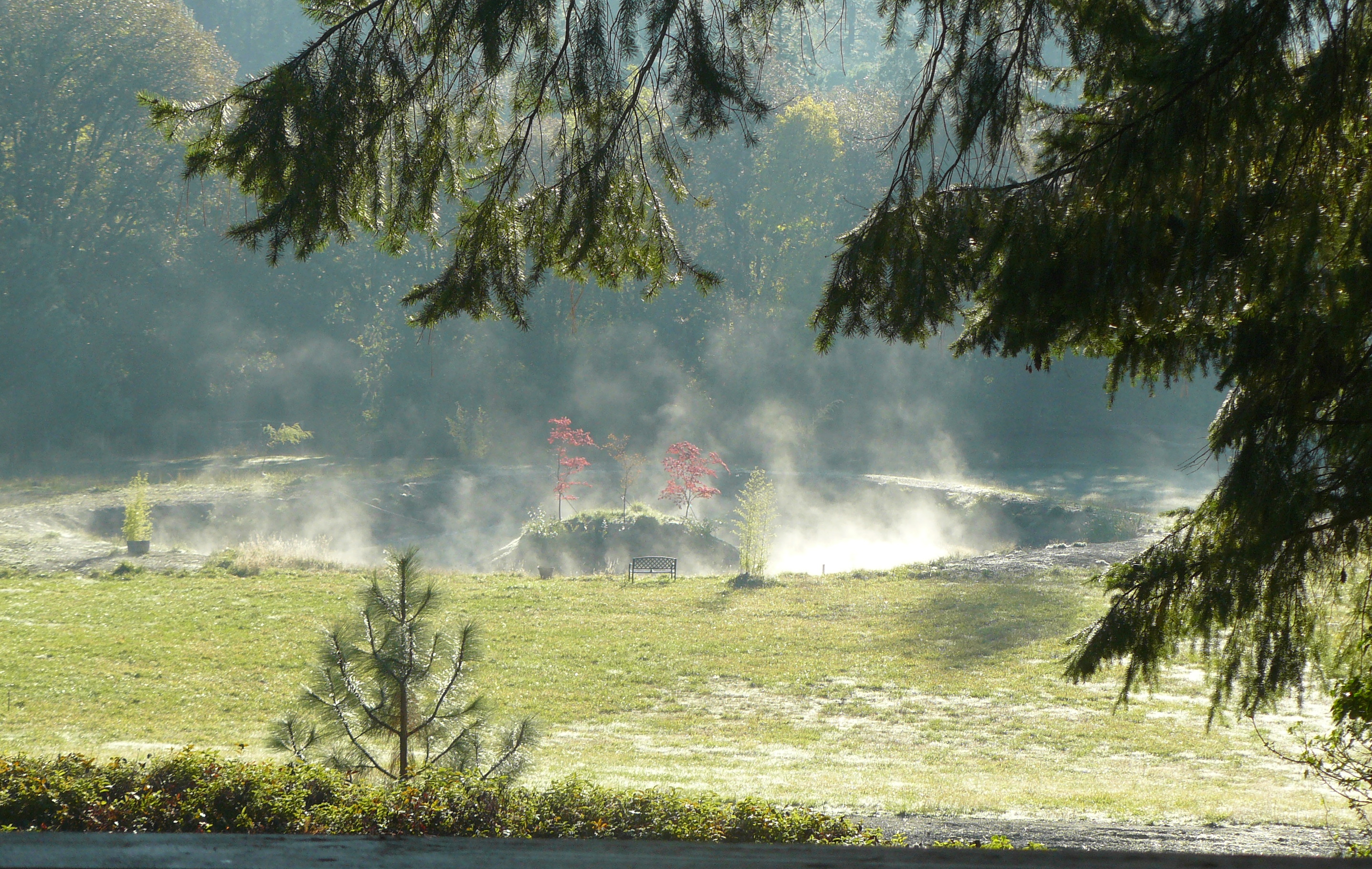
First, to set the tone, here is a photograph taken just before I sat down to write today’s post.

Space for Nature - all around us!
Space for Nature – all around us!

ooOOoo

Transitioners’ Digest (September 2014)

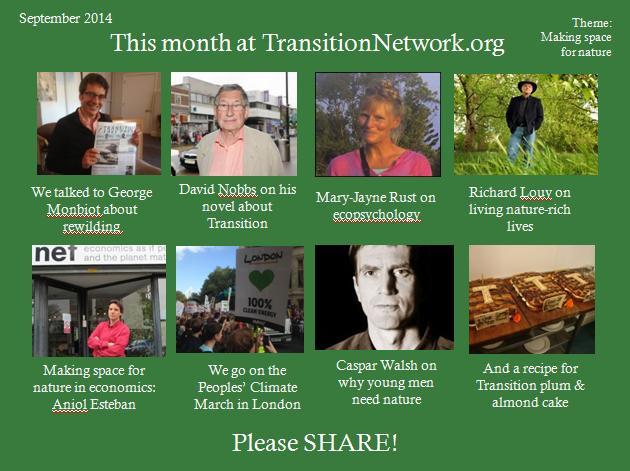
This month we have been exploring the theme of “Making Space for Nature” from a wide range of different angles. We started with an editorial piece which argued that one of the key things that digest2nature can bring our work doing Transition is a sense of wonder. Something to do with glowworms apparently. We grabbed George Monbiot before he went on stage and talked about his book Feral and the concept of rewilding.

Writer and founder of the charity Write to Freedom, Caspar Walsh, talked about the vital role nature can play in the healing of young men. “She, it, whatever it is”, he told us, “works on them and softens them up so I don’t have to do all the work”. Ecopsychologist Mary-Jayne Rust talked about the impacts being separated from nature can have on us, and the benefits we get from making space for it. “When was the last time you heard of an activist going on a pilgrimage for eight months?” she asked.

Isabel Carlisle introduced us to Community Charters, and the potential they have for making space for nature at the community scale. Richard Louv, author of Last Child in the Woods, and of the theory of Nature Deficit Disorder, talked to us via Skype. “If we’re not careful”, he told us, “environmentalists and others who care about the future of nature will carry nature in their briefcases, not in their hearts”. Mike Jones, who builds natural play spaces for kids, talked about the need to make space for “the primodial nature of kids”.

Sept14

Aniol Esteban of New Economics Foundation reflected on why we need to make space for nature in economics. He told us:

Nature contributes to our mental health. It delivers mental health benefits and physical health benefits. It delivers a wide range of societal benefits. It contributes to our education. It can help reduce levels of crime. It can help urban regeneration. There is a huge range of areas and ways in which nature contributes to our wellbeing – individual wellbeing and collective wellbeing.

2782613807-300x212
David Nobbs

TootingHayley Spann, one of the participants in One Year in Transition, reflected on “what nature taught me”. We had a review of the first mainstream novel about Transition, The Second Life of Sally Mottram by David Nobbs (see right). We also talked to the author about where the idea came from, and what makes a good story. We had a recipe for “Transition Plum and Almond Cake”. Mark Watson reflected on the importance of ‘Making Space for Flowers’, and the many ways in which his Transition initiatives, Sustainable Bungay, create opportunities for people to encounter and benefit from nature.

Rob Hopkins reflected on how different our approach to managing water and drought would be if we took forests as the model on which we based it. He also responded to a critique of Transition by Ted Trainer and explored why the language we use to talk about this stuff really matters. He also went on the Peoples’ Climate March in London and reflected on how that was.

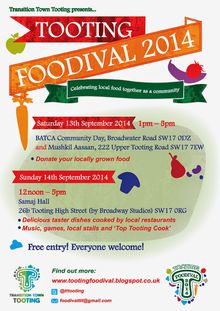
We heard from Transition initiatives about their experience of making space for nature in what they do. Hilary Jennings of Transition Town Tooting talked about the Tooting Foodival. Chris Bird wrote about the Transition Homes initiative in Totnes. Cara Naden discussed the many ways in which Transition Langport make space for nature. “I believe we all have an inherent bond with nature”, she wrote. “It makes us feel happy and healthy and makes us feel we are doing something positive and worthwhile for the benefit of wildlife, each other and ourselves”.

A very rich and thought-provoking month we hope you’ll agree. Our theme for October will be Transition and development. We hope you enjoy that too.

ooOOoo

(Note: there were many links in the original digest so do please check there as well.)

Can’t resist a couple more pictures from home to underline how we feel so strongly about having space for nature.

oooo

A misty October morning from a year ago.

oooo

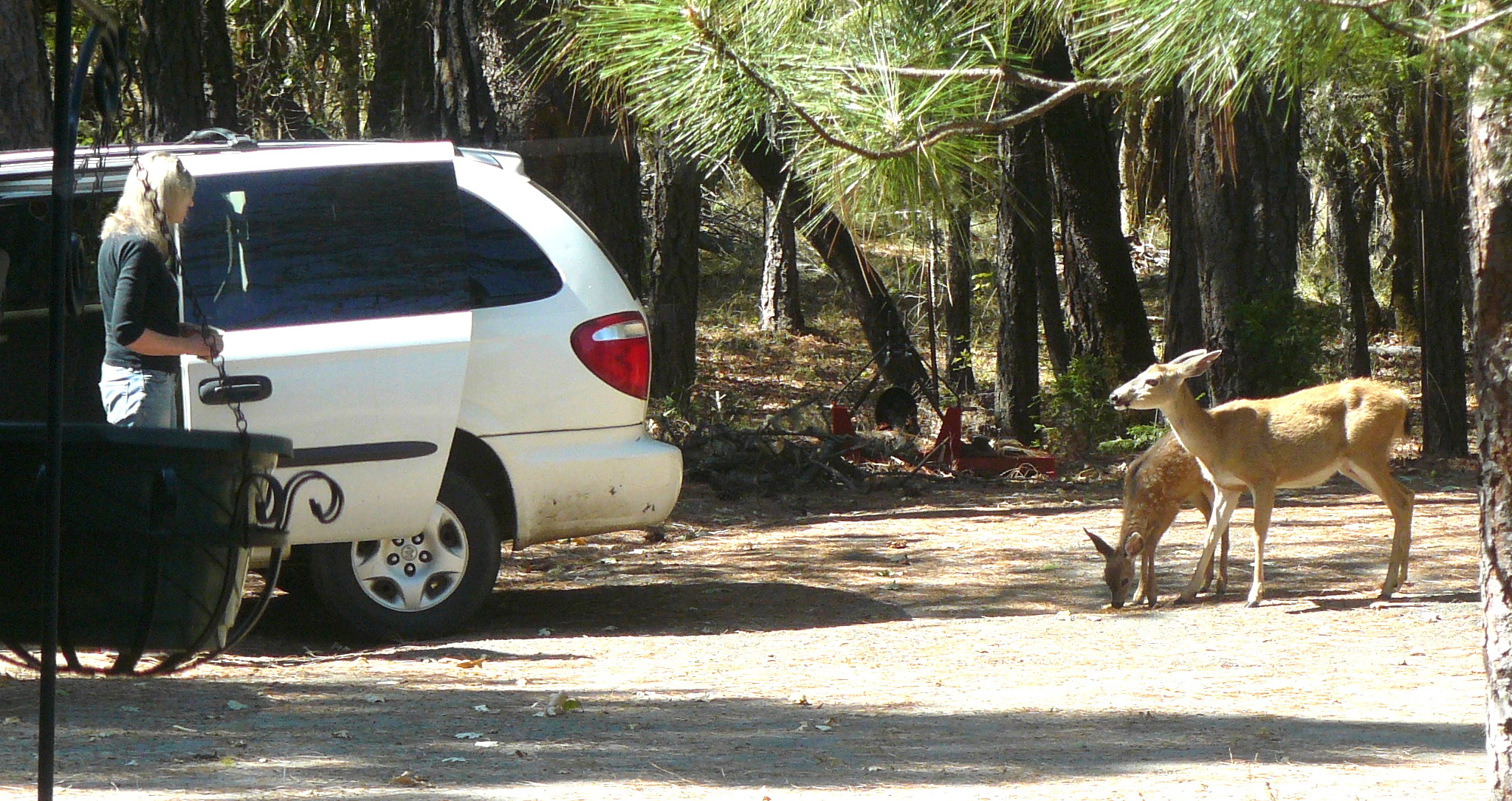
Trust between deer and Jean.
This is what making space is all about!

Let’s all have a great month of October embracing the natural world around us howsoever it can be done.

Governments: Listen to your people!

Because you clearly are not listening to Nature!

Sunday: 10:30 PDT. Won’t rabbit on too long as we are due out with our guests in the next thirty minutes. Just dipped into the online BBC News headlines and, frankly, was more than disappointed to see that the Climate March in New York, and many other cities all around the world, was the third headline after Afghanistan and Yemen.

Oh well!

What I read earlier in the morning was the most fabulous essay over on the Transition Times blogsite written by Jennifer Browdy.  It is republished in full with her kind permission.

This should be read in full!

ooOOoo

The People’s Climate March: Taking the Evolutionary Leap of Radical Democracy

The People’s Climate March in New York City is just one manifestation of a huge sea-change sweeping through our culture. Or perhaps “seeping” would be a better verb—this shift in awareness is not happening with the tsunami force of a revolution, but more with the steady, determined drip-drip-drip of water undermining rock.

Humans are paradoxical. On the one hand, we love everything that’s new and innovative, we all want to be out ahead of the curve when it comes to technological breakthroughs and new ideas. On the other hand, we hold tight to the received wisdom of our forebears, living by enshrined writings thousands of years old (the Bible, the Koran, the Mahabharata, Confucius, etc.) or hundreds of years old (the Declaration of Independence, the Constitution, the Bill of Rights).

We have established elaborate educational, political and legal systems designed to hold us to a particular form of society, permitting free, innovative thinking only along narrow channels carefully defined by the interests of business and commerce.

The arts and humanities, traditionally the realm of creative, imaginative exploration, have been steadily starved in this brave new world, which can only imagine creativity in the service of profit.

What happens to a society that can only envision creative energy in an instrumental, utilitarian light?

We become a society of robots. We lose our connection to the soul of the world, the anima mundi that sustains us humans along with all other living beings on the planet.

TT1

The People’s Climate March, which is happening not only in New York City but worldwide, with 2,808 marches and events in 166 countries, bears welcome witness to the fact that the sparks of creative, independent thinking have not totally gone out.

There are many, many people worldwide who are aware, and aghast, at the failure of our political and business leaders to act in the best interests of the people and all the beautiful, innocent creatures who are slipping away into the night of extinction day by day due to the relentless human assault on our shared planet.

We are here, we are aware, and we are engaged. We are not going to stand by silently and let corporate greed and shortsightedness overwhelm us.

It is true that business and government have a stranglehold on official channels of communication, education and social change.

They control the curricula taught in our schools, what appears on our major media channels, and what projects and areas of creative exploration are funded. They keep us in line with the debt bondage of school loans, mortgages, car payments and the fear of not having enough money in the bank for a comfortable old age. We’re so busy running on the treadmills they’ve set up we have no time or energy to think about changing the system.

Or do we?

We saw it happen in the Arab Spring, where people used cell phones and texts to organize themselves to resist oppression.

We saw those people get beaten back, the promise of their revolution squashed by the entrenched power of men with guns and tear gas.

The rise of the Islamic State, like the rise of Al Quaeda and the Taliban, is all about conservative forces resisting change.

I am just as afraid of men with guns and tear gas as the next woman. I am happier making revolution on my laptop than in the streets. But at some point we have to come out from behind our screens, get off the treadmills of debt bondage, look around us at the beauty of the world, and say: this is what I want to live for, and this is what I’m willing to die for.

So far, the one social area that has not been overtaken by corporate/governmental control is the World Wide Web. It’s still a Wild West space, a place where you can find everything and everyone, from dangerous sadists to beneficent spiritual leaders. There’s room for every kind of idea out there to percolate through our collective consciousness. And make no mistake: the energy we’re seeing in the People’s Climate March is fueled in large part by the distribution power of the Web, the ability to get the word out and get people fired up to come together to take a stand.

Photo: Cheryl Himmelstein

Environmental activist and writer Terry Tempest Williams, in her book The Open Space of Democracy, says that the time has come to “move beyond what is comfortable” (81) in pursuit of what she calls a “spiritual democracy.”

“We have made the mistake of confusing democracy with capitalism and have mistaken political engagement with a political machinery we all understand to be corrupt,” she says.

“It is time to resist the simplistic, utilitarian view that what is good for business is good for humanity in all its complex web of relationships. A spiritual democracy is inspired by our own sense of what we can accomplish together, honoring an integrated society where the social, intellectual, physical and economic well-being of all is considered, not just the wealth and health of the corporate few” (87).

Williams calls for a radical recognition of the interdependence of all life on Earth. “The time has come to demand an end to the wholesale dismissal of the sacredness of life in all its variety and forms,” she says. “At what point do we finally lay our bodies down to say this blatant disregard for biology and wild lives is no longer acceptable?” (86)

If we humans could step into our destiny as the stewards of our planet, the loving gardeners and caretakers of all other living beings, we would harness our incredible intelligence and creativity to re-stabilize our climate and do what needs to be done to ensure the well-being of all.

Williams calls this “the next evolutionary leap” for humanity: “to recognize the restoration of democracy as the restoration of liberty and justice for all species, not just our own” (89).

If we are able to take this leap, we will not only avert climate-related disaster on a Biblical scale, we will also overcome many of the social problems that we currently struggle with. “To be in the service of something beyond ourselves—to be in the presence of something other than ourselves, together—this is where we can begin to craft a meaningful life where personal isolation and despair disappear through the shared engagement of a vibrant citizenry,” says Williams (89).

TT2

Williams’ small gem of a book grew out of a speech she gave at her alma mater, the University of Utah, in the spring of 2003, as America was rushing into its ill-conceived War on Terror in Iraq. She describes her heart pounding as she got up to make a speech advocating a different form of democracy than that embraced and espoused by all the conservative friends and family sitting in the audience before her.

Challenging one’s own friends and family, betraying one’s own tribe, is the hardest aspect of being a social revolutionary. You have to question the very people you love most, who have given you so much and made your whole life possible.

But if we become aware that the social systems that gave birth to us are the very social systems that are undermining the possibility of a livable future on this planet, can we continue to just go with the flow, to avoid asking the difficult questions?

Or will we become change agents who work slowly and steadily, drip by drip, to awaken those around us, those we love most, to the necessity of undertaking “the next evolutionary leap” in the human saga on the planet?

TT3

ooOOoo

From that BBC News website:

On Tuesday, the UN will host a climate summit at its headquarters in New York with 125 heads of state and government – the first such gathering since the unsuccessful climate conference in Copenhagen in 2009.

So world leaders, are you going to reflect the wishes of millions of your peoples across the world and step up to the mark?  We will see.