Category: Capitalism

Never taking democracy for granted!

Cold-water shower time again!

All you good people who stick with this blog know that the majority of the posts are to do with dogs or cats in one form or another.

Yet, I am cognizant of the fact that no one can completely hide, metaphorically speaking, in the warm fur of our favourite dog or cat and let the rest of the world go tits up. From time to time I read an article or an essay that touches on something fundamentally important to a civil society and am compelled to share same with you.

That was the case on July 5th when I published a post called The Implications of Inequality.

OK – moving on!

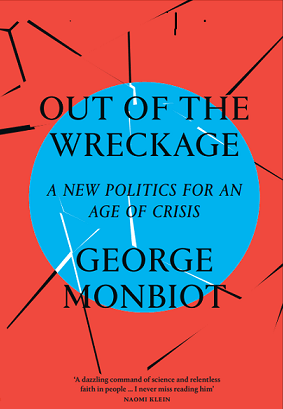
Regulars know that I am a great admirer of the writings of essayist George Monbiot. He is a very regular contributor to The Guardian newspaper. Just a few days ago, Mr. Monbiot published an essay that really does need to be read as widely as possible. It is called Missing Link and is republished here with George Monbiot’s very kind permission.

ooOOoo

Missing Link

21st July 2017
How a secretive network built around a Nobel prizewinner set out to curtail our freedoms

By George Monbiot, published in the Guardian 19th July 2017

It’s the missing chapter: a key to understanding the politics of the past half century. To read Nancy MacLean’s new book Democracy in Chains: the deep history of the radical right’s stealth plan for America is to see what was previously invisible.

The history professor’s work on the subject began by accident. In 2013 she stumbled across a deserted clapboard house on the campus of George Mason University in Virginia. It was stuffed with the unsorted archives of a man who had died that year, whose name is probably unfamiliar to you: James McGill Buchanan. She writes that the first thing she picked up was a stack of confidential letters concerning millions of dollars transferred to the university by the billionaire Charles Koch.

Her discoveries in that house of horrors reveal how Buchanan, in collaboration with business tycoons and the institutes they founded, developed a hidden programme for suppressing democracy on behalf of the very rich. The programme is now reshaping politics, and not just in the US.

Buchanan was strongly influenced by both the neoliberalism of Friedrich Hayek and Ludwig von Mises and the property supremacism of John C Calhoun, who argued, in the first half of the 19th century, that freedom consists of the absolute right to use your property – including your slaves – however you may wish. Any institution that impinges on this right is an agent of oppression, exploiting men of property on behalf of the undeserving masses.

James Buchanan brought these influences together to create what he called “public choice theory”. He argued that a society could not be considered free unless every citizen has the right to veto its decisions. What he meant by this was that no one should be taxed against their will. But the rich were being exploited by people who use their votes to demand money that others have earned, through involuntary taxes to support public spending and welfare. Allowing workers to form trade unions and imposing graduated income taxes are forms of “differential or discriminatory legislation” against the owners of capital.

Any clash between what he called “freedom” (allowing the rich to do as they wished) and democracy should be resolved in favour of freedom. In his book The Limits of Liberty, he noted that “despotism may be the only organisational alternative to the political structure that we observe.” Despotism in defence of freedom.

His prescription was what he called a “constitutional revolution”: creating irrevocable restraints to limit democratic choice. Sponsored throughout his working life by wealthy foundations, billionaires and corporations, he develop both a theoretical account of what this constitutional revolution would look like and a strategy for implementing it.

He explained how attempts to desegregate schooling in the American South could be frustrated by setting up a network of state-sponsored private schools. It was he who first proposed the privatisation of universities and the imposition of full tuition fees on students: his original purpose was to crush student activism. He urged the privatisation of Social Security and of many other functions of the state. He sought to break the links between people and government and demolish trust in public institutions. He aimed, in short, to save capitalism from democracy.

In 1980, he was able to put the programme into action. He was invited to Chile, where he helped the Pinochet dictatorship to write a new constitution, which, partly through the clever devices Buchanan proposed, has proved impossible to reverse in its entirety. Amid the torture and killings, he advised the government to extend its programmes of privatisation, austerity, monetary restraint, deregulation and the destruction of trade unions: a package that helped trigger economic collapse in 1982.

None of this troubled the Swedish Academy, that, through his devotee at Stockholm University, Assar Lindbeck, in 1986 awarded James Buchanan the Nobel Memorial Prize for economics. It is one of several decisions that have turned this prize toxic.

But his power really began to be felt when Charles Koch, currently the seventh richest man in the US, decided that Buchanan held the key to the transformation he sought. Koch saw even such ideologues as Milton Friedman and Alan Greenspan as “sellouts”, as they sought to improve the efficiency of government rather than destroying it altogether. But Buchanan took it all the way.

MacLean says that Charles Koch poured millions into Buchanan’s work at George Mason University, whose law and economics departments look as much like corporate-funded thinktanks as they do academic faculties. He employed the economist to select the revolutionary “cadre” that would implement his programme (Murray Rothbard, at the Cato Institute that Koch founded, had urged the billionaire to study Lenin’s techniques and apply them to the libertarian cause). Between them, they began to develop a programme for changing the rules.

The papers Nancy Maclean discovered show that Buchanan saw stealth as crucial. He told his collaborators that “conspiratorial secrecy is at all times essential.” Instead of revealing their ultimate destination, they would proceed by incremental steps. For example, in seeking to destroy the Social Security system, they would claim to be saving it, arguing that it would fail without a series of radical “reforms”. (The same argument is used by those attacking the NHS over here). Gradually they would build a “counter-intelligentsia”, allied to a “vast network of political power” that would eventually become the new establishment.

Through the network of thinktanks that Koch and other billionaires have sponsored, through their transformation of the Republican Party, and the hundreds of millions they have poured into state congressional and judicial races, through the mass colonisation of Trump’s administration by members of this network and lethally effective campaigns against everything from public health to action on climate change, it would be fair to say that Buchanan’s vision is maturing in the USA.

But not just there. Reading this book felt like a demisting of the window through which I see British politics. The bonfire of regulations highlighted by the Grenfell Tower disaster, the destruction of state architecture through austerity, the budgeting rules, the dismantling of public services, tuition fees and the control of schools: all these measures follow Buchanan’s programme to the letter. I wonder how many people are aware that David Cameron’s free schools project originated with an attempt to hamper racial desegregation in the American South.

In one respect, Buchanan was right: there is an inherent conflict between what he called “economic freedom” and political liberty. Complete freedom for billionaires means poverty, insecurity, pollution and collapsing public services for everyone else. Because we will not vote for this, it can be delivered only through deception and authoritarian control. The choice we face is between unfettered capitalism and democracy. You cannot have both.

Buchanan’s programme amounts to a prescription for totalitarian capitalism. And his disciples have only begun to implement it. But at least, thanks to Maclean’s discoveries, we can now apprehend the agenda. One of the first rules of politics is know your enemy. We’re getting there.

http://www.monbiot.com

ooOOoo

I found it very difficult to write these closing thoughts; as is obvious as you read this sentence!

Looking up quotations online under the headings of fairness or equality brought up many that could have worked here. Yet they seemed too trite, too obvious, too remote from the reality of what Mr. Monbiot describes here today.

So let me leave you with this: US income inequality is the highest it’s been since 1928. (Source: Pew Research.) But worse than that, US wealth inequality is even greater than income inequality. (Source: Pew Research.) (I’m certain that this is not exclusive to the USA.)

That is wrong! Plain and Simple!

Potty training.

Advice from DoctorPup.

I’m always a little cautious about submissions of guest articles from those who are ‘in the business’. But sometimes drawing the line between a genuinely informative article from a pet-related business and overt promotion is a fine one. I chose to publish an article from Alex back in November last year. It was about behavioral issues with dogs and was well received.

Earlier this month, in came another guest article from DoctorPup and, again, I think this is a good share with you. But please do let me know if you think it is too much of a product ‘sell’. I protect the integrity of this blog without question.

ooOOoo

Michael Schoeff reveals how to effectively potty train a puppy

Written by Florentina Popa on behalf of the company
Michael Schoeff, the inventor of the innovative potty training system called Pup Pee Poo Palace, considers that classic house training a puppy is a difficult process that takes time, patience, commitment and consistency.

Traditional potty training

If you want to follow the traditional path, it is important to inform yourself carefully and to establish clear guidelines to get on the right track your pup in just a few weeks. Puppies learn very fast from two to four months, picking up easily on the concept of housebreaking. Five to 30 minutes after eating, puppies want to defecate, so it is important to respect a clear schedule. The most important aspects you should take into consideration is to stay consistent, positive and patient and the results will appear gradually.
The first step is to establish a routine by creating a schedule for eating and playing. Feeding your puppy according to a clear schedule depending on his age, ensures eliminations at consistent times. This is crucial because generally, a puppy has control of his bladder one hour for every month of age so they are prone to accidents if they are not taken outdoor regularly. During his first months of life, a puppy should be taken outside at least every two hours as well as immediately after he wakes up, during and after playing and after eating.

Pick a specific spot outside and always take him there. Also, use a specific word or phrase before he goes outside to remind what he has to do. Take him to walks or playtime after he eliminated. Your attitude is important during potty training, so avoid being nervous or impatient as well as using a loud tone because you’ll make your pup anxious.

Reward him every time he eliminates outdoor, praising or giving treats immediately after he has finished and before coming back inside. This will help teaching him what you are expecting from him.
It is recommended to pick up his water dish about two hours before bedtimes to avoid relieving himself during the night.
An essential rule and hard to apply is to always supervise your puppy when he is indoor to avoid accidents or soiling. Keep your puppy in a specific area and watch him for signs he needs to go out. If you notice him barking, scratching the door, squatting, sniffing or circling, take him outdoor.
If there are times when you cannot supervise him, restrict him to an area small enough that he won’t want to eliminate there. Make sure that the space is comfortable to stand, lie down and turn around. A good idea is to use a crate or a leash, but don’t forget to take him outdoors whenever he needs to eliminate. You can gradually give him more freedom in the house as he learns to eliminate outdoor.
Keep in mind that accidents can happen anytime and make sure you act properly. If you see him eliminating indoor, interrupt him by saying “outside!” or making a noise without scaring him and take him to his eliminating spot outdoors. Always use positive reinforcement, keep calm and be assertive. Don’t punish him for eliminating in the house to avoid a negative connection with his bodily function, just clean up the room and make sure to remove the smell.
If your program doesn’t allow to stay at home with your puppy, you need to find someone to take your pup for bathroom breaks several times a day. You can teach him to eliminate in specific place indoors, but be careful regarding this process as he will get used to it and will practice it as well when becoming adult.
Pup Pee Poo Palace was released in 2013 as an ideal solution for busy dog owners that don’t have enough time to spend with their puppies. The system is based on puppies’ natural behavior to get up on things, so it contains the separate elevated sleep and play area and the elimination area. Bedding area is made of a frame covered in bedding material and it is raised above the floor of the cage using frame extensions. The system helps reinforcing good patterns for puppies and encouraging them to repeat the actions.Puppy owners can let the palace door open when being with their puppies so they can return to the cage whenever they need to eliminate.
Using Pup Pee Poo Palace avoids the risks of infections especially if your puppy hasn’t completed all his vaccinations. You can perform your daily activities while your pup is enjoying his comfortable private space without worrying that he needs to potty.
Furthermore, you can still train your puppy to go outdoors whenever you can, especially after eating, drinking, playing or sleeping, but if you are busy or you’re not at home, count on Pup Pee Poo Palace and stay assured. Your puppy potty training will be easier and faster.
Michael Schoeff and his partner, Gary Rybka, have created not only a very useful tool for dog owners, but a tool that suits any dog breed, starting with breeds that weigh under 5 lbs at maturity and finishing with those that weigh under 70 lbs at maturity.
Author Bio

Florentina Popa is the founder of the digital marketing agency. She is a young entrepreneur with a strong passion for innovation, digital marketing technologies and a real focus on marketing strategies and evaluation process for her clients. She currently advises several companies in the Southeastern Europe and USA. She is content writer and social media manager for several small and medium companies located in the Southeastern Europe. She loves to create articles about business, leadership, digital marketing, lifestyle, animals (especially dogs). She has a great collection of materials published on various online marketing, business and lifestyle websites. When she’s not online, Florentina loves exploring the mountains and local coffee shops with her dogs, traveling and discovering new cultures watching movies and reading. ‘If you believe, you can achieve’ – that’s her motto!

ooOOoo

Good people, I do hope you found this interesting and not crossing the line of offering free promotion to a business. Neither me nor Learning from Dogs in publishing this guest post can offer any explicit or implicit endorsement of the company or this product. Any reader interesting in learning more must conduct their own research.

The implications of inequality

What on earth has inequality to do with dogs!

A fair question one might think. Because this blog is primarily about what we humans should be learning from our dogs. Well, I do see a connection, a message of learning for us. Stay with me for a while.

But first, here’s how I open up Chapter 18 Sharing in my book – Learning from Dogs.

Here’s a silly story that made me laugh when I first came across it.

A man in a casino walks past three men and a dog playing poker.
“Wow!” he says, “That’s a very clever dog.“
“He’s not that clever,” replies one of the other players.
“Every time he gets a good hand he wags his tail.“

This clever dog couldn’t hide his happiness and had to share it by wagging his tail. OK, it was a little bit of fictional fun but we all recognise that inherent quality in our dogs, how they share so much of themselves in such an easy and natural fashion.

Now if one was being pedantic one would say that sharing is not the same as equality. Yet I see them as two separate seats in life’s common carriage.

Many lovers of dogs know that when they lived a life in the wild, slowly evolving from the grey wolf, they replicated, naturally, the pack characteristics of wolves. As in the pack size was around 25 to 30 animals. Yes, there was a hierarchy in the pack but that really only presented itself in the status of three animals: the female ‘alpha’ dog; the male ‘beta’ dog; the ‘omega’ dog that could be of either gender. Ninety percent of the pack were animals on equal standing. If only that was how we humans lived.

A few days ago there was an essay published on The Conversation blogsite under the title of Why poverty is not a personal choice, but a reflection of society.

It opened with this photograph.

A homeless camp in Los Angeles, where homelessness has risen 23 percent in the past year, in May 2017. AP Photo/Richard Vogel

Let me emphasize this: “A homeless camp in Los Angeles, where homelessness has risen 23 percent in the past year, in May 2017.”

Here are two small extracts from that article:

Research Investigator of Psychiatry, Public Health, and Poverty Solutions, University of Michigan


As someone who studies poverty solutions and social and health inequalities, I am convinced by the academic literature that the biggest reason for poverty is how a society is structured. Without structural changes, it may be very difficult if not impossible to eliminate disparities and poverty.


About 13.5 percent of Americans are living in poverty. Many of these people do not have insurance, and efforts to help them gain insurance, be it through Medicaid or private insurance, have been stymied. Medicaid provides insurance for the disabled, people in nursing homes and the poor.

Four states recently asked the Centers for Medicare and Medicaid Services for permission to require Medicaid recipients in their states who are not disabled or elderly to work.

This request is reflective of the fact that many Americans believe that poverty is, by and large, the result of laziness, immorality and irresponsibility.

In yesterday’s post celebrating July 4th, where I shared that lovely picture sent to me by Neil Kelly from my Devon days, there was an exchange of comments between me and author Colin Chappell. Colin is the author of the book Who Said I Was Up For Adoption.

First, in response to Colin saying “That pic really says it all doesn’t it!”, I replied:

No question. Indeed, one might ‘read’ that picture at many levels. From the level of providing a smile for the day all the way through to a very profound observation on life itself.

Colin then replied to me:

I ‘ll go straight for the profound perspective! As I recently noted on another blog, I cannot recall anybody from history who became famous for their material possessions. In fact, I recently read an article written after an individual had surveyed a few thousand gravestones… and they drew the same conclusion. There was not a single epitaph which alluded to a material possession. Dogs know all that intuitively, so why does our superior (?) mind have trouble grasping such a simple perspective?

I then responded by saying that I thought it would make a fabulous introduction to today’s post. The heart of which I am now coming to.

Here in our local city, Grants Pass, there is a Freethinkers and Humanists group. They meet once a month. Jerry Reed from that group some time ago recommended to me reading the book The Spirit Level authored by Richard Wilkinson and Kate Pickett.

Jerry and I were exchanging emails in the last couple of days and he reminded me of that book.

There it was sitting on my bookshelf with a bookmark in at page 62. For reasons that escape me, I had become distracted and forgotten to stay with the book. Despite me being very interested in the proposition.

I said as much in an email reply to Jerry. He then replied to my email with this:

Hey, that happens to me a lot too, very frequently. So, I frequently settle for a video that might capture the essence of the book in considerably less time, while also maintaining my attention much better.

So, if you want a video about what Wilkinson has to say, here’s the one I recommend:

Here is that video. It is a little under 17 minutes long. Please watch it.

Published on Oct 24, 2011

http://www.ted.com We feel instinctively that societies with huge income gaps are somehow going wrong. Richard Wilkinson charts the hard data on economic inequality, and shows what gets worse when rich and poor are too far apart: real effects on health, lifespan, even such basic values as trust.

I haven’t got anything profound to say by way of closing today’s post.

But what I will say is that if our societies, especially in certain countries not a million miles from home, more closely emulated the sharing and caring that we see in our dogs then that really would be wonderful.

Image seen on this website: http://enlightendogs.com/about/testimonials-2/

The view from across the pond!

The power of unanticipated outcomes.

I am referring to the result of the British election that was held last Thursday.

Now I am well aware that many readers will not have the same relationship with the outcomes of British elections as your faithful scribe. But I am also aware that we live in a very connected world. I am also acutely aware that for many, many years I was a devoted listener to the 15-minute weekly radio broadcast on the BBC by Alistair Cooke Letter from America.

So for me, and many others I don’t doubt, the views of America as to what goes on across the pond are just as fascinating today as they have always been.

But in the absence of dear Mr. Cooke (20 November 1908 – 30 March 2004) passing on his experienced assessment on what the outcomes of British elections mean for America then I turn to a recent item on The Conversation site and republished here within the terms of that site.

ooOOoo

How populism explains May’s stunning UK election upset: Experts react

June 9, 2017 6.04am EDT

Editor’s note: U.K. Prime Minister Theresa May’s election gamble failed badly as her Conservatives lost 12 seats, leaving them with 318, shy of a majority. It was a stunning loss for a party earlier projected to gain dozens of seats. Without a majority, the Conservatives will have to rely on another party to govern – known as a hung Parliament. If they’re unable to forge a coalition, rival Labour leader Jeremy Corbyn – whose party gained 31 seats – would be able to give it a go. We asked two experts to offer their insights on what Americans should make of the election and its results.

May had a bad night and may face a struggle over her party’s leadership

Tories’ growing populism begets a power struggle

Charles Hankla, George State University

The results of this election show how similar, and yet how different, British politics are from what is happening in America.

As in the United States, there has been an explosion of populism in Britain, most recently evidenced by the Brexit referendum. This new political force is translating into less liberal policies from the major parties.

In continental Europe, the new populism is mostly embodied by the resurgent far right. But in Britain, as in America, it is being filtered through the existing two-party system – though the U.K.‘s smaller parties do complicate the electoral map.

To accommodate the political winds, May and her Conservatives decided to shift their electoral strategy away from Margaret Thatcher’s pro-market economic approach toward a greater focus on immigration, security and economic nationalism.

Labour leader Jeremy Corbyn, for his part, deserted the more centrist “New Labour” ideas of Tony Blair in favor of a more robust form of social democracy.

The American left, like its British counterpart, has also become increasingly skeptical of unbridled markets. But among Republicans, a traditional hostility to “big government” makes pro-worker redistributive policies, some of which the Tories have adopted to win votes, hard to stomach. For this reason, populism on the American right has mostly taken the form of protectionist and anti-immigrant policies, as embodied by Donald Trump.

Yesterday’s results were devastating for May and indicate that the Conservatives were ultimately unable to balance their new populist message with their traditional support for neo-liberal policies.

Corbyn, for his part, will use this unexpected victory (of sorts) to solidify his hold over the Labour Party and to move it further to the left.

It remains to be seen whether the election will result in a minority or a coalition government, or whether the parties will be well and truly deadlocked. Whatever happens, the British electorate, like its cousin across the pond, has shown itself to be highly polarized.

Still, at a minimum, Britain’s parliamentary structure, along with the ability of the Labour leadership to co-opt disillusioned voters, seems to have spared Britain the fate of America – the takeover of government by a populist insurgent.

Corbyn and his Labour Party had reasons to smile on election night. AP Photo/Frank Augstein

For US companies, it’s business as usual

Terrence Guay, Pennsylvania State University

So now that we know the results, what are the implications for U.S. business interests in the U.K., America’s seventh-biggest trading partner?

May took a calculated political risk and lost. While the market reaction has been severe, with the pound plunging, it’s nothing new to companies, which take calculated risks like that every day – some pay off and some do not.

So first of all, U.S. corporate executives will need to take a deep breath. Assuming a combination of other parties do not cobble together at least 322 seats – despite winning seven seats, Northern Ireland’s Sinn Fein will not send MPs to London – the Conservatives will dominate a coalition government and have considerable sway over policy.

This means a “hard Brexit,” as outlined by May in January, and as seen in the European Union’s tough negotiating guidelines, is unlikely to change. But this is what most U.S. companies have been planning for anyway since last June’s Brexit vote. Many companies, particularly banks and financial institutions, are already planning to move some of their U.K. operations to other EU countries to take advantage of the single market rules.

This process will continue no matter who’s in power, since only the low-polling Liberal Democrat and Green parties promised a Brexit revote.

Second, a weakened Conservative Party will need more foreign friends, and that includes U.S. companies. Since Brexit, some foreign businesses have threatened to downsize or close their U.K. operations as leverage for obtaining government subsidies. Expect more companies to use this strategy with a weaker U.K. government.

As I argue in my recent book, the business environment of Europe is much more than the U.K. market, and U.S. companies have become increasingly aware of this since Brexit.

In other words, it’s business as usual, and that means the continued segmenting of companies’ U.K. and EU strategies, regardless of who is governing in London.

ooOOoo

Expect things to continue to be interesting for some time. Or as more eloquently put by Tariq Ramadan “Times have changed; so must the lenses through which we see the political future.”

Back to Alistair Cooke. There are many of his broadcasts available on the BBC Radio website and on YouTube.

I’m closing with just a small part of Charlie Rose interviewing Alistair Cooke in May, 1996.

Uploaded on Sep 25, 2011

Tuesday, May 7, 1996
Charlie Rose: An interview with Alistair Cooke
Alistair Cooke celebrates the 50 year anniversary of his BBC broadcast, “Letter from America”, a 15-minute talk about life in America for British listeners.

Recorded some twenty-one years ago. Somethings don’t seem to change!

A love for the wild!

Why can’t we leave nature to do what’s best for our world!

Now, I would be the first to ‘tut-tut’ a little over my sub-heading. For here I am sitting in front of a computer in a room in a reasonably-sized home that undoubtedly has denuded the natural world formerly underneath the present foundations.

Thirteen acres orientated West-East.

Plus, as the property boundary shown on the above picture confirms, about 50% of our acreage is no longer wilderness.

Ergo, it is impossible for humans to live on this planet without there being consequences that conflict with the natural order of the wild.

But homes to live in are one thing. A planned madness for the Lake District in Northern England is another thing altogether.

Read this latest essay from George Monbiot, republished with Mr. Monbiot’s kind permission.

ooOOoo

Fell Purpose

The attempt to turn the Lake District into a World Heritage site would be a disaster

By George Monbiot, published in the Guardian 9th May 2017

If this bid for power succeeds, the consequences for Britain will be irreversible. It will privilege special interests over the public good, shut out the voices of opposition and damage the fabric of the nation, perhaps indefinitely. No, I’m not writing about the election.

In the next few weeks Unesco, the UN’s cultural organisation, will decide whether or not to grant World Heritage status to the Lake District. Once the decision is made, it is effectively irreversible.

Shouldn’t we be proud that this grand scenery, that plays such a prominent role in our perceptions of nationhood, will achieve official global recognition? On the contrary, we should raise our voices against it. World Heritage status would lock the Lake District into its current, shocking state, ensuring that recovery becomes almost impossible.

Stand back from the fells and valleys and try to judge this vista as you would a landscape in any other part of the world. What you will see is the great damage farming has inflicted: wet deserts grazed down to turf and rock; erosion gullies from which piles of stones spill; woods in which no new trees have grown for 80 years, as every seedling has been nibbled out by sheep; dredged and canalised rivers, empty of wildlife and dangerous to the people living downstream; tracts of bare mountainside on which every spring is a silent one. Anyone with ecological knowledge should recoil from this scene.

This photo was used as the frontispiece of the “State of Conservation” section of the bid documents. It is meant to show how beautiful the fells are. If we saw it anywhere else, we would recognise it as an environmental disaster.

The documents supporting the bid for world heritage status are lavishly illustrated with photos, that inadvertently reveal what has happened to the national park. But this slow-burning disaster goes almost unmentioned in the text. On the contrary, the bid repeatedly claims that the park is in “good physical condition”, and that the relationship between grazing and wildlife is “harmonious”. Only on page 535, buried in a table, is the reality acknowledged: 75% of the sites that are meant to be protected for nature are in “unfavourable condition”.

This is another photo from the bid document, showing St John’s Beck in Thirlmere. The beck is notorious for its flashy response to rainfall – rising dangerously fast. It’s not hard to see why. As the photo shows, it has been dredged and canalised on behalf of the farmers in the valley, and now contains almost no natural features that can slow the flow.

This great national property has degenerated into a sheepwrecked wasteland. And the national park partnership, that submitted the bid, wants to keep it this way: this is the explicit purpose of its attempt to achieve world heritage status. It wants to preserve the Lake District as a “cultural landscape”. But whose culture? Whose landscape? There are only 1080 remaining farms in the district. Should the entire national park be managed for their benefit? If so, why? The question isn’t raised, let alone answered.

I can see the value and beauty of the traditional shepherding culture in the Lake District. I can also see that the farming there, reliant on subsidies, quad bikes and steel barns, now bears little relationship to traditional practice. As the size of landholdings has increased, it looks ever more like ranching and ever less like the old system the bid describes. The bid’s claim that farming there is “wholly authentic in terms of … its traditions, techniques and management systems” is neither intelligible nor true. Remnants of the old shepherding culture tend to be represented ceremonially, as its customs are mostly disconnected from the farm economy.

Shepherding is not the only cultural legacy in play. The other is that the Lake District is the birthplace of the modern conservation movement. Inspired by the Picturesque and Romantic movements, much of our environmental ethic and the groups representing it, such as the National Trust, originated here. Attempts to preserve natural beauty in the district began in the mid-18th century, with complaints against the felling of trees around Derwent Water. Today, the national park cares so little for this legacy that, as the bid admits, “there are no data available” on the condition of the Lake District’s woodlands.

The small group favoured by this bid sees environmental protection as anathema. Farmers’ organisations in the Lake District have fought tooth and nail against conservation measures. They revile the National Trust and the RSPB, whose mild efforts to protect the land from overgrazing are, with the help of a lazy and compliant media, treated like bubonic plague. As one of these farming groups exults, world heritage status “gives us a powerful weapon” that they can wield against those who seek to limit their impacts. If the plan is approved, this world heritage site would be a 230,000-hectare monument to overgrazing and ecological destruction.

30 years ago, this was a bare sheep pasture (with a couple of seeding birch trees). This is a photo I took (with my failing phone) on a hill elsewhere in Britain. It gives an idea of what parts of the Lake District fells could look like if they were allowed to recover.

This is not the only sense in which the bid is unsustainable. Nowhere in its 700 pages is Brexit mentioned. It was obviously written before the referendum, and has not been updated. Yet the entire vision relies, as the bid admits, on the economic viability of the farming system, which depends in turn on subsidies from the European Union.

Without these payments, there would be no sheep farming in the Lake District: it operates at a major loss. European subsidies counteract this loss, delivering an average net farm income of £9,600. Unsurprisingly, people are leaving the industry in droves: the number of farms in the national park is declining by 2% a year. And this is before the payments cease.

What is the national park partnership, that prepared this bid, going to do – march people onto the fells at gunpoint and demand they continue farming? Or does it hope that the government, amid the massacre of public investment that will follow Brexit, will not only match but exceed the £3bn of public money currently being passed to UK farmers by the European Union? Your guess is as good as mine. This omission alone should disqualify the bid.

The failure to mention this fatal issue looks to me like one of many attempts to pull the Herdwick wool over Unesco’s eyes. The entire bid is based on a fairy tale, a pretence that the rural economy of the Lake District hasn’t changed for 200 years. If Unesco grants world heritage status on these grounds, it will inflict irreparable harm on both our natural heritage and its own good standing.

The hills, whose clothes so many profess to admire, are naked. The narrative we are being asked to support is false. The attempt to ensure that the ecological disaster zone we call the Lake District National Park can never recover from its sheepwrecking is one long exercise in woolly thinking.

http://www.monbiot.com

ooOOoo

When one reads this one is left with a feeling of great sadness. A sadness that our ‘movers and shakers’ can’t resist the urge to meddle. Can’t understand the beauty that is found in nature in the raw.

Earlier on I illustrated how our own property has ‘interfered’ with the wilderness of this most beautiful Oregonian countryside. But as I hope to show you with the following photographs taken on our property back in 2014 that wild beauty can be hung on to in some measure.

Looking upstream along Bummer Creek from the driveway bridge.

oooo

Looking farther downstream from the bridge.

oooo

Pharaoh also appreciating the wild.

Finally, back to that Unesco proposition.

The details may be found on the Unesco site here: http://whc.unesco.org/en/tentativelists/5673/

I have sent a message to Unesco asking if the views of the public are being taken into account and, if so, how those views are to be communicated to Unesco. If you wish to contact them then the details are on this page: http://whc.unesco.org/en/world-heritage-centre/

Any replies from Unesco will be posted here.

UPDATE 0815 PDT May 22nd.

My email yesterday to Unesco was ‘bounced back’ as an invalid email address (despite me using the email address on the Unesco website!!).

But following George Monbiot’s reply to me, giving me the name of James Bridge (jbridge@unesco.org.uk) at Unesco, I have now sent Mr. Bridge the following email:

Dear Mr. Bridge,

I write as a British citizen, born a Londoner in 1944, to protest in the strongest possible terms to the proposal to turn the English Lake District into a World Heritage Site. This is your Tentative List reference http://whc.unesco.org/en/tentativelists/5673/.

Would you please provide me with the details of where or whom within Unesco I can write setting out in detail my objections to this proposal?

Your soonest reply would be very much appreciated.

Sincerely,

Paul Handover

I won’t hold my breath over getting a quick reply.

Up, Up And Away?

It is very hard to avoid hyperbole when one speaks of global warming.

I am indebted to The Nation magazine, May 8/15 Issue, in which is included a feature article authored by Bill McKibben. My sub-heading is much of what Bill wrote in his first line.

It is hard to avoid hyperbole when you talk about global warming. It is, after all, the biggest 
thing humans have ever done, and by a very large margin.

A few sentences later, Bill offers this:

In the drought-stricken territories around the Sahara, we’ve helped kick off what The New York Times called “one of the biggest humanitarian disasters since World War II.” We’ve melted ice at the poles at a record pace, because our emissions trap extra heat from the sun that’s equivalent to 400,000 Hiroshima-size explosions a day.

Yet what scares me, scares me beyond comprehension, is the almost universal disregard being shown by Governments and those with power and influence right across the world to what in anyone’s language is the most pressing catastrophe heading down the tracks. Not next year; not tomorrow, but now!

Or in Mr. McKibben’s words, once more from that Nation article:

But as scientists have finally begun to realize, there’s nothing rational about the world we currently inhabit. We’re not having an argument about climate change, to be swayed by more studies and journal articles and symposia. That argument is long since won, but the fight is mostly lost—the fight about the money and power that’s kept us from taking action and that is now being used to shut down large parts of the scientific enterprise. As Trump budget chief Mick Mulvaney said in March, “We’re not spending money on that anymore. We consider that to be a waste of your money to go out and do that.” In a case this extreme, scientists have little choice but to be citizens as well. And given their credibility, it will matter: 76 percent of Americans trust scientists to act in the public interest, compared with 27 percent who think the same thing about elected officials.

Whatever your response is to what I have already presented, the one thing that I do know is that you have been aware of humanity’s effect on our atmosphere for many, many years. Indeed, Bill McKibben wrote his first book twenty-eight years ago!

His 1989 book The End of Nature is regarded as the first book for a general audience about climate change, and has appeared in 24 languages; he’s gone on to write a dozen more books.

But I would be the first to acknowledge that back in 1989 while I did become aware of Bill McKibben and did purchase and read that book of his, I didn’t see the effects he prophesied. In addition, I didn’t understand the mechanisms that would bring those effects into place.

Now, today, it’s very difficult to deny that global weather systems are behaving in ways that most do not understand albeit we do understand how those weather changes are affecting our lives.

One person who did, and still does even more, understand the physics involved in our changing weather, is Patrice Ayme. For some nineteen years after Bill McKibben’s first book, Patrice published a post on his blog. I have been following Patrice’s blog for some years and while I would be the first to stick my hand in the air and declare that some of his posts are a little beyond me, there’s no question of the integrity of his writings and his bravery in spelling out the truth of these present times. (OK, the truth a la Monsieur Aymes but I would place a decent bet of PA being closer to the core truth of many issues than Joe Public.)

I am indebted to Patrice for granting me permission to republish that post. Please read it. Don’t be put off by terms that may not be familiar to you. Read it to the end – the message is very clear.

ooOOoo

Applying Equipartition Of Energy To Climate Change PREDICTS WILD WEATHER.

By Patrice Ayme, March 8th, 2008.

Lately, the world weather has been especially perplexing, influenced by the cold ocean temperatures of a La Niña current in the equatorial Pacific. For Earth’s land areas, 2007 was the warmest year on record.

This year, record cold is more the norm. Global land-surface temperatures so far are below the 20th-century mean for the first time since 1982, according to the National Climatic Data Center. Last month in China, snowstorms stranded millions of people, while in Mumbai, officials reported the coldest day in 46 years.

Yet, England basked in its fourth-warmest January since 1914, the British Met Office reported. The crocus and narcissus at the U.K.’s Royal Botanical Gardens at Kew flowered a week earlier than last year — 11 days ahead of their average for the decade and weeks ahead of their pattern in the 1980s. In Prague, New Year’s Day was the warmest since 1775.

“It is difficult to judge the significance of what we are seeing this year,” said Kew researcher Sandra Bell. “Is it a glitch or is it the beginning of something more sinister and alarming?”” (Robert Lee Hotz, Wall Street Journal, March 8, 2008).

Many scientists have pondered this question, as if they did not know the answer, but it is a straightforward application of thermodynamics.

A basic theorem of equilibrium thermodynamics, the EQUIPARTITION OF ENERGY theorem, says that the same amount of energy should be present in all degrees of freedom into which energy can spill.

(How does one demonstrate this theorem? Basically, heat is agitation, kinetic energy at the scale of atoms and molecules. This agitation can spill in a more organized manner, in great ensembles, such as vast low and high pressure systems, or large scale dynamics. See the note on entropy and negative temperatures.)

In the case of meteorology, this implies, oversimplifying a bit, that only one-third of the energy should go into heat (and everybody focuses on the augmentation of temperature). Now, of course, since the energy enters the system as heat, non equilibrium thermodynamics imposes more than one-third of the energy will be heat.

As time goes by, though, the other two degrees of freedom, potential energy (represented as the geometry of gradients of pressures, high and low pressure systems, hurricanes) and dynamics (wind speed and vast movements of air masses of varying temperatures and/or pressure; and the same for sea currents) will also store energy.

Thus the new heat created in the lower atmosphere by the increased CO2 greenhouse will be transformed in all sorts of weather weirdness: heat, cold, high and low pressures, wind, and big moves of big things. Big things such as vast re-arrangements of low and high pressure systems, as observed in the Northern Hemisphere, or the re-arrangement of sea currents as apparently also observed, and certainly as it is expected. Since it happened in the past (flash ice age of the Younger Dryas over Europe, 18,000 years ago).

As cold and warm air masses get thrown about, the variability of temperatures will augment all over.

In other words, record snow and cold in the Alps and record warmth simultaneously in England is a manifestation of the equipartition of energy theorem applied to the greenhouse warming we are experiencing. It is not mysterious at all, and brutal variations such as these, including sudden cold episodes, are to be expected, as more and more energy gets stuffed in the planetary climate, and yanks it away from its previous equilibrium.

Wind speed augmentations have already had a spectacular effect: by shaking the waters of the Austral ocean with increasingly violent waves, carbon dioxyde is being removed as if out of a shaken carbonated drink. Thus the Austral ocean is now a net emitter of CO2 (other oceans absorb CO2, and transform it into carbonic acid).

Hence the observed variations are the beginning of something more sinister and alarming. Climate change is changing speed. Up, up, and away.

Patrice Ayme
Patriceayme.com
Patriceayme.wordpress.com.

Note on entropy: Some may object that transforming heat into collective behavior of vast masses of air or sea violates the Second Law Of Thermodynamics, namely that entropy augments always, in any natural process. Well, first of all, the genius of the genus Homo, not to say of all of life itself, rests on local violations of the Second Law. Secondly, the most recent physics recognizes that fundamental considerations allow systems where increased energy lead to increased order (such a system is said to be in a negative temperature state).

Even more revealingly, a massive greenhouse on planet Earth would lead, as happened in the past, to a much more uniform heat, all around the planet, that is, a more ordered state. Meanwhile, the transition to the present order of a temperate climate to the completely different order of an over-heated Earth will bring complete disorder, as observed.

ooOOoo

Going to leave you with a picture taken from weather.com

An emaciated polar bear is seen on a small sheet of ice in this image taken in August in Svalbard, north of mainland Norway. (Kerstin Langenberger)

Please, please, please: make a difference! Environmentally, domestically and politically, please make a difference.

Still in the month of May!

Figurative and literal cracks!

My rather cryptic sub-heading will make sense very soon.

Just ten days ago I published a post The Month of May. It explained why May had always been a special month in my life and then went on to introduce an article published by The Smithsonian Using a New Roadmap to Democratize Climate Change.

That article featured the former president of Iceland, Olafur Grimsson, and how he was encouraging new solutions to climate change. Primarily via a new organisation called RoadMap. (Did you sign up??)

There is change in the air. People are starting to make a better future. Cities across the USA (and elsewhere undoubtedly) are pledging to go 100 percent renewable. Here’s what Grist published on May 4th.

ooOOoo

Cities all over the U.S. are pledging to go 100 percent renewable.

Atlanta, Georgia (Shutterstock)

On Monday, Atlanta lawmakers voted unanimously to power the city entirely with clean energy sources by 2035.

Atlanta is the 27th city to make the pledge, according to the Sierra Club. These kinds of municipal promises have been popping up nationwide over the past few months. Here’s a recap:

“We know that moving to clean energy will create good jobs, clean up our air and water, and lower our residents’ utility bills,” said Kwanza Hall, an Atlanta City Council member and mayoral candidate, in a statement. “We have to set an ambitious goal or we’re never going to get there.”

A round of applause for local climate progress!

ooOOoo

Lovely to see the city of Portland on that list.

Keep it coming. For we need to see cracks of change; cracks of hope.

Cracks to counter literal cracks.

ooOOoo

The crack that’s redrawing the world’s map.

(From the BBC Culture Newsletter 5th May.)

The shape of the world is hanging by a thread – or rather, according to experts, by a 110 mile-long (177km) rift. That’s the extent of a rapidly expanding crack in an enormous ice shelf in Antarctica. When the Larsen C shelf finally splits, the largest iceberg ever recorded (bigger than the US state of Rhode Island and a third the size of Wales) will snap off into the ocean. Widening each day by 3 ft (1 m), the groaning cleft is on the verge of dramatically redrawing the southern-most cartography of our planet and is likely to lead, climatologists predict, to an acceleration in the rise of sea levels globally.

 An aerial photo of the frigid fissure, taken late last year when it was discovered that the pace of the icy tear was quickening, was suddenly back in the news this week with the announcement that a second rift in the shelf had been detected. The fracture leads our eye along a zig-zagging path – from the backward gaze of the plane’s right engines to the pristine polar blue of the horizon in the distance. The jaggedness of the cleft, which takes our vision on a journey whose ultimate destination is unfathomable, seems at once monumental and terrifyingly fragile. The photo intensifies our helplessness in the face of cataclysmic change. It freezes the potential destruction in the blink of a camera’s shutter, while at the same time hinting at a catastrophe that we can witness unfolding but are utterly powerless to stop.

A second rift was recently discovered in the Larsen C ice shelf on the Antarctic peninsula (Credit: NASA/John Sonntag)

As a visual statement, the aerial photo of the Larsen C crack is, by definition, incomparable; never before has the world marked the glacial advance of such a sublime and fearsome fracture in its very fabric. Yet the reemergence of the image in the news anticipates the ten-year anniversary of one of the most intriguing and innovative large-scale works in contemporary art – a work whose power relies for its thought-provoking effect on the peculiar poetry of ruinous rifts. In October 2007, the Colombian-born artist Doris Salcedo unveiled in London an ambitious installation in the cavernous space of Tate Modern’s Turbine Hall – a piece that split reaction down the middle.

Inviting gallery-goers into the otherwise empty and austere interior of the former Bankside Power Station, Salcedo subverted expectations. Rather than offering visitors a hall of temporarily installed sculptures, she orchestrated the contemplation instead of a ragged subterranean breach that appeared to rip open the concrete floor of the structure – a crevice that extended from one end of the yawning space to the other.

For the Colombian artist Doris Salcedo’s 2007 work, Shibboleth, a giant crack was made in the concrete floor of Tate Modern’s Turbine Hall (Credit: Alamy)

Salcedo deepened the mystery of her bold and experimental conceptual work by giving to it the curious title Shibboleth – a biblical word which, when mispronounced, was said to have exposed the outsider status of individuals. Complicating matters still further, the artist insisted that her work was a comment not on the folly of material ambitions, but on racism – that deep cultural scar that tears at the foundations of humanity. Placed side-by-side, this week’s photo from Antarctica and the image captured a decade ago of Doris Salcedo’s challenging Shibboleth share both a brutal beauty and a common theme: the brittleness of being.

If you would like to comment on this story or anything else you have seen on BBC Culture, head over to our Facebook page or message us on Twitter.

And if you liked this story, sign up for the weekly bbc.com features newsletter, called “If You Only Read 6 Things This Week”. A handpicked selection of stories from BBC Future, Earth, Culture, Capital and Travel, delivered to your inbox every Friday.

ooOOoo

“the brittleness of being.”

Please, all of us, let’s make a positive difference so that we can soften the edges of that brittleness.

The Month of May!

For all my life this has felt like a very special month.

And, dear friends, at the risk of repeating myself to many of you, this is why the month of May is special for me.

Simply that I was born in London during the closing months of the Second World War. Inevitably, I was unaware of the number of German bombs that were falling on London during those last few months. But there were thousands.

On May 8th. 1945, the day that WWII ended and six months to the day from when I was born, my mother looked down at me and said aloud to me: “You are going to live”. Despite the fact that I don’t recall my mother saying that, it was verified many times later when I was growing up.

Now here we are approaching May 8th. 2017 and in a very real sense it seems that we are in another war.

A war of consequence.

A war that we have been engaged in for many, many years.

A war where we are inadvertently fighting on a global battlefield.

A war where 99.99% of us don’t consciously identify the weapons we are using. Weapons that are incredibly effective. So much so that we are in sight of winning the last battle; winning the war.

Yet a war where winning is no win at all. Indeed, where winning this war, this global war, spells the end. The end of life for 99.99% of us humans (and much else besides).

Now what on earth has got me so fired up?

Two things have:

The first is that I am living in my 73rd year of life. I have no idea of when my life comes to an end. But that death is a guarantee. Indeed, if one takes note of the average life expectancy of a male today in the USA (75.6 years) , it may not be that far away.

The second thing is that before my death I truly want to know that humankind has laid down its weapons of war against our planet and that there really is an unstoppable mission, a united wave of passion, to live in peace on this planet. Perhaps better put to live in peace with this planet.

Or in the words of an organization that I now want to introduce:

A mission which will require the hard work and dedication of each and every one of us as we do everything in our power as individuals, but also as we galvanize businesses, entrepreneurs, innovators, city planners, communities, people and politicians—all those who share our purpose.

OK! Thank you if you are still reading this! (Someone give Fred in that soft arm-chair over there a nudge; I can hear his snores from here!)

In the last Smithsonian electronic newsletter that I was reading yesterday morning there was a reference to an organization that I hadn’t previously come across. Here is the link to that item on The Smithsonian website. I am republishing it in full in this place. As you read it you will understand why I am republishing it.

ooOOoo

Using a New Roadmap to Democratize Climate Change

A new tool aims to bypass governments and put the power of climate action in the people’s hands

By Anne Glusker    Smithsonian.com     April 28, 2017

Olafur Grimsson, who was president of Iceland from 1996 to 2016 and saw his country through the worst economic crisis in its history, making headlines all over the world as banks collapsed and the country fell into a depression, is the very picture of an urbane statesman. Collected and poised, with a striking full head of white hair, as comfortable in English as in his native Icelandic, he seems an unlikely revolutionary, not the sort of person you’d look at and immediately find yourself thinking: “Power to the People.”

 But Grimsson is one of the primary architects of a quietly radical new idea whose aim is to facilitate action on climate change without any of the usual suspects—governments, countries, international bodies, negotiating parties.

He and several other veterans of the historic 2015 Paris Agreement on climate change were in Washington, D.C., last year, just before COP22, the climate meeting held in Marrakesh in 2016. They were pondering next steps when the conversation took a new and interesting turn, Grimsson says, addressing the question: “Was it possible to have the success of Paris without governments necessarily being in the leading role?”

The group included movers and shakers such as Peter Seligmann, the chairman of Conservation International; Laurene Powell Jobs, president of the philanthropic organization the Emerson Collective; and Andy Karsner, an assistant energy secretary during the administration of George W. Bush. Galvanized by their own query, they decided to try to answer it—to set about creating a new tool to aid in achieving the goals of the Paris accord.

At the Smithsonian’s Earth Optimism Summit, a gathering this past weekend of conservation-minded citizens, scientists and activists, Grimsson explained: “You get governments that are opposed or even hostile to climate action. We decided to bring together in Marrakesh a gathering of thinkers and scientists and innovators and policymakers from different countries in order to discuss a new model of securing the success of the future of the climate movement.”

At the Smithsonian’s Earth Optimism Summit, the former president of Iceland Olafur Grimsson encouraged new solutions to climate change, awarding cash prizes to the winners of the “Make for the Planet” challenge. (The Roadmap)

Grimsson’s group felt that due to changes in information technology and social transformations, the large organizations and structures that used to be necessary to effect change were now not needed. And thus was born Roadmap, a new crowdsourcing tool for anyone and everyone interested in climate action. Still in its very early stages, Roadmap’s founders envision it as a platform for those working on climate issues—from scientist and policymaker to farmer and fisherman—to facilitate the sharing of knowledge and ideas, methods and techniques.

“A new political model is possible—where everyone can be a doer, where you no longer need big government or big enterprises to bring about success,” Grimsson says.

This new model for social change that skips the usual cumbersome channels and processes has been seen everywhere from public health, where the Bill & Melinda Gates Foundation has redefined the sector, to the hospitality industry, which is working to combat the human trafficking that plagues its businesses, to perhaps most famously the Arab Spring, where the role of social media in bringing about political change is still being debated today.

And this new model is complemented by technological changes. “The innovation in energy technology is such that we no longer have to wait for the big energy breakthrough,” Grimsson says. “We already have the available technologies. Every individual, home, village, community, town and region can execute change. The good news from the climate point of view is that, in addition to the information technology revolution, there has now also taken place an energy revolution. A house can be a power station: If the people who live in that house have extra energy, they can sell their energy through the smart grid. The notion that every house can be a power station is as revolutionary as saying that every mobile phone can be a media company.”

Grimsson admits that it may seem odd for someone in his position to be advocating that ordinary citizens take action apart from the conventional corridors of governmental power.

“For me to say that these traditional political organizations and positions are somewhat outdated is perhaps a strange statement: I was a professor of political science, I’ve been a member of parliament, I’ve been a minister of finance, I was president for 20 years,” he says.

It was during Iceland’s financial meltdown that he first experienced this new kind of social change: “I saw this very strongly through the financial crisis in my own country, which led to a big social economic uprising. All those activities were engineered by unknown people, people who were not part of a big organization, who used Facebook and the information media to bring thousands of people together in one day.”

Right now, Roadmap consists of a website and a lofty manifesto that speaks of raising the value of “moral currency” and creating a “best practices warehouse.” Visitors to the site can fill out a form if they want to become part of its community of “doers.” The practical part of the manifesto speaks of identifying the best methodologies and models; implementing a “real-time system of measurement” and a way to “gauge and understand what is working, what is not, and exactly what is being achieved.” As the platform develops, it will be interesting to see exactly what form these gauges, measurement systems, and warehouses take.

After the Paris Agreement, Grimsson says of himself and his Roadmap co-founders, “We were all optimistic, but we are all also realists.” It is his belief that if you “give people the tools, they can execute the transformation and the change—without governmental leadership.” Perhaps Roadmap will be one of those tools.

 ooOOoo

Here’s a video that spells it out in ways that I find impossible to ignore. (And, yes, I signed up, as in joining, yesterday afternoon.)

Because in hundreds of years time I want others to look at the following picture of Troutbeck Valley in England and know how precious is this one and only planet we live on.

Or in the words of Sue Dreamwalker that I read yesterday evening:

We are witnessing more storms, more unseasonal weather patterns, and I just hope that we wake up soon to the damage we are doing to our beloved Mother that has held us in her eternal arms for so long..

Photo credit: Getty Images

Enjoy the month of May wherever you are in the world!

Closing by repeating a key pronouncement in that RoadMap video above:

Why We? Who Else!

Party Animal Dog Food Recall

This came in just a few minutes ago.

ooOOoo

Party Animal Dog Food Recall of April 2017

April 17, 2017 — Party Animal, Inc. has announced it is recalling specific lots of two varieties of its Cocolicious canned dog foods because they have each tested positive for the euthanasia drug, pentobarbital.

What’s Being Recalled?

The following products are affected by the recall:

  • Cocolicious Beef and Turkey
    Size: 12 ounce cans
    Lot Number: 0136E15204 04
    Best By Date: July 2019
  • Cocolicious Chicken and Beef
    Size: 12 ounce cans
    Lot Number: 0134E15 237 13
    Best By Date: August 2019

What Caused the Recall?

According to a statement posted on the company’s website and its Facebook page:

The safety of pets is and always will be our first priority. We sincerely regret the reports of the discomfort experienced by the pet who consumed this food.

As pet parents ourselves, we take this matter seriously.

On April 13, a retailer in Texas notified us that their customer had presented samples of our Cocolicious Beef and Turkey Lot #0136E15204 04 and Cocolicious Chicken and Beef Lot #0134E15 237 13 to a testing lab, and that the results had tested positive for pentobarbital.

We have requested those results.

When we were notified, we immediately tracked the lot numbers of the food in question and determined that the food had been manufactured and distributed in 2015.

We then contacted the two probable retailers that had sold the customer the food and asked them to isolate all remaining cans from these lots.

We also requested that the retailers send all of the cans from those lots to us so that we can forward them on to an accredited independent laboratory for independent testing.

We expect to receive the receive the results in 7 to 10 days.

We first saw the formal report from the lab at Texas A&M regarding the customer’s samples, today, April 17.

Out of an abundance of caution, we are retrieving the remainder of these two lots nationwide.

We are working with our distributors and retailers to determine if any additional beef-flavored products manufactured during this 2015 production period remain on shelves and, if so, to retrieve them from shelves, immediately, as well.

What to Do?

Consumers with questions may contact the company by phone at 855-727-8926 or by email at info@partyanimalpetfood.com.

U.S. citizens can report complaints about FDA-regulated pet food products by calling the consumer complaint coordinator in your area.

Or go to http://www.fda.gov/petfoodcomplaints.

Canadians can report any health or safety incidents related to the use of this product by filling out the Consumer Product Incident Report Form.

Get Dog Food Recall Alerts by Email

Get free dog food recall alerts sent to you by email. Subscribe to The Dog Food Advisor’s emergency recall notification system.

ooOOoo

As always, please share this as far and wide as you can!

Another life-saving dog!

There’s no end to how dogs protect us!

Last Tuesday, I published a guest post that had been sent to me by my sister, Eleanor, who lives in Johannesburg in South Africa.

Then a day later I read on the Care2 site about a therapy dog that alerted a group of schoolchildren to potentially very unsafe drinking water.  I must share that with you as well.

ooOOoo

Therapy Dog Helps Alert School District to Lead in Water

A therapy dog belonging to a San Diego elementary school teacher proved to be a potential lifesaver – but not for what you might think.

When the teacher filled his bowl with water from the classroom sink on Jan. 26, the dog refused to drink it. The teacher took a good look at the water in his bowl and noticed a sheen on its surface. Concerned, she notified school officials.

After testing samples from around Emerson-Bandini Elementary and the San Diego Co-Operative Charter School 2, which share a campus, results showed the water was contaminated with lead, exceeding the allowable level in the state of California.

School officials contacted the City of San Diego Public Utilities Department, which supplies the water. Because that therapy dog that refused to drink it, the city is now testing the water at each of the school district’s 187 campuses.

The tests, however, won’t begin until April 4, San Diego Unified Chief Operations Officer Drew Rowlands announced last week. In the meantime, students are getting bottled drinking water.

A notice sent to the schools’ staff and parents said the water is safe for handwashing. Since cafeteria meals aren’t prepared on campus, they’re not affected by the contaminants in the water, according to the notice.

The testing of the water, which is expected to be completed by the end of the school year in June, will take place early in the morning, before school starts. At each campus, up to five samples will be taken from water fountains and cafeterias where food is prepared. The test results will be posted online.

If excessive lead is discovered, the contamination source will be determined and school district staff will take “appropriate action on a case-by-case basis,” said San Diego Unified Chief Operations Officer Drew Rowlands. Those appropriate actions could include replacing plumbing fixtures and making repairs.

Making Drinking Water Safe for Schoolchildren

Coincidentally, just one month before the therapy dog refused to drink the San Diego school’s water, the State Water Resources Control Board (SWRCB) Division of Drinking Water launched a program that requires water providers to test for lead in the drinking water at all K-12 schools in California.

“Recent events in the United States have shown that lead in drinking water remains an ongoing public health concern, particularly for children,” the SWRCB stated on its website.

How does lead end up in school water fountains? Although lead rarely occurs naturally in California’s drinking water sources, it can contaminate water that flows through old plumbing fixtures or the solder connecting them. It’s less likely that the water came from a contaminated source, as was the case in Flint, Mich.

Children younger than six are especially susceptible to the effects of lead poisoning. According to the Centers for Disease Control (CDC), about half a million children between the ages of one and five have blood lead levels above 5 micrograms per deciliter, the level at which the CDC recommends the initiation of public health actions – although no “safe” blood lead level in children has been identified.

A problem with lead poisoning is that there are no obvious symptoms. By the time children show the signs, such as weight loss, irritability and lack of appetite, dangerous amounts of lead may have accumulated in their bodies.

This is a compelling reason for more states to follow California’s lead and require water to be tested in schools. Thanks to a teacher’s therapy dog, students at two San Diego schools got a jump start on having safer water available.

Photo credit: Irisdepiris

ooOOoo

 There is no end to the way that dogs love us, protect us and make us better persons!