Category: Business

Integrity in the making of films.

Creativity, Integrity and commercialism – are there conflicts?

This is guest post from Magnus Dennison.  Magnus is a Cinematographer who, together with his wife, Katja Roberts, runs a film production company in Newcastle-upon-Tyne in the North-East of England. Their company is called Meerkat Films.  Magnus writes about integrity in film making.

I am going to write about film producers who have made creative choices to ensure their films are commercial successes. My question is whether these films lose their integrity when the motivation for making them becomes financial.

A little about my background. I am an independent film producer working in the UK and don’t profess to be an expert on these matters; the views expressed here are simply my opinion.

I will start by presenting one of my favourite films: ‘The Lives of Others’ (2006) directed by Florian Henckel von Das_Leben_der_anderenDonnersmarck. The team has, in my opinion, made one of the most powerful films of the decade. But more interestingly, they have made many choices that have preserved the integrity of the story at the risk of reducing commercial viability.

It is obvious why they have done this; they are passionate about the artistry and the integrity of the film, more than the financial gain. The film is very slow paced and the tension builds so gradually you’re almost unaware of it until you are completely engrossed.

Read more of this guest post

Neuschwanstein, Crown Jewel of Bavaria

A King’s folly?

We are lucky enough to live near Füssen in the Allgäu, Bavaria. This is where King Ludwig built Schloss Neuschwanstein as his retirement home. Sadly, he never lived to inhabit it, dying in somewhat mysterious circumstances before it was completed.

neuschwanstein
Schloss Neuschwanstein, Schwangau, Bavaria

His death may have had something to do with the astronomical amount he spent on it, yet ironically, it was a magnificent long-term marketing coup, for today it is one of Europe’s most popular tourist attractions. Millions visit it each year, and for the Japanese tourist on his one and only lifetime visit to Europe it is top of the list of sights.

So, was it a humongous folly and waste of money or a shrewd investment that has given pleasure to countless millions since 1886?

Sometimes in life, it is difficult to be categorical about certain things ….. and one can’t help wondering, will Britain’s Millenium Dome one day rival the  Schloss?

Here’s another picture of the Castle and one of the Dome – just to help you answer that last question …

Neuschwansteinmillennium_dome


More about consumer protection for financial products.

Many ideas are more complex that we appreciate.

One of the great bonuses in being part of the author group of Learning from Dogs is that we are all having to dig in deeper on issues than we might otherwise do.  Part of the weakness of our modern busy lives is that we run the risk of forming or reinforcing opinions ‘on the fly’.  The modern media tends towards this approach.  But on a Blog that strives to write about integrity it behoves us all to be more careful about what is correct if, indeed, there is a correct answer.

John Lewis first posed the idea of whether financial products should be regulated in terms of consumer safety, like your toaster!  Sherry Jarrell then replied to that as a comment which was worth being made a separate Post.  That Post then attracted comments and, again, in amongst them was another detailed reply from Sherry that has been made the subject of this Post.  As implied, many of today’s issues are far too important to be left to the headline writers.  Here’s Sherry:

Read more of Sherry’s views on this topic

Understanding your Market, Part Three

Market research for sales people

Yesterday, in part two of this three-part Post, we looked at two real-life examples of how listening to your market works.  In this concluding part we examine some practical methods for sales people.  (By sales people I also include those who run their own business because there is no better sales person than the person who runs their own enterprise!)

  1. Empty your mind of all your pre-conceived ideas as to why your customers buy your product or service.
  2. Start off by listening to the reasons why a recent customer bought from you.  Ideally in person but if not, then by telephone.  Never by email!  I’ll leave it to you to think how you might do that – easy in practice.  Comment if you want to explore this aspect.
  3. Listen to sufficient number of customers so that you feel you have a representative view.  I guess what you are looking for is the Pareto relationship – what are the 20% of reasons/motives that generate 80% of your sales.  You should be able to end up knowing what are the differences that make the difference (between you and your competitors.)
  4. Just like Guy Watson of Riverford, knowing why a customer buys MUST also include knowing what use that customer is making of your product/service.
  5. Negotiate with as many customers as possible the opportunity to stay in touch – at whatever frequency makes sense to both sides. Again, think about how you stay in touch – personal visits may be unwieldy but phone usually is acceptable.  Not via email!
  6. Once you know why people become customers then you need to know what their experience is when they are accustomed to using your product or service.  This is key!  Think what you felt like when you bought your last car.  Full of the thrill of a new experience and the anticipation of enjoying your ‘smart’ decision.  Now think how you regard your car today after the reality of the cost of ownership, a few unplanned service issues and when it now feels much more like the utility vehicle that it really is.  If the original sales person doesn’t know how you feel today then there is no way that the sales person’s next sales proposition can be modified to keep you as a client.
  7. Staying in touch allows you to anticipate future needs of your customers – the key to all business success.
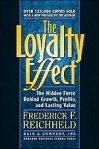
  8. Understanding your customers means that you can build loyalty – and loyal customers is the key to business LoyaltyEffectRevCoverprofitability.  If at all possible get hold of a copy of Prof. Fred Reichheld’s The Loyalty Effect.
  9. Use the relationships you build with your customers to seek their ideas as to what their future needs may be, how they would like to see your products and services evolve and who, and why,  they regard as your potential competitors.
  10. Finally, as in the first point, keep an open mind and never assume.  Remember the old ditty – if you assume you make an ‘ass’ out of ‘u’ and ‘me’.

By Paul Handover

Understanding your Market, Part Two

Market research for sales people.

Yesterday, I started a Post on undertaking market research, from a practical point of view. It continues.

To me, there are very significant advantages in being a small business and one of the most important benefits is that it is so much easier to really know what your customers want.  Here’s a fascinating extract (p.139-140) from Malcolm Gladwell’s book Outliers.

In 1889, Louis and Regina Borgenicht boarded an ocean liner in Hamburg bound for America.  Louis was from Galacia, in what was then Poland.  Regina was from a small town in Hungary.  They had been married only a few years and had one small child and a second on the way ……

….. They had enough money to last a few weeks, at best.

…..Louis and Regina found a tiny apartment on Eldridge Street, on Manhattan’s Lower East Side, for $8 a month.  Louis took to the streets, looking for work.  He saw peddlers and fruit sellers and sidewalks crammed with pushcarts.  The noise and activity and energy dwarfed what he had known in the Old World.  He was first overwhelmed, then invigorated.  He went to his sister’s fish store on Ludlow Street and persuaded her to give him a consignment of herring on credit.  He set up shop on the sidewalk with two barrels of fish ….

….. By the end of the week, he had cleared &8.  By the second week, $13.  Those were considerable sums.  But Louise and Regina could not see how selling herring on the street would lead to a constructive business…..

….The answer came to him after five long days of walking up and down the streets of Lower East Side, just a he was about to give up hope.  He was sitting on an overturned box, eating a late lunch of the sandwiches Regina had made for him.  It was clothes. Everywhere around hi, stores were opening – suits, dresses, overalls, shirts, skirts, blouses, trousers, all made and ready to be worn.  Coming from a world where clothing was sewn at home by hand or made to order by tailors, this was a revelation.

Borgenicht took out a small notebook.  Everywhere he went, he wrote down what people were wearing and what was for sale – menswear, women’s wear, children’s wear.  He wanted to find a ‘novel’ item, something that people would wear that was not being sold in the stores.  For four more days he walked the streets.  On the evening of the final day as he walked toward home, he saw a half dozen girls playing hopscotch.  One of the girls was wearing a tiny embroidered apron over her dress, cut low in the front with a tie in the back, and it struck him, suddenly, that in his previous days of relentlessly inventorying the clothing shops of the Lower East Side, he had never seen one of those aprons for sale.

This is such a wonderful example of what understanding your market is all about. Louise was sufficiently smart to know that selling herrings, while lucrative in the short term, was not the long-term answer. He was sufficiently patient to watch and not jump to conclusions until the answer was clear. He was sufficiently tough to keep at it until he had his answer.

Now let’s jump back to Riverford Organics. Here are the words of Guy Watson.

a cooking odyssey Monday 26th October 2009

As you may have guessed, I am a vegetable bore. Twenty five years ago when I sowed my first leek I was fairly well adjusted but now my wife reckons I can turn any conversation to growing, cooking or eating veg within seconds. The box scheme was founded on the invigorating but dangerous assumption that my obsession was, at least partially, shared by customers.

This year I set out on a cooking odyssey to understand how others use or don’t use our vegetables. I cooked in village halls, in my bus, on the beach, in tents in Wales, on stage at WOMAD [World of Music, Arts and Dance, Ed] but most of all in customers’ homes. The experience has been fascinating (for a veg bore), frustrating (you are all so different) and humbling (there is life after vegetables).

My abiding impression is that most of you do share an enthusiasm for our veg, but that we need to make it easier for you to incorporate them into often busy lives. According to our customer survey last year only 5% of you find it really easy to use your box and 32% struggle. However fresh and tasty, local and minimally packaged, fairly traded and sustainably grown those carrots and beans are, if you are struggling to use them we will lose you in the end. (My underlining)

Our mission for the coming months is to make life with a box easier. There will be a few minor changes like less clods of mud but mostly we want to do this by cooking with you; both virtually and in person. We plan to team up with around 100 like-minded professional cooks who are inspired by our veg and on a par with our chef, Jane Baxter, when it comes to cooking them. They will work part-time with us and our customers, inspiring, teaching, demonstrating, creating recipes. We plan to run initiatives including affordable cookery classes and demos in homes, workplaces and community venues; lunch clubs, supper clubs and cooking clubs and a recipe exchange for customers. We have already run some pilot events and now we really want to get going.

get involved

Would you like to improve your cooking, help others improve theirs or do you know a cook who might want to work with us? If you’d like to get involved, email riverfordcooks@riverford.co.uk with your name, contact details, postcode and what you are interested in and we’ll let you know what is going on in your area.

The underlined sentence is the key. Without this insight, Guy would have had no way of knowing what was influencing his sales figures. And if sales were continuing to grow then this potential loss of business would have remained deeply hidden from sight. Only getting out there and mixing it with your customers revealed this problem, potentially a serious problem.

Tomorrow the concluding part of this three-part Post in which we examine some very practical ways of listening to the market.

By Paul Handover

Understanding your Market, Part One

Market research for sales people.

John’s Post yesterday on Riverford Organics nudged me into writing this Post, something that has been in the back of my mind for ages.  My topic is understanding your customers or more properly described, understanding your market, because the word ‘market’ feels a better description of the objective: knowing why your present customers bought, what they like and dislike so you have a better idea of the buying intentions of your potential customers.

magnifying-glassThe term ‘Market Research’ is not a difficult or uncommon phrase (a Google search returns 132 million links!) but, in practice, it is one of those terms that is very tough to pin down as to what it means as a set of practical tasks.  Let’s try a few quotations from a Google search (this time only 6.6 million links!).

…. research that gathers and analyzes information about the moving of good or services from producer to consumer …
The systematic collection and evaluation of data regarding customer’s preferences for actual and potential products and services …
A study of consumer groups and business competition used to define a projected market.
The collection and analysis of data obtained from a sample of individuals or businesses relating to their characteristics, behaviour, attitudes …
…the activities undertaken by an organization to determine the nature of its customers and competitors, as well as the demand for its products or services along with the features that customers prefer in similar products or services. …

ad nauseum …

For something that is a critically important component of business strategy, such a wide variation in definitions is totally unacceptable.

Now it’s important that you know where I am coming from.  Since 1966, I have been working as a business-to-business salesman.  Since 1978, I have run my own companies but have still seen my only competence as that of a salesman.  (Technically I ‘retired’ in 2007 but still keep my hand in through mentoring and coaching.)

Cim_logoIn the early 80s, as my first company, Dataview Ltd, was growing rapidly, I became a chartered member of the Chartered Institute of Marketing. I thought that marketing was a skill I needed to know more of. But, to be frank, apart from a nice certificate and a glossy monthly magazine, it’s difficult to recall any life-changing experiences from that relationship.  Marketing seemed to be about medium to large businesses – not correct but that was the impression given.

Back to the theme of this Post. Read more about market research for sales people

Remarkable people update

Another quick look at Riverford Organics and a lesson for all.

Further to my post on Guy Watson of Riverford Organics, in the mini-series on remarkable people:

A couple of Saturdays ago (October 24), we had a great time out at Wash Farm, the home of Riverford Organics.

Our five year old son enjoys eating sweetcorn. Recently, having carried the weekly veg box from our doorstep to the sweetcornkitchen calling “Riverford coming through!”, he was then delighted to report: “there are three sweetcorns”, there having been two in previous weeks!

riverford 008On Saturday, he marched into a field of sweetcorn and, as if he had done it for years, went straight to a plant and, explaining what he was doing, tested the crop for size and ripeness and picked it by breaking it off like an expert. He then handed it to me and proceeded to pick many more of them. When I asked him how he knew what to do, all was revealed: “I saw it on the telly!”.

As luck would have it, I encountered Guy Watson at the event and it was great to shake his hand and offer a few words of congratulation on what he has done. Of course, he has no idea who I am!

Their customer service is great; and now they are embarking on more market research to understand better how their customers use their products! [See the relevant edition of their newsletter here!] [The subject of a Post on Market Research coming out soon. Ed.]

Although I am not an expert, I know enough to know that this is remarkable. To think about how customers are using the product, to measure it, to go into customers homes and find out what they are really doing with your products: this is at the pinnacle of good customer research!

No doubt there are others, but I have only ever heard of one other company who paid so much attention to customers in their homes. It was Intuit, the highly regarded US software vendor which, for decades, has consistently beaten Microsoft at providing accounting software. Their representatives would wait in a shop for a customer to buy their product and then request permission to travel with them to their home to record exactly what experience they had with installing and using it!

Final report from the day at Riverford: the event on Saturday was “Pumpkin Day”, its primary purpose being to buy (and have carved) your pumpkin for Hallowe’en. There was a competition to guess the weight of a (largish) pumpkin; I guessed by comparative lifting of the pumpkin and of said five-year-old son, and based my estimate on information from his mother about his most recent weight! Guess what? I have just heard that I won! So a case of (organic, of course) red wine is now expected to materialise alongside this weeks box of vegetables!

By John Lewis

P.S. The Riverford Blog is a good read

U.S. Cash for Clunkers Program a Failure?

Is there evidence that this US programme has been a failure?

I was asked by a reader recently about my claim that the Cash for Clunkers program was a failure.  He said, and I quote, “And your proof is…?”  Here is my response:

My conclusion that the Cash for Clunkers program was a failure is based on three factors.

One, it did not have the intended consequences on the environment; for those folks who purchased a marginally more fuel efficient car now, rather than later, the added fuel efficiency was likely more than offset by the pollution generated by destroying the old car, and by the loss in additional fuel efficiency they would have enjoyed had they waited a year or two to replace their current vehicle with an even later, even more fuel efficient model year.

Two, the costs of the program, which are much greater than the $4,500 rebate, far exceed any benefits generated. Abrams and Parsons in the Economists’ Voice estimate that the costs of the program exceeded the benefits by about $2000 per car.  A recent study by Edmunds.com put the cost of the program at $24,000 per car  once the cars purchases that would have occurred during that period anyway are deducted (http://content.usatoday.com/communities/driveon/post/2009/10/620000657/1). I think the real cost is somewhere in-between, but closer to $24,000 than $2,000. 

The true costs of the program include but are not limited to the additional paperwork and private and public workers needed to administer the program, the interest costs to dealerships of financing the rebate program while awaiting the government checks (some less capitalized dealerships actually went out of business because of the program), the costs of destroying the old vehicles, and the cost of lives lost and injuries sustained in accidents in smaller, less safe but more fuel efficient cars, just to mention a few.

Last, this “injection” into the economy — which, in reality, is the blatant substitution of private consumption choices with public policy, and an affront to our economic freedom — costs the economy untold sums by putting off the inevitable failure of automotive companies that fail to produce cars the population values sufficiently to keep the auto companies in business without being propped up by the government.

Case in point: GM’s plunge of 45% and Chrysler’s fall of 43% in the months following the rebate program; Honda and Toyota also reported double-digit slides, while Kia and Hyundai had double-digit increases.

New car sales fell in September as the predicted post-“cash for clunkers” slump dragged the U.S. market down to its lowest levels in seven months.

I wish it weren’t so, but I’m afraid that good business is not the strong suit of our policymakers.

By Sherry Jarrell

Sherry responds to John

A Post published today by John Lewis raises the question of why not consumer protection for financial ‘products.

Sherry’s reply.

A great question, John: why do we not have a threshold level of safety for financial products, as we do with cars and toys?

Well, for one, if a financial product “fails,” the consequence is purely financial – it is not injury or death.  A financial product simply represents a financial investment today in exchange for financial payoffs tomorrow.

The less certain those payoffs, the higher the minimum required return on that investment. If the returns were certified or regulated in some way, risk would be reduced, and the required return would also fall.  Limiting risk exposure throws out the baby with the bath water:  less risk means lower returns on the investment.  Look at the real returns to U.S. Treasury Bills – they are almost zero!

There is a role for regulation in financial products and that is for disclosure of relevant information.  When we invest in a financial product, we are putting our money at risk in exchange for future expected cash flows.  We forecast those cash flows on the basis of material information about the firm, its products or services, and its management and strategy.

Even here there is a fine line between the right to know and proprietary information that enables a firm to invest its own funds in the hope of generating a large return in exchange for taking risks.

The Securities and Exchange Commission’s requirement for a 20-day window between the time a bidder makes a tender offer for a target and the time the target shareholders must decide whether to accept the offer or not is an example of a regulation that crosses the line, in my view.

In a misguided attempt to protect shareholders from fly-by-night tender offers, the SEC has created an environment where multiple competing bids can arise, driving down the return to the original bidder and limiting the incentives for firms to productively redeploy assets through tender offers.

By Sherry Jarrell

Zombie Stocks: Not for the faint of heart

Prof. Sherry Jarrell in the news

A news release by Wake Forest University has been picked up by at least one publication. It reads as follows:
Two weeks before Halloween, the Securities and Exchange Commission again warned investors against buying shares of bankrupt companies, but like those creatures in horror films that rise from the dead, so-called “zombie” stocks–shares of companies that failed during the financial crisis–are still on the march.zombies

Take, for example, Washington Mutual and Lehman Brothers. At the end of last year, their stocks traded at 2 cents and 3 cents per share, respectively. With no future earnings in sight, shares of Washington Mutual recently traded around 20 cents, and Lehman Brothers shares have hovered around 15 cents–spectacular gains fueled by what many consider nothing more than gambling.

Critics have called on the SEC to halt the trading of such stocks to protect unsophisticated investors who might be lured into unwise trades. But Professor Sherry Jarrell, who teaches a graduate-level class on investments and portfolio management in the Wake Forest University Schools of Business, disagrees.

While Jarrell doesn’t think investing in zombie stocks is a sure-fire profitable strategy, she doesn’t consider it gambling either, because there is an expectation of gain. Jarrell also doesn’t believe those who are trading zombie stocks are ignorant or unsophisticated. Jarrell says:

To outlaw these stocks means that you’ve truncated an avenue for people to express their different risk preferences. If someone wants to go on that haunted trail, let them. It’s not like they’re taking advantage of people on the other side of the trade.

Washington Mutual and Lehman Brothers lost their standing to be listed on stock exchanges, so traders have to keep up with prices through a quotation service known as the Over the Counter Bulletin Board, which unsophisticated investors are unlikely to access. Other troubled companies, such as Fannie Mae, Freddie Mac and AIG, whose shares are widely considered to be zombie stocks, are still listed on major exchanges. The federal government’s own backing of those companies weakens any argument against allowing individuals to invest in them, if they dare.

One project Jarrell assigns her students is to identify a publicly traded stock they believe the market has significantly mispriced. By definition, she says, the exercise requires the same calculation made by traders of zombie stocks–reaching a different conclusion about a stock’s future cash flows and risks than that of the market.

Jarrell points out that all investments carry a degree of risk proportional to potential returns, and investors have varying tolerances for risk. Some hide from risk; others seek it out.

She recalls a study some years ago that found striking similarities in the blood chemistry of day traders on Wall Street and jet fighter pilots. “It turns out they need a certain amount of danger to feel normal,” Jarrell says. “They seek risk in order to feel comfortable.”

By Sherry Jarrell