Just to try to help put stock market swings into perspective,consider this:
the 347.8 point fall in the Dow Jones Industrial Average last week, from 10868.12 at the start of the trading day on Thursday, May 6, 2010 to 10520.32 at the close of trading, can be COMPLETELY explained by an increase in the perceived cost of capital from 12% to 12.23%.
do the math. Using the constant dividend growth model, a very simplified model of the market value of equity, or Market Value = Current Dividend/(cost of equity capital – dividend growth rate), and assuming a long-term average cost of U.S. equity capital of 12% and average growth rate of 5%, we find that the opening level of 10868.12 = 760.77/(.12 -.05), and the closing level of 10520.32= 760.77/(.1223 -.05).
I think it is entirely possible that the chaos in Greece and surrounding nations, and the interconnections between worldwide supplies of liquidity and financial capital, that an increase in the perceived risk and uncertainty of the returns to equity from 12% per year to 12.23% per year makes perfect sense.
The market’s are working. Market participants, from the individual investor using on-line trading at 2:00 in the morning from their living room to the most sophisticated computerized large-scale institutional trader, understands that a borrower’s ability to pay back its investors depends on the real productivity and growth of private industry, whether the borrower is a company or a country.
Came across a relatively new Blog with the title The Fourteenth Banker. Caught my eye because of the similarity to the book written by Simon Johnson and James Kwak of Baseline Scenario fame. Here’s an extract from the ‘About’ piece of this new Blog.
In response to the comments of folks in the Congress and oversight regimes, I have created this blog as a home for bankers who need to speak out and do not have a central clearinghouse or a safe place to do so. Big banks now treat their employees like property, bought and owned. Typically employees must subject themselves to all sorts of potential sanctions, forfeitures of compensation, clawbacks and even lawsuits if they speak in ways we often have thought were protected speech. I am not talking about revealing confidential customer or proprietary information, I am talking about simply commenting on a company, management philosophy, making general observations or raising concerns. It makes one appreciate unions even if not historically supportive of unions. At least management and labor can have a debate. Not so in today’s large banks. Gag orders are written in the most intimidating way, included in Codes of Ethics, attached to incentive plans, posted on the company home pages. We should ask ourselves, what is the big secret?
Do support the Blog by calling by. Here’s a taste of what they are writing about:
This can only be called what it is. Delusion. Delusion about self, society, morality, values and anything else you can name. These are symptoms of a grave illness which is too common among those in power. In fact, the illness may be the requisite to power.
Some videos are just fun to watch. Whether you are interested in aviation or not, this blast through the making of an aircraft by Boeing makes it all look quite easy really:
There are so many excellent Blogs out there that it is difficult at times to keep track of key articles. But here’s one reproduced from Washington’s Blog. It was published on the 30th April and sets out some powerful reasons why the so-called Too Big To Fail banks should, and must, be broken up. It is reproduced with permission. Ed.
But the giant banks are not only dangerous because they skew the political system. There are five economic arguments against the mega-banks as well.
Impaired Competition
Fortune pointed out last February that the only reason that smaller banks haven’t been able to expand and thrive is that the too-big-to-fails have decreased competition:
Growth for the nation’s smaller banks represents a reversal of trends from the last twenty years, when the biggest banks got much bigger and many of the smallest players were gobbled up or driven under…
As big banks struggle to find a way forward and rising loan losses threaten to punish poorly run banks of all sizes, smaller but well capitalized institutions have a long-awaited chance to expand.
So the very size of the giants squashes competition.
Less Loans, More Bonuses
Small banks have been lending much more than the big boys.
The Bank for International Settlements (BIS) is often called the “central banks’ central bank”, as it coordinates transactions between central banks.
BIS points out in a new report that the bank rescue packages have transferred significant risks onto government balance sheets, which is reflected in the corresponding widening of sovereign credit default swaps:
The scope and magnitude of the bank rescue packages also meant that significant risks had been transferred onto government balance sheets. This was particularly apparent in the market for CDS referencing sovereigns involved either in large individual bank rescues or in broad-based support packages for the financial sector, including the United States. While such CDS were thinly traded prior to the announced rescue packages, spreads widened suddenly on increased demand for credit protection, while corresponding financial sector spreads tightened.
In other words, by assuming huge portions of the risk from banks trading in toxic derivatives, and by spending trillions that they don’t have, central banks have put their countries at risk from default.
By failing to break up the giant banks, the government is guaranteeing that they will take crazily risky bets again and again and again.
We are no longer wealthy enough to keep bailing out the bloated banks. We have serious debt problems. See this, this and this.
(Anyone who claims that Chris Dodd’s proposed “reform” legislation will prevent banks from getting bailed out again is wrong. If the giant banks aren’t broken up now – when they are threatening to take down the world economy – they won’t be broken up next time they become insolvent, either. And see this.)
Unfair Competition and Manipulation of Markets
Moreover, Richard Alford – former New York Fed economist, trading floor economist and strategist – recently showed that banks that get too big benefit from “information asymmetry” which disrupts the free market.
Nobel prize winning economist Joseph Stiglitz noted in September that giants like Goldman are using their size to manipulate the market:
“The main problem that Goldman raises is a question of size: ‘too big to fail.’ In some markets, they have a significant fraction of trades. Why is that important? They trade both on their proprietary desk and on behalf of customers. When you do that and you have a significant fraction of all trades, you have a lot of information.”
Further, he says, “That raises the potential of conflicts of interest, problems of front-running, using that inside information for your proprietary desk. And that’s why the Volcker report came out and said that we need to restrict the kinds of activity that these large institutions have. If you’re going to trade on behalf of others, if you’re going to be a commercial bank, you can’t engage in certain kinds of risk-taking behavior.”
The giants (especially Goldman Sachs) have also used high-frequency program trading which not only distorted the markets – making up more than 70% of stock trades – but which also let the program trading giants take a sneak peak at what the real (aka “human”) traders are buying and selling, and then trade on the insider information. See this, this, this, this and this. (This is frontrunning, which is illegal; but it is a lot bigger than garden variety frontrunning, because the program traders are not only trading based on inside knowledge of what their own clients are doing, they are also trading based on knowledge of what all other traders are doing).
Goldman also admitted that its proprietary trading program can “manipulate the markets in unfair ways”. The giant banks have also allegedly used their Counterparty Risk Management Policy Group (CRMPG) to exchange secret information and formulate coordinated mutually beneficial actions, all with the government’s blessings.
Again, size matters. If a bunch of small banks did this, manipulation by numerous small players would tend to cancel each other out. But with a handful of giants doing it, it can manipulate the entire economy in ways which are not good for the American citizen.
A suit was filed last week in the US against Goldman Sachs by the US government’s financial watchdog, the Securities and Exchange Commission.
GS is an example of all that is morally and practically wrong with capitalism. This is an obscenely-rich company whose ludicrously-rewarded executives do not actually do anything that I would describe as “work”. Their activities do not in
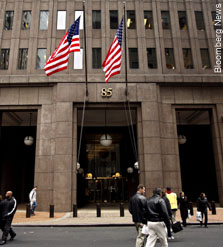
Goldman Sachs HQ
my estimation benefit the world in any meaningful way. They are parasites which feed off the backs of real workers (nurses, police, teachers, firemen, bridge-builders, electricians and so on) and – as in the recent shambles – end up practically killing the host.
There is a good case for forcibly putting them out of business and completely reorganising financial services, with the accent on SERVICES. A functioning society needs investment and jobs. Banks should be there to look after money and provide investment to companies, not shuffle around paper to make themselves obscenely-rich.
GS and others apparently have some sort of electronic system that operates automatically and instantaneously to market movements, allowing them to make vast sums by doing no work. NO WONDER bright graduates seek to join such leech-like firms instead of becoming teachers, researchers or otherwise seeking to do something useful for society apart from themselves.
If they are guilty, I hope we see the company broken up and put out of business. The criminal deception is no different from that at Enron, where people pretending (with already vast salaries) to serve the public were conniving to do criminal damage to put up the cost of their product. They were given a severe penalty, and it should be the same for any white-collar worker if found guilty. I don’t have much hope for the eventual down-to-earth-sizing of GS (they are well-connected and can afford good lawyers …), but I am not the only person angry about all this greed. Get past the cosy confines of Wall Street bars into the real America and there are plenty more who feel the same way.
We can carry on doing the same old things!
Along the way, we can improve, sell more, and cut costs.
But in end, sooner or later, we need to do something different.
That is why we innovate.
Now we know “how?”
Nowadays, everyone is talking about innovation!
Many things seem mysterious for a long time, and then we bring them under control.
It happened in “sales”, then in “quality”, now it is the turn of “innovation”.
In the past, a few people knew that they could manage innovation; now everyone knows.
There are processes for managing innovation using “ideation”, “co-creation” and, even, “open innovation”.
That is how we innovate.
“Son, your ego’s writing checks your body can’t cash.”
Well, this may be old hat for specialists but it surprised me. Is the same true for Britain? In either case, as Friedman says, it suggests we should explore more forcefully the ways we could aid business startups.
I always find Thomas Friedman excellent value for the time invested in reading him! See here:
“Here’s my fun fact for the day, provided courtesy of Robert Litan, who directs research at the Kauffman Foundation, which specializes in promoting innovation in America: “Between 1980 and 2005, virtually all net new jobs created in the U.S. were created by firms that were 5 years old or less,” said Litan. ‘That is about 40 million jobs. That means the established firms created no new net jobs during that period.’”
And if you want to know where the opening quote comes from, read the Friedman article!
This is the concluding part four of a multipart series on the factors that drive U.S. and foreign bond prices and yields.
[Part One is here, Part Two here, Part Three here Ed.]
Bond’s in a weak or faltering economy will generate a lower return to lenders than bonds in a strong economy, absent inflation or any other material changes in the purchasing power of the currency. Weak demand for goods and services means weak demand for financial capital which means low rates of return on financial capital.
The policies of the government can increase the borrowing costs of private industry. Fiscal policy that increases taxes reduces the profitability of projects and undermines the ability of companies to pay coupons and repay principal. Monetary policy that increases the money supply may lead to inflation, which also increases the cost of borrowing and reduces economic activity.
Lastly, and of the greatest concern of late, is the level of borrowing by the U.S. government. Debt levels are at record highs, with no relief in sight. The AAA rating of U.S. debt is reportedly in jeopardy (Chicago Tribune editorial).
Moody's Corporate Logo
Both existing and new lenders worry about the ability of the U.S. government to repay. Yes, the can simply roll over existing debt by raising taxes or creating money to retire old debt and replace it with new, but the interest rate required by new lenders goes up as the ability of the private economy to sustain tax revenues falls and the risk of inflation rises (Moody’s explains U.S. bond ratings).
Both factors are in play now: an anemic economy with little hope that this administration will undertake policies that support business, and a ballooning money supply and weak dollar that undermine the purchasing power of the returns to lenders. The returns to U.S. debt may still be healthy relative to those one can earn in other countries, but the spread is shrinking. The private economy remains fundamentally strong, thanks to the work ethic of the American people and the profit motive of the capitalistic system, but the policies of the U.S. government are straining those resources.
The yield on a bond is made up of several components. Some think of the return on a bond as the sum of the risk-free rate of interest (how impatient we are to get our money back, or how much we need to be compensated to delay consumption) and a risk premium (the additional return we require to compensate us for the risk of default, the risk the bond will be called, the risk of inflation reducing the purchase power of the repaid dollars, and many other sources of risk as outlined in the most recent article in this series).
Another useful way of thinking of the return on a bond is as the sum of the real rate of interest and the expected rate of inflation. But what is the real rate of interest? We never actually observe that rate, unless of course the inflation rate is zero and then the real rate is just the nominal rate set in the market.
It is useful, however, to think about what drives the ability of a company to generate a real rate of return to lenders, for this is essence of capitalism and risk-taking and creating economic value and growth.
Bond traders
A firm’s asset cash flows support the real returns to its lenders – all kinds of lenders (debt, equity, hybrid, and derivative security holders). A firm will want to borrow more, and is willing to pay a higher interest rate for those funds, the more profitable are the projects they want to undertake, or the greater the number of profitable projects. Profitability, in turn, is determined by the relationship between demand and supply: how much does society value a good or service, and how many resources does the business use in producing the good or service. As the marginal productivity or efficiency of a business goes up, it can afford to profitably fund more projects. So the core driver of the real return on bonds is the strength of the underlying economic activity of the private economy.
Or, when viewed from the investor’s side, note that an investor will purchase a bond, or lend money to a company, if they expect to earn a return sufficient to compensate them, first, for delaying consumption and, second, for bearing the various sources of risk or uncertainty associated with the bond’s cash flows or return.
The official unemployment rate of the U.S. economy remains at 9.7%, and the underemployment rate increased to 16.9%. These numbers represent a real tragedy for many Americans.
While the White House tries to celebrate the creation of 162,000 new jobs last month, at least 48,000 of these new jobs are government jobs, specifically temporary census workers, who are doing unproductive work and are being paid with taxes collected from the rest of the private economy.
Unemployment
Employment also increased in temporary help services and healthcare, but continued to decline in financial activities and in information, which is interesting given the recent comments by President Obama that the government takeover of the student loan program tucked into the health care bill “took $68 billion from banks and financial institutions.”(Obama’s April 1 remarks) That’s a lot of jobs, Mr. President.
Seems like there is more concrete evidence that, rather than creating jobs, the President’s policies are costing the economy jobs.




 Learning from Dogs