Category: Business

The end of an era, part one.

A review of David Kauder’s recently published book, The Greatest Crash.

Details of the availability of the book are included at the end of both parts of my review, part two is published tomorrow.

Extracts from the book included are with grateful thanks to Sparkling Books.

Personal introduction.

Back in the late 90s, when I was living in England, I attempted to bolster my self-employed income by investing and trading in equities. It was a frustrating game, game being the right word! One day I was lamenting this to a close friend and he gave me the name of David Kauders at Kauders Portfolio Management and suggested I might like to contact him.

I followed my friend’s recommendation and met with David. What he outlined at that meeting all those years ago was mind-blowing, no other way of putting it. Essentially, David predicted a financial and economic crisis of huge proportions. He convinced me of the likelihood of that crisis and in November 2001 I became a fee-paying client. As the world now knows that prediction came to fruition. My anticipated residency in the USA meant continuing to be a client was not possible, and I ceased being a client of Kauders Portfolio Management in June 2010.

Thus not only am I deeply indebted to my friend for referring me to David but also unable to write this review from an unprejudiced point of view.

The Greatest Crash

The book, released in paperback in England in October 2011, published by Sparkling Books, is subtitled ‘How contradictory policies are sinking the global economy‘. Frankly, that subtitle doesn’t do much for me. A clearer message that comes from the book is this: the economic world has reached a ‘systems limit’. Indeed, the term systems limit is used widely throughout the book.

In his introduction to the book, Professor D. R. Myddelton, Chairman of the Institute of Economic Affairs, writes,

Adam Smith said ‘There’s a deal of ruin in a nation’, and it would be a mistake to despair. But one of the things we need now is new thinking on the fundamentals. That is what David Kauders provides in his book ‘The Greatest Crash’.

Without doubt, David achieves that.

Starting with the first sentence, David sets out the core problem;

This book argues that it is impossible to expand the financial system much further.

expanding this a few paragraphs later,

This is the financial system limit: lack of new borrowing plus excessive weight of debt obligations from past borrowing combine to slow economies down. This is the barrier whichever way policy makers turn. It is like the lid on a boiling kettle. Enough steam can lift it for a while but it always snaps back into place. The financial system limit is a roadblock preventing growth.

A few pages later in this opening chapter ‘The roadblock preventing growth‘ this limit is explained thus,

Policy contradictions also show us that the financial system has reached a roadblock. The glaring conflict between bailout and austerity is at the core. Each bailout or stimulus requires creation of more credit, leading to false financial speculation, and for a short while markets recover their poise. The threat of inflation returns. Later, bad debts rise, the markets tumble again and a new crisis emerges. Austerity, the alternative policy, cuts spending thereby cutting the immediate level of economic activity and bringing economic decline more quickly than the stimulus alternative. Whichever way they turn, the authorities are damned.

In the next chapter, ‘Evolution by trial and error‘, David writes about economic cycles and reminds his readers that the long economic cycle is often “beyond the practical experiences of our working lifetimes“.  Then later suggesting that because we have seen the greatest period of inflation ever since the end of World War Two, ergo “the unwelcome lesson from history is that the greatest deflation should follow.

In Chapter 4, ‘An Era of Wishful Thinking‘, the spotlight is put on the horrific policy errors that have been made for decades, try these three examples (there is a longer list in the book),

  • Policy makers believed that debt could expand indefinitely, at no cost.
  • Nobody realised that interest rate rises would make existing borrowing unaffordable and cause a wave of defaults.
  • The world was swamped with so many detailed requirements and standards that nobody could understand how they all fitted together. It was assumed that ‘transparency’, i.e. extensive detail, would solve the inability to comprehend how the parts made the whole.

Part Two of the review, continuing with Chapter 5 is tomorrow.

Want to buy The Greatest Crash?  The ebook was published in October worldwide, the  paperback published in the UK on the 1st November UK, the hardcover being released any day now in the UK.  For North America both the paperback and hardcover versions are being published on 1st February, 2012.

Full details from the Sparkling Books webpage here.

Copyright © 2011 Paul Handover

A small step

Fabulous news from The President’s Office re the Keystone XL pipeline.

On the 27th October, I introduced an article about the pipeline, thus,

“Have the courage to say no. Have the courage to face the truth.  Do the right thing because it is right.  These are the magic keys to living your life with integrity.”

The above is attributed to W. Clement Stone, a businessman, philanthropist and author who died in 2002, aged 100.  It seemed an appropriate quotation with which to introduce a recent article by Bill McKibben, on the Grist blog, about the proposed Keystone XL pipeline.

A short time ago (Thursday) I received the following from Bill McKibben, 350.org.

Dear Friends,

Um, we won. You won.

Not completely. The President didn’t outright reject the Keystone XL pipeline permit. My particular fantasy — that he would invite the 1253 people arrested on his doorstep in August inside the gates for a victory picnic by the vegetable garden — didn’t materialize.

But a few minutes ago the President sent the pipeline back to the State Department for a thorough re-review, which most analysts are saying will effectively kill the project. The president explicitly noted climate change, along with the pipeline route, as one of the factors that a new review would need to assess. There’s no way, with an honest review, that a pipeline that helps speed the tapping of the world’s second-largest pool of carbon can pass environmental muster.

And he has made clear that the environmental assessment won’t be carried out by cronies of the pipeline company — that it will be an expert and independent assessment. We will watch that process like hawks, making sure that it doesn’t succumb to more cronyism. Perhaps this effort will go some tiny way towards cleaning up the Washington culture of corporate dominance that came so dramatically to light here in emails and lobbyist disclosure forms.

It’s important to understand how unlikely this victory is. Six months ago, almost no one outside the pipeline route even knew about Keystone XL. One month ago, a secret poll of “energy insiders” by the National Journal found that “virtually all” expected easy approval of the pipeline by year’s end. As late as last week the CBC reported that Transcanada was moving huge quantities of pipe across the border and seizing land by eminent domain, certain that its permit would be granted. A done deal has come spectacularly undone.

Our movement spoke loudly about climate change and the President responded. There have been few even partial victories about global warming in recent years so that makes this an important day. We need to let the president and oil companies know that we’re ready to take action should they try to push this pipeline through in a couple of years. There’s a pledge to take bold action against the pipeline up on our site, and I’ll be keeping your names an emails safely stored away so that you’ll be the first to know about anything we need to do down the road.

Please sign the pledge here.

The President deserves thanks for making this call — it’s not easy in the face of the fossil fuel industry and its endless reserves of cash. The deepest thanks, however, go to you: to indigenous peoples who began the fight, to the folks in Nebraska who rallied so fiercely, to the scientists who explained the stakes, to the environmental groups who joined with passionate common purpose, to the campuses that lit up with activity, to the faith leaders that raised a moral cry, to the labor leaders who recognized where our economic future lies, to the Occupy movement that helped galvanize revulsion at insider dealing, and most of all to the people in every state and province who built the movement that made this decision inevitable.

Our fight, of course, is barely begun. Some in our movement will say that this decision is just politics as usual: that the President wants us off the streets — and off his front lawn — until after the election, at which point the administration can approve the pipeline, alienating its supporters without electoral consequence. The president should know that If this pipeline proposal somehow reemerges from the review process we will use every tool at our disposal to keep it from ever being built; if there’s a lesson of the last few months, both in our work and in the Occupy encampments around the world, it’s that sometimes we have to put our bodies on the line.

In the meantime, since federal action will be in abeyance for a long stretch, we need to figure out how best to support our Canadian brothers and sisters, who are effectively battling against proposed pipelines west from the tar sands to the Pacific. And we need to broaden our work to take on all the forms of ‘extreme energy’ now coming to the fore: mountaintop removal coal mining, deepsea oil drilling, fracking for gas and oil. We’ll keep sending you updates; you keep letting us know what we need to do next.

Last week, scientists announced that the planet had poured a record amount of CO2 into the atmosphere last year; that’s a sign of how desperate our battle is. But we take courage from today’s White House announcement; it gives us some clues about how to fight going forward.

And I simply can’t say thank you enough. I know, because of my own weariness, how hard so many of you have worked. It was good work, done in the right spirit, and it has secured an unlikely victory. You are the cause of that victory; you upended enormous odds.

I’m going to bed tired tonight. But I’ll get up in the morning ready for the next battle, more confident because I know you’re part of this fight too.

Onwards,

Bill McKibben for the 350.org Team

P.S. Victories need to be shared. Let’s make this one fly all over the web: share it on Twitter here and share it on Facebook here.


The potential for the USA!

A powerful ‘good news’ story.

I am republishing in full a recent report from the Earth Policy Institute.  It underlines how wringing our hands in the face of so much doom and gloom, while perfectly understandable, can hide the fact that mankind can and does change, frequently for the better.  This EPI report is a tad ‘dry’ but still a great read.  As an incentive, let me show you the final sentence, “If so, the United States could become a world leader in cutting carbon emissions and stabilizing climate.

Here’s the full paper.
NOVEMBER 02, 2011
U.S. Carbon Emissions Down 7 Percent in Four Years: Even Bigger Drops Coming
Lester R. Brown


Between 2007 and 2011, carbon emissions from coal use in the United States dropped 10 percent. During the same period, emissions from oil use dropped 11 percent. In contrast, carbon emissions from natural gas use increased by 6 percent. The net effect of these trends was that U.S. carbon emissions dropped 7 percent in four years. And this is only the beginning.

The initial fall in coal and oil use was triggered by the economic downturn, but now powerful new forces are reducing the use of both. For coal, the dominant force is the Beyond Coal campaign, an impressive national effort coordinated by the Sierra Club involving hundreds of local groups that oppose coal because of its effects on human health.

U.S. Energy-Related Carbon Dioxide Emissions, 1950-2010, with Projection for 2011

In the first phase, the campaign actively opposed the building of new coal-fired power plants. This hugely successful initiative, which led to a near de facto moratorium on new coal plants, was powered by Americans’ dislike of coal. An Opinion Research Corporation poll found only 3 percent preferred coal as their electricity source—which is no surprise. Coal plant emissions are a leading cause of respiratory illnesses (such as asthma in children) and mercury contamination. Coal burning causes 13,200 American deaths each year, a loss of life that exceeds U.S. combat losses in 10 years of war in Afghanistan and Iraq.

The campaign’s second phase is dedicated to closing existing coal plants. Of the U.S. total of 492 coal-fired power plants, 68 are already slated to close. With current and forthcoming U.S. Environmental Protection Agency air quality regulations on emissions of mercury, sulfur, and ozone precursors requiring costly retrofits, many more of the older, dirtier plants will be closed

In August, the American Economic Review—the country’s most prestigious economics journal—published an article that can only be described as an epitaph for the coal industry. The authors conclude that the economic damage caused by air pollutants from coal burning exceeds the value of the electricity produced by coal-fired power plants. Coal fails the cost-benefit analysis even before the costs of climate change are tallied.

In July 2011, New York Mayor Michael Bloomberg announced a grant of $50 million to the Beyond Coal campaign. It is one thing when Michael Brune, head of the Sierra Club, says that coal has to go, but quite another when Michael Bloomberg, one of the most successful businessmen of his generation, says so.

The move to close coal plants comes at a time when electricity use for lighting will be falling fast as old-fashioned incandescent light bulbs are phased out. In compliance with the Energy Independence and Security Act of 2007, by January 2012 there will be no 100-watt incandescent light bulbs on store shelves. By January 2014, the 75-watt, 60-watt, and 40-watt incandescents will also disappear from shelves. As inefficient incandescents are replaced by compact fluorescents and LEDs, electricity use for lighting can drop by 80 percent. And much of the switch will occur within a few years.

The U.S. Department of Energy projects that residential electricity use per person will drop by 5 percent during this decade as light bulbs are replaced and as more-efficient refrigerators, water heaters, television sets, and other household appliances come to market.

Even as coal plants are closing, the use of wind, solar, and geothermally generated electricity is growing fast. Over the last four years, more than 400 wind farms—with a total generating capacity of 27,000 megawatts—have come online, enough to supply 8 million homes with electricity. (See data.) Nearly 300,000 megawatts of proposed wind projects are in the pipeline awaiting access to the grid.

Cumulative Installed Wind Power Capacity in the United States, 1980-2011

Texas, long the leading oil-producing state, is now the leading generator of electricity from wind. When the transmission lines linking the rich wind resources of west Texas and the Texas panhandle to the large cities in central and eastern Texas are completed, wind electric generation in the state will jump dramatically.

In installed wind-generating capacity, Texas is followed by Iowa, California, Minnesota, and Illinois. In the share of electricity generation in the state coming from wind, Iowa leads at 20 percent.

With electricity generated by solar panels, the United States has some 22,000 megawatts of utility-scale projects in the pipeline. And this does not include residential installations.

Closing coal plants also cuts oil use. With coal use falling, the near 40 percent of freight rail diesel fuel that is used to move coal from mines to power plants will also drop.

In fact, oil use has fallen fast in the United States over the last four years, thus reversing another long-term trend of rising consumption. The reasons for this include a shrinkage in the size of the national fleet, the rising fuel efficiency of new cars, and a reduction in the miles driven per vehicle.

Fleet size peaked at 250 million cars in 2008 just as the number of cars being scrapped eclipsed sales of new cars. Aside from economic conditions, car sales are down because many young people today are much less automobile-oriented than their parents.

In addition, the fuel efficiency of new cars, already rising, will soon increase sharply. The most recent efficiency standards mandate that new cars sold in 2025 use only half as much fuel as those sold in 2010. Thus with each passing year, the U.S. car fleet becomes more fuel-efficient, using less gasoline.

Miles driven per car are declining because of higher gasoline prices, the continuing recession, and the shift to public transit and bicycles. Bicycles are replacing cars as cities create cycling infrastructure by building bike paths, creating dedicated bike lanes, and installing sidewalk parking racks. Many U.S. cities, including Washington, D.C., Chicago, and New York, are introducing bike-sharing programs.

Furthermore, when people retire and no longer commute, miles driven drop by a third to a half. With so many baby boomers now retiring, this too will lower gasoline use.

As plug-in hybrid and all-electric cars come to market, electricity will replace gasoline. Ananalysis by Professor Michael McElroy of Harvard indicates that running a car on wind-generated electricity could cost the equivalent of 80-cent-a-gallon gasoline.

With emissions from coal burning heading for a free fall as plants are closed, and those from oil use also falling fast—both are falling faster than emissions from natural gas are ramping up—U.S. carbon emissions are falling.

We are now looking at a situation where the 7 percent decline in carbon emissions since the 2007 peak could expand to 20 percent by 2020, and possibly even to 30 percent. If so, the United States could become a world leader in cutting carbon emissions and stabilizing climate.

Lester R. Brown is president of the Earth Policy Institute and author of World on the Edge.

Copyright © 2011 Earth Policy Institute
The Keystone XL pipeline

“Have the courage to say no. Have the courage to face the truth.  Do the right thing because it is right.  These are the magic keys to living your life with integrity.”

The above is attributed to W. Clement Stone, a businessman, philanthropist and author who died in 2002, aged 100.  It seemed an appropriate quotation with which to introduce a recent article by Bill McKibben, on the Grist blog, about the proposed Keystone XL pipeline.

Bill McKibben

Keystone pipeline’s last defense: Cold, hard cash

What do you do if you’ve lost an argument?

Say you really really want to build a big pipeline from the tar sands of Alberta so that you can sell your bitumen to the world

But 20 of the nation’s top scientists have written to the president to say it’s a terrible idea — and the planet’s leading climatologist says burning the tar sands would be “game over for the climate.” And nine recent winners of the Nobel Peace Prize have condemned the plan. And Robert Redford has just made a video explaining why the plan is an attack on the nation’s heartland. Then, if you’re a poor forlorn oil industry feeling unloved and under assault, what do you do?

There’s really only one answer: Flash your wad.

As we get to the final chapters of the Keystone pipeline saga (the president has said he’ll make his decision by year’s end), money’s the only argument these guys have left.

They managed to buy a favorable environmental review from the U.S. State Department, which helpfully outsourced the job to a company that was a “major client” of TransCanada, the pipeline builder.

And yesterday, they proposed a $100 million “performance bond” to the state of Nebraska, whose Republican governor and senator have come out against the pipeline. The money is apparently designed to pay for damage to the Ogallala Aquifer if the pipeline starts to leak.

Meanwhile, when 33 Democratic representatives sent a letter to the White House demanding a rejection of the plan, lobbyists for TransCanada rounded up their own list of lawmakers from the president’s party to issue a rejoinder. But they only found 22. And what do you know — they included nine of the top 10 Democratic recipients of oil money in the House. On average the signatories received over 4.25 times more oil money than the average House Democrat in the 112th Congress. That would be 325 percent more. That would be how the game is played.

The other side — that is, scientists, Nobelists, and the kind of average people who went to jail in record numbers this summer to block the plan — doesn’t have that kind of money. We’ve had to figure out other currencies to work in: spirit, passion, creativity. We’ve spent our bodies, putting them on the line. The odds are still against us, but the odds are changing; we’re on a roll as we head toward Nov. 6, when we’ll ring the White House with people, exactly one year before the election. (You can sign up here.)

But every once in a while we get to play the money game too! While TransCanada was out there setting the $100 million price on the Ogallala Aquifer, this news story rolled across my screen. It described a big Democratic giver, Barbarina Heyerdahl. She gave 120 grand to Obama and the Democratic National Committee over the last three years, not to mention knocking on doors for the 2008 campaign. But she said Keystone is a bridge too far, that “she won’t be writing any more checks to Obama if he approves the carbon conduit that’s become the focus of the climate-change movement. ‘It’s a baseline issue,’ she says.”

I have no doubt that, even with Heyerdahl and other donors accounted for, the oil industry has all the money they need to win this fight. The Koch brothers are the third and fourth richest men in America, and they filed papers in Canada declaring their “direct and substantial” interest in the project. If money’s the only thing that matters, they’ll carry the day.

But if money’s the only thing that matters, we’re done for anyway. So we’ll keep using science and art and courage. And we’ll hope that Barack Obama hasn’t sold his soul. We’re going to find out in the next few weeks.

Bill McKibben is founder of 350.org and Schumann Distinguished Professor at Middlebury College in Vermont. He also serves on Grist’s Board of Directors.

Bill’s website may be found here.  Also, please PLEASE watch the video made by Robert Redford.  Only 3 mins 25 seconds long, the ink to the video is here.

Finally, a YouTube video from Tars and Action.

All that’s necessary for the forces of evil to win in the world is for enough good men to do nothing.” Edmund Burke

I must down to the seas again

History repeating itself in terms of the commercial sailing ship.

Tea clipper 'Cutty Sark'

Most Brits have heard of the tea clipper Cutty Sark.  As the Cutty Sark website explains,

Cutty Sark has travelled across the world, sailing under both the Red Ensign and the Portuguese flag, visiting every major port in the world through the course of her working life. In admiration of her beauty and in recognition of her fame, she was preserved for the nation by Captain Wilfred Dowman in 1922.

Since then, the old clipper has been berthed in Falmouth and Greenhithe, finally arriving at her current resting place in Greenwich in 1954.

And elsewhere on that website,

Cutty Sark matters because:
  • She is the epitome of the great age of sail.
  • She is the only surviving extreme clipper, and the only tea clipper still in existence.
  • Most of her hull fabric survives from her original construction and she is the best example of a merchant composite construction vessel.
  • She has captured the imagination of millions of people, 15 million of whom have come on board to learn the stories she has to tell.
  • She was preserved in Greenwich partly as a memorial to the men of the merchant navy, particularly those who lost their lives in both world wars.
  • She is one of the great sights of London.

I mention the Cutty Sark because it seems a historic connection with something very relevant to today’s world that was the subject of a recent item on Rob Hopkin’s Transition Culture blogsite.  In it Rob presents his first podcast, the topic being the sailing ship Tres Hombres, that is being used for commercial sea transport.  The link to the Transition Culture story is here, and the podcast follows, (just click on the link to listen to the fascinating 14 minutes audio story about the ship Tres Hombres.)

Tres Hombres podcastfinal

Sailing ship Tres Hombres

The first Transition podcast! A visit to the Tres Hombres, tasting a revolution in shipping

Last week I did a course with the Media Trust on how to make podcasts (highly recommended).  So, here, with some fanfare, is the first ‘Transition podcast’, I hope you like it.  If so, do embed it in other places.  It means I spent the time I would spend writing editing pieces of audio.  Let me know what you think.  So, the podcast is about a fascinating morning I spent visiting the sailing ship Tres Hombres which visited Brixham earlier this week.  It explores the potential of sail-powered shipping as the price of oil rises and the economy tightens.  It’s an exciting story.

Finally, let me close with a very well-known poem about sailing the big ships.

“Sea-Fever”

I must down to the seas again, to the lonely sea and the sky,
And all I ask is a tall ship and a star to steer her by,
And the wheel’s kick and the wind’s song and the white sail’s shaking,
And a grey mist on the sea’s face, and a grey dawn breaking.

I must down to the seas again, for the call of the running tide
Is a wild call and a clear call that may not be denied;
And all I ask is a windy day with the white clouds flying,
And the flung spray and the blown spume, and the sea-gulls crying.

I must down to the seas again, to the vagrant gypsy life,
To the gull’s way and the whale’s way where the wind’s like a whetted knife;
And all I ask is a merry yarn from a laughing fellow-rover
And quiet sleep and a sweet dream when the long trick’s over.

By John Masefield (1878-1967).
(English Poet Laureate, 1930-1967.)

The Sun to our Rescue

Possibly the start of the end of traditional means of generating electricity

A recent item by David Roberts on the Grist website/Blog caught my eye,

Solar is getting cheap fast—pay attention, Very Serious People

That was the headline to the opening, thus,

I hope everyone has read Kees Van Der Leun’s post about the rapidly falling cost of solar PV. I want to draw out one quick point that Kees leaves implicit.

He argues that PV will be the cheapest source of electricity for most of the world some time around 2018, and for the rest of the world soon after. That could be off by a few years in either direction. It depends on whether the cost curve for silicon solar cells continues as it has the past and, as Alan says in his comment, whether the cost curve for “balance of system” costs (steel, glass, installation, etc.) declines as well. Let’s say it could be off by five years either way. Let’s just assume it’s 2023 before solar PV crosses grid parity and becomes cheaper than coal.

The Kees Van Der Leun post, referred to, points out that,

For a long time, the holy grail of solar photovoltaics (PV) has been “grid parity,” the point at which it would be as cheap to generate one’s own solar electricity as it is to buy electricity from the grid. And that is indeed an important market milestone, being achieved now in many places around the world. But recently it has become clear that PV is set to go beyond grid parity and become the cheapest way to generate electricity.

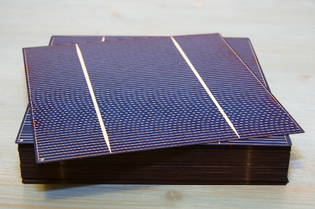
A hundred solar cells, good for 380 watts of solar PV power. Photo: Ariane van Dijk

Whenever I say this I encounter incredulity, even vehement opposition, from friends and foes of renewable energy alike. Apparently, knowledge of the rapid developments of the last few years has not been widely disseminated. But it’s happening, right under our noses! It is essential to understand this so that we can leverage it to rapidly switch to a global energy system fully based on renewable energy.

Working on solar PV energy at Ecofys since 1986, I have seen steady progression: efficiency goes up, cost goes down. But it was only on a 2004 visit to Q-Cells‘ solar cell factory in Thalheim, Germany, that it dawned on me that PV could become very cheap indeed. They gave me a stack of 100 silicon solar cells, each capable of producing 3.8 watts of power in full sunshine. I still have it in the office; it’s only an inch high!

That’s when I realized how little silicon was needed to supply the annual electricity consumption of an average European family (4,000 kWh). Under European solar radiation, it would take 1,400 cells, totaling less than 30 pounds of silicon.

Of course, you need to cover the cells with some glass and add a frame, a support structure, some cables, and an inverter. But the fact that 30 pounds of silicon, an amount that costs $700 to produce, is enough to generate a lifetime of household electricity baffled me. Over 25 years, the family would pay at least $25,000 for the same 100,000 kilowatt-hours (kWh) of electricity from fossil fuels — and its generation cost alone would total over $6,000!

Back to the David Roberts article,

He argues that PV will be the cheapest source of electricity for most of the world some time around 2018, and for the rest of the world soon after. That could be off by a few years in either direction. It depends on whether the cost curve for silicon solar cells continues as it has the past and, as Alan says in his comment, whether the cost curve for “balance of system” costs (steel, glass, installation, etc.) declines as well. Let’s say it could be off by five years either way. Let’s just assume it’s 2023 before solar PV crosses grid parity and becomes cheaper than coal.

Here’s the thing: 2023 isn’t that far off. It feels distant to us in a lot of ways. My kids will be out of college. Fifty versions of the iPhone will have come and gone. We might finally have the jetpacks we were promised.

But in terms of energy infrastructure, 12 years is nothing. It can take half that long or longer to permit and build big coal and nuclear plants, and they are meant to last a long-ass time. The Perry K Steam Plant, which serves downtown Indianapolis, was built in 1938. They didn’t have color TV then. Thirty-six coal plants in the U.S. were built before 1950. If a coal plant built today lasts that long, it will still be belching all over the atmosphere in 2072. My kids will be in their 60s.

This is also true of nuclear plants (the oldest is 42 years) and to a lesser extent natural-gas plants. It’s even true of transmission lines. These are large, long-term investments.

So if solar PV is going to be cheaper than coal in the next decade or so, that seems like the kind of thing utilities, regulators, investors, and political leaders would want to, I don’t know, talk over. Grapple with. Mull. It certainly seems relevant to the investment thesis for large, centralized power infrastructure. Yet it’s all but invisible in the elite U.S. energy conversation, outside of a few voices like FERC Chair Jon Wellinghoff. Very Serious People still see solar PV as an affectation, a kind of charity project.

Hope you are still with me, because this is really an incredibly positive message.  By the time children born today are becoming teenagers, the means of harnessing the sun to deliver clean energy cheaper than carbon-based and nuclear generation will be a reality.  In a little over a decade from now!

It is so easy to see doom and gloom wherever we look.  For good reasons; these are very difficult times as societies pull back from the greed and materialism of recent times to a better, sustainable relationship with our planet, the only one we have.  But technology and innovation are quietly creating the opportunities for a new future for humanity.

Let me finish with an email received recently from good friend, John H., up here in Payson, Arizona.

Greetings from a Mountain Top,

It has been another bright and peaceful day of Indian summer in the Ponderosa pine forests of the Arizona Rocky Mountains. Our annual state-wide church convention last weekend was a metaphorical breath of fresh air.  It was an opportunity to realize where we’ve been and consider how far we have to go.

From the early evening vantage point of an upper porch with a vista of forest, mountains and sky, it appears that we’re facing spiritual, environmental, human and economic bankruptcy caused by top down idolatry, arrogance and ignorance.

It’s deeply disturbing to watch our human heritage destroyed by a corporate-government-military-industrial-intelligence complex with a clear plan to control the world through oppression. This systemic machine continues to increase the drain on the earth’s severely depleted resources.

Our present energy sources can no longer sustain exponential human population growth.  The industrial use of fossil fuels is destroying the earth which sustains us.  It’s time for us to wake up and read the book of life.  It’s time to lighten the human footprint upon the earth while we still have a choice.  Nature doesn’t care about human ambition.

Peace and love, an old lamplighter

Steve Jobs, RIP

The man who put a ding in the universe!

Regular readers of Learning from Dogs know that my pattern is to write a single article each day with a focus on something light and airy over the week-end.  But I’m making an exception this Sunday, for two reasons.  The first was that I spent a couple of hours yesterday catching up on this week’s The Economist and especially liked the tribute to Steve Jobs; a small extract is below with a link to the full article.  The second reason was that friend, Neil K. in South Devon, sent me a lovely graphical tribute that I wanted so much to share with you.

So, first to The Economist article,

Steve Jobs

The magician

The revolution that Steve Jobs led is only just beginning

Oct 8th 2011 | from the print edition

Steve Jobs

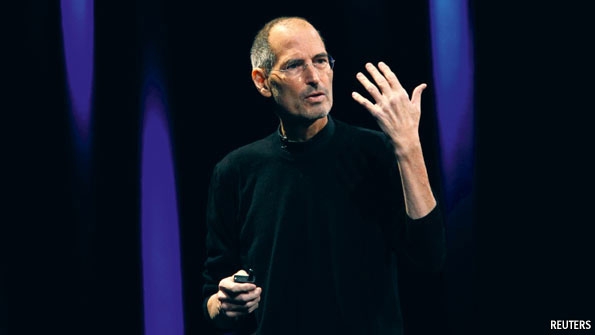
WHEN it came to putting on a show, nobody else in the computer industry, or any other industry for that matter, could match Steve Jobs. His product launches, at which he would stand alone on a black stage and conjure up an “incredible” new electronic gadget in front of an awed crowd, were the performances of a master showman. All computers do is fetch and shuffle numbers, he once explained, but do it fast enough and “the results appear to be magic”. Mr Jobs, who died this week aged 56, spent his life packaging that magic into elegantly designed, easy-to-use products.

Read the full article on The Economist website.  The article finishes, thus,

Mr Jobs was said by an engineer in the early years of Apple to emit a “reality distortion field”, such were his powers of persuasion. But in the end he conjured up a reality of his own, channelling the magic of computing into products that reshaped entire industries. The man who said in his youth that he wanted to “put a ding in the universe” did just that.

Copyright © 2011 The Economist

Next, the graphical tribute received from Neil K.,

You may have seen this but what a simple and effective way to celebrate the passing of great man…  N

Consequences

Acceptance of what has happened is the first step to overcoming the consequences of any misfortune. 

William James, January 11th, 1842 - August 26th, 1910

The above is a quotation attributed to the late American philosopher, William James, comprehensively written about on the Stanford Encyclopaedia of Philosophy.

When drafting this post last Wednesday, I used the quotation and reference to William James to soften, as it were, me reproducing an item on Yves Smith’s fabulous blog, Naked Capitalism.

I did have second thoughts about including the video below and the summary of what was written by Yves.  The second thoughts were around me not wanting Learning from Dogs to stray into sensationalism or hot pop topics.

The reason I did publish this post was that maybe, just maybe, young Mr. Alessio Rastani is saying it how it really is.  How we all have been lulled over the years into believing so much rubbish from so many movers and shakers in the world of power and politics.  Whereas, in truth, most people who stop and reflect on the world we are presently living in, intuitively sense, that something has broken.

The good news that may be interpreted from Mr. Rastani’s predictions is that we are now living through a period of change, the end of an era, and that the opportunity for a better, more caring world is wide open.

Introduced on the Naked Capitalism site, as follows,

This segment on BBC may not go viral, but it seems to be getting traction, based on the e-mails (hat tip readers Paul S and Marcus) and alerts in the comments section.

This is not an entertaining Rick Santelli-style rant, it’s a cool assessment of how the Euromarket crisis is likely to end, which he thinks is very badly. The flummoxed reaction of the BBC host suggests that the trader, Alessio Rastani, was a booking mistake.

But consider his second message: that Goldman and people rule the world and like him don’t care about what happens to the real economy. A depression is just a great investment opportunity if you see it coming and position yourself accordingly. Rastani is the bland, reasonable face of predatory capitalism.

But in the best interests of scepticism and balance, I also reproduce what was published in the UK’s Telegraph newspaper on the 27th September,

11:50PM BST 27 Sep 2011

The soundbites won Mr Rastani instant fame. He became a viral hit and was trending on Twitter. BBC business editor Robert Peston was among the fans. “A must watch if you want to understand the euro crisis and how markets work,” he told his army of 82,000 followers on Twitter on Tuesday.

The interview contained such gems as “Governments don’t rule the world, Goldman Sachs rules the world [and] Goldman Sachs does not care about the rescue package.”

But on Tuesday night the BBC was left facing questions about just how qualified Mr Rastani is to speak about the markets.

In the interview Mr Rastani described himself as an independent trader. Elsewhere he claims he’s an “investment speaker”. Instead of operating from a plush office in Canary Wharf Mr Rastani works and lives with his partner Anita Eader in a £200,000 semi in Bexleyheath, south London. The house, complete with a mortgage from Royal Bank of Scotland, belongs to her not him.

He is a business owner, a 99pc shareholder in public speaking venture Santoro Projects. Its most recent accounts show cash in the bank of £985. After four years trading net assets are £10,048 – in the red.

How a man who has never been authorised by the Financial Services Authority and has no discernible history working for a City institution ended up being interviewed by the BBC remains a mystery.

The incongruity led to some commentators speculating Mr Rastani was a professional hoaxer. The BBC denied the allegation: “We’ve carried out detailed investigations and can’t find any evidence to suggest that the interview with Alessio Rastani was a hoax.”

However, the BBC declined to comment on what checks, if any, it had done prior to the interview.

Mr Rastani was a little more forthcoming.

“They approached me,” he told The Telegraph. “I’m an attention seeker. That is the main reason I speak. That is the reason I agreed to go on the BBC. Trading is a like a hobby. It is not a business. I am a talker. I talk a lot. I love the whole idea of public speaking.”

So he’s more of a talker than a trader. A man who doesn’t own the house he lives in, but can sum up the financial crisis in just three minutes – a knack that escapes many financial commentators.

“I agreed to go on because I’m attention seeker,” he said on Tuesday. “But I meant every word I said.”

We shall see.


Food, growing your own!

The powerful story about how food could change

Yesterday, I referred to a piece on the Chris Martenson blog about Joel Salatin, proprietor of Polyface Farms.  I want to stay with the theme of food, and the growing thereof, as this is yet another critically important aspect of how we all have to change our attitudes and behaviours in the face of a growing ecological disaster.

I’m using a recent item presented by Rob Hopkins of Transition UK fame.  The link to the full piece is here but I am presenting some extracts and further links in this article.

A while ago I was sent a book called ‘SPIN farming basics: how to grow commercially on under an acre’ by Wally Satzewich and Roxanne Christensen.  The book describes itself as a “step-by-step learning guide to the sub-acre production system that makes it possible to gross $50,000+ from a half-acre”.  SPIN, which stands for ‘SmallPlot Intensive’ (their website is here), has the feel of an important, big, and timely idea, and it is one that fits into Transition beautifully.  So what is it?

At the moment, when contemplating urban food production, the models that are used tend to be allotments, community gardens, planting productive trees or forest gardens, private gardens or even, perhaps, rooftop gardens.  Commercial urban market gardens tend to be thought of as needing to be on a larger scale and requiring significant infrastructure.  SPIN is based on the idea of ‘patchwork farming’, of seeing unused areas of urban land as having the potential to be worked commercially, viewed through the eyes of a commercial grower rather than someone growing for a hobby.  This is a profound shift of emphasis and one that I find very exciting.  Here is a short talk by SPIN farmer Paula Sobie of City Harvest which gives her take on what SPIN farming is:

Let me quote how that article from Rob concludes,

‘SPIN farming basics’ is just one of the books that SPIN produce.  It isn’t a step-by-step growing guide, rather it is an overview book on how to run such an operation.  I have no way of gauging whether their figures are accurate and how they might translate into the UK context.  I’m also not sure what they do about slugs.   There is also, I guess, a distant danger that should this really take off it might edge out more egalitarian forms of urban land use, such as allotments and community gardens.  But even if they are only half right  about their potential yields, it is still an impressive approach, and it calls for a powerful shift in focus for urban growers.  In the wake of the recent riots in a number of English cities, I am struck by the potential of this approach to shift thinking about how to create viable social enterprises and a sense of purpose for young people.  It has certainly got my brain ticking over pretty rapidly.

As the authors put it, “once you put on SPIN glasses, you start seeing dollar signs all over vacant and underutilised patches of land”.  As economic contraction worsens, and peak oil starts to bite, this form of land use will become the norm, as it has done every time in history that societies have faced similar sets of circumstances.  The obstacle to getting started has always been how to make this stuff viable.  That obstacle, thanks to the work of the SPIN folks, would appear to no longer exist, or at least to be greatly diminished.   If you don’t do it someone else will, and they likely won’t do it in a way rooted in social justice, community benefit, food security and Transition.  This is an important window in time to get moving on this.

This is a revolutionary text, an incendiary call to rethink urban land use in a way that ticks everyone’s boxes.  I can’t recommend it too highly.

It is rather hard to tell from the SPIN website which of the books they offer is this one… so for the last time ever, here is a link to the book on Amazon…. it is quite pricey, but one to get and share with as many people as you can…

The SPIN Farming website is chock full of fantastic ideas, advice and guidance.  Website is here. From which you will understand,

THINKING OF FARMING? THINK AGAIN.

There’s a new way to farm. It’s called SPIN, and it is causing people to re-think not only how to farm, but what it means to be a farmer today.

  • Some practice SPIN in their backyards in the city. Others do it on front lawns in the suburbs.
  • Some do it part-time, others full-time.
  • Some are young and just starting out, while others are older and on their third or fourth careers.
  • Some have more money than they know what to do with, and others have less than they need.
  • Some are convinced the world is doomed, while others are trying to save it.

What unites them all is a calling to farm.

If you want to follow your calling, follow the system that shows you how to make money farming.

It’s one of the many beams from that wonderful rainbow just over the horizon!


Ernst Friedrich “Fritz” Schumacher

Ernst Friedrich “Fritz” Schumacher (16 August 1911 – 4 September 1977)

Ernst Friedrich "Fritz" Schumacher

It seems amazing to realise both that this far-sighted man was born a century ago this day and that his incredibly influential book, Small is Beautiful, was published 38 years ago.

The book has been hugely influential.  Indeed, my gut sense is that it probably started the whole ‘green’ movement.  The Times Literary Supplement of October 6, 1995 regarded E.F. Schumacher’s 1973 book Small Is Beautiful: a study of economics as if people mattered as among the 100 most influential books published since the end of the Second World War.

Just a personal note that for many years I lived just a few miles from Dartington in Devon (UK) where Schumacher College was founded in 1991.  Named after the great man, it provided, and still does, learning for sustainable living.  Perhaps no surprise at all that nearby Totnes became the world’s first ‘transition town’.

Want to find out more?  Then go to the New Economics Institute website here and discover,

The New Economics Institute is a US organization that uniquely combines vision, theory, action, and communication to effect a transition to a new economy — an economy that gives priority to supporting human well-being and Earth’s natural systems. Our multidisciplinary approach employs research, applied theory, public campaigns, and educational events to describe an alternative socio-economic system that is capable of addressing the enormous challenges of our times.  Our premise is that a fair and sustainable economy is possible and that ways must be found to realize it.

The Institute, formerly the E. F. Schumacher Society, is working in close partnership with the New Economics Foundation from London to add the programs and experience developed in the UK to its own work in the US.

Finally, to get a flavour of this wonderful man and the amazing legacy that he has left the planet, watch this short video of E.F. Schumacher answering a question from the moderator about whether or not Buddhist Economics can work in the West. (Question & Answer Panel at Great Circle Center, 3/19/77.  Peter Gillingham Collection, E. F. Schumacher Library Archives.)