Category: Business

‘Tolly’ finds something really special

I’m indebted to George Monbiot for this article, and ‘Tolly’ as a nickname for Iain Tolhurst.

Many articles from people that I follow online pass through my ‘inbox’.

But there was something special about a recent article by George Monbiot that was published in the Guardian on December 5th and I have great pleasure in republishing it here, with George’s permission.

ooOOoo

Shaking It Up

Posted on 7th December 2025

A eureka moment in the pub could help transform our understanding of the ground beneath our feet.

By George Monbiot, published in the Guardian 5th December 2025

It felt like walking up a mountain during a temperature inversion. You struggle through fog so dense you can scarcely see where you’re going. Suddenly, you break through the top of the cloud, and the world is laid out before you. It was that rare and remarkable thing: a eureka moment.
For the past three years, I’d been struggling with a big and frustrating problem. In researching my book Regenesis, I’d been working closely with Iain Tolhurst (Tolly), a pioneering farmer who had pulled off something extraordinary. Almost everywhere, high-yield farming means major environmental harm, due to the amount of fertiliser, pesticides and (sometimes) irrigation water and deep ploughing required. Most farms with apparently small environmental impacts produce low yields. This, in reality, means high impacts, as more land is needed to produce a given amount of food. But Tolly has found the holy grail of agriculture: high and rising yields with minimal environmental harm.

He uses no fertiliser, no animal manure and no pesticides. His techniques, the result of decades of experiment and observation, appear to enrich the crucial relationships between crops and microbes in the soil, through which soil nutrients must pass. It seems that Tolly has, in effect, “trained” his soil bacteria to release nutrients when his crops require them (a process called mineralisation), and lock them up when his crops aren’t growing (immobilisation), ensuring they don’t leach from the soil.

So why the frustration? Well, Tolly has inspired many other growers to attempt the same techniques. Some have succeeded, with excellent results. Others have not. And no one can work out why. It’s likely to have something to do with soil properties. But what?

Not for the first time, I had stumbled into a knowledge gap so wide that humanity could fall through it. Soil is a fantastically complex biological structure, like a coral reef, built and sustained by the creatures that inhabit it. It supplies 99% of our calories. Yet we know less about it than any other identified ecosystem. It’s almost a black box.

Many brilliant scientists have devoted their lives to its study. But there are major barriers. Most soil properties cannot be seen without digging, and if you dig a hole, you damage the structures you’re trying to investigate. As a result, studying even basic properties is cumbersome, time-consuming and either very expensive or simply impossible at scale. To measure the volume of soil in a field, for example, you need to take hundreds of core samples. But as soil depths can vary greatly from one metre to the next, your figure relies on extrapolation. This makes it very hard to tell whether you’re losing soil or gaining it. Measuring bulk density (the amount of soil in a given volume, which shows how compacted it might be), or connected porosity (the tiny catacombs created by lifeforms, a crucial measure of soil health), or soil carbon – at scale – is even harder.

So farmers must guess. Partly because they cannot see exactly what the soil needs, many of their inputs – fertilisers, irrigation, deep ploughing – are wasted. Roughly two-thirds of the nitrogen fertiliser they apply, and between 50% and 80% of their phosphorus, is lost. These lost minerals cause algal blooms in rivers, dead zones at sea, costs for water users and global heating. Huge amounts of irrigation water are also wasted. Farmers sometimes “subsoil” their fields – ploughing that is deep and damaging – because they suspect compaction. The suspicion is often wrong.

Our lack of knowledge also inhibits the development of a new agriculture, which may, as Tolly has done, allow farmers to replace chemical augmentation with biological enhancement.

So when I came to write the book, I made a statement so vague that it reads like an admission of defeat: we needed to spend heavily on “an advanced science of the soil”, and use it to deliver a “greener revolution”. While we know almost nothing about the surface of our own planet, billions are spent on the Mars Rover programme, exploring the barren regolith there. What we needed, I argued, is an Earth Rover programme, mapping the world’s agricultural soils at much finer resolution.

I might as well have written “something must be done!” The necessary technologies simply did not exist. I sank into a stygian gloom.

At the same time, Tarje Nissen-Meyer, then a professor of geophysics at the University of Oxford, was grappling with a different challenge. Seismology is the study of waves passing through a solid medium. Thanks to billions from the oil and gas industry, it has become highly sophisticated. Tarje wanted to use this powerful tool for the opposite purpose – ecological improvement. Already, with colleagues, he had deployed seismology to study elephant behaviour in Kenya. Not only was it highly effective, but his team also discovered it could identify animal species walking through the savannah by their signature footfall.

By luck we were both attached, in different ways, to Wolfson College, Oxford, where we met in February 2022. I saw immediately that he was a thoughtful man – a visionary. I suggested a pint in The Magdalen Arms.

I explained my problem, and we talked about the limits of existing technologies. Was seismology being used to study soil, I asked. He’d never heard of it. “I guess it’s not a suitable technology then?” No, he told me, “soil should be a good medium for seismology. In fact, we need to filter out the soil noise when we look at the rocks.” “So if it’s noise, it could be signal?” “Definitely.”

We stared at each other. Time seemed to stall. Could this really be true?

Over the next three days, Tarje conducted a literature search. Nothing came up. I wrote to Prof Simon Jeffery, an eminent soil scientist at Harper Adams University, whose advice I’d found invaluable when researching the book. I set up a Zoom call. He would surely explain that we were barking up the wrong tree.

Simon is usually a reserved man. But when he had finished questioning Tarje, he became quite animated. “All my life I’ve wanted to ‘see’ into the soil,” he said. “Maybe now we can.” I was introduced to a brilliant operations specialist, Katie Bradford, who helped us build an organisation. We set up a non-profit called the Earth Rover Program, to develop what we call “soilsmology”; to build open-source hardware and software cheap enough to be of use to farmers everywhere; and to create, with farmers, a global, self-improving database. This, we hope, might one day incorporate every soil ecosystem: a kind of Human Genome Project for the soil.

We later found that some scientists had in fact sought to apply seismology to soil, but it had not been developed into a programme, partly because the approaches used were not easily scalable.

My role was mostly fixer, finding money and other help. We received $4m (£3m) in start-up money from the Bezos Earth Fund. This may cause some discomfort, but our experience has been entirely positive: the fund has helped us do exactly what we want. We also got a lot of pro-bono help from the law firm Hogan Lovells.

Tarje, now at the University of Exeter, and Simon began assembling their teams. They would need to develop an ultra-high-frequency variant of seismology. A big obstacle was cost. In 2022, suitable sensors cost $10,000 (£7,500) apiece. They managed to repurpose other kit: Tarje found that a geophone developed by a Slovakian experimental music outfitworked just as well, and cost only $100. Now one of our scientists, Jiayao Meng, is developing a sensor for about $10. In time, we should be able to use the accelerometers in mobile phones, reducing the cost to zero. As for generating seismic waves, we get all the signal we need by hitting a small metal plate with a welder’s hammer.

On its first deployment, our team measured the volume of a peat bog that had been studied by scientists for 50 years. After 45 minutes in the field, they produced a preliminary estimate suggesting that previous measurements were out by 20%. Instead of extrapolating the peat depth from point samples, they could see the wavy line where the peat met the subsoil. The implications for estimating carbon stocks are enormous.

We’ve also been able to measure bulk density at a very fine scale; to track soil moisture (as part of a wider team); to start building the AI and machine learning tools we need; and to see the varying impacts of different agricultural crops and treatments. Next we’ll work on measuring connected porosity, soil texture and soil carbon; scaling up to the hectare level and beyond; and on testing the use of phones as seismometers. We now have further funding, from the UBS Optimus Foundation, hubs on three continents and a big international team.

Eventually, we hope, any farmer anywhere, rich or poor, will be able to get an almost instant readout from their soil. As more people use the tools, building the global database, we hope these readouts will translate into immediate useful advice. The tools should also revolutionise soil protection: the EU has issued a soil-monitoring law, but how can it be implemented? Farmers are paid for their contributions “to improve soil health and soil resilience”, but what this means in practice is ticking a box on a subsidy form: there’s no sensible way of checking.

We’re not replacing the great work of other soil scientists but, developing our methods alongside theirs, we believe we can fill part of the massive knowledge gap. As one of the farmers we’re working with, Roddy Hall, remarks, the Earth Rover Program could “take the guesswork out of farming”. One day it might help everyone arrive at that happy point: high yields with low impacts. Seismology promises to shake things up.

http://www.monbiot.com

ooOOoo

George Monbiot puts his finger precisely on the point of his article: “While we know almost nothing about the surface of our own planet, billions are spent on the Mars Rover programme.

What if we die before our pets?

We love our dogs and can never envisage being without one.

So what happens to them after the last one of us die?

I have just turned 81 and, although I am fit, think more seriously about this matter than I used to. Jean has no children and my son and daughter, from a previous marriage, are living in the U.K.

So an article from The Conversation caught my eye and I wanted to share it with you.

ooOOoo

Diane Keaton’s $5M pet trust would be over the top if reports prove true – here’s how to ensure your beloved pet is safe after you are gone

Allison Anna Tait, University of Richmond

Diane Keaton loved her dog, Reggie.

The award-winning actor, director and real estate entrepreneur frequently posted photos and video clips of the golden retriever on her social media accounts. After she died on Oct. 11, 2025, at 79, some news outlets reported that she left US$5 million of her estimated $100 million estate to her dog.

I’m a law professor who teaches about wills, trusts and other forms of inheritance law. Every semester, I teach my students how they can help clients provide for their pets after death. Because they, like many Americans, love their pets and want to know how to take care of them, this topic always piques their interest. https://www.youtube.com/embed/FYJGCvpJIV0?wmode=transparent&start=0 Diane Keaton was very open about her devotion to her dog, Reggie.

Writing pets into a will

An estimated 66% of all U.S. households include at least one pet. Many Americans consider their cats, dogs, tortoises or other animals to be part of their family, and their spending on those nonhuman relatives is immense. In 2024, they paid a total of about $152 billion for goods and services to feed and otherwise support their pets.

Taking good care of your pets can go beyond buying them treats and sweaters. It can include leaving clear directions to ensure their needs are met once you’re gone. There are several ways that you can do this.

The first is through your will. You can’t give your pet money directly in your will, because the law says that pets are property, like your books or your dishes.

You can, however, leave a bequest, the technical term for a gift to a person or a cause listed in a will, to someone who will be the animal’s caretaker. That bequest can include directions that the money be spent meeting the pet’s needs.

It’s worth it to also name an alternate or contingent caretaker in case the first person you name does not want to or cannot take on that responsibility, or they die before you or the animals you’ve provided for in the will.

Choupette’s life of luxury

German fashion designer, photographer and creative director Karl Lagerfeld, who died in 2019 at 85, was someone who made the mistake of leaving money directly to his fluffy Birman cat, Choupette. It worked out for Choupette, though.

The cat was, according to several reports, still alive in 2025 and eating meals out of the porcelain bowls that Lagerfeld bought for her. Choupette is cared for at great expense and in the utmost luxury by Françoise Caçote, the designer’s former housekeeper. The cat even had a 13th birthday party at Versailles.

Another pet owner who did right by her pet was the comedian, producer and red carpet interviewer Joan Rivers.

Rivers had two rescue dogs in Manhattan and two more dogs in California when she died in 2014 at age 81. Rivers had made provisions for their care in her will.

A petite woman holding a tiny dog stands next to three men on a TV set.
The late Joan Rivers, right, seen on the set of her short-lived talk show in 1987, planned ahead for her dogs’ care. Bettmann via Getty Images

Creating pet trusts

If you’d like an arrangement that’s more secure than a will, then you might want to opt for a pet trust, another celebrity favorite. These kinds of trusts were not possible until the 1990s, because pets were not considered true beneficiaries – meaning they couldn’t sue the trustee.

But in the 1990s, states began to change their rules to allow for pet trusts. Today, pet trusts are valid in the whole country, although the rules vary slightly from state to state.

To establish a pet trust, you or a lawyer must draw up a trust document that names two important people: a trustee and a caretaker. The trustee is the person who will manage the money you leave in trust. They will make distributions to the caretaker that you select.

You must also specify how the money is to be spent meeting the animal’s needs and who would get any money that could be left in the trust when the pet dies. Typically, these trusts take effect at the owner’s death, just like other provisions in a will.

Drafting a pet trust can be free, if you use an online template and get no legal guidance. The same thing might cost around $100 if you use an online service such as Legal Zoom that provides directions. More commonly, however, pet trusts are part of a broader estate plan, and costs range depending on how complicated your estate is.

When the rich go overboard

One of the most over-the-top pet trusts came from Leona Helmsley, the New York hotel and real estate mogul known widely as the “Queen of Mean.” She was famous for her pettiness and tough management style and for landing in prison for tax evasion.

When Helmsley died in 2007, she left her dog, a Maltese named Trouble who had reportedly bitten members of her staff, a $12 million trust fund. Most of Helmsley’s estate went to the Helmsley Charitable Trust, but she made individual gifts to several relatives, and the gift to Trouble was larger than any of those.

The grandchildren, upset that Trouble got more money than they did, took the case to court, where the probate judge was less than impressed by Trouble’s luxury lifestyle and knocked down the amount in trust to $2 million. The other $10 million flowed back to her family’s foundation, where the bulk of the estate went in the first place.

Lesson learned: Your dog can have a trust fund, but don’t go overboard.

Bequests for pets can be challenged – in which case it’s up to courts to determines how much they think is reasonable for the pet’s need. In Helmsley’s case, $12 million was found to be excessive. And maybe with good reason. Trouble still had a nice life with fewer millions. The dog died in December 2010 after several years in Sarasota, Florida, at a Helmsley-owned hotel.

Other pet owners who aren’t celebrities have used pet trusts as well, such as Bill Dorris, a Nashville businessman without any human heirs. He left his dog, Lulu, $5 million.

Pet-loving celebrities who loved all the pets

Finally, there’s a lesson to be learned from British fashion designer and icon Alexander McQueen, who was worth £16 million ($21 million) when he died in 2010 at the age of 40. McQueen left £50,000 ($66,000) in a trust for his two bull terriers so that they would be well cared for during the remainder of their lives.

McQueen also included a bequest of £100,000 ($132,000) to the Battersea Dogs and Cats Home in his will to help fund the care of some of the millions of other animals out there that need the basics of food and shelter.

Animal shelters, in the U.K., the United States and other countries, help rescue and protect animals, and these animals need more help than the Choupettes and Troubles of the world.

So, my advice is that you go ahead and create a pet trust for your cat. But don’t forget to give some money in your will – and ideally while you’re alive – to help the vast majority of the millions of companion animals who need new homes every year. None of them have trust funds.

What becomes of Reggie, Keaton’s golden retriever, and her estate remains to be seen. Keaton, who starred in hit movies such as “Annie Hall,” “Reds” and “The First Wives Club,” isn’t the first celebrity to leave millions of dollars to a pet. And it’s unlikely that she will be the last.

Allison Anna Tait, Professor of Law, University of Richmond

This article is republished from The Conversation under a Creative Commons license. Read the original article.

ooOOoo

Amending our Will to create a pet trust seems like a very good idea! And making sure there is money for the trust as well.

A Scottish thatcher.

Came across this a few days ago and you will love it!

The new world comes up with some marvellous treats. Here I was listening to the radio (BBC – Radio 4) from Southern Oregon and they had this item about a Scottish thatcher using a variety of plants to thatch roofs. The thatcher had been thatching for years.

Then a quick search on the internet found this video:

Far too short!

However really enjoyed the video.

Your start in a vet business

Penny Martin regularly sends me content that I can publish as a post for you kind people.

And so it is with this one.

ooOOoo

Going Green with Fur and Grit: How to Launch an Eco-Friendly Pet Care Business That Actually Work

You’ve been sitting on the idea for a while now. Maybe it started with that pile of single-use plastic baggies after your dog’s walk, or the ingredient list on your cat’s kibble that read more like a chemistry project than actual food. Maybe you just got tired of feeling like you had to choose between loving your pet and loving the planet. Whatever the reason, you’re here now, staring down the reality of launching a business that’s not only built for animals—but built for good. You want to make something that matters. And you can. But you need to know exactly what you’re walking into.

Anchor Yourself in a Real Way
 
You can’t build this kind of business on good vibes and a cool logo. Before anything else—before the business plan, the branding, or the Instagram account—you’ve got to know exactly why you’re doing this. If your reason isn’t rooted in something deeply personal, something that makes your chest tighten when you think about it, you’ll burn out fast. Maybe it’s watching your senior dog react to over-processed treats, or maybe it’s the garbage island growing in the ocean—whatever it is, let that be your compass.

Streamline the Chaos with the Right Tools

When you’re building a mission-driven business from scratch, the backend can get messy fast. That’s where using an all-in-one business platform becomes a game-changer—it keeps your focus on your values instead of your paperwork. Whether you’re forming an LLC, managing compliance, creating a website, or handling finances, this type of platform can provide comprehensive services and expert support to ensure business success. Platforms like ZenBusiness are built for entrepreneurs like you, giving you the structure to stay organized while you pour your energy into the work that really matters.

Get Ruthlessly Local with Sourcing
 
If you’re serious about sustainability, you’ve got to look hard at where your products come from. Local sourcing doesn’t just reduce your carbon footprint—it tells your community that you care about it. Reach out to nearby farms, independent makers, and ethical manufacturers who align with your mission. Not only will this lower your shipping emissions, it’ll also create real relationships with partners who have skin in the game—and people can feel that authenticity the moment they walk through your door.

Know That Packaging Will Be a Battle
 
You’re going to lose sleep over packaging. You’ll try compostable options that fall apart in humid weather. You’ll learn that “recyclable” doesn’t mean the same thing in every city. And somewhere along the way, you’ll realize that the most sustainable solution might be the least convenient one. This is the part where you have to experiment, ask questions, and stay transparent with your customers. No one expects perfection—but they’ll appreciate your effort to figure it out.

Make the Community Your Co-Founders
 
You’re not building this business for yourself. You’re building it for every person who loves their animal and wants to do better by the planet. So bring them in early. Host small events, set up “ask me anything” nights, partner with local shelters, and turn your customer base into a real community. These people won’t just buy your products—they’ll give you feedback, advocate for your brand, and make you feel less alone when the grind gets real.

Ditch the Guilt, Offer Solutions
 
You’re not here to shame anyone. The pet parent buying big-box kibble isn’t your enemy—they’re someone who probably hasn’t been offered a better option yet. So don’t lecture. Instead, educate through action. Make eco-friendly choices feel fun, feel doable, and feel worth it. When you center your messaging on empowerment instead of guilt, people are way more likely to stick around—and tell their friends.

Teach Through Curiosity, Not Preaching
 
People want to learn, but they don’t want to be condescended to. Your job is to become the kind of brand that shares knowledge without turning it into a TED Talk. Drop bite-sized facts on your packaging, start conversations in-store, and use your social platforms to casually open people’s eyes. Think of it like planting seeds—not every customer will bloom overnight, but the ones who do will remember how you made them feel when they were just getting started.

Hire with Heart, Not Just Skill
 
You can train someone to trim nails or restock shelves, but you can’t teach them to care. The team you build needs to believe in the mission as much as you do. They’re the ones explaining the difference between corn-based and petroleum-based bags to a frazzled pet parent who’s late for pickup. If your staff is just collecting paychecks, your message won’t land. But if they’re aligned with your values? That’s when your business becomes a movement.

Don’t Let Perfect Be the Point
 
You will mess up. You’ll stock a “sustainable” product that turns out to be greenwashed. You’ll order packaging that gets held up in customs. You’ll have days where you wonder if any of this actually matters. That’s normal. Progress in this space is messy, nonlinear, and full of trade-offs. The key is to keep going, stay honest, and let your customers come along for the ride. They don’t need you to be flawless—they just need to believe you’re trying.

Starting an eco-conscious pet care business means doing things the hard way on purpose. It means waking up early to answer emails from suppliers and staying up late comparing compostable labels. It means showing up for your customers, your team, your animals—and the planet. But if your heart’s in the right place and your feet stay on the ground, you’ll build something that matters. And really, that’s the kind of work worth doing.

Discover the wisdom of our loyal companions and explore the journey of life with Learning from Dogs, where every post is a step towards understanding and fulfillment.

ooOOoo

As a very ex-entrepreneur, I can tell you that there is much in Penny’s article that applies to starting any business.

And as an ex-salesman, everything starts with the customer. The persons who are attracted to what you are selling. It is hard work but pleasing work. Before I started Dataview I worked for IBM UK in their office products division, as a salesman. I loved the job!

Making your vet clinic profitable

The second guest post from Penny Martin.

ooOOoo

Image: Freepik

Vision to Reality: Building a Profitable Vet Clinic

Launching a veterinary clinic is a significant endeavor that requires meticulous planning and strategic decision-making. This venture combines a passion for animal care with the intricacies of managing a successful business. Aspiring clinic owners must navigate several critical steps to lay a strong foundation and ensure operational excellence. Starting your own clinic promises not only to fulfill a dream of helping animals but also to establish a thriving enterprise in the community.

Build a Strong Foundation with an Effective Marketing Strategy

A robust marketing strategy is essential to attract potential clients in the digital era. Establishing a professional online presence through a user-friendly website that details your services, team, and location builds trust among pet owners. Engage actively on social media with regular updates and client testimonials to showcase your expertise and commitment to animal care. Forge partnerships with local pet-related businesses to increase visibility and drive traffic to your clinic, enhancing both your and your partners’ customer bases.

Craft a Clear and Detailed Business Plan

A well-constructed business plan acts as your clinic’s roadmap, detailing your mission, services offered, and the specific target market. Identify your niche early—whether it’s specializing in certain animals or treatments—to attract the appropriate clientele. Include comprehensive financial projections and a marketing budget in your plan to ensure financial preparedness and support your clinic’s promotional activities.

Enhance Your Business Knowledge by Pursuing an MBA

Running a veterinary clinic demands a blend of clinical and business expertise. Pursuing a master’s of business administration online can boost your proficiency in key business areas such as strategy, management, and finance. An MBA not only deepens your understanding of business operations but also enhances leadership skills and self-assessment capabilities. These competencies are essential for balancing the medical and business demands of your clinic, ensuring its long-term success.

Safeguard Your Business with Proper Insurance

Operating a veterinary clinic comes with inherent risks, making comprehensive insurance coverage essential. Essential policies include malpractice insurance to handle legal issues and general liability insurance for accidents on your premises. Property insurance is crucial to protect your clinic’s infrastructure and equipment against unexpected events. Consulting with an insurance expert can ensure that you have thorough coverage to protect against potential financial setbacks.

Invest in High-Quality Veterinary Equipment

Providing top-tier care necessitates investing in high-quality veterinary equipment. Essential tools like X-ray machines, surgical instruments, and lab equipment should be of the highest standard to ensure accurate diagnoses and treatments. Modern technologies, such as digital imaging systems, not only enhance patient care but also improve operational efficiency. While the initial cost may be higher, investing in quality equipment pays off in the long run by boosting efficiency and minimizing errors.

Secure the Necessary Funding for Your Clinic

Securing sufficient funding is critical when starting a veterinary clinic. Estimate your startup costs accurately to understand your financial needs, including equipment, premises, staffing, and marketing. Explore diverse financing options, such as bank loans, private investors, and specialty medical practice loans that might offer favorable terms. Adequate initial funding prevents cash flow problems and supports your clinic’s growth trajectory.

Choose the Right Location for Your Clinic

The location of your clinic is pivotal to its success, necessitating a spot with a high demand for veterinary services. Conduct thorough market research to choose a community rich in pet owners who need your services. Select a location that is accessible, visible, and has ample parking to ensure convenience for your clients. Proximity to complementary services like pet groomers or dog trainers can further enhance client traffic and provide expansion opportunities.

Opening a veterinary clinic is both challenging and rewarding, demanding a careful blend of dedication and strategic foresight. Success in this field not only enhances the well-being of pets but also contributes positively to the local community. It requires ongoing commitment to adapt and grow in a dynamic environment. Ultimately, the fulfillment of running a successful veterinary clinic comes from both the impact on animal health and the achievement of entrepreneurial goals.

Discover the timeless wisdom that dogs offer at Learning from Dogs, where integrity and living in the present are celebrated. Dive into our content and embrace the lessons from our four-legged friends.

ooOOoo

This is all very sound advice. Thank you, Penny.

Starting a Veterinary Clinic

A guest post.

This post, and the next one, are submitted by Penny Martin.

ooOOoo

Image: Freepik

Vision to Reality: Building a Profitable Vet Clinic

Launching a veterinary clinic is a significant endeavor that requires meticulous planning and strategic decision-making. This venture combines a passion for animal care with the intricacies of managing a successful business. Aspiring clinic owners must navigate several critical steps to lay a strong foundation and ensure operational excellence. Starting your own clinic promises not only to fulfill a dream of helping animals but also to establish a thriving enterprise in the community.

Build a Strong Foundation with an Effective Marketing Strategy

A robust marketing strategy is essential to attract potential clients in the digital era. Establishing a professional online presence through a user-friendly website that details your services, team, and location builds trust among pet owners. Engage actively on social media with regular updates and client testimonials to showcase your expertise and commitment to animal care. Forge partnerships with local pet-related businesses to increase visibility and drive traffic to your clinic, enhancing both your and your partners’ customer bases.

Craft a Clear and Detailed Business Plan

A well-constructed business plan acts as your clinic’s roadmap, detailing your mission, services offered, and the specific target market. Identify your niche early—whether it’s specializing in certain animals or treatments—to attract the appropriate clientele. Include comprehensive financial projections and a marketing budget in your plan to ensure financial preparedness and support your clinic’s promotional activities.

Enhance Your Business Knowledge by Pursuing an MBA

Running a veterinary clinic demands a blend of clinical and business expertise. Pursuing a master’s of business administration online can boost your proficiency in key business areas such as strategy, management, and finance. An MBA not only deepens your understanding of business operations but also enhances leadership skills and self-assessment capabilities. These competencies are essential for balancing the medical and business demands of your clinic, ensuring its long-term success.

Safeguard Your Business with Proper Insurance

Operating a veterinary clinic comes with inherent risks, making comprehensive insurance coverage essential. Essential policies include malpractice insurance to handle legal issues and general liability insurance for accidents on your premises. Property insurance is crucial to protect your clinic’s infrastructure and equipment against unexpected events. Consulting with an insurance expert can ensure that you have thorough coverage to protect against potential financial setbacks.

Invest in High-Quality Veterinary Equipment

Providing top-tier care necessitates investing in high-quality veterinary equipment. Essential tools like X-ray machines, surgical instruments, and lab equipment should be of the highest standard to ensure accurate diagnoses and treatments. Modern technologies, such as digital imaging systems, not only enhance patient care but also improve operational efficiency. While the initial cost may be higher, investing in quality equipment pays off in the long run by boosting efficiency and minimizing errors.

Secure the Necessary Funding for Your Clinic

Securing sufficient funding is critical when starting a veterinary clinic. Estimate your startup costs accurately to understand your financial needs, including equipment, premises, staffing, and marketing. Explore diverse financing options, such as bank loans, private investors, and specialty medical practice loans that might offer favorable terms. Adequate initial funding prevents cash flow problems and supports your clinic’s growth trajectory.

Choose the Right Location for Your Clinic

The location of your clinic is pivotal to its success, necessitating a spot with a high demand for veterinary services. Conduct thorough market research to choose a community rich in pet owners who need your services. Select a location that is accessible, visible, and has ample parking to ensure convenience for your clients. Proximity to complementary services like pet groomers or dog trainers can further enhance client traffic and provide expansion opportunities.

Opening a veterinary clinic is both challenging and rewarding, demanding a careful blend of dedication and strategic foresight. Success in this field not only enhances the well-being of pets but also contributes positively to the local community. It requires ongoing commitment to adapt and grow in a dynamic environment. Ultimately, the fulfillment of running a successful veterinary clinic comes from both the impact on animal health and the achievement of entrepreneurial goals.

Discover the timeless wisdom that dogs offer at Learning from Dogs, where integrity and living in the present are celebrated. Dive into our content and embrace the lessons from our four-legged friends.

ooOOoo

Opening a vet clinic is well beyond me even though many years ago I was an entrepreneur.

However, one hopes that somewhere a person or two find this very useful.

German Shepherd Dogs

How to find a good breeder.

This is a long and comprehensive guest post from Michael Kempkes.

ooOOoo

5 Best German Shepherd Dog Breeders in California.

If you are looking for the highest-quality German Shepherd in California, you must choose the right breeder first and this selection will make all the difference. A well-bred German Shepherd is a loyal companion, a skilled working dog, and a trusted member of your family, so the right choice is extremely important. But with so many options available, how to pick a reputable breeder? In this post, we have compiled a list of the top 5 German Shepherd breeders in California for 2025. These breeders are known for their commitment to health, temperament, and ethical breeding practices and for producing strong, well-balanced dogs with excellent genetics. All these breeders provide German shepherds for different purposes whether you are looking for a family protector, a sports dog, or a working-line GSD.

So, let’s just find out the best places to get a well-bred German Shepherd in California.

1. Kempkes Executive K9s (Agua Dulce, CA)

  • Rating: ⭐⭐⭐⭐⭐
  • Location: 9450 Yucca Hills Rd, Agua Dulce, CA 91390
  • Specialization: Elite German & European Bloodline GSD
  • Certifications: SV, FCI, VA, Schutzhund/IPO Titled German Shepherd Dogs


Kempkes Executive K9s
 has over 30 years of experience in breeding top-quality German Shepherds. They focus on elite German and European bloodlines, their expertise makes them one of the best breeders in the world. You can trust their dogs to have exceptional traits and strong lineage. They provide top-tier, fully trained imported GSDs from the finest bloodlines perfect as protection dogs and family companions. They put health first, train with care, and build strong temperaments for 100% customer satisfaction. This commitment to quality sets them apart as a top breeder in California. A name you can trust for well-bred, highly trained dogs. They have years of experience working with all types of German bloodline dogs. This includes Malinois, West German Showline German Shepherds, Working Line German Shepherds, Rottweilers, Doberman Pinschers, and Schnauzers. Their team is skilled in handling these dogs, making sure they receive the best training.

What Makes Kempkes Executive K9s Stand Out?

  • Kempkes Executive K9s is renowned for producing elite German Shepherds with exceptional quality and temperament.
  • Each puppy and dog is carefully selected from the top European bloodline to ensure superior genetics and health.
  • Their German Shepherds undergo three levels of protection training, including guarding, bomb detection, and search and rescue, providing unmatched security.
  • They deliver advanced personalized training program packages to satisfy the personal needs of each family or individual.
  • All dogs are free from genetic health issues, ensuring a long and healthy life for your companion.
  • Their trainers have a deep understanding of German Shepherds’ behavior. They know the behavioral patterns and instincts of dogs. Using this knowledge, they apply proven training techniques to develop effective obedience and confidence in GSDs.
  • Their training programs help improve communication and build trust. Both the dog and owner will feel safe and supported during the entire training.

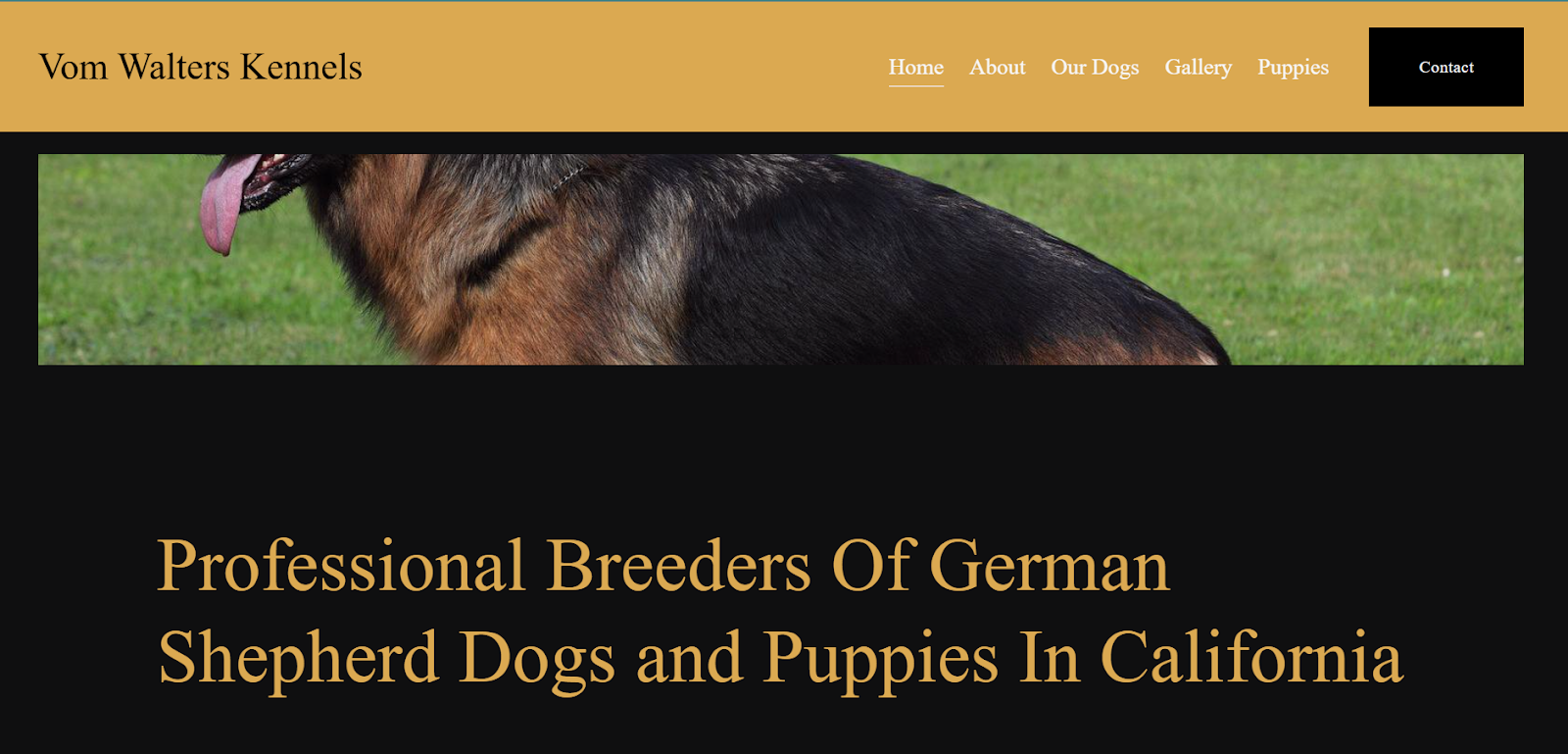
2. Vom Walters Kennels (Pilot Hill, CA)

  • Rating: ⭐⭐⭐⭐⭐
  • Location: 5580 Salmon Falls Rd, Pilot Hill, CA 95664, United States
  • Specialization: Finest German VA, V, & Schutzhund imported lines.
  • Certifications: AKC-registered & OFA-certified

Vom Walters Kennels breeds top-quality German Shepherds. They focus on the best German VA, V, and Schutzhund bloodlines. Years of experience help them raise dogs with great temperaments and strong abilities. Passion and commitment set them apart. First-time owners and experienced handlers will find the right match here. Their dogs come with expert care and full support. You also get a pet free from hip and elbow dysplasia.

What Makes Vom Walters Kennels Stand Out?

  • Vom Walters Kennels breeds come from elite bloodlines. These lines have strong genetics, high intelligence, and excellent working skills. 
  • Every dog at Vom Walters Kennels goes through strict health tests and gets OFA certification. They are checked for hip and elbow issues to make sure they are free from dysplasia. This focus on health gives buyers confidence. They can trust their dog will live a long and healthy life.
  • Vom Walters Kennels has dogs grow up in a caring environment and adjust well to different roles. They make great family pets, work with law enforcement, and excel in sports.
  • Vom Walters Kennels goes the extra mile to support their clients for life. They help you choose the right puppy, offer training advice, and continue to assist you throughout your journey together. Their dedication to your success goes beyond just getting a dog. You’ll always have the guidance and resources needed to build a strong bond with your pet.
  • Vom Walters Kennels values quality above all. The health and happiness of their dogs come first. Their breeding program focuses on strong health, good temperament, and following breed standards. Each puppy is carefully bred to represent the true German Shepherd breed.

3. Lundborg-Land (Southern CA)

  • Rating: ⭐⭐⭐⭐⭐
  • Location: 15110 Harness Hill Drive Perris, California 92570
  • Specialization: Show and Work quality dogs & puppies
  • Certifications: AKC, SV, Schutzhund titled, Hip Certified Dogs

Lundborg-Land is a distinguished breeder located in Southern California, specializing in show and work-quality German Shepherds. With a focus on breeding the German “SV” way, they produce dogs with exceptional temperament, intelligence, and physical structure. They raise puppies and adult dogs in an affectionate environment, which helps them grow confident, friendly, and ready for different roles. Some become loving family pets, while others shine in shows or as working dogs. Lundborg-Land focuses on top health and quality, that’s why German Shepherd lovers trust them.

What Makes Lundborg-Land Stand Out?

  • Lundborg-Land carefully selects their breed for their conformation, intelligence, and drive, making them versatile companions for families, competitors, and working professionals.
  • All dogs at Lundborg-Land are bred for the highest quality and good temperament. They are hip-certified and come from Schutzhund-titled, health-certified parents. This ensures they are free from genetic health issues and have stable, confident personalities.
  • Lundborg-Land breeds German Shepherds with excellence and maintains heritage. They stick to the highest standards set by the German Shepherd Club (SV). 
  • They train puppies well, each one learns obedience training and becomes a well-mannered and well-adjusted adult. 
  • Lundborg-Land offers dog boarding for your convenience, as well as new crates tailored to your dog’s size. They also assist with airplane flight costs, making it easier for out-of-state clients to bring home their new companions.

4. Mountain Valley K9 (Lindsay, CA)

  • Rating: ⭐⭐⭐⭐⭐
  • Location: 2500 Ave 220, Lindsay, CA 93247, US
  • Specialization: Working Line German Shepherd breeding
  • Certifications: AKC Registration, Hip & Elbow OFA, Schutzhund-titled dogs

Mountain Valley K9, based in Lindsay, California, breeds working-line German Shepherds. They focus on dogs that are smart, strong, and full of energy. These dogs are trained for jobs like family protection and sports. The puppies are raised in a loving home, helping them grow confident and social. The breeder cares about their dogs’ health, temperament, and abilities, making them a top choice for those looking for working dogs.

What Makes Mountain Valley K9 Stand Out?

  • Mountain Valley K9 specializes in breeding German Shepherds, these dogs are known for their strong instincts and quick learning abilities. They excel in protection, search and rescue, and even sports with smooth and efficient training programs. 
  • The breeding program pays close attention to structure, movement, and coat quality. This way, the dogs are not only capable but also look great.
  • Each puppy is checked by a vet, vaccinated, dewormed, and given plenty of love and care. This ensures they are healthy and ready for their new home.
  • Socialization starts early, with puppies being exposed to different sounds and sights. This helps them grow into confident, well-adjusted dogs.
  • Mountain Valley K9 stands behind their puppies. They offer a 100% satisfaction guarantee and provide ongoing support to make sure your dog thrives in your home.

5. Royal Tribes K9 (Beverly Hills, CA)

  • Rating: ⭐⭐⭐⭐⭐
  • Location: 113 North San Vicente Blvd. Suite 348, Beverly Hills, CA 90211
  • Specialization: Black and Long Hair German Shepherd
  • Certifications: Health Guarantee Certificate

Royal Tribes K9 is a luxury breeder based in Beverly Hills. They specialize in rare black and long-haired German Shepherds, these dogs are known for their beauty and wonderful temperaments. The puppies are bred to meet high standards of health, intelligence, and appearance. Royal Tribes K9 aims to provide top-tier companions for clients who want only the best. Each puppy is raised with great care, they are not only stunning to look at but also well-socialized. These dogs are ready to become a beloved member of your family.

What Makes Royal Tribes K9 Stand Out?

  • Royal Tribes K9 specializes in rare black, long-haired German Shepherds. These dogs offer a luxurious choice for anyone looking for a unique companion.
  • Each puppy undergoes thorough health checks to ensure they are in top condition, giving you confidence in their well-being.
  • The puppies are kept up-to-date on vaccinations and follow a strict care routine. This helps lay the foundation for a healthy, happy life.
  • If your puppy develops a hereditary genetic issue within five years, Royal Tribes K9 will replace it with a puppy of equal value. This shows their dedication to customer satisfaction.
  • To help your puppy stay healthy, they provide detailed food and supplement plans. These plans ensure your dog thrives in its new home.

What to Look for in a German Shepherd Breeder

You need to choose the right German Shepherd breeder to bring home a healthy, well-behaved dog. This decision is crucial. Here are four important things to consider when picking a breeder:

1. Health Screenings & Genetic Testing

An authentic breeder would really keep dogs in good health. Health screenings and genetic testing done on the dog would fetch out any potential problems. German Shepherds can have problems like hip dysplasia, elbow dysplasia, and degenerative myelopathy, and ask the breeder for health clearances for the parents. This includes hip and elbow clearances from OFA (Orthopedic Foundation for Animals). They should also test for degenerative myelopathy and other issues. Healthy puppies come from healthy parents, so make sure to ask for this information.

2. Ethical Breeding Practices & Socialization

Ethical breeding and proper socialization are key to raising German Shepherd dogs. These practices help make sure the dogs grow up healthy and well-balanced. They also build confidence and make them better suited for life with families. A responsible breeder follows ethical practices to raise puppies in a clean and smooth environment. Socializing puppies is also key, early exposure to various sights, sounds, and experiences helps build their confidence. It’s important to ask the breeder about:

  • How do they socialize their puppies? 
  • Do they introduce the pups to different people, places, and new things?

This early interaction helps them become well-adjusted adults later on.

3. Registration & Pedigree Verification

A reliable breeder will give you registration papers and pedigree details for their puppies. This shows the dog comes from a proven lineage and follows breed standards. Choose breeders who register their dogs with trusted groups like the:

  • American Kennel Club (AKC)
  • Verein fur Deutsche Schaferhunde (SV)
  • Federation Cynologique Internationale (FCI)
  • the German Shepherd Dog Club of America (GSDCA)

Pedigree details also show the dog’s family history. You can see if its parents or grandparents earned titles or awards. This can help you gauge the dog’s quality and temperament.

4. Customer Reviews and Breeder Transparency

Customer reviews and breeder transparency are key signs of a breeder’s trustworthiness. Check for feedback from past clients. Feel free to ask for references, a reliable breeder will answer all your questions openly. They’ll also let you visit their facility to meet the puppies and their parents. Trustworthy breeders are clear about their practices. Avoid breeders who seem secretive or refuse to share details about their breeding process.

The Bottom Line

The breeders listed here are known for their priority on health, ethical breeding, and expert training. If you need a working-line GSD, a show-quality champion, or a loyal family protector, these breeders deliver top-quality dogs with strong genetics and great temperaments.

You should first visit the breeder to inquire about the breeding standards, health, and many other aspects. The health certifications are of great importance to ensure the dog’s health. A well-bred German Shepherd is a long-term investment that will bring years of loyalty, protection, and companionship. The right breeder will help you find a dog that fits your home and lifestyle.

ooOOoo

The Author’s Bio.

Michael Kempkes grew up in Borken, Germany, and discovered his passion for German Shepherds at the age of nine. Over the years, he has gained deep experience in training, titling, and showing these incredible dogs. Michael has worked with the German Military, training dogs for Personal Protection, Guard duty, bomb detection, and search and rescue. He has earned his official certifications through one of the top schools in the world for K9 training in Koblenz, Germany.

My thanks to Michael.

This was a great guest post. Very informative and very useful information.

Finally, it is shame that all dogs do not live long enough, especially the German Shepherd!

Scamming

It is becoming very large!

Early on last Wednesday, February 26th, the BBC Radio 4 programme World at One, had a major item on scamming. Here are the details of that programme:

Released On: 26 Feb 2025

Back in September we revealed the knitted cardigan scam. Millions have been taken in by social media ads of expensive looking knitwear for a reasonable price. Victims hear nothing until something cheap and nasty arrives in the post months later. But it’s more than a simple con. Shari Vahl reveals what its really about. Sales of stout show no sign of stopping as more young women are turning to it. Guinness blames increased demand with supply chain issues for a recent shortage. Its rivals in the dark beer world are jumping on the opportunity with some success. Will it work? Finally, a listener tells us how his energy company gave his mobile number to a criminal who went on to steal £40,000. We find out how you can prevent this happening to you. Presenter: Shari Vahl Producer: Kevin Mousle.

Then later on that morning, I watched the video below, produced by the American Social Administration

Then there was this list of scams and frauds produced by the USA Government

Read it – that link is here: https://www.usa.gov/scams-and-fraud

Be carefully everybody!

Starting a veterinary clinic

Like any new start-up of a business venture, this requires knowledge, skills and quite a bit of luck!

I am delighted to offer this guest post by Penny.

ooOOoo

Image: Freepik

Vision to Reality: Building a Profitable Vet Clinic

Launching a veterinary clinic is a significant endeavor that requires meticulous planning and strategic decision-making. This venture combines a passion for animal care with the intricacies of managing a successful business. Aspiring clinic owners must navigate several critical steps to lay a strong foundation and ensure operational excellence. Starting your own clinic promises not only to fulfill a dream of helping animals but also to establish a thriving enterprise in the community.

Build a Strong Foundation with an Effective Marketing Strategy

A robust marketing strategy is essential to attract potential clients in the digital era. Establishing a professional online presence through a user-friendly website that details your services, team, and location builds trust among pet owners. Engage actively on social media with regular updates and client testimonials to showcase your expertise and commitment to animal care. Forge partnerships with local pet-related businesses to increase visibility and drive traffic to your clinic, enhancing both your and your partners’ customer bases.

Craft a Clear and Detailed Business Plan

A well-constructed business plan acts as your clinic’s roadmap, detailing your mission, services offered, and the specific target market. Identify your niche early—whether it’s specializing in certain animals or treatments—to attract the appropriate clientele. Include comprehensive financial projections and a marketing budget in your plan to ensure financial preparedness and support your clinic’s promotional activities.

Enhance Your Business Knowledge by Pursuing an MBA

Running a veterinary clinic demands a blend of clinical and business expertise. Pursuing a master’s of business administration online can boost your proficiency in key business areas such as strategy, management, and finance. An MBA not only deepens your understanding of business operations but also enhances leadership skills and self-assessment capabilities. These competencies are essential for balancing the medical and business demands of your clinic, ensuring its long-term success.

Safeguard Your Business with Proper Insurance

Operating a veterinary clinic comes with inherent risks, making comprehensive insurance coverage essential. Essential policies include malpractice insurance to handle legal issues and general liability insurance for accidents on your premises. Property insurance is crucial to protect your clinic’s infrastructure and equipment against unexpected events. Consulting with an insurance expert can ensure that you have thorough coverage to protect against potential financial setbacks.

Invest in High-Quality Veterinary Equipment

Providing top-tier care necessitates investing in high-quality veterinary equipment. Essential tools like X-ray machines, surgical instruments, and lab equipment should be of the highest standard to ensure accurate diagnoses and treatments. Modern technologies, such as digital imaging systems, not only enhance patient care but also improve operational efficiency. While the initial cost may be higher, investing in quality equipment pays off in the long run by boosting efficiency and minimizing errors.

Secure the Necessary Funding for Your Clinic

Securing sufficient funding is critical when starting a veterinary clinic. Estimate your startup costs accurately to understand your financial needs, including equipment, premises, staffing, and marketing. Explore diverse financing options, such as bank loans, private investors, and specialty medical practice loans that might offer favorable terms. Adequate initial funding prevents cash flow problems and supports your clinic’s growth trajectory.

Choose the Right Location for Your Clinic

The location of your clinic is pivotal to its success, necessitating a spot with a high demand for veterinary services. Conduct thorough market research to choose a community rich in pet owners who need your services. Select a location that is accessible, visible, and has ample parking to ensure convenience for your clients. Proximity to complementary services like pet groomers or dog trainers can further enhance client traffic and provide expansion opportunities.

Opening a veterinary clinic is both challenging and rewarding, demanding a careful blend of dedication and strategic foresight. Success in this field not only enhances the well-being of pets but also contributes positively to the local community. It requires ongoing commitment to adapt and grow in a dynamic environment. Ultimately, the fulfillment of running a successful veterinary clinic comes from both the impact on animal health and the achievement of entrepreneurial goals.

Discover the timeless wisdom that dogs offer at Learning from Dogs, where integrity and living in the present are celebrated. Dive into our content and embrace the lessons from our four-legged friends.

ooOOoo

This is a skilled summary of the needs of opening a vet’s clinic. And thank you, Penny, for your last paragraph. It has been a pleasure!

August’s video of felling our trees

August has produced a find video and it is presented today.

August Hunicke has completed the editing of the video he shot while taking down the very tall trees alongside our house on the 24th and 25th of last September.

It is shared with all of you today.

When a Smooth Job Meets Bad Company

The team involved in the project were shown in this previous post.