I opened the week last Monday by publishing a post under the title of Beyond humans. That post included me writing about Michael Mountain’s talk at the Personhood Beyond the Human conference at Yale University. That talk, that may be listened to in that post, was described in the following abstract:
Abstract: The past 50 years have seen enormous growth in the animal protection movement. But the situation for nonhuman animals in every sphere, with the exception of homeless pets, continues to deteriorate. Any small advances remain incremental. Animal rights and welfare groups find themselves at a loss to explain their inability to influence the general public. But the work of Ernest Becker (The Denial of Death) and of psychologists in the field of Terror Management Theory (TMT) offer essential insight.
In this talk, we discuss how our need, as humans, to proclaim that “I am not an animal!” and to deny personhood to other animals affects our relationship with them at a fundamental level. We argue that to be effective, the animal protection movement needs to understand TMT and take it into account. And we conclude that a new kind of relationship to the world of nature in the 21st Century is not only essential to the mitigation of the catastrophic effects of the Sixth Great Extinction, but that it also holds the key to Becker’s still-unanswered question of how we can begin to relate positively to our own terror of personal mortality — and therefore our own future as a species.
Thus I want to close the week by reinforcing Michael Mountain’s message by using an article published yesterday over at Mother Nature Network.
ooOOoo
Many Americans support equal rights for animals
Animal rights cases and films like ‘Blackfish’ are credited with influencing public opinion.
By: Tanya Lewis, LiveScience
Tue, May 26, 2015 at 11:08 AM
About 33 percent of people said they were ‘very concerned’ about the use of animals in research, and 21 percent were very concerned about zoo animals. (Photo: Pavel L Photo and Video/Shutterstock)
Nearly one-third of Americans believe animals should have the same rights as people, a recent poll finds.
Thirty-two percent of the people surveyed believe animals and humans should have equal rights, up from 25 percent in 2008. Another 62 percent believe animals deserve some protection from harm and exploitation, but it is “still appropriate to use them for the benefit of humans.” Only 3 percent believe animals don’t require protection from harm and exploitation “since they are just animals,” according to the poll.
Gallup interviewed a random sample of more than 1,000 people across the United States on May 6 to 10, 2015. About half of those surveyed were asked about the protection of animals, while the other half were surveyed about the treatment of animals in various settings. The poll’s margin of sampling error was 5 percentage points. [The 5 Smartest Non-Primates on the Planet]
Across all demographic groups, an increasing fraction of people support equal rights for animals, although women were more likely than men to have this view, the poll found. About 42 percent of the women polled supported full animal equality in 2015, compared with 22 percent of men. However, the percentage of men and women who support this view has increased by about the same amount since 2008 — from 35 percent to 42 percent for women, and 14 percent to 22 percent for men.
In addition, Democrats and Democratic-leaning independents were more likely than their Republican counterparts to support complete animal equality. About 39 percent of liberal-leaning people supported that view this year, compared with 23 percent of conservative-leaning people. But the number of both Democrats and Republicans who support animal equality has increased since the last poll, according to Gallup.
The poll found little difference between the views of younger and older Americans.
Gallup also asked Americans how they felt about the treatment of animals in different settings. About 33 percent of people said they were “very concerned” about the use of animals in research, compared with 21 percent who were very concerned about zoo animals. About two-thirds of people said they were “very or somewhat” concerned about animals in the circus; in competitive animal sports or contests; or in research. About 46 percent of people said they were very or somewhat concerned about the treatment of household pets.
The increasing concern for animals can be seen, for example, in the recent court case where animal-rights advocates sought personhood for chimpanzees. The Nonhuman Rights Project has argued for a writ of habeas corpus — a court order to prevent unreasonable detention — to free a pet chimpanzee named Tommy being kept in a cage in upstate New York.
Meanwhile, views on the treatment of marine or farm animals may have been influenced by popular documentaries such as “Blackfish” and “Food, Inc.,” which sought to expose truths about the treatment of whales at SeaWorld and of farm animals raised for consumption, respectively.
Concerns about the treatment of pets may reflect campaigns to stop cruelty toward these animals by organizations such as the American Society for the Prevention of Cruelty to Animals.
Follow Tanya Lewis on Twitter. Follow us @livescience, Facebook & Google+. This story was originally written for LiveScience and was republished with permission here. Copyright 2015 LiveScience, a Purch company. All rights reserved.
ooOOoo
The MMN article above included a number of links; too many on balance for me to insert in this republication.
So I recommend strongly that if this article strikes a chord of interest with you that you go to this place and check out all the many links.
Reinforcing the need to move personhood beyond the human person.
Yesterday, I wrote about the moves to have the concept of personhood extended to chimpanzees. Here’s a small extract:
The order to show cause on the issue of habeas corpus is the first step in a process which Steven Wise and the Nonhuman Rights Project (NhRP) hope will secure Hercules and Leo’s bodily liberty and integrity. If the court were to find in their favour, the chimpanzees would no longer be kept for research and could be moved to a sanctuary in Florida.
Last Friday, George Monbiot published an essay that reinforced our need to regard our animals differently than hitherto; especially our larger animals. It is my pleasure to republish it with Mr. Monbiot’s permission.
ooOOoo
Megadeath
22nd May 2015
The destruction of some of the last of the huge animals that shaped us inflicts a great wound in our lives.
By George Monbiot, published on the Guardian’s website 22nd May 2015
When I read about the attacks on the world’s remaining elephants and rhinos, the first thought that enters my head is: “these creatures used to be everywhere”. Almost every area of land and sea, in every region of the world, had a megafauna. Elephants lived throughout Europe, Asia, Africa and America until very recently in ecological time (30,000 years ago in Europe, 14,000 years ago in the Americas). Rhinos lived across Africa, Asia and Europe. Temperate forest rhinos lived in Britain during previous interglacials, and woolly rhinos lived here in colder periods. Russia was haunted by two gigantic species: humpbacked rhinos the size of elephants, eight feet to the crest, weighing perhaps five tonnes.
Lions were everywhere except Australasia (that had a marsupial equivalent); tigers ranged to the borders of Europe; hippos wallowed in British rivers; hyaenas survived into the early Mesolithic in Britain and northern Europe. All this is easily forgotten in a world afflicted by Shifting Baseline Syndrome: our habit of conceptualising as natural and normal the ecosystems that prevailed in our own youth, unaware that they were, even then, in an extremely degraded state.
The places in which monsters remain are the last tiny redoubts of what was once a global population. Of the 42 species of terrestrial mammals weighing more than a tonne that existed on Earth when modern humans left Africa, just eight are left: the African and Asian elephants, the larger of the two hippopotamus species and the black, white, Indian, Javan and Sumatran rhinos. Seven of them are threatened and four are critically endangered.
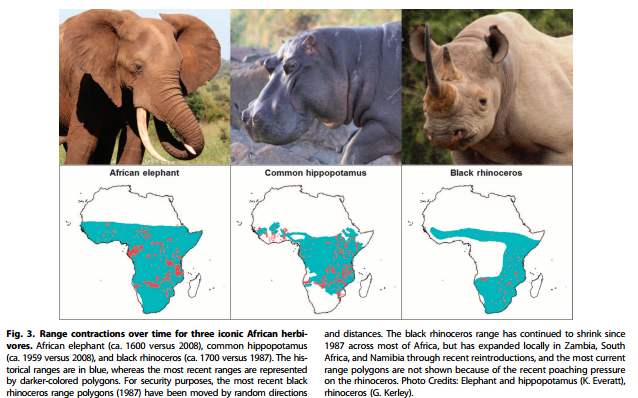
Even in the relatively recent past, the area of land over which these animals roamed has drastically declined. Maps published in a new paper in the journal Science Advances show that elephants, hippos and black rhinos occupied most of sub-Saharan Africa when their populations were first encountered by modern Europeans, but are now confined to a few tiny specks of land.
From William J. Ripple et al, 1st May 2015. Collapse of the world’s largest herbivores. Science Advances. 2015;1:e1400103
Why do the very large animals prove most susceptible to destruction? It’s partly because they reproduce slowly and partly because they require plenty of land and food for their survival, so the destruction of wild places tends to hit them sooner than it affects smaller species. But it’s also, I believe, because we have a deep-rooted urge to assert our status by killing them and owning their body parts. Even when people don’t do the killing themselves, possessing their skins, heads, tusks or horns has long been a means of acquiring bragging rights.
From the exquisite sculpture of two reindeer migrating across a river, carved from a piece of mammoth ivory 13,000 years ago and now housed in the British Museum, to the tiger skin rugs and heads of exotic beasts exhibited in stately homes today, bigging ourselves up by displaying our mastery of great beasts seems to be a fundamental human trait. Today’s aristocrats, some of whom are descendants of tribal chiefs, hang their ancestors on the wall to establish their genealogy and the heads of the animals they have killed beside them, to establish their prowess. Not much has changed in thousands of years.
Many of the world’s great sagas, tales of Ulysses, Sinbad, Sigurd, Beowulf, Cú Chulainn, St George, Arjuna, Lạc Long Quân and Glooskap, tell of struggles with megafauna real or imagined. Doubtless at least some of these stories originated in real battles with beasts whose true nature has been forgotten, as a result of their extinction. Think of Sinbad and the roc, which might be a garbled version of encounters with the elephant bird of Madagascar.
Today, some very rich people try to recreate these battles in ways that seem to me grotesque. They bid on the internet for the right to shoot a particular animal, sometimes paying tens of thousands of dollars, arrange a date, a time and a place, then fly over, in some cases with their taxidermists in tow, to bag the creature they have bought.
The animal is waiting for them – sometimes in an enclosure, sometimes just after being released from one, sometimes in the wild but already located by guides. There is no question about the outcome; otherwise the money would have to be repaid. I have heard that in some cases these people fly to a country for just a couple of days, during which they have booked the killing of several spectacular animals. Their diary secretaries arrange their schedules so that they can fit them all in. Once they have posed triumphantly with a foot on the beast they have just killed, they leave it for the taxidermist to process and move on to the next appointment with death.
This looks to me as dry and joyless as it is brutal and unsporting. Though I would struggle nowadays to bring myself to shoot a mammal or a bird (in my youth I killed and ate a few rabbits, squirrels and pigeons), I can understand the attraction of doing so in difficult circumstances, stalking and crawling and lying in wait much as a wild predator would. Canned, predetermined hunting of this kind seems empty of challenge and romance, bought rather than won. But such is the drive to establish dominion over the largest and most magnificent of beasts, and such is the obsession with conspicuous outcomes, that, for some people, none of this appears to matter.
Others are satisfied to remove themselves even further from contingency, by purchasing pieces of animals that have already been killed. My guess is that the use of rhino horn, tiger bones and other such body parts in traditional Chinese medicine, which are of course clinically useless, might be another manifestation of this deep-rooted drive, to make ourselves feel better by association with creatures larger or fiercer than ourselves.
You might have imagined that there were now plenty of alternative means of asserting our status and persuading ourselves of our own value, but traits that resonate with our evolutionary past – our ghost psyche – die hard.
So this great global tragedy continues. I know I should write about it more often. But I find it too upsetting.
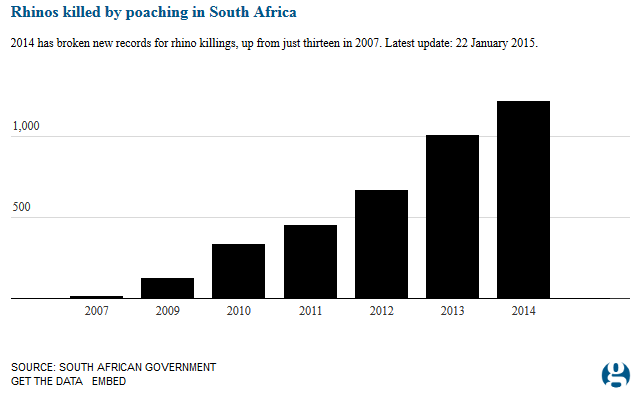
Until 2008, conservationists, in some places at least, appeared to be winning. But in that year the number of rhinos killed in South Africa rose (from 13 in 2007) to 83. By 2011, the horrible tally had risen to 448. It climbed to 668 in 2012, 1004 in 2013 and 1215 in 2014. In the first four months of this year, 393 rhinos have been killed there, which is 18% more than in the same period last year.
The reasons for this acceleration in the Great Global Polishing are complex and not always easy to tease out. But they appear to be connected to rising prosperity in Vietnam, the exhaustion of illegal stocks held by Chinese doctors and, possibly, speculative investment in a scarce and tangible asset during the financial crisis. Corruption and judicial failure help to keep the trade alive.
Already, the western black rhino is extinct (the declaration was made in 2011). The northern white rhino has been reduced to five animals: a male at the end of its anticipated lifespan and four females, scattered between Kenya, the US and the Czech Republic.
Similar stories can be told about some populations of elephants – in particular the forest elephants of West and central Africa.
It’s not just these wonderful, enchanting creatures that are destroyed by poaching, but also many of the living processes of the places they inhabit. Elephants and rhinos are ecological engineers, creating conditions that hundreds of other species have evolved to exploit.
As the paper in Science Advances notes, the great beasts maintain a constantly shifting mosaic of habitats through a cycle of browsing and toppling and trampling, followed by the regrowth of the trees and the other plants they eat. They open up glades for other herbivores, and spaces in which predators can hunt. They spread the seeds of trees that have no other means of dispersal (other animals are too small to swallow the seeds whole, and grind them up). Many trees in Africa and Asia are distributed exclusively by megaherbivores.
They transport nutrients from rich places to poor ones and in some places reduce the likelihood of major bushfires, by creating firebreaks and eating twigs and leaves that would otherwise accumulate as potential fuel on the ground. Many animal species have co-evolved with them: the birds that eat their ectoparasites, the fish that feed on hippos’ fighting wounds (some of these species, I believe, are now used for fish pedicures), the wide range of life that depends on their dung for food and moisture, on their wallows for habitats, on the fissures they create in trees for nesting holes.
Who knows what ecological processes the world has already lost through the retreat of the megafauna? Everywhere on earth, living systems have been radically altered by the loss of the great beasts. (I’ll be discussing the impacts of the extinction of European elephants in next month’s edition of BBC Wildlife magazine).
The destruction of some of the last populations of the animals that shaped us, as well as the natural world, inflicts, I feel, a great wound in our lives, diminishing the wonderful planet on which we evolved, shrinking imagination, crushing experience. All of us should have an interest in supporting those who seek to save these wonderful creatures.
Dear Reader, I don’t intend to cast you in some dark mental place with the republication of this dark essay from Mr. Monbiot. Yet if you care about the world that we are leaving for the next generation, and I’m certain that the majority, the vast majority, of you readers do so care, then these terrible aspects of humanity must be highlighted. For if just one person is moved to make a difference then the mental pain is a necessary step on that journey of making a difference.
“Always search for the rainbow – it’s there somewhere. If
Loving the animals on this planet must be more than a romantic notion.
Before you read on, take a small break in your busy day and watch the following:
On December 8, 2013 Michael Mountain spoke on “”I Am Not an Animal” — The Signature Cry of our Species” at the Personhood Beyond the Human conference at Yale University.
Michael Mountain is Past President and one of the founders of Best Friends Animal Sanctuary, the nation’s largest sanctuary for abused and abandoned animals.
Abstract: The past 50 years have seen enormous growth in the animal protection movement. But the situation for nonhuman animals in every sphere, with the exception of homeless pets, continues to deteriorate. Any small advances remain incremental. Animal rights and welfare groups find themselves at a loss to explain their inability to influence the general public. But the work of Ernest Becker (The Denial of Death) and of psychologists in the field of Terror Management Theory (TMT) offer essential insight.
In this talk, we discuss how our need, as humans, to proclaim that “I am not an animal!” and to deny personhood to other animals affects our relationship with them at a fundamental level. We argue that to be effective, the animal protection movement needs to understand TMT and take it into account. And we conclude that a new kind of relationship to the world of nature in the 21st Century is not only essential to the mitigation of the catastrophic effects of the Sixth Great Extinction, but that it also holds the key to Becker’s still-unanswered question of how we can begin to relate positively to our own terror of personal mortality — and therefore our own future as a species.
Me spending time becoming better acquainted with the subject of rights for other animals besides us humans coincided with a recent item published over on The Conversation and republished here within their rights.
ooOOoo
May 19 2015, 4.05pm EDT
Climbing the tree: the case for chimpanzee ‘personhood’
Should primates such as chimpanzees be given rights normally reserved for humans? phil/Flickr, CC BY-NC-SA
Hercules and Leo don’t know it, but a decision about their future has made history. In granting an order to show cause on whether Hercules and Leo (who just happen to be chimpanzees) are illegally imprisoned, a Supreme Court judge in Manhattan has kept open the possibility that some nonhuman animals will be granted legal rights under common law.
The plaintiffs are currently used for biomedical research at New York’s Stony Brook University. What the lawyers running the case hope to show is that Hercules and Leo shouldn’t be treated as if they were just things or property, but should instead be given the status of persons.
Showing that any animal has what is needed for legal personhood is a difficult task. But chimpanzees seem promising candidates as there is a wealth of scientific evidence showing they possess complex cognitive abilities, like self-awareness and autonomy.
The order to show cause on the issue of habeas corpus is the first step in a process which Steven Wise and the Nonhuman Rights Project (NhRP) hope will secure Hercules and Leo’s bodily liberty and integrity.
If the court were to find in their favour, the chimpanzees would no longer be kept for research and could be moved to a sanctuary in Florida.
NhRP was founded by Wise in 2007 and after years of research it filed its first cases back in December 2013. To date it has brought three cases on behalf of chimpanzees held in captivity in the state of New York. But NhRP is ambitious, aiming to run as many cases on behalf of animals as it can fund.
If it can find suitable plaintiffs, NhPR hopes to mount cases for the personhood of elephants, whales and dolphins too.
Different perspectives on personhood for animals
Reactions to treating nonhuman animals as persons vary widely. Some people think it is ridiculous to even entertain the idea. Persons have to be human – end of story.
For philosophers, this is not very satisfactory. It tries to answer the question of whether animals can be persons by asserting a definition rather than offering an argument. It gets more interesting when people give reasons to support their view.
One approach to defending the idea that only humans are persons involves saying that persons need to participate in society. Society is founded on reciprocity; you can’t just take rights without also assuming responsibilities. And animals like chimpanzees can’t take on responsibilities, so they can’t have rights.
Another tactic is to suggest that there is a whole heap of criteria that one has to meet to be a person. And although humans meet these criteria, nonhuman animals don’t. These criteria could include things like being rational, self-aware, autonomous, having culture and being able to communicate.
The problem is neither of these kinds of arguments stand up to interrogation. There are lots of humans who get the benefit of rights without living up to reciprocal responsibilities, such as young children and people with certain physical or mental impairments.
There are similar difficulties when using a criteria based approach. Just as there are many humans who don’t meet certain criteria for personhood, there are some nonhuman animals who do.
This is known as the “problem of marginal cases”. Taking a consistent approach would mean treating some animals, but not all humans, as worthy of moral consideration.
This is known as the “problem of marginal cases”. Taking a consistent approach would mean treating some animals, but not all humans, as worthy of moral consideration.
There are other people who are sympathetic towards giving greater ethical consideration to animals, but who don’t think using personhood is the best approach. Utilitarians, for example, worry about the capacity to suffer. If a chimpanzee – or for that matter a dog, cat or rat – can experience pleasure and pain, then they matter regardless of whether they meet a test for personhood.
Implications of nonhuman animals as persons
If Wise and the NhRP win their case it will be a significant precedent and other cases will surely follow. Chimpanzees in jurisdictions where successful cases are mounted will no longer be permitted to be used in research or kept in zoos and circuses.
However, less charismatic animals – ones that don’t look like us or where it is not in our interests to grant them rights – won’t be so fortunate. Historically, there is a deep inconsistency in how we treat different types of animals that is not easily overturned, even in the face of compelling legal and ethical arguments.
The case of Hercules and Leo also has connections to Australia. Wise was inspired to practice animal law back in the 1980s after reading the work of Australian philosopher, Peter Singer. The hearing of the case in New York was actually interrupted due to Wise’s long-standing commitment to visit Australia and deliver the 2015 Voiceless Animal Law Lecture Series.
The hearing is now scheduled for 10:30am Wednesday May 27 at the New York County Supreme Court. Those interested in seeking rights for nonhuman animals keenly await the outcome.
ooOOoo
Towards the end of that piece, one sentence stood out. This one: “Historically, there is a deep inconsistency in how we treat different types of animals that is not easily overturned, even in the face of compelling legal and ethical arguments.“
Well it has to be overturned if mankind is to have any future on this planet!
Yet another aspect of our lives where taking a lesson from our dogs would do us no harm.
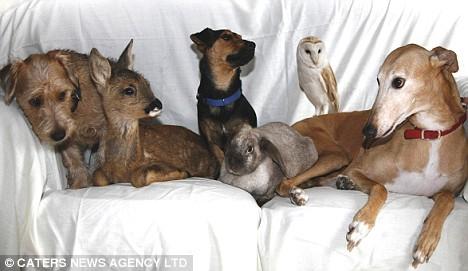
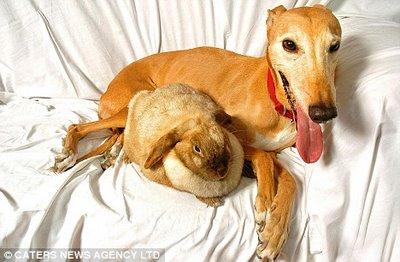
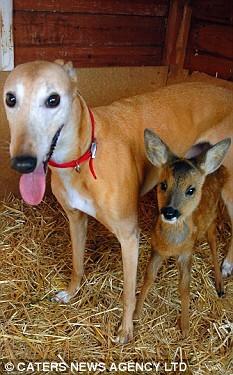
Pictured left to right are: “Toby”, a stray Lakeland dog; “Bramble”, orphaned roe deer; “Buster”, a stray Jack Russell; a dumped rabbit; “Sky”, an injured barn owl; and “Jasmine”. All told a mother’s heart doing best what a caring mother does.
This could be the most important lesson we learn from our dear dogs.
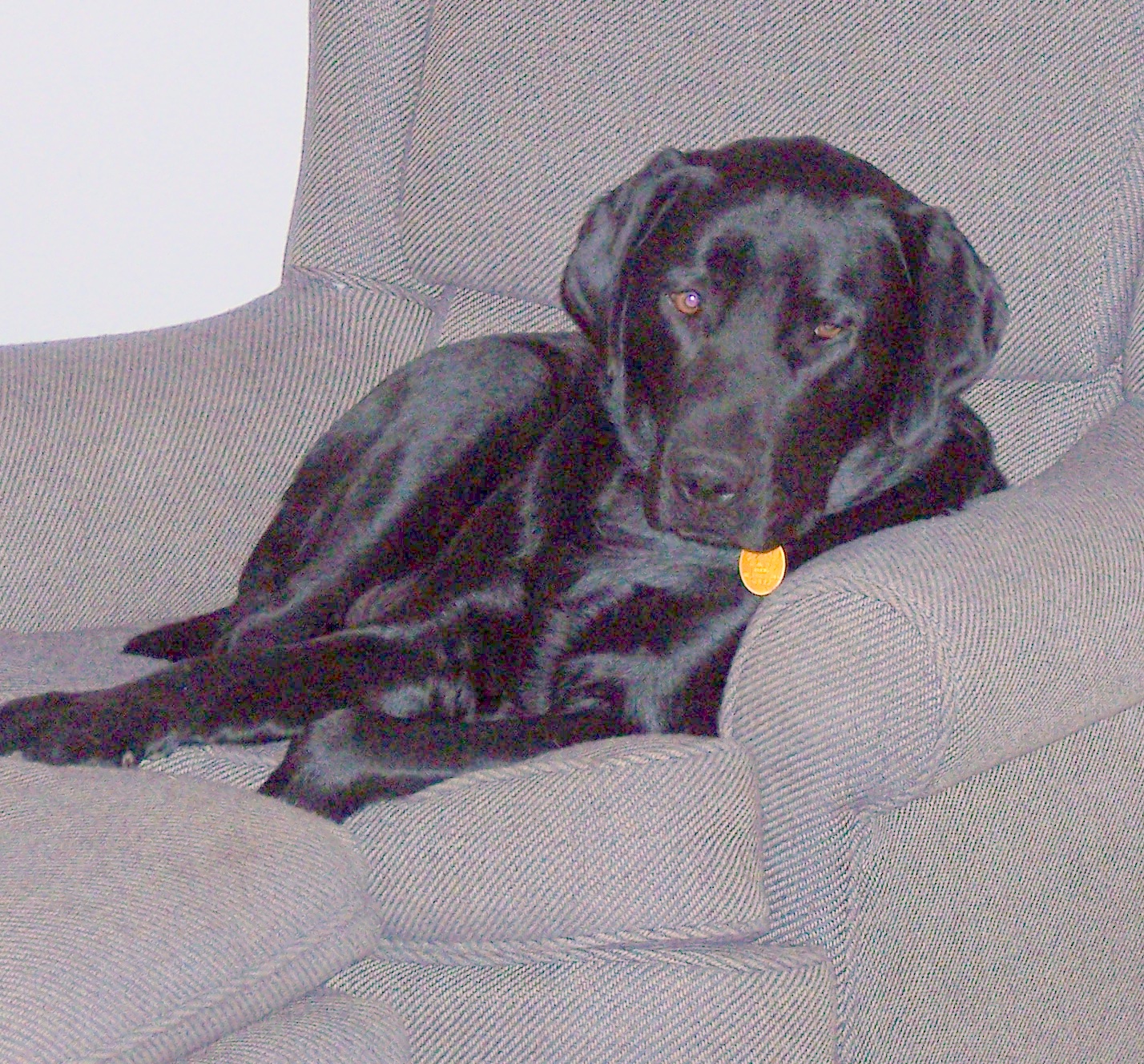
Reclining Clyde
Our immediate neighbours to the South of us, Larry and Janell, lost one of their dogs last Saturday. Here’s the email that was sent out by Larry:
Bad day at the ranch
We lost Clyde today. A neighbor who is a veterinarian came by this morning and did the deed. He had cancer in his shoulder, we had a tumor removed a couple of months ago but there must have been some left because his left front became totally unusable and then his left rear started to go too. We tried everything that the vets could come up with but it was starting to eat him up.
He was born in central South Dakota at a cattle ranch where I got him in April 2004, a six week old black bundle of wrinkles. He learned his manners from Barney, who we lost a little over 2 years ago from cancer as well. Barney and Clyde, what a GREAT pair!!
We still have Baxter the Aussie, who has pretty well recovered from getting hit by a car and severely injured the beginning of last month and Bob the cat.
I will miss Clyde terribly, just like I have ALL my labs! They are wonderful dogs. Just thinking that I’ll probably never have another big floppy eared pal like that makes me want to just cry my eyes out!!
One of the fondest memories of my life is/was going bird hunting, especially ducks, and having a well mannered lab as my partner!! I’ve shared time and my lunch with some good ones!! I so very much wish/hope that there really is a “RAINBOW BRIDGE”!!
Jean and I obviously knew Clyde and can confirm that he was the most gentle, kind-hearted dog one could find.
I wanted to treasure the memory of Clyde, on behalf of all the dear dogs in the world, and asked Larry and Janell if they would be comfortable with me publishing the email. They replied without hesitation that it was fine and then sent me some photographs of Clyde to include in this post.
———-
So the easy course for this post would be to leave it at this and move on. (And, please, if you are not up for a degree of introspection from yours truly, then do stop reading at this point!)
———-
But when I awoke this morning (Tuesday), a little after 5am, Jean still asleep next to me, three dogs likewise across the bed, and knowing I would be writing about Clyde later on in the day, I started to reflect on life and death and was there a lesson for us humans in the death of our beloved dogs. When Jean awoke an hour later, I asked her how many of her dogs had died over the years. She replied that there had been at least twenty dogs that had died and that she could remember each and every one of them.
That then opened up a much deeper reflection on death and whether our dogs really can offer us a lesson in this regard. For I’m not ashamed to admit that at times I feel scared about the future. I’m 70-years-old, seeing the signs of what the medics call ‘cognitive ageing’, have a few minor challenges in the areas of prostate, blood pressure, thyroid, and know how terribly unprepared I am for the second of life’s two certainties: death.
Jean’s view was that dogs have the ability to live so perfectly in the present that, except in very rare occasions, they don’t grieve for the loss of a loved one. Clearly, a significant difference between dogs and us humans.
Then it was clear that we humans only grieve for the death of someone we knew. That within the family that rarely extended back beyond our grand-parents. That seemed to offer some philosophical help. For if it comes down to the memories that others will have of us, after we have died, then it behoves us to live the best life we can, doing our best at every stage in our lives. Accepting that it is impossible not to make mistakes and end up with regrets, yet so long as we try to be true to ourselves then that’s all that matters.
It was then a very small onward step to love and the potential for the greatest learning from our dogs. For dogs so frequently show us the magic of unconditional love.
Back to Clyde.
Here are two other photographs of dear Clyde, separated by the words in Larry’s covering email.
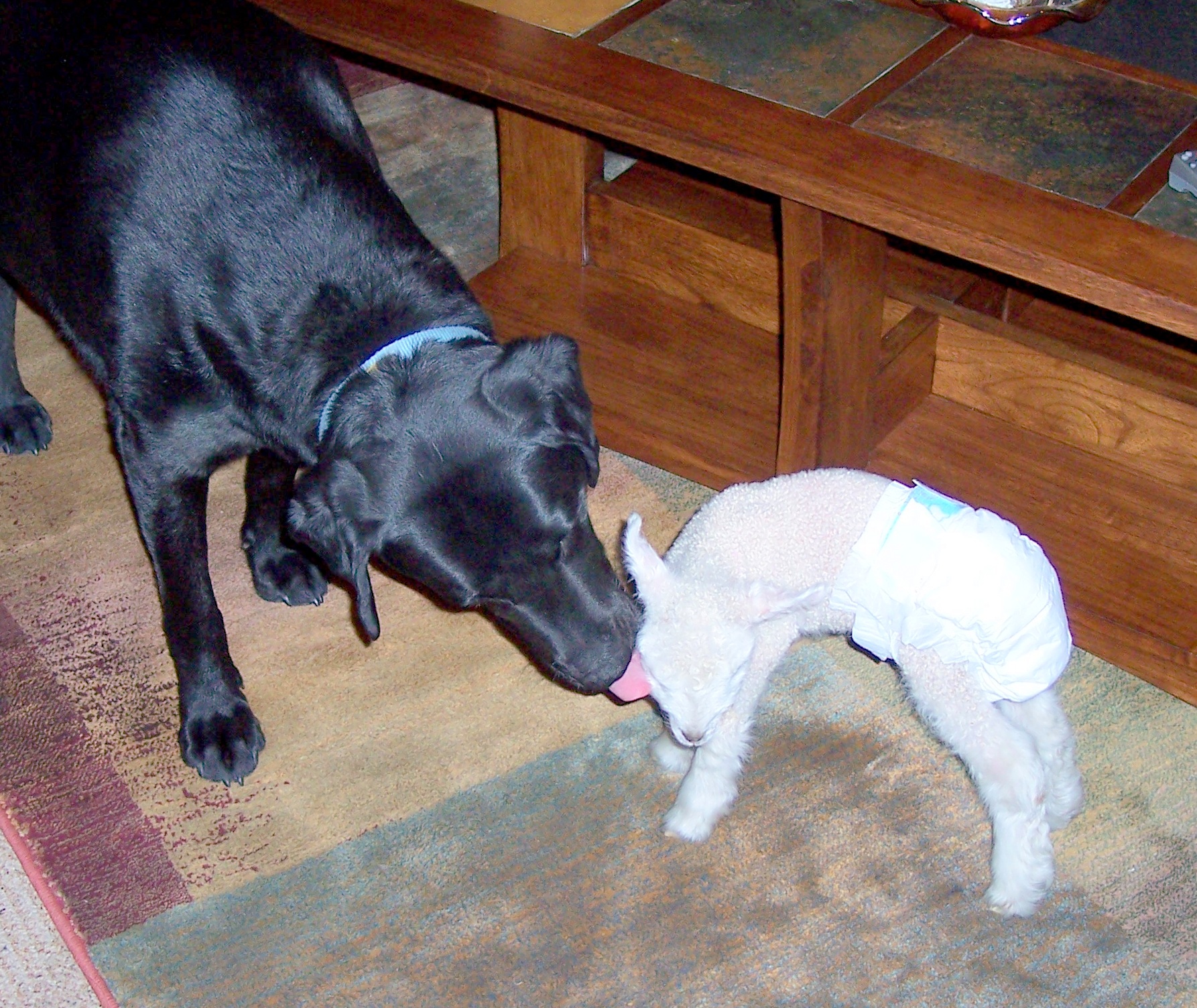
Clyde cleaning Pearl the lamb.
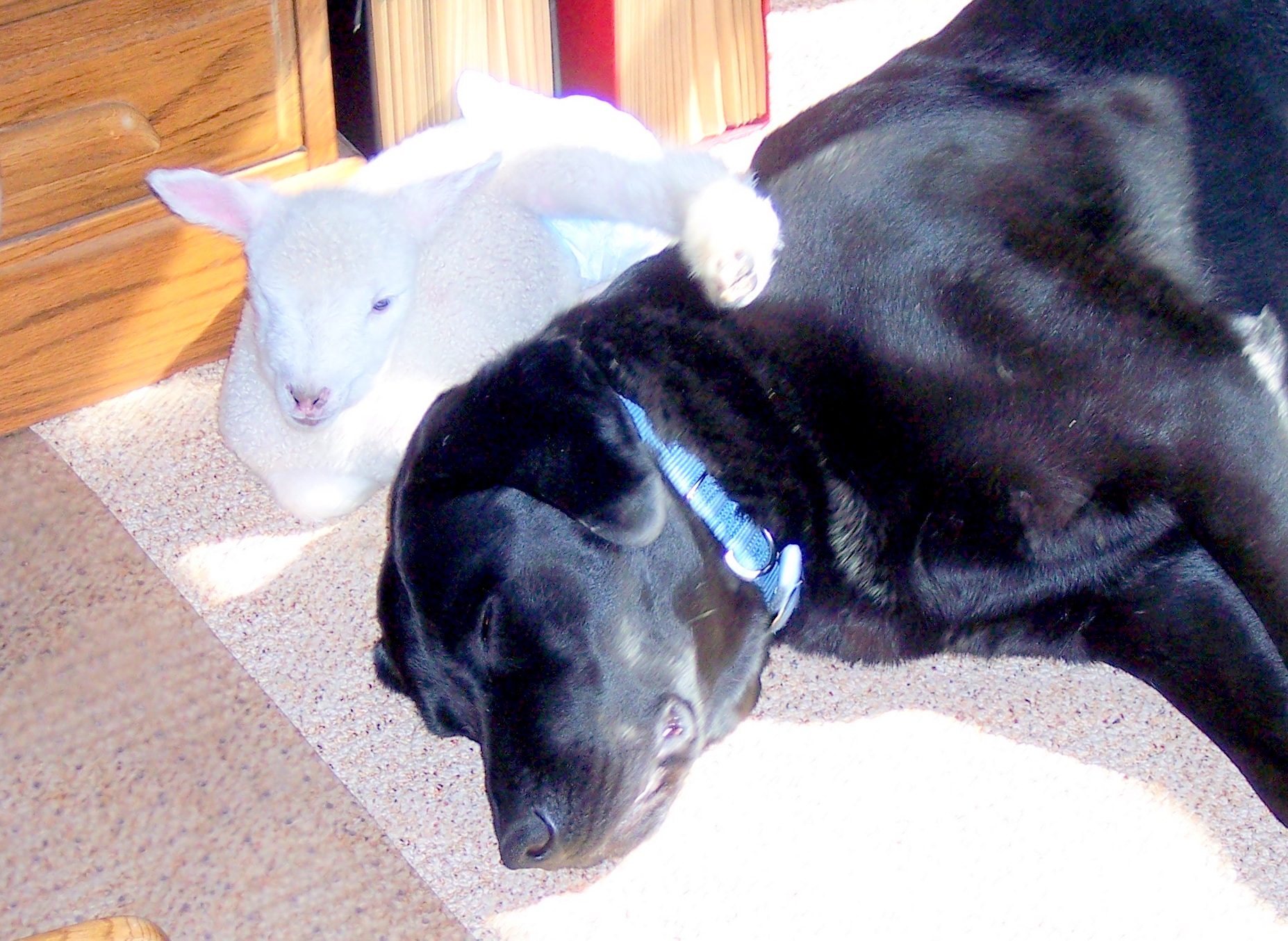
Paul, here are a few pictures of Clyde. Feel free to use what you like. We always said Clyde had a big heart, big stomach and no ambition as evidenced by these pictures! At one time we were nursing an orphan lamb in the house, Clyde adopted the lamb, Pearl, and looked after her, Larry.
Clyde and Pearl demonstrating a dear friendship.
I know that when our Lilly dies, she is 17, Jean will weep many tears.
I know that when our Pharaoh dies, he is soon to be 12, I will weep many tears.
But those pictures of Clyde remind all of us that it is in life that it is important to love. Important, almost beyond words, to be kind to others, to offer and receive love, and to treasure the present.
So, yes, we must shed a few tears of the heart yet thereafter we must treasure the memories.
“For if we cry at losing the sun, our tears will hide the light of the stars.”
Just a very beautiful true story. (And I am indebted to Suzann for sending it on to me.) One couldn’t ask for a better post to follow on from yesterday’s Picture Parade theme on parenting.
ooOOoo
The Greyhound
In 2003, police in Warwickshire, England, opened a garden shed and found a whimpering, cowering dog. The dog had been locked in the shed and abandoned. It was dirty and malnourished, and had quite clearly been abused.
In an act of kindness, the police took the dog, which was a female greyhound, to the Nuneaton Warwickshire Wildlife Sanctuary, which is run by a man named Geoff Gruecock, and known as a haven for animals abandoned, orphaned, or otherwise in need.
Geoff and the other sanctuary staff went to work with two aims: to restore the dog to full health, and to win her trust. It took several weeks, but eventually both goals were achieved. They named her Jasmine, and they started to think about finding her an adoptive home.
Jasmine
Jasmine, however, had other ideas. No one quite remembers how it came about, but Jasmine started welcoming all animal arrivals at the sanctuary. It would not matter if it were a puppy, a fox cub, a rabbit or, any other lost or hurting animal. Jasmine would just peer into the box or cage and, when and where possible, deliver a welcoming lick. Geoff relates one of the early incidents. “We had two puppies that had been abandoned by a nearby railway line. One was a Lakeland Terrier cross and another was a Jack Russell Doberman cross. They were tiny when they arrived at the centre, and Jasmine approached them and grabbed one by the scruff of the neck in her mouth and put him on the settee. Then she fetched the other one and sat down with them, cuddling them.” “But she is like that with all of our animals, even the rabbits. She takes all the stress out of them, and it helps them to not only feel close to her, but to settle into their new surroundings. She has done the same with the fox and badger cubs, she licks the rabbits and guinea pigs, and even lets the birds perch on the bridge of her nose.” Jasmine, the timid, abused, deserted waif, became the animal sanctuary’s resident surrogate mother, a role for which she might have been born. The list of orphaned and abandoned youngsters she has cared for comprises five fox cubs, four badger cubs, fifteen chicks, eight guinea pigs, two stray puppies and fifteen rabbits – and one roe deer fawn. Tiny Bramble, eleven weeks old, was found semi-conscious in a field. Upon arrival at the sanctuary, Jasmine cuddled up to her to keep her warm, and then went into the full foster-mum role. Jasmine the greyhound showers Bramble the roe deer with affection, and makes sure nothing is matted. “They are inseparable,” says Geoff. “Bramble walks between her legs, and they keep kissing each other. They walk together round the sanctuary. It’s a real treat to see them.” Jasmine will continue to care for Bramble until she is old enough to be returned to woodland life. When that happens, Jasmine will not be lonely. She will be too busy showering love and affection on the next orphan or victim of abuse. Pictured left to right are: “Toby”, a stray Lakeland dog; “Bramble”, orphaned roe deer; “Buster”, a stray Jack Russell; a dumped rabbit; “Sky”, an injured barn owl; and “Jasmine”. All told a mother’s heart doing best what a caring mother does.
ooOOoo
It was but a moment to find a video about Jasmine over on YouTube:
We are completely self funded. We receive no financial backing and so have to raise every single penny towards the upkeep of the sanctuary. It costs on average £360 per week to keep the sanctuary open, and a further £120 per week on food and bedding for the animals in our care. Please help us continue to rescue and rehabilitate Britain’s wildlife.
If you go to this link you can see what would be the best donation method for you. Plus, because the Sanctuary is not open for callers on Sundays I will call today (Monday) * and see if there are more details about the best way to offer support from those living outside the UK. Unconditional love is so perfectly demonstrated by our incredible dogs.
* I did call and speak with Catherine who recommended PayPal as the best means of donating to their cause, especially for those outside the UK.
36 golden retrievers rescued from streets of Turkey
Rescuers in Atlanta shower the lucky pups with love, medical attention and playtime.
By: Mary Jo DiLonardo
Tue, May 12, 2015 at 04:00 PM
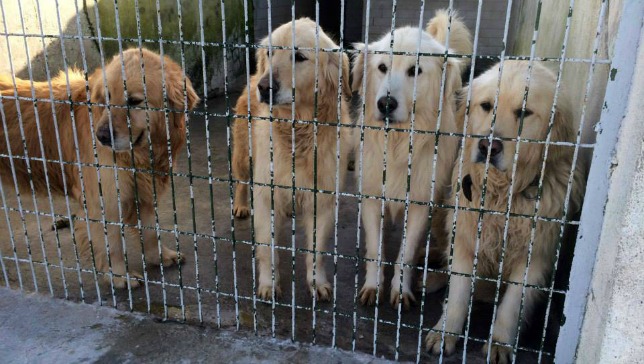
Golden retrievers are packed into an animal shelter in Turkey before being rescued and flown to Atlanta. (Photo: Adopt a Golden Atlanta/Facebook)
Three dozen abandoned golden retrievers made the long trek from the streets of Istanbul, Turkey, to an Atlanta suburb this week thanks to the efforts of an animal rescue group.
The dogs were discovered by an American living in Turkey, who said she saw them living on the streets and taking over shelters. The breed was once considered a status symbol, but as the dogs became more prolific, their popularity waned and the pets were quick to be discarded. On the harsh streets of Istanbul, the gentle dogs didn’t fare well against vicious feral dogs.
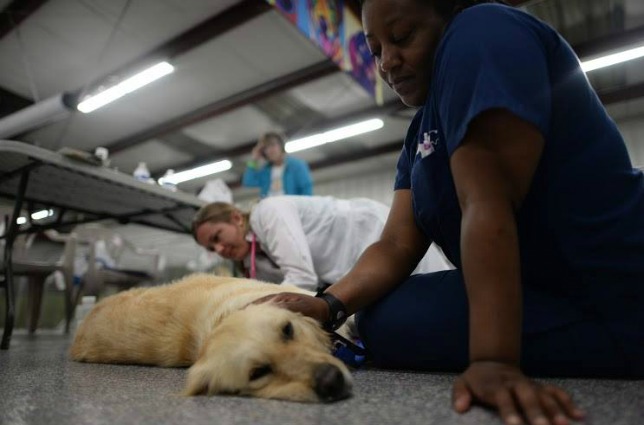
Adopt a Golden Atlanta arranged for 36 of the dogs to be flown to the U.S. where they’re now housed at the Pet Lodge Pet Resort in Alpharetta, an Atlanta suburb. They’ve been given medical attention, baths and lots of playtime. Although they don’t yet understand English commands, volunteers say they seem happy with all the attention — wagging tails all around.
[See footnote]
The goldens made a 12-hour flight and seven-hour layover to get to their new home. They range in age from 6 months to 10 years.
The pups should be available for adoption in a few weeks, and they already have names, says Adopt a Golden founder Lauren Genkinger, who spearheaded the rescue effort.
“They’re the freedom dogs and all of them have been given names, Freedom, Patriot, Liberty, Glory…” Genkinger told WXIA TV in the video above. “It wasn’t easy coming up with 36 patriotic names. The only thing missing from this story … is someone to call America in from the yard … to dinner.”
A golden retriever is examined in Atlanta after arriving from Turkey. (Photo: Adopt a Golden Atlanta)
ooOOoo
Footnote:
There is a two-minute video in the MNN version that I was unable to transport over to here. It may be watched here.
There was an item on the BBC News website yesterday morning that jumped out at me. The BBC headline is my sub-title for today. Here’s how the BBC opened that item:
Actor Johnny Depp has been told he has until Saturday to remove his dogs from Australia or they will be put down.
Depp and his wife Amber Heard are accused of not declaring Yorkshire Terriers Boo and Pistol to customs officials when they flew into Queensland by private jet last month.
Australia has strict animal quarantine laws to prevent importing infections.
Agriculture Minister Barnaby Joyce said he understood the dogs were being sent back to the US.
The dogs were discovered when a picture was posted of them at grooming parlour.
Later on that BBC report mentioned:
An online petition to save the “cute dogs” had received nearly 5,000 signatures by late on Thursday local time in Australia.
“Have a heart Barnaby! Don’t kill these cute puppies,” it appealed.
OK, Mr. Depp was a silly boy but his mistake must not be paid for with the lives of these wonderful dogs.
That petition is over on Change.org and here is the direct link. You will read these details.
There’s just 48 hours before Johnny Depp’s two puppies Boo & Pistol could be euthanised by Australian authorities. Please help save them!
Johnny Depp brought them to Australia with him to shoot the next Pirates of the Caribbean.
But today Agriculture Minister Barnaby Joyce has said that because he didn’t follow particular travel rules that he’ll seize and destroy them by the weekend if they’re not removed from Australia.
This seems so extreme and unnecessary. He shouldn’t kill these cute dogs simply because Depp didn’t follow particular rules.
Help me tell Barnaby Joyce not to kill or remove Johnny Depp’s dogs from Australia!
Have a heart Barnaby! Don’t kill these cute puppies.
While Jean and I no longer attend meetings of the Southern Oregon Beekeepers Association, the meetings are a little too far away for us, I still subscribe to their email updates. Thus that’s how I was informed of a most incredible set of photographs on the National Geographic website. Here’s how the article opens:
Researchers take advantage of photography technology developed by the U.S. Army to capture beautiful portraits of bees native to North America.
Text by Jane J. Lee
Photography by Sam Droege, USGS
Bees are the workhorses of the insect world. By transferring pollen from one plant to another, they ensure the next generation of the fruits, nuts, vegetables, and wildflowers we so enjoy.
There are 4,000 species of North American bees living north of Mexico, says Sam Droege, head of the bee inventory and monitoring program at the U.S. Geological Survey (USGS).
Only 40 of them are introduced species, including the European honeybee. (See “Pictures: Colored Honey Made by Candy-Eating French Bees.”)
Most of the natives are overlooked because “a lot of them are super tiny,” Droege says. “The bulk of the bees in the area are about half the size of a honeybee.”
The native species also go unnoticed because they don’t sting, he adds. They quietly go about their business gathering pollen from flowers in gardens, near sand dunes, or on the edges of parks.
The bee pictured above is a species of carpenter bee from the Dominican Republic known as Xylocopa mordax. It nests in wood or yucca stems, and is closely related to the U.S. species that chews through the wood in backyard decks.
Trust me when I say that to view these images, and more, in their breathtaking beauty you need to go here and revel in what you see and read. Plus, in the text above I didn’t include the many links that are in the Nat Geo site’s version – so go there!
The natural world is so deserving of man’s care and protection.