We watched recently a documentary on Netflix about the special attributes of our pets. It was very good but one thing that we learnt was that dogs have on the tips of their snouts an area that can pick up warmth. Because when dogs are tiny puppies and still blind they find their mothers’ teats by homing in on the warmth of the mother’s body.
Many people are aware of the scenting ability of the dog. To quote: “While humans have about five million olfactory receptors in their noses, dogs are said to have around 300 million.”
(Read that article that I linked above for it is very good.)
ooOOoo
Senior Dog Patiently Waits For Boops In The Same Place Day After Day
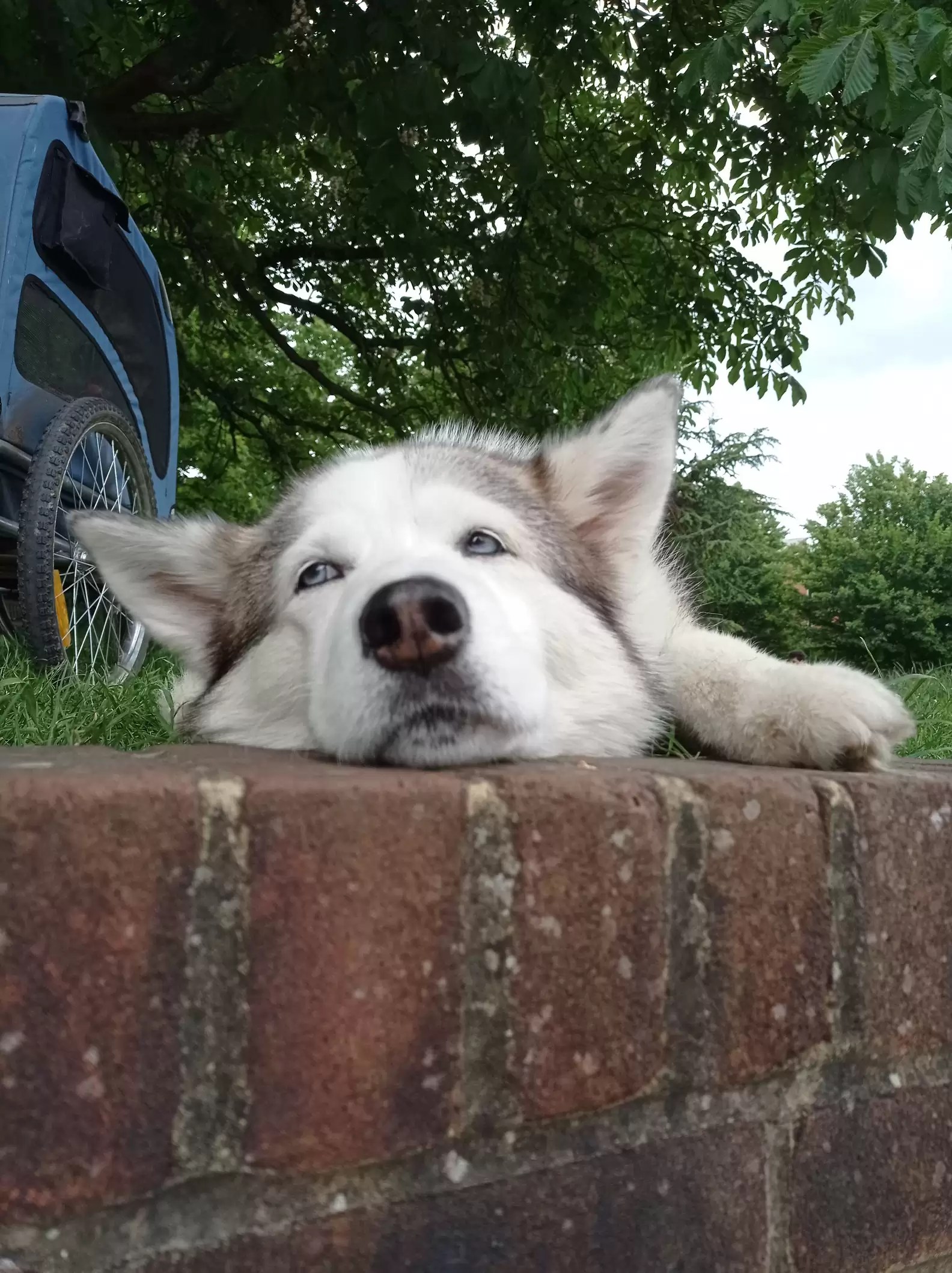
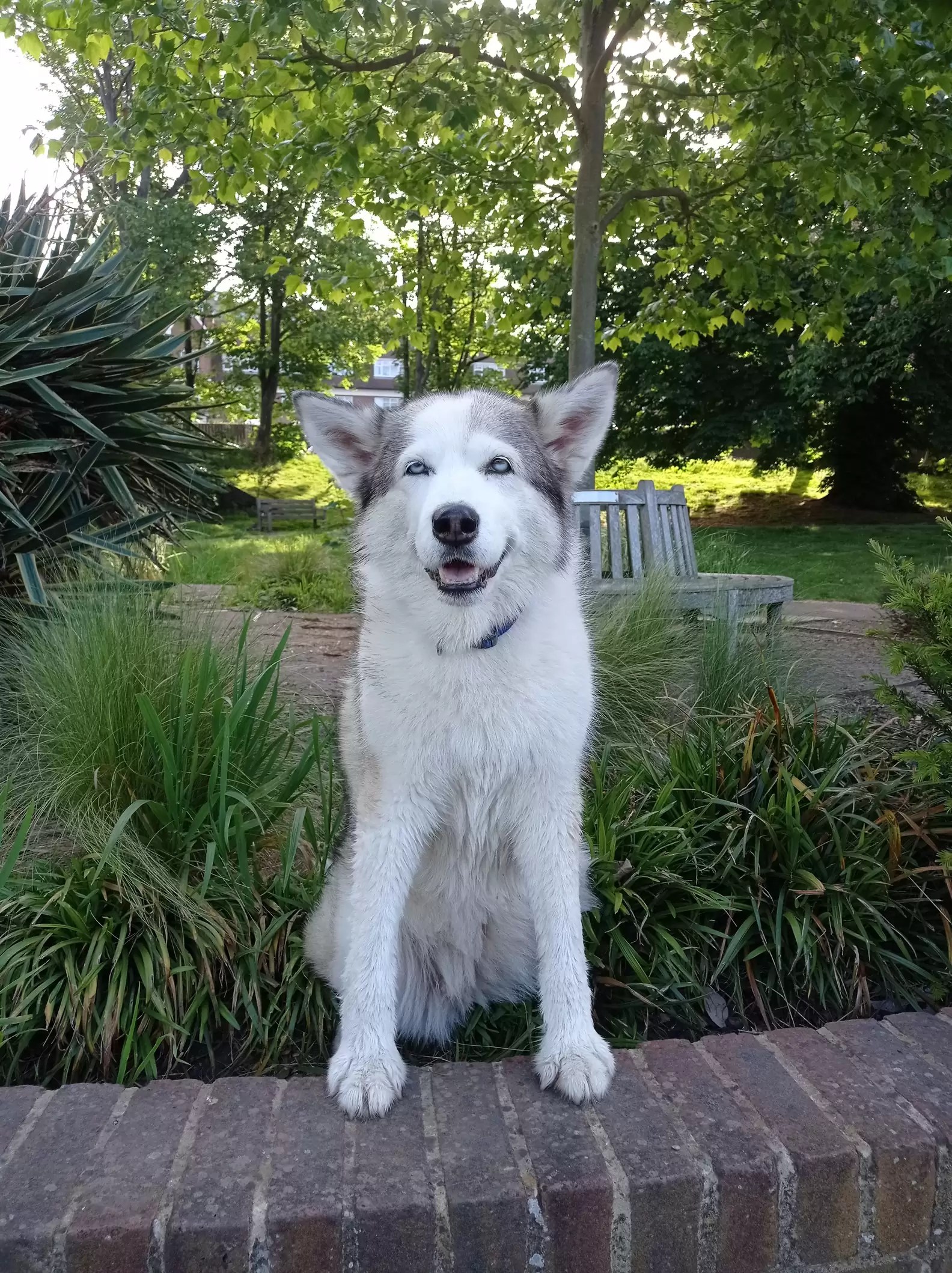
One of Hime’s favorite pastimes is a simple one: sit near a nature path and patiently wait for nose boops. The 13-year-old Siberian husky figured out long ago that, eventually, she’ll get what she came for.
“She likes that spot so she can watch the world go by,” David Nagadhana, Hime’s dad, told The Dodo. “But she has other strategies.”
Hime, who was adopted as a puppy, hitches a ride in Nagadhana’s bike trailer to get to the best petting spots.
“I cycle her because of her arthritis,” Nagadhana said. “Gentle in her old age, [Hime] looks for affection anywhere she can find it.”
The husky’s place of choice is by the Thames in Richmond, England, but Nagadhana takes her wherever she seems happiest.
“She loves finding new and interesting and exciting locations so that she may proceed to nap in them,” Nagadhana said. “She finds it relaxing enough to nod off on occasion.”
Nagadhana and Hime do everything together, and it won’t stop anytime soon.
“She was there for me when life ground to a halt during the pandemic,” Nagadhana said. “I’ll be there for her until the end. Raising dogs is like a rainbow. Puppies are the joy at one end, old dogs are the treasure at the other.”
Needless to say, Hime gets endless boops from her favorite person: Dad.
(All photographs by DAVID NAGADHANA.)
ooOOoo
One turns to the American Kennel Club for information about the breed, as in the Siberian Husky, and this is what is found:
Siberian Husky, a thickly coated, compact sled dog of medium size and great endurance, was developed to work in packs, pulling light loads at moderate speeds over vast frozen expanses. Sibes are friendly, fastidious, and dignified. The graceful, medium-sized Siberian Husky’s almond-shaped eyes can be either brown or blue ‘and sometimes one of each’, and convey a keen but amiable and even mischievous expression. Quick and nimble-footed, Siberians are known for their powerful but seemingly effortless gait. Tipping the scales at no more than 60 pounds, they are noticeably smaller and lighter than their burly cousin, the Alaskan Malamute. As born pack dogs, they enjoy family life and get on well with other dogs. The Sibe’s innate friendliness render them indifferent watchdogs. These are energetic dogs who can’t resist chasing small animals, so secure running room is a must. An attractive feature of the breed: Sibes are naturally clean, with little doggy odor.
I am republishing an item from the American Kennel Club on the subject.
Oliver has a very special relationship with me. Plus Jean loves him just as much. That is not to say that he isn’t very friendly with other humans that he knows but there’s something that I have trouble putting into words when it comes to the bond between me and Oliver.
It is very, very special and truly magical.
I am reminded of this bond between Oliver and me because of a post that I want to republish.
Emotional support dogs (ESAs) are pets and not service dogs.
Mental health professionals prescribe emotional support animals under the law.
Airlines are no longer required to accommodate emotional support animals.
Every dog owner knows there are many benefits to having a dog, from getting themselves out for exercise to receiving loyal companionship. However, for some people with mental or emotional conditions, the presence of a dog is critical to their ability to function normally on a daily basis. The pet provides emotional support and comfort that helps them deal with challenges that might otherwise compromise their quality of life. These pets are known as emotional support animals (ESAs).
What Is an Emotional Support Dog?
Although all dogs offer an emotional connection with their owner, to legally be considered an emotional support dog, also called an emotional support animal (ESA), the pet needs to be prescribed by a licensed mental health professional to a person with a disabling mental illness. A therapist, psychologist, or psychiatrist must determine that the presence of the animal is needed for the mental health of the patient. For example, owning a pet might ease a person’s anxiety or give them a focus in life. The dogs can be of any age and any breed.
Emotional Support Dog vs. Service Dogs
ESAs provide support through companionship and can help ease anxiety, depression, and certain phobias. However, they are not service dogs, and ESA users do not receive the same accommodations as service dog users.
A service dog, such as a guide dog or psychiatric service dog, is generally allowed anywhere the public is allowed; ESAs are not. For example, ESAs generally cannot accompany their owners into restaurants or shopping malls.
The Americans With Disabilities Act (ADA) defines service animals as “dogs that are individually trained to do work or perform tasks for people with disabilities.” The act clearly states that animals that simply provide emotional comfort do not qualify as service animals. Some state and local laws have a broader definition, so be sure to check with local government agencies to learn if ESAs qualify for public access in your area.
The key difference between a service dog and an emotional support dog is whether the animal has been trained to perform a specific task or job directly related to the person’s disability. For example, service dogs are trained to alert a hearing-impaired person to an alarm or guide a visually impaired person around an obstacle or provide pressure on someone with PTSD who is suffering from a panic attack.
Behaviors such as cuddling on cue, although comforting, do not qualify. The tasks need to be specifically trained to mitigate a particular disability, not something instinctive the dog would do anyway.
Emotional Support Dogs Are Not Psychiatric Service Dogs
There are service dogs, known as psychiatric service dogs that require extensive training to work specifically with people whose disability is due to mental illness. These dogs detect the beginning of psychiatric episodes and help ease their effects. Although this sounds similar to the role of an ESA, the difference between a psychiatric service dog and an ESA is again in the tasks performed by the dog and the training received to perform these tasks.
Psychiatric service dogs (recognized by the ADA as service dogs) have been trained to do certain jobs that help the handler cope with a mental illness. For example, the dog might remind a person to take prescribed medications, keep a disoriented person in a dissociative episode from wandering into a hazardous situation such as traffic or perform room searches for a person with post-traumatic stress disorder. If it is simply the dog’s presence that helps the person cope, then the dog does not qualify as a psychiatric service dog.
Housing Accommodations for Individuals Who Use Emotional Support Dogs
Individuals who use ESAs are provided certain accommodations under federal law in the areas of housing and air travel. The Fair Housing Act includes ESAs in its definition of assistance animals. Under the act, people cannot be discriminated against due to a disability when obtaining housing. Rules such as pet bans or restrictions are waived for people who have a prescription for an ESA, and they cannot be charged a pet deposit for having their ESA live with them.
Are Emotional Support Dogs Allowed on Flights?
In December 2020, the United States Department of Transportation (DOT) announced final revisions to its Air Carrier Access Act (ACAA). The final rule, effective in January 2021, defines a service animal as a dog, regardless of breed or type, that is individually trained to do work or perform tasks for the benefit of a qualified individual with a disability, including a physical, sensory, psychiatric, intellectual, or other mental disability. This change in the DOT’s definition of “service animal” aligns closely with the definition that the Department of Justice uses under the federal Americans with Disabilities Act.
The changes also clarify that emotional support animals (ESAs), comfort animals, companionship animals, animals being trained to be service animals, and species other than dogs are not considered to be “service animals” under the new DOT definition. Instead, airlines may recognize and accommodate emotional support animals as pets. For most airlines, the new no-fly policy for ESAs started on January 11. Some airlines now require passengers with service dogs to complete a DOT-authorized form prior to travel that confirms their training, health, and certification.
In the past, the AKC has expressed concern for safety with the previous recognition of ESAs as service animals, including the growing number of people misrepresenting their pets as service animals.
Emotional support dogs can perform an important role in the life of a person with mental or emotional conditions. When people who do not have a disability abuse the system by misrepresenting a pet as an ESA to obtain special accommodation, they undermine important accommodations for individuals with a legitimate need for this assistance.
ooOOoo
This is a valuable article in my opinion and, I am sure, in the opinion of many others. It clarifies the legal position of dogs that are not, however loving the animal is to you, legally-defined as service dogs.
It may seem trivial for those not in the category of requiring a dog that is a service dog but I am certain that for those who definitely do require such an animal this clarification was necessary.
Meantime I will stick with our Oliver, our Brandy, our Sheena, our Cleo, and our Pedi.
Last Friday, Jean and I were musing about the mice that had appeared in the house and the idea came up that we might return to having a cat. Our online research found a place in Medford, Committed Alliance to Strays or C.A.T.S., a place devoted to rescuing cats. We made an appointment for 2pm.
We came home with two Siamese. They are twins, both male, born on 15th March, 2017. Their names are Hogan and Skippy but we are thinking of renaming them.
Friday afternoon when we came home. Jean put them in a spare room and closed the door.
oooo
Saturday morning and they are in the main living room for a while.
One is more confident than the other but all the dogs, save Sheena, have had cats in their lives when we had our cats before.
The previous owner left a note on their cage at C.A.T.S. It read:
This is Skippy and Hogan! They were my cats and unfortunately my living situation changed drastically and I couldn’t keep them. 😦 They are very sweet, just a bit shy and timid. If you consider adopting them just know that they deserve the world. All I can hope is that they go to a good home!! They need to stay together; they are very attached.
It is early days but we have a hunch that this was a good move!
Last Sunday week, the 22nd May, seems both a long time ago and yet seems as though it was yesterday. Having my son here was fabulous and he was able to take plenty of mountain bike rides and photographs of birds, in particular hummingbirds at our hummingbird feeder.
But that picture does not make a post. What does is an article written by Cara Achterberg about very special mothers and their work in rescuing dogs. It was published on the website Who Will Let the Dogs Out.
Polk County, Florida is ranked first in Florida and fourth in the nation for the number of dogs ‘euthanized’ each year. The Polk County shelter killed 5000 dogs in 2020. Which is even more remarkable considering 2020 was the year so many shelters were emptied (momentarily).
The only way a dog labeled a bully breed can leave the Polk County Shelter alive is if a rescue pulls it. They are not allowed to adopt out any bully breeds. In 2020, the county took in 16,000 dogs; they killed nearly a third of them.
This is the harsh reality that Shannon and Angie, of the Polk County Bully Project stepped into. Like so many others, they never set out to create a rescue. They met through their children, and their relationship should have revolved around play dates and pool parties, but when they learned the plight of bully breeds in Polk County, they instead bonded over saving lives.
Initially, they volunteered with the Polk County SPCA to secure rescues and transport dogs out of Polk County a handful at a time. That simply wasn’t enough for these smart, driven, passionate women and they realized that with their own rescue they could save more than a handful of dogs. The Polk County Bully Project was born. PCBP saves about 600 dogs a year – almost all bully breeds, but also dogs with medical needs and lots of heartworm positive dogs—the dogs that would otherwise be killed at the shelter.
I asked how they were able to save so many of the breed of dog that others struggle to rescue or find placement for and Shannon shrugged, “We hustle,” she said.
But it’s also that they don’t know any different. They’ve never tried to rescue any other kind of dog. They don’t know there are easier dogs to rescue. To my mind, they jumped right in the deep end of rescue with very little swimming experience. And the remarkable thing is they are succeeding in every measure.
When we visited the rescue a few months ago, the dogs we met were sweet and happy and obviously well-cared for. The shelter is small, a remodeled brick rancher in a nondescript neighborhood. The dogs are divided into separate rooms with maybe four dogs in a room. We arrived at naptime when everyone was contentedly in their kennels, listening to soft music or watching TV. The staff had already had everyone out for walks and playtime, something that happens several times a day.
PCBP is big on enrichment—something critical to these smart, active dogs who need to be challenged. At Christmas they had 25 days of enrichment and every day brought the dogs special treats (anchovies, cheeseburgers, special individual cakes baked by a volunteer) and special activities (like a bubble machine and dog art, which they’ll be auctioning off).
On rainy days, the staff keeps the dogs busy with puzzles and their doggy treadmill. In their play area, where they also have regular play groups (all the staff has been trained to run playgroups), there is AstroTurf, lots of toys, even an agility teeter.
PCBP is a 501c3 run on 100% donations. Many of their adopters become their supporters, but they work hard with fundraising and events to pay for not just the staff (although Angie and Shannon do not take a salary and both work the rescue fulltime and more), but for their medical bills. Last year their bill was 115K! (If you’d like to donate directly towards their vet bills, give Lakeland Vet a call 863-648-4886.)
Beyond treating so many heartworm positive dogs, the rescue takes on lots of medical cases who would otherwise not make it out of the shelter. We met Aspen, a sweet little pitmix whose scarred face, protruding teeth, and wiggly butt combine to make him adorable. He was removed from a home where he’d had a leash wrapped so tightly and permanently around his nose that it was embedded in his skin. He’s had eight reconstruction surgeries to repair his face. But now he’s ready for an adopter.
Other dogs have had amputations, orthopedic surgeries, and Agatha, a sweet senior bulldog mix, has had vaginal reconstruction and eye surgery. We watched as Pippi, one of the staff brought her out to meet us off-leash. She’s 102 pounds of sweetness. When it was time to go back inside, Pippi pointed the way and Agatha ran/ambled back inside to her kennel on her own. Agatha is 11-12 years old, but the rescue would love to find an adopter, or even a foster for her because every dog deserves to live out their lives in a home not a shelter, even one as nice as this.
oooo
oooo
Polk County is a tough county for dogs, but even tougher for pit bulls. There are no animal laws, no spay/neuter vouchers available for community animals, and backyard breeders abound. At the time of our visit (January), the rescue had 64 puppies.
Beyond that, it’s simple prejudice (my words, not theirs). The leadership in Polk County judges these dogs not adoptable and condemns them based on their appearance. The rescue hopes that with education and advocacy, they can influence the commissioners in the county to enact anti-tethering laws, require dog licenses and breeder permits, and prioritize spay/neuter resources. Any of those would help to turn the tide.
To reach the next generation (these are two moms after all), they created an Ambassador program to get kids ages 8 and up involved at the rescue. They make toys, treats, and paint rocks in honor of the dogs at the shelter, but more than that they learn about the situation and how important it is we do better for our animals.
Rescues that focus on pit bulls are few and far between, but rescues who do it so well in such numbers are even harder to find. The Polk County Bully Project is saving the dogs who are the hardest to save. As their van says, “We fight for them, so they don’t have to.”
Shannon and Angie are positive people who operate on a currency of hope—that they can change the narrative here in Polk County.
They save the dogs that need them the most through sheer determination with the resourcefulness and creativity of moms, counting on their dog-loving community to come through for them. And they have.
Spending just an hour or so with them, it was clear that these two women are game-changers, rescue warriors, and then some. I believe they will do it, but they will need even more support to fight this battle.
If you’d like to help, you can donate through the secure link on their website, or by calling Lakeland Vet and donating to their vet bills directly (863-648-4886).
We are getting ready to head out on another shelter tour in two weeks. If you’d like to support our tour or sponsor one of the shelters, find out more here.
Until each one has a home,
Cara
Please help us raise awareness by subscribing and sharing this blog. You can also keep track of us on Facebook, Instagram, YouTube, and now Tik Tok!
The mission of Who Will Let the Dogs Out (we call it Waldo for short) is to raise awareness and resources for homeless dogs and the heroes who fight for them.
You can learn more about what is happening in our southern shelters and rescues in the book, One Hundred Dogs & Counting: One Woman, Ten Thousand Miles, and a Journey Into the Heart of Shelters and Rescues (Pegasus Books, 2020). It’s the story of a challenging foster dog who inspired me to travel south to find out where all the dogs were coming from. It tells the story of how Who Will Let the Dogs Out began. Find it anywhere books are sold. A portion of the proceeds of every book sold go to help unwanted animals in the south.
Amber’s Halfway Homeis our short documentary film produced in partnership with Farnival Films. It follows the work of a remarkable woman and one day of rescue in western Tennessee. Selected for sixteen film festivals (to date), it’s won eight awards (including Best Short Doc, Best Soundtrack, Best of Fest, and Audience Choice), and was nominated for an Emmy! It is a beautiful, heartbreaking, inspiring story we hope will compel viewers to work for change. Please watch it and share it far and wide.
Getting old is a fact of life. It applies to all living things. But the life expectancy is increasing, I’m pleased to say. There are some interesting facts on the Our World in Data website. But that is for humans. I don’t know if it applies also to dogs but I suspect that it does.
Bully is such a dog and his story was recently written up on The Dodo site. I have pleasure in sharing that with you.
ooOOoo
Oldest Dog At Rescue Is So Surprised To Get A 23rd Birthday Party
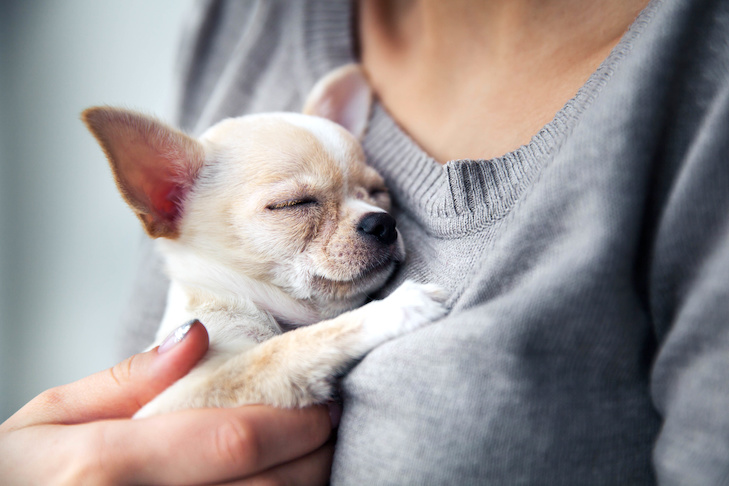
Since his birth in 1999, Bully has lived through five presidencies, the launch of the first iPhone, the rise of social media and many more historical events — but the Chihuahua probably can’t tell you about any of them.
But when the little dog recently turned 23 years old, his owners celebrated the milestone by throwing a party he’ll remember for years to come.
Bully spent the first 21 years of his life with a loving family, enjoying the companionship of his humans, playing outside and going for runs in the local park. When his elderly owner could no longer care for him, the super senior found his way to The Mr. Mo Project, a senior dog rescue run by Chris Hughes and his wife.
His former owner described Bully as a “big dog in a little dog’s body,” and Hughes quickly found that despite Bully’s advanced age, he hadn’t changed one bit.
“Bully is feisty, naughty, sweet, independent, gentle, calm and he has an old man bark,” Hughes told The Dodo. “Even at his age, he likes to try to push around another one of our Chihuahuas.”
Now that Bully is older, he needs more rest than the average pup. “Bully loves to sleep and he has earned that right,” Hughes said. “He will fall asleep absolutely anywhere, sometimes on the middle of the floor in the kitchen, on a potty pad or on the biggest, most comfortable bed in the corner.”
For Bully’s birthday party, the Hughes family decorated their house in honor of the little dog and gave him the two things he loves most in the world — treats and a nap. “He doesn’t have too many teeth, so we got a soft biscuit and crumbled it up for him to enjoy,” Hughes said. “He really enjoys sleeping, so that’s the best gift to give him.”
Hughes makes sure all the senior dogs in their care feel special by throwing parties to commemorate every possible event with them.
“We try to celebrate all the great things that happen in our home because so often there are not-so-great things that happen,” Hughes said. “We celebrate when dogs finish chemo treatments, birthdays, adoptions and have been known to have Christmas in July if we think someone won’t make it until Christmas.”
Thanks to the Hughes family, Bully will have many more celebrations to look forward to. And at the age of 23, he’s earned it.
Who knows whether it was a smell, or a sound, or what…
This is a story from England. From a town called Tow Law, a few miles to the south-west of Newcastle. As wikipedia explains: Tow Law is a town and civil parish in County Durham, England. It is situated a few miles to the south of Consett and 5 miles to the north west of Crook.
Anyway, the story was published by The Dodo and is reproduced below.
ooOOoo
Dog Out On A Walk Finds Someone Very Stuck In A Stone Wall
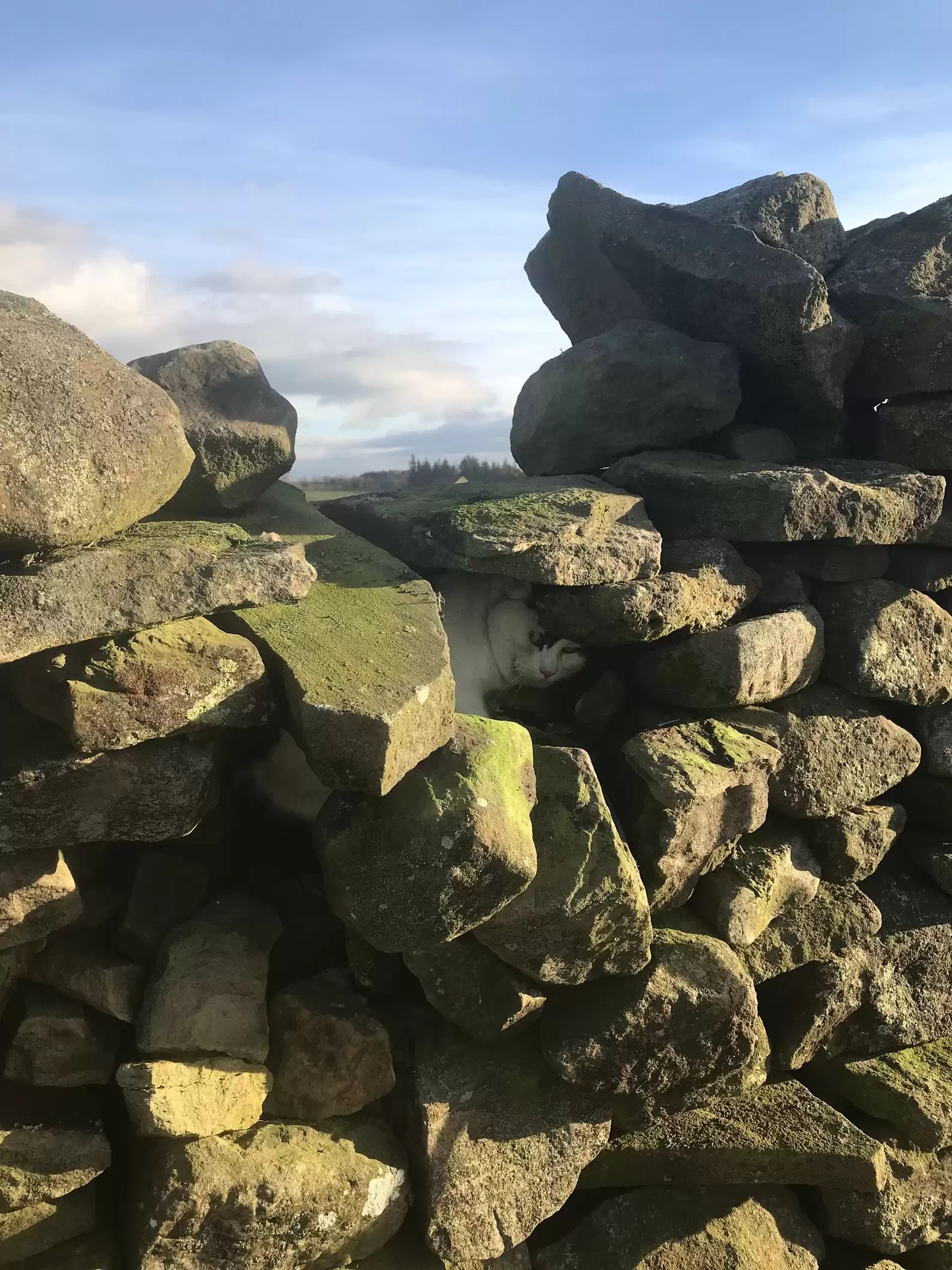
A guy and his dog were out on a walk one day through a field in Tow Law, England, when the dog suddenly became very interested in a nearby stone wall. After looking a little closer, the pair found a cat — who had somehow gotten himself completely stuck in the wall.
The RSPCA was called and Inspector Ruth Thomas-Coxon drove over to try and help. She was hoping that it would be as easy as just gently pulling the cat, later named Freddy, out of the wall, but she quickly discovered that he was much more stuck than that.
“Initially it looked as though he’d chosen to tuck himself inside the gap, but he didn’t try to run away when we got closer,” Thomas-Coxon said in a press release.
Thomas-Coxon weighed all her options and decided the best way to free Freddy would be to take apart the stone wall.
“The owner of the paddocks and wall came out and, between us, we removed some of the stones to dismantle the top part of the wall and free the cat,” Thomas-Coxon said. “He made a dash for it and jumped into another part of the wall, where we were able to catch him.”
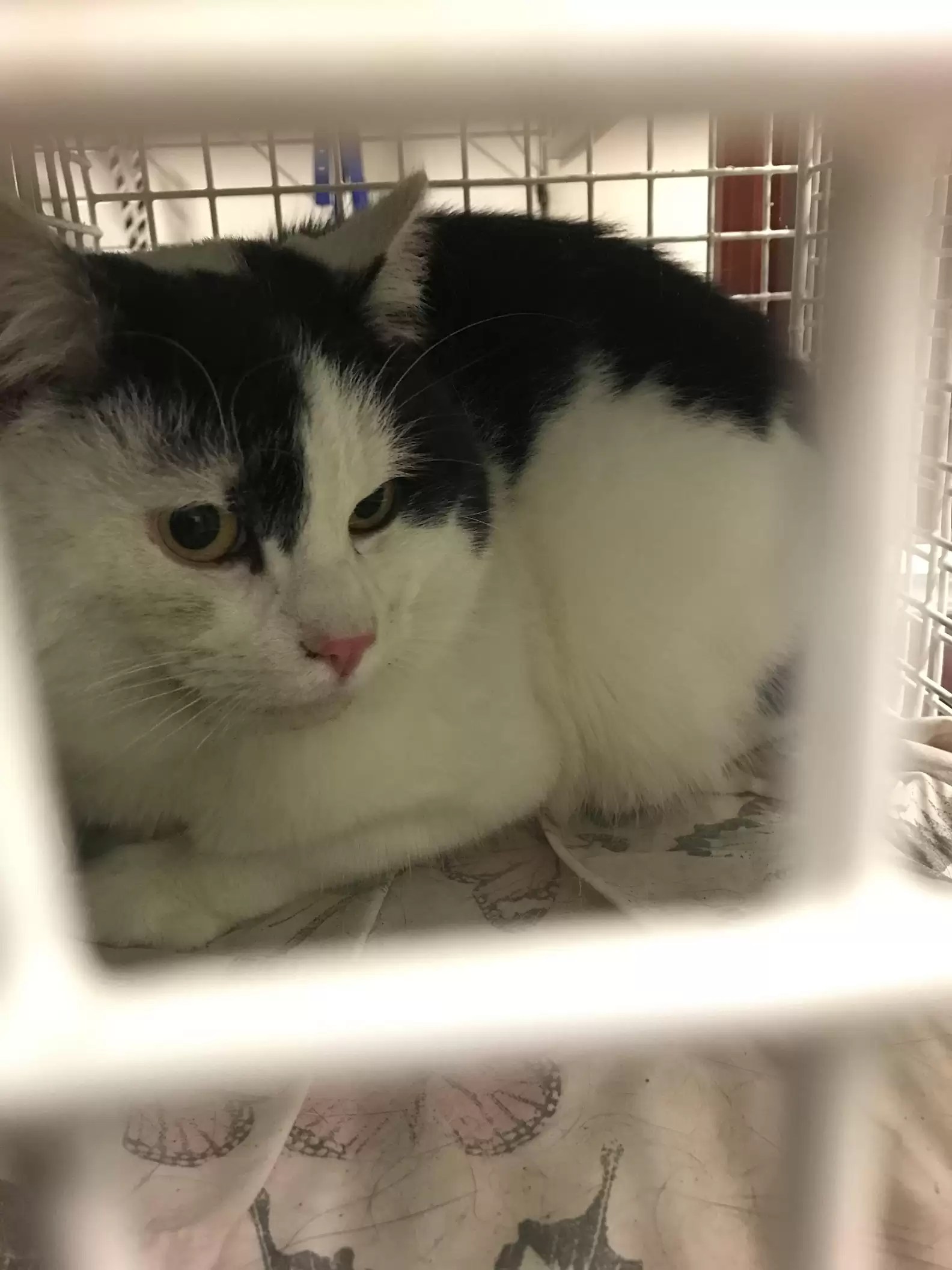
Even though Freddy was definitely stuck and needed help, he was also not super pleased about being rescued by strangers. Once he realized he was safe, though, he calmed down, and Thomas-Coxon took him to the vet to get him checked out.
“Vets found he was in fairly good health, although he had some mats in his coat, which they removed,” Thomas-Coxon said. “He was a sweet, friendly cat, so I wondered if he was a missing pet, but he was not microchipped. I made some inquiries nearby, put up a poster where we rescued him and also put his profile on PetsLocated, but, unfortunately, he’s not yet been claimed.”
Freddy is settling into the shelter well, and if no one comes forward to claim him, he’ll be put up for adoption. From being stuck in a stone wall to a potential forever home — Freddy’s come a long way.
ooOOoo
It’s a strange story in the sense that the cat was not claimed so who knows where he had come from. But his future is much better, thanks to the RSPCA, and if he is adopted it will be to a good, caring home.
Ukrainian soldiers were inspecting abandoned homes on the frontline near Kyiv, in an area that has been reclaimed from the Russians. The troops came across a lonely dog in an apartment and after finding identification documents, they discovered her name was Bavaria. A volunteer has taken the dog in and hopes to reunite it with its owner.
There was a short film also and I am delighted to find this video on YouTube.
With so much disruption and cruelty going on in Ukraine it is a real delight that compassion and love are still very much alive.
In a comment to a recent post on this blog, John said: “Just sent you an email.“
I went to that email and read:
Hi Paul — just a personal note to let you know Bela died yesterday at 3.30pm. Her old beaten up body couldn’t do it any longer. A week after the last of her two operations she started going downhill. Her walks were more laboured. Last Tuesday I stopped walking her because (although she wanted to keep going) she was failing. She deteriorated over the weekend… Monday was spent racing her between vets, diagnostic clinics, and finally to the emergency care hospital. She made it through the night. She made it to us going there to see her. She was in a terrible state, her kidneys dissolving, her heart giving up. She was thankfully without pain, and although barely conscious (she was on heavy, heavy opioids), she managed to lift her head one last time. The vet there later said it was like she was waiting for you to say goodbye. She died thirty minutes later. Her heart gave out, and they could not revive her.
John subsequently emailed me the details of when he found Bela.
I caught sight of something out of the corner of my eye driving home one day. I *thought* it looked like a dog. I turned around, and that’s how we found her… skin and bones, leg broken, paw smashed. And as we’d later discover, megaesophagus. We scooped her up and raced her to the vet. First time in my life after a rescue I actually asked the vet that day if we should just end her misery right then and there. Four years is what she gave us, and our lives are richer for it. Four short years.
Since then Bela has had four or five major operations, the last two to remove cancers were in January and March of this year. As John puts it: “In my mind we were setting her up for many more years of health.“
Finally, here is a video of Bela. It is rather poor quality because the original is far too large. But it doesn’t matter at all because it just shows Bela alive and well!









 Learning from Dogs