Category: Animal rescue

We are what we eat!

So why do we insist of manipulating the genetics of food!

I read somewhere recently, and of course now can’t find the reference, that the genetic modification of our food represents as big a danger to the long-term survival  of man as does the damage to our biosphere.

So a recent item on the blog Food Freedom News jumped out at me.  This was an item that was introduced as, “The author of Seeds of Destruction (about Monsanto) has a new piece out on pesticides and mass animal deaths… very sobering.

Clicking on the ‘new piece’ link takes one to here, from which I quote the opening paragraphs,

Death of the Birds and the Bees Across America

By F. William Engdahl
Global Research

“A recent study showed that every human tested had the world’s best-selling pesticide, Roundup, detectable in their urine at concentrations between five and twenty times the level considered safe for drinking water.”

Birds and bees are something most of us take for granted as part of nature. The expression “teaching about the birds and the bees” to explain the process of human reproduction to young people is not an accidental expression. Bees and birds contribute to the essence of life on our planet. A study by the US Department of Agriculture estimated that “…perhaps one-third of our total diet is dependent, directly or indirectly, upon insect-pollinated plants.”

The honey bee, Apis mellifera, is the most important pollinator of agricultural crops. Honey bees pollinate over 70 out of 100 crops that in turn provide 90% of the world’s food. They pollinate most fruits and vegetables–including apples, oranges, strawberries, onions and carrots.  But while managed honey bee populations have increased over the last 50 years, bee colony populations have decreased significantly in many European and North American nations. Simultaneously, crops that are dependent on insects for pollination have increased. The phenomenon has received the curious designation of Colony Collapse Disorder (CCD), implying it could be caused by any number of factors. Serious recent scientific studies however point to a major cause: use of new highly toxic systemic pesticides in agriculture since about 2004.

That first paragraph alone made me sit up, “A recent study showed that every human tested had the world’s best-selling pesticide, Roundup, detectable in their urine at concentrations between five and twenty times the level considered safe for drinking water.”  What a strange race we are!

Wlliam F. Engdahl

Then it was easy to find out more information about the author of the book Seeds of Destruction, William F. Engdahl, including his website.  Mr. Engdahl is clearly no stranger to controversy as this YouTube video illustrates,

Back to that Food Freedom article.  Further on, there is evidence of the size of the problem in the UK,

Alarming UK results

A private UK research organization, Buglife and the Soil Association, undertook tests to try to determine cause of the bee death. They found that the decline was caused in part by a group of pesticides called neonicotinoids. Neonicotinoids are “systemic” chemicals that kill insects by getting into the cell of the plant. In Britain it’s widely used for crops like oilseed rape and for production of potted plants.

The neonicotinoids are found in the UK in products including Chinook, used on oilseed rape and Bayer UK 720, used in the production of potted plants which then ends up in gardens and homes around the country. The new study examined in detail the most comprehensive array of peer-reviewed research into possible long-term effects of neonicotinoid use. Their conclusion was that neonicotinoid pesticides damage the health and life cycle of bees over the long term by affecting the nervous system. The report noted, “Neonicotinoids may be a significant factor contributing to current bee declines and could also contribute to declines in other non-target invertebrate species.” The organization called for a total ban on pesticides containing any neonicotinoids.

The president of the UK Soil Association, Peter Melchett, told the press that pesticides were causing a continued decline in pollinating insects, risking a multimillion pound farming industry. “The UK is notorious for taking the most relaxed approach to pesticide safety in the EU; Buglife’s report shows that this puts at risk pollination services vital for UK agriculture,” he said.

Indeed in March 2012 Sir Robert Watson, Chief Scientist at the British Government’s Department of Environment announced that his government was reconsidering its allowance of neonicotinoid use in the UK. Watson told a British newspaper, “We will absolutely look at the University of Stirling work, the French work, and the American work that came out a couple of months ago. We must look at this in real detail to see whether or not the current British position is correct or is incorrect. I want this all reassessed, very, very carefully.”  To date no policy change has ensued however. Given the seriousness of the scientific studies and of the claims of danger, a prudent policy would have been to provisionally suspend further uise of neonicotinoids pending further research. No such luck.

And if the harm to bees wasn’t serious enough, try this extract,

Effect on Human Brain?

But most alarming of all is the evidence that exposure to neonicotinides has horrific possible effects on humans as well as on birds and bees.

Professor Henk Tennekes describes the effects:

“Today the major illnesses confronting children in the United States include a number of psychosocial and behavioral conditions. Neurodevelopmental disorders, including learning disabilities, dyslexia, mental retardation, attention deficit disorder, and autism – occurrence is more prevalent than previously thought, affecting 5 percent to 10 percent of the 4 million children born in the United States annually. Beyond childhood, incidence rates of chronic neurodegenerative diseases of adult life such as Parkinson’s disease and dementia have increased markedly. These trends raise the possibility that exposures in early life act as triggers of later illness, perhaps by reducing the numbers of cells in essential regions of the brain to below the level needed to maintain function in the face of advancing age. Prenatal and childhood exposures to pesticides have emerged as a significant risk factor explaining impacts on brain structure and health that can increase the risk of neurological disease later in life.”

There is also growing evidence suggesting persistent exposure to plants sprayed with neonicotinoids could be responsible for damage to the human brain, including the recent sharp rise in incidents of autism in children.

This really is an article that you should read in full, which also includes a full bibliography and notes section.  Plus you can leave your responses as a comment – go for it!

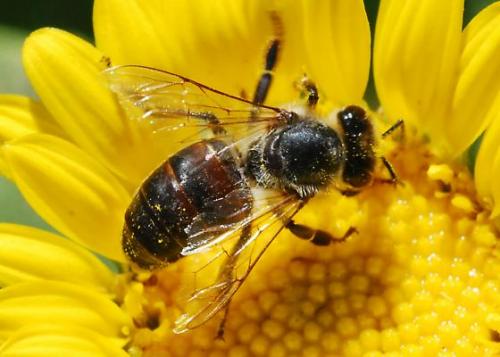
Apis mellifera – the honey bee (family Apidae)

The bond between dogs and humans

Such a beautiful and mutually-important relationship.

I didn’t plan to write more about this subject thinking that my last two posts, Woof at the Door and Prof. Pat Shipman, more than covered the theme; indeed much more.

But then a flurry of other articles conspired to pass my desk.

In no particular order there was an article on the Big Think website, Do Dogs Speak Human?  As the article opened,

What’s the Big Idea?

Perhaps the better question is, do humans speak dog? Either way, the debate over whether language is unique to humans, or a faculty also possessed by wild and domestic animals from dogs to apes to dolphins, is an interesting one. The answer depends on exactly how we define “language,” and who’s doing the talking, says David Bellos, the Booker prize-winning translator.

The article includes this three-minute video,

and concludes,

Broadly, a language is a mode of expression. “The argument that only human language is language and that animal communication systems, however sophisticated they are — and some of them are quite sophisticated — are not languages because they consist of discrete signals is a circular argument,” he argues. “It’s a self-fulfilling thing. And I think we should be a little bit more interested in the complexity and the variability of animal communication systems and less rigid about this distinction between what is a language and what is not a language.”

For now, we’re happy with this:

The June 30th edition of The Economist had an article entitled, Can dogs really show empathy towards humans? (You may have to register (free) to view this.)  That report ends, as follows,

As they report in Animal Cognition, “person-oriented behaviour” did sometimes take place when either the stranger or the owner hummed, but it was more than twice as likely to occur if someone was crying. This indicated that dogs were differentiating between odd behaviour and crying. And of the 15 dogs in the experiment that showed person-oriented responses when the stranger cried, all of them directed their attention towards the stranger rather than their owner.

These discoveries suggest that dogs do have the ability to express empathetic concern. But although the results are clear enough, Dr Custance argues that more work needs to be done to be sure that such behaviour is true empathy. It is possible, she points out, that the dogs were drawing on previous experiences in which they were rewarded for approaching distressed human companions. Dog-owners, however, are unlikely to need any more convincing.

It was then an easy follow-up to that Animal Cognition article which is available online here; here’s the abstract,

Empathy covers a range of phenomena from cognitive empathy involving metarepresentation to emotional contagion stemming from automatically triggered reflexes.

An experimental protocol first used with human infants was adapted to investigate empathy in domestic dogs. Dogs oriented toward their owner or a stranger more often when the person was pretending to cry than when they were talking or humming. Observers, unaware of experimental hypotheses and the condition under which dogs were responding, more often categorized dogs’ approaches as submissive as opposed to alert, playful or calm during the crying condition. When the stranger pretended to cry, rather than approaching their usual source of comfort, their owner, dogs sniffed, nuzzled and licked the stranger instead.

The dogs’ pattern of response was behaviorally consistent with an expression of empathic concern, but is most parsimoniously interpreted as emotional contagion coupled with a previous learning history in which they have been rewarded for approaching distressed human companions.

It doesn’t get closer than this.

Prof. Pat Shipman

Pat Shipman showing how animals were intimately involved in the development of early humans.

Yesterday’s fascinating post was predominately taken up by a long and deeply interesting essay by Prof. Pat Shipman, The Woof at the Door.

Today, I want to report further on Pat Shipman primarily by looking at her book The Animal Connection.

What makes us human?

Let me do no more than quote from page 259,

Domesticating animals provided a new sort of benefit.  They were living tools first and meat sources later, only when their useful lives were over or circumstances required.  The crucial importance of animal domestication in modern life shows that our relationship with animals selected for a set of communication skills and abilities to observe, draw conclusions and make connections among different observations that had been increasingly important since at least 2.6 million years ago.  The relationship between such skills and modern behaviors that characterize humanity is clear.

Prof. Shipman also confirms that the first domestication was of the dog at 32,000 years ago and goes on to say,

Other types of domestic animals provide enhanced protection for people, dwellings, stored crops, and other livestock.  Dogs and cats are the obvious examples, but herders have recently started touting llamas as guardians for flocks of sheep.

The domesticated carnivores also provide important assistance in hunting.  Dogs are better trackers than humans; they are faster runners, take larger prey, and will hunt with humans.  Cats hunt solitarily and are far superior to humans at catching rodents that can decimate crops or carry disease.  Dogs hunt with you; cats hunt for you; but both offer an advantage. (p.254)

As I said, it’s a fascinating book and one that is already reshaping my knowledge about the early evolution of man.  And in terms of reshaping knowledge about early man, do go across to Pat Shipman’s Blog, The Animal Connection.

You can read a full review with links to a number of book sellers here.  Let me close by using this praise for the book by Jeffrey Moussaieff Masson.  (Masson’s book Dogs Never Lie About Love is just a few feet from me as I write this, a deeply moving book for all dog lovers.)

This is what Jeffrey Masson wrote about The Animal Connection,

Pat Shipman has written one of the most important books on the human-animal connection ever.  One might even say it is the single most important book, possibly the only one, to look at our deep connection to animals over the entire evolutionary history of our species.

The oldest bond in the world!

Letting go; a dog lesson.

Some of us think holding on makes us strong; but sometimes it is letting go. Hermann Hesse

Nuneaton in Warwickshire is a town about 100 miles North-West of London.  It’s firmly in that part of England known as the Midlands, encircled by such places as Birmingham, Coventry, Rugby and Leicester.  It is also the home of the Nuneaton & Warwickshire Wildlife Sanctuary  So what, you might ask?

Watch this!

On the Wildlife Sanctuary’s website, there is the story of Jasmine,

Jasmine was a rescue dog who lived at the sanctuary until her passing in 2011. She was no ordinary rescue dog, she was the most amazing greyhound in the world!

She was only a young pup when she was locked in a shed and abandoned. When she was discovered by the police many days later she was emaciated, mange ridden and terrified. She was taken to the RSPCA quarters in Coventry where Geoff just happened to be visiting several weeks later. They were introduced and as they say ‘the rest is history’. She came to live with Geoff at the sanctuary. Each day her confidence grew and her personality flourished. But the most amazing thing was yet to come….

It turned out Jasmine was a natural ‘Mother hen’. One day a young fox cub was brought in to the sanctuary. She had been tied to railings and left to die. She was very small and weak and the outlook wasn’t bright. That was until Jasmine sauntered over to the fox cub’s basket and started to lick her. Geoff was immediately concerned, followed by bemusement, followed by amazement as he saw before his eyes the fox responding to Jasmine’s touch. He quickly realised that Jasmine was acting in the same way the fox cub’s mother would have done in the wild!

Over the next few days Jasmine continued to ‘mother’ the fox cub who Geoff had named Roxy. Roxy grew strong and grew up. She lives at the sanctuary with Jasmine who is mum and best friend all rolled into one.

Jasmine was truly one of a kind. She mothered many of the sanctuary’s residents back to health including Bramble the roe deer, Humbug the badger and two of the other sanctuary dogs, just to mention a few.

Sadly Jasmine passed away in 2011. She is greatly missed by all at the sanctuary.

So what’s Geoff’s story?  That is beautifully explained here,

In February 2001, an injured swan was taken to a veterinary clinic in Warwickshire. The swan was injured, but needed only a week of rest before it was able to be released back into the wild. However, there was nowhere in the area for the swan to rest and receive care, so it was put to sleep. This was when Geoff decided to set up the sanctuary.

Geoff had worked as a security guard for many years but was injured at work and forced to retire. He used his savings to transform his garden into a haven for wildlife and has never looked back.

Geoff, all the caring people in the world salute you!

As of 2011, the Sanctuary has been open for ten years, and has had 6,500 birds and 4,250 animals.

The Sanctuary relies on the work of our dedicated team of volunteers; who accompany us on fundraising events, talks, and shows to help raise money for the Sanctuary.

So let me close by thanking Suzann for sending me the video link to this beautiful story.  And do make a note to look in on Learning from Dogs next Saturday to marvel at yet another example of the way dogs (and Geoff!) throw off their pasts and rejoice in the present.

In the end these things matter most:

How well did you love?

How fully did you love?

How deeply did you learn to let go?

The Buddha

Dear George!

The sad story of the death of Lonesome George, a giant tortoise.

When you’re gone, you’re gone, it is said.  But in the case of this example of the beauty of Mother Nature, the idea of being gone is as final as it comes; George was the last of his species.

Here’s how the BBC reported the story,

Last Pinta giant tortoise Lonesome George dies

Staff at the Galapagos National Park in Ecuador say Lonesome George, a giant tortoise believed to be the last of its subspecies, has died.

Scientists estimate he was about 100 years old.

Park officials said they would carry out a post-mortem to determine the cause of his death.

With no offspring and no known individuals from his subspecies left, Lonesome George became known as the rarest creature in the world.

For decades, environmentalists unsuccessfully tried to get the Pinta Island tortoise to reproduce with females from a similar subspecies on the Galapagos Islands.

Park officials said the tortoise was found dead in his corral by his keeper of 40 years, Fausto Llerena.

While his exact age was not known, Lonesome George was estimated to be about 100, which made him a young adult as the subspecies can live up to an age of 200.

Lonesome George was first seen by a Hungarian scientist on the Galapagos island of Pinta in 1972.

Environmentalists had believed his subspecies(Chelonoidis nigra abingdoni) had become extinct.

Lonesome George became part of the Galapagos National Park breeding programme.

After 15 years of living with a female tortoise from the nearby Wolf volcano, Lonesome George did mate, but the eggs were infertile.

He also shared his corral with female tortoises from Espanola island, which are genetically closer to him than those from Wolf volcano, but Lonesome George failed to mate with them.

He became a symbol of the Galapagos Islands, which attract some 180,000 visitors a year.

Galapagos National Park officials said that with George’s death, the Pinta tortoise subspecies has become extinct.

They said his body would probably be embalmed to conserve him for future generations.

Tortoises were plentiful on the Galapagos islands until the late 19th century, but were later hunted for their meat by sailors and fishermen to the point of extinction.

Their habitat furthermore suffered when goats were introduced from the mainland.

The differences in appearance between tortoises from different Galapagos islands were among the features which helped the British naturalist Charles Darwin formulate his theory of evolution.

Some 20,000 giant tortoises of other subspecies still live on the Galapagos.

Continuing the tribute, Chris Mazzarella had some stunning photographs on his wonderful photographic blogsite Fast Forward. (Do take a look!) I held my breath and asked Chris for permission to republish his article and was delighted to be given his approval.  Thanks Chris, thanks very much.

oooOOOooo

An Ode To George

To pay tribute to our late friend Lonesome George, I thought it would be appropriate to write a post in celebration of turtles. George was the last tortoise of the subspecies Chelonoidis nigra abingdoni from Pinta Island in the Galapagos. Sadly George passed yesterday at the tender age of 100 years. This could be considered middle aged for the tortoise who’s counterparts can live beyond 200 years.

This is easily the smallest one I’ve seen all year. To give you some perspective, this lily pad is about eight inches across.

In Vermont, we have seven species of turtles, and I run into many of them while kayaking around the state. The one I see most often is the painted turtle. I spot these guys by the dozen basking in the sun while I’m paddling throughout the northeast. They are very cooperative subjects, but will head for a swim if you get too close. I don’t like spoiling anyone’s sunbath so I do my best to keep a respectable distance out on the water.

You can check out the biggest turtle I’ve seen all year in an April post entitled Snappers.

I’ve read that snapping turtles are the most common turtle in Vermont, yet I do not see quite as many in my travels. When I do see them, they are usually trolling underwater, covered in algae.

I have encountered a few snappers above the surface this year. I found this old guy lounging on a log in Bradford, Vermont a few days ago.

One of the rarer species of turtle I encountered this spring was a wood turtle in Magalloway Brook. I didn’t have much time to prepare for this shot before he launched off the log and into the water. It was a brief meeting, but certainly a memorable one as this is the only wood turtle I’ve ever photographed.

While turtles are not known for their speed they do offer unique challenges for photographers, particularly when shooting in the sun. Their reflective carapace makes them easy to spot, but difficult to expose for. A polarizing filter is sometimes necessary to reduce the glare on their wet shells. While this will help, the ideal situation is to shoot them under overcast skies.

Another thing to keep in mind is the angle of your shot. The kayak makes a great vehicle for wildlife photography because it keeps you low on the water. I often try to shoot wildlife at eye level. This gives you the same perspective from which the animal views the world. It’s much more interesting than a bird’s eye view, for example, and embodies the subject with the sense of pride that it deserves.

George’s passing marks the end of an important legacy, as the Galapagos turtles played a very important role in the foundation of Darwin’s theory of Natural Selection.

To learn more and see photos of George check out this great article by Jess Zimmerman at Grist.org.

We salute you George!

oooOOOooo

What stunningly beautiful photographs.  Once again, Chris, thanks for your permission to republish your Ode.

Finally, going back to 2009 there’s a BBC video of Simon Reeve visiting Lonesome George while visiting the Galapagos islands.

What the dog knew!

A guest post from Patricia Iles.

Regular readers will know that one of my joys of this blog writing game is the wonderful connections that are made across this funny old virtual world.  Trish Iles is one of those wonderful connections.

In fact, Trish is based at our local insurance firm, Crabdree Insurance, right here in Payson but until we ‘chit-chatted’ about writing a guest post for Learning from Dogs I had no idea there is much more to this lady.

To underline that, anyone who has their own blog called Contemplating Happiness will inevitably generate some curiosity.  That curiosity increases as one learns more about Trish and discovers that she is a published author.

Anyway, that’s enough from me, here is Trish Iles writing What the dog knew!

oooOOOooo

The wisdom of Chloe

I was pondering the eternal question: why does two weeks of relaxing vacation seem like so much more time than two weeks of working like my pants are on fire, here at my desk? My sweet husband and I talked about it a little bit, but came to no definitive answer. I chatted with friends about it. No insights. Google had no opinion, either.

Chloe came to us from a rescue organization. I think sometimes about what her experiences have been in her young life. She started out as an abandoned puppy on a reservation in New Mexico and was soon in the pound where she was on the euthanasia list. A kind woman rescued her and took care of her until she found us: just when Chloe was becoming at home with the rescue lady, she was uprooted again and sent home with two new people. What must she have been thinking?

Chloe didn’t close her heart to us, though. She watched for a few days. When she decided we weren’t going to make dinner out of her and that she was really staying with us, she threw her whole being into becoming one of the family. She let herself trust us.

I’m not sure I would have had the courage to trust a new set of people again. I’m doubly not sure that I give a rat’s patootie what those new people thought of or wanted from me. Chloe was willing not only to trust us, but to love us. She forgave us immediately for ripping her from the home she knew, and she adopted us right back.

Chloe was born knowing. She knows about joy. She knows about living a life in balance. She knows about forgiveness, trust, exuberance, a passion for learning and the power of a good nap. I think that when I grow up, I want to be just like her.

oooOOOooo

Don’t know about you dear reader but I just loved that story from Patricia.  Deep messages about what we can learn from our wonderful canine friends.

Indeed, I’m going to stay with the theme with tomorrow’s Post.

Fracking Hell!

Is it me or are we all totally mad?  Only if we don’t take action!

I’ve quoted this expression before so forgive me for using it again.  That’s the old Devon expression, “All the world’s a little queer, ‘cept thee and me, and I ha’ me doubts about thee!”  It really does seem as if most of us are ‘a little queer!’

Yesterday, I expressed the tip of much frustration, nay incredulity, in a rant about why society showed such complacency towards the impending crisis of our civilisation.  As I wrote,

Why isn’t there such a huge outpouring of anger at the complacency of the world’s leaders?  How far does the collapse of the conditions, both social and physical, as in biosphere, have to go before we get real, urgent change?

Well today’s Post is taking a selection of recent items that have been published to show why I feel as I do.  I make no apologies for this being a longish Post but that doesn’t make it anything other than incredibly important; personal opinion, of course!

Let’s start with our love affair with carbon-based fuels, in this case natural gas (that’s methane you know).  Over on Lack of Environment Martin Lack recently published a piece on Fracking.  Here’s an extract,

Burning fossil fuels just because they are there is insane
For a long time, I have told anyone that would listen that we should leave unconventional hydrocarbons in the ground because of the extremely high probability that James Hansen is right; if we burn them all the runaway greenhouse effect is a “dead certainty” (i.e. on page 236 of Storms of My Grandchildren). However, thanks to the persistence of my many friends in the blogosphere, I have now also woken up to the reality that unconventional fossil fuel extraction – and hydraulic fracturing (known as fracking) in particular – is having significant immediate adverse environmental impacts. Pendantry has described this as humanity “fouling its own nest”; but I think my own description of it as “defecating in our own pig pen” conveys a more appropriate image.

In the USA, fracking has recently been prohibited in the State of Vermont and it must be hoped that other States will now do the same. The Vermont legislature took this action as a result of reports confirming the link between fracking and minor earthquakes; and because of high profile campaigns mounted by those communities already being adversely impacted by fracking. However, the latter should not be confused with NIMBYism. This is because opposition to fracking is a response to real environmental problems afflicting real people as a result of real stupidity on an industrial scale.

The Marcellus Shale formation

Martin also included a 17-minute feature from Link TV on the use, and dangers, of extracting natural gas from the Marcellus Shale in the US North-East.  It’s a sobering reminder of how we are playing with fire with the planet, both literally and metaphorically.  This is the video:

My next reference is an article published in the latest issue of Nature.  Only a summary is available freely online, but here it is anyway,

Approaching a state shift in Earth’s biosphere

Localized ecological systems are known to shift abruptly and irreversibly from one state to another when they are forced across critical thresholds. Here we review evidence that the global ecosystem as a whole can react in the same way and is approaching a planetary-scale critical transition as a result of human influence. The plausibility of a planetary-scale ‘tipping point’ highlights the need to improve biological forecasting by detecting early warning signs of critical transitions on global as well as local scales, and by detecting feedbacks that promote such transitions. It is also necessary to address root causes of how humans are forcing biological changes.

The overall theme of this issue of Nature is shown in their leading story, again taking the liberty of republishing an extract.  First how the article opens,

Return to Rio: Second chance for the planet

Twenty years ago, when the world’s leaders pledged to protect Earth’s climate and biodiversity at the Rio Earth Summit, they knew it would not be easy. But few could have guessed how much worse the situation would get. In 1992, the atmosphere held fewer than 360 parts per million (p.p.m.) of carbon dioxide; the concentration is now nearing 400 p.p.m. and surging upwards. At the same time, species are disappearing at an accelerating rate.

On the eve of the second Rio Earth Summit, Nature explores the causes and consequence of those changes, as well as the efforts that are being made to avert the worst outcomes. Our assessment shows how little progress nations have made towards honouring the commitments they made in 1992.

Then how that article closes,

Anthony Barnosky and his colleagues argue that the global ecosystem could eventually pass a tipping point and shift into a new state, the likes of which are hard for science to predict. But there are ways to avoid that fate, say Paul Ehrlich and his colleagues (page 68), who suggest techniques to make societies more sustainable and to head off many of the world’s chronic environmental problems.

Earth and its inhabitants have a second chance in Rio. They may not get many more.

There’s more and more of this but, yes, I know, one can only take so much.  So let me head for the close with a message of what you and I, and all of us, can do.

The United Nations Environment Programme recently released a video showing how inadequate have been our leaders.  Watch it first and then I’ll offer a solution.

The fifth edition of the Global Environmental Outlook (GEO-5), launched on the eve of the Rio+20 Summit, assessed 90 of the most-important environmental goals and objectives and found that significant progress had only been made in four.

More on the report findings here.

So join with me as I focus my rant from yesterday into something more valuable – asking you to take action – in whatever way you can!

Go here and sign the petition from 350.org.

Add your name to this:

To the G20 and World Leaders:

As concerned global citizens, we urge you to honour your previous commitments to end taxpayer handouts to the fossil fuel industry. To save our planet we need a game-changer now — we call on you to first lead by example, and then make ending all polluter payments the top global priority for the Rio Earth Summit.

So do it now – Go here and sign the petition from 350.org.

Then when you have signed that plea to world leaders to stop the subsidies to fossil fuels, pass this link to everyone you can – www.350.org/rio

And get close to 350.org and stay in touch.

Let’s do this; it’s so much better than ranting!

Quirks of the natural world

Or should that be ‘quacks’?  A delightful duck story from San Antonia, Texas.

With big thanks to Merci O. for sending me the story.

A True Duck Story from San Antonio , Texas

Something really cute happened in downtown San Antonio this week. Michael R. is an accounting clerk at Frost Bank and works there in a second story office. Several weeks ago, he watched a mother duck choose the concrete awning outside his window as the unlikely place to build a nest above the sidewalk. The mallard laid ten eggs in a nest in the corner of the planter that is perched over 10 feet in the air. She dutifully kept the eggs warm for weeks, and Monday afternoon all of her ten ducklings hatched.

Michael worried all night how the momma duck was going to get those babies safely off their perch in a busy, downtown, urban environment to take them to water, which typically happens in the first 48 hours of a duck hatching.

Tuesday morning, Michael watched the mother duck encourage her babies to the edge of the perch with the intent to show them how to jump off. Office work came to a standstill as everyone gathered to watch.

The mother flew down below and started quacking to her babies above. In disbelief Michael watched as the first fuzzy newborn trustingly toddled to the edge and astonishingly leapt into thin air, crashing onto the cement below. Michael couldn’t stand to watch this risky effort nine more times! He dashed out of his office and ran down the stairs to the sidewalk where the first obedient duckling, near its mother, was resting in a stupor after the near-fatal fall. Michael stood out of sight under the awning-planter, ready to help.

As the second one took the plunge, Michael jumped forward and caught it with his bare hands before it hit the concrete. Safe and sound, he set it down it by its momma and the other stunned sibling, still recovering from that painful leap. (The momma must have sensed that Michael was trying to help her babies.)

One by one the babies continued to jump.. Each time Michael hid under the awning just to reach out in the nick of time as the duckling made its free fall. At the scene the busy downtown sidewalk traffic came to a standstill. Time after time, Michael was able to catch the remaining eight and set them by their approving mother.

At this point Michael realized the duck family had only made part of its dangerous journey. They had two full blocks to walk across traffic, crosswalks, curbs and past pedestrians to get to the closest open water, the San Antonio River, site of the famed “RiverWalk.”

The on-looking office secretaries and several San Antonio police officers joined in. An empty copy-paper box was brought to collect the babies. They carefully corralled them, with the mother’s approval, and loaded them in to the container. Michael held the box low enough for the mom to see her brood. He then slowly navigated through the downtown streets toward the San Antonio River. The mother waddled behind and kept her babies in sight, all the way.

As they reached the river, the mother took over and passed him, jumping in the river and quacking loudly. At the water’s edge, Michael tipped the box and helped shepherd the babies toward the water and to the waiting mother after their adventurous ride.

All ten darling ducklings safely made it into the water and paddled up snugly to momma.  Michael said the mom swam in circles, looking back toward the beaming bank book-keeper, and proudly quacking.

At last, all present and accounted for: “We’re all together again. We’re here! We’re here!”

And here’s a family portrait before they head outward to further adventures….

Like all of us in the big times of our life, they never could have made it alone without lots of helping hands. I think it gives the name of San Antonio ‘s famous “River Walk” a whole new meaning! Maybe you will want to share this story with others.

And even if you enjoyed the story, do settle down for 3 minutes and watch the YouTube version – it’s something you will treasure, I promise you!

Both versions end with this thought:

Live honestly, Love generously, Care deeply and Speak kindly

Fighting pet homelessness, one animal at a time.

With big thanks to Trish for sending me these details.

It may seem entirely irrelevant to the wider world to focus on one homeless dog now taken into care and looking for a loving home but if one ‘raises’ the theme to that of which Learning from Dogs is all about, namely Dogs are integrous animals. We have much to learn from them then not so!

I’m not going to waffle around this for much longer except to ask you to go across to Patrice Ayme’s Blog and read his recent essay, Blood: Appetite Comes With Eating.  It’s a very erudite, and deeply upsetting, commentary on something I touched on in a recent Post.  Patrice writes, “Today we have just one civilization. If it dies, it will have no replacement.”  So go and read the full essay.

So when we wonder why there seems such a departure from integrity within the higher echelons of society, it makes my heart leap to be reminded of the innocence and integrity of dogs (and, of course, all of nature’s animals), and the outstanding beauty of all those who love and care for them.

So forget about the big, wide world for a while and read what Trish emailed me,

Tiny Tinker needs a forever home

Tinker

Found fending for himself on the hot streets of South Phoenix, Tinker is six and a half pounds of pure puppy love! This sweet survivor was in very tough shape when he was rescued from the county shelter and brought to the vet. But while he was being examined, Tinker wouldn’t stop trying to kiss everyone around him, and couldn’t stop wagging his tail! Currently recovering in a foster home, this little trooper desperately needs to find a forever home where he’ll be loved for the rest of his life.

Can you help?

Tinker is a spunky sweetheart who loves to snuggle with people. According to the vet, this 12-year-old Chihuahua is the victim of bad genes and neglect. The poor baby was born with only one good eye, permanently dislocated back knees, and terrible teeth. He’ll have dental work done soon, so he can go to his new home with a healthy smile. But first, he needs to recover completely from kennel cough. His ragged ears are most likely the result of flies biting off the edges.

Despite everything, Tinker is one of the happiest little dogs you’ll ever meet. Extremely affectionate and full of energy, blood tests show he’s in overall good health. He’s already neutered, housetrained and up-to-date on his shots. And once he recovers, all he’ll need is medication for his knees to make him more comfortable. Tinker seems to like other dogs, so would welcome canine companions.

Small Chihuahuas can lead very long lives. And if ever a dog deserved to enjoy many years as someone’s cherished pet, it’s Tinker! If you or someone you know can offer him a good home, please contact Jill at (480) 363-8449 or jill@cdsframing.com.  She’d be thrilled to hear from you and delighted to introduce you to the terrific Tinker, who is living in Phoenix.

You can also help Tinker find a home by posting his adoption flyer wherever you work, play or shop.

Thank you for anything you can do to help Tinker and for everything you do for the animals. Each act of kindness brings us one step closer to No More Homeless Pets®.

And from that flyer comes the following information …

Breed: Mix Chihuahua
Location: Phoenix, Arizona
Sex: Male
Age: Senior
Description: Little Tinker found himself abandoned and left to fend for himself on the rough lonely and HOT streets in Phoenix, Arizona. His previous life, he was not well loved or cared for. When I met this little bugger, I fell in immediate love with him and got him fully vetted. He still needs a couple of teeth extractions but he is in excellent health otherwise – all bloodwork came back negative and normal for any possible under-lying medical conditions.

This is one happy boy! GREAT SELF-ESTEEM, his tail never stops wagging and he only weighs 6 1/2 itty bitty little pounds and yes he is around 12 years old. He is now current on all his vaccinations and is neutered. He has a lot of life and spunk about him despite all he has been thru….very lovable, snuggly, and affectionate little pooch. Tinker would love nothing more than to be your sweet little lap boy and car rides – yes, he loves to go in the car with you.

Pleae consider giving him a loving home – he deserves it!!!!
Contact: Jill Lenz Phone: 480-363-8449 Email: jill@cdsframing.com

So if you know someone who could help, then please follow that up.  If you don’t, then circulate these details just as far and wide as possible.  And if you are a person who might be interested or know someone who might be, and you are in another US State, then email or call Jill Lenz and say you saw the details on Learning from Dogs and somehow we can all work out how to get little Tinker in to your arms.

Thank you.

Dog goes for a 1,700 km run!

A wonderful news item from the BBC from their China ‘desk’.

Some dog run! All 1,700 kilometres across China

Here’s how it was presented on the BBC News website.

A stray dog has completed a 1700km journey across China after joining a cycle race from Sichuan province to Tibet.

The dog, nicknamed “Xiaosa”, joined the cyclists after one of them gave him food.

He ran with them for 20 days, covering up to 60km a day, and climbing 12 mountains.

Cyclist Xiao Yong started a blog about Xiaosa’s adventures, which had attracted around 40,000 fans by the end of the race.

Yong now hopes to adopt Xiaosa.

Luckily, someone smart grabbed the BBC footage and uploaded it to YouTube thus allowing me to include that below:

I did several Google searches for Xiao Yong’s blog but failed to come across it – never mind, it doesn’t detract from a delightful story this Memorial Day week-end here in America.