(For my regular readers, indeed, for all of you, just a reminder that I’m giving the Blog a small rest until later this week – just filling in with silly things!)
Dear friend, senior airline Captain, Bob D., sent me this video to demonstrate that not all flying is from one enormous hub to another.
A good friend here in Payson, himself a former ‘lamplighter’ forwarded me an email with a link to a video taken using the Head-Up-Display (HUD) camera which also has a voice recorder.
F-16 fighter/attack aircraft
This is the email,
Here’s the F-16 dead stick into Elizabeth City, NC: A fairly short RWY for jets, (about 6000 ft long), but qualifies for an “Emergency landing field” in the grand scheme of US aviation.
You’ll probably have to watch the video several times to appreciate how intense the situation and how busy the pilot was all the way to stopping on the runway. Very apparently, the pilot was one-of-four F-16s in a flight returning to their base, (most probably from the Navy Dare bombing range south of Manteo), and the F-16 in question had already reported a “Ruff-Running Engine” to his flight leader before the start of the video.
A few comments not readily apparent are:
The whole episode, from start-to-finish only takes about 3 1/2 minutes!
The video begins as the flight is being followed on radar.
The flight leader asks for the Elizabeth City tower UHF freq which is repeated as 355.6 and the entire flight switches to that freq: Just one-more-task for the pilot to execute in the cockpit as he reports that his engine has QUIT. He has to activate the Emergency Unit to maintain electric and hydraulic power. This unit is powered by Hydrazine: (the caustic fuel that Germany created in WW II to power their V-2 Rockets and their ME-163 rocket fighters among others.) Thus, the last call about requesting fire support after the jet is safe on deck, and pilot breathing easy.
Meanwhile, back in the cockpit, the pilot is busily attempting to “Re-light” his engine: (Unsuccessfully, of course) while tending to everything else. The video is taken using the Head-Up-Display (HUD) camera which also has a voice recorder.
The HUD is a very busy instrument, but among things to notice are the ‘circle’ in the middle which represents the nose of the aircraft and where it is ‘pointed’: “The velocity Vector”.
The flight leader reports they are 7-miles out from the airport and at 9000 ft altitude. Since the weather is clear and the airport is in sight, this allows for adequate “Gliding distance” to reach a runway with the engine OFF. Rest assured, jet fighters glide sorta like a rock. They don’t enjoy the higher lift design of an airliner like that which allowed Sullenburger to land in the NY river.
Coming down 9000 ft in only 7-miles requires a helluva rate of descent, so the pilot’s nose remains well below the “Horizon” until just prior to touching down on the runway. The HUD horizon is a solid, lateral bar, and below the horizon, the horizontal lines appear as dashes. You’ll see a “10” on the second dashed line below the horizon which = 10-degrees nose low.
Radio chatter includes the flight leader calling the tower and the tower stating runway 10 with wind 070 @ 5 mph with the altimeter setting of 30.13, yet another step for the pilot to consider.
The flight leader calls for the pilot to jettison his external fuel tanks and askes another pilot in the flight to “Mark” where they dropped. The tower later tells the pilot to land on any runway he chooses.
Pilot reports “Three in the green” indicating all three gear indicate down and locked which the flight leader acknowledges.
You will hear the computer voice of “Bitchin’-Betty” calling out “Warnings”. More confusing chatter when none is welcome or even necessary. (That’s “Hi-Tech” for ya.)
The pilot has only ONE CHANCE to get this right and must also slow to an acceptable landing speed in order to stop on the short runway. You’ll see Black rubber on the rwy where “The rubber meets the road” in the touchdown area. Note that during rollout, he gets all the way to the far end which you can see by all the black skid marks where planes have landed heading in the opposite direction.
OK: That’s more than ya probably wanted to know, but you have to appreciate the fine job this guy did in calmly managing this emergency situation. He is a “USAF Reserve” pilot and those guys generally have plenty of experience. That really pays off.
Please scroll down for the link + Enjoy.
The pilot just saved about $20+m at his own risk…….Great job! Note the breathing rate on the hot mic and also the sink rate (airspeed tape on the left side of the heads up display.)
Pretty cool guy!!!
See if you can keep all of the radio transmissions straight.
Probably the coolest sounding voice in the whole mix is the pilot of the engine out aircraft.
Just a reminder an F-16 has only one engine. When it goes, you are coming down. It is just a matter of figuring out where the airplane will come to rest on terra firma.
Note: For those not familiar, the EPU (Electrical Power Unit) provides hydraulic and electrical power in event of failure of the engine, electrical or hydraulics. The EPU is powered by Hydrazine which decomposes into hot gasses as it passes across a catalyst bed or engine bleed air (if available). The hot air passes through a turbine which drives the emergency hydraulic pump and generator through a gear box.
The video is also on YouTube, as below,
Most people are aware of the value of training and experience that saved, in this case, the US taxpayer a large pile of money.
Now onto a much more tragic case, the loss of Air France Flight AF 447 that went down on 1 June 2009 after running into an intense high-altitude thunderstorm, four hours into a flight from Rio de Janeiro in Brazil to Paris. AF 447 was an Airbus A330-203 aircraft registered F-GZCP.
Many will recall that earlier on in May the second of the ‘black boxes’ or flight recorders was found. Here’s how Bloomberg reported that,
Air crash investigators retrieved the second of two black boxes from the Air France jet that plunged into the Atlantic in 2009, which may help them unlock the mysteries of the crash after two years.
“They appear to be in a good state,” said Jean-Paul Troadec, head of the BEA, the French air crash investigator that has been probing the accident that killed all 228 people aboard a flight from Rio de Janeiro to Paris. “The first thing is to dry them, prepare them, which needs about a day.” Once the boxes arrive in BEA’s offices, in about 10 days, “the reading of information would be pretty fast,” he said.
Those who wish to read the report issued by the French Authorities may find it here. The summary from the report concludes,
NEW FINDINGS
At this stage of the investigation, as an addition to the BEA interim reports of 2 July and 17 December 2009, the following new facts have been established:
The composition of the crew was in accordance with the operator’s procedures.
At the time of the event, the weight and balance of the airplane were within the operational limits.
At the time of the event, the two co-pilots were seated in the cockpit and the Captain was resting. The latter returned to the cockpit about 1 min 30 after the disengagement of the autopilot.
There was an inconsistency between the speeds displayed on the left side and the integrated standby instrument system (ISIS). This lasted for less than one minute.
After the autopilot disengagement:
the airplane climbed to 38,000 ft,
the stall warning was triggered and the airplane stalled,
the inputs made by the PF were mainly nose-up,
the descent lasted 3 min 30, during which the airplane remained stalled. The angle of
attack increased and remained above 35 degrees,
the engines were operating and always responded to crew commands.
The last recorded values were a pitch attitude of 16.2 degrees nose-up, a roll angle of 5.3 degrees left and a vertical speed of -10,912 ft/min.
If my maths is correct a descent speed of 10,912 feet per minute is the equivalent of 124 miles per hour!
Anyway, I am advised by someone who is a very experienced Airbus captain that the odds of a stall in the cruise for a commercial airliner are extremely low, sufficiently so that it is not something that is regular covered during crew recurrent training sessions.
“In a world dependent on fossil energies, Solar Impulse is a paradox, almost a provocation.”
Press release gobbledygook? Absolutely. But you’ve got to give it up for any company with the guts to try designing and building a true solar airplane.
We’ve written about Solar Impulse — it’s a consortium of European financial and technology parters led by the Federal Institute of Technology in Lausanne, Switzerland. The group is working on a solar-powered plane that can take off under its own power without generating any emissions at all. The general idea is that sunlight would not only power the plane during the day but would also charge its lithium batteries, allowing it to fly around the clock pollution free.
That was written May 12th, 2008. This is now! Landing at Brussels International Airport, May 2011.
A wonderful tribute to Yuri Gagarin and all his team.
When I recently wrote of it being 41 years since Swigert on board Apollo 13 transmitted “Okay, Houston, we’ve had a problem here.” I also included a closing reflection as follows,
Finally, this Post is published, not only on the 41st anniversary of that memorable Apollo Flight but the day after the 50th anniversary of Yuri Gagarin’s first flight of a human into space, the 12th April, 1961.
Coincidentally, our favourite documentary film website, Top Documentary Films, featured on April 14th the new film First Orbit. We watched the film that night. It was a most unusual format for a film, yet a most haunting experience. Watching the credits, it then became clear that the film was a co-operative venture made especially for the 50th anniversary of that remarkable, historic flight.
Of course, had I previously been aware of the venture and this remarkable film then it would have been promoted on Learning from Dogs in good time before the anniversary date. However, better late than never!
Indeed, there is a dedicated website in recognition of this First Orbit. Here’s the background to the film,
April 12th 1961 – Yuri Gagarin is about to see what no other person has seen in the history of humanity – the Earth from space. In the next 108 minutes he’ll see more than most people do in a lifetime. What sights awaited the first cosmonaut silently gliding over the world below? What was it like to view the oceans and continents sailing by from such a height?
By matching the orbital path of the Space Station, as closely as possible, to that of Gagarin’s Vostok 1spaceship and filming the same vistas of the Earth through the new giant cupola window, astronaut Paolo Nespoli, and documentary film maker Christopher Riley, have captured a new digital high definition view of the Earth below, half a century after Gagarin first witnessed it.
Weaving these new views together with historic, recordings of Gagarin from the time, (subtitled in Englsih) and an original score by composer Philip Sheppard, we have created a spellbinding film to share with people around the world on this historic anniversary.
The music in the film is most beautiful, quite moving. Here’s the background to the music from the First Orbit website,
First Orbit’s producer Christopher Riley first worked with Philip in 2006 on the Sundance Award winning feature documentary film ‘In the Shadow of the Moon‘ and since then Philip had been working on a new suite of music inspired by spaceflight.
“We’d been working with some of these tracks on another project” says Chris, “and we suddenly realised how perfectly they could compliment ‘First Orbit’ as well. We contacted Philip to ask his permission to use them, only to find that his entire Cloud Song album was already in orbit onboard the International Space Station!”
“NASA astronaut Cady Coleman, had them on her iPod” says Philip. “Her husband Josh Simpson is a friend of mine and they’d listened to a lot of my music together before she left, so I made up a playlist for her!”
Quite by coincidence Cady had been listening to the music in ‘First Orbit’ at one end of the Space Station whilst European Space Agency astronaut Paolo Nespoli was shooting for the film at the other end, without either of them knowing the connection!
Back on Earth Chris and the film’s editor Stephen Slater took Philip’s tracks from Cloud Song and weaved them together with Paolo’s new views of the Earth to create the different moods of the film; from the first views of snowy Siberia to the darkness of night over the Pacific Ocean and the homecoming over Africa, as Gagarin starts to re-enter the atmosphere.
The result is a mesmerising combination of imagary and music which we hope convey the spectrum of emotions which no doubt went through Yuri’s mind as he gazed down upon the Earth.
Finally, here’s the film. It’s an hour and thirty-nine minutes and, as I said, an unconventional film experience. But if any part of you either remembers the event or wonders what it was like, those 50 years ago, then find somewhere out of reach of interruptions and watch the film.
Thanks to Mike T who I have known for a few years now. Mike is an air traffic controller as well as being a keen private pilot so if there is one person who can see through the telescope from both ends, it’s this man.
Anyway, GE Aviation are one of the big players in aviation. Here’s a quote from the website that I am going to link you to in a moment.
GE Aviation designs engines, flightpaths, and advanced aircraft systems. And we wanted to share the intricate choreography of flying in all its glory.
Dancing in the air!
Here’s the video – just 1:48 long – it’s captivating. This link takes you to the GE web page where there is much more of great interest other than the video.
If you only want to watch the video then, of course, there’s a copy on YouTube, as below. Enjoy!
Some remarkable recent achievements in aeronautics
Just happened that a few items crossed my inbox more or less in the same time-frame that made me reflect on the ingenuity and persistence of inventors and explorers.
Here’s the first item that I came across in The Register.
Canadian enthusiasts have finally achieved a feat that has eluded humanity’s finest engineers since the time of Leonardo da Vinci – to build a machine, powered by a human pilot’s muscles, which flies by flapping its wings: an ornithopter.
Then Klaus Ohlmann is recorded on the FAI website as submitting a world record claim for flying a solar powered glider a total of 375.7 km (233.4 miles) around three turning points. Oh, and not forgetting a claim by Jan BÈM and Olga ZALUSKÁ from the Czech Republic for a world record altitude by a weight-shift microlight – 8,188 metres no less (26,864 feet!) – or the claim by Richard Young of the USA for a world record of flying an aircraft between 300 to 500 kg around a closed circuit of 100 km at a speed of 390 km/h (242 mph). What is it with these guys – have they not got proper jobs to go to? 😉
Anyway, here’s Klaus on a nice video.
Finally, my dear friend of many years, Dan Gomez, reminded me in a recent email of this very brave pushing back of the boundaries.
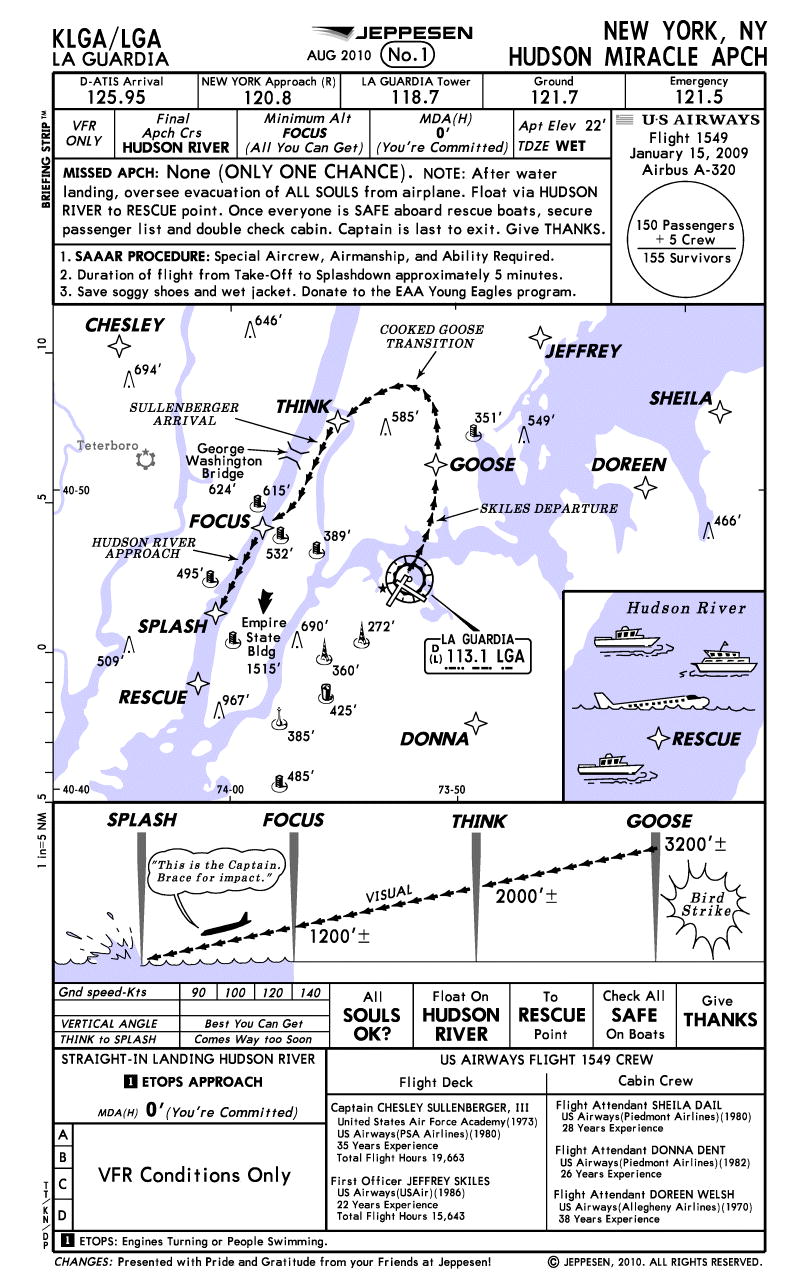
There has been much written and published about these two heros who enabled the stricken Airbus A-320 to ditch on the Hudson River with no loss of life. That was Flight 1549 on the 15th January, 2009.
However, at this year’s Oshkosh, Sullenberger and Skiles were presented with a wonderful memento from Jeppesen who publish among other products instrument approach charts for aircraft. They did something very creative in producing the following.
Jeppesen, known in the aviation industry as the worldwide leader in navigation and charting services, recently presented “Miracle on the Hudson” pilots captain Chesley Sullenberger and first-officer Jeffrey Skiles with a specially designed approach chart and engraved Jeppesen chart binders to commemorate the remarkable ditching of US Airways flight 1549 in the Hudson River in New York in January 2009.
Entitled “Hudson Miracle APCH,” the one-of-a-kind chart includes several light-hearted notations that honor the famous water landing that saved the lives of 155 passengers and crew on board the flight disabled by bird strikes. In the “briefing strip” section of the chart, instructions include: “After water landing, oversee evacuation of ALL SOULS from airplane. Float via HUDSON RIVER to RESCUE point. Once everyone is SAFE aboard rescue boats, secure passenger list and double check cabin. Captain is last to exit. Give THANKS.”
The chart documents the historic five minute flight with a unique graphic, beginning with departure from LaGuardia Airport, followed by a “Cooked Goose Transition” point and “Hudson River Approach,” which is then followed by “Splash” and “Rescue” points on the water. The humorous chart also salutes the career achievements of the crew of flight 1549, including Sullenberger, Skiles, and veteran flight attendants Sheila Dail, Donna Dent and Doreen Welsh.
Along with the commemorative chart, the pilots were presented with a special Jeppesen chart binder, engraved with the famous fortune cookie advice kept in Sullenberger’s flight bag: “A delay is better than a disaster.” The items were presented by Mark Van Tine, Jeppesen president and CEO, during the 2010 Gathering of Eagles fundraiser dinner and auction held during the EAA AirVenture fly-in and air show in Oshkosh, Wisc. The EAA Young Eagles event raises funds and awareness for youth involvement in aviation.
To view the commemorative US Airways flight 1549 chart, please visit this page.
A fellow pilot, Martin Thorpe, sent me the chart shortly after the Oshkosh event but it seemed appropriate to let some water flow under the bridge, so to speak, before I mentioned it on Learning from Dogs.
Demonstrating the joy of being really good at what you do!
Before I get to the subject matter, just another word from me about the Posts being published on Learning from Dogs just now. As I mentioned earlier, I’m presently away from home and back in England for as long as it takes to complete all the necessary procedures at the US Embassy in London. All part of me being allowed to become a resident of Payson, Arizona and the husband to my lovely Jeannie.
Anyway, I’m posting items that catch my eye and don’t require the normal amount of time to prepare and write, simply because to have a new Post every day means keeping the pipeline going to cover the times when I shall be in darkest Devon and away from internet coverage! Trust I have your support during this period – I just love seeing so many readers of the Blog!
OK, to the article.
Bob Hoover
Bob Hoover is well known to many besides pilots because for years he has demonstrated the huge skill in managing the energy of a flying aircraft – with both engines stopped.
Thanks to Peter Kelsey, a Facebook contact, who recently posted a YouTube video of Bob flying his famous display. But more about the man. Here’s an extract from Wikipedia:
Robert A. “Bob” Hoover (born January 24, 1922) is a former air show pilot andUnited States Air Forcetest pilot, known for his wide-brimmed straw hat and wide smile. In aviation circles, he is often referred to as “The pilots’ pilot.”
Bob Hoover learned to fly at Nashville‘s Berry Field while working at a local grocery store to pay for the flight training.[1] He enlisted in the Tennessee National Guard and was sent for pilot training with the Army.[2] He was sent to Casablanca where his first major assignment of the war was test flying the assembled aircraft ready for service.[3] He was later assigned to the Spitfire-equipped 52nd Fighter Group in Sicily.[4] In 1944, on his 59th mission, his malfunctioning Mark V Spitfire was shot down by a Focke-Wulf Fw 190 off the coast of Southern France and he was taken prisoner.[5] He spent 16 months at the German prison campStalag Luft 1 in Barth,Germany.[6]
He managed to escape from the prison camp, stole an Fw 190, and flew to safety in the Netherlands.[7] After the war, he was assigned to flight-test duty at Wright Field. There he impressed and befriended Chuck Yeager.[8] Later when Yeager was asked who he wanted for flight crew for the supersonicBell X-1 flight, he named Bob Hoover. Hoover was Yeager’s backup pilot in the Bell X-1 program and flew chase for Yeager in a LockheedP-80 Shooting Star during the Mach 1 flight.[9] He also flew chase for the 50th anniversary in an F-16 Fighting Falcon.[10]
What Bob shows is that true professionalism, in whatever one does, work or play, always comes over as an underplayed, understated skill. Just look at this video for proof of that:
Well over 1,700,000 viewings at the time of writing this Post!
Remember Gordo Cooper in the film “The Right Stuff” poses the question, “Who’s the greatest pilot you ever saw?” Most pilots of all sorts would elect Bob Hoover for that honorable position.
The Smithsonian seem to agree as well. If you can, settle back and watch Bob Hoover’s talk at the 2010 Smithsonian Charles A Lindberg lecture. The video at that link is a long one and Bob doesn’t come on stage until minute 20.
But the flying scenes in the introduction include some historic footage and the talk by Bob Hoover, now nearly 90, is just wonderful. That link also includes the following summary of Bob Hoover:
Robert A. “Bob” Hoover is a fighter, military, and civilian test and air show pilot of legendary proportions. Using his superb piloting skills to fly aircraft to the edge of their performance capabilities, Hoover has left an indelible mark in aviation history. During his Air Force and North American Aviation careers, he flew 58 combat missions (and as a WWII POW flew himself to freedom), served as back-up pilot on the Bell X-1 and tested a wide array of fighter aircraft. As an ambassador of aviation, Hoover flew aerobatic routines in a North American P-51 Mustang, the T-39, and the Aero Commander fleet, culminating in the Shrike Commander 500S, at more than 2,500 civilian and military air shows. Bob Hoover will discuss his career in aviation and some of the pilots he has known including Orville Wright, Eddie Rickenbacker, Charles Lindbergh, Jacqueline Cochran, Neil Armstrong, and Yuri Gagarin.
Many of the English readers of Learning from Dogs will comfortably skip this Post as already much of the news has been reporting the fact that we are 70 years after the Battle of Britain in 1940.
But for those that are from other places, where the BoB is not in the psyche of their national bloodstream, these links may be of interest.
The BBC has been doing well in presenting material.
While memories of the Battle of Britain remain fresh in the minds of The Few who flew, and the staff who supported them, veterans fear its significance could soon be forgotten by others.
The Luftwaffe lost 1,733 aircraft and the RAF 915 in the Battle of Britain
Seventy years ago the RAF was locked in a life and death struggle with the Luftwaffe in the skies over England.
The three weeks between mid-August and early September in 1940 were decisive for the Battle of Britain.
The bravery of the RAF pilots was captured in Winston Churchill’s speech on 20 August when he said “never in the field of human conflict was so much owed by so many to so few”.
Those left of The Few, as those pilots became known, are now in their 90s. Some of them fear they will soon not be around to remind people of the events that summer.
And if you want a flavour of what it was like to fly a Spitfire, then click here – excellent piece from Evan Davis of the BBC.
Seventy years on from the Battle of Britain, can the current generation comprehend what it is like to fly a Spitfire?
To find out, BBC Radio 4 Today programme presenter Evan Davis took a flight with The Aircraft Restoration Company’s chief engineer and test pilot John Romain.
And a thank-you to my Uncle who, despite being rather ill, is still alive. He was in the RAF and stationed at Biggin Hill during those demanding months in 1940.





 The Luftwaffe lost 1,733 aircraft and the RAF 915 in the Battle of Britain
 Learning from Dogs