I apologise for the rather trite sub-heading but it was a bit of attention grabbing to promote the results of a recent conference called Let Markets Be Markets. It was published by the Roosevelt Institute and had one very impressive line of speakers.
One of the speakers was Simon Johnson of Baseline Scenario fame, a Blog that Learning from Dogs has followed since our inception.
Here’s 8 minutes of Simon pulling no punches.
If you want to read and watch other presentations, then Mike Konczal’s Blog Rortybomb is the place to go.
As this Blog has repeated from time to time, this present crisis is a long way from being over.
The Celebrity Eclipse has recently left her construction dockyard at Papenburg, Germany bound for her home base. This enormous new ship attracted some news simply because the exercise of getting her from the dockyard to the open sea required some ‘shoe-horning’! This YouTube video shows why (amateur filming but a great soundtrack!):
The Celebrity Solstice leaving the dockyard (backwards!) at Papenburg
All would wish any ship that sets out to sea safe travel. But one wonders whether this huge ship, that must require such huge sums of money just to stay afloat, and that must have been conceived and ordered when times were much rosier, will ever be a commercial success?
Wikipedia have an interesting, and well referenced, entry on Air Safety. Within that entry is a table showing comparing deaths by air to other forms of travel.
The table in Wikipedia is much easier to read, it’s here, but the data is shown below for those that do not want to click through.
—————–
There are three main statistics which may be used to compare the safety of various forms of travel:
It is worth noting that the air industry’s insurers base their calculations on the number of deaths per journey statistic while the industry itself generally uses the number of deaths per kilometre statistic in press releases.
————————
Interesting to see how air travel varies in terms of comparative safety depending on how it is measured. But also interesting to see that however it is measured, riding a motorbike doesn’t come out so well.
Finally, that word’ billion’ is too easy to throw away, as it were. A billion hours ago was over a 114,000 years ago – when mankind was living in the Stone Age. A billion kilometres would represent 114,285 trips between London and Los Angeles.
Will this prove to be an accurate analysis of what happened?
Regular readers of Learning from Dogs will know that Yves Smith of Naked Capitalism is held in high regard by this author. She was one of the authors mentioned in a recent Post titled Free Speech and then a little later on there was a Post from me specifically praising her.
Last Friday the US Business News Network, BNN, ran a piece which included Yves discussing her new book ECONNED.
Yves Smith - ECONNED
The reason for publishing this Post is that the video clip covering Yves contribution is a very clearly articulated account of how we got ourselves into this economic mess. For those like this author who don’t really understand many of the sophisticated economic terms used widely elsewhere, this was a refreshing ‘tutorial’.
Do watch it – Yves is brought in around 3 min 45 secs.
In flying, mistakes have the power to inflict harm way beyond the immediate significance of the mistake. Thus the flying community have created a whole load of sayings that serve constantly to remind all those charged with the safe transport of aircraft. For example we have ‘If there’s any doubt, there’s no doubt‘. Or ‘There are old pilots and bold pilots, but no old, bold pilots‘. However the saying that underlines this story is ‘Never assume, always ask!’
Who is that in the LH seat?
His request approved, the CNN News photographer quickly used a cell phone to call the local airport to charter a flight. He was told a twin-engine plane would be waiting for him at the airport.
Arriving at the airfield, he spotted a plane warming up outside a hanger. He jumped in with his bag, slammed the door shut, and shouted, ‘Let’s go‘.
The pilot taxied out, swung the plane into the wind and took off.
Once in the air, the photographer instructed the pilot, ‘Fly over the valley and make low passes so I can take pictures of the fires on the hillsides.‘
‘Why?‘ asked the pilot.
‘Because I’m a photographer for CNN‘ , he responded, ‘and I need to get some close up shots.’
The pilot was strangely silent for a moment, finally he stammered, ‘So, what you’re telling me, is . . . You’re NOT my flight instructor?‘
Yves’ Blog Naked Capitalism has been mentioned many times on Learning from Dogs. Indeed, she was one of the Blog authors highlighted recently in this Post.
Yves Smith
I fail to understand how she finds the hours in the day to write in such detail – but those of us interested in getting under the skin of our present economic situation are all the better for it. Here’s a great example that was published on the 23rd February. I quote the opening paragraphs and then link to the rest of her post. From here on is her piece:
———————–
Martin Wolf, the Financial Times’ highly respected chief economics editor, weighs in with a pretty pessimistic piece tonight. This makes for a companion to Peter Boone and Simon Johnson’s Doomsday cycle post from yesterday.
Now, after the implosion, we witness the extraordinary rescue efforts. So what happens next? We can identify two alternatives: success and failure.
By “success”, I mean reignition of the credit engine in high-income deficit countries. So private sector spending surges anew, fiscal deficits shrink and the economy appears to being going back to normal, at last. By “failure” I mean that the deleveraging continues, private spending fails to pick up with any real vigour and fiscal deficits remain far bigger, for far longer, than almost anybody now dares to imagine. This would be post-bubble Japan on a far wider scale.
Yves here. Notice he associates success and failure with polar options. But how can you “reignite the credit engine” when the financial system is undercapitalized even before allowing for the need to take further writedowns? The IMF has found the converse in its study of 124 banking crises, that purging bad debt is a painful but necessary precursor to growth. So I fail to understand how Wolf envisages that “skip Go, collect $200″ of releveraging quickly comes about. And in fact, it turns out that Wolf’s “success” is a straw man:
Don’t know what time it is? Hardly surprising in Spring and Autumn.
Today is exactly one month before the United Kingdom ‘moves’ its clocks forward and enters British Summer Time; 1am (UTC) on Sunday 28th March 2010. Is that date the same across the world? One would think so because it makes life, especially international air transport, so much easier.
But no! In fact the way that time zones are applied and changed for Daylight Saving is a complete hotch-potch.
In the United States of America, daylight saving starts at 2am on March 14th, 2010. And just three years ago that start time would have been the first Sunday in April. Changes were made in the US Energy Policy Act of 2005.
Other parts of the world observe Daylight Saving Time as well. While European nations have been taking advantage of the time change for decades, in 1996 the European Union (EU) standardized an EU-wide “summertime period.” The EU version of Daylight Saving Time runs from the last Sunday in March through the last Sunday in October. During the summer, Russia’s clocks are two hours ahead of standard time. During the winter, all 11 of the Russian time zones are an hour ahead of standard time. During the summer months, Russian clocks are advanced another hour ahead. With their high latitude, the two hours of Daylight Saving Time really helps to save daylight. In the southern hemisphere where summer comes in December, Daylight Saving Time is observed from October to March. Equatorial and tropical countries (lower latitudes) don’t observe Daylight Saving Time since the daylight hours are similar during every season, so there’s no advantage to moving clocks forward during the summer.
Of course, someone had to create a web-site to track all these various time zones and changes. Here it is.
Last year, the BBC News website published an interesting article about the Greenwich Meridian aka The Prime Meridian. The setting of the Prime Meridian was done just over 125 years ago, in October 1884. When one thinks of the importance in having a standard meridian, both for time keeping and navigation, I would have guessed that it went back much further in time.
The other aspect that was news to me was that the conference had been convened at the request of the American President Chester Arthur.
From that BBC article:
Until the 19th Century, many countries and even individual towns kept their own local time based on the sun’s passage across the sky and there were no international rules governing when the day would start or finish.
However, with the rapid expansion of the railways and communications networks during the 1850s and 1860s, setting a standard global time soon became essential.
“The world was in a very big mix-up,” explains Dr Avraham Ariel, author of Plotting the Globe. “People had lots of prime meridians. Earlier in Europe there were 20 prime meridians. The Russians had two or three, the Spanish had their own and so on.”
Thus that famous line in the grounds of the National Maritime Museum at Greenwich, London is not as old as many might have thought.
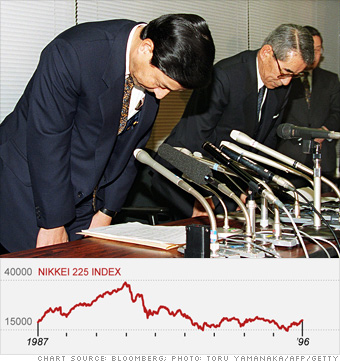
This Post is taken in its entirety from the website Contrary View. Contrary view number 73 has just been published, as follows. Please see note after signature. [The Japanese Nikkei 225 index was 10352 at the time of writing this Post – 0800 MT, 23rd Feb.]
There is plenty of evidence from Japan about lost decades for investments. Japan has now lost two decades in equity and property investment, during which time only Government Bonds provided any sanctuary. All policy options failed, because none tackled the real problem, which is that there is already too much debt. What lessons can be drawn for Britain?
Lost decades
Shares here [in Britain] have certainly had a lost decade. On the Japanese evidence, they may well suffer another lost decade. Property has only hit minor bumps, so the Japanese experience suggests that property may suffer a long decline for two decades. In the UK, the Bank of England’s support for mortgages will be withdrawn over the next two years, which itself threatens prices. Why, though, the hysteria about Government debt?
It is questionable whether pundits appreciate the extent of the private sector debt problem, which explains why two groups of economists can offer totally contradictory remedies. In a world with no Gold standard and therefore no anchor to the monetary system, Government debt is relatively safe. The global economy is perched on a knife edge, with a permanent loss of output that must cause income loss and therefore restrict the capacity of households to service their debts. Seeing the commercial risks, banks are still restricting lending, which means there can be no sustained recovery.
There is a misconceived demographic argument being touted at present, which completely ignores the real driver of the post-1945 expansion, namely increased credit. That credit growth has simply gone too far and now brings its own problems. For those people who neither saw the credit crunch nor the long fall in interest rates and inflation coming, to now be credible in predicting a lost decade for bonds, is itself unbelievable.
By Paul Handover
Note: Until very recently, the author was a client of Kauders Portfolio Services, the publisher of the Contrary View website. Please see the warning about these views posted on that site.
“Time and again we see behaviour by people – we are talking highly educated, high income people – who are making less than ideal financial decisions for themselves and their families,” said one source. “Other countries that have developed a strategy have focused on education in high schools. This task force has come to the early conclusion that, while enhanced financial education is vital over the long term, it is insufficient.”
The first sentence is so important, to my mind, that it is worth repeating, “Time and again we see behaviour by people – we are talking highly educated, high income people – who are making less than ideal financial decisions for themselves and their families,”
looking into ways of making Canadians “more savvy” about their personal finances.
The financial industry is very adept at producing complex financial products that are almost beyond the limits of the understanding of good common people. We, the people, need to be much smarter and that’s why this initiative from the Canadians seems, on the surface, to be such an excellent idea.





 Enlarge Image

 Learning from Dogs