On the 23rd October, I wrote a piece on Learning from Dogs about the innocence of dolphins and how some humans (not the correct term but it will do for now) sully the very soul of mankind by murdering these beautiful aquatic creatures.
Hopefully, the piece touched a folk with goodness in their hearts. Indeed, one such good person posted a lovely poem as a comment. That person was Sue of the Blogsite Dreamwalker’s Sanctuary. The poem deserved being made a post on here and so it’s an honour to do just that.
A Sanctuary for Inspirational Thoughts of Light, Love and Peace
Our Song, by Sue Dreamwalker
We are the giants that swim beneath the waves
Will you help our babies save?
Why do you Hunt us, why do you Kill?
Do you not realise what part we do play.
Singing our songs each and every day.
Vibration is what your world is held in
We balance your ocean along with Dolphin.
Now once again we are chased from the deep
Your awareness of us is what we do seek.
So painful a death as we face the harpoon.
Our calves are left orphaned to swim alone.
Our carcass is butchered, how long can we survive?
Our only escape is dive, dive, dive.
But connected to you we breathe the same air
Please listen to our despair.
For Our Song in lament we plead with you all.
For soon no longer will you hear our call.
Thanks Sue.
And do tune in next Monday (1st November) – another lovely story about dolphins.
I have been reading Will Hutton‘s latest book for the last couple of weeks and am now through the first 5 chapters, at the time of writing this Post! To my mind, it’s a very powerful and extremely well-argued summary of the sickness that has engulfed Britain, and by implication, other countries who have had similar experiences over the last 20 years.
There was a long extract published by the Guardian on the 26th September 2010 which gives one a good feel for the book. Here’s how that extract starts:
The British are a lost tribe – disoriented, brooding and suspicious. They have lived through the biggest bank bail-out in history and the deepest recession since the 1930s, and they are now being warned that they face a decade of unparalleled public and private austerity. Yet only a few years earlier their political and business leaders were congratulating themselves on creating a new economic alchemy of unbroken growth based on financial services, open markets and a seemingly unending credit and property boom. As we know now, that was a false prospectus. All that had been created was a bubble economy and society. Yet while the country is now exhorted to tighten its belt and pay off its debts, those who created the crisis — the country’s CEOs and bankers, still living on Planet Extravagance, not to mention mainstream politicians — all want to get back to “business as usual”: the world of 1997 to 2007.
There are many, many sentences in the book that have one gasping for breath. One of them that particular struck me was one on Page 13, see below for the sentence in italics. But let me include sufficient text to put the sentence into context:
Today, philanthropy or living according to a particular moral code does not confer status. Only money is able to do that. People start to question whether vocational career choices – in farming, teaching, medicine or science – make any sense when society rewards them so lowly while rewarding finance so high. Material values start to crowd out altruism, philanthropy and restraint.
Then comes this staggering reflection:
Two incidents in September 2007 highlighted the new values. Lance Bombardier Ben Parkinson, who lost both legs after a landmine exploded in Afghanistan, was offered £152,000 compensation by the Ministry of Defence. The very same week, Eric Nicoli left his job as CEO of EMI – having failed to turn around the company – with a pay-off of £3 million. [My italics]
Earlier, on page 6, Hutton writes of Richard Lambert, head of the Confederation of British Industry, the CBI as having said in March 2010, “for the first time in history officers of a company can become seriously rich without risking any of their own money.” Here’s another piece from that extract published in the Guardian:
We need a shared understanding of what constitutes fairness in order to restore our society. At present, there is none. The rich argue that it is fair for them to be so wealthy, in much the same way as Athenian noblemen believed that their riches were signifiers of their worth. They believe they owe little or nothing to society, government or public institutions. They accept no limit or proportionality to their wealth, benchmarking themselves only against their fellow rich. Philanthropic giving is declining; tax avoidance is rising; and executive pay is rising exponentially. All three are justified by the doctrine that the rich simply deserve to be rich. Meanwhile, the poor, in their view – and that of a virulent right-wing media – largely deserve their plight because they could have chosen otherwise. The mockery of chavs is premised on the assumption that they could be different if they wanted to be. The poor could work, save and show some initiative. So why should we indulge them by giving them state handouts?
This lies behind the arrogance with which bankers still defend their bonuses, in spite of everything that has happened over the past few years.
OK, you get my drift! I could go on and on but, hopefully, my point is made. This book by Hutton is going to be another of his classics and may well be seen as the ‘tipping point’ when society looks back in a decade’s time with that wonderful 20:20 hindsight!
Finally, are there other conclusions to be made of Hutton’s approach? Yes, of course. Reading the comments posted on the Guardian web page will show you many.
“Faith is not simply a patience that passively suffers until the storm is past. Rather, it is a spirit that bears things – with resignations, yes, but above all, with blazing, serene hope.” Corazon Aquino.
Yes, I cheated. I looked for a quotation to suit the mood of this post and came across the above. Corazon Aquino was the woman who led the revolution which toppled the authoritarian regime of the late strongman Ferdinand Marcos and restored democracy in the Philippines.
Anyway, to the theme of this Post.
Those that are regular readers of Learning from Dogs know that at one level I am not optimistic about the future over the coming years. A quick trawl through this Blog will find quite a few articles showing that things are going to get a lot worse before they get better.
One of the forecasters who has consistently been on the money, so to speak, is Gerald Celente. He runs an organisation known as Trends Research Institute.
Here’s 14 minutes from a recent interview on the Alex Jones Show. Do watch it to the end.
Despite being US focussed this interview still has massive implications for the rest of the world.
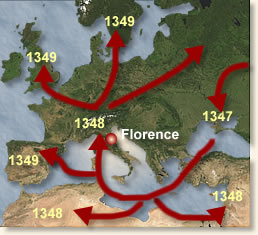
This Post is about faith. Around minute 10:30 in the above video, Celente talks of those people that have the faith in themselves to bring about change. Celente talks that from all great disasters comes change. He talks of the Black Death that in the three years from 1348 wiped out up to 50% of Europe’s population.
Coming out of the East, the Black Death reached the shores of Italy in the spring of 1348 unleashing a rampage of death across Europe unprecedented in recorded history. By the time the epidemic played itself out three years later, anywhere between 25% and 50% of Europe’s population had fallen victim to the pestilence.
Plague's progress
So here’s the point. In the Celente interview, he predicts that 20% of Americans will reject the way that they see their society going. Fascinating! That 20% figure.
Dr David Hawkins in his seminal book Power vs Force writes on page 77:
… 85% of the [world] race is below the critical level of 200, while the overall average level of human consciousness is approximately 204. The power of the relatively few individuals near the top counterbalance the weakness of the masses towards the bottom to achieve the overall balance.
Hawkins is saying that 15% of the world’s population has the integrity required to bring up the level of consciousness of all the rest.
I have the faith that we are on the verge of another renaissance for mankind, one based on integrity and truthfulness, honesty and love. In my faith, I see this next renaissance being born in America, still the land of the free.
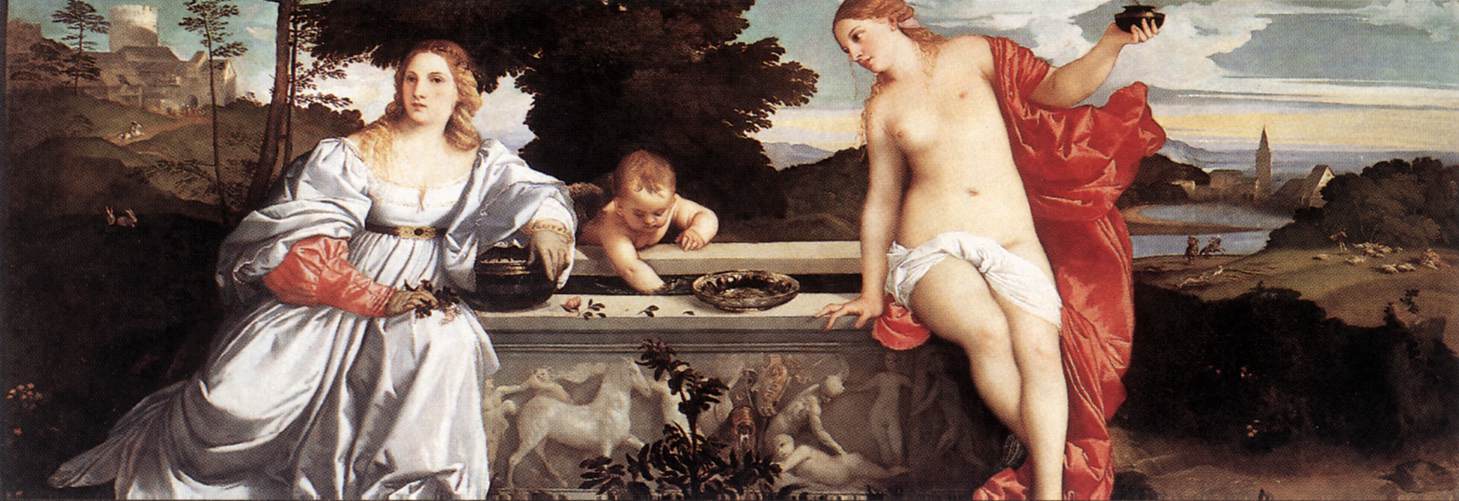
"Sacred and Profane Love" by Tiziano Vecellio, otherwise known as Titian
Titian was born in 1488 just 100 years after Europe was ravaged by the Plague.
Keep the faith – there is a wonderful new world just around the corner.
Well the first thing that raised a smile was me putting in the word ‘happiness’ into a Google search and noticing the response – About 50,000,000 results (0.15 seconds)!
50 million results – wow.
Let me tell you that I don’t propose to cast myself as anything other than an ordinary Joe. The simple motivation behind this Post is that if a single person reading these words gets some insight into seeing their own lives in a richer way, then it’s worth while.
Let’s come at the subject from the perspective of good mental health. What’s that then?
Here’s an extract from MIND – the leading mental health charity in the UK.
Good mental health isn’t something you have, but something you do. To be mentally healthy you must value and accept yourself. This means that:
You care about yourself and you care for yourself. You love yourself, not hate yourself. You look after your physical health – eat well, sleep well, exercise and enjoy yourself.
You see yourself as being a valuable person in your own right. You don’t have to earn the right to exist. You exist, so you have the right to exist.
You judge yourself on reasonable standards. You don’t set yourself impossible goals, such as ‘I have to be perfect in everything I do’, and then punish yourself when you don’t reach those goals.
If you don’t value and accept yourself, you are always frightened that other people will reject you. To prevent people seeing how unacceptable you are, you keep them at a distance, and so you are always frightened and lonely. If you value yourself, you don’t expect people to reject you. You aren’t frightened of other people. You can be open, and so you enjoy good relationships.
If you value and accept yourself, you are able to relax and enjoy yourself, without feeling guilty. When you face a crisis, you know that, no matter how difficult the situation is, you will manage. How we see ourselves is central to every decision we make. People who value and accept themselves cope with life.
The BBC, often so good at important public service issues, ran a series of programmes in 2008 under the banner of The Happiness Formula. Included in that web link is a simple test to measure one’s own happiness.
Psychologists say it is possible to measure your happiness.
NB: I just tried this test myself and wasn’t sure if the analysis part of the test was working – try it yourself. But the information offered is still well worth reading.
There’s more background on Prof. Diener here. And a short video below.
Perhaps more valuable is another excellent TEDtalks video Habits of Happiness.
I had real trouble in writing yesterday’s Post about the appalling slaughter of the dolphins in Japan. Perhaps there was something out there in the ether that recognised the pain that I was sharing with so many thousands of other dolphin lovers.
Because while I was writing the article, into my in-box came something from Save Japan Dolphins about how close dolphins are to mankind, in DNA terms.
Seema Kumar, of Discovery Channel Online, writes that scientists have discovered that the genetic make-up of dolphins is amazingly similar to humans. They’re closer to us than cows, horses, or pigs, despite the fact that they live in the water.
Busbee says, “If we can show that humans are similar to dolphins, and anything that endangers dolphins is an equal concern for humans, it may be easier to persuade governments to keep oceans clean.”
And make it easier for all honest and loving people to join the fight to stop that most dastardly murdering of dolphins in Taiji, Japan.
If you do nothing else, at least sign up to receiving the latest news from Save Japan Dolphins – which is how this Post was conceived.
In Japan, fishermen round up and slaughter hundreds and even thousands of dolphins and other small whales each year.In the small fishing village of Taiji, entire schools of dolphins are driven into a hidden cove after a prolonged chase. Once trapped inside the cove, the fishermen kill the dolphins, slashing their throats with knives or stabbing them with spears. The water turns red with their blood, and the air fills with their screams.
While I follow a number of Blogs, there are few that I read avidly. One of them in that latter category is Baseline Scenario. I wish I understood more of the technical issues presented by the Blog authors and the dozens of brilliant commentors. But the essence of what is being discussed is clear. I thoroughly recommend subscribing.
Here’s a recent Post from James Kwak (see end of Post for bio details). It was called Free Books and Board Seats. James very kindly has given Learning from Dogs written permission to reproduce the article in full.
Here in the blogging world, some of us are very sensitive to the potential appearance of impropriety. A year ago, the FTC published new rules requiring bloggers to disclose cash and in-kind payments they receive for reviewing products. The upshot, for most of us, is simply that now, when we discuss a book, we say if we got a free copy of the book from the publisher. (Although it’s not clear that that disclosure is required, since getting a free copy is something that readers should expect; I don’t think the New York Times Book Review bothers pointing out that, for every book they review, they got a free copy, although they almost certainly did.)
All the more relevant, then, is Gerald Epstein’s post about conflicts of interest in the economics profession.
“Jessica Carrick-Hagenbarth and I did a study of 19 prominent academic financial economists who were members of two influential groups that have played a key role in the financial reform and regulation debate in the U.S. Of the 19 academic economists in these groups, 70% advised, owned significant stock in or were on the board of private financial institutions. But you wouldn’t know by looking at their self-identification in media appearances, policy work or academic papers.”
There are certainly economists who were talking up the housing market in the summer of 2008 without disclosing their financial ties to banks–who were desperately hoping that housing prices would not collapse.
C’mon, guys. I don’t even get very many free books (maybe one per month on average–I decline most of them), and I always disclose that. I know it’s not feasible to list every company that ever paid you to give a speech. But really, if you’re a paid director of a bank and you write about the banking industry, can’t you at least point that out?
Well put James.
—————————— James Kwak is a former McKinsey consultant, a co-founder of a successful software company, and currently a student at the Yale Law School. He is not, never has been, and never will be a member of the Yale Law Journal. He is a co-founder of The Baseline Scenario.
Pure luck in discovering things you were not looking for.
But the Buddhist belief is that there is no such thing as luck. See here:
The dictionary defines luck as ‘believing that whatever happens, either good or bad, to a person in the course of events is due to chance, fate or fortune.’ The Buddha denied this belief completely. Everything that happens has a specific cause or causes and there must be some relationships between the cause and the effect. (My italics.)
So you takes your choice! The Free Dictionary goes on to provide a fascinating account of the word history of serendipity:
Word History: We are indebted to the English author Horace Walpole for the word serendipity, which he coined in one of the 3,000 or more letters on which his literary reputation primarily rests. In a letter of January 28, 1754, Walpole says that “this discovery, indeed, is almost of that kind which I call Serendipity, a very expressive word.” Walpole formed the word on an old name for Sri Lanka, Serendip.He explained that this name was part of the title of “a silly fairy tale, called The Three Princes of Serendip:as their highnesses traveled, they were always making discoveries, by accidents and sagacity, of things which they were not in quest of….”
The work that the dedicated folks at WITNESS do is both humbling and uplifting and puts into perspective the value of what we do everyday.
Take 10 minutes from your busy day to view this video and then look at the WITNESS website to see what real change looks like. It will inspire you and enrich your life. It is important.
That reference to the charity WITNESS impressed me. Especially the fact that
Peter Gabriel
it was founded by that great musician Peter Gabriel.
Here’s the video mentioned in the extract above:
So how to close this particular post? Not sure, to be honest. But whether one believes in luck or not, there’s no doubt that we attract the world around us that we ‘deserve’.
As has been said before on this Blog, we get more of what we think about most. So really the Buddhist approach that there “must be some relationships between the cause and the effect” is more than sufficient reason to be a good and integrous member of this planet.
Your task is not to seek for love, but merely to seek and find all the barriers within yourself that you have built against it.Jala ad-Din Rumi 1207 – 1273
One would suspect that readers of this Post title would have many different responses to the word ‘love’. Perhaps in this harsh, economically challenged world, it seems a little quaint to think about love in anything other than a romantic sense.
But, trust me, there’s nothing quaint or ‘away with the fairies’ about reminding us all of both the power of love and the urgent need to bring that power further up the scale of human consciousness. Let’s even try and aim for where dogs are. Dogs intuitively demonstrate unconditional love to those around them that they trust.
Dog love!
Before we look at the effects of love, let’s remind ourselves of some of the outcomes from the stress and trauma generated by present times. A news item from the London School of Hygiene and Tropical Medicine published in July, 2009, said this:
Researchers at London School of Hygiene & Tropical Medicine and Oxford University estimated that soaring stress brought on by job losses could prompt a 2.4% rise in suicide rates in people under-64 years of age, a 2.7% rise in heart attack deaths in men between 30 and 44 years, and a 2.4% rise in homicides rates, corresponding to thousands of deaths in European Union countries, such as the UK.
Nor is the impact just economic. The sudden flipping from the wild optimism of the boom to the personal gloom and self-doubt of recession and system-wide financial crisis is bad for health and well-being.
So it appears as if there’s no shortage of reasons why engaging the power of love offers infinite possibilities for us all.
The BBC recently reported on research that shows that people in love can lower their levels of pain.
Love hurts, at least according to many a romantic songwriter, but it may also help ease pain, US scientists suggest.
Brain scans suggest many of the areas normally involved in pain response are also activated by amorous thoughts.
Stanford University researchers gave 15 students mild doses of pain, while checking if they were distracted by gazing at photos of their beloved.
He said: “One example is a footballer who has suffered quite a painful injury, but who is able to continue playing because of his emotionally charged state.”
He added that while the effect noticed by the Stanford researchers might only be short-lived in the early stages of a love affair, it may well be replaced by something similar later in a relationship, with a sense of comfort and wellbeing generating the release of endorphins.
“It’s important to recognise that people who feel alone and depressed may have very low pain thresholds, whereas the reverse can be true for people who feel secure and cared for.
Prof Gilbert states on his web page that “After years of exploring the processes underpinning shame and its role in a variety of psychopathologies,
Prof. Gilbert
my current research is exploring the neurophysiology and therapeutic effectiveness of compassion focused therapy.” (My italics.)
The old adage that you can’t love another if you don’t love yourself is based on very high levels of awareness. So the starting point to gaining the power of love is self-awareness. Here’s something from MIND:
Good mental health isn’t something you have, but something you do. To be mentally healthy you must value and accept yourself. This means that:
You care about yourself and you care for yourself. You love yourself, not hate yourself. You look after your physical health – eat well, sleep well, exercise and enjoy yourself.
You see yourself as being a valuable person in your own right. You don’t have to earn the right to exist. You exist, so you have the right to exist.
You judge yourself on reasonable standards. You don’t set yourself impossible goals, such as ‘I have to be perfect in everything I do’, and then punish yourself when you don’t reach those goals.
Finally, back to romantic love. The most glorious feeling in the world.
Again expressed so beautifully by Rumi: “The minute I heard my first love story I started looking for you, not knowing how blind that was. Lovers don’t finally meet somewhere. They’re in each other all along.”




 Learning from Dogs