The glass is filled half-way. Is it half-full or half-empty?
This is a rhetorical question, of course. It is what comes to mind as I write this simply because of a small half-full/half-empty experience in the last 10 minutes. Let me explain.
I had started watching a video on TED.com. This one was entitled Jared Diamond on why societies collapse. Within a few minutes I started drifting to the comments, and read:
Jared Diamond talks of how societies choose (unwittingly) to collapse. William McDonough with his Cradle to Cradle concept also talks about choices and provides ‘Love of all children of all species for all time’ as a positive conscious choice.
With goals or missions in place (for example profit for businesses) humans have achieved amazing things.
So what would happen if all groups, families and individuals followed a mission of ‘Love of all children of all species for all time’?
I rather liked that. We always have choices. A positive conscious choice is always better.
So I stopped the Jared Diamond lecture and found the William McDonough one, also on TED.com, and conveniently shared on YouTube. It’s just 20 minutes long, so settle down somewhere, perhaps with a glass filled half-way with something!
Today, like every day, is a beautiful day of hope!
At 3.30pm US Mountain Time – 10.30pm UK time – the marriage service between me and Jean Susan will commence at the Episcopal Church in Payson, Arizona. It represents a wonderful day of hope.
But hope is something much bigger than a couple getting married. See it from this perspective. From the eyes of Shimon Schocken.
An inspirational film with an incredibly relevant message to us all.
I’m not going to yield to the temptation to take a personal view, real life is too complicated.
Just, if you can, watch the film.
Here’s the summary from Wikipedia. More background to the film is on the IMDB website including this review:
I saw this movie at Sundance, and it was brilliant. Beautiful shots, wonderful acting and such a moving story! It made me cry, it made me laugh (with Billy Boyd as much of the comic relief!), it made me want to see it again! Gaby Dellal’s direction was spot on, and the emotions from each of the characters was so true, that I wanted to cheer Frank (Peter Mullan)) on while swimming the English Channel and console him when he felt like he couldn’t do anything.
The only thing that I had an “issue” with, was that at a few moments, the Scottish accent was so thick that I missed what was said.
Note: the next 10 days are pretty challenging, in the most positive and beautiful way, as Jean and I are to be married at Payson Episcopal Church on Saturday afternoon and we have guests until the 29th. There will always be a daily post from either me or Jon but do forgive us if they are not of the usual longer reflective style.
Dr. David R. Hawkins, M.D., Ph.D.
Both Jon and I have written about Dr Hawkins many times in Learning from Dogs. But there is also a plethora of valuable material available from the organisation, Veritas Publishing, that is the wrapper, so to speak, around David Hawkins work.
His monthly newsletter is free and often very interesting. For example, in the one that arrived today, there are a couple of extracts from his October lecture that resonate very closely with what Jon published about Eckhart Tolle the previous two days.
“The Self knows. The mind thinks. The thinking is just added as a thrill. Thinking is a thrill and an entertainment. Can you get along without thinking? There is a chair. I don’t think about the chair but I know it’s there. Most of real knowingness goes on without thinking. The animal knows without thinking. It just knows right off the bat who is a friend and who is a burglar.”
“Make choices instead of craving and desire and clutching. Choose to be happy instead of craving what you don’t have. Give up all cravingness. ‘I cannot be happy unless I get to do this or that.’ You are putting happiness as outside of yourself. The source of happiness is within. Winning $1 million does not make a big change in your life. Surrender all cravings to God.”
And do watch this:
Finally, I have repeated a publication today of a post written about Truth published earlier on Learning from Dogs in September. It has come out at the same time as this Post.
(A copy of the original post published earlier in September on this Blog)
Dr David Hawkins writing about truth
One of the many strange consequences of leaving the United Kingdom in 2008 leading, eventually, to settling in Arizona is that we are within a half-day’s car ride of Sedona. Sedona is where Dr. David R Hawkins is based.
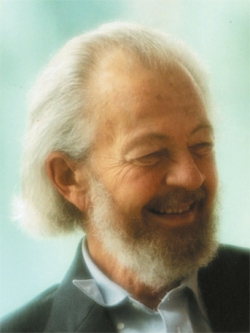
Dr. David R Hawkins
Dr. David Hawkins is a life member of the American Psychiatric Association but is best known for his research into “the hidden determinants of human behavior”. That quote is taken from the front cover of Hawkins’ seminal book, Power vs. Force.
Dr. Hawkins was Knighted by the Danish Crown for this work in 1996, a worthy recognition, it seems to me.
I have been reading Power vs. Force for some weeks now. Normally I devour a book, fiction or non-fiction, if it holds my interest. But this book is different! Power vs. Force contains so many profound teachings that frequently there is more than enough to take in from a single page, or even just a couple of paragraphs. To read on before a particular proposition has had time to invade and penetrate one’s deeper senses is almost painful.
The challenge in wanting to share some of these teachings is having the patience to finish the book before putting pen to paper, so to speak. I failed!
In one of the early chapters, Hawkins writes about “the intrinsic source of power and how it operates.” There are a couple of paragraphs that just punched out from the page. Here they are, interwoven with my thoughts:
In looking for the source of power we have noted that it is associated with meaning, and this meaning has to do with the significance of life itself. Force is concrete, literal and arguable. It requires proof and support. The sources of power, however, are inarguable and are not subject to proof. The self-evident is not arguable.
Just at this point, one might have forgiven me for being slightly skeptical. How can the ‘self-evident’ or anything be above argument? Especially if one reflects on the notion that all we perceive with our senses is an illusion, a product of our minds. I clearly recall having this fleeting thought at this point in the paragraph. But the eyes continued to the next sentence and, figuratively, I was gasping for breath. Remember I had just read, “The self-evident is not arguable.” This was what came next:
That health is more important than disease, that life is more important than death, that honor is preferable to dishonor, that faith and trust are preferable to doubt and cynicism, that the constructive is preferable to the destructive – all are self-evident statements not subject to proof. Ultimately, the only thing we can say about a source of power is that it just “is”.
Wow! Those few sentences stopped me in my tracks. Think about what Hawkins is saying. He is saying that we intuitively know, without the need of intellectual argument or ‘proof’, the rightness, the beauty, the perfection of some deeply fundamental concepts.
It’s as if from the earliest moments of human awareness, gravity, sunlight, night and day, for example, were obvious despite eons of time needing to pass before science could ’explain’ these aspects of life.
In other words, there are understandings that are deeply embedded in human consciousness. Hawkins continues:
Every civilization is characterized by native principles. If the principles of a civilization are noble, it succeeds; if they are selfish, it falls. As a term, “principles” may sound abstract, but the consequences of principles are quite concrete. If we examine principles we will see that they reside in an invisible realm within consciousness itself. Although we can point out examples of honesty in the world, honesty itself as an organizing principle central to civilization is nowhere independently existent in the external world. True power, then, emanates from consciousness itself; what we see is a visible manifestation of the invisible.
Phew! True power emanates from consciousness itself!
It’s now 2 days since I read that. It still reverberates within my mind. I was compelled to share it with you. And it reverberates for me in an even clearer form – truth emanates from consciousness itself! Stay with me just a while longer.
A very well-known magical attribute of the human brain is what goes on in the sub-conscious, our ‘back-office’. Give our brain some space to process a dilemma such as deciding what to do for the best and it does come up with what is best for us. Often the best space we can provide for our brain is a good night’s sleep. It’s common folklore to ‘sleep’ on a problem.
My co-founder of Learning from Dogs, Jon Lavin, says that often in sleep we find the truth. I think the same could be said for prayer, as in a spiritual sense more than in a religious sense.
Just reflect again on the power of what comes out from those two paragraphs. Truth is not something external to us; it is within us, all the time. Our level of consciousness is the key to this truth. Our self-awareness is the tool by which we understand our level of consciousness – our mirror to our soul.
This is not corny, this is at the heart of everything in life.
Nearly a month ago, I wrote a piece called The Power of Love. It was offered as a logical argument in favour of love – read it if you want to see what was written.
In line with the general Blog theme on here that we have much to learn from dogs and unconditional love is the BIG lesson we should take from these noble animals, here’s a lovely story that was sent to me by a dear friend.
WHOEVER DID THIS IS A VERY BEAUTIFUL PERSON
The ‘whoever’ being someone at a dead letter office within the US Postal System.
Here’s how it goes.
Our 14 year old dog, Abbey, died last month. The day after she died, my 4 year old daughter Meredith was crying and talking about how much she missed Abbey.. She asked if we could write a letter to God so that when Abbey got to heaven, God would recognize her. I told her that I thought we could so she dictated these words:
Abbey and Meredith
Dear God,
Will you please take care of my dog? She died yesterday and is with you in heaven. I miss her very much. I am happy that you let me have her as my dog even though she got sick.
I hope you will play with her.. She likes to play with balls and to swim. I am sending a picture of her so when you see her You will know that she is my dog. I really miss her.
Love, Meredith
We put the letter in an envelope with a picture of Abbey and Meredith and addressed it to God/Heaven. We put our return address on it.. Then Meredith pasted several stamps on the front of the envelope because she said it would take lots of stamps to get the letter all the way to heaven. That afternoon she dropped it into the letter box at the post office. A few days later, she asked if God had gotten the letter yet. I told her that I thought He had.
Yesterday, there was a package wrapped in gold paper on our front porch addressed, ‘To Meredith’ in an unfamiliar hand.. Meredith opened it. Inside was a book by Mr. Rogers called, ‘When a Pet Dies..’ Taped to the inside front cover was the letter we had written to God in its opened envelope. On the opposite page was the picture of Abbey &Meredith and this note:
Dear Meredith,
Abbey arrived safely in heaven.
Having the picture was a big help. I recognized Abbey right away.
Abbey isn’t sick anymore. Her spirit is here with me just like it stays in your heart. Abbey loved being your dog. Since we don’t need our bodies in heaven, I don’t have any pockets to keep your picture in, so I am sending it back to you in this little book for you to keep and have something to remember Abbey by..
Thank you for the beautiful letter and thank your mother for helping you write it and sending it to me. What a wonderful mother you have. I picked her especially for you.
I send my blessings every day and remember that I love you very much.
By the way, I’m easy to find, I am wherever there is love.
Love,
God
[The book is available on Amazon here. I have no financial interest in providing you with the link. Ed.]
Thanks Julie for sending that in – it’s a very moving example of unconditional love and generosity.
There is so much information around us these days that it’s easy to forget how incredibly advantaged are those today that wish to learn about everything and anything. It was just such a meander around the internet that brought me to a website called Science Daily, a wonderful daily digest of top science news items.
And a browse through that web site brought me to this piece on the creation of the very first stars in the universe.
June 1, 2007 — Astronomers removed light from closer and better known galaxies and stars from pictures taken with the Spitzer Space Telescope. The remaining images are believed to be the first objects in space, 13 billion light years away.
The first stars in our universe are long gone, but their light still shines, giving us a peek at what the universe looked like in its early years.
Astrophysicists believe they’ve spotted a faint glow from stars born at the beginning of time. Harvey Moseley, Ph.D., an astrophysicist at the NASA Goddard Space Flight Center in Greenbelt, Maryland, says, “The reason they’re faint is just because they’re very, very far away, they’re over at the far edge of the universe.”
I don’t know about you but I find this so deeply inspiring – a reminder of the instinctive nature of man to enquire and explore. And it is this exploratory instinct that will pull us all through from the challenges that we all face today.
Anyway, I’m wandering off the subject!
Do read the piece in full here and then watch the following video from Avi Loeb.
Oh, want to know how far 13 billion light years is? Brace yourself!
Light travels at 186,000 miles per second or more properly expressed 299,792.458 km/sec. See here. (Brilliant website by the way) That is 10 trillion kilometres a year.
So 13 billion light years is simply! 10 trillion multiplied by 13 billion kilometres. Anyone got a larger calculator?
Digital content opens up a whole new ways of thinking about price, value and success.
Book cover
Some time ago, I read the new book from Chris AndersonFree: The Future of a Radical Price It was a very busy period of my life and I had ‘parked’ the conclusions contained in the book for a later time – and then forgot about it!
Anyway, something that came into my in-box earlier today reminded me of the power of giving content away. But before going there, let me briefly come back to Anderson’s book. An extract from this link talking about what in the UK we know as jelly and in the US the name of Jell-O, (nice history on Wikipedia):
But it didn’t sell. Jell-O was too foreign a food and too unknown a brand for turn-of-the-century consumers. Kitchen traditions were still based on Victorian recipes, where every food type had its place. Was this new jelly a salad ingredient or a dessert?
For two years, Wait kept trying to stir up interest in Jell-O, with little success. Eventually, in 1899, he gave up and sold the trademark — name, hyphen, and all — to Orator Frank Woodward, a local businessman. The price was $450.
Woodward was a natural salesman, and he had settled in the right place. LeRoy had become something of a nineteenth- century huckster hotbed, best known for its patent medicine makers. Woodward sold plenty of miracle cures and was creative with plaster of paris, too. He marketed plaster target balls for marksmen and invented a plaster laying nest for chickens that was infused with an anti-lice powder.
But even Woodward’s firm, the Genesee Pure Food Company, struggled to find a market for powdered gelatin. It was a new product category with an unknown brand name in an era where general stores sold almost all products from behind the counter and customers had to ask for them by name. The Jell-O was manufactured in a nearby factory run by Andrew Samuel Nico. Sales were so slow and disheartening for the new product that on one gloomy day, while contemplating a huge stack of unsold Jell-O boxes, Woodward offered Nico the whole business for $35. Nico refused.
Anderson then explores what Woodward does next:
So in 1902 Woodward and his marketing chief, William E. Humelbaugh, tried something new. First, they crafted a three-inch ad to run in Ladies’ Home Journal, at a cost of $336. Rather optimistically proclaiming Jell-O “America’s Most Famous Dessert,” the ad explained the appeal of the product: This new dessert “could be served with the simple addition of whipped cream or thin custard. If, however, you desire something very fancy, there are hundreds of delightful combinations that can be quickly prepared.”
Then, to illustrate all those richly varied combinations, Genesee printed up tens of thousands of pamphlets with Jell-O recipes and gave them to its salesmen to distribute to homemakers for free.
(My emphasis – do read the extract in full from here.) The book is highly recommended.
So what was it that came into my email in-box? It was an email from Leo Babauta of Zen Habits, a Blog that I subscribe to. This is what it said:
I’m happy to announce that focus is now in the Kindle Store. You can get the full book — the free chapters plus bonus chapters from me and five other authors — for $8.99. It doesn’t include the videos, audio interviews and bonus PDFs in the full version.
The free version is simple: it’s 27 chapters that you can download for free, without having to give an email address or do anything else. It’s uncopyrighted, and you can share it with as many people as you like.
Again, you can share this ebook freely, so feel free to post it on your blog, Twitter, Facebook, or email.
I have no way of knowing how many downloads have been made but I suspect many more than one might imagine.
What I would be curious is to know from amongst the many Learning from Dogs readers how many of you have read this Post to the point of downloading the book for yourself, or others?
SUPER-FIT and ATTRACTIVE SINGLE BLACK FEMALE seeks male companionship, ethnicity unimportant. I’m a very good girl who LOVES to play. I love long walks in the woods, riding in your pickup truck, hunting, camping and fishing trips, cozy winter nights lying by the fire. Candlelight dinners will have me eating out of your hand. I’ll be at the front door when you get home from work, wearing only what nature gave me … Call 01272-6420 and ask for Annie, I’ll be waiting …..
Luckily, we were later able to obtain a photo of this georgeous prospect, enough to make any man slaver ….


 Learning from Dogs