Author: Paul Handover

Searching for something

Maybe less is more is really at the heart of our thirst for something more

A number of disparate recent experiences seem to have an underlying common thread.

See if these strike you in a similar fashion.

Yesterday, Joelle Jordan wrote about joy, about the wonderful relationship that dogs have with the world around them.  As Joelle wrote,

Joy is a difficult commodity to come by these days. I don’t mean entertainment, I don’t mean a good laugh, I mean pure joy, where, even just for a single moment, all worries and doubts, frustration and anger are lifted as though by Atlas.

Like so many other humans in our world, I often find myself in a constant state of stress. There always seems to be something to worry about, whether it’s money, job fulfilment, the state of my relationships, getting the house cleaned, finding time to get to the market, and more. If given the chance, I know we all could spend nearly all of our waking hours (and some of our sleeping hours, too) worrying about something. We spend so much time on the many things that inevitably work themselves out, and so little time on things that will create a memory and a crystal moment of joy.

My little dog Charlie spends his time in the completely opposite fashion; spending his waking hours seeking joy, and committing less time to things that worry him.

Charlie seems to exist normally in three states of being; content, happy and utterly joyful.

How many of us can echo Charlie’s existance in our own lives?

Then last Sunday, Father D’s sermon spoke about our tendency to develop habitual behaviours and rarely challenge the point of them.

The truth is that we get used to doing things a certain way and keep doing them without ever thinking of what we are doing.  We say things in the liturgy without even thinking of what we are saying.  I’m sure many people utter the words in the Book of Common Prayer without thinking of the theology behind the words, or the relationship between church and state that they express.

Later on,

There was a desire for “something more” but it was hard to put a finger on what it was.  I realized from these conversations that we are involved today in a time of intense searching.  Few of us are satisfied with what the church and society have served up.

The honest among us will readily admit we lead fractured lives – with a disembodied spirituality on one side, and a soulless daily existence on the other.  We are desperate for something more, for a faith with the power to transform both ourselves and our world.

“….  we are involved today in a time of intense searching“!  That smacked me right in the eye!

These are clearly challenging times with mankind facing increasing odds of an ecological disaster of Old Testament proportions, and much of the western world on the cusp of a long and difficult recession.  It is so easy to go on “doing things a certain way and keep doing them without ever thinking of what we are doing” while we wait for the leaders of our societies to fix our problems.

The truth is that we have to be the first to change, to question what we do on a daily basis and amend it if it is not truly healthy for us and for the planet.  As was said in that sermon, “It means bringing forth each day the fruits of the Spirit: Love, joy, patience, kindness, generosity, faithfulness, gentleness and self-control.”

Go back and read yesterday’s Post and reflect on how many of those ‘fruits’ are the ways of dogs.

My final connection with the theme of today’s essay is with a recent series from the BBC called ‘Status Anxiety’.  The programmes are still on YouTube and the first 10 minutes is below,

Status Anxiety discusses the desire of people in many modern societies to “climb the social ladder” and the anxieties that result from a focus on how one is perceived by others. De Botton claims that chronic anxiety about status is an inevitable side effect of any democratic, ostensibly egalitarian society. De Botton lays out the causes of and solutions to status anxiety.

Or if you prefer, all 2 hours 23 minutes may be watched on Top Documentary Films, described thus,

De Botton's book

Why doesn’t money (usually) buy happiness? Alain de Botton breaks new ground for most of us, offering reasons for something our grandparents may well have told us, as children.

It is rare, and pleasing, to see a substantial philosophical argument sustained as well as it is in this documentary. De Botton claims that we are more anxious about our own importance and achievements than our grandparents were. This is status anxiety.

Alain quotes philosophical writings, such as Democracy in America, a report by Alexis de Tocqueville on his visit to the USA in 1831. De Tocqueville noted that American equality, notable in those times, was accompanied by a climate of envy.

We jump to present-day USA, and see what, to de Botton, are some awful examples ofThe American Way. A Christian preaches get rich. A steelworker tells of his insecure life in an industry being closed down through others’ love of money.

Our protagonist points out the advantage of high status: those with high status will enjoy the care and attention of the world. Then joins this advantage with the illusion, orattempt at meritocracy in the USA, mentioning Jefferson’s notion of an aristocracy of talent.

Some of the messages towards the end of the programme are very thought-provoking indeed.  Let me draw this all together.

If you own a dog, or a cat, or any pet, stop a while today and see how their simplicity of life brings them so much more.  Naturally, we can never live life in the same way that our pet does but there are strong metaphors that carry equally strong messages for us.  Less is more.

Now watch the last part of Status Anxiety even if you didn’t watch the first segment above,  Reason?  Watch and it will become clear.


A self-affirmation

For today, I am incharge of my life.

Today, I choose my thoughts.

Today, I choose my attitudes.

Today, I choose my actions and behaviours.

With these, I create my life and my destiny.

The Power of Joy

Yet another fabulous example from dogs.

This is a guest post from Joelle Jordan.  Let me broadcast my gratitude for this lovely story. For two reasons.  The first is that Joelle is very generous in sharing her fine work and the second is that at the time of me putting this Blog post together, 4pm yesterday, I really needed a helping hand – have been short of time all week-end.  So thank-you Joelle.  Here’s her story.

————————-

Joy is a difficult commodity to come by these days. I don’t mean entertainment, I don’t mean a good laugh, I mean pure joy, where, even just for a single moment, all worries and doubts, frustration and anger are lifted as though by Atlas.

Like so many other humans in our world, I often find myself in a constant state of stress. There always seems to be something to worry about, whether it’s money, job fulfilment, the state of my relationships, getting the house cleaned, finding time to get to the market, and more. If given the chance, I know we all could spend nearly all of our waking hours (and some of our sleeping hours, too) worrying about something. We spend so much time on the many things that inevitably work themselves out, and so little time on things that will create a memory and a crystal moment of joy.

Jordan and Charlie

My little dog Charlie spends his time in the completely opposite fashion; spending his waking hours seeking joy, and committing less time to things that worry him.

Charlie seems to exist normally in three states of being; content, happy and utterly joyful. When I see him in an emotional state other than these, it nearly breaks my heart. I wonder why this little carefree being who brings such happiness to my life should be anything less than blissful at all times.

I notice something about how Charlie handles his stressful moments, however few and far between they may be. A recent example just occurred. My partner and I are teaching him how to behave on a leash. He has generally not given us any problems on a leash and took to the activity rather quickly. My partner can easily walk him to the corner and back, and he happily accompanies her, listening to her commands and responding, exploring his world in the safe company of his mama, creating a nice outing for them both.

However, his behavior closer to the house is less than stellar, barking at people (especially children who are frenetic and loud) and other dogs, generally forgetting that he is neither a big dog nor in charge of everyone, and just acting rather rude. A change in behavior from his human friend and he learned quickly that running after something and barking while on the leash earns him a very sudden and not so gentle stop, all powered by his own momentum, his harness jerking him off his paws and backwards. After the first incident or two, he ran back to me, the little boy that he is, placing his paws on my leg as I squatted down to him, burying his head in my chest. I assured him that he was fine and stroked him, and told him, “You can’t do that, buddy, see what happens?”

Here is where the story could turn into his utter contempt of the harness and leash. Rather, though, after a little stroking and encouragement, he became ready to try again. This time, instead of running and barking after the children at play in the neighbor’s yard, he calmly walked with me to the end of our driveway and then sat quietly and watched them shoot hoops. When it was time to go in, we walked back to the front door, accompanied by the cheering compliments of “Good job!” and pats from my partner. I saw him begin to walk a little taller and prouder, somehow understanding about a job well done and lesson learned. He trotted through the front door in search of his brother, our Chihuahua Jordan. His happy tongue dangled in wait for the promised treat. The stress he’d been seemingly engulfed in was simply released, gone. It was experienced and then just let go.

Perhaps I’m slightly jaded; after all, it was just a simple leash lesson. In truth, this little animal has no responsibilities except to be cute, not to pee in the dining room and not to chew on things. He has no bills to pay; his only worry is probably something vague about his supper. Sometimes, when letting them out of their crates, Charlie is less happy to see me (master, mama, food giver, spoiler) but is nearly bursting to get at and play with his big brother Jordan. Personal feelings (hurt and otherwise) aside, isn’t there a lesson to be learned here? He continues to teach me.

I watch his eyes. I have since I’ve known my little guy; I find them to be fascinating. In Merle’s Door, Ted Kerasote describes Merle as a “four eyed” dog; a dog that seems to have eyebrows (darker fur over his eyes ) that help express his feelings. Charlie is also a four-eyed dog.

Stanley Coren, the astute canine psychologist from the University of British Columbia, has also noted that these “four-eyed” dogs obtained their reputation for psychic powers “because their expressions were easier to read than those of other dogs. The contrasting-colored spots make the movement of the muscles over the eye much more visible.”

Case in point: the other morning Jordan had burrowed under an Indian blanket for it was a little chilly. Charlie, on the other hand, was in simple need of something: play. Jordan, however, was warming and had no interest. Charlie looked up at me, and held a conversation with me with only his eyes: Mom, make him play!

“He doesn’t want to play, bud, I’m sorry.”

He’s under the blanket! That’s the best time to play!

“But he doesn’t want to play right now, Charlie.”

Distraught. His eyebrows were high but off to the side, the classic cartoon expression of distress. If his lip could’ve quivered from holding back tears, it would have. A soft whimper.

How can that be?

It was a less than joyful moment for Charlie, but it was something out of my power to control. All I could do was redirect him. I enlisted him to come help me with the laundry. This is a favorite past-time of his because there are dryer sheets to be rooted out and torn to shreds. As I moved the clothes from the washer to the dryer, I saw that my boy had found his joy again but not in search of dryer sheets: he had jumped into the basket of dirty laundry and discovered a plethora of good and interesting smells, one of my t-shirts now covering his head like a scarf.

He was in heaven for probably the fourth or fifth time that morning.

————————-

Joelle in speaking about joy echoes a part of yesterday’s sermon that I hope to write a little about before the end of the week.

Update from Mr. Kelly

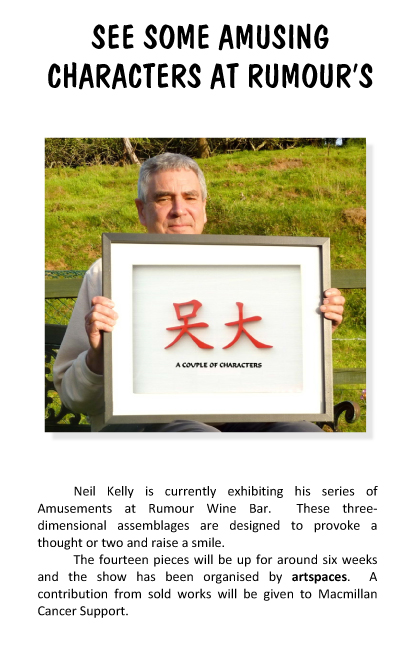
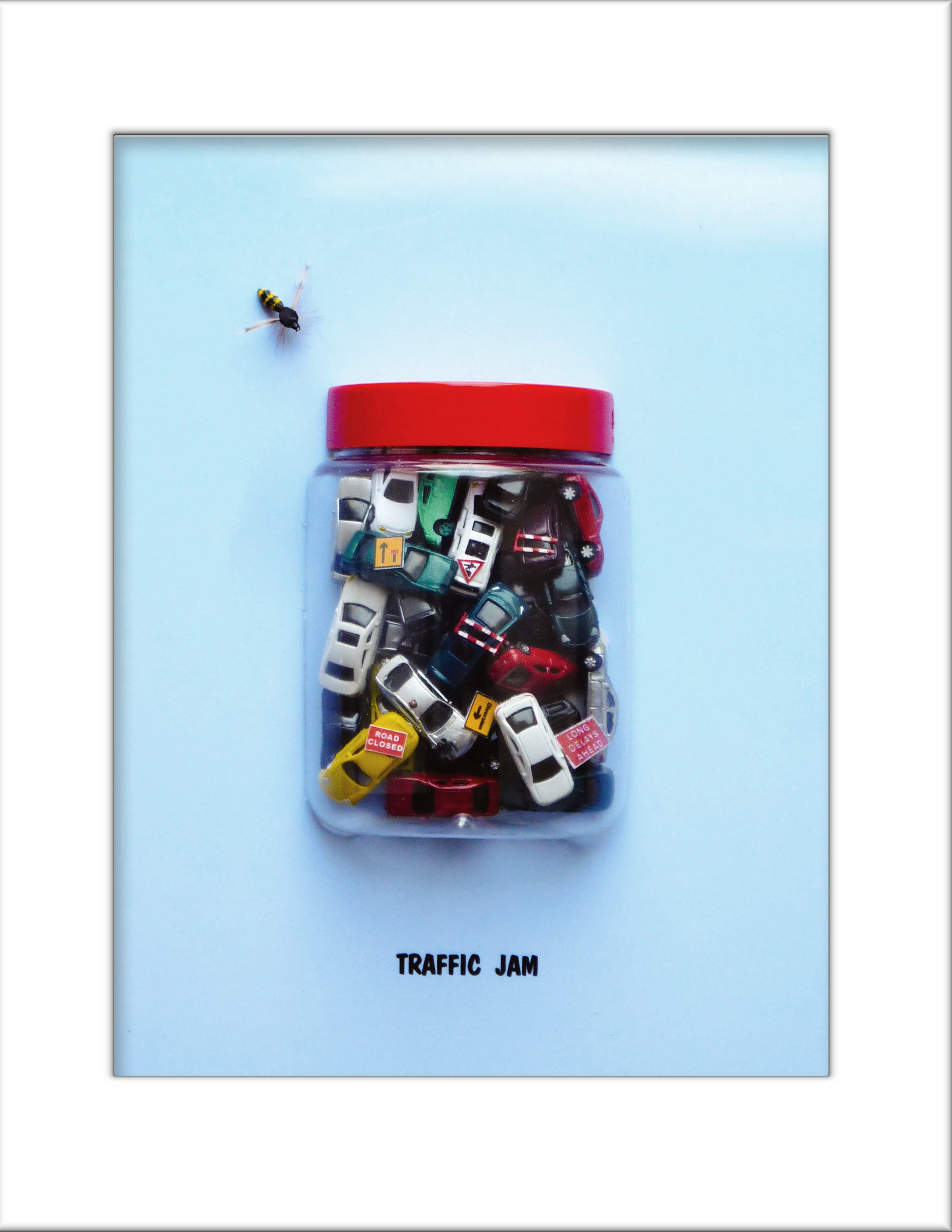
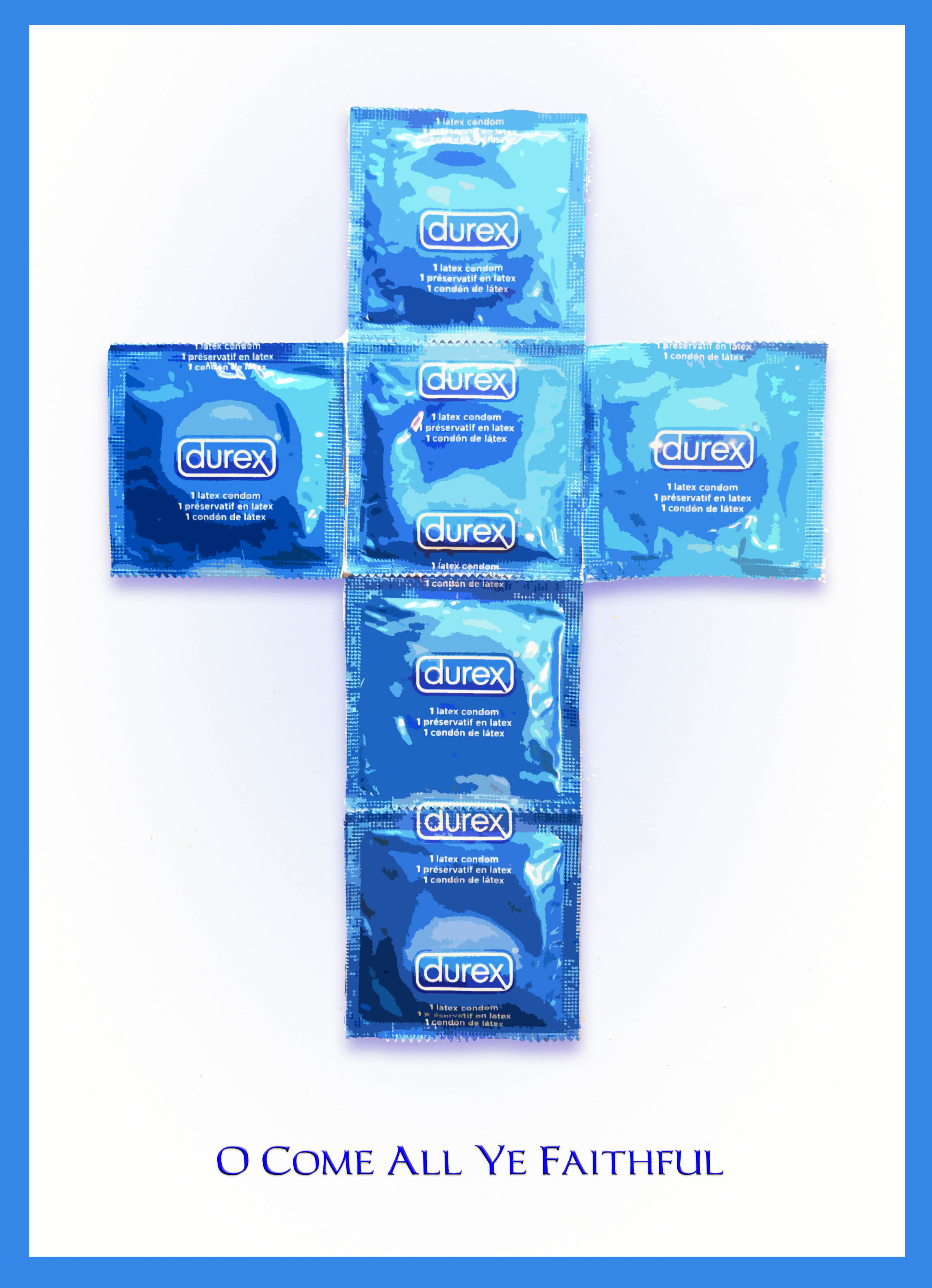
Just found this in my email inbox a few moments ago (it’s 8am here in Payson, Arizona).  Not only another lovely example of Neil’s creative mind, there might be a number of readers who can vote for this project.  Voting details here.

Amusing characters!

Chance to spotlight the very creative work of Neil Kelly

I have had the pleasure of knowing Neil for a good number of years.  I can’t recollect how and when we met but, these days, that applies to so much that slips away from the memory cells!  Neil has been a great friend of my sister, Corinne, and brother-in-law, John, who like Neil, have lived in South Devon for many years.  Pretty sure that it was through John and Corinne that I first met Neil.

Anyway, Neil’s wonderful, slightly askew sense of humour comes out in his art.  Rest is obvious.  Enjoy!

Finally, if you are within reach of Totnes and want to see Neil’s work, details of Rumour’s Wine Bar are here.

Cooking your dog!

Yet another Saturday smile from Neil K. in South Devon

I seem to recall that one of the mantras in retailing is placement; it’s all to do with placement.

As in,

compared to,

You all have a great day – what’s for dinner!

Consequences

Acceptance of what has happened is the first step to overcoming the consequences of any misfortune. 

William James, January 11th, 1842 - August 26th, 1910

The above is a quotation attributed to the late American philosopher, William James, comprehensively written about on the Stanford Encyclopaedia of Philosophy.

When drafting this post last Wednesday, I used the quotation and reference to William James to soften, as it were, me reproducing an item on Yves Smith’s fabulous blog, Naked Capitalism.

I did have second thoughts about including the video below and the summary of what was written by Yves.  The second thoughts were around me not wanting Learning from Dogs to stray into sensationalism or hot pop topics.

The reason I did publish this post was that maybe, just maybe, young Mr. Alessio Rastani is saying it how it really is.  How we all have been lulled over the years into believing so much rubbish from so many movers and shakers in the world of power and politics.  Whereas, in truth, most people who stop and reflect on the world we are presently living in, intuitively sense, that something has broken.

The good news that may be interpreted from Mr. Rastani’s predictions is that we are now living through a period of change, the end of an era, and that the opportunity for a better, more caring world is wide open.

Introduced on the Naked Capitalism site, as follows,

This segment on BBC may not go viral, but it seems to be getting traction, based on the e-mails (hat tip readers Paul S and Marcus) and alerts in the comments section.

This is not an entertaining Rick Santelli-style rant, it’s a cool assessment of how the Euromarket crisis is likely to end, which he thinks is very badly. The flummoxed reaction of the BBC host suggests that the trader, Alessio Rastani, was a booking mistake.

But consider his second message: that Goldman and people rule the world and like him don’t care about what happens to the real economy. A depression is just a great investment opportunity if you see it coming and position yourself accordingly. Rastani is the bland, reasonable face of predatory capitalism.

But in the best interests of scepticism and balance, I also reproduce what was published in the UK’s Telegraph newspaper on the 27th September,

11:50PM BST 27 Sep 2011

The soundbites won Mr Rastani instant fame. He became a viral hit and was trending on Twitter. BBC business editor Robert Peston was among the fans. “A must watch if you want to understand the euro crisis and how markets work,” he told his army of 82,000 followers on Twitter on Tuesday.

The interview contained such gems as “Governments don’t rule the world, Goldman Sachs rules the world [and] Goldman Sachs does not care about the rescue package.”

But on Tuesday night the BBC was left facing questions about just how qualified Mr Rastani is to speak about the markets.

In the interview Mr Rastani described himself as an independent trader. Elsewhere he claims he’s an “investment speaker”. Instead of operating from a plush office in Canary Wharf Mr Rastani works and lives with his partner Anita Eader in a £200,000 semi in Bexleyheath, south London. The house, complete with a mortgage from Royal Bank of Scotland, belongs to her not him.

He is a business owner, a 99pc shareholder in public speaking venture Santoro Projects. Its most recent accounts show cash in the bank of £985. After four years trading net assets are £10,048 – in the red.

How a man who has never been authorised by the Financial Services Authority and has no discernible history working for a City institution ended up being interviewed by the BBC remains a mystery.

The incongruity led to some commentators speculating Mr Rastani was a professional hoaxer. The BBC denied the allegation: “We’ve carried out detailed investigations and can’t find any evidence to suggest that the interview with Alessio Rastani was a hoax.”

However, the BBC declined to comment on what checks, if any, it had done prior to the interview.

Mr Rastani was a little more forthcoming.

“They approached me,” he told The Telegraph. “I’m an attention seeker. That is the main reason I speak. That is the reason I agreed to go on the BBC. Trading is a like a hobby. It is not a business. I am a talker. I talk a lot. I love the whole idea of public speaking.”

So he’s more of a talker than a trader. A man who doesn’t own the house he lives in, but can sum up the financial crisis in just three minutes – a knack that escapes many financial commentators.

“I agreed to go on because I’m attention seeker,” he said on Tuesday. “But I meant every word I said.”

We shall see.


Moving Together

Just an update to last Saturday’s event.

Readers may recall that John H. and I went to the nearest Moving Planet event in Phoenix, as posted on Monday.  Now 350.org have released a video of the event as seen from a global perspective.

2000+ events. 180+ countries. A single day to Move Beyond Fossil Fuels. 350.org’s 2011 day of action, Moving Planet, brought together Moving Together.

Photos and Videos submitted by thousands of organizers and activists around the world — THANK YOU!

Music by Alex Forster: http://www.alexforster.net

Many thanks to our partner organizations who helped us pull this off.

Special thanks to videographers around the world who captured such amazing moments — please contact videos@350.org if you want credits here.

Very inspiring!


Sceptical voices, reflections

If there’s any doubt, there’s no doubt!

I know that expression from my days as a private pilot.  It makes such obvious sense, especially in a single-engined light aircraft with one pilot on board.  It’s all about risk.

Frederick Herzberg, the famous American psychologist, coined the term ‘hygiene factor’.  It was the second part of a two-factor approach to the management of people.  According to Herzberg’s theory, people are influenced by two sets of factors, motivation factors and hygiene factors.  More background on this aspect here.

To me, as I reflect on the messages offered in the Sceptical Voices article, Part One and Part Two, the concepts of risk and hygiene seem totally appropriate to the topic of AGW, Anthropogenic Global Warming.

Whether or not AGW is a valid theory behind the rapid change in global warming is utterly irrelevant.  It is the risk to humanity that matters.  There is absolutely no harm done from assuming that AGW is happening and that feedback processes run a grave risk of tipping planetary conditions out of control, and getting that wrong.

On the other hand, assume that AGW is such an uncertain concept that it really isn’t wise to adjust our life styles, and getting that wrong would endanger the human species.

Think of being on a commercial airline flight and you become aware that one of the two pilots in the cockpit is incapacitated through food poisoning.  No doubt that you, with all your fellow passengers, would vote for an immediate diversionary landing.  It’s to do with risk.

From the perspective of Herzberg, a co-ordinated program by the world’s leading governments to tackle AGW might also improve the overall motivation of their peoples in a whole manner of ways.

Merci voiced this perfectly in her comment to Sceptical Voices, Part One, thus,

Yes, question all we want, yes, there are other important issues to resolve in the world, but WHAT IF “Climate Change/Global Warming“ is for real, what then?

Dan wrote also in that Part One piece,

And by “peel-back-the-onion”, I mean that any ardent, independent researcher should publish both sides of the story as a matter of course.  Especially in regards to global warming.

But publishing both sides of the story is not the argument.  The argument is the risk to humanity of doing nothing, and getting it wrong.

That well-respected weekly newspaper The Economist had a recent article about the melting of Arctic ice, from which is quoted,

Arctic sea ice is melting far faster than climate models predict. Why?

Sep 24th 2011 - from the print edition

ON SEPTEMBER 9th, at the height of its summertime shrinkage, ice covered 4.33m square km, or 1.67m square miles, of the Arctic Ocean, according to America’s National Snow and Ice Data Centre (NSIDC). That is not a record low—not quite. But the actual record, 4.17m square km in 2007, was the product of an unusual combination of sunny days, cloudless skies and warm currents flowing up from mid-latitudes. This year has seen no such opposite of a perfect storm, yet the summer sea-ice minimum is a mere 4% bigger than that record. Add in the fact that the thickness of the ice, which is much harder to measure, is estimated to have fallen by half since 1979, when satellite records began, and there is probably less ice floating on the Arctic Ocean now than at any time since a particularly warm period 8,000 years ago, soon after the last ice age.

That Arctic sea ice is disappearing has been known for decades. The underlying cause is believed by all but a handful of climatologists to be global warming brought about by greenhouse-gas emissions. Yet the rate the ice is vanishing confounds these climatologists’ models. These predict that if the level of carbon dioxide, methane and so on in the atmosphere continues to rise, then the Arctic Ocean will be free of floating summer ice by the end of the century. At current rates of shrinkage, by contrast, this looks likely to happen some time between 2020 and 2050.

Re-read the sentence, “The underlying cause is believed by all but a handful of climatologists to be global warming brought about by greenhouse-gas emissions.”  In particular, “by all but a handful of climatologists”  Think of risk.

That article, which should be read in full, concludes thus,

A warming Arctic will bring local benefits to some. The rest of the world may pay the cost.

Indeed, the rest of the world may pay the cost!  As I wrote, it’s all about risk.

So whether or not one wants to believe every word of that Economist article is irrelevant.  Or whether one should have believed, or not, the article in New York’s The Sun newspaper back in 2007,

By SETH BORENSTEIN, Associated Press | December 12, 2007

WASHINGTON — An already relentless melting of the Arctic greatly accelerated this summer, a warning sign that some scientists worry could mean global warming has passed an ominous tipping point. One even speculated that summer sea ice would be gone in five years.

Greenland’s ice sheet melted nearly 19 billion tons more than the previous high mark, and the volume of Arctic sea ice at summer’s end was half what it was just four years earlier, according to new NASA satellite data obtained by the Associated Press.

“The Arctic is screaming,” a senior scientist at the government’s snow and ice data center in Boulder, Colo., Mark Serreze, said.

Last year, two scientists surprised their colleagues by projecting that the Arctic sea ice was melting so fast that it could disappear entirely by the summer of 2040. This week, after reviewing his own new data, a NASA climate scientist, Jay Zwally, said: “At this rate, the Arctic Ocean could be nearly ice-free at the end of summer by 2012, much faster than previous predictions.”

So scientists in recent days have been asking themselves these questions: Was the record melt seen all over the Arctic in 2007 a blip amid relentless and steady warming? Or has everything sped up to a new climate cycle that goes beyond the worst case scenarios presented by computer models? “The Arctic is often cited as the canary in the coal mine for climate warming,” Mr. Zwally, who as a teenager hauled coal, said. “Now as a sign of climate warming, the canary has died. It is time to start getting out of the coal mines.” [My emphasis, PH]

So, in conclusion, scepticism is healthy and is an important aspect of open debate within an open society, part of determining truth, however challenging that simple concept might be.

But eventually one needs to take a position, to take a stand on the really important issues in life and in the case of climate change the risk of being too sceptical, too cautious is to put the lives of future generations at stake.  For me, and I guess for tens of thousands of others, that is a risk too far.

Nothing but the truth!

Why should such an obvious concept, that of truth, be so very difficult to define?

Who in the world whose native tongue is English isn’t familiar with the words of the oath, “I swear to tell the truth, the whole truth and nothing but the truth,” often with the phrase, “so help me God.”  It is the fundamental foundation of a working justice system.  Probably the most famous of oaths is the American Presidential oath upon taking up office, “I do solemnly swear (or affirm) that I will faithfully execute the Office of President of the United States, and will to the best of my Ability, preserve, protect and defend the Constitution of the United States.”

Then just the other day I was exploring the blog Lack of Environment written by Martin Lack who made himself known to Learning from Dogs from a comment to the post Sceptical voices, part two, published on the 23rd.  Martin’s blog carried an article about scientific scepticism (outcome being very little) in global warming being caused by man.  There was reference to the book Climate Cover-Up written by James Hoggan and an extract from that book on the Desmogblog website, as follows,

Democracy is utterly dependent upon an electorate that is accurately informed. In promoting climate change denial (and often denying their responsibility for doing so) industry has done more than endanger the environment. It has undermined democracy. There is a vast difference between putting forth a point of view, honestly held, and intentionally sowing the seeds of confusion. Free speech does not include the right to deceive. Deception is not a point of view. And the right to disagree does not include a right to intentionally subvert the public awareness.

The sentence highlighted by me is fundamental to this essay.  Perhaps the crux of why it feels so difficult to determine the truth is that the vast 24-hour output of news and information, the 24-hour fear machine as John H. calls it, carries no means of distinguishing the reliability of the source, no details of any affiliations that the person offering the information to that particular media outlet may have, and so on and so on.  I wrote a piece on the 12th July called What Exactly is the Truth where I concluded that,

Despite my chest-beating on the subject of politicians and leaders deliberately lying in that recent piece about Juncker, there’s something much more fundamental.  What defines lying is really not that important.  It’s whether or not we trust that our leaders are doing their best for their constituents, to the best of their abilities.

Whether you support left-leaning or right-leaning policies is unimportant; indeed political differences and the ability to vote for one’s beliefs is at the heart of an open democracy.

But if we don’t trust that our leaders are doing their best for our country then that causes the destruction of faith.  If we do not have faith in those that lead us then the breakdown of a civilised social order becomes a very real risk.

So examining the essence of the word ‘truth’ creates a conflict, well it does in my mind.  A conflict between the idea that truth is a very simple concept and that peeling back the meaning of the word truth reveals many, many layers.  Let me quote from the Stanford Encyclopaedia of Philosophy,

Truth is one of the central subjects in philosophy. It is also one of the largest. Truth has been a topic of discussion in its own right for thousands of years. Moreover, a huge variety of issues in philosophy relate to truth, either by relying on theses about truth, or implying theses about truth.

It would be impossible to survey all there is to say about truth in any coherent way. Instead, this essay will concentrate on the main themes in the study of truth in the contemporary philosophical literature. It will attempt to survey the key problems and theories of current interest, and show how they relate to one-another. A number of other entries investigate many of these topics in greater depth. Generally, discussion of the principal arguments is left to them. The goal of this essay is only to provide an overview of the current theories.

The problem of truth is in a way easy to state: what truths are, and what (if anything) makes them true. But this simple statement masks a great deal of controversy. Whether there is a metaphysical problem of truth at all, and if there is, what kind of theory might address it, are all standing issues in the theory of truth. We will see a number of distinct ways of answering these questions.

“Truth has been a topic of discussion in its own right for thousands of years.”  So I’m not the first and certainly won’t be the last to ponder on how one gets to know the truth.

Do I have any answers?  None!  Except, perhaps, to muse that if truth can be so difficult to pin down then adopting a rigid stance based on assumptions of truth will carry risk.  And, of course, to reflect that dogs don’t lie.

I’ll close with the quote from Oscar Wilde, “Truth is rarely pure and never simple.”  Quite so.

Moving Planet day

Just a quick item about last Saturday.

My apologies but the demands on my time are a little challenging this week.  All as a result of the creative writing course that is being undertaken at our local Gila Community College, a course that I am loving, by the way!

Last Saturday, John H. and I went down to Tempe, Phoenix to attend the nearest Moving Planet event.  It was well-attended especially by people the right side of 40 years-old!  After all it is the succeeding generation that is going to cope with the consequences of the present abuse of the planet’s resources.

The leader of the event down in Tempe was Doug Bland of Arizona Interfaith Power and Light and it was very encouraging to see such a strong ecumenical involvement.

Later this week, I want to respond to the views that came out in the first part of the Sceptical voices piece last week but for now let me just leave you with a 4-minute video that was shown to the group down in Tempe last Saturday.  It is called Try not to Make Connections.