A rather poignant moment as the last NASA Space Shuttle is programmed to launch today.
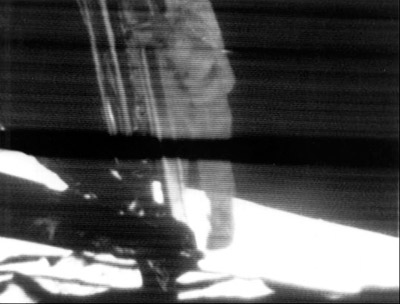
Many of my age will have been fascinated by man’s progress in exploring space, from the Russian Sputnik 1 launched into earth orbit in October, 1957 (I was 12!) through to man first putting a foot on the surface of the moon on 20th July, 1969 on the US Apollo 11 Mission.
Still frame from the video transmission of Neil Armstrong stepping onto the surface of the Moon at 02:56 UTC on 21 July 1969.
Today, the end of an era is being played out. Today, the last Space Shuttle, Atlantis, is due to be launched. From the NASA website,
Date: July 8 Mission: STS-135 Launch Vehicle:Space Shuttle Atlantis Launch Site: Kennedy Space Center – Launch Pad 39A Launch Time: 11:26 a.m. EDT Description: Space shuttle Atlantis will carry the Raffaello multipurpose logistics module to deliver supplies, logistics and spare parts to the International Space Station. Atlantis also will fly a system to investigate the potential for robotically refueling existing spacecraft and return a failed ammonia pump module.
The BBC recently had an interesting news item where all six crew members of Shuttle Discovery were interviewed after that last flight, more details including a video of the interview here.
Astronauts of shuttle Discovery describe ‘amazing’ craft
At almost 27 years old, and with more than 143 million miles on the clock, the space shuttle Discovery returned from her final mission in March.
The crew of Discovery’s final mission, Commander Steve Lindsey, astronauts Eric Boe, Stephen Bowen, Alvin Drew, Michael Barratt and Nicole Stott, spoke to Breakfast News about what it was like to fly the shuttle for the last time.
So where does it go from here?
The current edition of The Economist has a quite a lot to say about that. A leader starts with raising the question of how big the Earth is?
HOW big is the Earth? Any encyclopedia will give you an answer: its equatorial diameter is 12,756km, or, for those who prefer to think that way, 7,926 miles. Ah, but then there is the atmosphere. Should that count? Perhaps the planet’s true diameter is actually nearer 13,000km, including all its air. But even that may no longer be an adequate measure. For the Earth now reaches farther still. The vacuum surrounding it buzzes with artificial satellites, forming a sort of technosphere beyond the atmosphere. Most of these satellites circle only a few hundred kilometres above the planet’s solid surface. Many, though, form a ring like Saturn’s at a distance of 36,000km, the place at which an object takes 24 hours to orbit the Earth and thus hovers continuously over the same point of the planet.
Later, this leader speculates,
The reason for that second objective is also the reason for thinking 2011 might, in the history books of the future, be seen as the year when the space cadets’ dream finally died. It marks the end of America’s space-shuttle programme, whose last mission is planned to launch on July 8th (see article, article). The shuttle was supposed to be a reusable truck that would make the business of putting people into orbit quotidian. Instead, it has been nothing but trouble. Twice, it has killed its crew. If it had been seen as the experimental vehicle it actually is, that would not have been a particular cause for concern; test pilots are killed all the time. But the pretence was maintained that the shuttle was a workaday craft. The technical term used by NASA, “Space Transportation System”, says it all.
But the shuttle is now over. The ISS is due to be de-orbited, in the inelegant jargon of the field, in 2020. Once that happens, the game will be up. There is no appetite to return to the moon, let alone push on to Mars, El Dorado of space exploration. The technology could be there, but the passion has gone—at least in the traditional spacefaring powers, America and Russia.
From STS-1 launched on 12 April 1981 through to today’s planned launch of STS-135, it indeed has been an era for science, for exploration and for adventure.
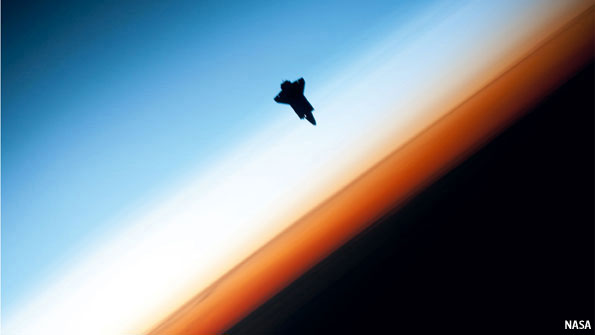
Iconic view of man's urge to explore
UPDATE 10:30 am Mountain Time
Up and safely away!
Still awe-inspiring after all these years. Live BBC feed is here. Travel safely guys!
Part One of The Trap is available to watch in my Post of the 4th, US Independence Day. It also provides some background thoughts. It really is a most powerful set of programmes so, if you haven’t already done so, best to watch Part One first.
This is Part 2 of the brilliant Adam Curtis documentary originally produced for the BBC. It talks about the modern political realities, where the policies came from and the massive failures of those ideals and how they have ended up exactly where they did not want to be. This episode focuses on the 1990’s and how the politicians decided to apply the model of a free market economy to the rest of society and consequences of these actions being felt all over the world in western democracies.
Wow, this seems an odd-ball topic for Learning from Dogs. But, as all you regular readers know, Learning from Dogs is about understanding the importance, the critical importance of integrity, and having dogs, who are integrous, act as an example and metaphor for humankind.
OK, to the point of the article.
Somewhere (probably Naked Capitalism but not sure) I came across a link to a piece in PC Mag entitled, Are Amazon Reviews Corrupt? Here’s a flavour of the article written by John Dvorak.
It’s a known fact that PR agencies and corporations have been burrowing into the community of online, “public” reviewers and obscure bloggers and easily corrupting them with trinkets. It’s like a lost tribe being bribed with a pretty necklace of cheap polished rocks. Now there is some proof that there is a problem.
I received a press release titled, “Buyer beware: study reveals hidden motives behind Amazon reviews.” Here is the gist in a nutshell:
In the first academic study of its kind, Trevor Pinch, Cornell University professor of sociology and of science and technology studies, independently surveyed 166 of Amazon’s top 1,000 reviewers, examining everything from demographics to motives. What he discovered was 85 percent of those surveyed had been approached with free merchandise from authors, agents or publishers.
Pinch, who also found the median age range of the reviewers he surveyed was 51 to 60, a surprise said Pinch, because the image of the internet is more of a young person’s thing. Amazon is encouraging reviewers to receive free products through Amazon Vine, an invitation-only program in which the top 1,000 reviewers are offered a catalog of free products to review.
John later linked to the website set up by Trevor Pinch, called Freelunch, where the full details of what is going on are contained in a report, available for all to download and read. The web page from where the report may be downloaded is here, and below is what you will read if you go to that weblink.
They tell us what to buy, but who are Amazon’s elite product reviewers and why do they do it?
They are the familiar faces of the world’s largest online retailer, the voices of reason we rely upon to make sense of everything from Shakespeare to sleeping bags.
But who are Amazon’s top reviewers, why do they invest the massive effort required to review tens of thousands of products, and how are changes at Amazon changing the way these reviewers help us decide what to buy?
In the first academic study of its kind, we examine the elite class of top-thousand Amazon reviewers by conducting a detailed survey with a subset of 166 of these top reviewers. The study, examines everything from age, gender and education (typically middle-aged, male and master’s degree), to the motives and concerns of this volunteer corps who’ve helped drive Amazon’s growth from quaint virtual bookstore to the planet’s most valuable retail brand.
The study was carried out just as Amazon introduced a new way of ranking its reviewers causing much consternation as some fell dramatically in the rankings. We ask why it is that Amazon has changed its ranking system at this time and we elicit the top reviewers responses to this change.
Our study holds an assumption and asks a question: the assumption is that there are no free lunches. So how come Amazon has managed to persuade so many people to give them the morsels from which they have built one of the biggest free lunches ever? That is the question.
Speaking as someone who probably spends a couple of hundred dollars a year with Amazon, particular on books, and who does get tipped into buying an unknown book by the reviews, this report is not without consequence.
Hyman Minsky
Indeed, as you read this there will be winging it’s way to me two books ordered last week. The first was Hyman Minsky’s book, Stabilizing an Unstable Economy, cost $21.14 and a book that I had no doubts about wanting to read.
But the second, The Great Disruption by Paul Gilding, was bought a) to take me over $25 and provide me with free shipping and b) because it looked like a book I would enjoy and all six reviews were strong recommendations!
I suppose if you don’t have a dog it is hard to understand why anyone would be so upset (that isn’t an insult or a judgement just a statement of fact) and if you do there isn’t much need to explain.
As so often he’s spot-on. I remember in my teens a girlfriend walking through the door one Saturday morning and bursting into floods of tears – and it wasn’t the state of my room.
“What’s the matter ?”
“They’ve taken her to the vet to be put down!” – ‘her’ being the companion of her childhood, a thousand walks and a hundred days out in the country with parents. But I didn’t think like that at the time – I was properly sympathetic and held her till my shoulders were soaked in tears – but it was only a dog, a nice enough dog, but still a dog. At this distance memory fails, but I probably assumed it was just a girl thing, what with being more emotionally open and all that.
The same blindness afflicted me with regard to the effect of children, although I think I wasn’t alone in this. Our single lives were so endlessly fascinating, what friends were doing, who was with whom, the places to go, the people, the parties, that we looked on people who’d got children slightly pityingly, as if they’d been afflicted with a crippling disease (and it IS crippling to a wild social life, although I know a few exceptional people and couples who have just carried on – I’m just not exceptional) which not only curtailed their social life but made them talk about children an awful lot – as if that topic was of any interest at all compared to the important things.
You live and learn. Hopefully. Now I feel more that becoming a parent is gaining access to the secret heart of life and the long chain of familial links down the generations. Not that it doesn’t have its many, many drawbacks. Susan and I looked at each other one day after #2 had arrived and said “whatever did we do with all that time we had?”.
I digress. So I finally learned about why parents are interested in kids, but still didn’t get the dog thing. Our neighbours were childless but treated their dogs like their children – they slept upstairs and their doings were part of our everyday chats. Most odd, we thought.
Dog lovers …
I’d taken my firstborn up to visit his grandpa, and grandpa and I were out walking with grandpa’s dog and the pushchair plus baby. I loved that new dad bit, with bonny boy getting cooed over by all and sundry … the checkout queue turning into a little love fest … and he WAS a beautiful baby – he’s 21 now and six foot.
Lady approaching on the pavement, breaks into happy smile :
“Oh, what a beautiful …”
(Dad smiles modestly… he’s getting used to this …)
“Dog!”
(Smile vanishes instantly)
Then our youngest went off to Big School, and it left a bit of a gap in Susan’s life. Suddenly there were no babies to care for – and she likes caring for things. One day she went off and returned with this chap (and promptly had him snipped, to my horror). Apparently Labradors were very even tempered, good with children and an all round ideal first dog for a family with no dog-owning history on either side, at least since our great-grandparents were on the farm. What’s impressive is that AFAIK, apparently all dogs are descended from domesticated wolves. Just shows what breeding will do.
The kids were thrilled, promised to walk him etc., etc., – didn’t last and soon Mum and Dad were doing most of the walks. But the exercise is great – he and we usually get about three miles a day in – it’s good for an ageing chap with a desk job. I’ve learned most of the footpaths and circular routes round the house.
Labradors seem to eat anything – three week old bird carcases, stones, deer poo, sheep poo, horse poo – and they roll in fox poo, which is not a nice smell and means an hour shampooing him in the garden (then a shower and complete change of clothes). On the good side they love apples, blackberries, plums, the farmer’s turnips – healthy eaters.
He once found a rotting, rank dead rabbit inside a plastic bag, scoffed it, then sat in his crate in the kitchen and disgorged the lot some hours later. Not a nice clean-up job – the smell at close quarters was truly evil.
They’re meant to have more acid in their stomachs than humans to enable digestion of bad food – but ours pushes that way beyond the limits. The Muslims are right enough when they consider dogs unclean. They’re filthy, dirty creatures.
But they have a way of wrapping themselves round the heart. Always pleased to have human company, playful, cheery. All the family quickly grew to love him – even grandma, very much a non-dog person, has a soft spot.
October last year, grandma is round for Sunday tea/dinner, I’m just out in the garden using the last of the light at ten to six.
“Can he stay out here with you? ”
“OK”
The call for tea. I call him – he’s not anywhere in the garden. Round the house – no sign.
“Has he come in?”
“No”
“He’s not in the garden”
Poor grandma. She was left alone in the house while everyone emptied into the darkening garden, calling, then after a quick conference and grabbing of mobiles, two cars head slowly in opposite directions, and the boys are in the local wood with torches. Daughter and I take the car across rough farm tracks, along the routes of his favourite walks, stopping, scanning the gloomy fields, calling him, on again, repeat.
Forty minutes later it’s pitch black and the cars are back. The boys have been right through the woods to the fields on the other side, which we’ve also scanned from the cars as best we could, then back again. Up and down the village – again – half expecting to see a limp form in the headlights. Not a sight or sound.
Tea at seven in almost total silence. The only thing I can compare it with was the first family Christmas without my grandmother.
Eight o’clock. He’s been gone two hours. We’ve been out in the garden and around the house again. Nothing. The feeling that he’s gone for good starts to solidify.
Nine o’clock. My daughter’s standing at the back door, calling his name. Nothing. I feel she’s wasting her time, but in solidarity I go to the side door to call. Open it – he’s standing on the step.
God knows where he’d been. One moment of tremendous pleasure – calling my daughter into the kitchen, without telling her who was there, then watching the ecstatic reunion – the boys hearing the noise and tumbling in, happy uproar. “For he was lost, and is found“.
Once again Mr Kipling has the words :
There is sorrow enough in the natural way
From men and women to fill our day;
And when we are certain of sorrow in store,
Why do we always arrange for more?
Brothers and sisters, I bid you beware
Of giving your heart to a dog to tear.
Buy a pup and your money will buy
Love unflinching that cannot lie
Perfect passion and worship fed
By a kick in the ribs or a pat on the head.
Nevertheless it is hardly fair
To risk your heart to a dog to tear.
When the fourteen years which Nature permits
Are closing in asthma, or tumour, or fits,
And the vet’s unspoken prescription runs
To lethal chambers or loaded guns,
Then you will find – it’s your own affair
But … you’ve given your heart to a dog to tear.
When the body that lived at your single will,
With its whimper of welcome, is stilled (how still!)
When the spirit that answered your every mood
Is gone – wherever it goes – for good,
You will discover how much you care,
And will give your heart to a dog to tear.
We’ve sorrow enough in the natural way,
When it comes to burying Christian clay.
Our loves are not given, but only lent,
At compound interest of cent per cent.
Though it is not always the case, I believe,
That the longer we’ve kept ’em, the more do we grieve:
For, when debts are payable, right or wrong,
A short-term loan is as bad as a long
So why in Heaven (before we are there)
Should we give our hearts to a dog to tear?
As a US resident since just mid-April, perhaps no better day than July 4th to pose this question.
As a British citizen, born in London towards the end of WWII, I am well aware that Britain has had a long tradition of ‘owning’ colonies. In 1770 explorer James Cook charted the East coast of Australia and returned to Britain recommending colonisation in the area that became known as Botany Bay, now part of Sydney. Britain’s response was to set up a penal colony in 1778.
In 1617 the British East India Company was given permission by an Indian rajah to trade in India. Via lots of convolutions that I don’t understand, that led to the British Crown taking over in 1857.
So far as America is concerned, the British ended up with 13 colonies along the Eastern seaboard during the period 1607 to 1733. Then we had the British West Indies and Canada and …… well, you get the message!
Wikipedia has a summary of the US independence timetable,
The second day of July, 1776, will be the most memorable epoch in the history of America. I am apt to believe that it will be celebrated by succeeding generations as the great anniversary festival. It ought to be commemorated as the day of deliverance, by solemn acts of devotion to God Almighty. It ought to be solemnized with pomp and parade, with shows, games, sports, guns, bells, bonfires, and illuminations, from one end of this continent to the other, from this time forward forever more.
Adams’s prediction was off by two days. From the outset, Americans celebrated independence on July 4, the date shown on the much-publicized Declaration of Independence, rather than on July 2, the date the resolution of independence was approved in a closed session of Congress.
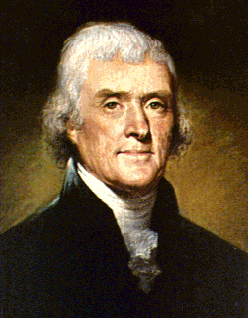
Thomas Jefferson April 13, 1743 – July 4, 1826
Thomas Jefferson became the third President of the United States of America. As one of the founding fathers, Jefferson envisioned America as an “Empire of Liberty”.
So it came to pass that Independence Day is annually celebrated on July 4. The celebrations have deep roots in the American tradition of political freedom.
Reflect then on that notion of liberty and freedom as you watch the first episode from a most compelling series from Adam Curtis that was broadcast by the BBC in 2007. The series is called The Trap, the first programme entitled “F**k You Buddy” (11 March 2007)
Individual freedom is the dream of our age. It’s what our leaders promise to give us, it defines how we think of ourselves and, repeatedly, we have gone to war to impose freedom around the world. But if you step back and look at what freedom actually means for us today, it’s a strange and limited kind of freedom.
Politicians promised to liberate us from the old dead hand of bureaucracy, but they have created an evermore controlling system of social management, driven by targets and numbers. Governments committed to freedom of choice have presided over a rise in inequality and a dramatic collapse in social mobility. And abroad, in Iraq and Afghanistan, the attempt to enforce freedom has led to bloody mayhem and the rise of an authoritarian anti-democratic Islamism. This, in turn, has helped inspire terrorist attacks in Britain. In response, the Government has dismantled long-standing laws designed to protect our freedom.
The Trap is a series of three films by Bafta-winning producer Adam Curtis that explains the origins of our contemporary, narrow idea of freedom. It shows how a simplistic model of human beings as self-seeking, almost robotic, creatures led to today’s idea of freedom. This model was derived from ideas and techniques developed by nuclear strategists during the Cold War to control the behavior of the Soviet enemy.
Part Two of this article is being published on the 7th, next Thursday, and Part Three next Monday, the 11th.
This coming next couple of weeks is going to see me reflecting on some of the powerful messages that flow from three one-hour documentaries by Adam Curtis during a series of programmes for the BBC in 2007.
For today, just enjoy the BBC trailer. (Assuming ‘enjoy’ is the right expression!)
Herman Daly, Ph.D, makes some very powerful points at his keynote address to the AMS workshop on Federal Climate Policy, 13th November, 2007.
Note: This video is only the first 8 minutes from what is clearly a longer address. I have struggled to find the subsequent parts of this address, although there appear to be other versions of the address on YouTube. However, the points raised in these first few minutes are compelling,
Complexity stifles policy
The danger of overwhelming the decision of what to do now
Leave it until it’s perfectly clear and the likelihood is that it will be too late
Enjoy this most stimulating speech.
If you are stimulated to dig a little deeper into Hermon E. Daly here are some snippets I came across.
Herman Daly’s Ecological Economics – An Introductory Note
By John Attarian
Mainstream opinion has it that economic growth, the democratization of affluence, and ever-increasing consumption are the formula for individual and social happiness. A thoughtful and well-informed minority emphatically disagrees. Few have contributed more to this dissent than Herman E. Daly, widely regarded as the founding father of ecological economics.
Born in 1938, Daly earned his B.A. at Rice University (1960) and Ph.D. at Vanderbilt University (1967). From 1968 to 1988 he taught economics at Louisiana State University. Then he served as Senior Economist in the World Bank’s Environmental Department until 1994, when he became a professor at the University of Maryland’s School of Public Affairs, his current position.
As a graduate student, Daly believed that growth would solve mankind’s problems, but three experiences radically transformed his outlook. He studied under the economist Nicholas Georgescu-Roegen (1906-1994), whose book The Entropy Law and the Economic Process (1971) explained the decisive economic importance of the second law of thermodynamics (the entropy law) in a closed system, the availability of useful energy always declines. Georgescu-Roegen argued that the economic process transforms natural resources into waste — that is, transforms matter-energy from a state of low entropy into a state of high entropy. Georgescu-Roegen’s great contribution, Daly observes, was “reuniting economics with its biophysical foundations.” Teaching in Brazil in the late 1960s, Daly observed explosive population growth firsthand. Reading Rachel Carson’s Silent Spring was also influential.
Wrong to publish more but if this catches your eye, then the full article is here. Oh, perhaps I can just include the last two paragraphs of John Attarian’s fine piece ….
Daly co-founded the scholarly journal Ecological Economics in 1989 and still serves as an associate editor. His thought is slowly attracting appreciative notice, and some honors have come his way. For the Common Good won the 1991 Grawenmeyer Award for Ideas for Improving World Order, and in 1996 Daly received the Honorary Right Livelihood Award and the Royal Netherlands Academy of Arts and Sciences Heineken Prize for Environmental Science.
Integrating theology, ethics, science, and economics, Daly’s ecological economics is the kind of comprehensive vision we too seldom see, and one of the most important and promising intellectual developments of our time. Our selection of Daly’s works is a concise yet comprehensive introduction to his thought. May he find the audience he deserves.
Forgive me for making this a much shorter contribution but the efforts of the previous two posts took rather a long time!
This is about the debt situation in the United States of America and, as always, Learning from Dogs trying to get to the underlying truth.
It’s from the BBC and it’s a radio programme that is included in this Post.
But why the headline referring to Churchill? Well in the programme Justin Webb, of the BBC, reminds the world of a characteristic of the American Nation noted by Sir Winston Churchill, “Americans can always be counted on to do the right thing…after they have exhausted all other possibilities.” (But caution about the precise wording of that quote – see here!)
Here’s the article that accompanied the BBC broadcast, the radio programme is after this article,
Is the US in denial over its $14tn debt?
Is America in denial about the extent of its financial problems, and therefore incapable of dealing with the gravest crisis the country has ever faced?
This is a story of debt, delusion and – potentially – disaster. For America and, if you happen to think that American influence is broadly a good thing, for the world.
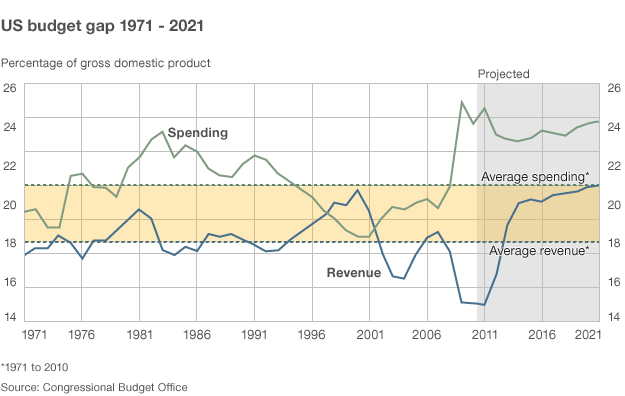
The debt and the delusion are both all-American: $14 trillion (£8.75tn) of debt has been amassed and there is no cogent plan to reduce it.
The figure is impossible to comprehend: easier to focus on the fact that it grows at $40,000 (£25,000) a second. Getting out of Afghanistan will help but actually only at the margins. The problem is much bigger than any one area of expenditure.
The economist Jeffrey Sachs, director of Columbia University’s Earth Institute, is no rabid fiscal conservative but on the debt he is a hawk: “I’m worried. The debt is large. It should be brought under control. The longer we wait, the longer we suffer this kind of paralysis; the more America boxes itself into a corner and the more America’s constructive leadership in the world diminishes.”
The author and economist Diane Coyle agrees. And she makes the rather alarming point that the acknowledged deficit is not the whole story.
The current $14tn debt is bad enough, she argues, but the future commitments to the baby boomers, commitments for health care and for pensions, suggest that the debt burden is part of the fabric of society:
“You have promises implicit in the structure of welfare states and aging populations that mean there is an unacknowledged debt that will have to be paid for by future taxpayers, and that could double the published figures.”
Richard Haass of the Council on Foreign Relations acknowledges that this structural commitment to future debt is not unique to the United States. All advanced democracies have more or less the same problem, he says, “but in the case of the States the figures are absolutely enormous”.
Mr Haass, a former senior US diplomat, is leading an academic push for America’s debt to be taken seriously by Americans and noticed as well by the rest of the world.
He uses the analogy of Suez and the pressure that was put on the UK by the US to withdraw from that adventure. The pressure was not, of course, military. It was economic.
Britain needed US economic help. In the future, if China chooses to flex its muscles abroad, it may not be Chinese admirals who pose the real threat, Mr Haass tells us. “Chinese bankers could do the job.”
Because of course Chinese bankers, if they withdrew their support for the US economy and their willingness to finance America’s spending, could have an almost overnight impact on every American life, forcing interest rates to sky high levels and torpedoing the world’s largest economy.
Not everyone accepts the debt-as-disaster thesis.
David Frum is a Republican intellectual and a former speech writer to President George W Bush.
He told me the problem, and the solution, were actually rather simple: “If I tell you you have a disease that will absolutely prostrate you and it could be prevented by taking a couple of aspirin and going for a walk, well I guess the situation isn’t apocalyptic is it?
“The things that America has to do to put its fiscal house in order are not anywhere near as extreme as what Europe has to do. The debt is not a financial problem, it is a political problem.”
Mr Frum believes that a future agreement to cut spending – he thinks America spends much too big a proportion of its GDP on health – and raise taxes, could very quickly bring the debt problem down to the level of quotidian normality.
‘Organised hypocrisy’
I am not so sure. What is the root cause of America’s failure to get to grips with its debt? It can be argued that the problem is not really economic or even political; it is a cultural inability to face up to hard choices, even to acknowledge that the choices are there.
I should make it clear that my reporting of the United States, in the years I was based there for the BBC, was governed by a sense that too much foreign media coverage of America is negative and jaundiced.
The nation is staggeringly successful and gloriously attractive. But it is also deeply dysfunctional in some respects.
Take Alaska. The author and serious student of America, Anne Applebaum makes the point that, as she puts it, “Alaska is a myth!”
People who live in Alaska – and people who aspire to live in Alaska – imagine it is the last frontier, she says, “the place where rugged individuals go out and dig for oil and shoot caribou, and make money the way people did 100 years ago”.
But in reality, Alaska is the most heavily subsidised state in the union. There is more social spending in Alaska than anywhere else.
To make it a place where decent lives can be lived, there is a huge transfer of money to Alaska from the US federal government which means of course from taxpayers in New York and Los Angeles and other places where less rugged folk live. Alaska is an organised hypocrisy.
Too many Americans behave like the Alaskans: they think of themselves as rugged individualists in no need of state help, but they take the money anyway in health care and pensions and all the other areas of American life where the federal government spends its cash.
The Tea Party movement talks of cuts in spending but when it comes to it, Americans always seem to be talking about cuts in spending that affect someone else, not them – and taxes that are levied on others too.
And nobody talks about raising taxes. Jeffrey Sachs has a theory about why this is.
America’s two main political parties are so desperate to raise money for the nation’s constant elections – remember the House of Representatives is elected every two years – that they can do nothing that upsets wealthy people and wealthy companies.
So they cannot touch taxes.
In all honesty, I am torn about the conclusions to be drawn. I find it difficult to believe that a nation historically so nimble and clever and open could succumb to disaster in this way.
But America, as well as being a place of hard work and ingenuity, is also no stranger to eating competitions in which gluttony is celebrated, and wilful ignorance, for instance regarding (as many Americans do) evolution as controversial.
The debt crisis is a fascinating crisis because it is about so much more than money. It is a test of a culture.
It is about waking up, as the Americans say, and smelling the coffee. And – I am thinking Texas here – saddling up too, and riding out with purpose.
More on the many and varied approaches to this complex subject. Again, a long piece which, dear reader, I hope you will stay with.
As I wrote in response to Per Kurowski’s comment on yesterday’s Part One of this article, ” I am reminded of the saying that in war the first casualty is truth. It ‘feels’a lot like that in this scenario.”
Part Two isn’t attempting to indicate the truth, just the many opinions out there.
First, let me quote an email that Patrice sent to me late last night,
Hi Paul!
I think that the propaganda from the fossil fuel and other feudal plutocracies have confused the issue. The primary problem is not “climate change” (aka planetary heating/broiling).I am not confused, because it’s NOT about climate change. Climate change is a second order effect. It may, or may not happen, short term.
The gist of my essay is that climate change will NOT happen, short term, if the sun cools down spectacularly, as it did TWICE in the last five centuries (~ Little Ice Age).
The way to look at things correctly, thus, is CO2 POISONING. Even if the sun cooled down spectacularly, as I emphasized, the ACIDIFICATION of the oceans would proceed unabated. After killing the oceans, if the sun goes back to normal, the greenhouse would rebound enormously.
Although I did not speak of it in that particular essay, we now know the rate of CO2 in the atmosphere, through shell formation in the ocean, for at least 20 million years (and soon at least 100 million; the method should work for half a billion years!). Thus we know the level of CO2 equivalent is the highest in 20 million years (although some have claimed that transitory fluxes much higher than that have occured, from volcanoes; that would not be a problem, as a high flux does not allow storage in the oceans!)
Feel free to quote from this, I just thought of this formulation now, and it may help clarify matters (and it is clearly the idea of the essay). BTW, let me emphasize that my essay explains why FLOODING, by no means certain on a proxymal massive scale, is, however a clear possibility. London under water seems even a near certainty on the scale of a century (but for enormous works, requiring huge energy!)
Patrice
OK, a useful footnote to yesterday’s piece. But then if one goes back to Patrice’s original article on his Blog on 31st May, 2009 and reads the comments, you find this, (and I’m going to quote entirely from Mr Day’s comments).
Barry Day says
(QUOTE)What does this mean? We should be cooling down, because the sun’s output has been going down as much as an astounding 6% in some frequencies. But, nevertheless, the lower troposphere has been warming up (END QUOTE)
Ever heard of lag?
“New data show that the balance between the airborne and the absorbed fraction of carbon dioxide has stayed approximately constant since 1850, despite emissions of carbon dioxide having risen from about 2 billion tons a year in 1850 to 35 billion tons a year now.”
“This suggests that terrestrial ecosystems and the oceans have a much greater capacity to absorb CO2 than had been previously expected.” From Pysorg.com of November 10th, 2009.
“Apart from the “long-term” trends shown above, which show an ongoing persistent increase, it is perhaps more stark to record that earthquakes across the planet show a marked increase in activity since 1997. There are more major earthquakes occurring now, and this on an ever more frequent basis.”
“A total of 1,085 earthquakes measuring magnitude 6 or greater occurred between 1980 to 1989, averaging 109 per year over the decade. In the 1990s the decadal total increased to 1,492 averaging at 149 major earthquake per year over the period.
Since January 1, 2000 [ see table below for the date and time] a total of 1,438 major earthquakes have so far occurred worldwide raising the annual total over the last 9 years to 160 with more than 12 and a half months to go to the decade’s end.
The increase from 109 to 160 major earthquakes per year in the 1980 to 2008 period translates to a rise of 47 percent in just under three decades.” [This reference is dated December 13th, 2008, before the Japanese earthquake, Ed.]
The Barry Day goes on to highlight these references,
Abstract
The United Nations Intergovernmental Panel on Climate Change (IPCC) released its Fourth Assessment Report (AR4) in 2007. Here we show that the accurate value for climate sensitivity is 0.277 K/(W/m^2), which is 3 times smaller than the generally accepted value of 0.8 K/(W/m^2). Thus the climate change on doubling CO2 from 300 ppm to 600 ppm will be 1.0 degree, not 3 degrees. Because the IPCC data show that doubling CO2 will not double absorption of infrared radiation, the Beer-Lambert law is not being followed, because of diminishing returns after more-than-50% absorption.
[This is an extremely difficult essay for a non-scientist to follow. All I can do is to include the source of the article, as below, Ed.]
This article by Roger Taguchi, 234 Knox Crescent, Ottawa, Ontario, Canada K1G 0K8, e-mail address rtaguchi@sympatico.ca, was posted on Monday Aug. 31, 2009.
Then just a small selection from other items posted by Barry (to see the full extent of Barry’s comments, do go to Patrice’s original post here).
Scientists stumble across huge underwater mountain 29 May 09 – Marine scientists have discovered a massive underwater volcano off Indonesia’s western coast. The 4,600m (15,000ft) mountain spans 30 miles at its base, with its summit some 1,300 meters below the surface. Its discovery was “completely unexpected.”
————–
Galapagos volcano erupts – lava flowing into the ocean 12 Apr 09 – Again, we have 2,150-degree lava pouring into the ocean – ten times the boiling point – and we keep blaming humans for heating the seas.
————–
Underwater volcano building new mountain 7 May 09 – “An active underwater volcano near the island of Guam erupts so frequently that it has built a new cone 131ft high (13 stories) and 984ft wide in just three years.
————–
Undersea volcanic eruption in Tonga heating the water? 19 Mar 09 – Sea Surface Temperature (SST) maps show a warm anomaly in the Tonga that extends off to the east. Is that a result of the underwater volcano, or just a coincidence?
————–
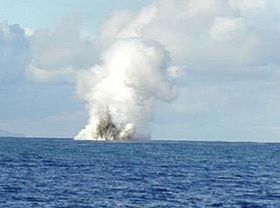
Underwater volcano erupts off Tonga 19 Mar 09 – Spectacular columns of steam and smoke spewed out of the seaabout 6 miles (10 km) from the main island of Tongatapu – an area where up to36 undersea volcanoes are clustered. Large
amounts of pumice from the volcanowill likely clog beaches on the southern coast of nearby Fiji islands shortly.
————–
Global warming may be caused by underwater volcanoes (Which I’ve been saying for years) 8 Dec 08 – A new study shows that the rise in land temperatures can be tied directly to increased heat and humidity coming from warmer oceans, which in turn may be caused solely by natural forces, including underwater volcanoes.
————–
Ocean Floor Geysers Warming The Seas (And we wonder why the oceans are warming) 22 Sep 08 – “It’s like finding Old Faithful in Illinois. When we went out to try to get a feel for how much heat was coming from the ocean floor and
how much sea water might be moving through it, we found that there was much more heat than we expected at the outcrops.”
————–
Geothermal heat may be melting the Greenland glaciers Nov 2007 – “Hansen’s model is wrong! In reality, the Greenland and Antarctic ice sheets occupy deep basins, and cannot slide down a plane. Furthermore glacial flow depends on stress as well as temperature, and much of the ice sheets are well below melting point.
————–
World’s deepest chain of undersea volcanoes to be explored 1 Sep 08 — Scientists at the National Oceanography Centre are set to explore the world’s deepest undersea volcanoes five kilometers beneath the Caribbean.
————–
‘Black smokers’ found in Arctic Ocean 4 Aug 08 – Jets of searingly hot water spewing up from the sea floor have been discovered in a far-northern zone of the Arctic Ocean, Swiss-based scientists announced Monday.
————–
Boiling Hot Water Found in Frigid Arctic Sea 24 Jul 08 – “Many miles inside the Arctic Circle, scientists have found
vents of scalding liquid rising out of the seafloor at temperatures that are more than twice the boiling point of water.
————–
Undersea volcanic activity blamed for mass extinction 93 million years ago 16 Jul 08 – Researchers from the University of Alberta, Canada, find evidence of underwater volcanism in rocks dating to a mass extinction 93 million years ago.
————–
Huge Underwater Volcanoes in the Arctic Ocean, but scientists see no significant connection to melting ice? 27 Jun 08 – The eruptions discharge large amounts of carbon dioxide, helium, trace metals and heat into the water over long distances, but scientists see no significant connection to melting ice.
————–
Giant Undersea Volcano Found Off Iceland (And we wonder why the oceans are warming) 22 Apr 08 – It’s an active volcano that rises about 3,300 feet (1,000 meters) above the surrounding sections, coming within 1,300 feet (400 meters) of the surface.
————–
Hawaiian volcano pumping more lava than usual into the ocean 5 Jul 08 – The Hawaiian Volcano Observatory said Saturday that Hawaii’s Kilauea volcano is pumping more lava than usual into the ocean.
————–
Magma May Be Melting Greenland Ice
18 Dec 07 – I added another article to this posting
13 Dec 07 – Scientists have found at least one natural-magma hotspot under the Greenland Ice Sheet where heat from Earth’s insides could seep through,
————–
Arctic seabed afire with lava-spewing volcanoes 25 Jun 08 – Red-hot magma has been rising from deep inside the earth
and blown the tops off dozens of submarine volcanoes, four kilometers below the ice. And we wonder what is melting the ice.
————–
Underwater Volcanic Eruptions, Not Meteor, May Have Killed Dinosaurs New discovery validates theories in Not by Fire but by Ice 30 Oct 07 – “A series of monumental volcanic eruptions in India may have killed the dinosaurs 65 million years ago, not a meteor impact in the Gulf of Mexico.
Then Barry adds another comment,
We’ve forgotten that this isn’t the first time our seas have warmed. Sea temperatures also shot upward 10º to 18ºF just prior to the last ice age.
As the oceans warmed, evaporation increased. The excess moisture then fell to the ground as giant blizzards, giant storms and floods (Noah’s Deluge type floods), and a new ice age began.
The same thing is happening today.
It’s not global warming, it’s ocean warming, and humans have nothing to do with it. Our seas are being heated, I believe, by underwater volcanism. Here’s why:
We are living in a period of vastly increased volcanism, said Dixy Lee Ray in her 1993 book Environmental Overkill, the greatest in 500 years. Eighty percent of all volcanism (say experts at NOAA) occurs underwater. Therefore, underwater volcanism should also be the greatest in 500 years.
Our seas, heated by underwater volcanism, are leading us directly into the next ice age . . . and we don’t even know it.
That’s what El Niño is all about. Warmer seas send excess moisture into the sky, leading to increased precipitation.
Worldwide flood activity is the worst since before Christopher Columbus. In Poland, it’s the worst in several thousand years. In the U.S., precipitation has increased 20 percent just since 1970. This is no coincidence.
When that precipitation begins falling in the winter, you have the makings of an ice age.
South America’s oldest trees give up the ghost of climate past.
They’ve been dead for over 50,000 years, but South America’s longest-living trees still have a few tales to tell. A new study of the growth rings of partially fossilized trees in southern Chile hints that the global climate before the last ice age was rather like today’s.
Barry mentions Kavachi Island and I did a quick search and came up with this.
From Wikipedia,
Kavachi is one of the most active submarine volcanoes in the south-west Pacific Ocean.Located south of Vangunu Island in the Solomon Islands, it is named after a sea god of the New Georgia Group islanders, and is also referred to locally as Rejo te Kavachi (“Kavachi’s oven’). The volcano has become emergent and then been eroded back into the sea at least eight times since its first recorded eruption in 1939.
In May 2000, an international research team aboard the CSIRO research vessel FRANKLIN fixed the position of the volcano at 8° 59.65’S, 157° 58.23’E. At that time the vent of the volcano was below sea level, however frequent eruptions were ejecting molten lava up to 70m above sea level, and sulfurous steam plumes up to 500m. The team mapped a roughly conical feature rising from 1,100 m water depth, with the volcano having a basal diameter of about 8 km.
When the volcano erupted in 2003, a 15-meter-high island formed above the surface, but it disappeared soon after. Additional eruptive activity was observed and reported in March 2004 and April 2007.
Kavachi erupting May 14th, 2000.
Barry then looks as CO2 levels, he writes,
Carbon dioxide
If today’s rising carbon dioxide are caused by humans, what caused the dramatic rise in CO2 levels at the dinosaur extinction?
It was a matter of a moment’s search to find this, from Ice Age Now, Home Page here
If today’s rising carbon dioxide are caused by humans, then what caused the dramatic rise in CO2 levels at the dinosaur extinction?
Research shows that there was “a sudden and dramatic rise” in carbon dioxide in the Earth’s atmosphere at the dinosaur extinction of 65 million years ago. A recent report attributes the rise in CO2 levels to an asteroid impact.
See http://news.bbc.co.uk/1/hi/sci/tech/2038599.stm
I disagree. I think today’s rise in CO2 levels can be attributed to our warming oceans. After all, the oceans are known as a carbon dioxide “sink,” especially when the water is cold.
But as the water warms up, it releases CO2 into the atmosphere. This happens in much the same way that a warm bottle of home-brewed root beer will release CO2. And if you give that CO2 no way to escape, the bottle will explode.
We’ve got it backwards. We’ve got cause and effect in reverse.
The CO2 is not causing global warming. Instead, our warming oceans are releasing CO2 into the atmosphere.
It’s not global warming, it’s ocean warming, and it’s leading us into an ice age.
Finally, Barry offers this,
No Global Warming
“Even with needed corrections, data still don’t show the expected signature of global warming,” says Dr. Roy Spencer, Senior Scientist for Climate Studies NASA/Marshall Space Flight Center.
Unfortunately, the URL that Barry included didn’t function. But a quick search on the NASA website came up with this,
Scientists are working to understand why the lower atmosphere isn’t heating up as fast as some global warming models predict.
July 21, 2000 — The question sounds like a Zen koan: How could the globe be warming and not warming at the same time?
That’s the riddle posed to climatologists by satellite and radiosonde data which show that while the Earth’s surface has been warming over the past decades, the lowest layer of the atmosphere shows a weaker warming trend.
The measurements are surprising, because computer simulations of the world’s climate predict that the two lowest layers of the atmosphere — which together form the “troposphere” — should be warming faster than the Earth’s surface.
Read the full article here. It’s well worth reading and concludes with these closing paragraphs,
Current models suffer from several shortcomings.
For example, clouds are not well represented by the models. The resolution of current models is too coarse for features as small as clouds, Spencer said. Yet clouds clearly play a crucial role in climate due to their influence on humidity, precipitation and albedo (the percentage of solar energy reflected back into space as light).
“The role of clouds is still regarded as one of the biggest uncertainties in global warming predictions,” Spencer said.
The ability of plants to remove carbon dioxide from the atmosphere and the role of soils have only recently been added to the models, and scientists aren’t confident yet of how the models portray these factors, Spencer said.
“While we know that vegetation takes up some of the carbon dioxide we generate from burning of fossil fuels, how that sink of carbon will change in the future is still pretty uncertain,” Spencer said.
Climate models are also limited by the computing power available.
“The global models would be much better if computers were much faster,” Spencer said. “Instead, a lot of approximations are made to make the models simple enough to do climate simulations over the whole globe.
“Unfortunately,” Spencer continued, “we know that many of the processes that are crudely represented are quite non-linear, and so have the potential to respond in unexpected ways.”
The Global Hydrology and Climate Center is a joint venture between government and academia to study the global water cycle and its effect on Earth’s climate. Jointly funded by NASA and its academic partners, and jointly operated by NASA’s Marshall Space Flight Center in Huntsville, Ala., and the University of Alabama in Huntsville, the Center conducts research in a number of critical areas.
Web Links
Global Hydrology and Climate Center — a joint venture between government and academia to study the global water cycle and its effect on Earth’s climate
OK, that’s enough from me for today. Clearly it would take a great time for a layman, such as yours truly, to go through all this material, and more, to determine the truth of it all, to the very best abilities of science. For the verdict on whether man’s increased generation of CO2 in the atmosphere is having a global effect on the global climate should be in the hands of scientists.
Once science has shown cause and effect then, and only then, should politicians endeavour to offer the way forward for society.
Having said that, there is no reason at all for mankind to maintain the present disconnect from Planet Earth. Even if the jury is still well and truly out in terms of the effect of CO2 on the atmosphere, the number of other issues that are just as important for our long-term survival are still prodigious. There’s an old saying in aviation, “If there’s any doubt, there’s no doubt.”




 Learning from Dogs
