If you eat food, and hope to do so in the future, read this!
I subscribe to Food Freedom News and often read their articles when they appear in my ‘in-box’. Especially so yesterday morning when the headline jumped off the ‘page’ at me: Autism and Disappearing Bees: A Common Denominator?
So, in a sense, hand-in-hand with the article in yesterday’s Learning from DogsFood, glorious food! Because if trying to feed 9 billion people living on a planet where ‘farmers holding seeds that won’t sprout‘ means the even greater use of chemicals then ….. then, I don’t know what!
The Food Freedom website showed that the article came from Brian Moench of the Common Dreams website. Not a website I had come across before but one that quickly impressed me!
A few days ago the Salt Lake Tribune’s front page headline declared, “Highest rate in the nation, 1 in 32 Utah boys has autism.” This is a national public health emergency, whose epicenter is Utah, Gov. Herbert. A more obscure story on the same day read: “New pesticides linked to bee population collapse.” If you eat food, and hope to do so in the future, this is another national emergency, Pres. Obama. A common denominator may underlie both headlines.
A honeybee pollinates a flower in a citrus grove just coming into blossom. (Photograph: David Silverman/Getty Images)
A Stanford University study with 192 pairs of twins, with one twin autistic and one not, found that genetics accounts for 38% of the risk of autism, and environmental factors account for 62%.
Supporting an environmental/genetic tag team are other studies showing autistic children and their mothers have a high rate of a genetic deficiency in the production of glutathione, an anti-oxidant and the body’s primary means of detoxifying heavy metals. High levels of toxic metals in children are strongly correlated with the severity of autism. Low levels of glutathione, coupled with high production of another chemical, homocysteine, increase the chance of a mother having an autistic child to one in three. That autism is four times more common among boys than girls is likely related to a defect in the single male X chromosome contributing to anti-oxidant deficiency. There is no such thing as a genetic disease epidemic because genes don’t change that quickly. So the alarming rise in autism must be the result of increased environmental exposures that exploit these genetic defects.
During the critical first three months of gestation a human embryo adds 250,000 brain cells per minute reaching 200 billion by the fifth month. There is no chemical elixir that improves this biologic miracle, but thousands of toxic substances can cross the placenta and impair that process, leaving brain cells stressed, inflamed, less well developed, fewer in number and with fewer connections with each other all of which diminish brain function. The opportunity to repair the resulting deficits later on is limited.
The list of autism’s environmental suspects is long and comes from many studies that show higher rates of autism with greater exposure to flame retardants, plasticizers like BPA, pesticides, endocrine disruptors in personal care products, heavy metals in air pollution, mercury, and pharmaceuticals like anti-depressants. [my emphasis] (Utah’s highest in the nation autism rates are matched by the highest rates of anti-depressant use and the highest mercury levels in the country in the Great Salt Lake).
Doctors have long advised women during pregnancy to avoid any unnecessary consumption of drugs or chemicals. But as participants in modern society we are all now exposed to over 83,000 chemicals from the food we eat, the water we drink, the air we breathe and the consumer products we use. Pregnant women and their children have 100 times more chemical exposures today than 50 years ago. The average newborn has over 200 different chemicals and heavy metals contaminating its blood when it takes its first breath. 158 of them are toxic to the brain. Little wonder that rates of autism, attention deficit and behavioral disorders are all on the rise.
How does this relate to vanishing bees and our food supply? Two new studies, published simultaneously in the journal Science, show that the rapid rise in use of insecticides is likely responsible for the mass disappearance of bee populations. The world’s food chain hangs in the balance because 90% of native plants require pollinators to survive.
The brain of insects is the intended target of these insecticides. They disrupt the bees homing behavior and their ability to return to the hive, kind of like “bee autism.” But insects are different than humans, right? Human and insect nerve cells share the same basic biologic infrastructure. Chemicals that interrupt electrical impulses in insect nerves will do the same to humans. But humans are much bigger than insects and the doses to humans are miniscule, right?
During critical first trimester development a human is no bigger than an insect so there is every reason to believe that pesticides could wreak havoc with the developing brain of a human embryo. But human embryos aren’t out in corn fields being sprayed with insecticides, are they? A recent study showed that every human tested had the world’s best selling pesticide, Roundup, detectable in their urine at concentrations between five and twenty times the level considered safe for drinking water.
The autism epidemic and disappearing bees are real public health emergencies created by allowing our world to be overwhelmed by environmental toxins. Environmental protection is human protection, especially for the smallest and most vulnerable among us.
Please bring this to the notice of any couples who you know are planning for a family!
If all this sort of information makes you want to curl up and kiss your backside goodnight, then hold on. Next week I hope to publish a summary of a fascinating presentation given to a local women’s group here in Payson that shows the many obvious and easy steps we can all take to revert back to a resilient life on this planet.
This Post includes the details of a live broadcast of an important event Feeding the World While the Earth Cooks from Washington D.C. If you would like to watch that broadcast then it starts at:
6am US Mountain Time Zone
9am US Eastern Daylight Time
13:00 Greenwich Mean Time (GMT/UTC)
2pm British Summer Time
Full details below.
H’mm, maybe the days of Oliver are well and truly numbered!
A quick ‘search’ found the lyrics of the famous song from the musical Oliver. Here’s a part of the chorus:
Food, glorious food!
Don’t care what it looks like —
Burned!
Underdone!
Crude!
Don’t care what the cook’s like.
Just thinking of growing fat —
Our senses go reeling
One moment of knowing that
Full-up feeling!
Not to be taken for granted.
However, a recent announcement from Arizona State University quite rightly points out the challenges that lay ahead in terms of feeding the world’s population. Here are the details of that ASU announcement.
The future of food: feeding the world while the Earth cooks
Editor’s Note: This event is presented by Future Tense, a partnership between Arizona State University, the New America Foundation and Slate, that examines emerging technologies, public policy and society.
The event considers the agricultural crisis that may ensue when today’s toddlers are parents themselves – a time when the world population will reach 9 billion. “A growing global middle class will demand more food. And climate change will leave farmers holding seeds that won’t sprout. By 2050, will our global appetite outgrow our agricultural capacity?”
Tune in to find out how everyone – growers, technologists, governments, business leaders, and carbon-conscious consumers – will be part of the solution.
Speakers include Nina Fedoroff, special advisor on science and technology to the Secretary of State; Fred Kirschenmann, Distinguished Fellow at the Leopold Center for Sustainable Agriculture and President of Stone Barnes Center; Debra Eschmeyer, founder and program director of FoodCorps; and Bill Hohenstein, director of the USDA Global Change Program Office.
Let me highlight that the event is being carried live and is available to view.
The link you need to that ASUtv programme is here. From where you will see that:
Arizona State University, the New America Foundation , and Slate present “Feeding the World While the Earth Cooks” live from Washington, D.C., this April 12 from 6:00 am to 12:15 pm. The program will air in it’s entirety onASUtv.
(From the New America Foundation): When today’s toddlers are parents themselves, they will face an agricultural crisis. The world population will reach 9 billion. A growing global middle class will demand more food. And climate change will leave farmers holding seeds that won’t sprout. By 2050, will our global appetite outgrow our agricultural capacity?
Join us to find out how everyone—growers, technologists, governments, business leaders, and carbon-conscious consumers—will be part of the solution.
The day’s speakers include Dr. Nina Fedoroff, Special Advisor on Science and Technology to the Secretary of State; Dr. Fred Kirschenmann, Distinguished Fellow at the Leopold Center for Sustainable Agriculture and President of Stone Barnes Center; Debra Eschmeyer, Founder and Program Director of FoodCorps; Bill Hohenstein, Director of the USDA Global Change Program Office; and many more.
So if you want to watch that event then here are the UTC times.
April 12 from 6:00 am to 12:15 pm US Mountain Time equates to 13:00 – 19:15 UTC (2 pm to 8:15 pm British Summer Time)
A Biological Basis for the Unconscious? Surely not?
Ten days ago or thereabouts, I saw a piece on Big Think about the unconscious. The title of the piece was as the sub-heading: A Biological Basis for the Unconscious? I was intrigued, to say the least, and wanted to write about that on Learning from Dogs.
Today, the question of how people make decisions is an animated and essential one, capturing the attention of everyone from neuroscientists to lawyers to artists. In 1956, there was one person in all of New York known for his work on the brain: Harry Grundfest. An aspiring psychiatrist who was born in Austria in the 1930’s, Eric Kandel took an elective in brain science during medical school and found himself studying alongside Grudfest at Columbia University.
“What is it you want to study?” Grundfest asked Kandel. “I want to know where the id, the ego, and the super-ego are located in the brain,” Kandel replied. Grundfest looked at him as if he was crazy. “I haven’t got the foggiest notion whether these constructs exist,” he said. “But the way to approach the brain is to study it one cell at a time. Why don’t you study how the cells work?”
Now it would be improper to republish the whole article, not having permission to so do, and I thoroughly recommend you going to the article here and reading it completely from the Big Think website.
But there are a number of interesting videos on YouTube and the one I have selected is a great example of Kandel’s power of mind. As the short description of the video reveals, “A Conversation With Nobel Laureate Eric Kandel, Who Continues to Look Forward at 80.”
On April 10, 1912, the Titanic, largest ship afloat, left Southampton, England on her maiden voyage to New York City. The White Star Line had spared no expense in assuring her luxury. A legend even before she sailed, her passengers were a mixture of the world’s wealthiest basking in the elegance of first class accommodations and immigrants packed into steerage.
She was touted as the safest ship ever built, so safe that she carried only 20 lifeboats – enough to provide accommodation for only half her 2,200 passengers and crew. This discrepancy rested on the belief that since the ship’s construction made her “unsinkable,” her lifeboats were necessary only to rescue survivors of other sinking ships. Additionally, lifeboats took up valuable deck space.
Four days into her journey, at 11:40 P.M. on the night of April 14, she struck an iceberg. Her fireman compared the sound of the impact to “the tearing of calico, nothing more.” However, the collision was fatal and the icy water soon poured through the ship.
It became obvious that many would not find safety in a lifeboat. Each passenger was issued a life jacket but life expectancy would be short when exposed to water four degrees below freezing. As the forward portion of the ship sank deeper, passengers scrambled to the stern. John Thayer witnessed the sinking from a lifeboat. “We could see groups of the almost fifteen hundred people still aboard, clinging in clusters or bunches, like swarming bees; only to fall in masses, pairs or singly, as the great after part of the ship, two hundred and fifty feet of it, rose into the sky, till it reached a sixty-five or seventy degree angle.” The great ship slowly slid beneath the waters two hours and forty minutes after the collision
The next morning, the liner Carpathia rescued 705 survivors. One thousand five hundred twenty-two passengers and crew were lost. Subsequent inquiries attributed the high loss of life to an insufficient number of lifeboats and inadequate training in their use.
Read more of this fascinating account, especially the story of Elizabeth Shutes who, aged 40, was governess to nineteen-year-old Margaret Graham who was traveling with her parents. As Shutes and her charge sit in their First Class cabin they feel a shudder travel through the ship. At first comforted by her belief in the safety of the ship, Elizabeth’s composure is soon shattered by the realization of the imminent tragedy.
Also grateful to my cousin, Rose F., who sent me a link to a story in the British newspaper The Telegraph that came out in September, 2010. I don’t have permission to reproduce that story but hope that it being 18 months since it was published by the Telegraph makes my act forgiveable!
Titanic sunk by steering blunder, new book claims
It was always thought the Titanic sank because its crew were sailing too fast and failed to see the iceberg before it was too late.
But now it has been revealed they spotted it well in advance but still steamed straight into it because of a basic steering blunder.
According to a new book, the ship had plenty of time to miss the iceberg but the helmsman panicked and turned the wrong way.
By the time the catastrophic error was corrected it was too late and the side of the ship was fatally holed by the iceberg.
Even then the passengers and crew could have been saved if it had stayed put instead of steaming off again and causing water to pour into the broken hull.
The revelation, which comes out almost 100 years after the disaster, was kept secret until now by the family of the most senior officer to survive the disaster.
Second Officer Charles Lightoller covered up the error in two inquiries on both sides of the Atlantic because he was worried it would bankrupt the liner’s owners and put his colleagues out of job.
Since his death – by then a war hero from the Dunkirk evacuation – it has remained hidden for fear it would ruin his reputation.
But now his granddaughter the writer Lady (Louise) Patten has revealed it in her new novel. “It just makes it seem all the more tragic,” she said. “They could easily have avoided the iceberg if it wasn’t for the blunder.”
The error on the ship’s maiden voyage between Southampton and New York in 1912 happened because at the time seagoing was undergoing enormous upheaval because of the conversion from sail to steam ships.
The change meant there were two different steering systems and different commands attached to them.
Some of the crew on the Titanic were used to the archaic Tiller Orders associated with sailing ships and some to the more modern Rudder Orders.
Crucially, the two steering systems were the complete opposite of one another.
So a command to turn “hard a starboard” meant turn the wheel right under the Tiller system and left under the Rudder.
When First Officer William Murdoch spotted the iceberg two miles away, his “hard a-starboard” order was misinterpreted by the Quartermaster Robert Hitchins.
He turned the ship right instead of left and, even though he was almost immediately told to correct it, it was too late and the side of the starboard bow was ripped out by the iceberg.
“The steersman panicked and the real reason why Titanic hit the iceberg, which has never come to light before, is because he turned the wheel the wrong way,” said Lady Patten who is the wife of former Tory Education minister, Lord (John) Patten.
Whilst her grandfather Lightoller was not on watch at the time of the collision, her book Good as Gold reveals that a dramatic final meeting of the four senior officers took place in the First Officer’s cabin shortly before Titanic went down.
There, Lightoller heard not only about the fatal mistake, but also what happened next, up on the bridge.
While Hitchins had made a straightforward error, what followed was a deliberate decision.
Bruce Ismay, chairman of Titanic’s owner, the White Star Line, persuaded the Captain to continue sailing. For ten minutes, Titanic went “Slow Ahead” through the sea.
This added enormously to the pressure of water flooding through the damaged hull, forcing it up and over the watertight bulkheads, sinking Titanic many hours earlier than she otherwise would have done.
“Ismay insisted on keeping going, no doubt fearful of losing his investment and damaging his company’s reputation,” said Lady Patten. “The nearest ship was four hours away. Had she remained at ‘Stop’, it’s probable that Titanic would have floated until help arrived.”
The truth of what happened on that historic night was deliberately buried.
Lightoller, the only survivor who knew precisely what had happened, and who would later go on to be a twice-decorated war hero, decided to hide what he knew from the world, including two official inquiries into the sinking.
By his code of honour, he felt it was his duty to protect his employer – White Star Line – and its employees.
Lady Patten said: “The inquiry had to be a whitewash. The only person he told the full story to was his beloved wife Sylvia, my grandmother. As a teenager, I was enthralled by the Titanic. Granny revealed to me exactly what had happened on that night and we would discuss it endlessly.
She died when I was sixteen and, though she never told me to keep the knowledge to myself, I didn’t tell anyone. My mother insisted that everything remained strictly inside the family: a hero’s reputation was at stake.
Nearly forty years later, with Granny and my mother long dead, I was plotting my second novel and it struck me that I was the last person alive to know what really happened on the night Titanic sank.
My grandfather’s extraordinary experiences felt like perfect material for Good As Gold.
Brilliant mathematics without the need for a calculator!
Thanks to the bottomless resources of the Internet, I could quickly find a relevant quote or two to open up today’s Post. Rene Descartes (1596-1650) was reputed to have said, “Perfect numbers like perfect men are very rare.”
Sorry, couldn’t resist that! It wasn’t the quote relevant to this essay but it was too good to miss. (Descartes was also the person who coined the phrase: I think therefore I am!)
The quote that I thought was relevant was this one from Descartes, “With me everything turns into mathematics.” Well until I read something recently on the Big Think website I would have been certain that the emotions, such as happiness, were well beyond reach of the logical power of mathematics. I was wrong!
….. argues (against Einstein, as it happens), that everything that counts can and ought to be counted. A hotelier by trade, he says that GDP and the bottom line are blunt instruments for measuring the health of a society or a business. After the dot.com crash of 2001, and a visit to the Buddhist nation of Bhutan, which has a “Gross National Happiness” index, Conley and his team decided to create indices for measuring the well-being of their employees and customers.
And a paragraph later continues,
In Emotional Equations, Conley takes the mathematics of human happiness a step further, creating simple formulas like anxiety = uncertainty x powerlessness, which, when used systematically, he says, can give individuals and organizations a concrete method for addressing the human needs that drive them.
The description of the book on the Amazon website is thus,
Mr Chip Conley
Using brilliantly simple math that illuminates universal emotional truths, Emotional Equations crystallizes some of life’s toughest challenges into manageable facets that readers can see clearly—and bits they can control. Popular motivational speaker and bestselling author Chip Conley has created an exciting, new, immediately accessible visual lexicon for mastering the age of uncertainty. Making mathematics out of emotions may seem a counterintuitive idea, but it’s an inspiring and incredibly effective one in Chip Conley’s hands. When Conley, dynamic author of the bestselling Peak, suffered a series of tragedies, he began using what he came to call “Emotional Equations” (like Joy = Love – Fear) to help him focus on the variables in life that he could deal with, rather than ruminating on the unchangeable constants he couldn’t, like the bad economy, death, and taxes. Now this award-winning entrepreneur shares his amazing new self-help paradigm with the rest of us. Emotional Equations offers an immediately understandable means of identifying the elements in our lives that we can change, those we can’t, and how they interact to create the emotions that define us and can help or hurt our progress through life. Equations like “Despair = Suffering – Meaning” and “Happiness = Wanting What You Have/Having What You Want” (Which Chip presented at the prestigious TED conference) have been reviewed for mathematical and psychological accuracy by experts. Conley shows how to solve them through life examples and stories of inspiring people and role models who have worked them through in their own lives. In these turbulent times, when so many are trying to become “superhuman” to deal with our own and the world’s problems, Emotional Equations arms readers with effective formulas for becoming super human beings.
So it all seems not quite so daft as one might initially guess. Indeed, settle down for twenty minutes and watch Chip eloquently explain his ideas captured at that TED Conference referred to above.
There’s also an audio conversation with Mr. Conley that you can download free from here.
Finally, let me close with yet another quote from Rene Descartes, “It is not enough to have a good mind. The main thing is to use it well.” Amen to that!
The arrival of Cleo brings us back to eleven dogs.
Way back in 2003 when I became the proud ‘Dad’ of Pharaoh, my German Shepherd dog that you see on the home page of Learning from Dogs, Sandra Tucker who ran the GSD Breeders Jutone, where Pharaoh was born, gave me some advice. Sandra said that when Pharaoh was getting on in life, then bring in a German Shepherd puppy. Apparently, there were two solid reasons why this made sense. The first was that Pharaoh would teach the new puppy many of the skills and disciplines that Pharaoh had learnt as a young dog and, secondly, the puppy would keep Pharaoh active.
Now we know this to be true because years later when Pharaoh had his own mini pack here in Payson, we introduced a new ‘rescue’ puppy called Sweeny. Pharaoh took an instant like to him and became very tolerant to Sweeny’s ‘games’.
Hi! I'm Pharaoh, going to be my buddy? (February, 2011)
But as adorable as Sweeny is, Jean understood the deep reasons why I always wanted a German Shepherd in our lives. So when a chance encounter in Payson Feed Store between Jean and Brendon S. revealed that Brendon had a litter of German Shepherd puppies for sale, just a couple of miles outside Payson, the temptation was irresistible!
Thus a few days ago, Jean and I went round to Brendon’s home and spent a couple of hours mingling with the puppies and their GSD mother. They all looked excellent dogs and a review of their blood lines showed that their genetic background included German stock not too far back. It was difficult to select any one pup as they were all wonderful animals. But one youngster seemed to catch Jean’s eye.
Little bit of bonding going on!
Then the next test was to introduce Pharaoh to the puppies. That took place last Friday and it was wonderful to see how well he coped with the onslaught of puppies!
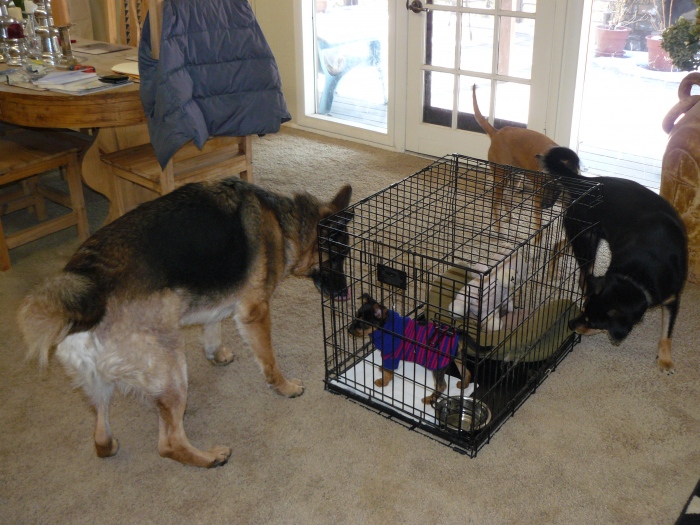
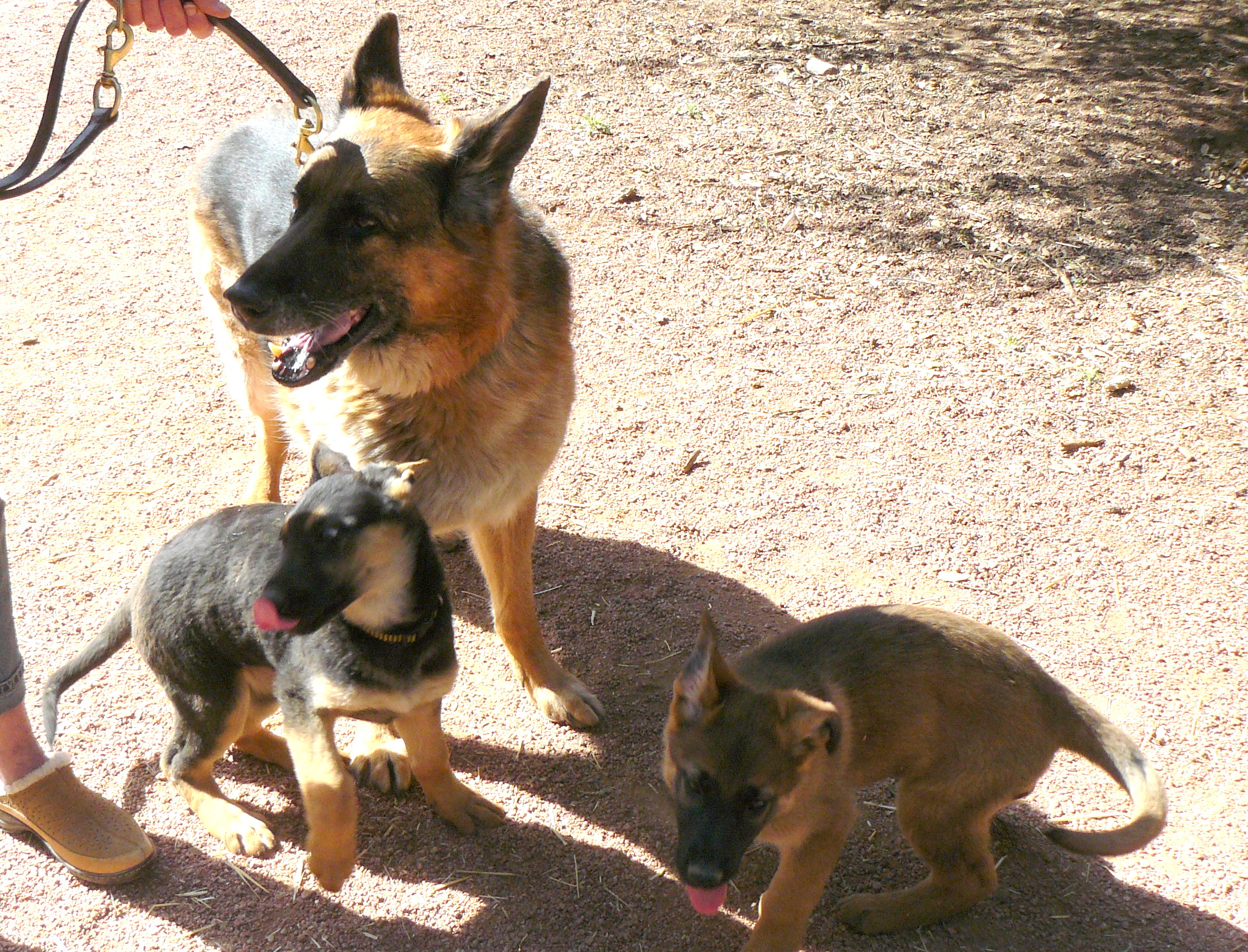
More puppies that one could shake a stick at!
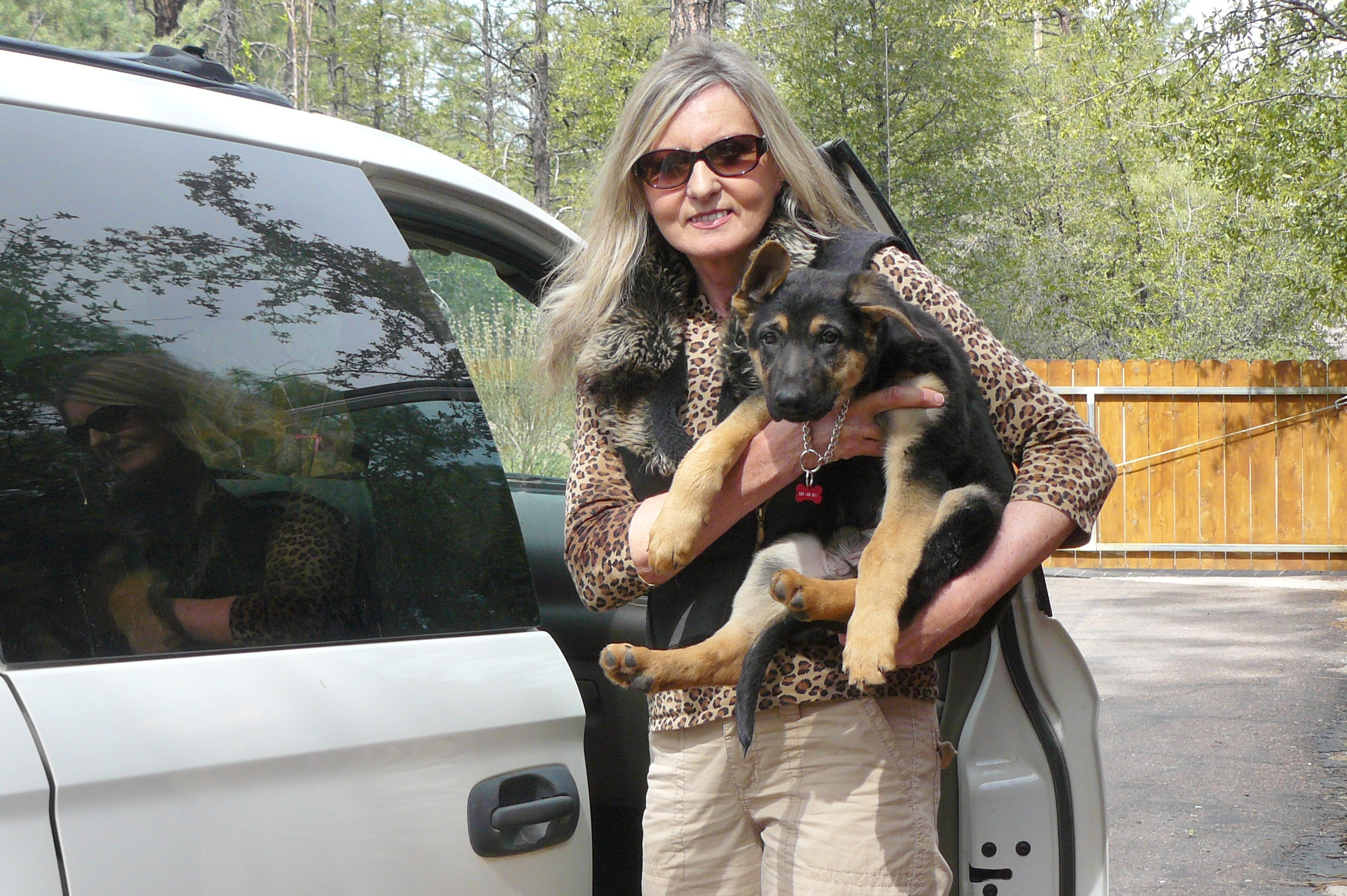
In the end, we ran out of reasons not to follow Sandra’s advice from all those years ago and we agreed terms on a young female GSD that, inevitably, was christened Cleopatra (Cleo) by Jean!
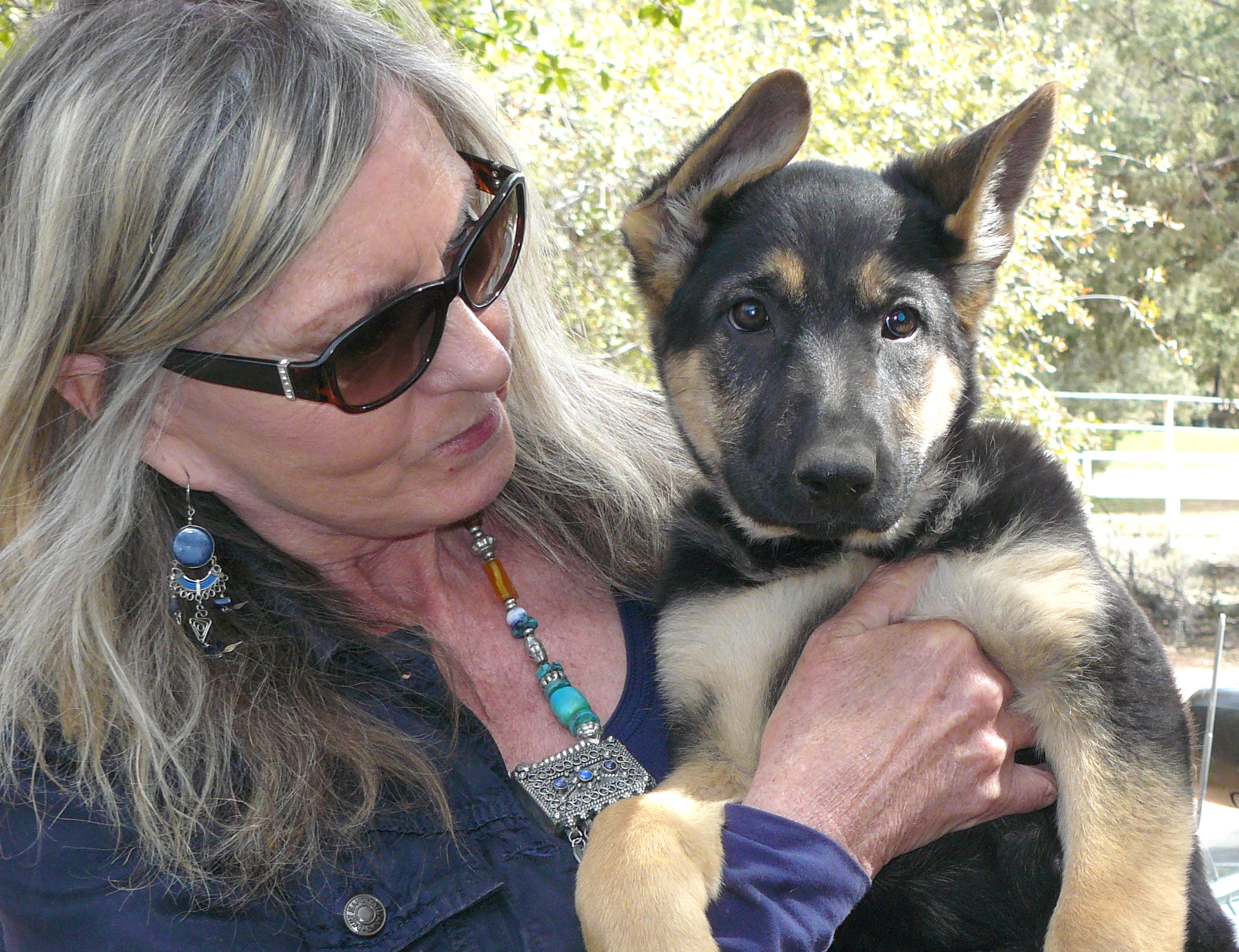
Cleo meet your new Mum!
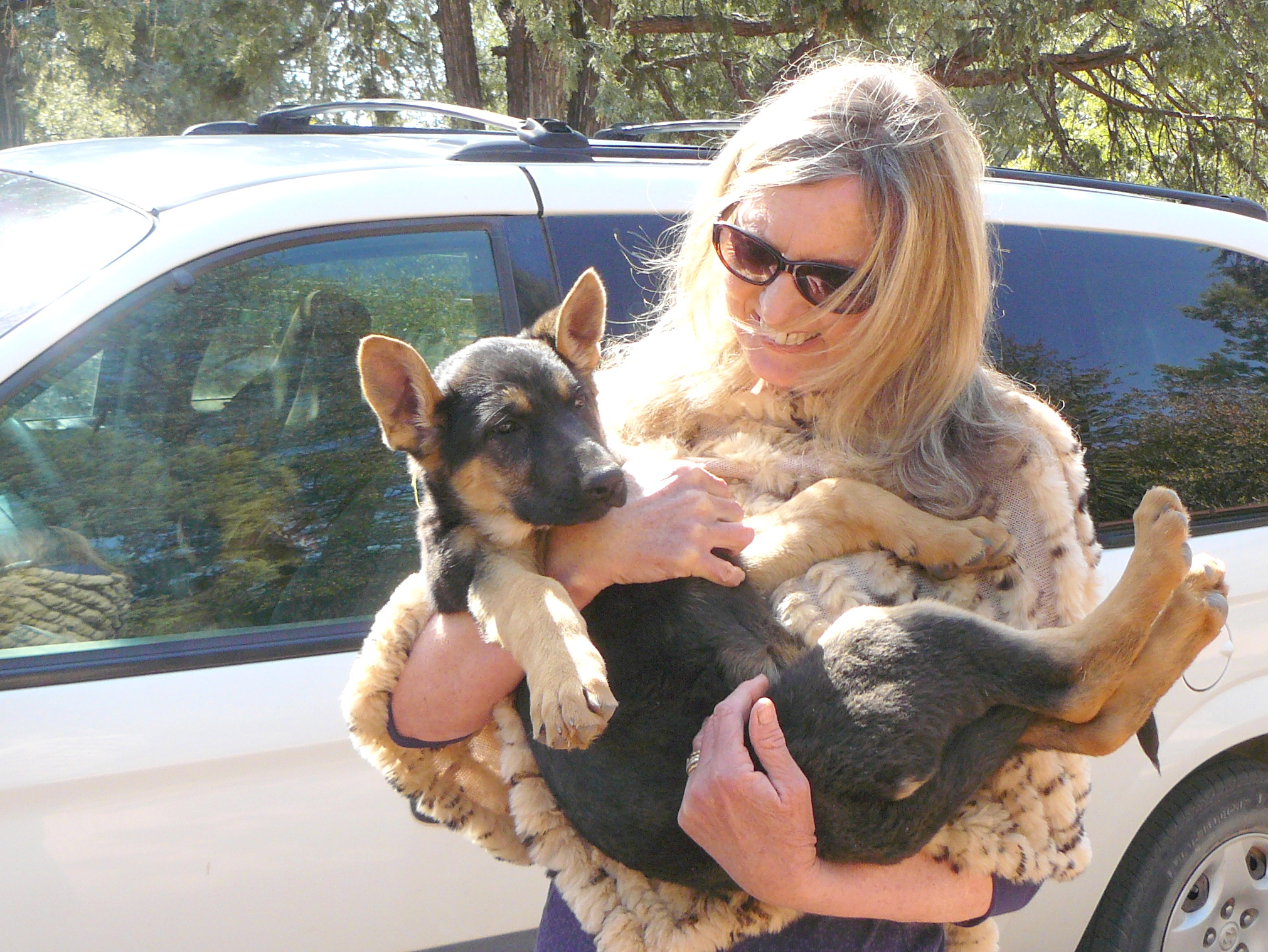
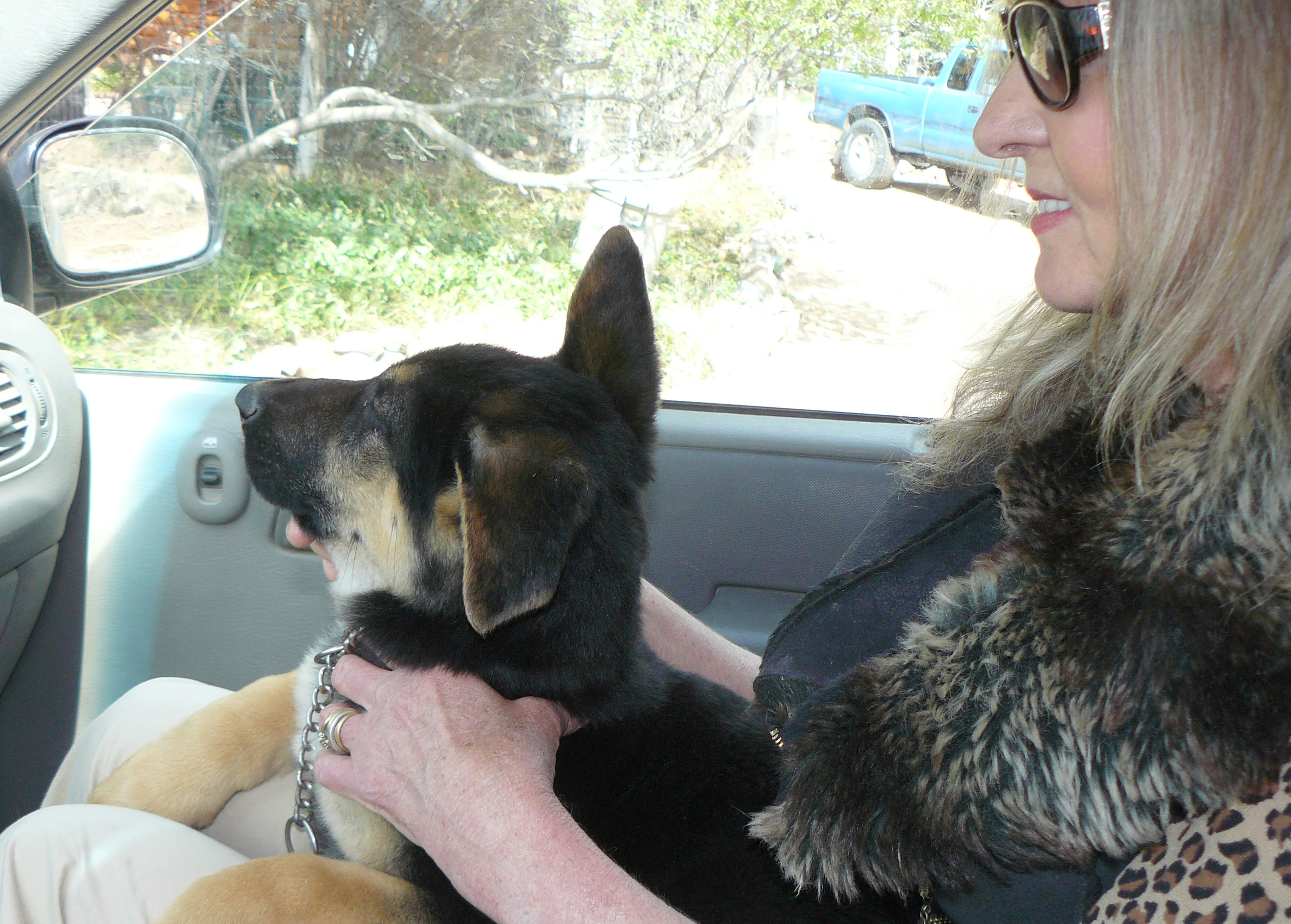
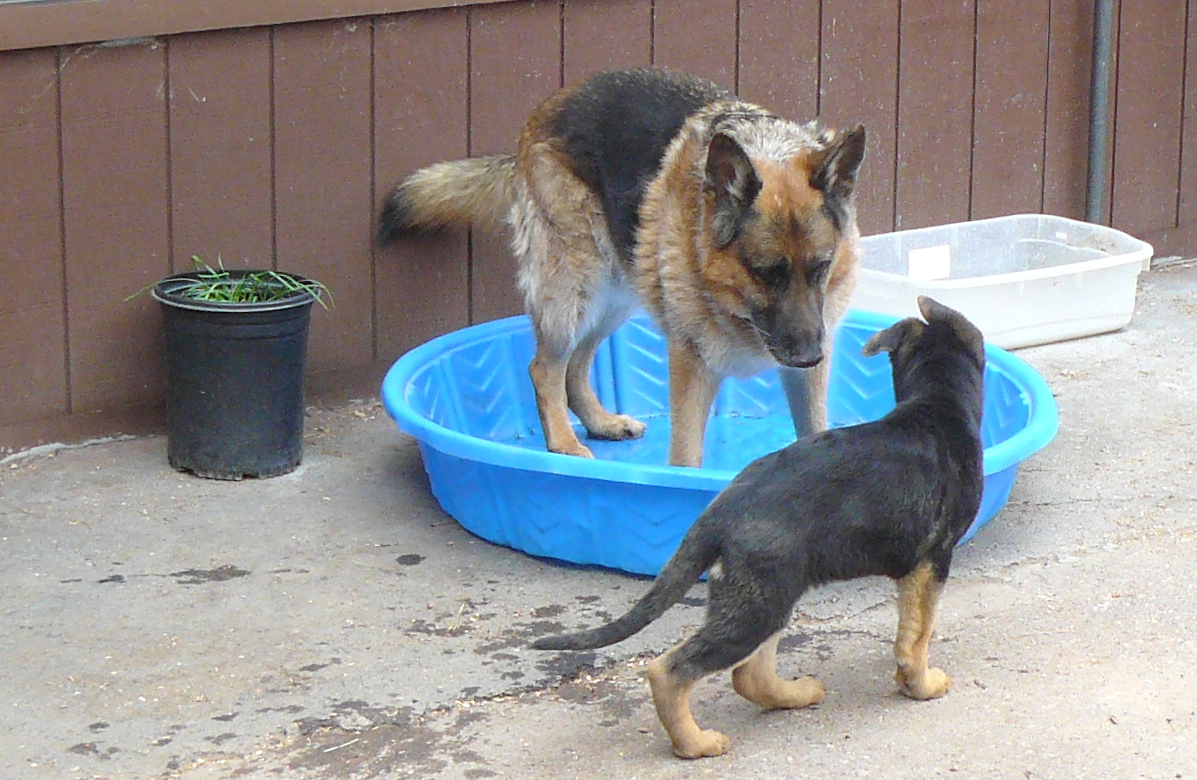
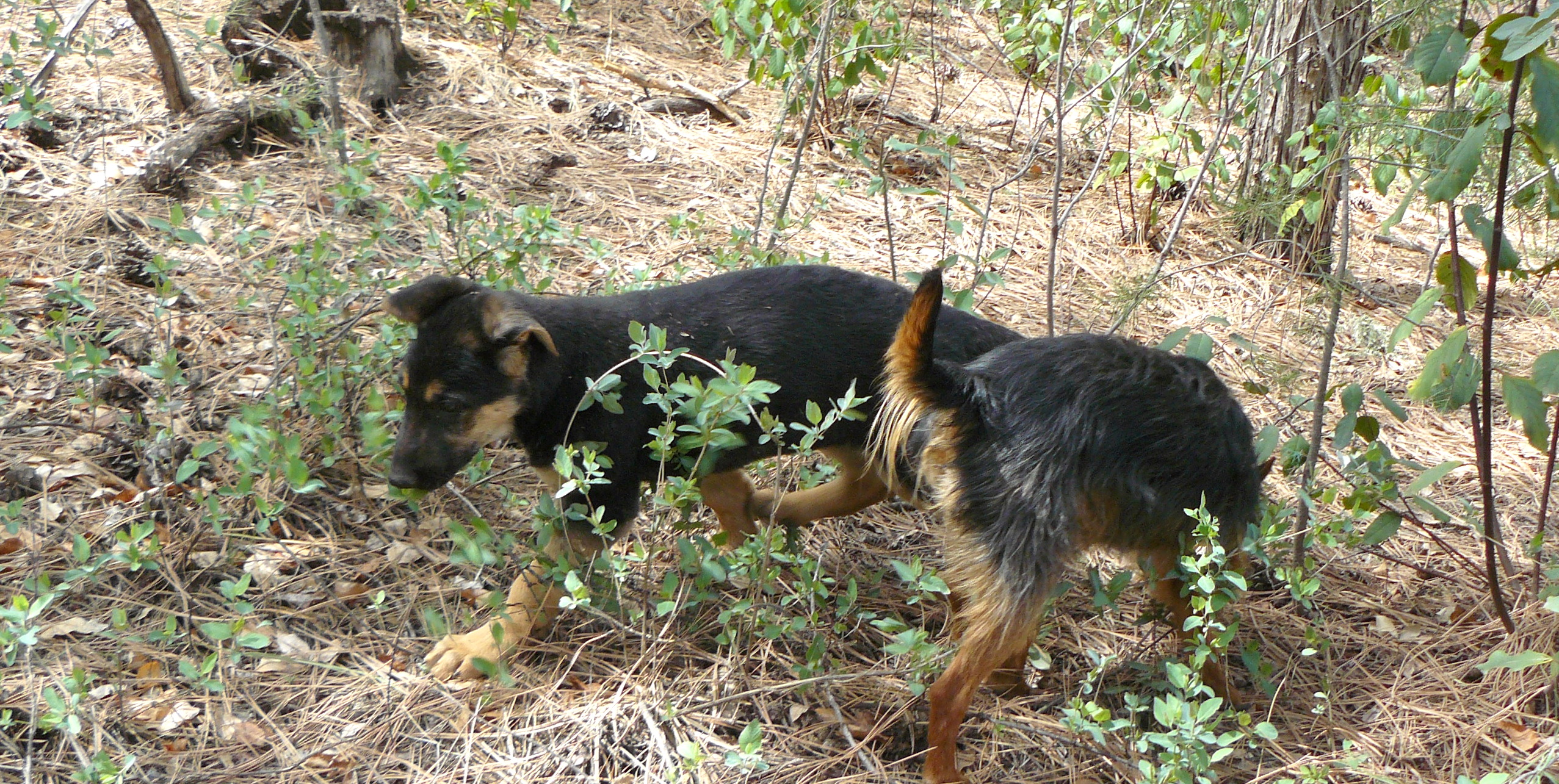
Then yesterday, Saturday, we went back round to collect young Cleo, meeting Brendan’s wife Ebony in the process. The following photographs record some of the key moments.
Homeward bound to a new life!Next step is to meet the gang!Welcome, young lady. I'm the boss around here!It's my pool but you can use it!Hey Sweeny, fancy having one's own woods to play in!She'll do! Nice addition to my family!
So there we are. Back up to eleven dogs, five chickens, six cats, and a fish!
Finally, a big thanks to Sandra of Jutone for her guidance in the last few days.
With thanks to Dan Gomez for sending me the YouTube link.
It’s a crazy old world but sometimes that craziness provides a relief from the ‘serious’ side to life.
This week the Dutch company PAL-V announced the first flights of its prototype “flying car”.
This unique vehicle is called the PAL-V One, or the ‘Personal Air and Land Vehicle’, and It marks the start of a new era.
On the ground the vehicle drives like a sports car. Within minutes its rotor is unfolded and its tail is extended: then it is ready to take off thanks to the advanced gyrocopter technology.
With these successful test results it is proven that it is not only possible to build a flying car but also that it can be done within existing international rules for both flying and driving.
Having passed this important milestone the company is now inviting investors to join them in creating the future.
The next step will be the design of the first commercial production model of the PAL-V, and first deliveries are expected in 2014.
For 100 years people have dreamed of a flying car, and many attempts have been made to realize this dream, but now it has truly become a reality.
Maybe there’s a new twist to that rather derogatory phrase!
For the life of me, I can’t remember how this story came to my ‘in-box’ but most likely it was from my Big Think subscription. But I do know that the story has spread like wild-fire (poor choice of simile for Arizona!) and not without good reason.
Benefits of Taking Your Dog to Work May Not Be Far-Fetched
Man’s best friend may make a positive difference in the workplace by reducing stress and making the job more satisfying for other employees, according to a Virginia Commonwealth University study.
Stress is a major contributor to employee absenteeism, morale and burnout and results in significant loss of productivity and resources. But a preliminary study, published in the March issue of the International Journal of Workplace Health Management, found that dogs in the workplace may buffer the impact of stress during the workday for their owners and make the job more satisfying for those with whom they come into contact.
The VCU researchers compared employees who bring their dogs to work, employees who do not bring their dogs to work and employees without pets in the areas of stress, job satisfaction, organizational commitment and support.
Bring your dog to work to lower stress; Companies that allow pooches have happier workers
Amazon, Ben & Jerry’s and Zynga all have pup-friendly policies
A new study supports the stress-reducing benefits of bringing your pooch to work — to play with, look at, and pet while working.
According to a Virginia Commonwealth University study, having a dog at work not only reduces the owners’ stress level but also increased the level of job satisfaction for other employees as well. The study, announced Thursday, was published in the International Journal of Workplace Health Management.
“Dogs in the workplace can make a positive difference,” said head researcher Randolph T. Barker. “The differences in perceived stress between days the dog was present and absent were significant. The employees as a whole had higher job satisfaction than industry norms.”
Here’s a great example. The photograph below,
One hand for the desk and one for the dog!
comes from the website of Interior Design Hound (seriously) where the by-line is Good Design with a Canine Twist! (No, I’m not making it up!)
Anyway, back to that NY Daily News item,
The study took place at Replacements Ltd, a service-manufacturing-retail company located in North Carolina, which employs approximately 550 people. The company has a dog friendly policy, similar to other companies such as Amazon, Ben & Jerry’s and Zynga, according to CBS News, with around 20 to 30 dogs romping through the office every day. The study took place over a period of one work week, and subjects completing both surveys and saliva samples to measure stress levels.
According to The Humane Society of the United States, there are numerous benefits to having dogs at work, including improved staff morale, worker productivity, and camaraderie among employees.
Numerous studies have shown that having a pet is a good investment for your health. One study found that having a pet lowered your risk factors for heart disease, and another found that dogs encourage more consistent walking and exercise.
Seems pretty obvious to me.
Another tough day at the office!
Mind you, going back to the metaphorical ‘having a dog of a day‘ here’s one woman who probably wished she hadn’t got out of bed that morning,
Woman has a dog of a day in court
Sydney – If you have a phobia about dogs and hurt yourself running away from one, is it your own fault or should the owner of the dog pay compensation?
An Australian judge on Wednesday ruled against a woman who had put that case to him and ordered her to pay substantial legal costs.
Mileva Novakovic took her brother, Michael Stekovic, and his wife to the New South Wales Court of Appeal to try to overturn a lower court verdict that found they were not liable for injuries she sustained at his house in 2008.
Novakovic slipped and fell in a panic over finding a dog in their lounge room. She admitted to a fear of dogs and said she was compelled to run despite Cougar, a mastiff, showing no aggression towards her.
I wanted to call this post Change out of hope but that title was used on March 17th so opted for Turning corners instead!
Either way, this Post is prompted by a recent item published on the Earth Policy Institute website. While Lester Brown’s book World on the Edge is a tough read, Lester is President of the Earth Policy Institute, it’s all too easy to think that the future for humanity is wall-to-wall gloom. So here’s the article that was recently published, reproduced here under the copyright terms of the Earth Policy Institute.
Hope turning on the wind!
Wind Tops 10 Percent Share of Electricity in Five U.S. States
by J. Matthew Roney
A new picture is emerging in the U.S. power sector. In 2007, electricity generation from coal peaked, dropping by close to 4 percent annually between 2007 and 2011. Over the same time period, nuclear generation fell slightly, while natural gas-fired electricity grew by some 3 percent annually and hydropower by 7 percent. Meanwhile, wind-generated electricity grew by a whopping 36 percent each year. Multiple factors underlie this nascent shift in U.S. electricity production, including the global recession, increasing energy efficiency, and more economically recoverable domestic natural gas. But ultimately it is the increasing attractiveness of wind as an energy source that will drive it into prominence.
Wind power accounted for just 2.9 percent of total electricity generation in the United States in 2011. In five U.S. states, however, 10 percent or more of electricity generation came from wind. South Dakota leads the states, with wind power making up 22 percent of its electricity generation in 2011, up from 14 percent in 2010. In 2011, Iowa generated 19 percent of its electricity with wind energy. And in North Dakota, wind’s share was 15 percent.
The two most populous U.S. states are also harnessing more of their wind resources. While adding more than 900 megawatts of new wind farms in 2011 to its existing 3,000-megawatt wind capacity, California was able to increase its wind electricity share from 3 to 4 percent. Texas has the most wind installations of all the states, with 10,400 megawatts. In fact, if Texas were a country, it would rank sixth in the world for total wind capacity. Figures from the Electric Reliability Council of Texas (ERCOT), the independent service operator that delivers 85 percent of the state’s electricity, show that wind’s share of electricity in the ERCOT region jumped from 2.9 percent in 2007 to 8.5 percent in 2011.
Even though the cost of generating electricity from the wind has fallen substantially, certain policies have been needed to help it compete with the longtime support and lack of full-cost accounting for fossil fuels. Through so-called renewable portfolio standards (RPS), 29 states now require a percentage of utilities’ electricity to come from renewables by a certain date. This includes 8 of the top 10 states in total installed wind power capacity. For example, California’s RPS requires one third of the state’s electricity to come from renewable sources by 2020. But the biggest policy driver of U.S. wind power growth thus far has been the federal production tax credit (PTC) for each kilowatt-hour of electricity a wind turbine generates. When Congress has allowed the PTC to expire, as it is scheduled to do again at the end of 2012, wind installations in the following year have plummeted.
In the short term, extending the PTC will be critical for the U.S. wind industry, which boasts more than 400 turbine component manufacturers and employs some 75,000 people. Ultimately, moving away from the recurring boom-bust threat by establishing a national RPS or a carbon tax would encourage even greater manufacturing growth and wind installations.
In a country where wind resources could power the entire economy, there is still great potential to be realized. Four states in northern Germany have set the mark, with each getting more than 40 percent of their electricity from the wind. Which U.S. state will get there first?
This video is well worth watching as well as going to that link at the end of the essay above.
Lester Brown, Thomas Friedman, and Paul Krugman discuss the need for a carbon tax in order to price carbon emissions at their true cost.
The “Journey to Planet Earth” series continues with a special program, hosted by Matt Damon, which features environmental visionary Lester Brown and author of “Plan B.” This documentary delivers a clear and unflinching message — either confront the realities of climate change or suffer the consequences of lost civilizations and failed political states.
I will see how much material there is available online with regard to that programme hosted by Matt Damon and, maybe, present some of it on Learning from Dogs.
Finally, the picture of the wind turbine at the head of this Post came from a website called www.windgeneratorblog.com. Fancy a home wind generator?
A republication of a recent Post from Kate of Climate Sight.
Introduction
My apologies for a second republication of another’s Post in two days, but a number of things today (Tuesday) have robbed me of the time I usually have for writing for Learning from Dogs. So the Post from ClimateSight that I had planned to bring to you on Thursday has been brought forward.
To Kate’s Post on ClimateSight but first a little of Kate’s background,
Kate is a B.Sc. student and aspiring climatologist from the Canadian Prairies.
She became interested in climate science several years ago, and increasingly began to notice the discrepancies between scientific and public knowledge on climate change. She started writing this blog when she was sixteen years old, simply to keep herself sane, but she hopes she’ll be able to spread accurate information far and wide while she does so.
I subscribe to ClimateSight and, thus, on the 1st April, I received the following. I republish it in full with Kate’s written permission.
March Migration Data
In my life outside of climate science, I am an avid fan of birdwatching, and am always eager to connect the two. Today I’m going to share some citizen science data I collected.
Last year, I started taking notes during the spring migration. Every time I saw a species for the first time that year, I made a note of the date. I planned to repeat this process year after year, mainly so I would know when to expect new arrivals at our bird feeders, but also in an attempt to track changes in migration. Of course, this process is imperfect (it simply provides an upper bound for when the species arrives, because it’s unlikely that I witness the very first arrival in the city) but it’s better than nothing.
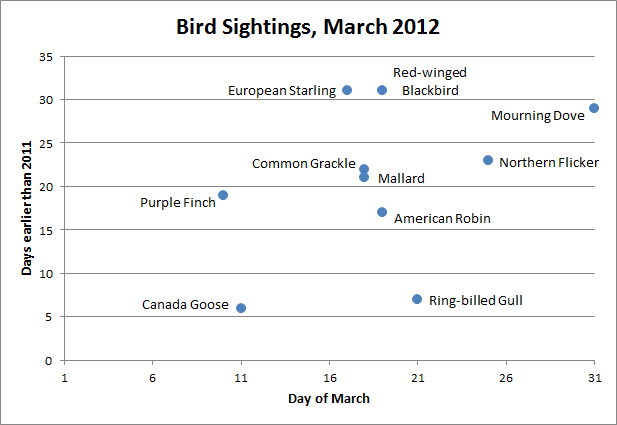
Like much of the Prairies and American Midwest, we’ve just had our warmest March on record, a whopping 8 C above normal. Additionally, every single bird arrival I recorded in March was earlier than last year, sometimes by over 30 days.
I don’t think this is a coincidence. I haven’t been any more observant than last year – I’ve spent roughly the same amount of time outside in roughly the same places. It also seems unlikely for such a systemic change to be a product of chance, although I would need much more data to figure that out for sure. Also, some birds migrate based on hours of daylight rather than temperature. However, I find it very interesting that, so far, not a single species has been late.
Because I feel compelled to graph everything, I typed all this data into Excel and made a little scatterplot. The mean arrival date was 20.6 days earlier than last year, with a standard deviation of 8.9 days.
Back to me.
What is equally interesting as Kate’s Post above are some of the comments. Like this one,
Roger
Doesn’t always work…
Here in central Illinois the robins depart in the fall and arrive in the spring; that’s the way it’s always been and that’s the way it should be, right?
Not anymore. Some years recently we’ve seen robins nearly the entire winter, if we can still call it that.
Our Canadian Geese have forgotten how to migrate.
and these two from ‘Climatehawk1’.
climatehawk1
Thanks, interesting info. I heard a mourning dove here (Vermont) Feb. 6, which is extraordinary. Some other items on birds: