Author: Paul Handover

Questions are never stupid!

A powerful guest post from Patrice Ayme on where next for American energy.

Introduction.

I must have spent an age musing over what to call this Post.  Patrice called it simply ‘Energy Question For The USA’ and it’s a highly appropriate question.  But in the end I chose the title ‘Questions are never stupid’ because I was mindful of the well-known saying, “There is no such thing as a stupid question, only a stupid answer!

So the smart question raised by Patrice is not only very highly appropriate for 2012, it’s also a question that just has to have a smart answer.  Because we are on the brink of it being too late to be flirting with stupid answers.  What many scientists are saying, in one form or another, is that if we don’t embrace the journey of moving away from carbon-based sources of energy for society now and find those alternate sustainable sources by the end of this decade then the laws of unintended consequences will kick in with a vengeance.  The end of the decade is eight years away!

Here’s a picture of my grandson who was one-year-old just a week ago.

Trusting his elders!

That picture reminds me of the comment early on in James Hansen’s book, Storms of my Grandchildren, where he writes ‘I did not want my grandchildren, someday in the future, to look back and say, “Opa understood what was happening, but he did not make it clear.

So on to the Guest post from Patrice.  It’s not an easy, quick read but I’ll tell you what it is!  It’s the sort of ‘wake-up’ call this fine Nation and this even finer Planet should be getting from countless politicians and leaders.  So do read it and, even better, add your comments, and wonder why we seem so content on fiddling while Rome burns!

oooOOOooo

Energy Question For The USA

THE AGE OF OIL PRODUCED THE AMERICAN CENTURY. NOW WHAT?

No Vision, No Mission, No Energy

***

Another editorial of Paul Krugman firing volleys at republican “paranoia” for accusing Obama of driving up oil prices. As he observes in “Paranoia Strikes Deeper“: …“the president of the United States doesn’t control gasoline prices, or even have much influence over those prices. Oil prices are set in a world market, and America, which accounts for only about a tenth of world production, can’t move those prices much. Indeed, the recent rise in gas prices has taken place despite rising U.S. oil production and falling imports.”

American households tend to borrow as much as they can. Thus, when oil prices increase markedly, Americans have to cut in crucial budgets, such as house payments. I said at the time that it would lead to a peak in housing prices, and it did.

Why such a drastic influence of oil prices on the economy of the USA? Because Americans, except in a few places such as New York, commute by private car to work. So Americans have to feed the car, if they want to feed themselves.

It was not this way a century ago, or so. At the time public transportation systems using electric tramways and trains were found all over, even in Los Angeles. Car companies put an end to that outrage in the late fifties by buying, and then destroying, all the public transportation system they could put their greedy hands on.  Fossil fuel plutocrats were delighted.

But let’s set aside Krugman’s fake indignation. He is smart enough to know that Romney will do what Romney needs to do to win the Obama, I mean, the election. Waxing lyrical about Romney doing as Obama, does not beat going lyrical about sunrise.

Gasoline prices in the USA are way down in real dollars to what they used to be, decades ago. And so is the gas tax. This means that, far from adapting to the gathering multiply-pronged world ecological and energy crisis, the USA has gone the other way, denying there is any crisis. “What? Me worry?” That’s got to be anti-American indeed.  No, real blooded Americans are all into strip searches and the death panel at the White House.

In Europe, gas prices are more than twice that of the USA, thanks to heavy taxes (stations in France have sported two euros a liter, that is 8 euros per gallon, or more than $10.50). [UK unleaded petrol price, as of today, is the equivalent of $8.70 per gallon, Ed.]

This means that far from being down and out, Europe is efficient enough to operate at that high price level. It also means that Europe is much more motivated than the USA to get much more efficient. In other words, high gasoline prices in Europe are a safety margin. The high prices force the European free market to adapt to a situation that the free market of the USA will encounter someday. Adaptation takes decades: new energies take on the average, historically speaking, 50 years to become dominant. Same, one would guess, for energy efficiencies.

Basically, if oil prices doubled from here, gasoline prices would double in the USA. Whereas, even if the Europeans decided to keep the same high taxes, gasoline prices would only augment by 50%. And, in the much more efficient European economy, with plenty of public electric transportation available, the noxious effects on the European economy would be much less than one would expect from a 50% oil price rise.

The world gets 55 × 1018 joules of useful energy from 475 × 1018 joules of primary energy produced by fossil fuels, biomass and nuclear power plants. That tremendous inefficiency (less than 13%!)  needs to be corrected. It will be, if, and only if, prices are kept high. Thus energy taxes are necessary to adapt to the looming penury.

Why looming penury? Because the reserves of other fossil fuels may have been vastly overestimated (by a factor of 5 in the case of coal). Various fossil fuel lobbies have an interest to over-estimate the reserves (because it keeps the world addicted, as they present their industry as a long range solution, which it is not).

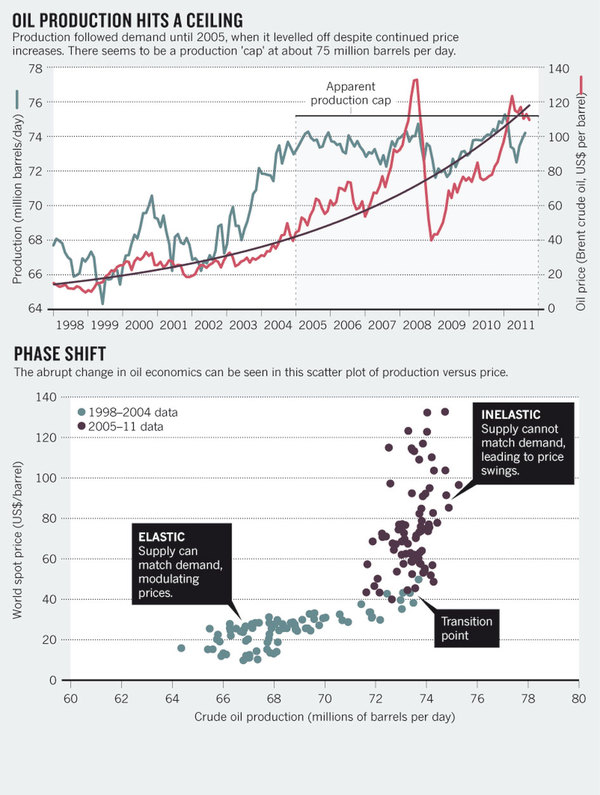
Looking at the raw production numbers, as exhibited below in the graphs, paints a completely different story: production from existing fields is going down dramatically (at 5% rate, per year).  In other words we are in the treachorous waters between the catastrophe of CO2 poisoning and the disaster of running out of energy to burn.

The unavoidable rise of fuel prices will be less grave in Europe than in the USA, because many Europeans would opt for the available electric-based public transportation system (the combination of much more efficient electric motors and central generation is much more efficient than distributing oil to put in SUVs all over, as done in the USA; SUVs, because there are too many holes in the asphalt. A problem partly related to high oil prices!).

Yet, the increase of the cost of imported oil corresponds exactly to the Italian deficit ($55 billion). Although that deficit increase had many causes, oil price increase was by far the most important. And the same for other Southern European countries. So the rise of oil prices was the barrel that broke the back of European debt.

In the USA, ten out of 11 post WWII recessions were followed by oil price spikes. Why are American minds so closed up to the looming strangulation of their economy by oil? Because the fossil fuel plutocracy is on a rampage in the USA. It uses a red hot propaganda to persuade the vast American public of undifferentiated sheep that there is no CO2 ecological crisis, and no energy crisis. (Although the latest polls indicate that two thirds of the public, in a splendid turn-around, believe that there is indeed a man-made climate change crisis; never mind that the New York Times had the latest tornado rampage, with 40 dead, presented as discreetly as possible.)

Why are the fossil plutocrats hysterical? Well we are past Peak Cheap Oil. Moreover, the “majors“, the world’s largest oil companies, have been pushed out of more and more countries, and replaced by national oil companies. Desperate, the majors have gone for riskier and riskier drilling in the deep ocean. Now Chevron, and Transocean, after a 4-day leak off Brazil, see prosecutors asking for lengthy prison sentences and enormous fines.

Most of these oil companies are American, so they have pushed forfracking (destroying the underground with poisons to extract fossil fuels). Superficially, it works: USA imports of fossil fuels went quickly from 60% down to 40%.

However, that did not make a dent in the world price situation, because the demand keeps rising, but the world, overall, is PAST PEAK OIL (as I have long argued and the Nature article alluded to below confirmed, using the obvious argument found in the graphs).

So, basically, American fracking finances Chinese oil consumption. Here are some graphs extracted from Nature and the USA government:
When the horrid sun of diminishing resources rises over the parched American oil desert, while fracking reveals itself to be an unfathomable catastrophe, the howling is going to be very great, and one more reason for a depression will blossom.

Much of the USA’s superiority, in the last 150 years, has come from abundant and cheap oil. First in the North-East, then down to Oklahoma, Texas, Colorado, California. Compare with Western Europe, which had basically no oil.

Oil was not just a question of cheap, convenient energy. Oil has, short of nuclear energy, the highest energy density of any material (OK, nuclear energy is millions of time more energy dense).

Oil gave the USA enormous diplomatic and conspiratorial leverage. American oil plutocrats helped Lenin and Stalin develop their colossal fields in the Caucasus and Caspian. One of those plutocrats, Harriman, son of a railroad magnate, and brother of another Harriman, was one of the main operators of the democratic party. Let alone banker to Hitler. He was decorated both by Stalin, and by Hitler. He then went on as U.S. ambassador to major European capitals, and stayed one the main operators of the government of the USA for decades. “Democrats” have long been impure.

Interestingly, I searched the Internet for a document mentioning Harriman’s Stalino-Hitlerian decorations, but could not find it (I have seen the pictures in the past). All I could read is how much Harriman resisted Stalin each time they met, and that was all the time (a total lie that Harriman resisted Hitler, or Stalin: Harriman was an accomplice of Stalin, and helped give him half of Europe, in exchange for manganese and other stuff. But now Internet agents are obviously paid to reconstruct a truth where American plutocrats look good,  knights in shining armor, fighting Stalin or Hitler, each time they met for tea, dinner, lunch, breakfast, and interminable conferences, for years on end, decade after decade).

A famous example of the clout oil provided the USA with: Texaco fueled Hitler’s conquest of the Spanish republic (this one is hard to hide, because the U.S. Congress slapped Texaco with a symbolic fine, well after the deed was done). That used to amuse Hitler a lot (Hitler gave elaborated reasons to his worried supporters for being in bed with American plutocrats; as the Nazi Party was officially socialist, and anti-plutocratic, that awkward situation may have led him to declare war to the USA on December 11, 1941, to ward off the German generals’ argument that he was just a little corporal in above his head).

Another example: Mussolini was hanged from an American gas station in Milan. Italian communists hanged him from his sponsors’ works.

The fueling of the fascists by American fossil fuel companies helped bring the American Century to the world in general, and Europe in particular. Without Stalin and American plutocratic oil, Hitler’s Panzers could not have moved in 1939 or 1940.

The dignified Elie Wiesel, instead of crying crocodiles tears, wondering how such a thing as Auschwitz was possible, should ask how and why the Nazi extermination machine was fuelled by American plutocrats, and how come he, himself, never talks about that.

Wiesel got the Nobel Peace Prize, just as Jimmy Carter (who launched the American attack on Afghanistan). Was it for disinformation? (And how come waging war in Afghanistan is a big plus for the Peace Prize? Is it related to the same mood which made Sweden help Hitler before and during WWII, and never having a serious look at that, ever since? I know the prize is ostensibly given by Norwegians.)

Wikipedia is big on the notion of “weasel words“, and rightly so. Deeper than that is what I would call weasel logic. And ever deeper, weasel worlds. To talk about Hitler without ever wondering who his sponsors were, and what they were after, is to live in a weasel world.

I like Elie Wiesel personally. Yet, just as I like Krugman, Obama, and countless others, such as the infamous Jean-Paul Sartre, he likes power even more than truth. OK, It is unfair to put Sartre, who really espoused the most abject terrorism, with the others… As long as individuals prefer power to truth, the spontaneous generation of infamy is insured.

Total oil sales, per day are about 100 million barrels (in truth the cap is lower, see graph above), at, say $100, so ten billion dollars a day, 3.6 trillion a year. The USA uses about 25% of that. Some have incorporated the price of the part of the gigantic American war machine and (what are truly) bribes to feudal warlords insuring Western access to the oil fields, and found a much higher cost up to $11 a gallon.

Ultimately, and pretty soon, in 2016, specialists expect oil prices to explode up, from the exhaustion of the existing oil fields. Then what?

Moreover, in 2016, the dependence upon OPEC, or, more exactly Arab regimes, is going to become much greater than now. What’s the plan of the USA? Extend ever more the security state, and go occupy the Middle East with a one million men army? To occupy, or not to occupy, that is the question.

Is it time for a better plan? And yes, any better plan will require consumers to pay higher energy prices. As consumers apparently want the army to procure the oil, they ought to pay for it.

***

Patrice Ayme

***

Note 1: Flying cost at least ten times more in CO2 creation than taking a train. And jet fuel is not taxed, at least until the carbon plan of the European Union starts charging next year, in 2013. In spite of the screaming from the USA and its proxies: it’s funny how attached to subsidies American society can be.

Note 2: Refusing to pay for necessary military expenses through taxation and mobilization, was a big factor in the downfall of the Roman Principate.

The Principate then tried to accomplish defense on the cheap, by using more and more mercenaries. Many of these mercenaries or their children and descendants were poorly integrated in Roman republican culture (say emperors Diocletian or Constantine, let alone Stilicho the Vandal, a century later), so they established theDominate, itself a negation of the Roman republic. Amusingly the Western Franks, those salt water (“Salian“) Franks remembered the Roman republic better than all these imports from the savage East… who could not remember it, they, and their ancestors, having never known it.

Guess what? The USA’s army presently employs 300,000 “private contractors” (aka, mercenaries). Curiously, in that case, it’s not so much to save money, than to extract more money from the system (but that’s another story). Still, it will have the same effect.

oooOOOooo

Is it me? Or are we all truly insane?

At times it does seem as though we, as in mankind, are truly beyond help!

If you detect a note of frustration in the title of today’s Post and the sub-heading above, then you are not mistaken.  It comes from a series of communications that have impinged upon my consciousness over the last twelve hours or so.

This morning Rob I., from here in Payson, emailed me a scan of an article in today’s (Monday) The Arizona Republic newspaper, written by Doyle Rice.  It was entitled Study: Global temps may jump 5 degrees by 2050

I’m going to take the liberty of reproducing it in full.

As the U.S. simmers through its hottest March on record — with more than 6,000 record-high temperatures already set this month — a new study released Sunday shows that average global temperatures could climb 2.5 to 5.4 degrees by 2050 if greenhouse-gas emissions continue unabated.

The study findings are based on the results of 10,000 computer model simulations of future weather overseen by researchers at Oxford University in the United Kingdom.

“These are the first results to suggest that the higher warming scenario could be plausible,” said study lead author Dan Rowlands of Oxford.

It is a faster rate of warming than most other models predict.

Most scientists say that increasing amounts of carbon dioxide in the atmosphere from the burning of fossil fuels such as oil, gas and coal are causing the planet to warm to levels that cannot be explained by natural variability.

The study was published online Sunday in the journal Nature Geoscience and backs up similar predictions from the Intergovernmental Panel on Climate Change in 2007.

The climate models used in the study accurately reproduced actual, observed temperature changes over the last 50 years. Assuming that models that simulate past warming realistically are the best candidates for future warming predictions, the authors conclude in the study that a warming of 2.5 to 5.4 degrees by 2050, compared with the 1960-90 average, is in the “likely range” of climate warming.

The Earth’s average temperature during the decade of 2000-10 was almost a full degree higher than the average from 1960-90, Rowlands said.

I don’t feel too bad at ‘borrowing’ the story above because I also subscribe to the UK’s Met Office News Blog and, guess what, in my ‘in-box’ this morning were two news stories from the Met Office.  Let me take them in this order.

The first one I want to refer to here is this Citizen science looks at future warming uncertainty  and includes the link to the Nature Geoscience magazine article that prompted the story in The Arizona Republic.

This is how it develops,

A project running almost 10,000 climate simulations on volunteers’ home computers has found that a global warming of 3 degrees Celsius by 2050 is ‘equally plausible’ as a rise of 1.4 degrees.

The study addresses some of the uncertainties that previous forecasts, using simpler models or only a few dozen simulations, may have over-looked.

Importantly, the forecast range is derived from using a complex Met Office model that accurately reproduces observed temperature changes over the last 50 years.

The results suggest that the world is very likely to cross the ’2 degrees barrier’ at some point this century if emissions continue unabated.

It also suggests that those planning for the impacts of climate change need to consider the possibility of warming of up to 3 degrees (above the 1961-1990 average) by 2050, even on a mid-range emission scenario. This is a faster rate of warming than most other models predict.

Just go and read that last paragraph again: “This is a faster rate of warming than most other models predict.

Then the next item from the Met Office blog was this,  Why is it so warm?  It’s referring to the specific weather conditions in the UK at present:

The last few days have been unseasonably warm but why is this happening so early in the year? The answer lies largely in the air flow directly above the United Kingdom but more importantly where that air has come from.

Just a few paragraphs down we read, “we have seen a new record high for Scotland in March as the temperature reached 22.8 °C  [73.04 °F] at Fyvie Castle in Aberdeenshire on Sunday 25 March.”  So another temperature record!

I had a quick call with Martin Lack about an hour before starting this Post and he pointed me to the Australian website of CSIRO.  There we find the latest State of the Climate report, from which we read,

The previous State of the Climate, released in March 2010 highlighted a multi-decadal warming trend over Australia’s land and oceans, an increase in record hot days and decrease in record cold days across the country, a decrease in rainfall in southwest and southeast Australia, an increase in global sea level, and increases in global greenhouse gas concentrations.

Do read the full report starting here.  Or if you want a video to watch, then here it is:

Dr Karl Braganza from the Climate Monitoring Section of the Bureau of Meteorology discusses the State of the Climate in 2012.

Also on the CSIRO website is a small piece saying,

Planet Under Pressure 2012

Scientists from around the globe are meeting in London in March to discuss ‘solutions, at all scales, to move societies on to a sustainable pathway’. Planet Under Pressure 2012 is designed to bring together senior policymakers, industry leaders, NGOs, young scientists, the media, health specialists, and academics from many disciplines.
25 March 2012

Meeting to discuss ‘solutions, at all scales, to move societies on to a sustainable pathway’.  Any rational thinking person on this planet if given a chance to reflect on the science knows we have to change our ways.  And the means to do it are clear; we are not talking rocket-science here.

So when Martin Lack catches my attention with a recent piece entitled The seven woes of the Tea Party and I am linked to this article by Rick Santorum, I feel as though it must be me!  This is what Mr. Santorum writes:

The Elephant in the Room: Challenging science dogma

As with evolution, the ‘consensus’ on climate change has become an ideology.

Questioning the scientific consensus in pursuit of the truth is an important part of how science has advanced through the centuries. But what happens when the scientific consensus becomes an ideology that trumps the pursuit of truth? Answer: Those making legitimate inquiries are ostracized, the careers of dissenters are destroyed, and debate is stifled.

Unfortunately, I am referring not only to the current proponents of the theory of man-made global warming.

With the penultimate paragraph reading thus,

Why? Well, maybe because Americans don’t like being told what to believe. Maybe because we have learned to be skeptical of “scientific” claims, particularly those at war with our common sense – like the Darwinists’ telling us for decades that we are just a slightly higher form of life than a bacterium that is here purely by chance, or the Environmental Protection Agency’s informing us last week that man-made carbon dioxide – a gas that humans exhale and plants need to live, a gas that represents less than 0.1 percent of the atmosphere – is a dangerous pollutant threatening to overheat the world.

Frankly, I am lost for words and probably best that I am!  Lost because irrespective of political ‘left’ or ‘right’ the science of where this so-called intelligent species we call homo sapiens is heading, is beyond question.  I use the phrase ‘beyond question’ not as a statement of fact but as a statement of truth.  For science, as this non-scientist understands it, is about distinguishing the truth from ‘non-truth’.

Our beautiful companions for thousands of years truly do know better.  That’s the truth you see in those eyes below.

The truth is always clear, Mr. Man. Just open your eyes!

Meating climate change!

An interesting reflection on the rearing of cattle and an ‘Anti-Meat pill!  No kidding!

I was vaguely aware of the contribution of cattle towards the overall rise in greenhouse gases.  A very quick web search found this news item from the United Nations which included,

29 November 2006 – Cattle-rearing generates more global warming greenhouse gases, as measured in CO2 equivalent, than transportation, and smarter production methods, including improved animal diets to reduce enteric fermentation and consequent methane emissions, are urgently needed, according to a new United Nations report released today.

“Livestock are one of the most significant contributors to today’s most serious environmental problems,” senior UN Food and Agriculture Organization (FAO) official Henning Steinfeld said. “Urgent action is required to remedy the situation.”

But what prompted me to look a little closer at this was a recent article on the Big Think website that was entitled, The Anti-Meat Pill: Human Engineering to Combat Climate Change.

Let me quote a little from the article, presented on the Big Think website by Daniel Honan.

NYU Bio-ethicist Matthew Liao has caused a stir recently with a forthcoming paper that explores the biomedical modification of humans in order to stop us from consuming red meat.

and a paragraph later continued with,

In a forthcoming paper to be published in Ethics, Policy and the Environment, Liao suggests that humans might take pills to bring about mild nausea to rid ourselves of our appetite for red meat. This would have a mitigating effect on climate change, he argues.

Liao refers to studies such as a widely-sited UN report that estimates 18 percent of greenhouse emissions come from livestock, which is a higher share than transportation. Another report, from 2009, estimates livestock emissions are significantly higher, at 50 percent. Fact of life: cows fart. Other negative impacts of increased livestock farming includes deforestation and a drain on water supplies.

The Internet rapidly found Matthew Liao’s website and from there the paper referred to above, which is introduced thus,

Professor Matthew Liao of New York University

Anthropogenic climate change is arguably one of the biggest problems that confront us today. There is ample evidence that climate change is likely to affect adversely many aspects of life for all people around the world, and that existing solutions such as geoengineering might be too risky and ordinary behavioural and market solutions might not be sufficient to mitigate climate change. In this paper, we consider a new kind of solution to climate change, what we call human engineering, which involves biomedical modifications of humans so that they can mitigate and/or adapt to climate change. We argue that human engineering is potentially less risky than geoengineering and that it could help behavioural and market solutions succeed in mitigating climate change. We also consider some possible ethical concerns regarding human engineering such as its safety, the implications of human engineering for our children and for the society, and we argue that these concerns can be addressed. Our upshot is that human engineering deserves further consideration in the debate about climate change.

Now if we go back to that UN article, we can see that emissions from cattle and livestock in general is not a minor issue.

When emissions from land use and land use change are included, the livestock sector accounts for 9 per cent of CO2 deriving from human-related activities, but produces a much larger share of even more harmful greenhouse gases. It generates 65 per cent of human-related nitrous oxide, which has 296 times the Global Warming Potential (GWP) of CO2. Most of this comes from manure.

And it accounts for respectively 37 per cent of all human-induced methane (23 times as warming as CO2), which is largely produced by the digestive system of ruminants, and 64 per cent of ammonia, which contributes significantly to acid rain.

With increased prosperity, people are consuming more meat and dairy products every year, the report notes. Global meat production is projected to more than double from 229 million tonnes in 1999/2001 to 465 million tonnes in 2050, while milk output is set to climb from 580 to 1043 million tonnes.

But modifying humans, frankly, misses the point.

That is unless we wholeheartedly embrace the need to change, to sustain the only planet we can call home, and do it because we care, Planet Earth will do the bioengineering for us – engineering us into extinction.  For example, just cut back on eating meat!  And if you don’t want to do it for the planet, do it for the health of your children as this Health Petition underlines in spades.

So I’m sorry Professor Liao but this seems like a step too far – by a long way.

The magic of pets!

Dear friend Dan Gomez sent this to me on the 9th but I split it into two parts, covering yesterday and today.  Then found that the first part didn’t Post correctly; the pictures were missing.

So both parts are today – enjoy!

oooOOOooo

Part One: How many dogs does it take to change a light bulb?

1. Golden Retriever: The sun is shining, the day is young, we’ve got our whole lives ahead of us,

and you’re inside worrying about a stupid burned out bulb?

     2. Border Collie: Just one. And then I’ll replace any wiring that’s not up to code.

   3. Dachshund: You know I can’t reach that stupid lamp!

       4. Rottweiler: Make me!

   5. Boxer: Who cares? I can still play with my squeaky toys in the dark.

6. Lab: Oh, me, me!!!!! Pleeeeeeeeeze let me change the light bulb!

Can I? Can I? Huh? Huh? Huh? Can I? Pleeeeeeeeeze, please, please, please!

7. German Shepherd: I’ll change it as soon as I’ve led these people from the dark,

check to make sure I haven’t missed any, and make just one more

perimeter patrol to see that no one has tried to take advantage of the situation!

8. Jack Russell Terrier: I’ll just pop it in while I’m bouncing off the walls and furniture.

9. Old English Sheep Dog: Light bulb? I’m sorry, but I don’t see a light bulb!

10. Cocker Spaniel: Why change it? I can still pee on the carpet in the dark.

11. Chihuahua : Yo quiero Taco Bulb. Or “We don’t need no stinking light bulb.”

12. Greyhound: It isn’t moving. Who cares?

13. Australian Cattle Dog:First, I’ll put all the light bulbs in a little circle…

14. Poodle: I’ll just blow in the Border Collie’s ear and he’ll do it.

By the time he finishes rewiring the house, my nails will be dry.

How many cats does it take to change a light bulb?

Cats do not change light bulbs. People change light bulbs.

So, the real question is: “How long will it be before I can expect some light, some dinner, and a massage?”

ALL OF WHICH PROVES, ONCE AGAIN, THAT WHILE DOGS HAVE MASTERS, CATS HAVE STAFF!

oooOOOooo

Part Two: Why God made pets!

They help out around the house…


They protect our children… 


They look out for the smaller ones… 


They show us how to relax…


They “converse” with each other. 


They help you when you’re down… 


They are great at decorating for the Holidays.


They have “great” expectations. 


They are Patriotic.


They are happy to “test” the water.


They know who’s “BOSS. 


AND – They know when we need a good LAUGH! 


HAVE YOU SMILED TODAY? It is done by moving the corners of the mouth upward.
LET ME SHOW YOU HOW…

NOW PASS IT ON, AND MAKE SOMEONE ELSE SMILE!!!

Big thank-you, Dan, but more to the point a big thanks to ‘SKF’ who sent it to you.

Changing that light bulb?

Apologies!

At 10:15 last night, I discovered that this Post is likely to be published with all the pictures missing.  Operator error on my part.

So rather than delete it and you, dear reader, not know what had happened, I have left it as it is and will correct it by including the pictures for tomorrow, Sunday.

Dear friend Dan Gomez sent this to me on the 9th but I have split it into two parts, the concluding part will be tomorrow.

oooOOOooo

How many dogs does it take to change a light bulb?

Description:                                         cid:1.2287114833@web110304.mail.gq1.yahoo.com
1. Golden Retriever: The sun is shining, the day is young, we’ve got our whole lives ahead of us, and you’re inside worrying about a stupid burned out bulb?
Description:                                         cid:2.2287114833@web110304.mail.gq1.yahoo.com
2. Border Collie: Just one. And then I’ll replace any wiring that’s not up to code.
Description:                                         cid:3.2287114834@web110304.mail.gq1.yahoo.com
3. Dachshund: You know I can’t reach that stupid lamp!
Description:                                         cid:4.2287114834@web110304.mail.gq1.yahoo.com
4. Rottweiler: Make me.
Description:                                         cid:5.2287114834@web110304.mail.gq1.yahoo.com
5. Boxer: Who cares? I can still play with my squeaky toys in the dark.
Description:                                         cid:6.2287114834@web110304.mail.gq1.yahoo.com
6. Lab: Oh, me, me!!!!! Pleeeeeeeeeze let me change the light bulb! Can I? Can I? Huh? Huh? Huh? Can I? Pleeeeeeeeeze, please, please, please!
Description:                                         cid:7.2287114834@web110304.mail.gq1.yahoo.com
7. German Shepherd: I’ll change it as soon as I’ve led these people from the dark, check to make sure I haven’t missed any, and make just one more perimeter patrol to see that no one has tried to take advantage of the situation
Description:                                         cid:8.2287114834@web110304.mail.gq1.yahoo.com
8. Jack Russell Terrier: I’ll just pop it in while I’m bouncing off the walls and furniture.
Description:                                         cid:9.2287114834@web110304.mail.gq1.yahoo.com
9. Old English Sheep Dog: Light bulb? I’m sorry, but I don’t see a light bulb!
Description:                                         cid:10.2287114834@web110304.mail.gq1.yahoo.com
10. Cocker Spaniel: Why change it? I can still pee on the carpet in the dark.
Description:                                         cid:11.2287114834@web110304.mail.gq1.yahoo.com
11. Chihuahua : Yo quiero Taco Bulb. Or “We don’t need no stinking light bulb.”
Description:                                         cid:12.2287114834@web110304.mail.gq1.yahoo.com
12. Greyhound: It isn’t moving. Who cares?
Description:                                         cid:13.2287114834@web110304.mail.gq1.yahoo.com
13. Australian Cattle Dog:First, I’ll put all the light bulbs in a little circle…
Description:                                         cid:14.2287114834@web110304.mail.gq1.yahoo.com
14. Poodle: I’ll just blow in the Border Collie’s ear and he’ll do it. By the time he finishes rewiring the house, my nails will be dry.

How many cats does it take to change a light bulb?
Cats do not change light bulbs. People change light bulbs. So, the real question is:
Description:                                         cid:15.2287114834@web110304.mail.gq1.yahoo.com
“How long will it be before I can expect some light, some dinner, and a massage?”
ALL OF WHICH PROVES, ONCE AGAIN, THAT WHILE DOGS HAVE MASTERS, CATS HAVE STAFF!

Part Two tomorrow.

The most important alarm ever heard.

The heading says it all.

In fact the heading was taken from an email that came in from Bill McKibben’s 350.org yesterday.  But before reproducing that email in full, let me take you back to the 6th January this year when I published a piece simply called Keystone XL pipeline.  This is how that Post opened up,

Yesterday, I had published a lecture given in Melbourne by Britain’s eminent Astronomer Royal, Lord Martin Rees.  Lord Rees concluded his lecture with the call for us to take better care of our own planet. He, like many others, recognises the unique place in history that we occupy. For the first time a single species is capable of exerting profound changes on the Earth’s natural and physical environments.

Over and over again, scientists are reporting the rise in climate temperature of Planet Earth and the implications thereof if we do not wakeup soon to changing our ways.  The Keystone pipeline is a huge potential mistake!

Bill McKibben of 350.org

Not easy to focus on a single sentence from Lord Rees but this one’s pretty direct, “For the first time a single species is capable of exerting profound changes on the Earth’s natural and physical environments.”

God only knows what money, power and influence is going on behind the scenes because no leader in their right mind ought to be supporting any major investment in the continuation of carbon-based energy.  So it was with deep dismay that around 2pm US Mountain Time yesterday afternoon the following email arrived in my in-box.  (Feel free to republish this Post, indeed please do so!)

Dear friends,

Earlier today, Barack Obama wrapped up his first trip to Oklahoma as President. He arrived just after a week of floods, capping off a winter that never came, which followed the hottest and driest summer Oklahoma had seen in thousands of years, perhaps ever.

But he wasn’t in Oklahoma to talk about these climate disasters. He was there to laud his administration’s fast-tracking of the southern leg of the Keystone XL tar sands pipeline. In his speech today, President Obama didn’t connect the dots between fossil fuel extraction, climate change, and the extreme weather that has reshaped so much of the American landscape this past year.

It’s a painful reminder that sometimes we must be leaders ourselves, before we can expect our elected officials to follow. It’s clearly up to us to connect the dots.

Today 350.org is launching a global day of action to call attention to these and other climate disasters, here on the same day as the President’s annoucement. Across the planet now we see ever more flooding, ever more drought, ever more storms. People are dying, communities are being wrecked — the impacts we’re already witnessing from climate change are unlike anything we have seen before.

If we’re going to do these communities justice, we need to connect the dots between these disasters and show how all of them are linked to fossil fuels. We’re setting aside May 5th for a global day of action to do just that: Connect the Dots between extreme weather and climate change.

Anyone and everyone can participate in this day. Many of us do not live in Oklahoma, the Philippines, or Ethiopia — places deeply affected by climate impacts. For those of us not in directly-impacted communities, there are countless ways to stand in solidarity with those on the front-lines of the climate crisis: some people will be giving presentations in their communities about how to connect the dots. Others will do projects to demonstrate what sorts of climate impacts we can expect if the crisis is left unchecked. And here in the US, it’s particularly important that we make the connections clear to our elected officials — beginning with President Obama.

However you choose to participate, your voice is needed in this fight — and you can sign up to host a local event here: www.climatedots.org/start

(For more general info about the day, check out our new website here: www.climatedots.org)

350.org has done giant global days of action before (over the last three years we’ve helped coordinate over 15,000 events in 188 countries) and they’re always beautiful moments when our movement stands together. This year we’ll use that same captivating tactic to draw attention to the struggles of our friends around the world  — the communities already feeling the harsh impacts of climate change.

These will also be beautiful events, we’re sure. But they will also have an edge. It’s right that we get a little angry at those forces causing this problem. The fossil fuel industry is at fault, and we have to make that clear. Our crew at 350.org will work hard to connect all these dots — literally — and weave them together to create a potent call to action, and we will channel that call directly to the people who need to hear it most.

May 5 is coming soon; we need to work rapidly. Because climate change is bearing down on us, and we simply can’t wait. The world needs to understand what’s happening, and you’re the people who can tell them.

Please join us — we need you to send the most important alarm humanity has ever heard.

Onwards,

–Bill McKibben for the whole 350.org team

P.S. This is news worth spreading — and it only takes a moment to share it. Click here to share it on Facebook, or click here to post it on Twitter.

The governance of Planet Earth

How fundamental reforms of environmental governance are urgently needed.

I must admit that as Post titles go, the one above is about as ‘weighty’ as it comes!  But then again, one might argue as Ronald Firbank, a British novelist, was reputedly to have quoted, “The world is so dreadfully managed, one hardly knows to whom to complain!

One of the great assets of the part of the world where Jean and I live, namely Arizona, is the state university or to give it it’s proper title Arizona State University.  The university has an important School of Sustainability and I subscribe to their regular newsletter.  But it was Rob I. here in Payson who spotted a recent item and forwarded same to me.  Thank goodness because it covered something of supreme relevance to the future.

I’m taking the liberty of reproducing it in full, as follows;

Fundamental steps needed now in global redesign of Earth system governance

Leading experts from around the world, 4 from Pac-12 colleges, argue for immediate ambitious reforms

Some 32 social scientists and researchers from around the world, including Kenneth W. Abbott, a professor of international relations in ASU’s Sandra Day O’Connor College of Law and a Senior Sustainability Scholar in the Global Institute of Sustainability a Senior, are calling for fundamental reforms of global environmental governance to avoid dangerous changes in the Earth system.

Some 32 social scientists and researchers from around the world, including a senior sustainability scholar at Arizona State University, have concluded that fundamental reforms of global environmental governance are needed to avoid dangerous changes in the Earth system. The scientists argued in the March 16 edition of the journal Science that the time is now for a “constitutional moment” in world politics.

Research now indicates that the world is nearing critical tipping points in the Earth system, including on climate and biodiversity, which if not addressed through a new framework of governance could lead to rapid and irreversible change.

“Science assessments indicate that human activities are moving several of Earth’s sub-systems outside the range of natural variability typical for the previous 500,000 years,” wrote the authors in the opening of “Navigating the Anthropocene: Improving Earth System Governance.”

Reducing the risk of potential global environmental disaster requires the development of “a clear and ambitious roadmap for institutional change and effective sustainability governance within the next decade,” comparable in scale and importance to the reform of international governance that followed World War II, they wrote.

In particular, the group argued for the creation of a Sustainable Development Council that would better integrate sustainability concerns across the United Nations system. Giving a leading role to the 20 largest economies (G20) would help the council act effectively. The authors also suggested an upgrade of the UN Environment Program to a full-fledged international organization, a move that would give it greater authority and more secure funding

To keep these institutions accountable to the public, the scientists called for stronger consultative rights for representatives of civil society, including representatives from developing countries, NGOs, consumers and indigenous peoples.

“We should seek input from people closest to the ground, not just from the elites, not just at the 30,000-feet level,” noted Kenneth W. Abbott, a professor of international relations in ASU’s Sandra Day O’Connor College of Law. “Consultations should not take place only at the global scale, where the broadest policies are created, but also at local scales, smaller scales, all scales,” he said.

To improve the speed of decision-making in international negotiations, the authors called for stronger reliance on qualified majority voting. “There has to be a change in international negotiating procedures from the current situation, in which no action can be taken unless consensus is reached among all participating governments,” Abbott said.

The authors also called for governments “to close remaining regulatory gaps at the global level,” including the treatment of emerging technologies.

“A great deal of attention has been given to issues such as climate change, yet nanotechnology and other emerging technologies, which may bring significant benefits, also carry potential risks for sustainable development,” Abbott said.

Relying on research by Abbott and his colleagues at ASU’s College of Law, the authors wrote that emerging technologies “need an international institutional arrangement – such as one or several multilateral framework conventions” to support forecasting and transparency, and to ensure that environmental risks are taken into account.

“Working to make the world economy more green and to create an effective institutional framework for sustainable development will be the two main focal points at this summer’s United Nations Conference on Sustainable Development in Rio de Janeiro,” Abbott said. “This article was written to bring urgency to those discussions and to outline specific ‘building blocks’ for a more effective and sustainable Earth system governance system.”

The authors also argued for increased financial support for poorer nations. “More substantial financial resources could be made available through novel financial mechanisms, such as global emissions markets or air transportation levies for sustainability purposes,” they wrote.

Lead author Frank Biermann, of Free University Amsterdam and Lund University, Sweden, said, “Societies must change course to steer away from critical tipping points in the Earth system that could lead to rapid and irreversible change. Incremental change is no longer sufficient to bring about societal change at the level and with the speed needed to stop Earth system transformation.

“Structural change in global governance is needed, both inside and outside the UN system and involving both public and private actors,” said Biermann, who also is chair of the scientific steering committee of the Earth System Governance Project.

All 32 authors of the Science article are affiliated with the Earth System Governance Project, a global alliance of researchers and leading research institutions, specializing in the scientific study of international and national environmental governance. ASU’s Abbott is one of some 50 lead faculty of the Earth System Governance Project. Lead faculty are scientists of high international reputation who share responsibility for research on earth system governance. Additional information is at http://earthsystemgovernance.org.

Among the other authors of “Navigating the Anthropocene” are: S. Andresen, Fridtjof Nansen Institute, Norway; K. Bäckstrand, Lund University, Sweden; S. Bernstein, University of Toronto, Canada; M. M. Betsill, Colorado State University; H. Bulkeley, Durham University, U.K.; B. Cashore, Yale University; J. Clapp, University of Waterloo, Canada; C. Folke, Stockholm Resilience Centre Stockholm University and Beijer Institute, Royal Swedish Academy of Sciences, Sweden; A. Gupta, Wageningen University and Research Centre, Netherlands; J. Gupta, Free University Amsterdam and UNESCO-International Institute for Hydraulic and Environmental Engineering Institute for Water Education, Netherlands; P. M. Haas, University of Massachusetts at Amherst; A. Jordan, Tyndall Centre, University of East Anglia, U.K.; N. Kanie, Tokyo Institute of Technology and United Nations University Institute of Advanced Studies, Japan; T. Kluvánková-Oravská, CETIP, Slovak Academy of Sciences, Slovakia; L. Lebel, Chiang Mai University, Thailand;

And, D. Liverman, University of Arizona and Oxford University, U.K.; J. Meadowcroft, Carleton University, Canada; R. B. Mitchell, University of Oregon; P. Newell, University of Sussex, U.K.; S. Oberthür, Vrije University, Belgium; L. Olsson, Lund University, Sweden; P. Pattberg, Free University Amsterdam; R. Sánchez-Rodríguez, El Colegio de la Frontera Norte, Mexico, and University of California, Riverside; H. Schroeder, Tyndall Centre, University of East Anglia, U.K.; A. Underdal, University of Oslo, Norway; S. Camargo Vieira, Universidade de Itaúna, Brazil; C. Vogel, independent scholar, South Africa; O. R. Young, University of California, Santa Barbara; A. Brock, Free University Amsterdam; and R. Zondervan Lund University, Sweden.

Abbott is also a senior sustainability scholar in the Global Institute of Sustainability, a transdisciplinary unit in ASU’sOffice of Knowledge Enterprise Development that advances research, entrepreneurship, innovation and economic development, and a professor of global studies in the School of Politics and Global Studies at ASU’s College of Liberal Arts and Sciences.

Carol Hughes, carol.hughes@asu.edu
480-965-6375

In that first paragraph, it was reported that the March 16 edition of the journal Science carried the argument put forward by the scientists.  Here the link to that argument which also includes a link to the full text from which I quote the abstract,

Policy Forum

Navigating the Anthropocene: Improving Earth System Governance

Science assessments indicate that human activities are moving several of Earth’s sub-systems outside the range of natural variability typical for the previous 500,000 years (12). Human societies must now change course and steer away from critical tipping points in the Earth system that might lead to rapid and irreversible change (3). This requires fundamental reorientation and restructuring of national and international institutions toward more effective Earth system governance and planetary stewardship.

The full list of references including the author’s email address can be seen here.

Then we were ten, plus chicks!

One doesn’t have to be mad to live here, but it sure helps!

Jean and I had been kicking around the idea of having our own eggs.  To the point where we had made enquiries at our local feed store, Payson Feed.

Chickens for sale!

Then the idea grew to the point where we started building our own chicken coop, then a couple of weeks ago we bought the heat lamp and feeders leading inevitably to yesterday morning when we picked up 5 little chicks.

Choosing the chicks in the store.

We planned to buy four chicks but, of course, came out with five! The five being four golden ‘cross-breds’ and one Buff Orpington  Our plan had been to buy Rhode Island Reds but we were advised that cockerels could sometimes be bought unintentionally as when just a couple of days old, they couldn’t be identified from the hens, whereas the cross-breeds could be properly ‘sexed’.

Welcome to your new home!

So shortly before mid-day yesterday, Jean was gently transferring our latest ‘pets’ into their new home in the guest bedroom, where they will be fed, watered and kept warm for the next 8 weeks or so before being moved to the chicken coop.

Home sweet home!

I have no doubt that before the week is out, Jean will have given them all names!

Very cute, even at two days old!

Why the title to this Post being ‘Then we were ten, plus chicks’?

Only that three weeks ago, I wrote about Casey joining our dogs and bringing the number of dogs to ten.  (Oh, not forgetting the six cats and one fish.)  No doubt, status reports on our young chicks will creep into Learning from Dogs from time to time!

Winds of Change

A guest post from Sue Dreamwalker.

Introduction

Sue has been a wonderful supporter of Learning from Dogs for which I am very grateful.  Sue is the author of the blog, Dreamwalker’s Sanctuary and I do recommend that you pop across there and read her wonderful Posts.  Recently, I read a beautiful poem that Sue had written and not only did she give me permission to republish that Post but also offered the following introduction.  Thank you, Sue.  The rest is all Sue!

First my thanks go to Paul who continues to awaken our knowledge to the Earth and our environment and whose posts are in-depth and informative posts on subjects which we should all be immersed in.

For Planet Earth is our Home and she is dying.  And we Humans are still in a slumber as to the destruction we have inflicted upon her.

Our Native American Brothers knew long ago that we have to balance nature and we should only take that which we need.. But we have used Greed as our cutting tools and we as a species have become out of balance with nature and ourselves.

Paul has kindly asked if he could re-blog my poem .  This poem speaks of those changes we all feel is happening within our world.  I firmly believe like the Native Americans that we are united in Consciousness and that extends to our Earth Mother. We are linked together As One.

…oooOOOooo…

The Winds Of Change

The Winds of Change.

The Winds of Change flow across our land

Sweeping us up like the grains of sand

Twisting us round to look in the mirror

Cutting us deep to make us consider…

~

Our past which holds so many stains

As Ego rules in a world full of pain

The winds of Change are here to uplift

It’s time for Humanity to embrace all her gifts

~

But before we fly along with the wind

Mankind is reaping all his sown sins

The Anger, the Hatred, the Greed and his Pride

Will no longer have any places to hide

~

For the Winds of Change a tornado will swirl

As into the Abyss the Material will hurl

A river so deep into Oceans will run

With all tears cried from when time first begun

~

A cleansing of hearts as each soul will cry

As the Winds of Change blows into our eyes

Eyes that will open as we come awake

And Mankind will realise he can no longer take

~

The road of discovery can often be hard

A lonely walk as the Winds they bombard

It strips us bare to reveal our true souls

In a journey we’ve walked from Millennia of old

~

And as our tears fall they wash us all clean

Of the lies of the Past and all that has been

The Winds of Change it whistles in our Hearts

Get ready to fly – for we’re soon to depart.

~~~

Many things are happening around our world right now, and for many we are all going through some personal changes.. Change is always hard, and painful, for we resist it as we cling onto that which is familiar. But without Change we do not grow, or progress..

Some of those Changes which are taking place around our Earth are bringing with it tears..

Tears we weep help cleanse our inner-most souls as we wash ourselves from within and we release our emotions.

So, too, our Earth Mother is getting ready for Change… her Winds too are blowing a warning, as she is releasing her tears as she lets them spill as rain..
Too long has she held them within…

We are One with Mother Nature… Watch her, as she is stirring..

Be Ready..

She is Changing, and as she does we will feel her shake, as her body sobs.

By sending out your love,

By loving your selves we are helping each other over these Changes..

We are helping Unite ourselves and Mother Earth once again in Harmony

~~~~

A tree knows how to bend in the wind, or it breaks and falls..

Water finds its path as it flows into ALL to find its own level

So too we must go within that flow and follow our hearts

We need to be that Oneness,

We need to stop hurting one another,

We need to breath in that Light of Love

And Share it in Unity of Oneness

This is the Time of Change

Let the Winds blow

Love into your

Hearts

 Native American Indian Quote

“You must teach your children that the ground beneath their feet is the ashes of your grandfathers.
So that they will respect the land, tell your children that the earth is rich with the lives of our kin.
Teach your children what we have taught our children, that the earth is our mother.
Whatever befalls the earth befalls the sons of the earth.
If men spit upon the ground, they spit upon themselves.”
~ Unknown ~

© Sue Dreamwalker – 2012 All rights reserved.

Optimistically unrealistic!

A reflection of our unconscious minds – and the potential perils ahead.

Last Monday, March 12th, the BBC aired a programme under their excellent Horizon science series.  This programme was entitled, Out of Control?  Here’s how the programme was introduced,

We all like to think we are in control of our lives – of what we feel and what we think. But scientists are now discovering this is often simply an illusion.

Surprising experiments are revealing that what you think you do and what you actually do can be very different. Your unconscious mind is often calling the shots, influencing the decisions you make, from what you eat to who you fall in love with. If you think you are really in control of your life, you may have to think again.

The whole 60 minute programme was fascinating right from the start when Professor Nobre introduced the secret world of our unconscious mind.  Professor Anna Nobre heads The Brain & Cognition Laboratory, a cognitive neuroscience research group at the Department of Experimental Psychology in the University of Oxford.

For starters, how much of your mind do you think is your conscious mind as opposed to your unconscious mind?  Watch this clip and be amazed!

“Are you in control of your unconscious, or is it in control of you?”

So let me link how our mind works to something more relevant today than possibly any other aspect of life.

I’m thinking of the fundamental question that bothers me and, perhaps millions of others.  That question being: “Why, with the overwhelming scientific evidence that man is critically threatening the planet’s biosphere upon which we all depend, is there not an equally overwhelming global commitment for change to a sustainable way of life?

Take, for example, this compelling story.

Last Saturday the BBC News website published a report by Richard Black, the BBC’s Environment correspondent, that opened thus,

An eminent UK engineer is suggesting building cloud-whitening towers in the Faroe Islands as a “technical fix” for warming across the Arctic.

Scientists told UK MPs this week that the possibility of a major methane release triggered by melting Arctic ice constitutes a “planetary emergency“. [my emboldening]

The Arctic could be sea-ice free each September within a few years.

and later goes into this detail (do please read it all, it’s only a few minutes of quiet reading),

On melting ice

The area of Arctic Ocean covered by ice each summer has declined significantly over the last few decades as air and sea temperatures have risen.

For each of the last four years, the September minimum has seen about two-thirds of the average cover for the years 1979-2000, which is used a baseline. The extent covered at other times of the year has also been shrinking.

What more concerns some scientists is the falling volume of ice.

Analysis from the University of Washington, in Seattle, using ice thickness data from submarines and satellites, suggests that Septembers could be ice-free within just a few years.

Data for September suggests the Arctic Ocean could be free of sea ice in a few years

“In 2007, the water [off northern Siberia] warmed up to about 5C (41F) in summer, and this extends down to the sea bed, melting the offshore permafrost,” said Peter Wadhams, professor of ocean physics at Cambridge University.

Among the issues this raises is whether the ice-free conditions will quicken release of methane currently trapped in the sea bed, especially in the shallow waters along the northern coast of Siberia, Canada and Alaska.

Methane is a much more potent greenhouse gas than carbon dioxide, though it does not last as long in the atmosphere.

Several teams of scientists trying to measure how much methane is actually being released have reported seeing vast bubbles coming up through the water – although analysing how much this matters is complicated by the absence of similar measurements from previous decades.

Nevertheless, Prof Wadhams told MPs, the release could be expected to get stronger over time.  “With ‘business-as-usual’ greenhouse gas emissions, we might have warming of 9-10C in the Arctic.  That will cement in place the ice-free nature of the Arctic Ocean – it will release methane from offshore, and a lot of the methane on land as well.”

This would – in turn – exacerbate warming, across the Arctic and the rest of the world.

Abrupt methane releases from frozen regions may have played a major role in two events, 55 and 251 million years ago, that extinguished much of the life then on Earth.

Meteorologist Lord (Julian) Hunt, who chaired the meeting of the All Party Parliamentary Group on Climate Change, clarified that an abrupt methane release from the current warming was not inevitable, describing that as “an issue for scientific debate”.

But he also said that some in the scientific community had been reluctant to discuss the possibility.

“There is quite a lot of suppression and non-discussion of issues that are difficult, and one of those is in fact methane,” he said, recalling a reluctance on the part of at least one senior scientists involved in the Arctic Climate Impact Assessment to discuss the impact that a methane release might have.

Reams of other factual evidence shows that mankind may have only a few years left to stop the planet going into a runaway condition that would then extinguish much of the life on Earth!

So what’s stopping us?

Dr. Sharot

Well back to that Horizon programme.  In the programme, Dr. Tali Sharot of University College London explains how we are all optimists despite the risks.  I.e. our unconscious mind deliberately prevents negative information from affecting our conscious mind, our conscious judgment.

In an experiment, an individual is asked to guess the likelihood of a whole range of outcomes, 80 in all.  Ergo, you see a gentleman guessing the likelihood of cancer as 18%, of a bone fracture as 10%, of Alzheimer’s as 2%, and so on.

In some cases he guessed a pessimistic probability, in others an optimistic probability.  After each guess he was shown the correct probability.  E.g. cancer 30% vs his estimate of 18%, for a bone fracture 34% vs his guess of 10%, and the risk in reality of Alzheimer’s is 10% versus his instinct of just 2%.   I’ve just quoted his optimistic guesses, in many questions his guess was a pessimistic view, i.e. he guessed a higher likelihood than the statistical reality.

Then he was asked all 80 questions again, having seen the accurate probability compared to his intuitive guess.

So here’s the fascinating outcome.

Where his instinct was a negative guess versus the statistical probability then he adjusted his mind and was able to quote a more accurate figure the second time around.  But where the reality was more pessimistic than his first guess, then that adjusted knowledge wasn’t retained.  In other words, our beliefs only change when we can adjust to a more positive view of the future.

I just hope I have made that clear.  Readers may like to view an article written by Dr. Sharot published in TIME Magazine in May, 2011, called The Optimism Bias or read the introduction to a lecture given in Seattle in June, 2011;  “A sunny outlook doesn’t just make you a more pleasant companion: Tali Sharot argues that optimism is a tool for survival and happiness that gets us through hard times—even an economic recession. Sharot, author of The Optimism Bias, uncovers myths about optimism, illuminates the ways it can affect our lives, examines why optimism is necessary for us to function, and illustrates how the human brain is extremely adept at turning lead into gold.

A summary of a publication, Sharot, T. (2011). The optimism bias. Curr Biol 21(23), R941-R945, reads,

The ability to anticipate is a hallmark of cognition. Inferences about what will occur in the future are critical to decision making, enabling us to prepare our actions so as to avoid harm and gain reward. Given the importance of these future projections, one might expect the brain to possess accurate, unbiased foresight. Humans, however, exhibit a pervasive and surprising bias: when it comes to predicting what will happen to us tomorrow, next week, or fifty years from now, we overestimate the likelihood of positive events, and underestimate the likelihood of negative events. For example, we underrate our chances of getting divorced, being in a car accident, or suffering from cancer. We also expect to live longer than objective measures would warrant, overestimate our success in the job market, and believe that our children will be especially talented. This phenomenon is known as the optimism bias, and it is one of the most consistent, prevalent, and robust biases documented in psychology and behavioral economics.

More fascinating information can be found at the Affective Brain Lab.

So here’s the crunch!

Our bias towards an optimistic future is a “tool for survival and happiness that gets us through hard times.”  But if that ancient bias is preventing mankind from recognising just how close we may be to some form of ‘tipping point’ then this tool for survival may be our undoing.

But if on the other hand, we now unite in changing our ways, first by community then by town then by country our future is incredibly optimistic.

 “A single candle may light a thousand others and they in turn many thousands more” – Buddha