Patience, yet something else we can learn from dogs!
My friend, Neil, of many years back in South Devon, England, recently sent me a link to a website called Patient Dogs. From where one can view the following.
As I said, more lovely examples to be seen here. Thanks Neil!
Just about the most fundamental requirement in life!
I subscribe to the Mother Nature Network website and recently in their ’round robin’ was this item, A Breath of Fresh Air. It’s all about the role of plants inside the home for improving the quality of the air we breathe. Thought, dear reader, that you would enjoy this.
15 houseplants for improving indoor air quality
Photo: ivama/Flickr
A breath of fresh air
In the late ’80s, NASA and the Associated Landscape Contractors of America studied houseplants as a way to purify the air in space facilities. They found several plants that filter out common volatile organic compounds (VOCs). Lucky for us the plants can also help clean indoor air on Earth, which is typically far more polluted than outdoor air. Other studies have since been published in the Journal of American Society of Horticultural Science furtherproving the science. Want to see the best flowers? Just click through the buttons above to see all 15 plants. (Text: Julie Knapp)<
The image above is just one of 17, each with details of how they contribute to cleaner, less toxic, air. So don’t delay, click here and read all about them yourself. Here’s an example of the presentation from picture number 16.
Peace lily (Spathiphyllum)
Shade and weekly watering are all the peace lily needs to survive and produce blooms. It topped NASA’s list for removing all three of most common VOCs — formaldehyde, benzeneand trichloroethylene. It can also combat toluene and xylene.
A stark reminder that more of the same will hurt us.
On the 14th August I published a post with the title of From feeling to doing. The post was a 15-minute video presented by David Roberts of Grist showing, in essence, how fundamentally simple was the issue of climate change and how profound the implications if we didn’t halt the rise in the temperature of Planet Earth.
I’m not going to insert that video in this post because you can click on the link above and do that yourself. What I will do is to draw your attention to the accompanying article on Grist under the title of Climate change is simple: We do something or we’re screwed. That article includes the slides that were in the video, such as this one:
So with that in mind, here’s what the BBC published on their news website yesterday morning,
Science advisor warns climate target ‘out the window’
By Pallab Ghosh, Science correspondent, BBC News
One of the Government’s most senior scientific advisors has said that efforts to stop a sharp rise in global temperatures were now unrealistic.
Professor Sir Robert Watson said that the hope of restricting the average temperature rise to 2C was “out the window”.
He said that the rise could be as high as 5C – with dire conseqences.
Professor Watson added the Chancellor, George Osborne, should back efforts to cut the UK’s CO2 emissions.
He said: “I have to look back (on the outcome of sucessive climate change summits) Copenhagen, Cancun and Durban and say that I can’t be overly optimistic.
“To be quite candid the idea of a 2C target is largely out of the window.”
As the BBC points out Professor Watson is a highly respected and world renown scientist on climate change policy and is currently Chief Scientist at the Department for Food and Rural Affairs (DEFRA) and a former Chair of the Intergovernmental Panel on Climate Change. Professor Watson was also with the World Bank and an advisor to former Vice President Al Gore. The BBC item goes on,
Professor Watson, who is due to step down from his role at Defra next month, suggested that the Chancellor, George Osborne, reconsider his opposition to tough measures to reduce carbon dioxide emissions.
Mr Osborne has said that the UK’s ambitious targets for CO2 should be relaxed so as not to drive businesses to countries which have set themselves much lower targets.
“I would say to George Osborne, ‘work with the public sector. Work with the public on behavior change. Let’s demonstrate to the rest of the world that we can make significant progress here” Professor Watson argues that the UK and Germany should continue to take the lead in driving efforts to reach an effective international treaty.
Hurt Poorest
“If we carry on the way we are there is a 50-50 chance that we will get to a 3 degree rise,” he said.
“I wouldn’t rule out a 5 degree world and that would be quite serious for the people of the world especially the poorest. We need more political will than we currently have”.
It shows that the impact on human health, the availability of food and water, the loss of coastlines becomes progressively worse as the average temperature of the planet rises.
The 2C target was agreed at the United Nations Framework Convention on Climate Change meeting in 2010.
The majority of countries though prefer a lower target of 1.5C.
Professor Watson added that deep cuts in CO2 emissions are possible using innovative technologies without harming economic recovery.
“This doesn’t take a revolution in energy technology, an evolution would get us there.”
What I would add to this report that has been widely circulated is that while it’s natural to assume, ‘We need more political will than we currently have‘, that political will flows from the will of the people.
Take the effect of a 4C rise, as David Roberts explains,
Which is described in the Grist article as,
Here’s the edition of the Royal Society journal that came out of the conference on 4 degrees C of warming. Read through it and see if you think “hell on earth” is an exaggeration. Desertification, water shortages, agricultural disruptions, rising sea levels, vanishing coral, tropical forest die-offs, mass species extinctions, oh my. Kevin Anderson, one of the lead scientists involved, was moved to say that “a 4 degrees C future is incompatible with an organized global community, is likely to be beyond ‘adaptation’, is devastating to the majority of ecosystems, and has a high probability of not being stable.”
So come on people, get real! Make sure that the democratic systems work and that our leaders know the sort of change that has to take place. As the wise Professor highlighted, ‘… deep cuts in CO2 emissions are possible using innovative technologies without harming economic recovery.’ Sort of makes sense to me. How about you?
So back to non-doggy stuff although I hope the themes of truth and integrity continue to rein supreme though this blog!
In the last couple of weeks, I have devoted a number of posts to the subject of change, as in how do we humans change. The first post was Changing the person: Me where I started examining the process of change; by process I mean the models of change commonly understood in, say, management change.
The next post was You have to feel it! which drew heavily on research from Ezra M. Markowitz & Azim F. Shariff regarding the psychological aspects posed by climate change to the human moral judgement system.
The final post was From feeling to doing. In this post, David Roberts of Grist showed that one could put aside all the ‘head stuff’ about change and in just 15 minutes cover all that one would ever want to know about the biggest issue of all facing this planet.
So rather a long introduction to two guest posts that today and tomorrow set out the case for what we all have to consider; doing nothing is just not a viable option. The first is from Martin Lack of the popular and hard-hitting blog Lack of Environment.
oooOOOooo
Avoiding the catastrophe of indifference.
by Martin Lack.
Paul has very kindly invited me to follow-up his recent post regarding David Roberts’ item on the Grist blog entitled ‘Why climate change doesn’t spark moral outrage, and how it could’ followed by a second post in which was embedded David Roberts’ excellent video ‘Climate change is simple – we do something or we’re screwed’.
So my guest post is an expansion of a comment I submitted in response to the first of those two posts, You have to feel it. However it would be wrong not to first add my voice to all those that have applauded David Roberts for all his excellent work.
Reading Hamilton’s book was one of the reasons I decided, as part of my MA in Environmental Politics, to base my dissertation on climate change scepticism in the UK.
In the process, I read much but Hamilton’s book was one of very few that I actually read from cover to cover – I simply did not have time to read fully all the books for my research. However, because I have a background in geology and hydrogeology, my greatest challenge was learning to think like a social scientist.
I was all for taking these climate change sceptics head on and demolishing their pseudo-scientific arguments or taking them to task for the ideological prejudices that drive them to reject what scientists tell us. Thus, it fell to my dissertation supervisor to mention politely but firmly that I needed to disengage with the issues and analyse patterns of behaviour and frequency of arguments favoured by different groups of people. In short, I needed to stop trying to prove the scientific consensus correct and start understanding the views held by those that dispute that consensus.
Having said how I read Professor Hamilton’s book in full, I must admit to learning about a load of other equally-scary sounding books since subscribing to Learning from Dogs; Lester Brown’s World on the Edge: How to Prevent Environmental and Economic Collapsebeing just one that comes to mind!
David Roberts
Then of course there is what David Roberts himself says, which is just as scary. I think we have good reason to be scared. However, as Hamilton points out, we must move beyond being scared, which is simply debilitating, and channel our frustration into positive action.
Because if we do not, there is a great deal of circumstantial evidence to suggest that civilisation may well fail. If that means engaging in acts of civil disobedience, as it has done for James Hansen and many others, well, so be it. I suspect that nothing worthwhile has ever been achieved without someone breaking the law in order to draw attention to injustice – the abolition of slavery and child labour, the extension for all of the right to vote including women, come to mind.
That is the conclusion of Hamilton’s book; that civil disobedience is almost inevitable (p.225). Just as turkeys won’t vote for Christmas, our politicians are not going to vote for climate change mitigation unless we demand that they do so.
So it was the steer from my dissertation supervisor that lead me to read David Aaronovitch’s Voodoo Histories: How Conspiracy Theory Has Shaped Modern History, and much more about psychology. All of which guided the Introductory section of my dissertation, which summarised the philosophical roots of scepticism, the political misuse of scepticism, and the psychology of denial; see a recent post on my blog Lack of Environment. In terms of what I want to say here, it is an elaboration of the last of those topics, the psychology of denial. Indeed, it formed the preamble to the findings of my research.
Despite my initial reluctance to learn about psychology, the more I read the more I realised just how central psychology was to explaining why we humans have failed to address the problem of climate change.
I ended up summarising the work of Dickinson, together with other sources of material, in the following manner.
In considering reasons for the collective human failure to act to prevent anthropogenic global warming (AGW), a number of authors appear to have been influenced by Ernest Becker’s The Denial of Death (1973). For example, Aaronovitch proposed that we try to avoid the “catastrophe of indifference” that a world devoid of meaning or purpose represents (p. 340). Hamilton suggested that climate disruption “has the smell of death about it” (p. 215).
Janis Dickinson elaborates a little more, exploring what she describes as “…one of the key psychological links between the reality of global climate change and the difficulty of mobilizing individuals and groups to confront the problem in a rational and timely manner”, then referring to what psychologists call terror management theory (TMT) – Dickinson also categorises denial of climate change; denial of human responsibility and immediacy of the problem as proximal responses (Dickinson 2009).
Furthermore, as referenced here, both Dickinson and Hamilton suggest that other distal TMT responses, such as focussing on maintaining self-esteem or enhancing self-gratification, can be counter-intuitive and counter-productive. Dickinson summarises the recent work of Tim Dyson by saying “[b]ehavioral response to the threat of global climate change simply does not match its unique potential for cumulative, adverse, and potentially chaotic outcomes” (ibid).
Based on the evidence of the most frequently used arguments for dismissing the scientific consensus regarding climate change, I collated the findings of my research and which might be summarised as follows:
Having analysed the output of such UK-based Conservative think-tanks (CTTs), along with that of scientists, economists, journalists, politicians and others, it would appear that the majority of CTTs dispute the existence of a legitimate consensus, whereas the majority of sceptical journalists focus on conspiracy theories; the majority of scientists and economists equate environmentalism with a new religion; and politicians and others analysed appear equally likely to cite denialist or economic arguments for inaction.
As I find myself saying quite frequently, the most persistent arguments against taking action to mitigate climate change are the economic ones.
However, as all the authors mentioned have suggested, or at least inferred, I think it is undoubtedly true that the most potent obstacle to people facing up to the truth of climate change is our psychological reluctance to accept responsibility for something that is obviously deteriorating – namely our environment!
Nevertheless, all is not yet lost. We do not all need to go back to living in the Dark Ages to prevent societal and environmental collapse but we do need to accept a couple of fundamental realities:
Burning fossilised carbon is trashing the planet. Therefore, fossil fuel use must be substituted in every possible process as rapidly as possible. Unfortunately, it is not substitutable in the most damaging process of all; aviation. That merely increases the urgency of substituting where we can (i.e. power, lighting and temperature control).
Poor people in developing countries have a legitimate right to aspire to having a more comfortable life but the planet definitely cannot cope with 7 to 10 billion people living like we do in the “developed” countries.
Once we accept these realities, we will learn to use less fossil fuels and, if we can become self-sufficient using renewable energy sources, we can have a flat-screen TV in every room and leave them on standby and the A/C on full power 24/7 and still have a clear conscience. However, we must get off fossil fuels ASAP.
oooOOOooo
I am indebted to Martin for writing such an insightful analysis of how we all have to change. Tomorrow, another guest post further exploring the options that face us all as we work towards a sustainable future. As I opened this post, doing nothing is not an option!
Remaining with the theme of love, love lost and new love.
John Hurlburt sent me the following last week and it is so perfect as a sequel to the writings of the last two days. That was John’s poetry last Saturday on Learning from Dogs, by the way.
oooOOOooo
Two lost souls
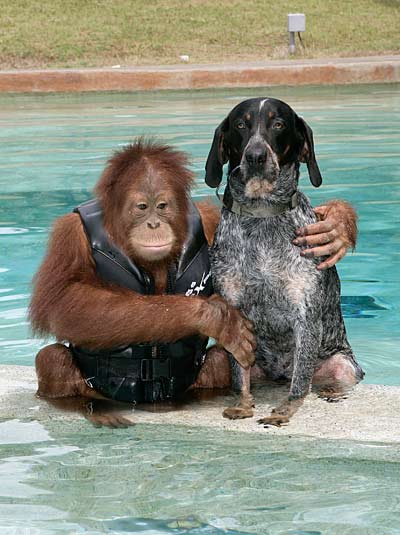
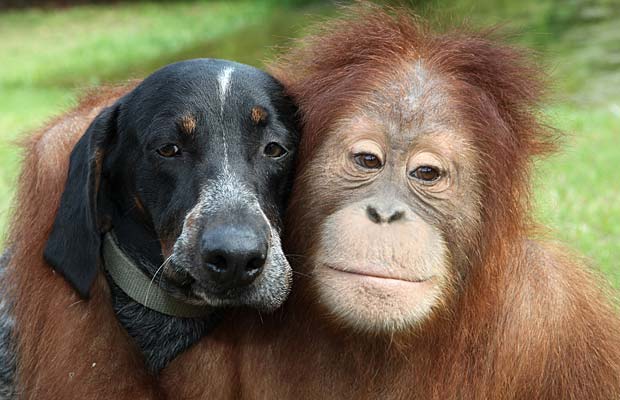
After losing his parents, this three year old orangutan was so depressed he wouldn’t eat and didn’t respond to any medical treatments. The veterinarians thought he would surely die from sadness.
The zoo keepers found an old sick dog on the grounds in the park at the zoo where the orangutan lived and took the dog to the animal treatment center. The dog arrived at the same time the orangutan was there being treated.
The two lost souls met and have been inseparable ever since. The orangutan found a new reason to live and each always tries his best to be a good companion to his new found friend. They are together 24 hours a day in all their activities.
They live in Northern California where swimming is their favorite past-time, although Roscoe (the orangutan) is a little afraid of the water and needs his friend’s help to swim.
Together they have discovered the joy and laughter in life and the value of friendship.
They have found more than a friendly shoulder to lean on.
Long Live Friendship!
I don’t know, but some say life is too short, others say it is too long, but I know that nothing that we do makes sense if we don’t touch the hearts of others. While it lasts!
May you always have love to share, health to spare, and friends who care…..even if they are a little hairy at times.
oooOOOooo
I must say that the generosity of so many of my readers in sending me these beautiful examples of what is really important in this world of ours touches me deeply. Thank you, John. Thank you, one and all.
A most beautiful conclusion to this reflection on animals and love.
Yesterday, I took a personal journey through the subject of love. I closed that post by saying, “So let me close this essay by asking you to come back here and read the guest post tomorrow from author Eleanore MacDonald, where Eleanore writes of the loss of their dog Djuna. You will read the most precious and heart-rending words about love.”
So an enormous thank-you for being granted permission to republish the tribute Eleanore MacDonald wrote upon the loss of their dear dog Djuna. I guarantee you will need a handkerchief or tissue close to hand!
oooOOOooo
one of the seven great dogs
“Until one has loved an animal, a part of one’s soul remains unawakened.” Anatole France
Djuna Cupcake, my heart of hearts, photo by Breelyn MacDonald
A great squall came upon us here on our farmlet a week ago. I saw it first from a distance, in that dawning of the morning when Djuna usually announced the coming day with his gentle, breathy ‘woooof’, his polite plea to join us on the bed. Mysteriously disturbing, it surely was a sign of things to come, but we didn’t know how dangerous it really was until it was upon us.
And when it was suddenly there, a Great Joy was sucked from our world and an overwhelming sadness took its place … a raging stillness, hot and stifling, no breath, no heartbeat.
My springs of Joy are dry … (a sentiment stolen in part from that great old song, Long Time Traveler)
Djuna Cupcake was one of the Seven Great Dogs. If you’ve seen the film ‘Dean Spanley’, you will know what I mean. If you have loved and been loved by a dog of pure heart … one who was a great teacher of presence, of patience, one who was the dispenser of unconditional love and the blessings of an incomparable joy … one who was a great listener, guardian, and the embodiment of Buddha, Coyote, the Goddesses Eleos and Kuan Yin all in one soft coated body … one who was your loving shadow because he or she felt that it was their job to see you safe at all times … you will know what I mean.
He died quite suddenly. Like that squall, his death came with no warning and for days after Paul and I were sucked deep into that great black hole of grief. The dread attacked us at every turn, where we would always see him but now only a glaring emptiness stood. I felt as though my heart and soul had a raw, oozing, gaping, searingly painful wound where he had been torn away from me. Stolen. We cried a lot.
Some people will never understand. I try to feel compassion for them, rather than issuing the big ‘EFF YOU”, but I am only human. What is this BS about a ‘three day’ rule? What? Because he was ‘just a dog’ we should be over it all in 3 days? Djuna was surely a better person than most Humans and I will never stop missing him. I feel so deeply sorry for those people who have overlooked having such grace and beauty bless their lives –– the companionship of a great dog (or cat or horse, or human person) –– so that, when the monumental end comes and they’ve come through the great fires of sorrow, and have been washed by the flush of a million tears, they come through to the other side where they are able to see the remarkable love, joys and lessons they’d been gifted by that companionship. I can only hope now to ‘be’ the person Djuna thought me to be.
3 days and 3 more and 3 million more and even then more just won’t do it.
Paul and I were with Djuna on our bedroom floor when he died. I lay with him next to my heart, whispering love, my arm draped over his neck … and as he was leaving us, I saw him standing just beyond Paul. Alert, ears akimbo, head cocked, eyes bright, a wad of socks in mouth, standing in his particularly great exuberance, as he did each morning when the time for chores presented itself – “Come on! It’s time to go! Get with it you silly humans! There’s work to be done, there’s a barn to clean and a day to sniff, there’s delight to be found!” And then he left.
My ‘joyometer’, my daily dispenser of mirth, and my constant reminder of the importance of presence, has gone missing – his lessons of ‘Be Here Now’ measured in doses of ’Oh, sense the beauty in the music of the wind!’, ‘Let’s just run in circles and laugh’, ‘I love, love, love you!’ … gone. It is wholly up to me now to remember to stay in each moment, to just be a nice person, cry whenever I must, to laugh as much as possible and dance for the sheer joy of it. And when the cacophony of the deafening silence has quieted and the colors of sorrow have muted and gone transparent and I’ve had some time to let the Aegean clean up those bloodied wounds in my heart and soul, there will be room again here for another one of the Seven Great Dogs. And the cycles will continue on.
Almost every evening Djuna and I took an evening stroll down our quiet lane. I loved watching him dance his great joy, nose to the ground scenting all of the news of the day or nose to the sky, sensing what was coming on the breeze. On our walks I watched the seasons change, the rising of the full moon, the greening of the new spring and the evening skies, like snowflakes, no one ever alike … I watched the Canadian geese come and go, the Red Tail hawks courting in the air above me, and let the build up of my day fall away as I tread softly with my gentle friend. It took me several days after Djuna’s death for me to realize that here was yet again another gift he had left for me in his wake, and one I should continue to enjoy. The sky was black to the West, we’d had heavy winds and rain all day, but when there was a break I set off on ‘our’ walk. Wrapped tightly in sadness and hardly breathing with the missing of him, I shuffled along about a 1/2 mile and turned for home before the rains started up and the chill wind began to blow, fierce again, from the south. That wind battered and bashed me until it freed the tears from my eyes, and the freezing rain lashed my face until I grew numb. As though suddenly realizing I was about to drown, I surfaced, taking in great gulps of air as though I’d not been breathing for several days, and began to climb free of the suffocating bonds of my sadness.
Part of our family
My Djuna, my Cupcake … My Heart of Hearts who knew my soul, my every thought; great lover of Paul and I, and of Breelyn; great lover of his mare and his pony, of socks and his furry toys and his GWBush chew doll; great lover of his evening walkies and of riding in the car, and feeding the birds; great lover of sofa naps and sleeping in late with us on the bed and chasing BALL and rolling on the grass and of eating horse poop; bountiful bestower of stealthy kisses; joyful jokester, Greek scholar (he knew about 15 words and understood several phrases spoken to him in Greek; something we did only after he’d begun to understand words and phrases *spelled out* in English! ‘Car’, ‘dinner?’, ‘play with the ball?’, ‘feed the birds’, water, pony, get the goat, etc!); Djuna, beloved Honorary Cat, our timekeeper, our guardian angel, our boss, our playfully dignified friend (thanks for that Marija) and family member, and one of the Seven Great Dogs – we will love and miss you forever.
But now – there’s work to be done, there’s a barn to clean and a new day to sniff, there’s delight to be found!
love – photo by Breelyn MacDonald
Copyright (c) 2012 Eleanore MacDonald
oooOOOooo
When I originally read this, I left a comment, “Achingly beautiful words. One of the most precious pieces of prose about a dog that I can ever remember reading.” Few will disagree!
As I replied in a recent email to Pat Shipman in response to Eleanore’s words above, “That really does endorse the proposition that, in a very real sense, our humanity is the product of our ancient relationship with animals.“
Dear Eleanore, thank you so much for allowing me to republish your beautiful thoughts.
How the relationship that we have with domesticated animals taught us the meaning of love.
This exploration into the most fundamental emotion of all, love, was stimulated by me just finishing Pat Shipman’s book The Animal Connection. Sturdy followers of Learning from Dogs (what a hardy lot you are!) will recall that about 5 weeks ago I wrote a post entitled The Woof at the Door which included an essay from Pat, republished with her permission, that set out how “Dogs may have been man’s best friend for thousands of years longer than we realized“.
The following day, I wrote a further piece introducing the book and then commenced reading it myself. Please go there and read about the praise that the book has received.
What I want to do is to take a personal journey through love. I should add immediately that I have no specialist or professional background with regard to ‘love’ just, like millions of others, a collection of experiences that have tapped me on the shoulder these last 67 years.
I would imagine that there are almost as many ideas about the meaning of love as there are people on this planet. Dictionary.com produces this in answer to the search on the word ‘love’.
love
[luhv] noun, verb, loved, lov·ing. noun
a profoundly tender, passionate affection for another person.
a feeling of warm personal attachment or deep affection, as for a parent, child, or friend.
sexual passion or desire.
a person toward whom love is felt; beloved person;sweetheart.
(used in direct address as a term of endearment, affection,or the like): Would you like to see a movie, love?
But, I don’t know about you, those definitions leave something missing for me. Here’s my take on what love is, and it’s only by having so many dogs in my life that I have found this clarity of thought.
Love is trust, love is pure openness, love is knowing that you offer yourself without any barriers. Think how you dream of giving yourself outwardly in the total surrender of love. Reflect on that surrender that you experience when deeply connecting, nay loving, with your dog.
Here’s how Pat Shipman expressed it in her book:
Clearly, part of the basis of our intimacy with tame or domesticated animals involves physical contact. People who work with animals touch them. It doesn’t matter if you are a horse breeder, a farmer raising pigs, a pet owner, a zoo keeper, or a veterinarian, we touch them, stroke them, hug them. Many of us kiss our animals and many allow them to sleep with us. We touch animals because this is a crucial aspect of the nonverbal communication that we have evolved over millennia. We touch animals because it raises our oxytocin levels – and the animal’s oxytocin levels. We touch animals because we and they enjoy it. (p.274)
Pat soon after writes,
From the first stone tool to the origin of language and the most recent living tools, our involvement with animals has directed our course.
Thus it is not beyond reason to presume that tens of thousands of years of physical and emotional closeness between humans and their animals have developed the emotion of love in us humans, so eloquently expressed in art and life.
There’s another aspect of what we may have learned from dogs. In Alexandra Horowitz’s book Inside of a Dog, she writes of the way that dogs look at us,
Having been folded into the world of humans, dogs no longer needed some of the skills that they would to survive on their own. As we’ll see, what dogs lack in physical skills, they make up for in people skills.
AND THEN OUR EYES MET ….
There is one final, seemingly minor difference between the two species. This one small behavioral variation between wolves and dogs has remarkable consequences. The difference is this: dogs look at our eyes.
Dogs make eye contact and look to us for information – about the location of food, about our emotions, about what is happening. Wolves avoid eye contact. In both species, eye contact can be a threat: to stare is to assert authority. So too is it with humans. In one of my undergraduate psychology classes, I have my students do a simple field experiment wherein they try to make and hold eye contact with everyone they pass on campus. Both they and those on the receiving end of their stares behave remarkably consistently: everyone can’t wait to break eye contact. It’s stressful for the students, a great number of whom suddenly claim to be shy: they report their hearts begin to race and they start sweating when simply holding someone’s gaze for a few seconds. They concoct elaborate stories on the spot to explain why someone looked away, or held their gaze for a half second longer. For the most part, their staring is met with deflected gazes from those they eyeball.
Then a few sentences later, Alexandra continues to write,
Dogs look, too. Though they have inherited some aversion to staring too long at eyes, dogs seem to be predisposed to inspect our faces for information, for reassurance, for guidance. Not only is this pleasing to us – there is a certain satisfaction in gazing deep into a dog’s eyes gazing back at you – it is also perfectly suited to getting along with humans. (pps 45-46)
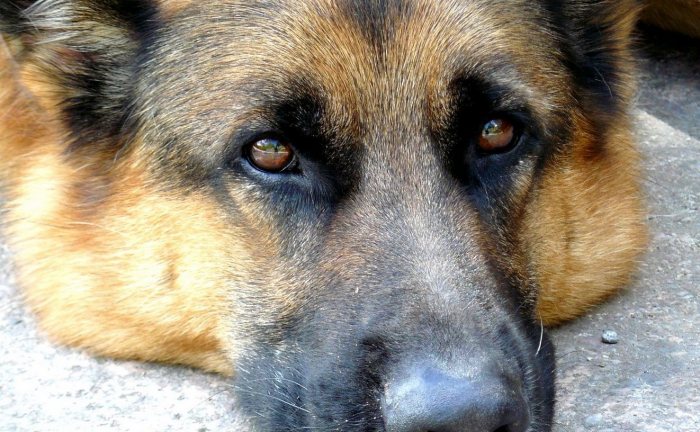
No apologies for now inserting the photograph of Pharaoh that adorns the Welcome page of Learning from Dogs. Underlines what Alexandra wrote above in spades.
Now that is a gaze!
OK, time to start bringing this to a close.
The Toronto Star ran a great review of Pat Shipman’s book from which I will just take this snippet,
“But understanding animals and empathizing with them also triggered other changes in humanity’s evolution, Shipman said.
All those things allow people to live with people. Once people have domesticated animals, they start to live in stable groups. They have fields, crops and more permanent dwellings.”
In other words, we can see that living with animals took us from nomadic hunter-gatherers to living with other people in stable groups; the birth of farming. It is my contention that the evolution of communities and the resulting more stable relationships elevated love leading to love becoming a higher order emotion than just associated with the ‘grunt’ of reproduction.
I started by saying that it was Pat Shipman’s book that stimulated me to wander through my own consciousness and realise that when I bury my face in the side of one of the dogs, say on the bed, it resonates with the most ancient memories in my human consciousness. Indeed, I am of no doubt that my openness and emotional surrender to that dog enables me to be a better, as in more loving, person for Jean.
So let me close this essay by asking you to return here and read the guest post tomorrow from author Eleanore MacDonald, where Eleanore writes of the loss of their dog Djuna. You will read the most precious and heart-rending words about love. Thank you.
Regular followers of Learning from Dogs will know that Dan and I go back a long way; far too long! In fact the occasion of me becoming aware of Mr. Daniel Gomez was at a Commodore Computer users conference in Boston, Mass.
I was giving a talk promoting a word-processing program that I was marketing for the Commodore. That software was called Wordcraft and I think the year was 1979, possibly 1980. Anyway, I used the word ‘fortnight’, which back in England is a common word meaning two weeks. Immediately, a voice called out from the audience, “Hey Handover, what’s a fortnight?”
The session deteriorated rapidly thereafter! Dan and I became very good friends and his LA company Cimarron became my West Coast USA distributor for Wordcraft. And it was Dan’s sister, Suzann, who invited me down to Mexico for Christmas 2007 which led to me meeting my beloved Jeannie! Funny old world!
On to the video
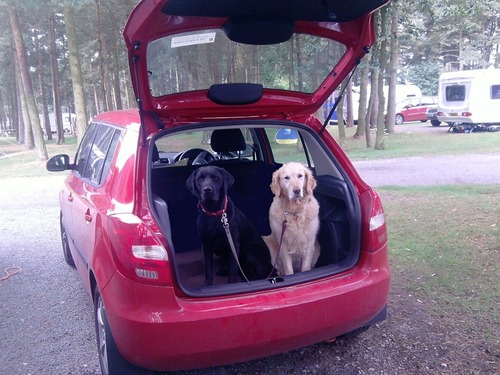
The male golden dog on the left-hand side of pool is Willis, a two-year-old Golden Retriever who has cataracts and is practically blind. Then there is Gwendy who seems to have been with Dan for an absolute lifetime.
Then the black dog is Bella, a flat-coated retriever, that belongs to a neighbour.
When I spoke with Dan over the phone about Willis, Dan said that he is not in any way a disabled dog. In the pool, he listens to where the ball lands, swims towards it and then lets his nose locate it precisely. Out walking, when Dan throws the ball, Willis is just able to see Dan’s arm move through the air. Willis then computes where the ball is heading, runs in that direction and, again, uses his power of smell to pin down the ball exactly.
By one of those lovely patterns in life, John’s last contribution to Learning from Dogs was exactly a year ago, a Post that was called Definitions, questions and prayers.
The U.S. leads the world in cutting CO2 emissions — so why aren’t we talking about it?
On the 31st July, I republished a TomGram from William deBuys that showed some pretty frightening aspects of climate change in the South-West USA. Then there was the video on the 10th August, last Friday, that spelt out in very clear ways how the world is in a new, unfamiliar place. It would be so easy to think it’s all going to hell in a handbasket. So a change of tone.
There was an article on Grist by David Roberts about the US leading the world in cutting CO2 emissions. David kindly gave me permission to republish it on Learning from Dogs.
U.S. leads the world in cutting CO2 emissions — so why aren’t we talking about it?
By David RobertsContrary to popular belief, the U.S. is making progress on climate change.We have cut our carbon emissions more than any other country in the world in recent years — 7.7 percent since 2006. U.S. emissions fell 1.9 percent last year and are projected to fall 1.9 percent again this year, which will put us back at 1996 levels. It will not be easy to achieve the reductions Obama promised in Copenhagen — 17 percent (from 2005 levels) by 2020 — but that goal no longer looks out of reach, even in the absence of comprehensive legislation.
Why isn’t this extraordinary story a bigger deal in U.S. politics? You’d think Obama would be boasting about it! Turns out, though, it’s a little awkward for him, since several of the drivers responsible are things for which he can’t (or might not want to) take credit.
Awkward: that whole recession thing
First off there’s the Great Recession, which flattened electricity demand in 2008. It has never recovered — in fact, in part due to 2011′s mild winter, it has even declined slightly:
Click to embiggen.
For obvious reasons, boasting about the environmental benefits of the recession is not something Obama’s eager to do.
Awkward: frack-o-mania
The second big driver is the glut of cheap natural gas, which is currently trading at the 10-year low of about $3 per million British thermal units. This is absolutely crushing coal, the biggest source of CO2 in the electric sector:
The share of U.S. electricity that comes from coal is forecast to fall below 40% for the year, its lowest level since World War II. Four years ago, it was 50%. By the end of this decade, it is likely to be near 30%.
Here’s U.S. electricity generation from 2000-2012. Look how dramatic coal’s recent plunge is:
Click to embiggen.
In April, coal and natural gas both contributed 32 percent to the U.S. electricity mix — equal for the first time since EIA started collecting data in the ’70s. This is, as Alexis Madrigal emphasizes, an extraordinary shift, unprecedented in the history of the U.S. electrical system.
It’s helpful to Obama to be able to point to cheap natural gas when people accuse his EPA of killing coal. And it’s helpful in his effort to claim “all of the above.” But fracking’s potential environmental and health impacts has quickly made it a flash point with his environmental base (and his Hollywood base), so it’s at the very least a fraught subject.
Awkward: Kenyan socialist EPA sharia tyranny
A less significant driver of the switch from coal to natural gas is the EPA’s long overdue rollout of new or tightened clean-air rules on mercury, SO2 and NOx, and CO2. Those rules may do more work later on down the line when/if natural gas prices rise again, but for now the best analysis [PDF] shows that natural gas is doing most of the work killing coal. Nonetheless, EPA regs have proven a source of potent right-wing attacks on Obama and he’s probably not eager to call undue attention to them.
Thus: silence in the political world
So: given the fact that the decline in emissions is driven, at least in the conventional narrative, by an explosion in fossil fuel production, a recession, and a series of EPA regulations, it’s not hard to see why Obama isn’t eager to put it front and center. It’s got a little something for everyone to hate.
And of course the right isn’t eager to talk about it either, since conservative dogma tells us that there’s no way to grow the economy and shrink CO2 emissions at the same time … and yet, uh, that’s what’s happening. At the end of 2012, our economy will be much larger than it was in 1996, yet its carbon emissions will be the same. If conservatives acknowledge that it’s possible to loosen the link between climate pollution and economic growth, they’ll have to explain why we shouldn’t do a whole lot more of it.
Still, while the story has remained largely sub rosa in political media, there are several overlooked details that paint a happier picture than the conventional one above. There’s more to this story than natural gas and recession.
Happy: Coal’s getting its ass kicked by activists
First, it isn’t just natural gas and EPA taking coal out — it’s the kick-ass anti-coal movement! Fighting tooth-and-nail, plant-by-plant, it has blocked new construction and shut down over 100 existing plants.
The campaign has been so disciplined and successful that it’s drawn the support of NYC Mayor Michael Bloomberg, who does not typically invest his own money in feel-good symbolism. He expects accountability and he’s getting it. Like the man said, “Ending coal power production is the right thing to do.”
Happy: Clean energy is happening
Renewable energy still represents a small portion of U.S. electricity generation, but that fact obscures its outsized impact. The U.S. doesn’t need to add a ton of renewables for things to start shaking loose.
Here’s growth over the last decade:
Click to embiggen.
One thing that jumps out is that renewables are growing much faster in some places than others. South Dakota now gets 22 percent of its electricity from wind, Iowa 19 percent. The top two states in total installed wind are Kansas and Texas. The top two for wind jobs are Iowa and Texas. That’s three red states and a deeply purple one — a wedge separating clean energy from the climate culture wars. That portends accelerating changes in the political economy.
Also driving changes in political economy: 29 states and D.C. now have mandatory renewable energy standards.
And renewables don’t have to get that big to start making waves. The sun shines most when the most electricity is being used — “peak demand” — so it serves to sharply reduce peak prices. Turns out that’s where utilities make a lot of their money. U.S. utilities are being forced to crank off coal plants when peak prices drop and then crank them back on afterwards.
It is no fun to turn coal plants on and off — it’s slow, laborious, and kills their economics. More and more, utility managers are turning toward upgraded, smarter grids and more flexible, responsive “mid-load” plants (i.e. natural gas). By hacking off peak prices, renewables will make the dynamics even worse for coal, well before they reach a large proportion of total electricity.
So renewables are a bigger part of this story than they appear, and getting bigger.
Happy: Demand is leveling off long-term
It’s not just the recession that’s bringing down U.S. energy demand — the leveling off of demand is a long-term trend. The U.S. Energy Information Administration (EIA) projects energy use will grow quite slowly through 2035:
Click to embiggen.
And this is almost certainly conservative: EIA doesn’t model policy changes, underestimates the role of technology, ignores rising fossil fuel prices, and is incapable of predicting cultural shifts.
For instance, few projections anticipated the sharp decline in driving in the U.S., which has been driven (ahem) as much by cultural and demographic factors as by economics.
Or consider the dramatic progress in energy use in buildings, which was also not anticipated by EIA. From Architecture 2030 comes this graph, which compares the EIA Annual Energy Outlook (AEO) projections on U.S. building stock from 2005 with the ones from 2012:
Click to embiggen.
The growth in U.S. building stock is slowing (in part — but only in part! — due to the recession), but growth in building energy consumption is dramatically slowing, thanks to advances in energy efficiency technology. EIA now expects CO2 emissions from the building sector to decline by 2035. That’s a pretty big change from going up by over 50 percent!
And that’s just with straight-line projections. If “best available demand technologies” are deployed, it looks like this:
Click to embiggen.
It’s within our reach to reduce the CO2 emissions of the building sector almost 22 percent! Given that building standards are one of the few areas of bipartisan agreement on energy these days, it’s not crazy to think that we’ll get closer to the latter projections than the former.
And the EIA projections for building energy consumption, Architecture 2030 notes, do not incorporate “sustainable planning applications or passive heating and cooling, natural ventilation, daylighting, or spatial configuration and site design strategies,” all of which are gaining in popularity and sophistication.
In short, there’s reason to think the demand-side story is similar to the supply-side story: official projections are dramatically underestimating potential.
Worry, but be happy
To sum up: yes, the explosive growth of natural gas and the Great Recession played a big part in U.S. climate emissions declining in recent years. And either of them could reverse in years to come. But they are not the whole story. There are real transitions underway — seedlings that can be watered and fertilized.
As Brad Plumer notes, America’s modest progress to date still leaves the world on a pathway to climate catastrophe. But it also shows that projections are not destiny. Things can change, and quickly.
Let me just pick out two sentences from near the end, “But they are not the whole story. There are real transitions underway — seedlings that can be watered and fertilized.”
It serves as a very good reminder that many people are voting with their feet, so to speak, and making a difference.







 By Pallab Ghosh, Science correspondent, BBC News








 Learning from Dogs