Author: Paul Handover

Truth never follows a straight line.

A delusion is something that people believe in despite a total lack of evidence.Richard Dawkins.

Yesterday, I started down the road of determining how one gets to the truth of a complex issue.  I called the post Doggedly seeking the truth.  My proposition was effectively saying that just because a person believes in argument ‘a’ or argument ‘b’ that doesn’t of itself make ‘a’ or ‘b’ the truth.

Unwittingly, Martin Lack of the blog Lack of Environment reinforced that point in spades.  He wrote in a comment to yesterday’s post:

The deliberate spreading of misinformation is a fundamental part of the industry-led movement to deny the reality of anthropogenic climate disruption. Alex Rawls is just part of this campaign and I therefore do wish that you would consult me before deciding to help publicise and/or lend credence to such nonsense.

Now I have every sympathy for Martin’s outpourings of feelings; his blog is based on the conviction of his own beliefs. A position of integrity.

But taken literally, Martin’s words, “consult me before deciding to help publicise” mean that he wishes to influence what I choose to write.  Of course he didn’t mean to convey that.

Back to yesterday’s post.  With Dan’s permission, I reproduced the personal email that he sent me with those two articles.  Dan isn’t on the payroll of the Koch brothers or blindly following an “industry-led movement to deny the reality of anthropogenic climate disruption“, he is a thinking human who is yet to be convinced that AGW is as rational a process as, say, gravity!

Humans are not fundamentally rational; we are emotional beings who even in this 21st century have little real understanding of what a human being is. (Must be honest and say that this last sentence is a tickler for a mind-opening video on the nature of human consciousness coming out on Friday.)

So if Dan is not convinced about the effects that mankind is having on Planet Earth, then spare a moment to ponder about the millions of others around the world who are far less capable, even if they had the time and inclination, to adopt a rational, open-minded view of the complexity of AGW.

It gets even more convoluted.  In Professor McPherson’s video that was presented yesterday, this gets said, “If we act as if it’s too late, then we becomes a self-fulfilling prophesy”.  On the face of it, that’s obvious. But on Guy McPherson’s blog Nature Bats Last the video has it’s own post and includes a comment left by Daniel, from which I quote:

Guy,

There are so many insoluble dilemmas concerning industrial civilization, it’s almost impossible for anyone to attempt to propose a “solution”, or attempt to describe the work that now needs to be done, without becoming a hypocrite.

At this stage, hypocrisy is unavoidable. Beyond the point of overshoot, at least in our culture, all that’s required to be a hypocrite, is to be alive.

I have watched your presentation evolve over the last few months, and with this latest one, something struck me as peculiar. You’ve added this line:

“If we act as if it’s too late, then we becomes a self-fulfilling prophesy”.

Basically, implying that we shouldn’t accept that it’s too late. Yes?

The evidence that now exists, has established an immovable catastrophe, which is now, well outside human agency ( aside from the looming boondoggle of geo-engineering). This is what the evidence shows.  We have effectively already become a self-fulfilling prophesy. The most dire warnings of the last three decades, have now become prophetic. What are eight non-reversible feedbacks if not a physical manifestation of a self-fulfilling prophesy?

To which Guy replies:

Daniel, you’re asking the same questions many others have been asking lately. I’ll try to respond with my next essay, which I’ll complete and post in a couple days.

(I’m pretty sure that next essay is this one: Playing court jester.)

Seems to reinforce the message.  That we really shouldn’t be surprised at the delusions, games and power interplays going on, especially in the corridors of power, so to speak.

Right! Time for me to show my hand!

I am totally convinced that we humans are responsible for the rising levels of CO2 in the atmosphere and that this accounts for the majority of the abnormal weather events being experienced in so many parts of the planet.

I think I’m right.  Therefore I give more weight to the evidence that supports my view that, guess what, reinforces me thinking I’m right.

Is that scientific?  Of course not!  Science is about producing reproducible outcomes. With, say gravity, that’s a piece of cake.

I’m not a scientist, far from it. Therefore the following statement may be unreliable.  That the problem with producing an uncontroversial, hard-wired proof that man is screwing up (you see, I did say that I wasn’t a scientist) our planet is that we don’t have other planets with which to test the thesis.  When it surely is an uncontroversial, hard-wired proof it will be too late!

Having said all that, tomorrow I will present the best evidence that I can find to support the notion that Dan’s beliefs are wrong.

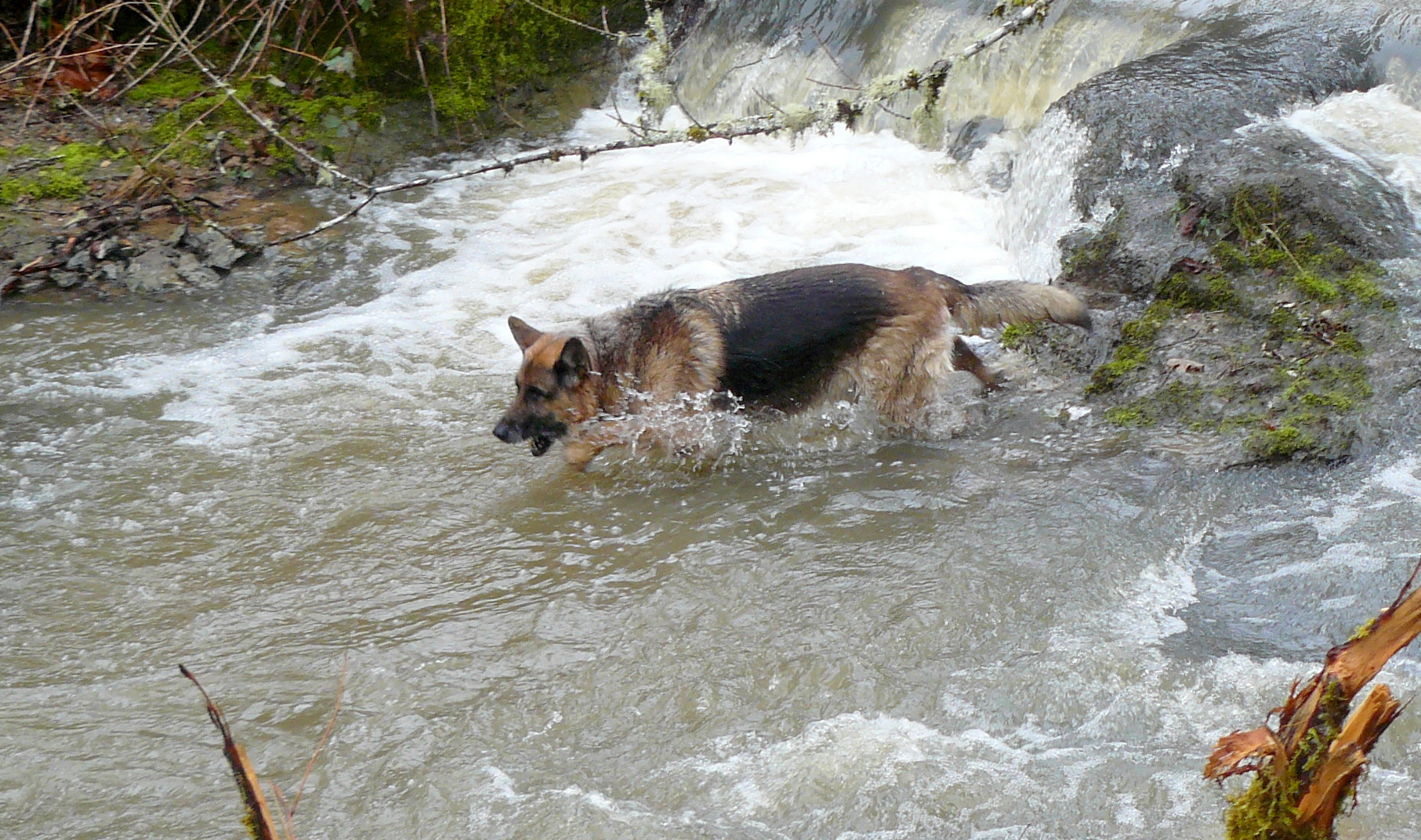
Back to Casey and that scent:

P1110034
Now where’s that scent now? Sweeny, help me!
Hang on, let me finish sniffing your bum! Ask Ruby to help, she’s just by the fence.

We can never be as rational as dogs.  But maybe if we learnt to live more in the present, as dogs do so well, the world would be a much simpler and sustainable place.

Last words from Guy McPherson from Playing Court Jester,

On the road, there’s little possibility to develop a lasting relationship. I throw a Molotov cocktail into the conversation, and then I leave the area.

On the road, I describe how we live at the mud hut. I describe the importance of living for today. [my emphasis]

Doggedly seeking the truth.

As a dog follows a scent.

P1110019
Casey doing what dogs do so well – picking up a scent.

I have been pondering about how one gets to the truth of a complex issue.  And there’s none more complex nor more essential in terms of the truth of an issue than Anthropogenic Global Warming (AGW).

It was kicked off by an email received from Dan Gomez.  Followers of Learning from Dogs will have seen mention of Dan’s name as he regularly sends me bits and pieces.  Indeed, let me refer you to a post that came out last August, Feeling depressed? Join your pals in the pool! and this extract:

Regular followers of Learning from Dogs will know that Dan and I go back a long way; far too long! In fact the occasion of me becoming aware of Mr. Daniel Gomez was at a Commodore Computer dealers conference in Boston, Mass.

I was giving a talk promoting a UK word-processing program that I was marketing for the Commodore. That software was called Wordcraft and I think the year was 1979, possibly 1980. Anyway, I used the word ‘fortnight’, which back in England is a common word meaning two weeks. Immediately, a voice called out from the audience, “Hey Handover, what’s a fortnight?“

The session deteriorated rapidly thereafter! Dan and I became very good friends and his LA company Cimarron became my West Coast USA distributor for Wordcraft. And it was Dan’s sister, Suzann, who invited me down to Mexico for Christmas 2007 which led to me meeting my beloved Jeannie! Funny old world!

Dan is a smart cookie. He holds a degree in psychology, as well as being a very easy guy to get along with.  We have been good friends for more than 30 years.

Anyway, back to the theme of the post; determining the truth of a complex issue.

Recently, Dan sent me an email with the subject heading of The Controversy Continues – A couple of Articles for your Digestive Tract….

The first article was:

Report shows UN admitting solar activity may play significant role in global warming

A leaked report by a United Nations’ group dedicated to climate studies says that heat from the sun may play a larger role than previously thought.

“[Results] do suggest the possibility of a much larger impact of solar variations on the stratosphere than previously thought, and some studies have suggested that this may lead to significant regional impacts on climate,” reads a draft copy of a major, upcoming report from the U.N.’s Intergovernmental Panel on Climate Change (IPCC).

The man who leaked the report, StopGreenSuicide blogger Alec Rawls, told FoxNews.com that the U.N.’s statements on solar activity were his main motivation for leaking the document.

The second article was from the Dick Morris website, from which I offer this extract (if, like me, you hadn’t heard of Mr. Morris before, details are here):

According to Bloomberg News, US carbon emissions are down 13% over the past five years and that they are now the lowest since 1994. In fact, we are more than halfway to President Obama’s goal of a 17% reduction below our peak year of 2007.

….

Coal has fallen to only 18% of our energy use (down from 23% in 2007) and natural gas is up to 31%. Natural gas has half the carbon emissions of coal.

Evidence suggests that climate change and global warming are happening, but at a much slower rate than doomsday warnings suggested. We are now on track for an increase in global temperatures of one degree centigrade by 2100. This increase is not enough to cause major flooding or rises in sea levels.

Please feel free to read the whole Dick Morris piece here.

So on the face of it, two convincing reports, especially the one from Alec Rawls.

Professor McPherson
Professor McPherson

Now let me turn to Professor Guy McPherson; professor emeritus at the University of Arizona.  Just take a peek at the professional recognition granted to Professor McPherson.

Guy McPherson writes a blog called Nature Bats Last.  It is described thus:

This blog focuses on the natural world, with a particular emphasis on the twin sides of our fossil-fuel addiction: (1) global climate change and (2) energy decline. Because these phenomena impact every aspect of life on Earth, specific topics range widely, and include philosophy, evolution, economics, humanity, politics, current events, and many aspects of the human condition.

Less than 3 months ago, Guy McPherson visited Greenfield Community College in western Massachusetts to deliver his presentation “The Twin Sides of the Fossil-Fuel Coin: Developing Durable Living Arrangements in Light of Climate Change and Energy Decline.

It lasts for just 40 minutes and needs to be watched.  Why do I say needs to be watched?  Because tomorrow I delve deeper into the challenges facing ordinary folk and watching the presentation and reflecting on the start of this post are very pertinent to following the scent of truth.

DA14

Not such a bizarre post title as you might think!

asteroid-2012-da14-art

DA14, or to give it’s full name, Asteroid 2012 DA14, is calling by Planet Earth rather soon.  To quote the item on the Planetary Society’s website,

Asteroid 2012 DA14 Discovery Enabled by Planetary Society Grant

On Friday, February 15, 2013, Asteroid 2012 DA14 will travel just 17,000 miles above the Earth – closer to our planet than the orbit of the communications satellite that broadcast the Super Bowl around the world. About half the size of a football field and with more than 100 times the energy impact of the nuclear bomb that fell on Hiroshima, DA14 will miss Earth this time around, but if it had impacted, this asteroid could have taken out any major metropolitan city on our planet.

The discovery of Asteroid DA14 was made by a small team of observers at La Sagra Observatory in Southern Spain, on February 22, 2012, enabled with a grant provided by The Planetary Society. One of the observatory’s telescopes had recently been upgraded with funds donated by The Planetary Society’s NEO Shoemaker Grant program. Its new camera enabled detection of fast moving objects like 2012 DA14 – requiring very fast imaging for discovery and determination of their paths. The upgraded instrument has far outperformed the Observatory’s other telescopes.

Now, we get to point the world’s telescopes at this 2013 close flyby and learn more about this asteroid and its orbit because of the support of our Planetary Society Members all over the world.

This asteroid won’t hit Earth, at least for many, many decades.  But it is a reminder we live in a cosmic shooting gallery.  We need to find, track, and characterize these objects and develop the technical and political capability to deflect an asteroid.  It is not a matter of whether there will be a dangerous impact, it is a matter of when.

The Planetary Society and its members are working to do our part through programs like ourShoemaker NEO Grants, like the one that made the discovery of 2012 DA14 possible, and projects like Laser Bees, exploring new ways to potentially deflect a dangerous asteroid.

NASA have recently released a video, see below, but a search on YouTube will find more, some of which are more engaging than the rather dry style of the NASA release.


Have questions?  Bet you do!  Here are some of the answers to the obvious ones.  Including these:

What is the time of closest approach

Feb. 15, 2013, 19:25 UTC (11:25 PST)

What is the closest approach altitude?

Approximate altitude above the surface of the Earth will be 27,330 km, 17,000 mi (34,100 km, 21,200 mi from center of Earth).  That is closer than the altitude of geosynchronous satellites, e.g., satellite TV satellites, at 35,786 km (22,236 mi) altitude.

Will it be visible with the naked eye, how bright will it be?

It will not be a naked eye object.  At closest approach, its brightness will be about a magnitude of 7.  It will be bright enough that it could be seen with steady binoculars or a small telescope if you are on the side of Earth it will be passing.

What parts of Earth will have a chance to observe it telescopically?

Near closest approach when it is brightest, most of Europe, Asia, and Africa.  It will pass from the southern hemisphere to northern hemisphere.  Though it will be much dimmer, it is observable by larger telescopes for days to weeks before and after closest approach.

Finally, well done those gents that first spotted DA14.

Miguel Hurtado, Jaime Nomen, and Jaume AndreuWinners of a Planetary Society Shoemaker NEO Grant in 2010
Miguel Hurtado, Jaime Nomen, and Jaume Andreu
Winners of a Planetary Society Shoemaker NEO Grant in 2010

Now where did I put my tin helmet?

Have a great Sunday!

If you are not into dogs, especially big dogs, then skip today’s post!

Two ways to view these wonderful pictures of large dogs.

Either watch the video, if you don’t mind the advert at the end, (cool music, by the way.)

Or take a look at the pictures, one by one, with a big thanks to Dan for sending them to me.

Here we go!

Dogs Who Don’t Realize

They are BIG!!!!

Bigdog1

oooo

bigdog2

oooo

bigdog3

oooo

bigdog4

oooo

bigdog6

oooo

bigdog7

oooo

bigdog8

oooo

bigdog9

oooo

bigdog10

oooo

bigdog11

oooo

bigdog12

oooo

bigdog13

oooo

bigdog14

oooo

bigdog15

oooo

bigdog16

oooo

bigdog17

oooo

Finally, assuming you haven’t had sufficient of dogs, here’s a lovely animated GIF sent to me by Chris Sunggs.

noname

Oregon and the wolf

Sharing a beautiful aspect of this new home State of ours.

Let’s face it, Jean and I know as much about Oregon as we know about Timbuktu! A house and property requiring much love and care and 10 dogs, 5 cats and 2 miniature horses does rather cramp one’s style!  Actually, let me be honest.  We just adore the grounds that surround the house.  Almost every single walk around the property with or without a few dogs brings some new discovery.  Thus we are not lusting to get out.

Just by way of example, yesterday we discovered that the dam built across our creek, just upstream of the bridge, was used in days long ago for creating flood irrigation.  That’s the dam in the picture below.  The old plank and steel work are still in the undergrowth alongside the creek; to the right of the picture.

Irrigation dam on Bummer Ck.

OK, to the point of this post.

Shortly after we arrived here in Merlin, Oregon we joined Oregon Wild.  Their Mission Statement says: Oregon Wild works to protect and restore Oregon’s wildlands, wildlife and waters as an enduring legacy for all Oregonians.  Can’t argue with that!

Last December a press release was issued about Bringing Wolves Back Home to Oregon.  Here’s part of that release.

Wolves in Oregon:

Gray wolves (Canis lupus) were once common in Oregon, occupying most of the state. However, a deliberate effort to eradicate the species was successful by the late 1940s.

Trouble for wolves began before Oregon even became a state. In 1843 the first wolf bounty was established and Oregon’s first legislative session was called in part to address the “problem of marauding wolves”. By 1913, people could collect a $5 state bounty and an Oregon State Game Commission bounty of $20. The last recorded wolf bounty was paid out in 1947.

After an absence of over half a century, wolves began to take their first tentative steps towards recovery. Having dispersed from Idaho, the native species is once again trying to make a home in Oregon. One of the first sightings came in 1999 when a lone wolf was captured near the middle fork of the John Day River, put in a crate and quickly returned to Idaho. In 2000, two wolves were found dead – one killed by a car, the other illegally shot.

In 2006, a flurry of sightings led state wildlife biologists to believe that a number of wild wolves were living in Northeast Oregon near the Wallowa Mountains and the Eagle Cap Wilderness. In May of 2007 a wolf was found shot to death near La Grande, OR.

As I explain on this blog, there is a deep connection between dogs and wolves:

Dogs are part of the Canidae, a family including wolves, coyotes and foxes, thought to have evolved 60 million years ago.  There is no hard evidence about when dogs and man came together but dogs were certainly around when man developed speech and set out from Africa, about 50,000 years ago.  See an interesting article by Dr. George Johnson.

Back to Oregon Wild.  Just three weeks ago came this update.

State Announces Wolf Recovery Numbers

With the state’s wolf killing program on hold, conservationists celebrate recent success, express concern for the future.

SALEM, OR Jan 16, 2013

Today the Oregon Department of Fish and Wildlife (ODFW) announced the state’s wolf population has risen to at least 53 animals and as many as five breeding pairs. Though still mostly confined to the Northeastern corner of the state, the news was welcomed by conservationists.

The confirmation of wolf numbers comes on the heels of a number of announcements of new wolf pups, interbreeding between packs, and new science demonstrating the important and irreplaceable role wolves and other native hunters play on the landscape.

The announcement also comes on the heels of the one-year anniversary of another great wolf recovery story. On December 28, 2011, a wolf known as Journey (OR-7) crossed the Oregon border to become the first wolf in California in nearly a century. The story was celebrated around the world.

Read the rest of this good news story here.  But I couldn’t resist showing you this photograph that appeared in that story.

These wolf pups born to the Wenaha Pack in 2012 helped get recovery back on track. But their future remains tenuous (photo courtesy ODFW)

Let me close with these two videos.

Imnaha alpha female wolf, July 2011

Snake River Wolf Pack howling

Published on Aug 1, 2012

On July 25, 2012, an ODFW wolf biologist on a survey for wolf pups took this video of a Snake River wolf pack pup howling. The video was taken in the Summit Ridge area within the Snake River Wildlife Management Unit, in Wallowa County.

In the video, the pup howls three times. A low returning howl is heard and the pup gets up. Then, other members of the wolf pack (not seen in the video) return the pup’s howls.

Wolves are highly social animals and howling is a common behavior that help packs communicate and stay together. Wolf howls can be heard from several miles away.

More information on wolves in Oregon can be found at http://www.dfw.state.or.us/wolves.

What is this thing called love?

The discovery of love.

love

Through the wonderful world of web connections, I came to this topic by first reading Jeremy Nathan Mark’s blog The Sand County. Highly recommended.

Jeremy had written a post under the intriguing title of Blogging as Virtual Love-Making, And the Science Behind It.  Blogging; Love-Making; have I really just read those words!  In fact, Jeremy had reposted an article written by Deborah J. on her blog Living on the Edge of the Wild; another great find out there in this virtual world.  So with Deborah’s kind permission here it is reposted on Learning from Dogs.

oooOOOooo

Blogging as Virtual Love-Making, And the Science Behind It

dj1Often when I leave comments on a blog post that moved me, I write “I love this post” or “I love the way you do [this]” or “I love that quotation.” Lately I’ve been wondering if I’m overusing the word “love”.

Am I really feeling this strong emotional attachment, or am I just being lazy, unwilling to take the time to precisely articulate what strikes me about a particular piece?

After reading a recent article in The Atlantic  on the science behind love, I’m inclined to believe that, more often than not, I use the word “love” because that’s what I’m actually feeling– a “micro-moment of positivity resonance.”   That’s how Barbara Fredrickson defines love in her new book Love 2.0: How Our Supreme Emotion Affects Everything We Feel, Think, Do.

In The Atlantic article “There’s No Such Thing as Everlasting Love (According to Science), author Emily Esfahani Smith writes:

Fredrickson, a leading researcher of positive emotions at the University of North Carolina at Chapel Hill, presents scientific evidence to argue that love is not what we think it is. It is not a long-lasting, continually present emotion that sustains a marriage; it is not the yearning and passion that characterizes young love; and it is not the blood-tie of kinship.

Rather, it is what she calls a “micro-moment of positivity resonance.” She means that love is a connection, characterized by a flood of positive emotions, which you share with another person—any other person—whom you happen to connect with in the course of your day. You can experience these micro-moments with your romantic partner, child, or close friend. But you can also fall in love, however momentarily, with less likely candidates, like a stranger on the street, a colleague at work, or an attendant at a grocery store. Louis Armstrong put it best in “It’s a Wonderful World” when he sang, “I see friends shaking hands, sayin ’how do you do?’ / They’re really sayin’, ‘I love you.”

PenguinsSo when I say I “love” Louis Armstrong’s song, now I know why—because I feel such a strong positive connection to what he’s saying, as well as with how he says it, and the music he says it with, that I experience a triple love-whammy!

What I feel when reading things by fellow bloggers, or see the images they’ve created, is similar—a deeply-felt resonating connection, often on several levels.

Smith writes:

When you experience love, your brain mirrors the person’s you are connecting with in a special way,” and then she goes on to explain how “[t]he mutual understanding and shared emotions” between a story-teller and a listener “generated a micro-moment of love, which ‘is a single act, performed by two brains,’ as Fredrickson writes in her book.

Flower in Vase Pa-ta San-JenThis can happen between a writer and reader as well, or between an artist and viewer. In his book “Tao and Creativity” Chang Chung-yuan describes this connection between poet and reader as a “spiritual rhythm.”  It is the means by which the reader participates in the inner experience of the poet. He writes:

In other words, the reader is carried into the rhythmic flux and is brought to the depth of original indeterminacy from which the poetic pattern emerges.  The reader is directly confronted with the objective reality which the poet originally faced. The subjectivity of the reader and the objective reality of the poem interfuse . . . .

This is very interesting because Fredrickson discovers a similar phenomenon when she compares the brainwaves of a storyteller and listeners. Smith describes this in her article:

What they found was remarkable. In some cases, the brain patterns of the listener mirrored those of the storyteller after a short time gap. The listener needed time to process the story after all. In other cases, the brain activity was almost perfectly synchronized; there was no time lag at all between the speaker and the listener. But in some rare cases, if the listener was particularly tuned in to the story—if he was hanging on to every word of the story and really got it—his brain activity actually anticipated the story-teller’s in some cortical areas.

The mutual understanding and shared emotions, especially in that third category of listener, generated a micro-moment of love, which ‘is a single act, performed by two brains,’ as Fredrickson writes in her book.

Big Sur and Mothers Day picnic 111Fredrickson also discovered that the capacity to experience these daily love connections in our lives can be increased through simple loving-kindness meditations, where, as Smith describes, “you sit in silence for a period of time and cultivate feelings of tenderness, warmth, and compassion for another person by repeating a series of phrases to yourself wishing them love, peace, strength, and general well-being.”

“Fredrickson likes to call love a nutrient,” Smith writes.  “If you are getting enough of the nutrient, then the health benefits of love can dramatically alter your biochemistry in ways that perpetuate more micro-moments of love in your life, and which ultimately contribute to your health, well-being, and longevity.”

public domain beeSo remember, fellow readers, as you go meandering from one blog site to another like busy little bees, making those “micro-moment” connections with people whose work you admire, that you are engaged in a kind of virtual love-making.  You are distributing a pollen-like “nutrient” that nurtures others, as well as yourself.

As Louis says, “what a wonderful world” we live in!

oooOOOooo

Deborah concludes with Louis Armstrong singing ‘What a Wonderful World’.

However, for me the song that really resonates with this fascinating article is Ella Fitzgerald’s rendition of What Is This Thing Called Love.  Take it away Ella.

A big thank you to Jeremy and Deborah.  Finally, to all those that enjoyed (loved?) this post, do go and read The Atlantic article in full; it’s fascinating.

A rest day.

Taking a day off from the serious stuff!

It’s 4.30pm and I have just come in after being out since 8am.  A dry sunny day offered a great opportunity to get stuck into logging up a large number of trees that had been victims of Winter storms before Christmas.  I’m knackered!

So going to take a break from the serious stuff and offer you a few pics, kindly sent to me by Chris Snuggs.

snuggs1


oooo

snuggs2

oooo

snuggs3

oooo

snuggs4

And the last one that seems very appropriate to how yours truly is feeling!

snuggs5

See you tomorrow.

Plus ça change – footnote

Plus ça change, plus c’est la même chose (“the more it changes, the more it’s the same thing”).

The final of three repostings from a year ago.  To recap, I wrote on Monday, “… out of curiosity I wondered what I had published a year ago, in early February 2012.  To my amazement what was published was as fresh and relevant as if it had been published today.

The second post from a year ago was reposted yesterday.  Today the footnote is from the 9th February, 2012.  (It reads in its original form with the links and references unchanged.)

oooOOOooo

So many vested opinions!

Regular readers will know that I published recently, in two parts, a post with the heading of Climate, truth and integrity, the first part being here and the second part here.

To me the arguments supporting the premise that mankind is engaged in the process of destroying our very being are powerful and convincing.  But if there is any serious scientific doubt, then I am reminded of that saying in aviation circles about a risk to the safety of an aircraft, “If there’s any doubt, there’s no doubt!”  Surely, that’s the stance the climate change skeptics should be taking!  Because when the evidence of global warming, pollution, natural resource depletion, species extinctions, and habitat destruction is drawn together and there are no skeptics left, then will the last person left alive please switch the lights off!

Anyway, I’m going to republish, with permission, a recent Post that appeared on Tom Engelhardt‘s powerful blogsite, Tom Dispatch.  It was written by Bill McKibben of 350.org fame.  Here it is,

Tomgram: Bill McKibben, Why the Energy-Industrial Elite Has It In for the Planet

Posted by Bill McKibben at 9:39am, February 7, 2012.

Introduction

Two Saturdays ago, I was walking with a friend in a park here in New York City.  It was late January, but I was dressed in a light sweater and a thin fall jacket, which I had just taken off and tied around my waist.  We were passing a strip of bare ground when suddenly we both did a double-take.  He looked at me and said, “Crocuses!”  Dumbfounded, I replied, “Yes, I see them.”  And there they were, a few clumps of telltale green shoots poking up from the all-brown ground as if it were spring.  Such a common, comforting sight, but it sent a chill through me that noticeably wasn’t in the air.  Even the flowers, I thought, are confused by our new version of weather.

Later that same week, as temperatures in the Big Apple crested 60 degrees, I was chatting on the phone with a friend in Northampton, Massachusetts.  I was telling him about the crocuses, when he suddenly said, “I’m looking out my window right now and for the first time in my memory of January, there’s not a trace of snow!”

Of course, our tales couldn’t be more minor or anecdotal, even if the temperatures that week did feel like we were on another planet.  Here’s the thing, though: after a while, even anecdotes add up — maybe we should start calling them “extreme anecdotes” — and right now there are so many of them being recounted across the planet.  How could there not be in a winter, now sometimes referred to as “Junuary,” in which, in the United States, 2,890 daily high temperature records have either been broken or tied at last count, with the numbers still rising?  Meanwhile, just to the south of us, in Mexico, extreme anecdotes abound, since parts of the country are experiencing “the worst drought on record.”  Even cacti are reportedly wilting and some towns are running out of water (as they are across the border in drought-stricken Texas).  And worst of all, the Mexican drought is expected to intensify in the months to come.

And who can doubt that in Europe, experiencing an extreme cold spell the likes of which hasn’t been seen in decades — even Rome had a rare snowfall and Venice’s canals were reported to be freezing over — there are another set of all-too-extreme anecdotes.  After all, in places like Ukraine, scores of the homeless are freezing to death, pipes are bursting, power cuts are growing, and maybe even an instant energy crisis is underway (at a moment when the European Union is getting ready to cut itself off from Iranian oil).

That’s just to begin a list.  And yet here’s the strange thing.  At least in this country, you can read the “freaky” weather reports or listen to the breathless TV accounts of unexpected tornadoes striking the South in January and rarely catch a mention of the phrase “climate change.”  Given the circumstances, the relative silence on the subject is little short of eerie, even if worries about climate change lurk just below the surface.  Which is why it’s good to have TomDispatch regular Bill McKibben, author of Eaarth: Making a Life on a Tough New Planet, take a clear-eyed look at American denialism and just what it is we prefer not to take in. Tom

The Great Carbon Bubble
Why the Fossil Fuel Industry Fights So Hard

By Bill McKibben

If we could see the world with a particularly illuminating set of spectacles, one of its most prominent features at the moment would be a giant carbon bubble, whose bursting someday will make the housing bubble of 2007 look like a lark. As yet — as we shall see — it’s unfortunately largely invisible to us.

In compensation, though, we have some truly beautiful images made possible by new technology.  Last month, for instance, NASA updated the most iconic photograph in our civilization’s gallery: “Blue Marble,” originally taken from Apollo 17 in 1972. The spectacular new high-def image [see below, Ed] shows a picture of the Americas on January 4th, a good day for snapping photos because there weren’t many clouds.

It was also a good day because of the striking way it could demonstrate to us just how much the planet has changed in 40 years. As Jeff Masters, the web’s most widely read meteorologist, explains, “The U.S. and Canada are virtually snow-free and cloud-free, which is extremely rare for a January day. The lack of snow in the mountains of the Western U.S. is particularly unusual. I doubt one could find a January day this cloud-free with so little snow on the ground throughout the entire satellite record, going back to the early 1960s.”

In fact, it’s likely that the week that photo was taken will prove “the driest first week in recorded U.S. history.” Indeed, it followed on 2011, which showed the greatest weather extremes in our history — 56% of the country was either in drought or flood, which was no surprise since “climate change science predicts wet areas will tend to get wetter and dry areas will tend to get drier.” Indeed, the nation suffered 14 weather disasters each causing $1 billion or more in damage last year. (The old record was nine.) Masters again: “Watching the weather over the past two years has been like watching a famous baseball hitter on steroids.”

In the face of such data — statistics that you can duplicate for almost every region of the planet — you’d think we’d already be in an all-out effort to do something about climate change. Instead, we’re witnessing an all-out effort to… deny there’s a problem.

Our GOP presidential candidates are working hard to make sure no one thinks they’d appease chemistry and physics. At the last Republican debate in Florida, Rick Santorum insisted that he should be the nominee because he’d caught on earlier than Newt or Mitt to the global warming “hoax.”

Most of the media pays remarkably little attention to what’s happening. Coverage of global warming has dipped 40% over the last two years. When, say, there’s a rare outbreak of January tornadoes, TV anchors politely discuss “extreme weather,” but climate change is the disaster that dare not speak its name.

And when they do break their silence, some of our elite organs are happy to indulge in outright denial. Last month, for instance, the Wall Street Journal published an op-ed by “16 scientists and engineers” headlined “No Need to Panic About Global Warming.” The article was easily debunked. It was nothing but a mash-up of long-since-disproved arguments by people who turned out mostly not to be climate scientists at all, quoting other scientists who immediately said their actual work showed just the opposite.

It’s no secret where this denialism comes from: the fossil fuel industry pays for it. (Of the 16 authors of the Journal article, for instance, five had had ties to Exxon.)Writers from Ross Gelbspan to Naomi Oreskes have made this case with such overwhelming power that no one even really tries denying it any more. The open question is why the industry persists in denial in the face of an endless body of fact showing climate change is the greatest danger we’ve ever faced.

Why doesn’t it fold the way the tobacco industry eventually did? Why doesn’t it invest its riches in things like solar panels and so profit handsomely from the next generation of energy? As it happens, the answer is more interesting than you might think.

Part of it’s simple enough: the giant energy companies are making so much money right now that they can’t stop gorging themselves. ExxonMobil, year after year, pulls in more money than any company in history. Chevron’s not far behind. Everyone in the business is swimming in money.

Still, they could theoretically invest all that cash in new clean technology or research and development for the same. As it happens, though, they’ve got a deeper problem, one that’s become clear only in the last few years. Put briefly: their value is largely based on fossil-fuel reserves that won’t be burned if we ever take global warming seriously.

When I talked about a carbon bubble at the beginning of this essay, this is what I meant. Here are some of the relevant numbers, courtesy of the Capital Institute: we’re already seeing widespread climate disruption, but if we want to avoid utter, civilization-shaking disaster, many scientists have pointed to a two-degree rise in global temperatures as the most we could possibly deal with.

If we spew 565 gigatons more carbon into the atmosphere, we’ll quite possibly go right past that reddest of red lines. But the oil companies, private and state-owned, have current reserves on the books equivalent to 2,795 gigatons — five times more than we can ever safely burn. It has to stay in the ground.

Put another way, in ecological terms it would be extremely prudent to write off $20 trillion worth of those reserves. In economic terms, of course, it would be a disaster, first and foremost for shareholders and executives of companies like ExxonMobil (and people in places like Venezuela).

If you run an oil company, this sort of write-off is the disastrous future staring you in the face as soon as climate change is taken as seriously as it should be, and that’s far scarier than drought and flood. It’s why you’ll do anything — including fund an endless campaigns of lies — to avoid coming to terms with its reality. So instead, we simply charge ahead.  To take just one example, last month the boss of the U.S. Chamber of Commerce, Thomas Donohue, called for burning all the country’s newly discovered coal, gas, and oil — believed to be 1,800 gigatons worth of carbon from our nation alone.

What he and the rest of the energy-industrial elite are denying, in other words, is that the business models at the center of our economy are in the deepest possible conflict with physics and chemistry. The carbon bubble that looms over our world needs to be deflated soon. As with our fiscal crisis, failure to do so will cause enormous pain — pain, in fact, almost beyond imagining. After all, if you think banks are too big to fail, consider the climate as a whole and imagine the nature of the bailout that would face us when that bubble finally bursts.

Unfortunately, it won’t burst by itself — not in time, anyway. The fossil-fuel companies, with their heavily funded denialism and their record campaign contributions, have been able to keep at bay even the tamest efforts at reining in carbon emissions. With each passing day, they’re leveraging us deeper into an unpayable carbon debt — and with each passing day, they’re raking in unimaginable returns. ExxonMobil last week reported its 2011 profits at $41 billion, the second highest of all time. Do you wonder who owns the record? That would be ExxonMobil in 2008 at $45 billion.

Telling the truth about climate change would require pulling away the biggest punchbowl in history, right when the party is in full swing. That’s why the fight is so pitched. That’s why those of us battling for the future need to raise our game. And it’s why that view from the satellites, however beautiful from a distance, is likely to become ever harder to recognize as our home planet.

Bill McKibben is Schumann Distinguished Scholar at Middlebury College, founder of the global climate campaign 350.org, a TomDispatch regular, and the author, most recently, of Eaarth: Making a Life on a Tough New Planet.

Follow TomDispatch on Twitter @TomDispatch and join us on Facebook.

Copyright 2012 Bill McKibben

This photo was taken on January 4, 2012.

Most Amazing High Definition Image of Earth – Blue Marble 2012

January 25, 2012

*Updated February 2, 2012: According to Flickr, “The western hemisphere Blue Marble 2012 image has rocketed up to over 3.1 million views making it one of the all time most viewed images on the site after only one week.”

A ‘Blue Marble’ image of the Earth taken from the VIIRS instrument aboard NASA’s most recently launched Earth-observing satellite – Suomi NPP. This composite image uses a number of swaths of the Earth’s surface taken on January 4, 2012. The NPP satellite was renamed ‘Suomi NPP’ on January 24, 2012 to honor the late Verner E. Suomi of the University of Wisconsin.

Suomi NPP is NASA’s next Earth-observing research satellite. It is the first of a new generation of satellites that will observe many facets of our changing Earth.

Suomi NPP is carrying five instruments on board. The biggest and most important instrument is The Visible/Infrared Imager Radiometer Suite or VIIRS.

To read more about NASA’s Suomi NPP go to: www.nasa.gov/npp

Credit: NASA/NOAA/GSFC/Suomi NPP/VIIRS/Norman Kuring

Plus ça change – sequel

Plus ça change, plus c’est la même chose (“the more it changes, the more it’s the same thing”).

As I wrote yesterday, “… out of curiosity I wondered what I had published a year ago, in early February 2012.  To my amazement what was published was as fresh and relevant as if it had been published today.

So here’s the second part of that trilogy of posts from February, 2012.  (It reads in its original form with the links and references unchanged.)

oooOOOooo

Climate, truth and integrity, part two

Continuing from Part One last Friday.

Last Friday I started re-publishing the wonderful comments that had appeared on Climate Sight in response to a question that I had raised, namely,

While in every way that I can think of, I support the premise of mankind affecting global climate, I would love to hear from someone who could reconcile the Post above with these recent items:” and then included the links to the WSJ and Daily Mail items.

If you are not familiar with those WSJ and Daily Mail items, then you will need to go back to Friday’s Post.

So moving on.

The third response was from chrisd3, here’s what he wrote,

Paul, here is the Met Office’s response, which begins, “[The Daily Mail] article includes numerous errors in the reporting of published peer reviewed science undertaken by the Met Office Hadley Centre and for Mr. Rose to suggest that the latest global temperatures available show no warming in the last 15 years is entirely misleading.”

Here is Deltoid taking David Rose apart on some earlier pieces:

And NASA never said anything about the Thames freezing over. Rose just made that bit up.

Finally, here is a chart of global temps from HadCRU:

From this, it is pretty clear why Rose chooses 15 years as his starting point: 1997-1998 was the time of the largest El Nino ever recorded, resulting in a huge temperature spike. Using that as the starting point for a temperature comparison is absolutely classic cherry-picking.

And in any event, you can’t say anything about trends in noisy data by simply comparing two arbitrary points. That is not a valid way to analyze the data (especially if you pick an obvious outlier as your starting point!). It is like trying to say whether the tide is coming in or going out by looking at the height of two waves. It just doesn’t work that way. You have to look at the long-term trend to remove the noise.

Let me take you to that Met Office response (and I’m republishing it in full).

Met Office in the Media: 29 January 2012

Today the Mail on Sunday published a story written by David Rose entitled “Forget global warming – it’s Cycle 25 we need to worry about”.

This article includes numerous errors in the reporting of published peer reviewed science undertaken by the Met Office Hadley Centre and for Mr. Rose to suggest that the latest global temperatures available show no warming in the last 15 years is entirely misleading.

Despite the Met Office having spoken to David Rose ahead of the publication of the story, he has chosen to not fully include the answers we gave him to questions around decadal projections produced by the Met Office or his belief that we have seen no warming since 1997.

For clarity I have included our full response to David Rose below:A spokesman for the Met Office said: “The ten year projection remains groundbreaking science. The complete period for the original projection is not over yet and these projections are regularly updated to take account of the most recent data.

“The projections are probabilistic in nature, and no individual forecast should be taken in isolation. Instead, several decades of data will be needed to assess the robustness of the projections.

“However, what is absolutely clear is that we have continued to see a trend of warming, with the decade of 2000-2009 being clearly the warmest in the instrumental record going back to 1850. Depending on which temperature records you use, 2010 was the warmest year on record  for NOAA NCDC and NASA GISS, and the second warmest on record in HadCRUT3.”

Global average temperatures from 1850 to 2011 from the three individual global temperature datasets (Met Office/UEA HadCRUT3, NASA GISS and NOAA NCDC)

Furthermore despite criticism of a paper published by the Met Office he chose not to ask us to respond to his misconceptions. The study in question, supported by many others, provides an insight into the sensitivity of our climate to changes in the output of the sun.

It confirmed that although solar output is likely to reduce over the next 90 years this will not substantially delay expected increases in global temperatures caused by greenhouse gases. The study found that the expected decrease in solar activity would only most likely cause a reduction in global temperatures of 0.08 °C. This compares to an expected warming of about 2.5 °C over the same period due to greenhouse gases (according to the IPCC’s B2 scenario for greenhouse gas emissions that does not involve efforts to mitigate emissions).  In addition the study also showed that if solar output reduced below that seen in the Maunder Minimum – a period between 1645 and 1715 when solar activity was at its lowest observed level – the global temperature reduction would be 0.13C.

Back to that response from chrisd3.  He offered this, “Finally, here is a chart of global temps from HadCRU.”  Here is that chart, remember we are looking at Global temperatures.

Global temperature trend

OK, between this Post and my Post last Friday, you probably get the message!  There were many other contributions and I could go on and on quoting the great responses I got, all of them uniformly saying there IS global warming unprecedented in recent years.  The message is crystal clear and those who wish to deny the evidence … well, I can’t come up with a polite term, so will just leave it at that!

My final contribution is from Martin Lack, author of the Blog Lack of Environment, and a good friend of Learning from Dogs.  Here is what he wrote in a recent email,

You may have seen my latest response to How much is most?

When I eventually saw your earlier comment, I was surprised and disappointed in equal measure because I almost feel that I have failed in some way. Let me explain:  Unlike ClimateSight and SkepticalScience, which both do an excellent job of focusing on the science of climate change, my blog is deliberately focused on the politics underlying the denial of all environmental our problems; including 2 key aspects to my MA dissertation, namely the political misuse of scepticism; and the psychology of denial.  See my How to be a Climate Change ‘Sceptic’  for more detail.

Therefore, although not specifically categorised as such, just about everything I have posted is traceable back to Paul and Anne Ehrlich’sBetrayal of Science and Reason (1996) and/or Naomi Oreskes and Erik Conway’s Merchants of Doubt (2010).  For someone who does not currently go to any Church, I am remarkably fond of quoting Scripture so, if necessary, please forgive me but, as the Good Book says:  “What has been will be again, what has been done will be done again; there is nothing new under the sun” (Ecclesiastes 1:9).

Therefore, I do not think you should be surprised by the amount of misinformation and misrepresentation contained in the original WSJ Sixteen’s article; and/or the fact that denialist arguments are repeated no matter how many times they have been shown to be false.  Furthermore, I would warn against trying to summarise it all on Learning from Dogs.  This is definitely Book territory and, in addition to the two mentioned above, the market is already saturated by the likes of Climate Change Cover-up by James Hoggan and Climate Change Denial by Haydn Washington and John Cook.

With very best wishes for a fog-free future,

What to say to close these two Posts off?  Frankly, it’s difficult to know how to pitch it.  The science seems clear beyond reasonable doubt.  But if you are reading this and disagree, then PLEASE offer the science to refute the conclusions presented here.  I promise you that I will present it on Learning from Dogs.

So let me end with a simple photograph.

Earthrise

This is the photograph that wilderness photographer Galen Rowell called, “the most influential environmental photograph ever taken.”

The now world-famous photograph was taken by Astronaut William Anders from Apollo 8, the first manned mission to the Moon, a little over 43 years ago on December 24th, 1968.

As the Earth rose above the horizon of the moon, NASA astronaut Frank Borman uttered the words, “Oh my God! Look at that picture over there! Here’s the Earth coming up. Wow, is that pretty.”  Bill Anders then took the ‘unscheduled’ photograph.

Now project forward 43 years to the year 2055 and play with the idea of what ‘pretty‘ planet Earth will be like for mankind and so many other species, including our longest companion, the dog, if we don’t get our act together pretty soon!

Plus ça change

Plus ça change, plus c’est la même chose (“the more it changes, the more it’s the same thing”).

I’m at my PC thinking about tomorrow’s post.  It’s past 4pm and my creative juices are elsewhere!  So out of curiosity I wondered what I had published a year ago, in early February 2012.  To my amazement what was published was as fresh and relevant as if it had been published today.  So that’s what I am doing.  Republishing it along with the sequels on Tuesday and Wednesday.

oooOOOooo

Climate, truth and integrity, part one.

It ought to be straightforward, but the reality is different!

Those of you, dear readers, that have been following these ramblings and musings over the last 30 months, now amounting to more than 1,200 Posts [now 1,582, Ed.] , will hopefully have sensed that Learning from Dogs is much more than a blogsite about dogs!  It is, as I say here, about truth, integrity, honesty and trust using dogs as a powerful metaphor for these essential qualities of a civilised society.

But perhaps there is no topic more challenging for people to determine the truth than the topic of man’s impact on the earth’s climate.  I’m sure that millions intuitively sense that we are over-consuming ourselves to oblivion.  That is where I come from.  I am not a scientist, just a humble writer, and rely on quality sources of information and instinct to form my conclusions in this area.  I am also deeply suspicious of the largely out-of-sight relationships between large corporations, big money and politics!

I have no doubt that there are other millions of people who do believe that mankind is changing our planet’s climate.

So when I saw this article in the Wall Street Journal, I was dumbstruck.  Here’s the headline and opening paragraph,

No Need to Panic About Global Warming

There’s no compelling scientific argument for drastic action to ‘decarbonize’ the world’s economy.

Editor’s Note: The following has been signed by the 16 scientists listed at the end of the article:

A candidate for public office in any contemporary democracy may have to consider what, if anything, to do about “global warming.” Candidates should understand that the oft-repeated claim that nearly all scientists demand that something dramatic be done to stop global warming is not true. In fact, a large and growing number of distinguished scientists and engineers do not agree that drastic actions on global warming are needed.

The long article closes with this paragraph just ahead of the ‘signatures’ of the scientists.

Every candidate should support rational measures to protect and improve our environment, but it makes no sense at all to back expensive programs that divert resources from real needs and are based on alarming but untenable claims of “incontrovertible” evidence.

Then in short order, up came this from the Daily Mail online,

The supposed ‘consensus’ on man-made global warming is facing an inconvenient challenge after the release of new temperature data showing the planet has not warmed for the past 15 years.

The figures suggest that we could even be heading for a mini ice age to rival the 70-year temperature drop that saw frost fairs held on the Thames in the 17th Century.

Based on readings from more than 30,000 measuring stations, the data was issued last week without fanfare by the Met Office and the University of East Anglia Climatic Research Unit. It confirms that the rising trend in world temperatures ended in 1997.

I subscribe both to Climate Sight and Lack of Environment, although wish I spent more time thoroughly reading these fabulous sources of information.  However, I did spot an article on Climate Sight that came out on the 31st January with the heading of How much is most?  It opened thus,

A growing body of research is showing that humans are likely causing more than 100% of global warming: without our influences on the climate, the planet would actually be cooling slightly.

In 2007, the Intergovernmental Panel on Climate Change published its fourth assessment report, internationally regarded as the most credible summary of climate science to date. It concluded that “most of the observed increase in global average temperatures since the mid-20th century is very likely due to the observed increase in anthropogenic greenhouse gas concentrations”.

A clear question remains: How much is “most”? 51%? 75%? 99%? At the time that the IPCC report was written, the answer was unclear. However, a new frontier of climate research has emerged since, and scientists are working hard to quantify the answer to this question.

The timing was impeccable, so far as I was concerned.  I posted a comment, “While in every way that I can think of, I support the premise of mankind affecting global climate, I would love to hear from someone who could reconcile the Post above with these recent items:” and then included the links to the WSJ and Daily Mail items.

Little did I realise what a response I would get.  Just wonderful!  I will offer some of them to you in this piece, but please do read all the comments offered on that Climate Sight post.

First up was Dana Nuccitelli.  Dana is an environmental scientist at a private environmental consulting firm in the Sacramento, California area. He has a Bachelor’s Degree in astrophysics from the University of California at Berkeley, and a Master’s Degree in physics from the University of California at Davis.  (Taken from here.)  This is what he wrote,

How to reconcile the two? The folks who wrote those two articles you linked are misinformed and/or misinformers. I covered the first here  (and) SkS will shortly have a post on the second as well, but I covered the solar cycle issue recently here.

Dana’s article in Skeptical Science, that first link, included this:

Nearly half of the list (at least 7 of 16) have received fossil fuel industry funding, and the list also includes an economist, a physician, a chemist, an aerospace engineer, and an astronaut/politician.  These are apparently the best and brightest the climate denialists can come up with these days?

  • Claude Allegre, former director of the Institute for the Study of the Earth, University of Paris
  • J. Scott Armstrong, cofounder of the Journal of Forecasting and the International Journal of Forecasting;
  • Jan Breslow, head of the Laboratory of Biochemical Genetics and Metabolism, Rockefeller University;
  • Roger Cohen, fellow, American Physical Society;
  • Edward David, member, National Academy of Engineering and National Academy of Sciences;
  • William Happer, professor of physics, Princeton; 
  • Michael Kelly, professor of technology, University of Cambridge, U.K.;
  • William Kininmonth, former head of climate research at the Australian Bureau of Meteorology;
  • Richard Lindzen, professor of atmospheric sciences, MIT;
  • James McGrath, professor of chemistry, Virginia Technical University;
  • Rodney Nichols, former president and CEO of the New York Academy of Sciences;
  • Burt Rutan, aerospace engineer, designer of Voyager and SpaceShipOne;
  • Harrison H. Schmitt, Apollo 17 astronaut and former U.S. senator;
  • Nir Shaviv, professor of astrophysics, Hebrew University, Jerusalem;
  • Henk Tennekes, former director, Royal Dutch Meteorological Service;
  • Antonio Zichichi, president of the World Federation of Scientists, Geneva.

RED – No climate science publications, member of at least one climate denialist group – GWPF (advisory board), George C. Marshall Institute (board of directors or roundtable speakers), Australian Climate Science Coalition (advisory panel), Heartland Institute (board of directors), and/or ExxonMobil

BLUE – Published climate science research

Orange – both a member of a climate denialist group and has published climate science research

Black – no climate science publications or climate denialist group membership

Next was Gail Zawacki who writes a compelling Blog Dead Trees and Dying Forests.  She commented thus,

Paul, try climate progress, first link here and second link here.  I suggest you read those refutations very carefully.

The first link went to this,

Panic Attack: Murdoch’s Wall Street Journal Finds 16 Scientists to Push Pollutocrat Agenda With Long-Debunked Climate Lies

By Joe Romm on Jan 29, 2012 at 12:33 pm

A lot of folks have asked me to debunk the recent anti-truthful Wall Street Journal article with the counterfactual headline, “No Need to Panic About Global Warming.”  I’ll combine my debunking with the rapidly growing list of debunkings from scientists and others.  And I’ll update this as new debunkings come in.

That the WSJ would publish an amateurish collection of falsehoods and half truths is no surprise.   The entire global Murdoch enterprise is designed to advance the pollutocrat do-nothing agenda (see Scientist: “The Murdoch Media Empire Has Cost Humanity Perhaps One or Two Decades in Battle Against Climate Change”).  As National Academy of Sciences member Peter Gleick explains in his evisceration of the piece, “Remarkable Editorial Bias on Climate Science at the Wall Street Journal“:

But the most amazing and telling evidence of the bias of the Wall Street Journalin this field is the fact that 255 members of the United States National Academy of Sciences wrote a comparable (but scientifically accurate) essay on the realities of climate change and on the need for improved and serious public debate around the issue, offered it to the Wall Street Journal, and were turned down. The National Academy of Sciences is the nation’s pre-eminent independent scientific organizations. Its members are among the most respected in the world in their fields. Yet the Journal wouldn’t publish this letter, from more than 15 times as many top scientists. Instead they chose to publish an error-filled and misleading piece on climate because some so-called experts aligned with their bias signed it. This may be good politics for them, but it is bad science and it is bad for the nation.

Science magazine – perhaps the nation’s most important journal on scientific issues – published the letter from the NAS members after the Journal turned it down.

A tad more surprising is that 16 admittedly non-leading scientists would choose to soil their reputations by stringing together a collection of long-debunked falsehoods.  What is surprising is that these falsehoods are more easily debunked than the typical disinformer clap-trap because they are so out-of-date!

This is a long, detailed and powerful response to that WSJ article.  Do try and read it in full.

Gail’s second link went to this,

Human emissions of heat-trapping greenhouse gases have risen so rapidly that they now overwhelm any plausible decrease in solar activity.  Indeed, a paper from last June found that even if the Sun goes into “Hibernation” it won’t stop catastrophic global warming.

But that doesn’t stop serial disinformer David Rose of the UK’s Daily Mail from misleading the public — even after being slammed by top scientists in 2010 for falsely asserting “no global warming since 1995″ — see “Error-riddled articles and false statements destroy Daily Mail’s credibility.“  Rose has another willfully misleading piece, “Forget global warming – it’s Cycle 25 we need to worry about (and if NASA scientists are right the Thames will be freezing over again): Met Office releases new figures which show no warming in 15 years.”

OK, I think this is going to end up too long for one Post.

So let’s pause there and I will continue on Monday. [Tomorrow, Ed.]

Would love your comments, of course!