Author: Paul Handover

Just about water.

Having no drinking water puts every other aspect of living in the shade!

Yesterday afternoon, around 4pm, local thunderstorm activity produced some rain.  Not much but sufficient to wet the ground.  It brought to an end several weeks of intense drought complicated by what is now more than 55,000 acres of fires burning in southwest Oregon: more details here.

Oregon Wildfires
A Redmond Hotshots crew on the Douglas Complex conducts a burnout operation to create a barrier to the wildfire’s advance by removing fuel in its path.

Anyway, this is not about fire, irrespective of how potentially dangerous it can be in this part of the world, it is about water. So with that in mind, here’s a recent ‘Tomgram‘ from William deBuys, with introduction by Tom Engelhardt; republished with Tom’s generous permission.

oooOOOooo

Tomgram: William deBuys, Goodbye to All That (Water)

Martha and the Vandellas would have loved it.  Metaphorically speaking, the New York Times practically swooned over it.  (“An unforgiving heat wave held much of the West in a sweltering embrace over the weekend, tying or breaking temperature records in several cities, grounding flights, sparking forest fires, and contributing to deaths.”) It was a “deadly” heat wave, a “record” one that, in headlines everywhere, left the West and later the rest of the country “sweltering,” and that was, again in multiple headlines, “scary.”  The fire season that accompanied the “blasting,” “blazing” heat had its own set of “record” headlines — and all of this was increasingly seen, in another set of headlines, as the “new normal” in the West. Given that 2012 had already set a heat record for the continental U.S., that the 10 hottest years on record in this country have all occurred since 1997, and that the East had its own sweltering version of heat that wouldn’t leave town, this should have been beyond arresting.

In response, the nightly primetime news came up with its own convenient set of new terms to describe all this: “extreme” or “severe” heat.  Like “extreme” or “severe” weather, these captured the eyeball-gluing sensationalism of our weather moment without having to mention climate change or global warming.  Weather, after all, shouldn’t be “politicized.”  But if you’re out in the middle of the parching West like TomDispatch regular William deBuys, who recently headed down the Colorado River, certain grim realities about the planet we’re planning to hand over to our children and grandchildren can’t help but come to mind — along with a feeling, increasingly shared by those in the sweltering cities, that our particular way of life is in the long run unsustainable. Tom

Never Again Enough

Field Notes from a Drying West 

By William deBuys

Several miles from Phantom Ranch, Grand Canyon, Arizona, April 2013 — Down here, at the bottom of the continent’s most spectacular canyon, the Colorado River growls past our sandy beach in a wet monotone. Our group of 24 is one week into a 225-mile, 18-day voyage on inflatable rafts from Lees Ferry to Diamond Creek. We settle in for the night. Above us, the canyon walls part like a pair of maloccluded jaws, and moonlight streams between them, bright enough to read by.

One remarkable feature of the modern Colorado, the great whitewater rollercoaster that carved the Grand Canyon, is that it is a tidal river. Before heading for our sleeping bags, we need to retie our six boats to allow for the ebb.

These days, the tides of the Colorado are not lunar but Phoenician. Yes, I’m talking about Phoenix, Arizona.  On this April night, when the air conditioners in America’s least sustainable city merely hum, Glen Canyon Dam, immediately upstream from the canyon, will run about 6,500 cubic feet of water through its turbines every second.

Tomorrow, as the sun begins its daily broiling of Phoenix, Scottsdale, Mesa, Tempe, and the rest of central Arizona, the engineers at Glen Canyon will crank the dam’s maw wider until it sucks down 11,000 cubic feet per second (cfs). That boost in flow will enable its hydroelectric generators to deliver “peaking power” to several million air conditioners and cooling plants in Phoenix’s Valley of the Sun. And the flow of the river will therefore nearly double.

It takes time for these dam-controlled tidal pulses to travel downstream. Where we are now, just above Zoroaster Rapid, the river is roughly in phase with the dam: low at night, high in the daytime. Head a few days down the river and it will be the reverse.

By mid-summer, temperatures in Phoenix will routinely soar above 110°F, and power demands will rise to monstrous heights, day and night. The dam will respond: 10,000 cfs will gush through the generators by the light of the moon, 18,000 while an implacable sun rules the sky.

Such are the cycles — driven by heat, comfort, and human necessity — of the river at the bottom of the continent’s grandest canyon.

The crucial question for Phoenix, for the Colorado, and for the greater part of the American West is this: How long will the water hold out?

Major Powell’s Main Point

Every trip down the river — and there are more than 1,000 like ours yearly — partly reenacts the legendary descent of the Colorado by the one-armed explorer and Civil War veteran John Wesley Powell. The Major, as he preferred to be known, plunged into the Great Unknown with 10 companions in 1869. They started out in four boats from Green River, Wyoming, but one of the men walked out early after nearly drowning in the stretch of whitewater that Powell named Disaster Falls, and three died in the desert after the expedition fractured in its final miles. That left Powell and six others to reach the Mormon settlements on the Virgin River in the vicinity of present-day Las Vegas, Nevada.

Powell’s exploits on the Colorado brought him fame and celebrity, which he parlayed into a career that turned out to be controversial and illustrious in equal measure. As geologist, geographer, and ethnologist, Powell became one of the nation’s most influential scientists. He also excelled as an institution-builder, bureaucrat, political in-fighter, and national scold.

Most famously, and in bold opposition to the boomers and boosters then cheerleading America’s westward migration, he warned that the defining characteristic of western lands was their aridity. Settlement of the West, he wrote, would have to respect the limits aridity imposed.

He was half right.

The subsequent story of the West can indeed be read as an unending duel between society’s thirst and the dryness of the land, but in downtown Phoenix, Las Vegas, or Los Angeles you’d hardly know it.

By the middle years of the twentieth century, western Americans had created a kind of miracle in the desert, successfully conjuring abundance from Powell’s aridity. Thanks to reservoirs large and small, and scores of dams including colossi like Hoover and Glen Canyon, as well as more than 1,000 miles of aqueducts and countless pumps, siphons, tunnels, and diversions, the West has by now been thoroughly re-rivered and re-engineered. It has been given the plumbing system of a giant water-delivery machine, and in the process, its liquid resources have been stretched far beyond anything the Major might have imagined.

Today the Colorado River, the most fully harnessed of the West’s great waterways, provides water to some 40 million people and irrigates nearly 5.5 million acres of farmland. It also touches 22 Indian reservations, seven National Wildlife Reservations, and at least 15 units of the National Park System, including the Grand Canyon.

These achievements come at a cost. The Colorado River no longer flows to the sea, and down here in the bowels of the canyon, its diminishment is everywhere in evidence. In many places, the riverbanks wear a tutu of tamarisk trees along their edge. They have been able to dress up, now that the river, constrained from major flooding, no longer rips their clothes off.

The daily hydroelectric tides gradually wash away the sandbars and beaches that natural floods used to build with the river’s silt and bed load (the sands and gravels that roll along its bottom). Nowadays, nearly all that cargo is trapped in Lake Powell, the enormous reservoir behind Glen Canyon Dam. The water the dam releases is clear and cold (drawn from the depths of the lake), which is just the thing for nonnative trout, but bad news for homegrown chubs and suckers, which evolved, quite literally, in the murk of ages past. Some of the canyon’s native fish species have been extirpated from the canyon; others cling to life by a thread, helped by the protection of the Endangered Species Act. In the last few days, we’ve seen more fisheries biologists along the river and its side-streams than we have tourists.

The Shrinking Cornucopia

In the arid lands of the American West, abundance has a troublesome way of leading back again to scarcity. If you have a lot of something, you find a way to use it up — at least, that’s the history of the “development” of the Colorado Basin.

Until now, the ever-more-complex water delivery systems of that basin have managed to meet the escalating needs of their users. This is true in part because the states of the Upper Basin (Colorado, Wyoming, Utah, and New Mexico) were slower to develop than their downstream cousins. Under theColorado River Compact of 1922, the Upper and Lower Basins divided the river with the Upper Basin assuring the Lower of an average of 7.5 million acre-feet (maf) of water per year delivered to Lees Ferry Arizona, the dividing point between the two. The Upper Basin would use the rest. Until recently, however, it left a large share of its water in the river, which California, and secondarily Arizona and Nevada, happily put to use.

Those days are gone.  The Lower Basin states now get only their annual entitlement and no more. Unfortunately for them, it’s not enough, and never will be.

Currently, the Lower Basin lives beyond its means — to the tune of about 1.3 maf per year, essentially consuming 117% of its allocation.

That 1.3 maf overage consists of evaporation, system losses, and the Lower Basin’s share of the annual U.S. obligation to Mexico of 1.5 maf. As it happens, the region budgets for none of these “costs” of doing business, and if pressed, some of its leaders will argue that the Mexican treaty is actually a federal responsibility, toward which the Lower Basin need not contribute water.

The Lower Basin funds its deficit by drawing on the accumulated water surplus held in the nation’s largest reservoir, Lake Mead, which backs up behind Hoover Dam. Unfortunately, with the Lower Basin using more water than it receives, the surplus there can’t last forever, and maybe not for long. In November 2010, the water level of the lake fell to its lowest elevation ever — 1,082 feet above sea level, a foot lower than its previous nadir during the fierce drought of the 1950s.

Had the dry weather held — and increasing doses of such weather are predicted for the region in the future — the reservoir would have soon fallen another seven feet and triggered the threshold for mandatory (but inadequate) cutbacks in water delivery to the Lower Basin states. Instead, heavy snowfall in the northern Rockies bailed out the system by producing a mighty runoff, lifting the reservoir a whopping 52 feet.

Since then, however, weather throughout the Colorado Basin has been relentlessly dry, and the lake has resumed its precipitous fall. It now stands at 1,106 feet, which translates to roughly 47% of capacity.  Lake Powell, Mead’s alter ego, is in about the same condition.

Another dry year or two, and the Colorado system will be back where it was in 2010, staring down a crisis.  There is, however, a consolation — of sorts.  The Colorado is nowhere near as badly off as New Mexico and the Rio Grande.

How Dry I Am This Side of the Pecos

In May, New Mexico marked the close of the driest two-year period in the 120 years since records began to be kept. Its largest reservoir, Elephant Butte, which stores water from the Rio Grande, is effectively dry.

Meanwhile, parched Texas has filed suit against New Mexico in multiple jurisdictions, including the Supreme Court, to force the state to send more water downstream — water it doesn’t have. Texas has already appropriated $5 million to litigate the matter.  If it wins, the hit taken by agriculture in south-central New Mexico could be disastrous.

In eastern New Mexico, the woes of the Pecos River mirror those of the Rio Grande and pit the Pecos basin’s two largest cities, Carlsbad and Roswell, directly against each other. These days, the only thing moving in the irrigation canals of the Carlsbad Irrigation District is dust. The canals are bone dry because upstream groundwater pumping in the Roswell area has deprived the Pecos River of its flow. By pumping heavily from wells that tap the aquifer under the Pecos River, Roswell’s farmers have drawn off water that might otherwise find its way to the surface and flow downstream.

Carlsbad’s water rights are senior to (that is, older than) Roswell’s, so in theory — under the doctrine of Prior Appropriation — Carlsbad is entitled to the water Roswell is using. The dispute pits Carlsbad’s substantial agricultural economy against Roswell’s, which is twice as big. The bottom line, as with Texas’s lawsuit over the Rio Grande, is that there simply isn’t enough water to go around.

If you want to put your money on one surefire bet in the Southwest, it’s this: one way or another, however these or any other onrushing disputes turn out, large numbers of farmers are going to go out of business.

Put on Your Rain-Dancing Shoes

New Mexico’s present struggles, difficult as they may be, will look small-scale indeed when compared to what will eventually befall the Colorado. The U.S. Bureau of Reclamation expects the river’s 40 million water-users to grow to between 49.3 and 76.5 million by 2060. This translates into a thirst for Colorado River water of 18.1 to 20.4 maf — oceans more than its historical yield of 16.4 maf.

And that’s not even the bad news, which is that, compared to the long-term paleo-record, the historical average, compiled since the late nineteenth century, is aberrantly high. Moreover, climate change will undoubtedly take its toll, and perhaps has already begun to do so. One recent study forecasts that the yield of the Colorado will decline 10% by about 2030, and it will keep falling after that.

None of the available remedies inspires much confidence. “Augmentation” — diverting water from another basin into the Colorado system — is politically, if not economically, infeasible. Desalination, which can be effective in specific, local situations, is too expensive and energy-consuming to slake much of the Southwest’s thirst. Weather modification, aka rain-making, isn’t much more effective today than it was in 1956 when Burt Lancaster starred as a water-witching con man in The Rainmaker, and vegetation management (so that trees and brush will consume less water) is a non-starter when climate change and epidemic fires are already reworking the landscape.

Undoubtedly, there will be small successes squeezing water from unlikely sources here and there, but the surest prospect for the West?  That a bumper harvest of lawsuits is approaching. Water lawyers in the region can look forward to full employment for decades to come. Their clients will include irrigation farmers, thirsty cities, and power companies that need water to cool their thermal generators and to drive their hydroelectric generators.

Count on it: the recreation industry, which demands water for boating and other sports, will be filing its briefs, too, as will environmental groups struggling to prevent endangered species and whole ecosystems from blinking out. The people of the West will not only watch them; they — or rather, we — will all in one way or another be among them as they gather before various courts in the legal equivalent of circular firing squads.

Hey, Mister, What’s that Sound?

Here at the bottom of Grand Canyon, with the river rushing by, we listen for the boom of the downstream rapids toward which we are headed. Sometimes they sound like a far-off naval bombardment, sometimes more like the roar of an oncoming freight train, which is entirely appropriate. After all, the river, like a railroad, is a delivery system with a valuable cargo. Think of it as a stream of liquid property, every pint within it already spoken for, every drop owned by someone and obligated somewhere, according to a labyrinth of potentially conflicting contracts.

The owners of those contracts know now that the river can’t supply enough gallons, pints, and drops to satisfy everybody, and so they are bound to live the truth of the old western saying: “Whiskey’s for drinkin’, and water’s for fightin’.”

In the end, Powell was right about at least one thing: aridity bats last.

William deBuys, a TomDispatch regular, irrigates a small farm in northern New Mexico and is the author of seven books including, most recently, A Great Aridness: Climate Change and the Future of the American Southwest.

Copyright 2013 William deBuys

oooOOOooo

The stuff of life: literally.

If readers will forgive me, I will continue the theme tomorrow with a rather more personal perspective.

Feelings, as in the animal variety!

It really is absurd to think that animals don’t have feelings!

Surely, a smiling Sweeny?

Many thousands of animal owners will intuitively know that animals have feelings.  Not only expressed through their behaviour but also through many other subtle signs including facial expressions.  But what about the science behind this?

Back towards the end of May, there was an item on the BBC News website that was headlined: Ape tantrums: Chimps and bonobos emotional about choice. It caught my eye.

Ape tantrums: Chimps and bonobos emotional about choice

Like many humans, chimpanzees and bonobos react quite emotionally when they take risks that fail to pay off.

This is according to researchers from Duke University in the US, who developed decision-making games that the apes played to earn edible treats.

Some animals that lost the game – receiving a bland piece of cucumber rather than a preferred piece of banana – reacted with what looked like the ape equivalent of a tantrum.

The findings are published in Plos One.

It was then only a matter of a couple of ‘mouse clicks‘ to go to that Plos One publication of the findings.

Chimpanzees and Bonobos Exhibit Emotional Responses to Decision Outcomes

Abstract

The interface between cognition, emotion, and motivation is thought to be of central importance in understanding complex cognitive functions such as decision-making and executive control in humans. Although nonhuman apes have complex repertoires of emotional expression, little is known about the role of affective processes in ape decision-making. To illuminate the evolutionary origins of human-like patterns of choice, we investigated decision-making in humans’ closest phylogenetic relatives, chimpanzees (Pan troglodytes) and bonobos (Pan paniscus). In two studies, we examined these species’ temporal and risk preferences, and assessed whether apes show emotional and motivational responses in decision-making contexts. We find that (1) chimpanzees are more patient and more risk-prone than are bonobos, (2) both species exhibit affective and motivational responses following the outcomes of their decisions, and (3) some emotional and motivational responses map onto species-level and individual-differences in decision-making. These results indicate that apes do exhibit emotional responses to decision-making, like humans. We explore the hypothesis that affective and motivational biases may underlie the psychological mechanisms supporting value-based preferences in these species.


Wonderfully, just a short time later I found on Psychology Today an article about the emotions felt by dogs.  It was written by Stanley Coren, Ph.D., F.R.S.C., who is Professor Emeritus in the Department of Psychology at the University of British Columbia.  (As an aside, a quick search revealed that Prof. Coren was mentioned in a blog post back in October, 2011 in this place: The power of joy.)

So imagine my pleasure and delight at receiving written permission from the Professor to republish his article in full.  So without further ado, here it is.

oooOOOooo

Which Emotions Do Dogs Actually Experience?

Dogs have the same emotions as a human 2 year-old child.

Published on March 14, 2013 by Stanley Coren, Ph.D., F.R.S.C. in Canine Corner

Since most of us routinely read emotions in our dogs (wagging tail means happy, cringing means afraid and so forth) it may be difficult to believe that the existence of real emotions in dogs was, and in some places still is, a point of scientific controversy. In the distant past it was presumed that dogs had very rich mental lives with feelings much like those of humans. However with the rise of science things began to change. We learned enough about the principles of physics and mechanics, so that we could build complex machines, and began to notice that living things (both people and animals) were also based upon by systems governed by mechanical rules and chemical processes. In the face of such discoveries, religions stepped in to suggest that there must be more to human beings than simply mechanical and chemical events. Church scholars insisted that people have souls, and the evidence they gave for this was the fact that humans have consciousness and feelings. Animals might have the same mechanical systems, but they did not have a divine spark, and therefore they do not have the ability to experience true feelings.

Since most research at the time was church sponsored it is not surprising that prominent scholars, such as the French philosopher and scientist René Descartes adopted this viewpoint. In a highly influential set of analyses, Descartes suggested that animals like dogs were simply some kind of machine. He would thus describe my Beagle, Darby, as simply being a dog-shaped chassis, filled with the biological equivalent of gears and pulleys. Although this machine doesn’t have consciousness and emotions it can still be programmed to do certain things.

In recent times science has progressed a long way beyond Descartes and we now understand that dogs have all of the same brain structures that produce emotions in humans. Dogs also have the same hormones and undergo the same chemical changes that humans do during emotional states. Dogs even have the hormone oxytocin, which, in humans, is involved with feeling love and affection for others. With the same neurology and chemistry that people have, it seems reasonable to suggest that dogs also have emotions that are similar to ours. However it is important to not go overboard and immediately assume that the emotional ranges of dogs and humans are the same.

To understand what dogs feel we must turn to research which was done to explore the emotions of humans. Not all people have the full range of all possible emotions. In fact at some points in your life you did not have the full complement of emotions that you feel and express today. Research shows that infants and very young children have a more limited range of emotions, but over time the child’s emotions begin to differentiate and they come to be able to experience different and more complex emotional states.

This data is important to our understanding of the emotional lives of dogs because researchers have come to believe that the mind of a dog is roughly equivalent to that of a human who is two to two-and-a-half years old. This conclusion holds for most mental abilities — including emotions. Thus we can look to the human research to see what we might expect of our dogs. Like a young child, dogs will clearly have emotions, but many fewer kinds of emotions than we find in adults.

I’ve illustrated this in the accompanying illustration. At birth a human infant only has an emotion that we might call excitement. This indicates how aroused he is, ranging from very calm up to a state of frenzy. Within the first weeks of life the excitement state comes to take on a positive or a negative flavor, so we can now detect the general emotions of contentment and distress. In the next couple of months disgust, fear, and anger, become detectable in the infant. Joy often does not appear until the infant is nearly six months of age and it is followed by the emergence of shyness or suspicion. True affection (the sort that it makes sense to use the label “love” for) does not fully emerge until nine or ten months of age.

dogemotions

The complex social emotions, those which have elements that must be learned, don’t appear until late. Shame and pride take more than three years to appear, while guilt appears around six months after these. A child must be nearly four years of age before it feels contempt.

This developmental sequence is the golden key to understanding the emotions of dogs. Dogs go through their developmental stages much more quickly than humans do, and have all of the emotional range that they will ever achieve by the time they are four to six months of age (depending on the rate of maturing in their breed). However, we know that the assortment of emotions available to the dog will not exceed that which is available to a human who is two to two-and-a-half years old. This means that a dog will have all of the basic emotions: joy, fear, anger, disgust and even love. However based on current research it seems likely that your dog will not have those more complex emotions like guilt, pride and shame.

Now many people might argue that they have seen evidence which indicates that their dog is capable of experiencing guilt. The usual situation is where you come home and your dog starts slinking around and showing discomfort, and you then find that he or she has left a smelly brown deposit on your kitchen floor. It is natural to conclude that the dog was acting in a way that shows that it is feeling  guilty about its transgression. However this is not guilt, but simply the more basic emotion of fear. The dog has learned that when you appear and his droppings are visible on the floor, bad things happen to him. What you see is his fear of punishment—he will never feel guilt.

So what does this mean for those of us who live with, and interact with dogs? The good news is that you can feel free to dress your dog in that silly costume for a party. He will not feel shame, regardless how ridiculous he looks. He will also not feel pride at winning a prize at a dog show or an obedience competition. However your dog can still feel love for you, and contentment when you are around, and aren’t these the emotions we truly value?

Stanley Coren is the author of many books including: Born to Bark; Do Dogs Dream? The Modern Dog; Why Do Dogs Have Wet Noses? The Pawprints of History; How Dogs Think; How To Speak Dog; Why We Love the Dogs We Do; What Do Dogs Know? The Intelligence of Dogs; Why Does My Dog Act That Way? Understanding Dogs for Dummies; Sleep Thieves; The Left-hander Syndrome

Copyright SC Psychological Enterprises Ltd. May not be reprinted or reposted without permission

oooOOOooo

NB: Do make a bookmark of Canine Corner.

So going to return to that BBC News item.  I broke off after that reference to the findings being published in Plos One.  This is how the BBC item continued:

The researchers worked with 23 chimps and 15 bonobos in two ape sanctuaries in the Republic of Congo.

“The animals were all [rescued] orphans of the bushmeat trade,” explained lead researcher Alexandra Rosati, now at Yale University.

“They’re sort of in semi-captivity, but it’s possible to play games with them.

“It’s as close as we can come to wild animals without actually being in the wild.”

Dr Rosati, who studies problem-solving in apes in order to examine the origins of human behaviour, designed two games.

In the first, the animals could choose between receiving a relatively small food reward immediately, or receiving a larger reward but having to wait for it.

The second game involved choosing between a “safe” and a “risky” option. The safe option was six peanuts hidden under a bowl. But a second bowl concealed either a slice of cucumber or a highly favoured portion of banana.

Many of the apes – both bonobos and chimps – became emotional when they had to wait or took a gamble that did not pay off.

The researchers recorded some very tantrum-like responses: vocalisations including “pout moans” and “screams”, as well as anxious scratching and banging on the bars of the enclosure.

“Some of the reactions look similar to a kid [shouting] ‘no, I wanted it!’,” said Dr Rosati.

Emotional decisions

The results, Dr Rosati explained, suggest that the emotional component of decision-making – feelings of frustration and regret that are so fundamental to our own decisions – are intrinsic to ape society and are not uniquely human.

Emotions may have shaped the way great apes, including chimpanzees and bonobos, live.

The researchers also found differences in the way the two species responded to the games; chimps were more willing to take risks, and also more patient than bonobos.

This could suggest that the apes’ capacity for emotion may have helped shape the way they live.

“These differences might be reflected in differences in how the apes choose to forage in the wild,” said Dr Rosati.

“This might be why chimpanzees are more likely to engage in risky strategies like hunting, in that you could spend all day pursuing a monkey, but end up with nothing.

Overall, she said that the results suggested that decision-making in apes involved moods and motivations similar to our own.

OK, better let the dogs outside now – I’m on the receiving end of that look!

The habit of doing nothing!

Last word for a while on the power of meditation.

This is not a single topic blog. But the last few days have brought such a wealth of marvellous stuff that I couldn’t resist this final, for the time being, post on the benefits of slowing down, of taking a break – meditation, in other words.

First, and I wish I could remember from whence it came, I found this essay by Bertrand Russell In Praise of Idleness It’s a wonderful piece of writing from one of the great masters of the art.  Take this extract from just the first paragraph, (and the photo insertion is from me!):

Bertrand Russell (18 May 1872 – 2 February 1970)

I think that there is far too much work done in the world, that immense harm is caused by the belief that work is virtuous, and that what needs to be preached in modern industrial countries is quite different from what always has been preached. Everyone knows the story of the traveler in Naples who saw twelve beggars lying in the sun (it was before the days of Mussolini), and offered a lira to the laziest of them. Eleven of them jumped up to claim it, so he gave it to the twelfth. This traveler was on the right lines. But in countries which do not enjoy Mediterranean sunshine idleness is more difficult, and a great public propaganda will be required to inaugurate it. I hope that, after reading the following pages, the leaders of the YMCA will start a campaign to induce good young men to do nothing. If so, I shall not have lived in vain.

Then from out of the Transition Network stables came this interview by Rob Hopkins with Sophy Banks on the Power of Not Doing Stuff.  Just going to pick out a couple of exchanges that really struck me.

Sophy, I’m sure you get asked the question lots of times, but how would you describe Inner Transition ? What’s Inner Transition for you?

I gave a talk about Inner Transition in Canada just recently, and someone said “what I want from the talk is, what’s the most succinct story? What’s the E=mc² of Inner Transition?” The way that I’m talking about that at the moment is to say the absolute core of Inner Transition is that in our groups, within ourselves, in our relationships, in what we’re doing in our communities, how can we be creating a culture that supports us to be in a state of feeling resourced, feeling empowered, feeling seen and appreciated? With the understanding that when we have those kind of external conditions, we find ourselves in a state where we’re the most open to new ideas, the most open to connection, the most able to build relationships with people who are different from us.

That’s the core of it, to understand that internally we can be in different inner states, we can be in a state where we feel stressed and closed and driven or whatever, or we can be in a state where we’re open and creative and learning and available. That’s one way of framing Inner Transition, how do we keep recreating that?

Part of it, I think, is when we’re all in that state of being open and creative and connected with each other and with ourselves, we make the best decisions. We’re able to take the longest and the widest view, we’re able to see the consequences of what we do, so there’s also something which has really been resonating for me. That’s not only the process we need for Transition, that’s the end-state we want to get to. Part of what’s not working in our culture is that lots of the people with a lot of power who are making really key decisions are in a state of constant stress and pressure and having to make very narrow decisions, decisions based on very narrow viewpoints.

oooo

One of the expressions you’ve been using increasingly over the last couple of years is “healthy human culture” and this idea that that’s ultimately the aim of Transition, to enable that and to create that. What does that mean? Can you define “healthy human culture”?

This is where my enquiry took me. I got really interested in seeing polarities and dualities – people have been doing that for centuries – about our culture and calling it dualistic. I came across Riane Eisler’s work. She talks about basically two kinds of human culture. One is based on partnership and one is based on domination. I got really interested in that and the question what if that’s true? It’s a big proposition.

If that’s true, what’s underneath that and what is it about what goes on inside us that we’re constructed, the way we’ve evolved, that causes that to be so, that there are these two stable states? I feel like I’ve been looking at lots of different territories, I’m really interested in trauma and how that affects us in the creation of the unconscious that comes through trauma.

This whole thing about how we create unintended consequences. The idea that anybody could have sat down and designed the consequences that we’re living with is inconceivable. However dysfunctional people were and however much they’re interested in wealth or power or anything, I just don’t believe that anybody intended it to be like this. How do we get this as a by-product of something that’s natural and…just who we are, who we’ve evolved to be.

So for me, the question around “healthy human culture” is one of the inner. What’s the inner state of a culture that creates partnership, learns to live within its resources, that’s oriented towards joyful, pleasurable existence, that has a belief about ourselves as humans that we’re trustworthy and generous and want good things for the future, good things for our children. What I see very very strongly: in a lot of the depth work that I’ve done, what I see is when you peel away a lot of the damage, what you find is a profound and I could say universal. In my experience (I haven’t worked with the psychopaths and the most damaged people) but that sense that if we’re healed and whole what we want is to love each other and do good in the world.

Then there’s another state we could be in, which comes back to your first question, where we feel under-resourced, disempowered, under attack. There’s not enough and I’m taught that other people are selfish, violent and greedy so I need to fight for what I can get. In order to have status I’ve got to have stuff, I’ve got to prove myself. With that goes a whole lot of very difficult feelings.

I’m very interested in that idea, that in unhealthy culture we have a whole lot of unmanageable feelings centred around shame and not being good enough that we then disown – I can’t deal with that in myself, I’ll put it on to you, I’ll find somebody else to have that experience and then I’ll watch it in them and feel OK about myself. It’s really interesting to look at cultures of domination and colonialism and capitalism and power-over as being driven by the need to not feel stuff myself, but grab enough power so that I can do it to somebody else.

The whole driver for those things is a psychological state of splitting and projection. When I bring that back to me and what culture I create in my relationships and my groups, you see it out in those big systems in the world but it’s also a very precise way of understanding and discerning what culture do I make in this room with these people, around splitting and projection or unity.

That’s quite a big answer! The short answer is “healthy human culture” is that one where we reel resourced, empowered, connected, appreciated and safe. Those seem to be the 5 things. If we have those, we are in that state of openness and availability and connection and learning and receptivity and then taking good action instead of action that creates a problem somewhere else in the system.

It really is a fascinating and thought-provoking interview.  Go and read it in full, or better still, find somewhere to sit and relax, close your eyes and listen to it.

Moving on.

There was an article in Nature about the BrainNeuroscience: Idle minds – Neuroscientists are trying to work out why the brain does so much when it seems to be doing nothing at all.

For volunteers, a brain-scanning experiment can be pretty demanding. Researchers generally ask participants to do something — solve mathematics problems, search a scene for faces or think about their favoured political leaders — while their brains are being imaged.

But over the past few years, some researchers have been adding a bit of down time to their study protocols. While subjects are still lying in the functional magnetic resonance imaging (fMRI) scanners, the researchers ask them to try to empty their minds. The aim is to find out what happens when the brain simply idles. And the answer is: quite a lot.

Again, a very important read so do go across and read it in full.  Because, you will come to this:

Zen and the art of network maintenance

Raichle favours the idea that activity in the resting state helps the brain to stay organized. The connections between neurons are continually shifting as people age and learn, but humans maintain a sense of self throughout the upheaval. Spontaneous activity might play a part in maintaining that continuity. “Connections between neurons turn over in minutes, hours, days and weeks,” says Raichle. “The structure of the brain will be different tomorrow but we will still remember who we are.”

Or perhaps the activity is part of the reshaping process, tweaking connections while we idle. Several teams have reported changes in resting connectivity after language and memory tasks and motor learning. Chris Miall, a behavioural brain scientist at the University of Birmingham, UK, and his colleagues have shown that spontaneous activity at rest can be perturbed by what has just happened. The team scanned volunteers at rest, and then asked them to learn a task involving using a joystick to track a moving target. When the participants were scanned at rest again, the team could see the effects of motor learning in the resting networks. That study, and subsequent work along the same lines, suggests that “the brain is not only thinking about supper coming up, but it’s also processing the recent past and converting some of that into long-term memories”, says Miall. The network changes are specific to the tasks performed.

So, hopefully, anyone who has read this post and who would like to slow down, to practise the art of doing nothing, will be eager to learn how. Well, keep reading!

Yesterday, I referred to Leo Babauta’s website.  Thanks to Leo’s wonderful ‘uncopyright‘ offer, I am free to republish his ‘How To Meditate‘ guide.

How to Do It Daily

There are lots and lots of ways to meditate. But our concern is not to find a perfect form of meditation — it’s to form the daily habit of meditation. And so our method will be as simple as possible.

1. Commit to just 2 minutes a day. Start simply if you want the habit to stick. You can do it for 5 minutes if you feel good about it, but all you’re committing to is 2 minutes each day.

2. Pick a time and trigger. Not an exact time of day, but a general time, like morning when you wake up, or during your lunch hour. The trigger should be something you already do regularly, like drink your first cup of coffee, brush your teeth, have lunch, or arrive home from work.

3. Find a quiet spot. Sometimes early morning is best, before others in your house might be awake and making lots of noise. Others might find a spot in a park or on the beach or some other soothing setting. It really doesn’t matter where — as long as you can sit without being bothered for a few minutes. A few people walking by your park bench is fine.

4. Sit comfortably. Don’t fuss too much about how you sit, what you wear, what you sit on, etc. I personally like to sit on a pillow on the floor, with my back leaning against a wall, because I’m very inflexible. Others who can sit cross-legged comfortably might do that instead. Still others can sit on a chair or couch if sitting on the floor is uncomfortable. Zen practitioners often use a zafu, a round cushion filled with kapok or buckwheat. Don’t go out and buy one if you don’t already have one. Any cushion or pillow will do, and some people can sit on a bare floor comfortably.

5. Start with just 2 minutes. This is really important. Most people will think they can meditate for 15-30 minutes, and they can. But this is not a test of how strong you are at staying in meditation — we are trying to form a longer-lasting habit. And to do that, we want to start with just a two minutes. You’ll find it much easier to start this way, and forming a habit with a small start like this is a method much more likely to succeed. You can expand to 5-7 minutes if you can do it for 7 straight days, then 10 minutes if you can do it for 14 straight days, then 15 minutes if you can stick to it for 21 straight days, and 20 if you can do a full month.

6. Focus on your breath. As you breathe in, follow your breath in through your nostrils, then into your throat, then into your lungs and belly. Sit straight, keep your eyes open but looking at the ground and with a soft focus. If you want to close your eyes, that’s fine. As you breathe out, follow your breath out back into the world. If it helps, count … one breath in, two breath out, three breath in, four breath out … when you get to 10, start over. If you lose track, start over. If you find your mind wandering (and you will), just pay attention to your mind wandering, then bring it gently back to your breath. Repeat this process for the few minutes you meditate. You won’t be very good at it at first, most likely, but you’ll get better with practice.

And that’s it. It’s a very simple practice, but you want to do it for 2 minutes, every day, after the same trigger each day. Do this for a month and you’ll have a daily meditation habit.

Now to the close.

Beautifully rendered thanks to Terry Hershey.  For on his website there is this:

When I pause, I put myself in a new or different environment.
When I pause, I create spaces–or sanctuaries–in which renewal can be born.
When I pause, I allow my soul to savor, relish, value, honor, welcome, see, celebrate, wonder, and to experience grace.

Enough said!

Overload and rescue!

Starting to look like a bit of a theme!

Over the last few weeks there have been a number of posts touching on the role of meditation and the huge potential benefits of taking a little time out each day.  For those new to Learning from Dogs or to this particular thread, here are links to previous posts.

On the 19th June, there was a post called Maybe home is found in our quietness. In that post there were three references to the power of meditation, that is in a curative sense.  Here’s a small extract from that post:

A few weeks ago when meeting our local doctor for the first time since we moved to Oregon, I had grumbled about bouts of terrible short-term memory recall and more or less had shrugged my shoulders in resignation that there was nothing one could do: it was just part of getting older, I guessed!

“On the contrary”, responded Dr. Hurd, continuing, “There’s growing evidence that our information-crowded lives: cell phones; email; constant TV; constant news, is pumping too much for our brains to manage.”

Dr. Hurd continued, “Think about it! Our brains have to process every single sensory stimulus. The research is suggesting that our brains are being over-loaded and then the brain just dumps the excess data. If that is the case, and the evidence is pointing in that direction, then try thirty minutes of meditation each day; give your brain a chance to rest.”

Just hang on to what Dr. Hurd said, “There’s growing evidence that our information-crowded lives: cell phones; email; constant TV; constant news, is pumping too much for our brains to manage.

The second post was on the 25th June,  Unlocking the inner parts of our brain.  It included this:

The second was a recent science programme on the BBC under the Horizon series. The programme was called,The Truth About Personality.

…….

Within the programme came the astounding fact that even ten minutes a day meditation can help the brain achieve a more balanced personality (balance in terms of not being overly negative in one’s thoughts).

You will not have failed to note, “even ten minutes a day meditation can help the brain achieve a more balanced personality“.

So let me move on!

Not sure how I came across the website Natural health news but on July 03, 2013, Zach Miller wrote a piece under the title of Information Fatigue Syndrome (IFS): What it is and how it affects you.  I’m hoping it’s OK to republished Zach Miller’s article.  Because it so perfectly supports those referred posts.

oooOOOooo

Information Fatigue Syndrome (IFS): What it is and how it affects you

Wednesday, July 03, 2013 by: Zach C. Miller

(NaturalNews) These days, we’re living in an increasingly connected, electronic world. Every day we use the internet, computers, cell phones, Blackberries, and Bluetooth devices. We read newspapers, watch TV and listen to internet radio (and even read ads on billboards as we drive down the freeway). While all our media and technology is convenient and useful (we’re always just an internet search away from the answer to any question that pops into our heads, especially if our cellular phone has mobile internet), being connected so much results in something called “Information Overload”, a term coined by futurist Alvin Toffler back in 1970. The term refers to our inability to absorb and process all the information we’re exposed to, and this information is literally everywhere these days.

The problem defined

Information Overload, or “Information Fatigue Syndrome (IFS),” occurs when we over-expose ourselves to media, technology and information. Our brains have trouble keeping up with everything that we are feeding them, and the distorted-spin EMF energy fields we’re being exposed to don’t help the case (generated by cell phones and wi-fi). We end up having headaches and being exhausted and end up making mistakes and wrong decisions. The main point is, when exposed to too much information and technology, we tend to shut down.

Causes

Information Overload is now commonplace around the world, at work, at home and during leisure time. Some of the causes include:

– Widespread and easy access to the Internet

– Social networking sites such as Facebook and Twitter

– Cheap and accessible use of cell phones, texting, and mobile internet

– Online and offline news, media, and advertising: TV, newspapers, magazines, and billboards

Simple solutions

The only upside to these problems is that they have a relatively simple solution; take a day off occasionally from being connected to any media and the internet, and set limits on your internet in terms of hours per day. These restrictions may sound scary for us web-addicted techno-humans, but it’s absolutely imperative if we want to regain control of our energy levels, mental health, and life in general in an increasingly information-infused modern era.

Take a full day off from all media and electronic devices (including cell phones; this may be nearly impossible for some), and go out into nature and pursue outdoor interests. If you feel better, which you likely will, take a day off occasionally whenever you need one. If you’d rather a set schedule, take one day per week and set it aside as a internet-free day. If this is too often, make it bi-monthly. Pick a schedule that fits in with work or school. A key point being that even good things need to be used in moderation, including useful techo-goodies as the internet, Facebook, and Twitter updates.

Sources for this article include:

http://www.wnd.com

http://www.infogineering.net/understanding-information-overload.htm

http://psychcentral.com

https://en.wikipedia.org/wiki/Electromagnetic_field

About the author:
Zach C. Miller was raised from an early age to believe in the power and value of healthy-conscious living. He later found in himself a talent for writing, and it only made sense to put two & two together! He has written and published articles about health & wellness and other topics on ehow.com and here on NaturalNews. He holds a Bachelor’s degree in Applied Science.

oooOOOooo

The problem, I’m sure, is that the vast majority of readers of this post will give a sage nod because they intuitively  agree and …… do nothing about it!  Trust me, I’m just as guilty.  My short-term memory is really crap and it feeds my worry that this may be early stage dementia. (My sister’s recent death from dementia doesn’t help!)

So even though my doctor spoke about the benefits of meditation, even though there have been other articles recently posted on this blog, even though I would, supposedly, do anything to arrest or reverse my memory problems, guess what; I’m pathetic!  Kept up taking 30 minutes away from everything for a week and then the good intentions crumbled.

If this verbal slap across my wrists is resonating out there, dear reader, then that’s good.  Because, I am going to try harder!  From today!

So how to close this! Obviously with more advice about meditating! None better than from Leo Babauta over on Zen Habits.  It’s called How to Meditate Daily.  Starts thus:

The habit of meditation is one of the most powerful things I’ve ever learned.

Amazingly, it’s also one of the most simple habits to do — you can do it anywhere, any time, and it will always have immediate benefits.

How many habits can you say that about?

While many people think of meditation as something you might do with a teacher, in a Zen Center, it can be as simple as paying attention to your breath while sitting in your car or on the train, or while sitting at the coffee shop or in your office, or while walking or showering.

It can take just one or two minutes if you’re busy. There’s no excuse for not doing it, when you simplify the meditation habit.

So, go on, take a couple of minutes to read the rest of the article!

And then realise there’s yet another wonderful lesson we learn from dogs – chilling out!

Cleo and Sweeny - just chilling out!
Sweeny and Cleo – just chilling out!

Picture parade two.

More photographs courtesy of Neil Kelly, Devon.

Time to hang on!
Time to hang on!

oooo

Is it a bird? A man?
Is it a bird? A woman? Take your guess!

oooo

Carbon copies??
Carbon copies??

oooo

All taped up and nowhere to go!

oooo

Belt tightening.
Belt tightening.

oooo

Snake Pass, maybe?
Snake Pass, maybe?


oooo

A bit of a fiddle!
A bit of a fiddle!


oooo

Your wish is my command.


oooo

Aren’t these stunningly wonderful pictures!  Another set of eight next Sunday. Oh, and if you missed last Sunday’s set please drop in here and admire them.

Animal love

“Until one has loved an animal, a part of one’s soul remains unawakened.” Anatole France

This gorgeous video has been doing the rounds and came to me thanks to Suzann.

Enjoy!

Very Talented Russian Bear and His Awesome Friend

This unbelievably talented and cute Russian bear can roll over, play the trumpet, sit on a lawn chair, play the trumpet, you name it. Leave it to a random Russian guy to train such an awesome bear.

The sounds of life.

Bernie Krause: The voice of the natural world

Not going to do anything other than ask you to watch, or more pertinently listen, to this 14-minute video.

Published on Jul 15, 2013

Bernie Krause has been recording wild soundscapes — the wind in the trees, the chirping of birds, the subtle sounds of insect larvae — for 45 years. In that time, he has seen many environments radically altered by humans, sometimes even by practices thought to be environmentally safe. A surprising look at what we can learn through nature’s symphonies, from the grunting of a sea anemone to the sad calls of a beaver in mourning.

The Wikipedia entry explains that:

Bernie Krause was born in 1938. Somewhat of a musical prodigy, by age 3-1/2 he studied violin and by age 4 classical composition. He performed on a variety of stringed instruments (cello, bass, viola, harp) but fell in love with the guitar. He was disappointed when in 1955 not a single music school to which he applied would accept him with guitar as his primary instrument. Krause went on to work as a studio guitarist on jazz sessions and, occasionally, on early Motown sessions. He also worked as a recording engineer and producer in Ann Arbor while an undergraduate at the University of Michigan. He joined The Weavers in 1963, occupying the position created by co-founder Pete Seeger and stayed with them until they disbanded a year later.

More details here.

Do go across to Bernie Krause’s website Wild Sanctuary if only to listen to the sounds of birds on the ‘home page’!


Interesting few days!

Well at least it isn’t boring!

Last Friday, the 26th, the area where we live in Oregon, that is Merlin just to the North-West of Grants Pass, Oregon, experienced a significant thunder and lightning storm.  The challenge was that the storm had very little associated rain and, as a consequence, a number of fires were started in the tinder-dry forest.

We were not really aware of these fires over the week-end.

Then on Monday morning, our microwave internet linked failed.  I went next door to our neighbours (thanks Dordie and Bill) and borrowed their PC to post a Loss of Service notice around 2pm on that Monday.  That’s also when I heard that one of the fires, named the Brimstone Fire, had started less than a couple of miles away from where we live – h’m-mm!

The edge of the smoke cover.

Later on that evening, the first of a great number of helicopter fire dousing flights flew by overhead.

Returning to refill at Grants Pass Airport.

The wind was creating some interesting cloud waves in the smoke cover.

Wave cloud - in the smoke cover.
Wave cloud – in the smoke cover.

Then as each day passed the air became more and more smoke filled.  Reliable reports had said that the smoke cover had expanded to Northern California.

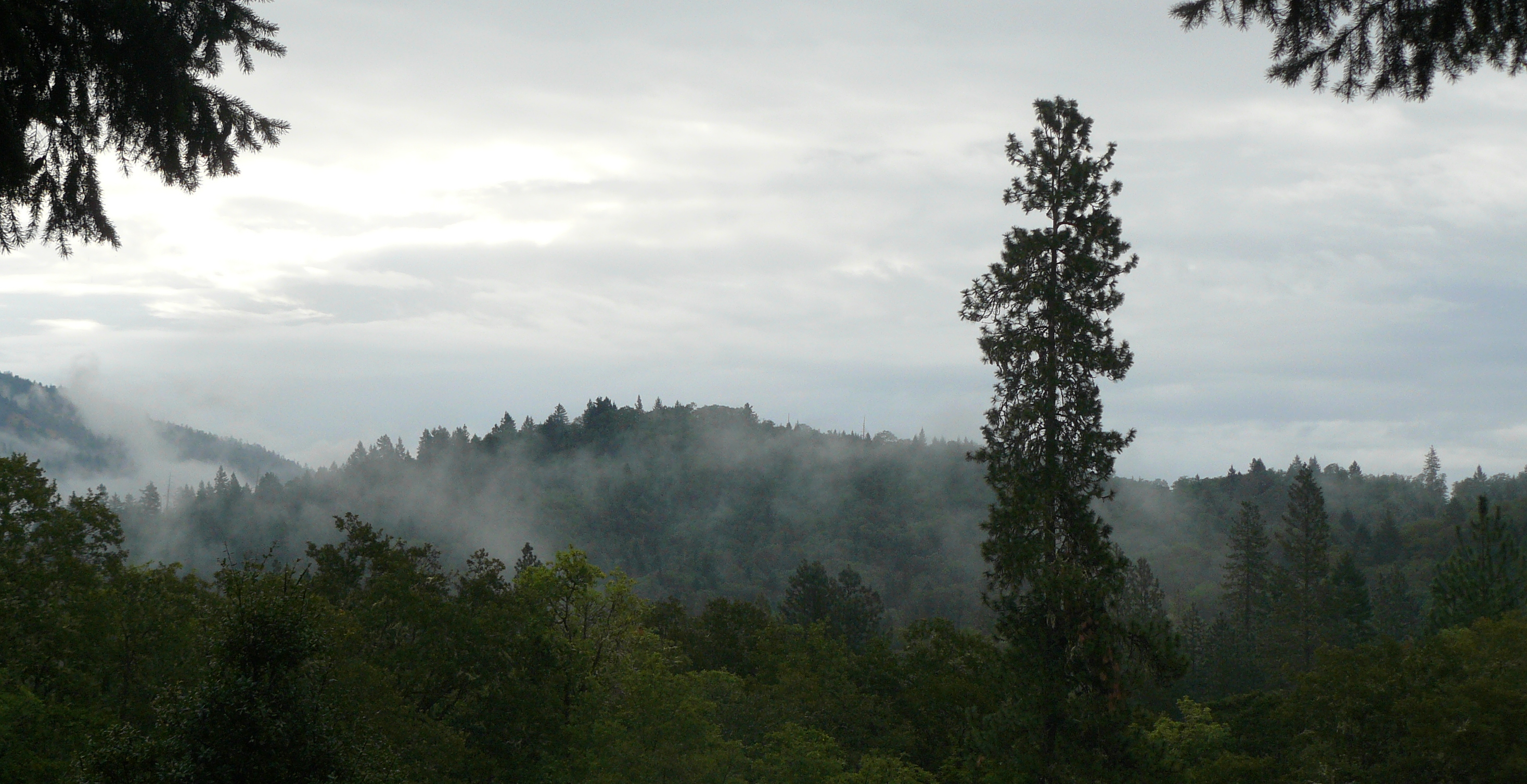
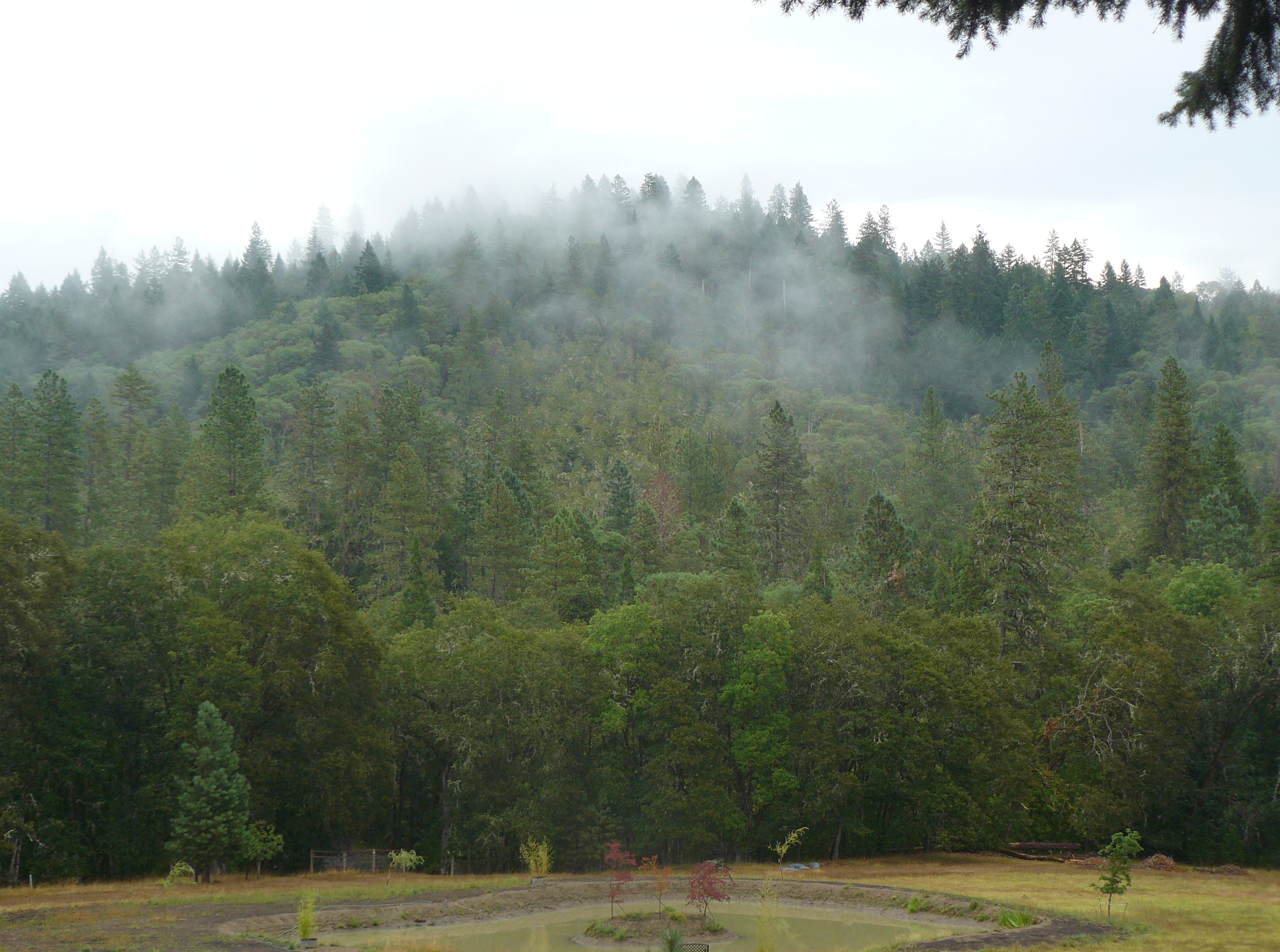
Here’s a picture taken yesterday morning of the ground that drops away from the house!

About a quarter-mile visibility, frequently worse!

But at least our internet service has been restored enabling me for the first time to access the Fire Incident website, from which I read at 4:40 pm yesterday, the following.

Incident Overview

The 1,600-acre Brimstone Fire, located 5 miles west of Sunny Valley, made no significant movement late Tuesday or overnight. Crews coming in from night shift said planned fireline improvement on the north and southeast corners was completed, and burnouts in those same areas were successful. Nearly 800 people are assigned to the Brimstone Fire’s suppression effort. Specifically, 29 crews, 26 wildland fire engines, seven bulldozers and nine water tenders are divided between the day and night shifts. The weather has been calm and this has helped reduce fire activity.  However, the heavy smoke layer has made it impossible to use helicopters on the fire.No evacuations have been announced for residential areas around the fire area, but structural fire protection personnel have assessed homes should an evacuation become necessary. To find out more about evacuation planning, call the Josephine County Emergency Operations Center (EOC) at (541) 474-5305.Firefighters ask that the public not use roads in the Upper Quartz Creek Rd and Hogs Creek Rd areas because these roads are narrow and are being heavily used by fire engines, trucks hauling water, and bulldozers.

Basic Information
Incident Type: Wildfire
Cause: Lightning
Date of Origin: Monday July 29th, 2013 approx. 02:00 AM
Location: 10 miles northwest of Merlin, OR
Incident Commander: Chris Cline
Current Situation
Total Personnel: 773
Size: 1,600 acres
Percent Contained: 10%
Fuels Involved: Mixed conifer and hardwood trees of widely varied ages, snags (dead, standing trees), brush and logging slash.
Fire Behavior: Torching and short-range spotting. The fire is difficult to see due to smoky conditions.
Significant Events: Three roads are closed because fire engines and other equipment are using the roads. The closed roads are Hog Creek, Quartz Creek and Angora Creek.
Outlook
Planned Actions: Improve the fire line and strategically burn out unburned areas inside the fire line.
Growth Potential: High
Terrain Difficulty: High
Current Weather
Wind Conditions 10 mph NW
Temperature 85 degrees
Humidity 31%

Well at least I can settle down and work my way through 130+ emails!!

Loss of service

Crumbling edge techonology!

At around 11am local Pacific time today (Monday) we lost our internet connection at home. (I have borrowed neighbours Dordie and Bill’s connection to publish this.)

The engineers say it could be up to 48 hours before they attend to the issue.

So enjoy a couple of days peace!

Regards to all,

Paul

From wolf to dog!

The science behind our fabulous dogs.

I was doing some research for another writing project about the history of the domestication of the dog and came across a peer-reviewed article on The National Center for Biotechnology Information website, here in the USA.  The article was entitled: Genome-wide SNP and haplotype analyses reveal a rich history underlying dog domestication. The website link is here.  (As an aside, if you drop in here and look at the NCBI sitemap it may well serve as an excellent resource.)

Anyway, the dog domestication article is, of necessity, highly scientific but nonetheless worth the read.  Here’s a taste from the Abstract.

Advances in genome technology have facilitated a new understanding of the historical and genetic processes crucial to rapid phenotypic evolution under domestication 1,2. To understand the process of dog diversification better, we conducted an extensive genome-wide survey of more than 48,000 single nucleotide polymorphisms in dogs and their wild progenitor, the grey wolf. Here we show that dog breeds share a higher proportion of multi-locus haplotypes unique to grey wolves from the Middle East, indicating that they are a dominant source of genetic diversity for dogs rather than wolves from east Asia, as suggested by mitochondrial DNA sequence data 3

But what really caught my eye was Figure 1, a wonderful illustration of the links between all the breeds of dogs and the grey wolf.

Neighbour-joining trees of domestic dogs and grey wolves.

From:Nature. Author manuscript; available in PMC 2012 November 9.
Published in final edited form as: Nature. 2010 April 8; 464(7290): 898–902.
Published online 2010 March 17. doi: 10.1038/nature08837

Copyright/License ►Request permission to reuse

Branch colour indicates the phenotypic/functional designation used by dog breeders 8,9. A dot indicates ≥95% bootstrap support from 1,000 replicates. a, Haplotype-sharing cladogram for 10-SNP windows (n = 6 for each breed and wolf population). b, Allele-sharing cladogram of individuals based on individual SNP loci. c, Haplotype-sharing phylogram based on 10-SNP windows of breeds and wolf populations. d, Allele-sharing phylogram of individual SNPs for breeds and wolf populations. For c and d, we note breeds where genetic assignments conflict with phenotypic/functional designations as follows: 1, Brussels griffon; 2, Pekingese; 3, pug; 4, Shih-tzu; 5, miniature pinscher; 6, Doberman pinscher; 7, Kuvasz; 8, Ibizian hound; 9, chihuahua; 10, Pomeranian; 11, papillon; 12, Glen of Imaal; 13, German shepherd; 14, Briard; 15, Jack Russell; 16, dachshund; 17, great schnauzer; and 18, standard schnauzer. Gt, great; mtn, mountain; PBGV, petit basset griffon vendeen; pin., pinscher; ptr, pointer; ret., retriever; shep., shepherd; sp., spaniel; Staf., Staffordshire; std, standard; terr., terrier. Canine images not drawn to scale. Wolf image adapted from ref. 31; dog images from the American Kennel Club (http://www.akc.org).

The diagram on its own was a bit of a struggle but looked at in conjunction with the research paper was much better understood.  Another reason for going to the original article on the NCBI website is the interesting range of links to other scientific papers that may be seen to the right-hand side of the screen. For example:

Coat variation in the domestic dog is governed by variants in three genes.

mtDNA data indicate a single origin for dogs south of Yangtze River, less than 16,300 years ago, from numerous wolves.

that included this in the Abstract:

The mean sequence distance to ancestral haplotypes indicates an origin 5,400-16,300 years ago (ya) from at least 51 female wolf founders. These results indicate that the domestic dog originated in southern China less than 16,300 ya, from several hundred wolves. The place and time coincide approximately with the origin of rice agriculture, suggesting that the dogs may have originated among sedentary hunter-gatherers or early farmers, and the numerous founders indicate that wolf taming was an important culture trait.

Ancient DNA evidence for Old World origin of New World dogs.

Abstract

Mitochondrial DNA sequences isolated from ancient dog remains from Latin America and Alaska showed that native American dogs originated from multiple Old World lineages of dogs that accompanied late Pleistocene humans across the Bering Strait. One clade of dog sequences was unique to the New World, which is consistent with a period of geographic isolation. This unique clade was absent from a large sample of modern dogs, which implies that European colonists systematically discouraged the breeding of native American dogs.

If you needed a reminder of the Pleistocene period, as I did, there’s a helpful Wikipedia entry here.

The final link that I wanted to highlight was this one, for all dog owners who worry about the health of our dogs.

The legacy of domestication: accumulation of deleterious mutations in the dog genome.

Abstract

Dogs exhibit more phenotypic variation than any other mammal and are affected by a wide variety of genetic diseases. However, the origin and genetic basis of this variation is still poorly understood. We examined the effect of domestication on the dog genome by comparison with its wild ancestor, the gray wolf. We compared variation in dog and wolf genes using whole-genome single nucleotide polymorphism (SNP) data. The d(N)/d(S) ratio (omega) was around 50% greater for SNPs found in dogs than in wolves, indicating that a higher proportion of nonsynonymous alleles segregate in dogs compared with nonfunctional genetic variation. We suggest that the majority of these alleles are slightly deleterious and that two main factors may have contributed to their increase. The first is a relaxation of selective constraint due to a population bottleneck and altered breeding patterns accompanying domestication. The second is a reduction of effective population size at loci linked to those under positive selection due to Hill-Robertson interference. An increase in slightly deleterious genetic variation could contribute to the prevalence of disease in modern dog breeds.

Have to say that there are some fabulous learning opportunities from the enormous range of websites available nowadays.