These are a few from a collection sent to me by Cynthia Gomez. (Captions from yours truly)
Left hand not knowing right hand comes to mind.
oooo
It’s a fair question!
oooo
Ouch, a bit close to home!!
oooo
Next two photographs from a weblink that Dan Gomez sent me.
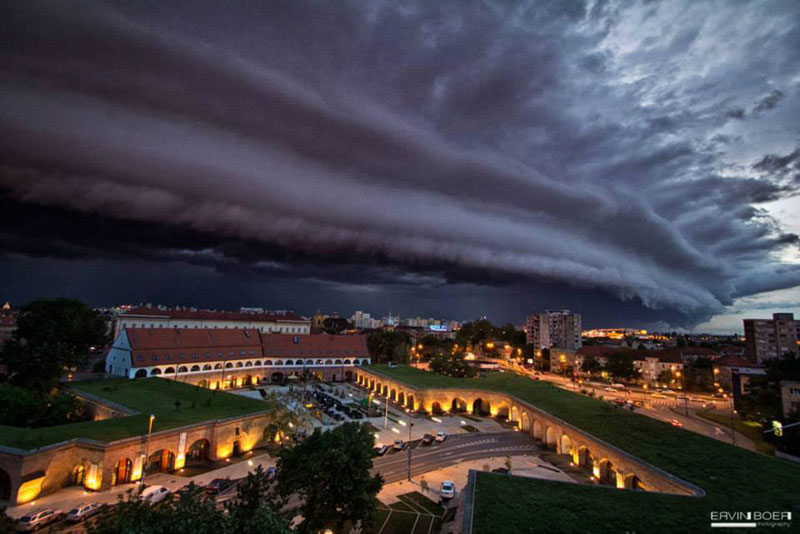
Shelf clouds over Timisoara
oooo
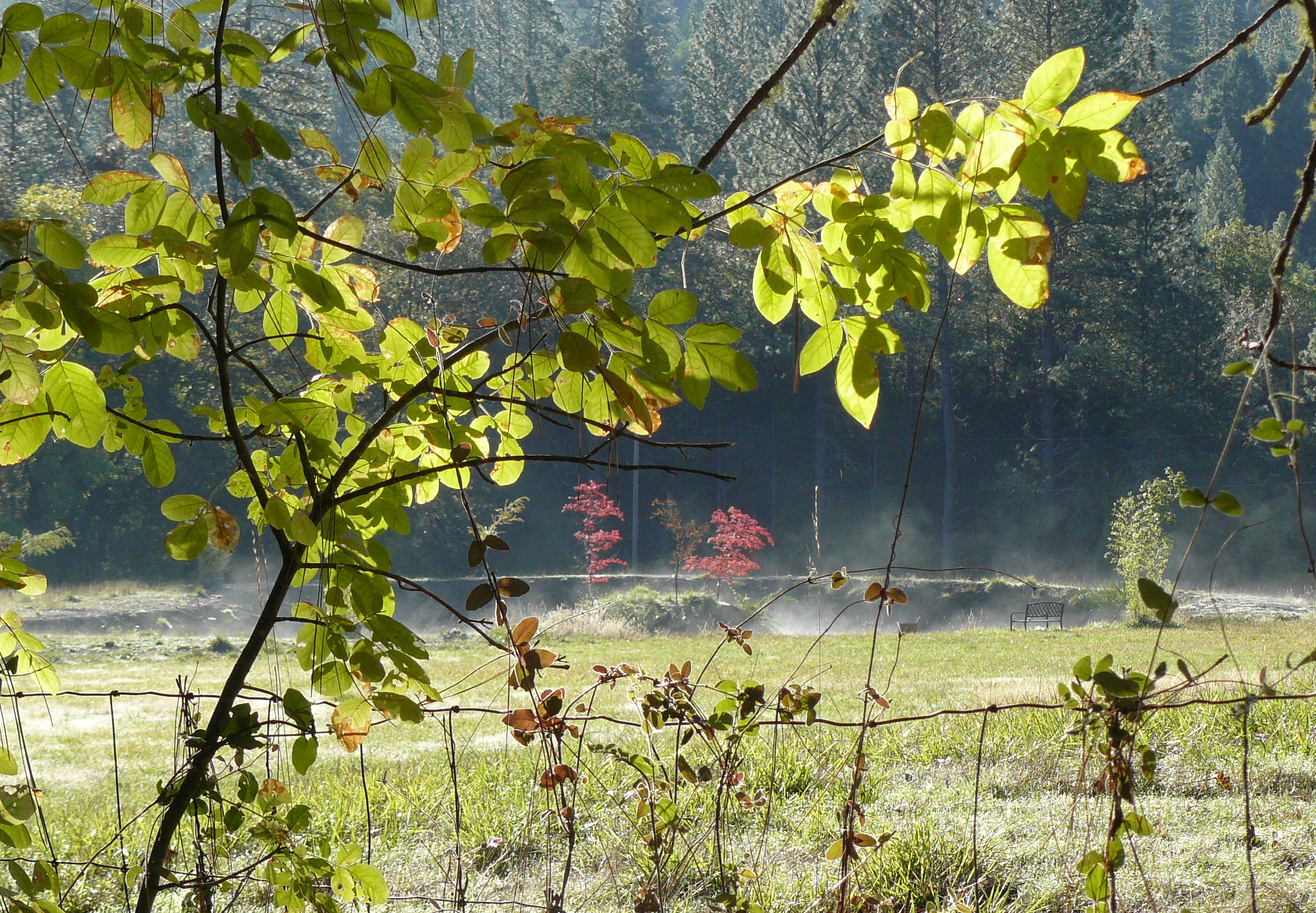
A world of green.
oooo
Now a few from yours truly, all taken from here at home.
Autumn hues.
oooo
Dhalia enjoying the Fall scents.
oooo
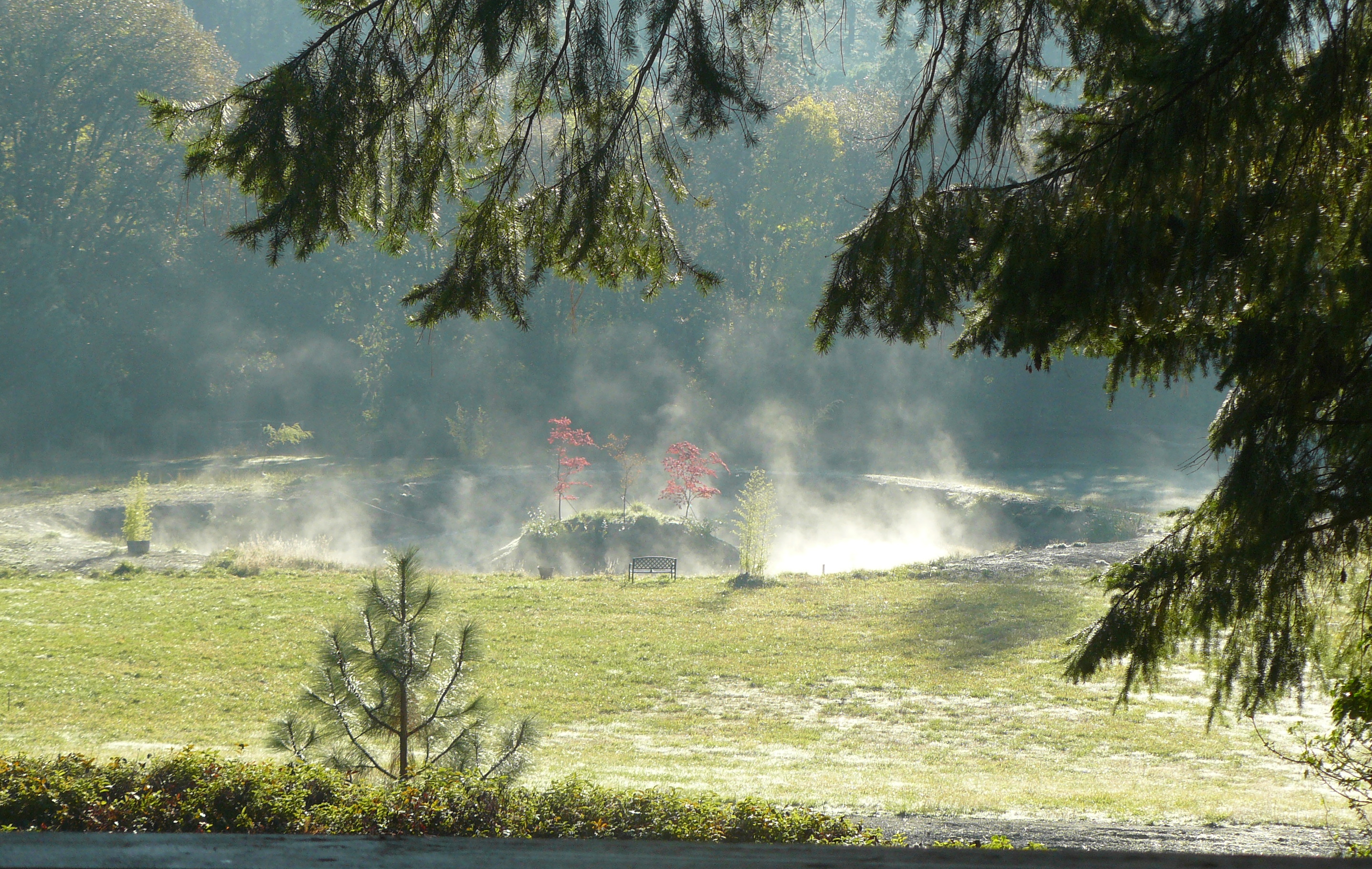
Misty October morning.
The final item is a YouTube video that Dan Gomez pointed out to me. Enthralled is an understatement! Do Watch It In Fullscreen!
Oh, don’t watch it if you don’t have a head for heights!!
NOTE: When running this video at this end, it has been starting with the volume muted. The volume setting is bottom left so check before the video gets under way for you.
They are both breathtakingly wonderful to watch and listen to. So put your feet up for half-an-hour and be swept away by these incredible musicians.
The first features Darren Foreman otherwise known as Beardy Man. His bio is here.
Published on Aug 2, 2013
Frustrated by not being able to sing two notes at the same time, musical inventor Beardy Man built a machine to allow him to create loops and layers from just the sounds he makes with his voice. Given that he can effortlessly conjure the sound of everything from crying babies to buzzing flies, not to mention mimic pretty much any musical instrument imaginable, that’s a lot of different sounds. Sit back and let the wall of sound of this dazzling performance wash over you.
Beardy Man
The second features Usman Riaz and Preston Reed and demonstrates the power of this new wired-up world we live in.
Usman Riaz is a 21-year-old whiz at the percussive guitar, a style he learned to play by watching his heroes on YouTube. The TED Fellow plays onstage at TEDGlobal 2012 — followed by a jawdropping solo from the master of percussive guitar, Preston Reed. And watch these two guitarists take on a very spur-of-the-moment improvisation.
Preston Reed has his own website from where I took the following photograph.
We see instinct as common across all species including man, so why is so little known about it.
There was an item seen on the BBC Capital website. It was an article about intuition:
Trusting your gut: Smart management or a fool’s errand?
by Eric Barton*
Photographer Mindy Véissid woke up one winter morning in 2010 with a simple idea: dogs running in the snow.
“That’s all I had,” she recalled.
The Manhattan resident followed her gut and went across town to Central Park. There, Véissid found three dogs jumping around in a couple of inches of new snow covering the famed park’s Great Lawn. She plopped down in the field and waited. That’s when the dogs headed right for her. She snapped off a shot just before they barrelled over her.
The picture she took that morning, of happy-looking pups charging through a cloud of snow with the New York City skyline behind them, has become one of Véissid’s calling cards, maybe her most recognisable shot. It’s a photo she would have missed if she had not trusted her gut.
“What I realised is that if I follow my heart, if I follow my feelings, I get good photographs,” Véissid said. “We try to control everything in our lives, and sometimes you have to let go.”
It wasn’t long ago that decision-by-intuition would have been regarded as little more than magical thinking or a try at luck. But research has changed that and intuition has been embraced as a key component to business decision making.
There is, however, an inherent danger to it, and blindly following your gut can be worse than ignoring it altogether. For managers, that means learning how to trust your own instincts and encouraging employees to do the same. But it also means learning to recognise when careful planning trumps sudden inspiration.
Perhaps the thing that most changed the way businesses think about inspiration was a 2008 study co-authored by Gerard Hodgkinson, professor at Leeds University Business School in the United Kingdom. Hodgkinson found that intuition can be beneficial in specific circumstances. First, it’s best to rely on a gut feeling when you need to make a quick decision. Second, and this is the important part, trust your intuition only when you have extensive knowledge on the subject. In other words, the best intuition is pulled from a well of deep knowledge and expertise.
“A lot of people think intuition is general purpose, but intuition is actually domain specific,” said Massimo Pigliucci, a philosophy professor at City University of New York, and author of Answers for Aristotle: How Science and Philosophy Can Lead Us to A More Meaningful Life. “Intuition is the result of your subconscious brain picking up on clues and hints and calculating the situation for you, and that’s based solely on experience.”
Wrong to republish the whole piece, however I do want to republish the closing paragraphs as they are so relevant to today’s post.
Western cultures began to embrace intuition only recently, Pigliucci said, while research suggests Southeast Asian countries have long given credit to gut feelings being a good guide to decision making. Eastern managers, for instance, are more likely to rely on hunches and give them credit for successes afterward.
After photographer Véissid learned to rely on her gut feelings, she wanted to teach others how to do it. Her class, the Art of Intuitive Photography, teaches the photography basics, but her instruction is more about following hunches.
“You can get a good photograph and it will be technically correct,” she said. “But if you follow your heart, you can take photos that can be wonderful.”
Follow BBC Capital on Twitter @BBC_Capital or follow us and join the conversation about this or any other Capital story on Facebook: BBC Capital on Facebook.
—-
* Eric is a freelance journalist who lives in Fort Lauderdale, Florida. He is formerly a writer and editor at New Times in Fort Lauderdale and The Pitch in Kansas City, Missouri. His work has been featured by the Florida Center for Investigative Reporting.
To my mind, what Eric Barton has written about is not instinctive. That is if one believes that instinct is something that is ‘hard-wired’, so to speak, into our psyche at birth, a function of our genetic heritage.
When one reflects on the start of life, ergo for all warm-blooded species that are the result of a successful copulation between the two genders of that species, then one realises that there is little functioning at birth beyond those bodily functions vital to that new life.
But if we mean by instinctive those behaviours that are subconsciously acted out while the mind is engaged on other mental processes, then that’s different.
Read that last opening paragraph again [my emphasis]:
“A lot of people think intuition is general purpose, but intuition is actually domain specific,” said Massimo Pigliucci, a philosophy professor at City University of New York, and author of Answers for Aristotle: How Science and Philosophy Can Lead Us to A More Meaningful Life. “Intuition is the result of your subconscious brain picking up on clues and hints and calculating the situation for you, and that’s based solely on experience.”
Think of when we drive a car how much of what we are doing in the ‘hand-eye’ department is being managed by our subconscious brain. Think about the way we use a language, especially the language of our birth country. One will immediately recognise that the brain is on auto-pilot. Yet we were born unable to speak, or to drive a car!
Abstract: “Innate Knowledge” is a stupid idea. The truth is the exact opposite: KNOWLEDGE IS EVERYWHERE, OUT THERE.Knowledge is the opposite of innate. This insight has tremendous consequences on our entire prehension of the world.
(It will not escape the cognoscenti that Socrates, Plato, and Aristotle, were partisans of innateness. And that believing in the superiority of inheritance is a necessary condition for racism, fascism, slavery, and hereditary plutocracy as fairness. That makes the likes of Chomsky and Dawkins self contradictory)
Subjective time slows down in smaller brains.
Fastest Wings, Fastest Brains. Anna Hummingbird California
Those wings go at 100 Hertz, four time the human perception limit.
Thus time is relative; just as light-clock time slows down in a fast reference frame, or in a heavy gravitational field, neurological timeslows down in a small neurology.
(Interestingly, the deepest reason for the slowing of time… boils down to the same in the Relativity case as in the Neurological one! It’s all about energy.)
A lot of ideas on instinct came from studying insects: insects seem to know all, without having studied anything. However, if insect time flows slowly, insects actually have time to learn.
And that’s rendered easier by having brains adapted to their environment. If they have only a few tricks to learn, and what looks like ten seconds for us is an hour for them, no wonder they learn lots. Thus slow in small explains how “instinct” works.
Hence behaviors one describes as “instinctive” are just fast studies. A lot of the silliness about “genes” is thus dispelled, and the mind comes on top.
It’s an essay that deserves the full reading. This is how it closes:
Conclusion:
Instinct As Fast Learning solves the nature-nurture problem. It also shows something else, even more important. It shows that the force of nature makes not just the force, but even the very geometry, of our minds.
(The construction of neuromorphology itself being forced by feedback from nature.)
The minds of sentient species, from bees to hummingbirds, are exquisitely tuned to be programmed by the (part of) nature they are made to respond to, all the way to the speed of time they need.
If we kill the environment, we kill out instruction set. The usual reason given to save the environment is that we would not want our descendants to live in a bad world. But what we see now is that a poor world gives poor minds, and that even time may go askew. Another, deeper than ever, reason to be a fanatical ecologist. Nature is not just our temple. Nature is where, and how, time itself is built, one neurological impulse at a time.
***
Patrice Ayme
On Monday, I have a sequel to this post. It’s an insight into the conscious and unconscious skills that come from flying a glider, or sailplane in American speak! Plus something that could just possibly be the key to mankind having a long-term sustainable future on this planet: The Power of Thinking.
But back to today.
You will recall that the item from the BBC website opened with photographer Mindy Véissid waking up one winter morning in 2010 with a simple idea: dogs running in the snow. Too good not to miss for a blog called Learning from Dogs.
Mindy’s website is here and do go across there and browse. You will quickly discover, for example:
we teach small sized group and private digital photography classes and workshops in fun locations throughout nyc, focusing on how to use your camera, how intuition can help guide you to images, and compositional improvement
So having given Mindy that small, but well-deserved, plug, I don’t feel too bad closing today with Mindy’s picture of those dogs running in the snow.
I’ve always felt great wildlife photography mapped well to the Chinese proverb “the journey is the reward.” While I obviously enjoy seeing the end result of my wildlife photography outings I get a great deal of satisfaction in the crafting of those images. My best images often rise to the top because of one of the following maxims: –
1. Backgrounds are Equally Important as Your Subject
Pronghorn Antelope (Antilocapra americana) Portrait. Canon EOS 1Ds III, Canon 70-200mm f/2.8 IS USM + 2x teleconverter, 1/250 sec, f/8, ISO 400
It has loads of fabulous advice plus some pretty neat pictures.
Take a look at the last tip:
7. Utilize Negative Space
Alert Sea Otter and Pup. Canon EOS 1Ds III, Canon 600mm + 1.4x teleconverter, 1/1000 sec, f/8, ISO 400
Don’t have a long lens? Fear not as images taken with shorter focal length lenses can help capture areas of negative space. By employing negative space you can enhance your subject by highlighting its place/scale, its environment and/or leverage contrasting color and textures to make your subject stand out.
Finally, having ‘borrowed’ these couple of images, it seems only proper to close the post with the last two paragraphs of the article promoting both the NWF and the guest author, Jim Goldstein. If you own a camera and enjoy the great outdoors then do read the article in full.
Enter the National Wildlife Photo Contest
Be sure to read Jim’s previous post about selecting the right gear for spectacular landscape photography. And, after you’ve rented your gear, planned your trip, and taken your wonderful nature photos, remember to enter the National Wildlife Photo Contest. You could win part of $6,000 in prizes, including a Grand Prize trip for two to Churchill, Canada where you can see and photograph polar bears. There are wildlife and landscape categories, but the deadline to enter is July 15, so enter soon!
About Jim Goldstein
Jim Goldstein is a San Francisco-based professional photographer and author who has been in numerous publications, including Outdoor Photographer, Digital Photo Pro, Popular Photography and has self-published a PDF eBook Photographing the 4th Dimension – Time covering numerous slow shutter techniques. Follow Jim Goldstein on Google+ | Twitter | Facebook | 500px
And let me close with a favourite of mine – a dog photograph, of course!
Each of us, whoever you are, for the sake of your children and for all of the children in the world, embrace today the qualities, the values of Nature.
Now if the shenanigans going on over here in my home country aren’t bad enough, then a recent essay from George Monbiot about the UK’s Department of Environment (DOE) really takes the cake. The essay is called Age of Unreason, published in the UK Guardian newspaper, and for obvious copyright reasons, I can only offer limited extracts. This is how the essay opens:
The governments of Britain, Canada and Australia are trying to stamp out scientific dissent.
By George Monbiot, published in the Guardian 1st Ooctober 2013
It’s as clear and chilling a statement of intent as you’re likely to read. Scientists should be “the voice of reason, rather than dissent, in the public arena.”(1) Vladimir Putin? Kim Jong-un? No, Professor Ian Boyd, chief scientific adviser at the UK’s department for environment.
Boyd’s doctrine is a neat distillation of government policy in Britain, Canada and Australia. These governments have suppressed or misrepresented inconvenient findings on climate change, pollution, pesticides, fisheries and wildlife. They have shut down programmes which produce unwelcome findings and sought to muzzle scientists. This is a modern version of Soviet Lysenkoism: crushing academic dissent on behalf of bad science and corporate power(2).
Mr. Monbiot offers a very convincing argument to show how Professor Ian Boyd used poor scientific data to justify the culling of British badgers and how Boyd’s boss, the UK’s Environment Secretary Owen Paterson, is playing down the dangers of global warming – even suggesting the process had its advantages. George Monbiot goes on to show how that aforementioned Department has claimed, “that its field trials of neonicotinoid pesticides on bees showed that “effects on bees do not occur under normal circumstances”! [my italics].
Oh, and that there was an attempt to cull British buzzards to enable the rich and famous to ‘enjoy’ better pheasant shoots!
To be reasonable, when a government is manipulating and misrepresenting scientific findings, is to dissent. To be reasonable, when it is helping to destroy human life and the natural world, is to dissent. As Julien Benda argued in La Trahison des Clercs, democracy and civilisation depend on intellectuals resisting conformity and power(28).
A world in which scientists speak only through their minders and in which dissent is considered the antithesis of reason is a world shorn of meaningful democratic choices. You can judge a government by its treatment of inconvenient facts and the people who expose them. This one does not emerge well.
It’s enough to make a dog very angry!
oooo
Please do go across and read the essay in full because Mr. Monbiot is a journalist whom one can trust. In stark contrast to so many that purport to be governing on our behalf.
As an Englishman grateful to have the right to live in this fair country, it pains me to see what is happening to both my old country and my new one. When I was granted my visa, my fiancee visa, from the US Embassy in London I was given a small booklet containing the text of the US Constitution. Page One is open in front of me at this moment:
We the People of the United States, in Order to form a more perfect Union, establish Justice, insure domestic Tranquility, provide for the common defence, promote the general Welfare, and secure the Blessings of Liberty to ourselves and our Posterity, do ordain and establish this Constitution for the United States of America.
Yesterday’s long rant was the outcome of me promising ‘a debate’ with Patrice Ayme. Succinctly, I had disagreed with a comment from Patrice where he had written: “Force is the truth of man. Everything else is delusion, even the vegetarian style.” and wanted to respond within the space of a post rather than the more restrictive comment.
For my disagreement with Patrice had been essentially about his statement, ‘Force is the truth of man‘. I don’t recall a war in the last 50 years that has been a force for good.
But then it was Alex’s comment, see below, that stopped me short. For I realised that I was confusing ‘force’ with ‘war’ and that was probably a big mistake on my behalf. Of course, I’m writing this without the benefit of knowing better what Patrice meant in his comment! Blogging, as powerful a media as it is, does not provide for immediate interaction!
Nevertheless, Alex’s comment yesterday was powerfully inspirational. Because so many of us (and I include me in that ‘us’) all too often behave as though we are a species utterly divorced from Nature.
So what to do? Because I am fundamentally at odds with the sentiment expressed by Patrice Ayme; “Force is the truth of man. Everything else is delusion, even the vegetarian style.“
The answer takes us to tomorrow’s post, A return to integrity.
And, yes, it does mention dogs! Rather a lot as it happens!
Dogs are the one species that man has lived with longer than any other species. So when we refer to the qualities of the dog it is simply because we are so familiar with them. In no way does that exclude the numerous other species that bond with man and share the same wonderful qualities.
Qualities so easily seen: Love, Honesty, Loyalty, Trust, Openness, Faithfulness, Forgiveness and Affection. Together they are Integrity.
Of course dogs will kill a rabbit, for example, as readily as a cat will kill a mouse. In this respect force isthe truth of Nature.
The only way for species man to survive on this planet is for every element of man’s existence on this planet to be rethought of in terms of the natural order. Read the comment left by Alex in yesterday’s post:
Hi Paul, what you highlight are examples of disconnection between humanity with nature and each other. I have on my own blog highlighted a concept of Ubuntu – “I am because we are” – which is only possible when the self realises they are part of an inter-connected network of life. Your example of islands of fragmented forest where disconnected wildlife are dying out is how it is with disconnected humanity, we are doomed to destruction because we are cut off from the life-giving connection to nature.
All the problems you highlight are symptoms of the disease of disconnection, until there is reconnection to nature none of these symptoms can be successfully addressed.
War is an integral part of nature, when people seek to dismiss this then they add to the disconnection from nature. I was stung in the face by a drunken wasp a few days ago, this is how it is with nature, it is beautiful but also brutal. Peace and balance are illusions, life is in a becoming because of unbalance and strife. I advocate harmony, like a downhill skier we do not seek to control our surroundings, but instead act in harmony by moving around the obstacles such as rock and tree.
Disconnection can be as large as destroying whole forests by ignorant energy policies to those idiots who kicked a puffball to pieces before I could harvest it, or the new owners of my former home who have taken a chainsaw to all the trees and bushes in the garden. People who are disconnected do not consider how their actions impact nature or people contrary to the philosophy of Ubuntu.
“I am because we are!” Each and every one of us is where we are today, for good or ill, because of what we are: part of Nature. It’s so incredibly obvious – we are a natural species – yet who reading this wouldn’t admit at times to behaving “as though we are a species utterly divorced from Nature.”
Millions of us have pets and animals that we love. Yet we still miss the key truth of our pets. That we are a part of Nature, subject to Natural order, just as much as our pets are. We have so much to learn from our animals.
Take this rather sad story but, nonetheless, a formidable story of the integrity of one species for another. Watch the video.
oooo
Take this rather happier story about the integrity of one species for another. Watch the video.
oooo
Thus when we see the extraordinary benefits that arise from love and trust, from loyalty and faithfulness, and much more, why oh why is so much of our society fundamentally broken?
As John Hurlburt wrote in a recent email, it is because, “we are spiritual bankrupt. We spend too much of our time thinking about ourselves and what we want and too little of our time thinking about other people and what we all need.” John went on to add that this spiritual bankruptcy had preceded our moral and economical bankruptcy. He pointed out that the solution to our moral and financial problems, as well as our salvation as individuals and as a species, is spiritual. “We simply need to love the Nature of God, the earth and each other regardless of what we may believe God to be.”
Now whether you are a religious soul, or a heathen, or somewhere in the middle, it matters not. For if we continue to defy Nature and the natural laws of this planet we are going to be dust before the end of this century. Again in John’s powerful words:
Denying climate change is a death wish.
Nature always wins in the long run.
Nature is balanced. Are we?
As if to endorse the great examples that Nature offers us in terms of the benefits of love and trust, take a look at these three recent photographs from here in Oregon.
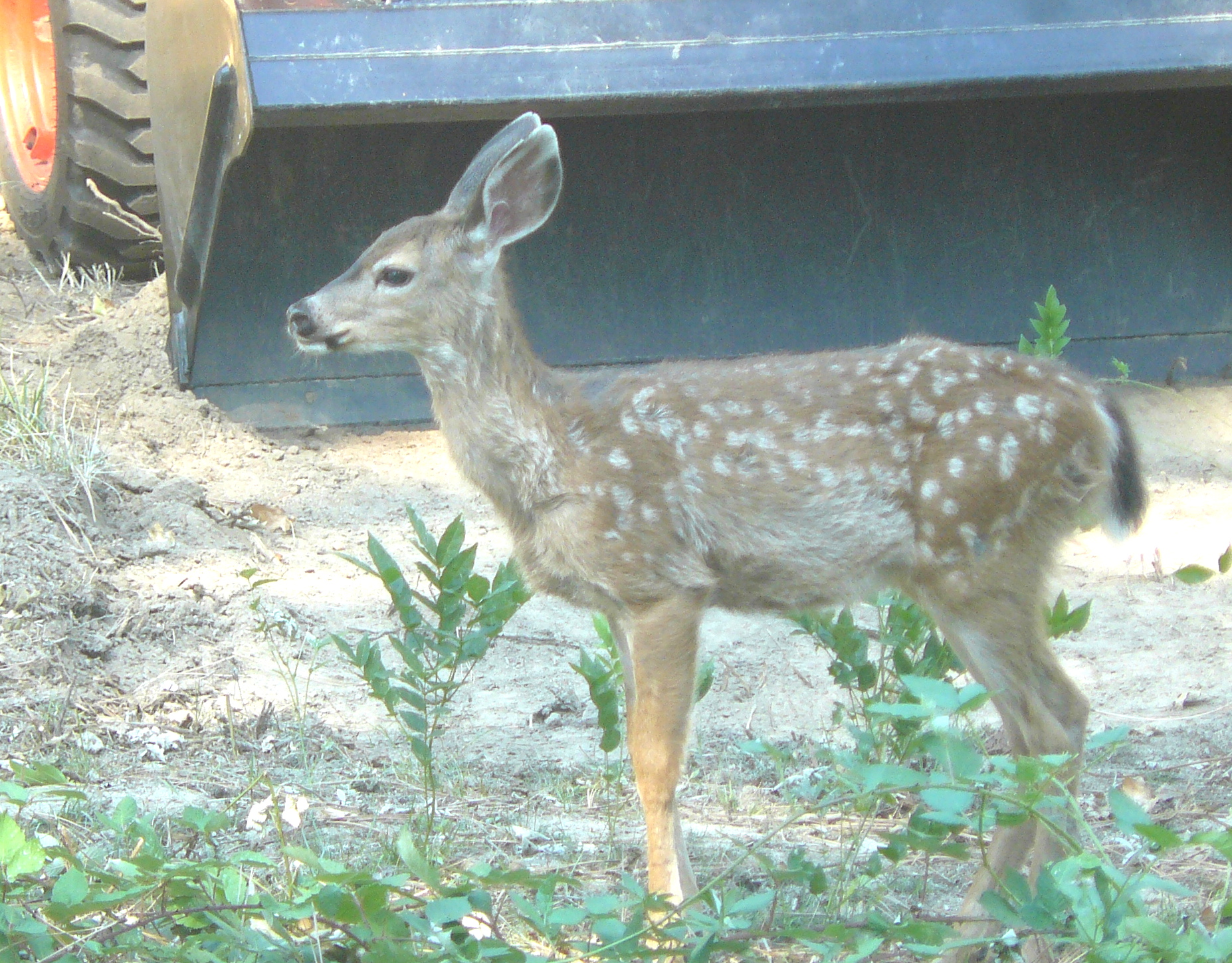
A young timid deer showing her trust of me as I sat quietly on the ground less than 30 feet away.
oooo
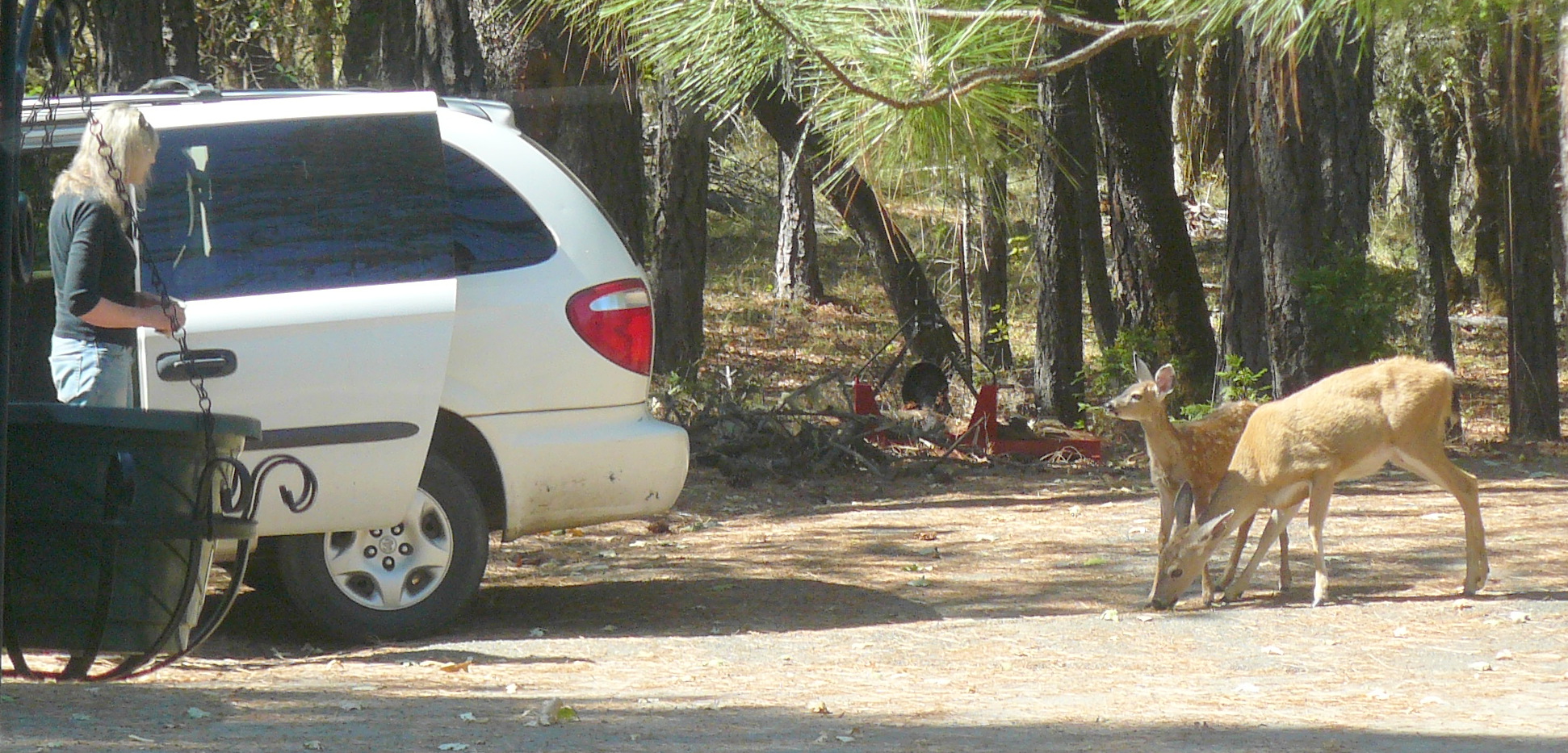
A mother and her fawn trusting Jean’s love for them, and getting a good feed!
oooo
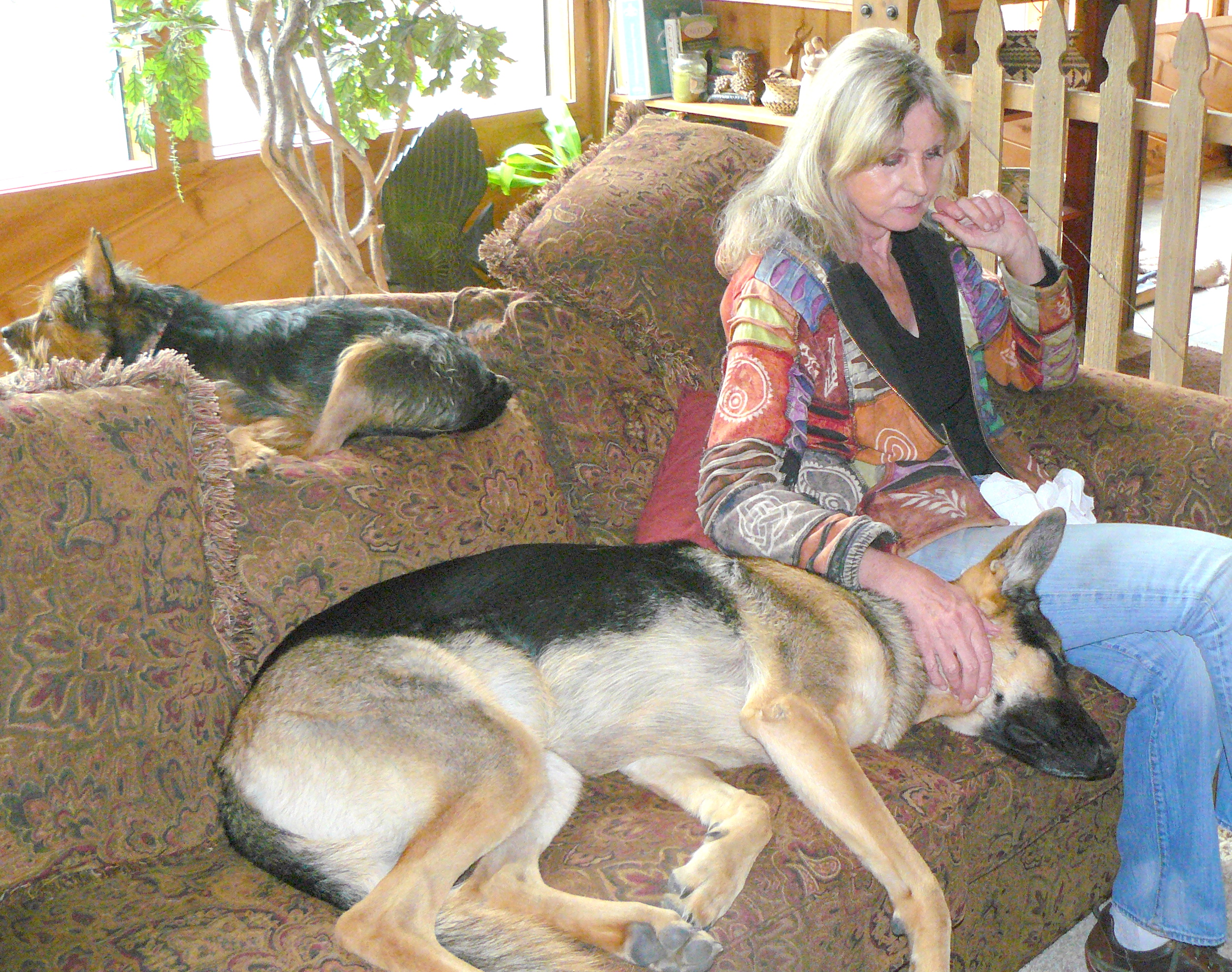
Little Sweeny and Cleo converting trust to peace and happiness. (Not to mention Jean!)
Now these are not photographs to ‘ooh’ and ‘ah’ over, these are reminders that kindness, generosity, selflessness and trust are part of Nature. All the great virtues and values of man do not come from a vacuum, they come to us via Nature.
We have been blessed by an evolution that has allowed mankind to achieve remarkable things. Even to the point of leaving the confines of our planet and setting foot on the Moon and sending probes from out of our Solar System. There’s a sense, a distinctly tangible sense, that man has conquered all; that we have broken the link from being part of Nature; from being of Nature.
And now Mother Earth is reminding all of her species, every single one of them including species man, that everything is bound by her Natural Laws.
Does this mean that man has to revert to some form of pre-civilised stone-age era? Of course not! Progress can be as much within the Natural order than in competition with it, as it has been in recent times. In fact, Professor Pat Shipman explains our progress is benefited by being part of that Natural order. Here’s how Amazon describe her book, The Animal Connection.
The Animal Connection: A New Perspective on What Makes Us Human
A bold, illuminating new take on the love of animals that drove human evolution.
Why do humans all over the world take in and nurture other animals? This behavior might seem maladaptive—after all, every mouthful given to another species is one that you cannot eat—but in this heartening new study, acclaimed anthropologist Pat Shipman reveals that our propensity to domesticate and care for other animals is in fact among our species’ greatest strengths. For the last 2.6 million years, Shipman explains, humans who coexisted with animals enjoyed definite adaptive and cultural advantages. To illustrate this point, Shipman gives us a tour of the milestones in human civilization-from agriculture to art and even language—and describes how we reached each stage through our unique relationship with other animals. The Animal Connection reaffirms our love of animals as something both innate and distinctly human, revealing that the process of domestication not only changed animals but had a resounding impact on us as well.
It’s a powerful read and greatly recommended. Here’s an extract from the book [page 274, my emphasis]:
Clearly, part of the basis of our intimacy with tame or domesticated animals involves physical contact. People who work with animals touch them. It doesn’t matter if you are a horse breeder, a farmer raising pigs, a pet owner, a zoo keeper, or a veterinarian, we touch them, stroke them, hug them. Many of us kiss our animals and many allow them to sleep with us. We touch animals because this is a crucial aspect of the nonverbal communication that we have evolved over millennia. We touch animals because it raises our oxytocin levels – and the animal’s oxytocin levels. We touch animals because we and they enjoy it.
From the first stone tool to the origin of language and the most recent living tools, our involvement with animals has directed our course.
So to round this off. These last two posts came from my need to debate with Patrice the statement that “Force is the truth of man.” If Patrice’s meaning was that the truth of man is subject to the force of Nature, then I agree one-hundred percent.
For the time for man to recognise that the force of Nature is “the truth of man” is running out.
Each of us, whoever you are, for the sake of your children and for all of the children in the world, embrace today the qualities, the values of Nature.
On the 21st., I published a post Be in peace this day! It was noting this year’s International Peace Day. One of the comments left by Patrice Ayme, in response to an earlier comment from Alex Jones, was this:
Alex: I read your message, and I approve it. Very well put. As Lord Keynes said: ”In the end, we are all dead.” Death seems pretty violent to me. Yet, one can live with it, and embrace it, because, as there is no choice, we may as well.
War is not anymore a problem than peace is. What matters most is the harmony of the society with the environment, not strife within. Plutocrats have unbalanced the environment, so they should be reduced, and that means war, because peace certainly will not reduce them.
Force is the truth of man. Everything else is delusion, even the vegetarian style.
To which I replied:
Patrice, as much as I deeply respect your intellect, I fundamentally am at odds with the sentiments you express. But rather than hide behind a short reply that few will read and even fewer take notice of, I’m going to write a post exploring my reactions in detail. As always, your comments are welcomed.
This, then, is that post.
But where oh where to start? Perhaps by me setting out this general premise.
Wherever one looks, it seems there are examples of madness bordering on the criminally insane.
In so many ways and at so many levels we are running the very real risk that by 2050 the end of this present era of human civilisation by the end of the century will be unavoidable. Ergo: Born after 1980? Then brace yourself for the end times.
The only solution is to adopt the core values of humanity. Very soon!
So on to a few examples of the present madness (and I would be the first to admit that I am, perhaps prejudicially, inclined to see the darkness of our present times).
First: Climate Change
The recent IPCC report made it clear that climate change is most likely a result of man’s activities on this planet. As the summary for policy makers says (selected extracts):
Warming of the climate system is unequivocal, and since the 1950s, many of the observed changes are unprecedented over decades to millennia. The atmosphere and ocean have warmed, the amounts of snow and ice have diminished, sea level has risen, and the concentrations of greenhouse gases have increased.
and
Human influence on the climate system is clear. This is evident from the increasing greenhouse gas concentrations in the atmosphere, positive radiative forcing, observed warming, and understanding of the climate system.
and [my emboldening]
Human influence has been detected in warming of the atmosphere and the ocean, in changes in the global water cycle, in reductions in snow and ice, in global mean sea level rise, and in changes in some climate extremes (Figure SPM.6 and Table SPM.1). This evidence for human influence has grown since AR4. It is extremely likely that human influence has been the dominant cause of the observed warming since the mid-20th century.
But denial is only part of the problem. More significant is the behaviour of powerful people who claim to accept the evidence. This week the former Irish president Mary Robinson added her voice to a call that some of us have been making for years: the only effective means of preventing climate breakdown is to leave fossil fuels in the ground. Press any minister on this matter in private and, in one way or another, they will concede the point. Yet no government will act on it.
As if to mark the publication of the new report, the Department for Business, Innovation and Skills has now plastered a giant poster across its ground-floor windows: “UK oil and gas: Energising Britain. £13.5bn is being invested in recovering UK oil and gas this year, more than any other industrial sector.”
The message couldn’t have been clearer if it had said “up yours”. It is an example of the way in which all governments collaborate in the disaster they publicly bemoan. They sagely agree with the need to do something to avert the catastrophe the panel foresees, while promoting the industries that cause it.
It doesn’t matter how many windmills or solar panels or nuclear plants you build if you are not simultaneously retiring fossil fuel production. We need a global programme whose purpose is to leave most coal and oil and gas reserves in the ground, while developing new sources of power and reducing the amazing amount of energy we waste.
But, far from doing so, governments everywhere are still seeking to squeeze every drop out of their own reserves, while trying to secure access to other people’s. As more accessible reservoirs are emptied, energy companies exploit the remotest parts of the planet, bribing and bullying governments to allow them to break open unexploited places: from the deep ocean to the melting Arctic.
And the governments who let them do it weep sticky black tears over the state of the planet.
Kevin Anderson, professor of energy and climate change at the University of Manchester
What has changed significantly since the last report is that we have pumped an additional 200 billion tonnes of CO2 into the atmosphere. Annual emissions are now 60% higher than at the time of the first report in 1990 and atmospheric CO2 levels are the highest they have been for over two million years.
So what are we doing in the UK to help reverse this reckless growth in emissions? Record levels of investment in North Sea oil, tax breaks for shale gas, investment in oil from tar sands and companies preparing to drill beneath the Arctic.
Against this backdrop, the UK Treasury is pushing for over 30 new gas power stations, whilst the government supports further airport expansion and has dropped its 2030 decarbonisation target – all this alongside beleaguered plans for a few wind farms and weak energy efficiency measures. Governments, businesses and high-emitting individuals around the world now face a stark choice: to reduce emissions in line with the clear message of the IPCC report, or continue with their carbon-profligate behaviour at the expense of both climate-vulnerable communities and future generations.
OK, let’s move to another example of our collective madness.
Second: The way we treat the natural wildlife.
Last Thursday, the New York Times published an item about a recent report confirming the terrible cost to our wildlife of fragmenting their habitat. Here are the opening paragraphs, including the leading photograph in that NYT piece.
In Fragmented Forests, Rapid Mammal Extinctions
An isolated forest in the Chiew Larn reservoir. A Thai government project to supply hydroelectric power to the area transformed 150 forested hilltops into islands. ANTONY LYNAM
By CARL ZIMMER
September 26, 2013
In 1987, the government of Thailand launched a huge, unplanned experiment. They built a dam across the Khlong Saeng river, creating a 60-square-mile reservoir. As the Chiew Larn reservoir rose, it drowned the river valley, transforming 150 forested hilltops into islands, each with its own isolated menagerie of wildlife.
Conservation biologists have long known that fragmenting wilderness can put species at risk of extinction. But it’s been hard to gauge how long it takes for those species to disappear. Chiew Larn has given biologists the opportunity to measure the speed of mammal extinctions. “It’s a rare thing to come by in ecological studies,” said Luke Gibson, a biologist at the National University of Singapore.
Over two decades, Dr. Gibson and his colleagues have tracked the diversity of mammals on the islands. In Friday’s issue of the journal Science, they report that the extinctions have turned out to be distressingly fast.
“Our results should be a warning,” said Dr. Gibson. “This is the trend that the world is going in.”
On a similar theme, many will recall my post back on the 19th, Pity the bees; pity us when I drew attention to the drastic reduction in the numbers of wild bees, including the quote “the vanishing honeybee could be the herald of a permanently diminished planet.“
Guard their future – and ours!
Third: Money and power.
Again from The New York Times but this time an essay by Paul Krugman.
Robert Benmosche, the chief executive of the American International Group, said something stupid the other day. And we should be glad, because his comments help highlight an important but rarely discussed cost of extreme income inequality — namely, the rise of a small but powerful group of what can only be called sociopaths.
For those who don’t recall, A.I.G. is a giant insurance company that played a crucial role in creating the global economic crisis, exploiting loopholes in financial regulation to sell vast numbers of debt guarantees that it had no way to honor. Five years ago, U.S. authorities, fearing that A.I.G.’s collapse might destabilize the whole financial system, stepped in with a huge bailout. But even the policy makers felt ill used — for example, Ben Bernanke, the chairman of the Federal Reserve, later testified that no other episode in the crisis made him so angry.
And it got worse. For a time, A.I.G. was essentially a ward of the federal government, which owned the bulk of its stock, yet it continued paying large executive bonuses. There was, understandably, much public furor.
So here’s what Mr. Benmosche did in an interview with The Wall Street Journal: He compared the uproar over bonuses to lynchings in the Deep South — the real kind, involving murder — and declared that the bonus backlash was “just as bad and just as wrong.”
OK, that’s enough ‘copying’ from me so please go and read more about the plight of those poor billionaires. But if the NYT and Paul Krugman will forgive me, here’s the paragraph towards the end of the Krugman essay that makes me sick [my emboldening]:
The thing is, by and large, the wealthy have gotten their wish. Wall Street was bailed out, while workers and homeowners weren’t. Our so-called recovery has done nothing much for ordinary workers, but incomes at the top have soared, with almost all the gains from 2009 to 2012 going to the top 1 percent, and almost a third going to the top 0.01 percent — that is, people with incomes over $10 million.
Staying with the struggles of our billionaires for a moment longer, try the recent report on Bloomberg about the recent Monaco Yacht Show that included this:
As the yacht size has stretched — this year saw the launch of a record-holding 590-footer called the Azzam — so has the list of distractions onboard. Soaking in a jacuzzi, shooting hoops on a floating court or playing a baby grand Steinway piano no longer cut it.
“There is a change in attitude of super-yacht owners,” said Bert Houtman, founder and chairman of the Netherlands-based U-Boat Worx, surveying two of his submarine models on display quai-side in Monaco. “They’re fed up with drinking white wine and riding jet skis so they’re looking for another thrill.”
later including:
“A lot of guys who are billionaires have profound financial accomplishments and are now concerned about their legacy,” said Deppe. (Marc Deppe, Triton Subs vice-president of sales and marketing.)
It’s enough to make one weep!
Fourth: Politicians and governments not serving their peoples.
Making this my last example. Simply because a recent item published on Naked Capitalism had so much detail on what is wrong with our leaders; in this particular case regarding the American Affordable Care Act (ACA). This is how the article opens:
Many people, and especially Obama supporters, characterize the ACA (ObamaCare) as “just starting” or a “work in progress” and then go on to urge that the program will have “glitches,” needs to be “tweaked,” isn’t yet “fully implemented,” and so forth. We think it’s a mistake to see the ACA as just starting. We also think it’s a mistake not to weigh the costs of ObamaCare’s stately three-year progress toward partial coverage for the the American people, and just as important to weigh the opportunity costs.
The ACA was passed in March 2010, incorporating many features designed to meet Republican objections to the Bill. Yet, in the end, Democrats never put Medicare for All on the table, abandoned the public option and many other features, and did not get a single Republican vote in either chamber.
The Democrats even saw to it that the bill was fiscally neutral over a 10 year projection at a time when the tanked economy needed more deficit spending and the jobs that would have brought. And to do that, they postponed implementation of most of the bill for more than three years, until now, allowing people to go without care, to die, to divorce, and to lose their homes or go bankrupt due to medical bills, just so they could argue that the bill was fiscally neutral. In gauging the record of the bill, these 3 to 3.5 years of waiting for its implementation and their real costs to the people of the United States must be taken into account.
It also must be taken into account that in the year before the ACA was passed there were some 45 million Americans uninsured, and they were dying at the rate of 1,000 more for every million than in the general population. That is, lack of insurance was causing more than 45,000 fatalities per year. (The cost of those deaths in money terms: $1.38 trillion).
That’s what we’ve lost by not trying to pass HR 676 and by trying instead to take a bipartisan insurance company conciliation approach to passing the ACA. This post, gives the total for the anticipated opportunity cost by comparing Romney’s 2012 alternative to the ACA, the baseline of no reform at all, the ACA, and Medicare for All over the period 2010 – 2022. Bottom line: the ACA is projected to cost 286,500 lives through 2022, assuming no change. That’s a lot better than the baseline and a lot better than Romney’s 2012 alternative. But it’s still terrible compared to what we might have had if we had a President who really represented people rather than Wall Street.
What if an effort to pass HR 676 had failed in 2009 because too many Democrats in the Senate defected to pass it? Well, I think this would have been very unlikely with the very large Democratic majority and the popularity of the president at its height, but even if it would have failed, then the Democrats could still have compromised with members of their party to pass enhanced Medicare for All for everyone under 26 and over 45, or under 26 and over 50, or whatever compromise would have moved those wayward Democrats up to the 50 vote mark. Such a compromise bill would still have lowered the fatalities substantially by providing insurance for those who needed it most and by enhancing the Medicare program for seniors (full coverage and no co-pays). It would also have been something Democrats could have run on and built upon in each successive election year, rather than having to defend the sorry ACA with its package of inadequate goodies, silly mandate, IRS enforcement, high cost for lousy coverage, and Rube Goldberg eligibility determination. Again there would have been no Tea Party, because Tea Partiers like Medicare, and there would have been no Republican nationwide sweep in 2010, no gerrymandering, no voter suppression, no anti-woman bills, and none of all the rest of the nonsense we’ve seen because the Democrats did what they did.
Earlier in the post I offered a general premise that included, “Wherever one seems to look there are examples of madness bordering on the criminally insane.”
To my mind, these examples support that premise. Trust me, there are countless more examples.
So what to do? Because I am fundamentally at odds with the sentiment expressed by Patrice Ayme; “Force is the truth of man. Everything else is delusion, even the vegetarian style.”
The answer takes us to tomorrow’s post, A return to integrity.
And, yes, it does mention dogs! Rather a lot as it happens!
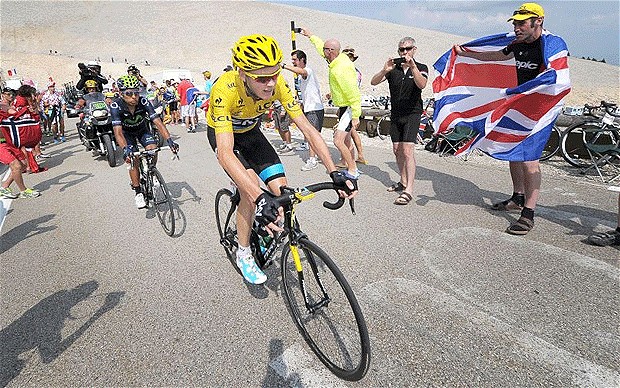
Tour de France 2013: Spectre of Lance Armstrong could prevent Chris Froome reaping sponsorship deals
The spectre of Lance Armstrong could hurt Chris Froome’s ability to fully exploit his Tour de France triumph, leading sponsorship experts warned last night.
Heading for glory: Chris Froome is cheered on by a British fan Photo: PA
Brands might have been expected to flock to Britain’s latest cycling star after he became the country’s second successive winner of the world’s most famous bike race yesterday.
However, Froome was also the first man to secure the yellow jersey since Armstrong confessed to doping his way to all seven of his Tour de France victories, a scandal from which the sport has yet to fully recover.
A slightly different thought from Willie Nelson brought to you courtesy of Bob Derham:
“I think it is just terrible and disgusting how everyone has treated Lance Armstrong, especially after what he achieved, winning seven Tour de France races while on drugs.
When I was on drugs, I couldn’t even find my bike ….”
I ran out of time and inspiration for today’s post; was going to republish something from earlier blogging days.
Then Suzann came to the rescue in sending me an email with a link to the following. Guess Su wanted me to keep up with some of the strange ideas of us Brits.
Published on Apr 2, 2013
Sacla’ served up a great surprise at John Lewis Foodhall from Waitrose and staged an impromptu Opera in the food aisles.
They planted five secret opera singers who were disguised as casual shoppers and store staff amongst the groceries who broke into song bringing the foodhall to a standstill with a rousing rendition of the Italian classic Funiculì, Funiculà.
I know it was an advertising stunt, but it was very well done! More please!












 Learning from Dogs