We can never be reminded too often of this most special bond.
Again, the pressures of the book and the fact that Jean and I were away from the house until early afternoon, made it difficult for me to spend time writing a post from scratch.
Then in my blog folder, I saw this lovely story reported by the British Daily Mail newspaper; to be honest, probably quite some time ago.
But so what!
The bond between humans and dogs is timeless.
ooOOoo
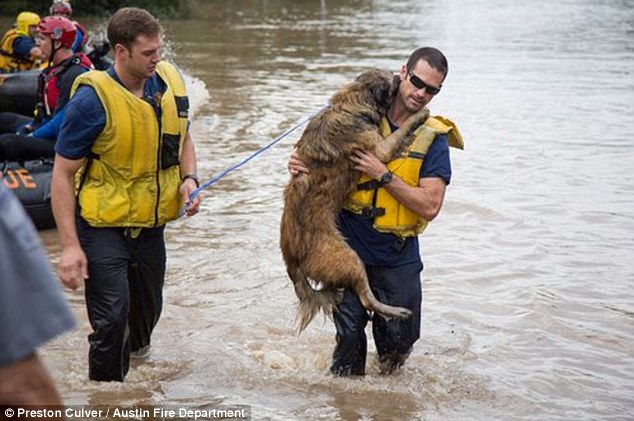
Touching moment as firefighters save this dog from flood waters.
Two firefighters with the Austin Fire Department were pictured saving a dog from flood waters in central Texas yesterday.
The department posted the picture of firefighters Matt Harvey and Michael Cooper with the animal to their Facebook page, saying: ‘We don’t just rescue two-legged victims…we love our four-legged friends as well.”
The animal looks like it’s been through a lot, and clings to one of the firefighters as if they’re hugging.
There was a bonus in waiting a while before publishing this. For the story of the dog being reunited with its owner made television news.
You may recall that back on the 15th of this month, I posted a Note to Readers that spoke about my need to be focused on the editing of my manuscript. Here’s part of that note:
Dear readers, we are talking hours of revisions that I need, and want, to make.
All of which is my way of saying that if my posts over the next couple of weeks more strongly lean on the republishing of other material then you will understand why. In all cases I will endeavour to republish articles that are likely to interest you, of course!
Late yesterday, I completed the many revisions to the manuscript recommended by Joni Wilson but still have more days of formatting changes ahead.
Thus another republication of an item, this time an article that appeared on the Smithsonian website.
ooOOoo
Domestication Seems to Have Made Dogs a Bit Dim
Thanks to their relationship with us, dogs are less adept at solving tricky puzzles than their wolf relatives
It’s OK, buddy. We’re here to help. (stelo/iStock)
By Rachel Nuwer, smithsonian.com, September 15, 2015
Dogs are considered some of the most intelligent animals on the planet. Thanks to a relationship with humans that dates back tens of thousands of years, dogs can respond to emotions, recognize numerous words and be trained to follow commands.
Notably, these seemingly smart accomplishments all hinge on the partnership between our two species. Now, however, tests of canine problem-solving skills indicate that dogs rely on humans so much that we actually seem to be dumbing them down.
Most studies that investigate dog intelligence assume that certain interactions with humans are indicative of higher cognitive function. In one experiment, for example, dogs and human-socialized wolves were presented with a canine version of the Kobayashi Maru — an unopenable box that contained food.
When confronted with a difficult task, dogs often turn to us—their human masters—for guidance, indicating their puzzlement with a cock of the head and eyes that seem to implore for help. Indeed, the dogs in the study quickly gave up and simply stared at the nearest human. The wolves, on the other hand, sought out no such help and persisted at trying to solve the impossible puzzle on their own.
Researchers usually interpret such findings as a sign of dogs’ intelligence; the wolves kept trying to win the no-win scenario, while the dogs knew that humans could help out with tasks they themselves could not solve.
But depending on humans for help is not necessarily a cognitive asset, points out Monique Udell, an assistant professor of animal and rangeland sciences at Oregon State University.
If dogs only turn to humans when presented with an impossible task—not a solvable one—then their “look back” behavior would indeed be advantageous. On the other hand, if they simply throw their paws up at the slightest hint of cognitive challenge, then that could indicate “a conditioned inhibition of problem-solving behavior,” as Udell puts it. Like a child whose parents always give away the answers to homework, dogs may be overly reliant on us, she surmised.
To test this hypothesis, Udell presented ten pet dogs and ten human-socialized wolves with a solvable puzzle. Sausage was placed inside a sealed plastic tub with a lid that included a bit of rope. With some paw and mouth finagling, the lid could be opened.
She also included ten shelter dogs in the study, because past research shows that shelter dogs are initially less responsive to humans compared to established pets. These animals acted as a sort of intermediary between hyper-socialized dogs and wolves.
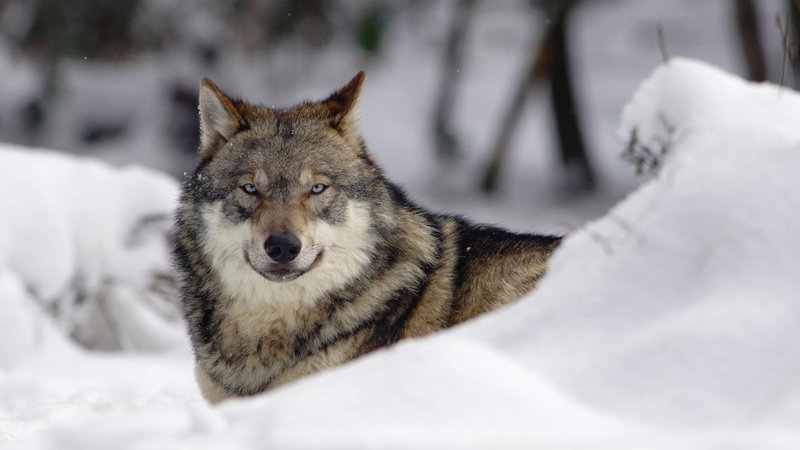
Crazy smart, like a wolf. (Kaphoto/iStock)
Udell presented the canines with the puzzle box both in the presence of humans—an owner, caretaker or familiar person—and without any person nearby. Each time, the animals had two minutes to figure out how to get at the sausage. Subjects that failed in both trials were given a third and final try in which they also received verbal encouragement from their human friend.
Udell’s findings, reported today in the journalBiology Letters, were telling. In the presence of humans, just one pet dog and none of the shelter dogs managed to open the box. Eight out of ten of the wolves, however, succeeded in enjoying the sausage treat inside.
Wolves also spent more time chipping away at the problem and more time staring at the box, as if working out how to open it. Both pet and shelter dogs, on the other hand, did the opposite—they gave up more quickly and stared at humans instead of the box, seemingly asking for help.
When humans were not around, the findings were similar—nearly all of the wolves figured out how to open the box, while just one shelter dog and no pet dogs succeeded. In the third and final trial, dogs that had failed in both of the prior tests performed a bit better when humans encouraged them.
With some human cheerleading, four of nine shelter animals and one of eight pet dogs opened the box, and all spent more time trying to open the box and looking at the box than they did when they were either alone or when their human friends remained silent.
Udell’s results indicate that dogs do seem to be overly dependent on us compared to their wild relatives, although the cause of this—whether biological, environmental or both—still needs to be worked out.
Lucky for pet pooches, however, we humans will no doubt always be there to help them navigate all of life’s tricky plastic containers.
Picking up on that last sentence, luckily for us humans our dogs will always be there to help us in innumerable ways, especially giving us unconditional love.
I came across the following video as a result of my brother-in-law, Warwick Hamilton, posting it on his Facebook page. In turn, it had been published by Jason Fechner on his FB page, describing it:
Your Tuesday Moment of Zen — Diesel, the English Bulldog who has found a new toy… and won’t let go! 🙂
In contrast to yesterday’s post highlighting the disgusting way humans kill wildlife, today is all about humans saving life. Specifically, the life of a seven-year-old French bulldog.
I came across a news item reported by Citynews in Canada on the BBC News website. This is how the news story opened:
Air Canada flight diverted to save dog from freezing
16 September 2015
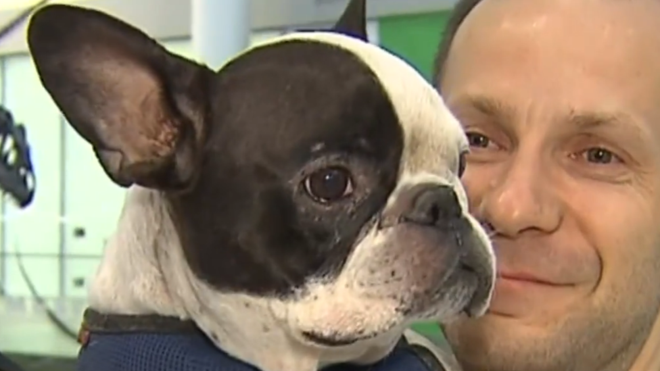
Picture copyright CityNews, Toronto.
An Air Canada flight was diverted after the pilot realised that a cargo hold heating unit failed, threatening the life of a pet dog.
Simba, a seven-year-old French bulldog, was riding in the cargo hold where – without heating – temperatures can become very cold at high altitude.
The Sunday flight from Tel Aviv, Israel, to Toronto, Canada, and was diverted to Frankfurt, Germany.
It was then a simple process to go to that CityNews website in Canada and read the original story. It contained these delightful messages:
With the dog’s well-being in peril the pilot decided to land the plane in Frankfurt, Germany.
Simba was placed on another flight and the plane continued on to Toronto.
The dog’s owner was more than grateful.
“It’s my dog, it’s like my child. It’s everything to me,” he said after they were reunited at Pearson Airport.
Aviation expert Phyl Durby said the pilot made the right call, despite tacking on about $10,000 in fuel costs and delaying the flight by 75 minutes.
“If you look at the outside temperature, if it’s minus 50 or 60, there is some insulation but it will probably still get down to below freezing (in the cargo area),” Durby said.
“The captain is responsible for all lives on board, whether it’s human or K-9.”
The owner of the dog, German Kontorovich, was thankful for the pilot’s rapid actions, “It’s my dog, it’s like my child. It’s everything to me,” Mr Kontorovich told the Canadian news website CityNews.
To close today’s good news story, watch the following:
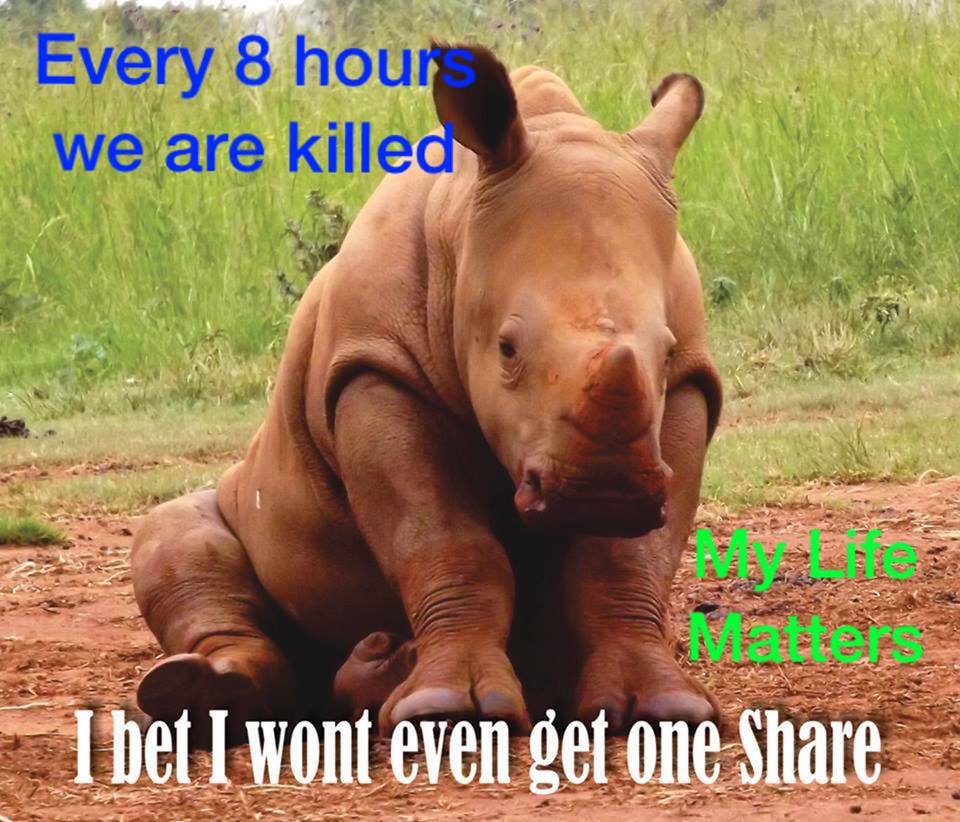
Chris Snuggs, friend from my English days, linked to an item on his Facebook page about the appalling loss of elephants and rhinos. The item included this picture:
The reason I am writing about this today is to give readers notice that on Saturday, October 3 from 10:30am – 3:00pm there is a march, a global march, for Elephants and Rhinos. The item on Facebook details the location as Jefferson Square, 1101 Eddy St, San Francisco, California 94109.
If we lived closer to San Francisco we would most definitely attend.
Back to Chris’ Facebook entry where he subsequently wrote:
I am flattered! I thought it was just my usual bilious rant! Actually, the killing of rhinos, tigers, elephants and so on is so surreally-pointless and evil as to be almost beyond belief. You might like this photo of a rhino I saw in Senegal from about 20 metres away! Magnificent and totally innocent creatures, unlike Homo Sapiens I fear.
Jean and I feel the same way about the hunting of any animals for any purpose other than feeding oneself.
The interconnectedness of everything – even beyond our wildest imagination.
A while ago John Zande signed up to follow Learning from Dogs. Naturally, I went across to John’s blog to thank him. There I discovered that John is an animal lover and an author. For he states, referring to his book, that, “BUY IT. ALL PROCEEDS GO TO ANIMAL RESCUE AND SHELTER IN BRAZIL”. Fabulous!
(I did buy the book, am about 20% through it and finding it very stimulating, – if you would like to buy it then click the image of the book on John’s home page.)
Anyway, a few days later we watched the BBC Horizon programme on multiple universes. Here’s how the BBC introduced the programme:
Which Universe Are We In?
Horizon, 2014-2015 Episode 17 of 19
Imagine a world where dinosaurs still walk the earth. A world where the Germans won World War II and you are president of the United States. Imagine a world where the laws of physics no longer apply and where infinite copies of you are playing out every storyline of your life.
It sounds like a plot stolen straight from Hollywood, but far from it. This is the multiverse.
Until very recently the whole idea of the multiverse was dismissed as a fantasy, but now this strangest of ideas is at the cutting edge of science.
And for a growing number of scientists, the multiverse is the only way we will ever truly make sense of the world we are in.
Horizon asks the question: Do multiple universes exist? And if so, which one are we actually in?
Horizon is always great to watch but this episode was incredibly stimulating and interesting. Later, in a exchange of comments to one of John’s posts, where I referred to that programme, John wrote:
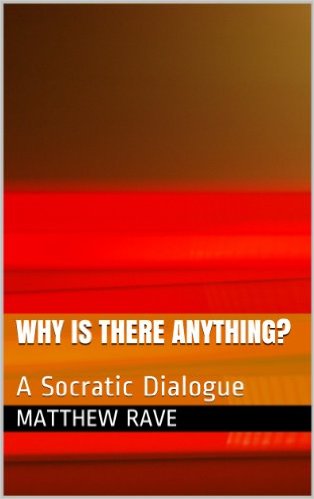
The mulitverse is actually the more reasonable explanation for why there is something, and although I don’t understand the maths, the people who do say its simplistically beautiful. Matt Rave is an associate professor of physics and comments here regularly. He has a great book on it all, Why is There Anything?
That lead me to purchasing Matthew Rave’s book that, likewise, is a most fascinating and unusual approach to this topic. His Amazon author’s page reveals that, “Dr. Matthew Rave is an assistant professor of physics at Western Carolina University, in the mountains of North Carolina. His research interests include interpretations of quantum mechanics, the geometric phase, solid state physics, and physics education.” Matthew Rave’s blogsite is here.
Matthew Rave’s book further illustrates the paradox, to my mind, that comes from thinking about why are we here, are we here and, if so, how do we know we are here?
So if that isn’t enough for you and me, then very recently The Conversation blogsite published the following from Geraint Lewis who is Professor of Astrophysics at the University of Sydney. It is republished here within the terms of The Conversation. Did I mention paradoxes and headaches!
To a human, the universe might seem like a very inhospitable place. In the vacuum of space, you would rapidly suffocate, while on the surface of a star you would be burnt to a crisp. As far as we know, all life is confined to a sliver of an atmosphere surrounding the rocky planet we inhabit.
But while the origin of life on Earth remains mysterious, there are bigger questions to answer. Namely: why do the laws of physics permit any life at all?
Hang on, the laws of physics? Surely they are a universal given and life just gets on with it?
But remember that the universe is built of fundamental pieces, particles and forces, which are the building blocks of everything we see around us. And we simply don’t know why these pieces have the properties they do.
There are many observational facts about our universe, such as electrons weighing almost nothing, while some of their quark cousins are thousands of times more massive. And gravity being incredibly weak compared to the immense forces that hold atomic nuclei together.
Why is our universe built this way? We just don’t know.
But what if…?
This means we can ask “what if” questions. What if the electron was massive and quarks were fleeting? What if electromagnetism was stronger than the nuclear strong force? If so, what would that universe be like?
Let’s consider carbon, an element forged in the hearts of massive stars, and an element essential to life as we know it.
Initial calculations of such stellar furnaces showed that they were apparently inefficient in making carbon. Then the British astronomer Fred Hoyle realised the carbon nucleus possesses a special property, a resonance, that enhanced the efficiency.
But if the strength of the strong nuclear force was only fractionally different, it would wipe out this property and leave the universe relatively devoid of carbon – and, thus, life.
The story doesn’t end there. Once carbon is made, it is ripe to be transmuted into heavier elements, particularly oxygen. It turns out that oxygen, due to the strength of the strong nuclear force, lacks the particular resonance properties that enhanced the efficiency of carbon creation.
This prevents all of the carbon being quickly consumed. The specific strength of the strong force has thus resulted in a universe with an almost equal mix of carbon and oxygen, a bonus for life on Earth.
Death of a universe
This is but a single example. We can play “what if” games with the properties of all of the fundamental bits of the universe. With each change we can ask, “What would the universe be like?”
The answers are quite stark. Straying just a little from the convivial conditions that we experience in our universe typically leads to a sterile cosmos.
This might be a bland universe, without the complexity required to store and process the information central to life. Or a universe that expands too quickly for matter to condense into stars, galaxies and planets. Or one that completely re-collapses again in a matter of moments after being born. Any complex life would be impossible!
The questions do not end there. In our universe, we live with the comfort of a certain mix of space and time, and a seemingly understandable mathematical framework that underpins science as we know it. Why is the universe so predictable and understandable? Would we be able to ask such a question if it wasn’t?
Our universe appears to balance on a knife-edge of stability. But why?
We appear to be very lucky to live in a universe that accommodates life. Zdenko Zivkovic/Flickr, CC BY
One of a multiverse
To some, science will simply fix it all. Perhaps, if we discover the “Theory of Everything”, uniting quantum mechanics with Einstein’s relativity, all of the relative masses and strengths of the fundamental pieces will be absolutely defined, with no mysteries remaining. To others, this is little more than wishful thinking.
Some seek solace in a creator, an omnipotent being that finely-tuned the properties of the universe to allow us to be here. But the move from the scientific into the supernatural leaves many uncomfortable.
There is, however, another possible solution, one guided by the murky and confused musings at the edge of science. Super-strings or M-theory (or whatever these will evolve into) suggest that the fundamental properties of the universe are not unique, but are somehow chosen by some cosmic roll of the dice when it was born.
This gives us a possible explanation of the seemingly special properties of the universe in which we live.
We are not the only universe, but just one in a semi-infinite sea of universes, each with their own peculiar set of physical properties, laws and particles, lifetimes and ultimately mathematical frameworks. As we have seen, the vast majority of these other universes in the overall multiverse are dead and sterile.
They only way we can exist to ask the question “why are we here?” is that we happen to find ourselves in a universe conducive to our very existence. In any other universe, we simply wouldn’t be around to wonder why we didn’t exist.
If the multiverse picture is correct, we have to accept that the fundamental properties of the universe were ultimately dished out in a game of cosmic roulette, a spin of the wheel that we appear to have won.
A smart partnership introduces hard-to-home dogs to high-energy humans.
Note to Readers
Last week I completed the final edit of my book of the same name as this blog, Learning from Dogs. I am learning the truth of what one experienced author said to this new author and that was that writing the book is the easy part! For the next stage is the professional editing of the manuscript. I was previously referred to Joni Wilson and I am so pleased that she is undertaking the task. Well, I think I am pleased! 😉 That last sentence comes from me utterly misjudging just how much work is being created for me as I start to go through hundreds, literally, of ‘recommendations’ from Joni. Dear readers, we are talking hours of revisions that I need, and want, to make.
All of which is my way of saying that if my posts over the next couple of weeks more strongly lean on the republishing of other material then you will understand why. In all cases I will endeavour to republish articles that are likely to interest you, of course!
So with those words in mind, here is another article from Mother Nature Network that stays with yesterday’s theme of adopting those dogs that are not necessarily the easiest to so do.
ooOOoo
Outdoorsy dogs find their perfect matches
A smart partnership introduces hard-to-home dogs to high-energy humans.
By: Jaymi Heimbuch, September 11, 2015
Anniston is on her way to her new home, thanks to a brilliant campaign to match high-energy dogs with high-energy humans. (Photo: Ruffwear)
A couple weeks ago, Outdoor Retailer held an adoption event for shelter dogs. But it wasn’t just any event — this was specifically for high-energy, adventure-loving dogs seeking high-energy, adventure-loving humans. This matchup can be tough to find at a rescue or shelter, but what if the adoption event takes place where outdoorsy folks shop? Wouldn’t the potential for love at first wag be higher? It turns out that’s exactly what happens.
Ruffwear and Best Friends Animal Society created the Ruff Adventure Dog Adoption Program to place usually hard-to-home dogs — dogs that need a lot of exercise and outdoor activity and require a home with someone who wants a companion for trail runs, hiking, camping and other fun activities. They put the program to the test at Outdoor Retailer.
Among those who found a home are:
Jennifer finds Krone
Jennifer and Krone bond after meeting at an Outdoor Retailer event. (Photo: Ruffwear)
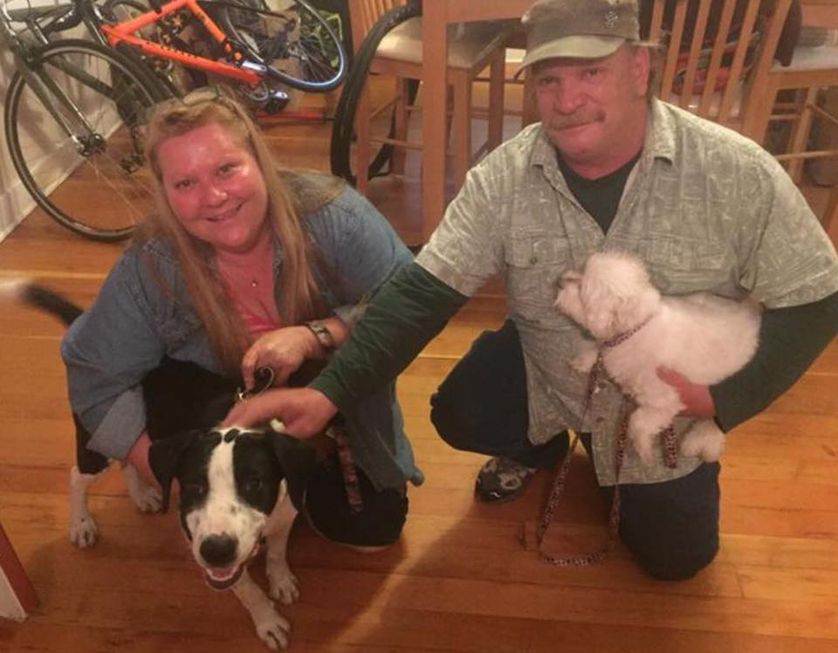
Huck finds Gerald
It’s a match made in outdoor-loving heaven for Huck the dog and Gerald, his new owner. (Photo: Ruffwear)
Niko finds his future parents
A future of happy tail-wagging adventure awaits for Niko, the black and white dog pictured at left. (Photo: Ruffwear)
“Over the course of two days, Best Friends’ Salt Lake City partner, Rescue Rovers, brought in eight fresh air-seeking, adventure-ready dogs to the Salt Palace. [I]t wasn’t long before people stopped by the Ruffwear booth to hand in their adoption requests. Of the eight dogs who attended, six were adopted,” says the press release from Ruffwear.
“People expect us to have dogs at the booth, and they’re always a draw. But we had no idea how receptive show attendees would be to actually adopting these dogs. Rescue Rovers did a great job bringing dogs that would pair well with our active, outdoorsy crowd. I think the first application came in just hours after the dogs arrived and by the end of the first day, nearly all dogs present had applications pending; it was amazing,” said Greg Freyberg, Ruffwear’s Brand Manager.
The happy tale doesn’t end with this event. Ruffwear and Best Friends continue to match these trail-loving dogs with their perfect humans. Since the program launched in May, 13 dogs have been matched, with Ruffwear covering the cost of adoption fees as well as airfare to get the dogs to their new homes.
Check out this super feel-good video explaining the adoption partnership and the wonderful service it provides to high-energy dogs:
ooOOoo
Once again, remember: Don’t Shop: Adopt!
Now where was I an hour ago???
“they” is plural, but in the previous sentence you have “dog” which is singular, so I changed this to be singular.
—
The word “over” usually has to do with physical properties—the cow jumped over the Moon, or standing over something.
—
Fast forward without a hyphen is a noun, while the hyphen makes it a verb
Ernest Hemingway apparently stated, “There is nothing to writing. All you do is sit down at a typewriter and bleed.” Well, Mr. Hemingway is correct in that while the apparatus of typing has changed out of all recognition since his days, the bleeding has not!
We have always adopted dogs on the basis of their need, never letting age come into it. In the years before I knew Jean she was rescuing dogs off the streets of Mexico, again without regard to breed, age, condition or temperament.
So this recent article on Mother Nature Network struck me as important. Please share it.
ooOOoo
Don’t be afraid to adopt an older dog, says photographer
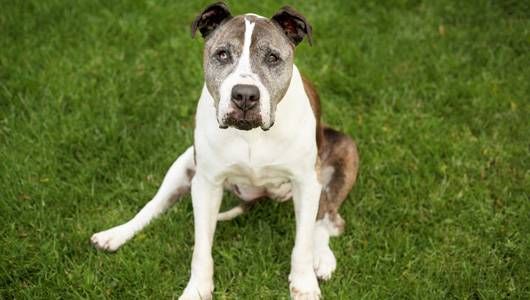
An abandoned dog named Sunny made Lori Fusaro realize that ‘no dog should die alone’ and inspired her to start a photography project to benefit senior pets.
By: Laura Moss, July 22, 2013
Photo: Lori Fusaro
The hardest part of loving a pet is having to say goodbye. That’s why the idea of adopting an older animal made dog lover Lori Fusaro so uneasy.
“I thought it would just be too sad and painful,” Fusaro told Today.com, “I didn’t think my heart could take it, so I wasn’t willing to open myself up.”
But that all changed in June 2012 when Fusaro met Shady while she was photographing dogs at the South Los Angeles Animal Shelter. Shady was 16 years old with infected eyes and a large cancerous tumor on her leg.
“She was so sad and depressed. She wouldn’t even lift her head for a treat. I didn’t think I could adopt her and I left the shelter without her. But her face never left my mind. She kept popping into my thoughts.”
As she contemplated adoption, Fusaro sought out more information on the dog.
“I thought Shady was a stray that found her way into the shelter,” she wrote on her blog. “Turns out I was wrong. Living her entire life with a family and then dumped because she was too old. With this new information, her face haunts me even more.”
Fusaro couldn’t stand the idea of the gentle dog dying alone, so she took her home and changed her name to Sunny.
“I always come back to the idea that no dog should have to die alone. Even if she got just two months of joyous, happy life, it’s worth it for my heartbreak,” she said.
Watching Sunny transform from an anxious shelter dog into the happy family member she is today inspired Fusaro to start Silver Hearts, a photography project that showcases senior pets and the joy they bring to people’s lives.
“When I realized that there were probably hundreds of Sunnys languishing in shelters, I knew I had to do something about it. Silver Hearts became a way that I could use my photography to show these dogs as loving, happy souls that have a zest for living and deserve to spend their golden years in a loving home.”
Fusaro visited families across the United States to photograph their dogs and share their compelling stories. Many of the dogs were taken to shelters because they got sick or old or because the families could no longer afford to care for them.
Although older dogs are often calmer — and already house-trained — they’re typically the highest-risk animals in a shelter. Fusaro hopes her photographs can help change that.
She launched a Kickstarter campaign to try to raise money to self-publish the book, but failed to make the fundraising goal. Fusaro is now considering other methods of publication.
“When I look back at my unwillingness to adopt an older dog, it was more about my own selfishness — about not wanting to feel that pain, not wanting to make hard decisions,” Fusaro said. “But every dog is important. Every dog deserves a home. I finally just boiled it down to love. That’s the most important thing.”
Lori explains why she photographs senior dogs in the video below.
ooOOoo
Abandoned and homeless dogs so desperately need the love of caring owners.















 Learning from Dogs