It was formed when this former volcano, “which collapsed on itself during an eruption just 7,700 years ago and slowly filled with melted snow, now stands as Oregon’s only national park.”
At over 2,000 feet deep it is the deepest lake in the United States of America.
It’s one of the biggest puzzles in cosmology. Why two different methods used to calculate the rate at which the universe is expanding don’t produce the same result. Known as the Hubble tension, the enigma suggests that there could be something wrong with the standard model of cosmology used to explain the forces in the universe.
Now, recent observations using the new James Webb Space Telescope (JWST) are shaking up the debate on how close the mystery is to being resolved.
In this episode of The Conversation Weekly podcast, two professors of astronomy explain why the Hubble tension matters so much for our understanding of the universe.
(The Conversation included two files that one could listen to but they could not be played directly. But I have left them in the post just in case.)
In February, the Nobel prize-winning physicist Adam Reiss, published a new paper. It said that new observations of far-away stars using the JWST matched those obtained by the Hubble Space Telescope.
These stars, called Cepheids, are commonly used in one method of calculating the rate at which the universe is expanding. Known as the local distance ladder, or cosmic distance ladder, this method has been around since observations first made by Edwin Hubble himself in 1929. And it generally produces a rate of expansion of around 73km per second per mega parsec.
But a second method, using predictions of the cosmic microwave background radiation left over by the Big Bang, has constantly arrived at a different number for the rate of expansion of the universe: 67km per second per mega parsec.
Reiss said that when the new data confirmed the earlier observations from the Hubble Space Telescope, the gap between the numbers remains unresolved. “What remains is the real and exciting possibility that we have misunderstood the universe,” he said.
A few months later, however, more data from the JWST, presented by Wendy Freedman, a physicist at the University of Chicago, using observations from a different set of stars, arrived at 69km per second per mega parsec, a number closer to the cosmic microwave background figure of 67. Freedman is excited that the numbers seem to be converging.
Vicent Martínez and Bernard Jones are fascinated by the Hubble tension. Jones is an emeritus professor of astronomy at the University of Groningen in the Netherlands. Martínez, his former student, is now a professor of astronomy and astrophysics at the University of València in Spain.
“The fundamental basis of science, what distinguishes science from science fiction, is our ability to verify the information we are getting,” explains Jones.
That’s why Martinez says the mystery of the Hubble tension is still driving people to:
Research and imagine experiments and organise huge projects with the complicated observation of the cosmos in order to understand what’s going on. At the end, this will affect your idea of the whole universe and probably you will need to change some fundamental ingredient of your cosmological model.
Martinez and Jones have just written a book, along with their co-author Virginia Trimble, about moments in history when scientists realised they’d got something very wrong, and had to readjust their way of thinking. Martínez thinks this could happen again with the Hubble tension:
It could happen that, for example, a new theory of gravity could solve the problem of dark energy or dark matter. We have to be open to those ideas.
Listen to Bernard Jones and Vicent Martínez talk more about the Hubble tension, and how it fits in the wider history of science, on The Conversation Weekly podcast. The episode also features an introduction from Lorena Sánchez, science editor at The Conversation in Spain.
It was a sunny spring day in Compton, California, when a group of residents spotted something white bolt across an unused canal. It’s not uncommon to find discarded items strewn along the canal, known as Compton Creek, but this was the first time they’d seen a dog trapped inside.
Situated tens of feet below ground level, the worried onlookers were unsure how a tiny pup made it into the canal in the first place.
“[T]here was no way in except to climb down,” Suzette Hall, founder of Logan’s Legacy 29 dog rescue, wrote on Facebook.
Instagram – La Fine Street Repair
The Good Samaritans rushed to help the pup, later named Sammy, but he was too scared to let anyone get close.
“There were people who went to try to get the dog, but they were unable to secure [him],” Kristina Ross, one of Sammy’s original helpers, wrote in a Facebook comment.
Facebook – Kristina Ross
Ross posted footage of Sammy sprinting down the canal on Facebook and pleaded for someone to save him. After three days of failed attempts, they contacted Logan’s Legacy, and Hall was eager to help.
Hall soon arrived with a humane dog trap in hand. As she figured out a way to lower herself into the canal to set up the trap, another pair of Good Samaritans descended.
“I [saw] the post today and jumped down the sewer with a rope,” one of the Good Samaritans wrote on Instagram. “[I] felt the need to rescue this poor baby.”
Instagram – La Fine Street Repair
The pair trudged through muddy sewer water and trash to reach Sammy. As dangerous and uncomfortable as wading through the canal was, they knew that Sammy’s experience was even worse.
Hall watched as the men tried to catch Sammy multiple times. On their final attempt, one of the guys, Nelson, successfully cornered Sammy and threw a net around him to stop him from bolting again.
Nelson then carefully gathered up the net with Sammy still in it, and his partner lifted the pup out of the canal. They handed Sammy over to Hall, who gave the dog a big, triumphant hug before loading him up in her car.
“He literally melted in my arms,” Hall wrote. “He knew he was finally safe.”
Suzette Hall
Ross, the woman who had originally posted about Sammy, offered to foster him for the night. The grateful pup slept through the night in a cozy bed before heading to the veterinary clinic the next day, where he was immediately treated for a rotten tooth and an injured paw.
The tiny dog was soon on the mend, but his rescuers still couldn’t believe what he’d been through.
“I can’t imagine how scared he was down here in that big, huge canal, all by himself,” Hall wrote on Facebook. “He’s in recovery and doing just fine.”
Suzette Hall
While Sammy recovered at the vet clinic, he stole the heart of one of the vet techs caring for him. Instantly smitten with the pup, the loving vet tech decided to give him the best forever home he could’ve ever dreamed of.
“She said, ‘We have fallen in love … can we please adopt him?’” Hall wrote on Facebook. “[It’s] just so meant to be. He is beyond loved and getting spoiled.”
Suzette Hall
Over a month after his rescue, Sammy is thriving in his new home alongside his equally tiny Chihuahua sibling. His days are filled with cozy beds, walks with his family and play sessions with his doting sibling — and he wouldn’t have it any other way.
For his rescuers, it seems like Sammy’s journey through the canal was just yesterday. But for Sammy, his days of feeling alone and scared are far in the past. Now, he only knows love.
To help pups like Sammy get the care they need, you can donate to Logan’s Legacy 29 here.
ooOOoo
I have included the link to Logan’s Legacy 29 just in case you wanted to help Sammy as well. We have made a small donation.
This is the most perfect outcome one can imagine. Beautiful Sammy!
Patrice, not his real name, lives in France. He is a thinker but also a communicator. Thank goodness! For many of Patrice’s blog posts are superb. Like this one ….
ooOOoo
No Tribe, No Vibe… Thrive With The Herd, Think Like The Herd: Not The Easiest Way To Advance Wisdom
By Patrice Ayme, June 15th, 2024.
Tribal effects are dominant, in all fields of thinking, even in the hardest sciences, logic, math, theoretical physics. It took more than three centuries for Buridan’s concept of momentum to finally rule… Among the top thinkers.
So a particular analysis is only relative to what a particular tribe will tolerate… And this is true all over, especially in so-called analytic philosophy. I recently found a (very!) unexpected effect in Relativity (by using Relativity in an unusual way). Instead of rejoicing and inquiring, the main Relativity site immediately blocked and canceled me. No debate. Never mind that I obviously knew Relativity better than most on that site. I was removed because I had not followed “the rules” … which apparently are that all what is officially known in Relativity as an Einstein cult is all there is to know.
Once I gave a physics seminar at Stanford, on Black Holes, and I prepared it with what I hoped was profound thought. Grave error. I was excoriated for showing the obvious: no good predictions without a better understanding of Quantum Mechanics. 20 years later, everybody was doing that, including the (world top) luminaries in attendance 20 years earlier.
The effect seems ubiquitous. The most creative thinkers have to be iconoclasts, and iconoclast thinkers are hated by the tribe for breaking their icons… Until great priests of the tribe (or, more craftily, their students) steal said ideas and make them their own… The best example of this is Relativity, 99% developed by Poincaré and his associates, stolen by Einstein. Poincaré, although the world’s top mathematician, and discoverer of E = mcc, and the rest of Relativity had one problem: he belonged not just to the French tribe, but was part of a family keen to resist further German invasion… His cousin was Raymond Poincaré, the President of the French Republic, fiercely opposed to German domination. .
So why do people do what they do? Generally to get power, be it just the power of clothing, a roof, food and consideration. And what provides all this? A tribe.
No tribe, no vibe…
So then what? Any time an idea surfaces, the first question of the most profound, hence most independent thinker, should be the idea’s tribal localization.
If an idea has no tribal origin, it has a much better chance to be new. Conversely, ideas which are like flags should often best be… flagged down… But some will object, where is wisdom in all this? Wisdom? What is it? The etymological root of the concept (etymology means logic of the truth…) of wisdom is to see, hence to know… The tribe has seen all there was to see, with its thousands of eyes. To see more, to see what was not seen yet… One has to go, where one didn’t go yet, or to be, what nobody was yet… or taste what had not been tasted yet (the origin of sap, hence sapiens, and sage, sagesse…)
Tribes may have the vibes, and the wiles, but also dumb down beautiful minds.
Patrice Ayme
We got to own this world, one idea at a time. And all of these ideas were born once, in one human mind, and no more than that. Thriving tribes may have the vibes and the wiles, but they never found the smarts.
ooOOoo
Of course I left a comment on Patrice’s blog. This is what I said,
It is 0430 in Oregon and I have just read your essay out to Jeannie. That was after reading it quietly myself.
It is profound. And it leads me on to thinking about the future, as in the next ten years. For recently a weather scientist (name forgotten) said that the peoples of Planet Earth have just ten years to reduce our emissions of, primarily, CO2 or we go past a global tipping point.
Just ten years! Not much time for a global tribe to pickup the vibe of this scientist and run with it. We require a global democracy so we can eschew our governments and get to work, now!
This story has been widely reported. For instance, the OregonLive website introduced the story as follows:
“After a car crash landed 61-year-old Brandon Garrett and his four dogs at the bottom of an 85-foot-ravine in eastern Oregon last Sunday, Garrett found an unexpected hero in his dog Blue.
Blue, a whippet and pit bull mix, traveled four miles to find help — and then captured the hearts of people in Baker County and beyond.”
But I am going to continue this with a YouTube video.
Dogs are truly amazing! (And I know I have said this many times before!)
You’ve probably heard people say, “It’s not the heat, it’s the humidity.” There’s a lot of truth to that phrase, and it’s important to understand it as summer temperatures rise.
Humidity doesn’t just make you feel sticky and uncomfortable – it also creates extra dangerous conditions on hot days. Together, too much heat and humidity can make you sick. And in severe cases, it can cause your body to shut down.
Meteorologists talk about the risk of heat and humidity using the heat index, but it can be confusing.
I’m a risk communication researcher. Here’s what you need to know about the heat index and some better ways meteorologists can talk about the risks of extreme heat.
Heat index is the combination of the actual air temperature and relative humidity:
Air temperature is how hot or cold the air is, which depends on factors such as the time of day, season of the year and local weather conditions. It is what your thermometer reads in degrees Celsius or Fahrenheit.
Relative humidity compares how much water vapor is in the air with how much water vapor the air could hold at that temperature. It’s expressed as a percentage.
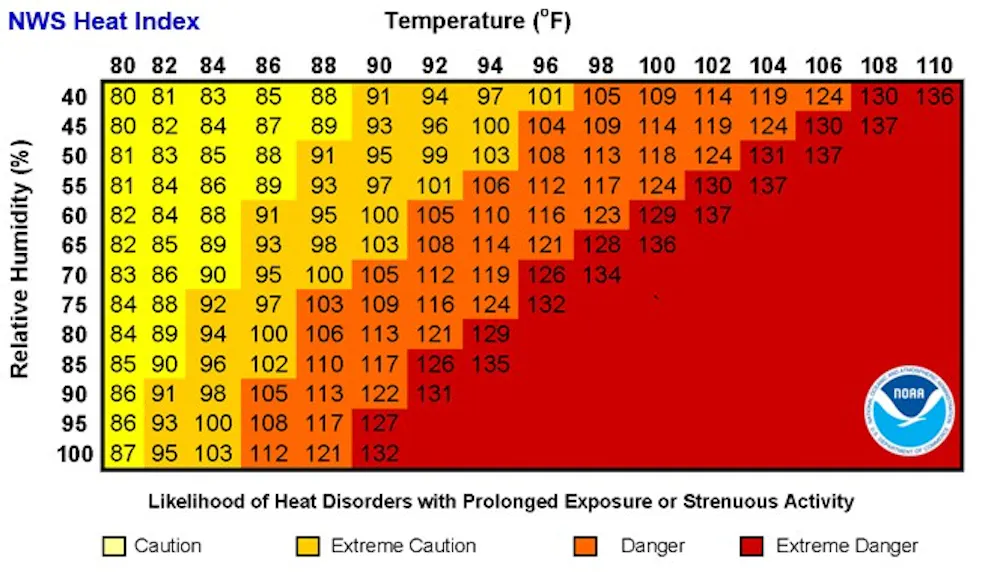
The heat index tells you what it “feels like” outside when you factor in the humidity. For example, if it’s 98 degrees Fahrenheit (36.7 Celsius) with 55% relative humidity, it might feel more like a scorching 117 F (47.2 C).
NOAA’s heat index chart shows how heat and humidity combine for dangerous temperatures. NOAA
But there’s a catch: Heat index is measured in shady conditions to prevent the sun’s angle from affecting its calculation. This means if you’re in direct sunlight, it will feel even hotter.
Apparent temperature, alerts and wet bulb
“Apparent temperature” is another term you might hear this summer.
Apparent temperature is the “feels like” temperature. It considers not only temperature and humidity but also wind speed. This means it can tell us both the heat index and wind chill – or the combination of the temperature and wind speed. When conditions are humid, it feels hotter, and when it’s windy, it feels colder.
We found that apparent temperature is even less well understood than the heat index, possibly due to the word apparent having various interpretations.
There are a few other ways you may hear meteorologists talk about heat.
Wet bulb globe temperature considers temperature, humidity, wind and sunlight. It’s especially useful for those who spend time outdoors, such as workers and athletes, because it reflects conditions in direct sunlight.
HeatRisk is a new tool developed by the National Weather Service that uses colors and numbers to indicate heat risks for various groups. More research is needed, however, to know whether this type of information helps people make decisions.
Knowing about heat and humidity is important, but my colleagues and I have found that the term heat index is not well understood.
We recently conducted 16 focus groups across the United States, including areas with dry heat, like Phoenix, and more humid areas, like Houston. Many of the people involved didn’t know what the heat index was. Some confused it with the actual air temperature. Most also didn’t understand what the alerts meant, how serious they were or when they should protect themselves.
In our discussions with these groups, we found that meteorologists could get across the risk more clearly if, instead of using terms like heat index, they focus on explaining what it feels like outside and why those conditions are dangerous.
Watches, warnings and advisories could be improved by telling people what temperatures to expect, when and steps they can take to stay safe.
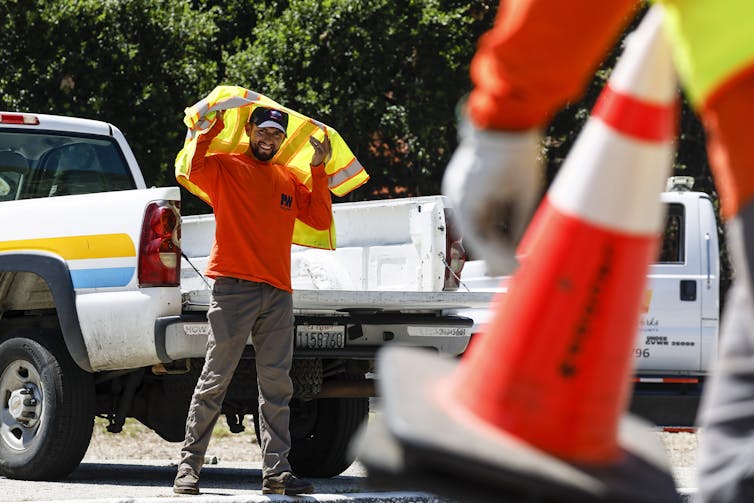
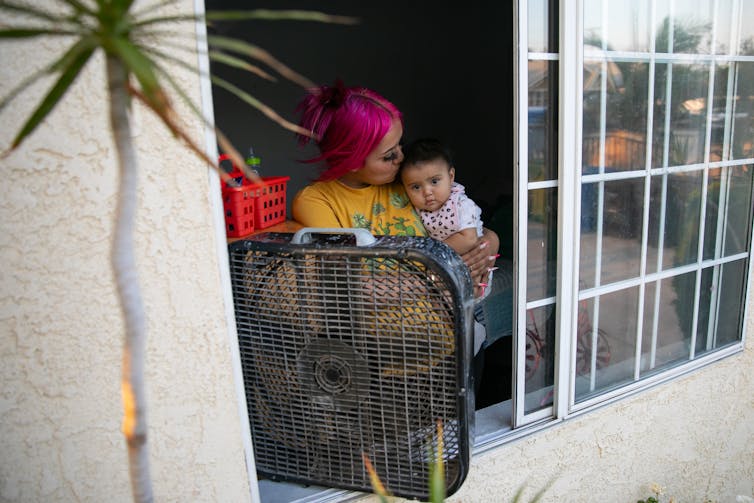
Clear warnings can help residents understand their risk and protect themselves, which is especially important for small children and older adults, who are at greater risk of heat illness. Jason Armond/Los Angeles Times via Getty Images
Climate change is exacerbating heat risks by making extreme heat more common, intense and long-lasting. This means clear communication is necessary to help people understand their risk and how they can protect themselves.
What you can do to protect yourself
With both hot and humid conditions, extra precautions are necessary to protect your health. When you get hot, you sweat. When sweat evaporates, this helps the body cool down. But humidity prevents the sweat from evaporating. If sweat cannot evaporate, the body has trouble lowering or regulating its temperature.
Although everyone is at risk of health issues in high heat, people over 65, pregnant women, infants and young children can have trouble cooling their bodies down or may run a higher risk of becoming dehydrated. Certain health conditions or medications can also increase a person’s risk of heat-related illness, so it’s important to talk to your doctor about your risk.
Heat illnesses, such as heat exhaustion and heat stroke, are preventable if you take the right steps. The U.S. Centers for Disease Control and Prevention focuses on staying cool, hydrated and informed.
Stay cool: Use air conditioning in your home, or spend time in air-conditioned spaces, such as a shopping mall or public library. Limit or reschedule your exercise and other outdoor plans that occur in the middle of the day when it is hottest.
Stay hydrated: Drink more water than you might otherwise, even if you don’t feel thirsty, so your body can regulate its temperature by sweating. But avoid sugary drinks, caffeine or drinks with alcohol, because these can cause you to become dehydrated.
Stay informed: Know the signs of heat illness and symptoms that can occur, such as dizziness, weakness, thirst, heavy sweating and nausea. Know what to do and when to get help, because heat illnesses can be deadly.
The difference between heat exhaustion and heat stroke and the CDC’s advice on how to respond. NOAA, CDC
That last diagram on staying cool, staying hydrated, and staying informed is one element in me choosing this article for publication. Further, if one looks up the website for the Centers for Disease Control and Prevention then immediately one comes across:
Stay cool indoors.Stay in an air-conditioned place as much as possible. If your home does not have air conditioning, go to the shopping mall or public library—even a few hours spent in air conditioning can help your body stay cooler when you go back into the heat.
















 Learning from Dogs