Author: Paul Handover

Dog Food Recall Update Report

I thought it would be useful to publish this.

Here is the text of an email that was received yesterday morning.

ooOOoo

Dear Fellow Dog Lover,

Because you signed up on our website, I’m sending you this recall update report. If you no longer wish to receive these emails, please click the “unsubscribe” link at the bottom of this message.
Over the past 60 days, the FDA has announced 2 dog food recalls:

  • Thogersen Family Farm recalled its raw frozen pet food due to contamination with Listeria bacteria (4/8/2019)
  • Hill’s Pet Nutrition recalled multiple lots of Prescription Diet and Science Diet wet dog foods due toxic levels of vitamin D(3/20/2019)

For details, please visit our Dog Food Recall Alerts Center.

Feeding Tip

Got a dog that’s 7 years… or older? Here are 5 of The Advisor’s Top 15 Best Senior Dog Foods for 2019:

  • Wellness Core Grain Free Senior Formula
  • Merrick Lil’ Plates Senior Dog Food
  • Purina Pro Plan Bright Mind Adult 7+
  • Diamond Naturals Senior Dog Food
  • Victor Senior Healthy Weight

Click here to see all 15 of The Dog Food Advisor’s top senior picks for May 2019.

Please feel free to share this recall update report with other dog lovers.

Mike Sagman, Editor
The Dog Food Advisor

P.S. Not already on our dog food recall notification list? Sign up to get critical dog food recall alerts by email. There’s no cost for this service. No spam. Cancel anytime.

ooOOoo

You are welcome to receive notifications via this web site but for a more reliable, long-term service then sign up to the email service.

Best wishes!

It’s time to change our habits.

Funny how things evolve!

A week ago I was casually reading a copy of our local newspaper, the Grants Pass Daily Courier, and inside was a piece by Kathleen Parker, a syndicated columnist, entitled It’s the end of everything – or not.

I found it particularly interesting especially a quotation in her piece by Robert Watson, a British chemist who served as the chair of the panel of the Intergovernmental Science-Policy Platform on Biodiversity and Ecosystem Services (IPBES). The IPBES had recently published the results of the three-year study by 145 authors from 50 countries.

So I wrote to Kathleen Parker asking if I might have permission to quote that excerpt and, in turn, received her permission to so do.

Here it is:

Robert Watson wrote in a statement that:

“the health of ecosystems on which we and all species depend is deteriorating more rapidly than ever. We are eroding the very foundation of our economies, livelihoods, food security, health and quality of life worldwide.”

But, Watson also said, it’s not too late to repair and sustain nature – if we act now in transformative ways.

It is time to change our habits both at an individual level and the level of countries working together.

Moreover we haven’t got decades. We have got to do it now!

Back to Coyotes!

Hunting, and not for food!

We hate hunting. Period.

It’s sort of alright when the person needs to hunt to stay alive. But in the Western world the incidence of that is pretty remote.

So when author Jim wrote about coyotes and hunting I had to share it with you (and, for the record, both Jean and I are atheists).  Published with Jim’s permission.

ooOOoo

The Incredible Coyote and Western Morality

How killing for fun is not only a Christian Right, but a value

By Jim, August 5th 2018.

Christian vulgarity has reigned it’s bullets down on the North American coyote for over 100 years. The longest standing extermination order in history has killed millions of coyotes and continues its bounty program in most states. Competitive hunts sponsored throughout the nation each year with cash prizes and trophies instill to our kids the right obligation to kill for fun.

“One morning in the late 1930s, the biologist Adolph Murie stood near a game trail in Yellowstone National Park and watched a passing coyote joyously toss a sprig of sagebrush in the air with its mouth, adroitly catch it, and repeat the act every few yards. At the time, Mr. Murie was conducting a federal study intended to prove, definitively, that the coyote was “the archpredator of our time.” But Mr. Murie, whose work ultimately exonerated the animals, was more impressed by that sprig-tossing — proof, he believed, of the joy a wild coyote took in being alive in the world” (1)

The majority of politicians have failed to address this with any passion, and being the good, high moral standard western value Christians that they are, continue the killing spree. A useless torture that drives the coyote without mercy and without effect. “Under persecution, the biologists argued, evolved colonizing mechanisms kicked in for coyotes. They have larger litters. If alpha females die, beta females breed. Pressured, they engage an adaptation called fission-fusion, with packs breaking up and pairs and individuals scattering to the winds and colonizing new areas. In full colonization mode, the scientists found, coyotes could withstand as much as a 70 percent yearly kill rate without suffering any decline in their total population”.

Hunters have their ultimate victim to hunt—one that can outbreed the continued onslaught. How fun is it? While the coyote is hunted for sport, they die in earnest. Leave them to experience their joy, and populations will mitigate in their own necessary way.

Christian values and morals once again are superior delayed in common decency and way off the mark—unless your talking killing for sport.

ooOOoo

I want to add a couple of comments that were left on the post:

Not many christians are bothered by this. Why should they, when you hear them quote from their holy book, that god commanded them to subdue the earth.

It is for this very reason that many christians are nonchalant when we talk about climate change

oooo

The price paid for pointlessly killing predators is a dear one. Moreover, all needless killing of animals is wrong, says the immoral, convinced atheist.

oooo

(to which Jim replied)

Part of the doctrine is to subdue and have dominion. To hell with inferior, soulless life. The ripple effect of what was once naturally flowing is tragic and painful.

Enough said!

How close are you to your dog?

A reflection on our dogs.

I was sorting out some stuff the other day and came across the following. It is the record of a talk I gave some time ago in connection with the publication of my book Learning from Dogs.

As much as I would have expected to have previously published this on the blog I cannot find an entry. So here you are!

ooOOoo

The concept of attributing dogs with human traits is nothing new. In fact the ancient Greeks came up with a fancy word for it around two thousand years ago: anthropomorphism.

As ever, the truth of the matter is not a case of black and white but subtle shades of grey. No doubt in another two thousand years as science advances and we discover more about DNA and the mysteries of the human and canine brains the picture will develop into sharper focus. In the meantime, we must satisfy ourselves with some basic observations.

Let’s start off on common ground. One thing that we all seem to agree on is that humans are at the top of the pile in terms of evolutionary sophistication. For obvious reasons we view ourselves as the being the highest life form (although there is increasing alarm that we have totally lost touch with our basic instincts, if not totally lost the plot, by endangering the very planet that sustains life as we know it).

But I digress – back to common ground. We agree that as children our mental capacity is not fully developed. We survive by our instincts and the basic needs to be fed, watered, sheltered and bonded in a family group where we defer to a natural hierarchy. When you think about it this is precisely how dogs survive.

Like children, dogs display the most basic instincts to rough and tumble, compete for toys and establish a natural pecking order. Inherent in this is the need for a parent or pack leader to set down boundaries and create order and stability out of chaos. Without this both child and dog feel insecure and may well grow to display anti-social behaviour.

You would responsibly bring a child up with love and discipline, have consistent boundaries, teach them what is safe and what is dangerous, what is sociable and what is unsociable.

Dogs too need love and discipline, consistent boundaries, and to learn what is safe and what is dangerous, what is sociable and what is unsociable.

Communicating with a child is not so very different from communicating with a dog. Young children, like dogs, do not have the power of speech so you have to work out alternative strategies to speech in order to get through to them. You will find that if you approach a dog in much the same way as you approach a child, life will be a whole lot easier for you. And the dog! Hopefully you will have realised that praise is a far stronger motivator that punishment.

A positive approach.

Take the example of the puppy that makes a puddle on the floor and the child that wets its bed. Each one of them have not learnt control of their bladder and are simply responding to the call of nature. Neither are being naughty nor are in the wrong.

Yelling at the child will only make it more stressed and, therefore, more likely to continue wetting the bed. In exactly the same way if a puppy has an accident on the carpet being harsh will make matters worse.

How many human ‘sports’ involve chasing a moving object? How many of these games also involve people working as a team to ‘catch’ these objects? Football, rugby, basketball, tennis, badminton, etc. I could go on but you get the idea.

Why do we enjoy these games? Is it not because we too are instinctively striving for a pecking order within the pack and following our predatory instincts.

“No, no no!’ I hear you say. ‘We are a civilised, sophisticated race who have created these games for our enjoyment. They are so different to the throw and fetch games our canine friends mindlessly enjoy.’

Don’t kid yourself. Look also how football supporters revert to uninhibited childlike behaviour. At worst becoming hooligans and behaving, almost literally, like savage animals when they find themselves challenged or threatened by an opposing pack.

Or on a much more positive note how hundreds of fans, unrehearsed, suddenly find one voice and break into a prefect, heart-stopping rendition of “You’ll Never Walk Alone”. Now that’s a perfect example of the ‘pack call’.

We all enjoy the close relationship we have with our dogs. Maybe sometimes we don’t realise quite how close we are.

ooOOoo

I can’t imagine life without our dogs.

They mean everything to Jeannie and me.

A photo of Pharaoh when he was quite an old fella!

Picture Parade Two Hundred and Eighty-Seven

More from Dan’s email.

oooo

oooo

oooo

oooo

oooo

oooo

Perfect. A combination of wise sayings and lovely photographs. Plus, more in a week’s time!

How much time do we have left?

A post from Patrice Ayme.

I have subscribed to Patrice Ayme for some time now. I don’t know who he is because he writes under a pseudonym, or a nom-de-plume. (And, indeed, I may have the gender incorrect but I’m pretty sure it’s a male.)

Patrice writes frequently and doesn’t mince his words.

But then he writes about really serious matters and often has criticism for the ‘ruling classes’.

Such as he has in the post that was published on the 6th May. I left a comment:

It’s extremely worrying and not something that can be put off. The clock is at 5 minutes to midnight. In Britain Extreme Resistance are pursuing a campaign that may just produce a political outcome. And, indeed, the English Government have come up with goals to combat climate change.

So keep banging your drum, Patrice, and hope that urgent action across the world isn’t too far away.

To which Patrice replied:

Dear Paul:
thanks! Here I am fighting with my daughter’s school, which has decided to install artificial, plastic grass. It’s horrendous for the environment, and it endangers the lives of children (in many ways, including a disease called “SUBEROSIS” caused by organic cork.) Here real ecologist take it hard, and have started to burn artificial plastic flame retardant fields: 13,000 were recently installed in the USA, a proof of mass corruption…
Feel free to use my essay on your site, BTW, of course…
And thanks again…
P

Now I hadn’t heard of Suberosis before, but no problem, a quick web search brought up Wikipedia and this:

Suberosis is a type of hypersensitivity pneumonitis usually caused by the fungus Penicillium glabrum (formerly called Penicillum frequentans) from exposure to moldy cork dust.[1][2] Chrysonilia sitophilia, Aspergillus fumigatus, uncontaminated cork dust, and Mucor macedo may also have significant roles in the pathogenesis of the disease.[1]

Cause

Cork is often harvested from the cork oak (Quercus suber) and stored in slabs in a hot and humid environment until covered in mold.[1] Cork workers may be exposed to organic dusts in this process, leading to this disease.[1]

I don’t fully understand how the laying of artificial grass leads to possible Suberosis.

But I have decided to republish even though it has nothing to do with dogs! (Well, not directly.)

ooOOoo

Nature Collapsing, Plutocracy Thriving

Both phenomena are related. The more nature collapses, the more plutocracy thrives (see the multi-centennial fall of Rome, for reference). Small people and other losers have no interest to see nature collapse. However, plutocracy does. Because Pluto-Kratia, Evil-Power, is best expressed and justified during war-like states, and civilizational collapse sure qualifies.

Plutocracy survived the collapse of the Roman and Carolingian empires with flying colors. In the Roman case, most noble families had a bishop in their midst. The collapse of the Renovated Empire of the Romans (Renovatio Imperii Romanorum) and its renewal by the Ottos and Capets brought the feudal order, another plutocratic success.

Now is no different: we have a terminal CO2 crisis bringing in extreme, sudden temperature, acidification and ocean rises: 1% of US CO2 is from state subsidized private jets. Nobody notices, because media have made sure to create entire generations just preoccupied by celebrities, not by what is going on, which is really most significant.

Nor has the media been keen to notice the likes of Biden annihilated the Banking Act of 1933, in the 1990s, bringing in the age of the financial plutocracy… itself a heavy financier of fossil fuels. So all what some schools are thinking of is installing “Apps”, and plastic grass, instead of teaching sustainable global citizenship. We are cruising towards an apocalypse, at an increasing pace: the Sixth Mass Extinction. The United Nations just came up (May 6, 2019) with an analysis made by 132 countries and 455 scientists: one million species are disappearing. For example, nearly all amphibians.

https://www.cnn.com/2019/05/06/world/one-million-species-threatened-extinction-humans-scn-intl/index.html
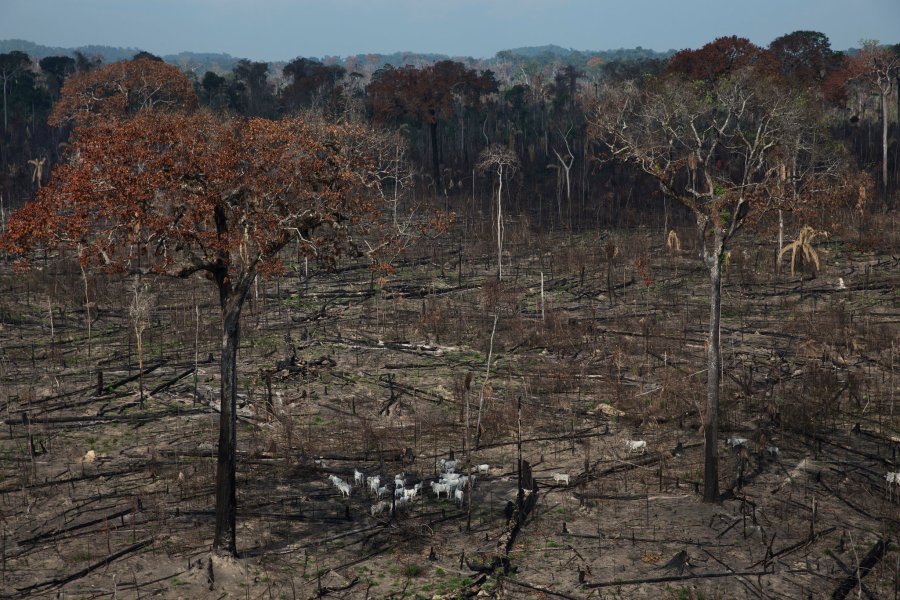
One problem with burning forests in the tropics is that what is left are often extremely poor soils (differently from northern European soils, which are very forgiving, explaining in great part why north west Europe replaced the Greco-Roman world…) Cattle grazing on a tract of illegally cleared Amazon forest in Pará State, Brazil. In most major land habitats, the average abundance of native plant and animal life has fallen by 20 percent or more, mainly over the past century,,, [Credit Lalo de Almeida for The New York Times]

In Africa, burned forest is often replaced by lateritis, a soil which is red, baked, hard… for the good reason that it is full of Aluminum.

It is the Sixth Mass Extinction, but this time the dinosaurs have thermonuclear weapons.

What to do? Get involved, get aware, protest. Protests can become unbearable to the powers that be.

This is the way the fascist government of Brunei on the island of Borneo was just dealt with. It drew powerful international condemnation when it rolled out its interpretation of sharia laws on April 3. Now, the Sultan of Brunei, Hassanal Bolkiah, reverted his decision: after all, the country won’t enforce Islamic laws that include stoning to death for rape, adultery and gay sex.

Killing all the people who got killed in World War Two was atrocious. However, what is now unfolding has the potential to be way way worse. Einstein said he didn’t know which weapons will be used to fight World War Three, but next it would be sticks and stones. That was naively optimistic. If we acidify further the ocean with acid from CO2, we may kill the Earth’s oxygen making mechanism. Not really news, as this was clear five years ago already:

https://patriceayme.wordpress.com/2014/05/30/global-hypoxia/ 

Many behave as if there will be no tomorrow, because they feel that way! It’s a self-fulfilling prophecy, it has to be resisted.

What’s needed, beyond recording what’s going on, is interpreting it, going beyond, building ideas, and moods meant to last. Only deeper thinking can do this, and ensure a planet capable of lasting. Because we are not at the regional level anymore. When climate change, plus nefarious human impact, forced the Harappan civilization to abandon its homeland, the Indus valley, it was dealing with forces it had no idea existed. Maybe there are such forces out there. But there are also plenty of forces we can see, and which are plenty lethal enough, at civilizational scale, and the scale of the entire biosphere. Stop. And think. One million species are marching towards extinction, among the plants and animals we know.

Patrice Ayme

***

***

From NYT:

WASHINGTON — Humans are transforming Earth’s natural landscapes so dramatically that as many as one million plant and animal species are now at risk of extinction, posing a dire threat to ecosystems that people all over the world depend on for their survival, a sweeping new United Nations assessment has concluded.

The 1,500-page report, compiled by hundreds of international experts and based on thousands of scientific studies, is the most exhaustive look yet at the decline in biodiversity across the globe and the dangers that creates for human civilization. A summary of its findings, which was approved by representatives from the United States and 131 other countries, was released Monday [May 6, 2019] in Paris. The full report is set to be published this year.

Its conclusions are stark. In most major land habitats, from the savannas of Africa to the rain forests of South America, the average abundance of native plant and animal life has fallen by 20 percent or more, mainly over the past century. With the human population passing 7 billion, activities like farming, logging, poaching, fishing and mining are altering the natural world at a rate “unprecedented in human history.”

At the same time, a new threat has emerged: Global warming has become a major driver of wildlife decline, the assessment found, by shifting or shrinking the local climates that many mammals, birds, insects, fish and plants evolved to survive in. When combined with the other ways humans are damaging the environment, climate change is now pushing a growing number of species, such as the Bengal tiger, closer to extinction.

As a result, biodiversity loss is projected to accelerate through 2050, particularly in the tropics, unless countries drastically step up their conservation efforts.

ooOOoo

I’m in the autumn of my life and may not live to see the consequences of what we are doing to Nature and to the Planet.

Then again, if some of the predictions bear true, I won’t have to live an awful lot longer to experience real change.

It’s time for a complete re-analysis of our relationship with the natural world.

Coyote puppies

An obvious follow-on to yesterday’s post.

We all know about how wolves habituated themselves to human all those thousand of years ago but the same is happening to coyotes today.

There was an article on EarthSky on March 28th, 2019 that I want to share with you, and here it is:

ooOOoo

How coyote pups get used to humans

Posted by in | March 28, 2019

Across North America, coyotes are moving into urban environments. While human residents are having to get used to the new animal neighbors, coyotes are also habituating to people.

Seven-week-old coyote pups walk through the research facility in Utah as the mother follows. The first pup carries a bone in its mouth. Image via USDA National Wildlife Research Center/Steve Guymon.

As coyotes are moving into urban environments across North America, many human residents – whether they like it or not – are having to get used to them. Meanwhile, how are coyotes habituating to people?

A new study, published December 2018 in the peer-reviewed journal Ecology and Evolution, suggests that coyotes can habituate to humans quickly and that habituated parents pass this fearlessness on to their offspring.

Image via Connar L’Ecuyer via National Park Service/Flickr.

Until the 20th century, coyotes lived mostly in the U.S. Great Plains. But when wolves were hunted almost to extinction in the early 1900s, coyotes lost their major predator, and their range began to expand.

With continuing landscape changes, coyotes are now increasingly making their way into suburban and urban environments — including New York City, Los Angeles and cities in the Pacific Northwest — where they live, mainly off rodents and small mammals, without fear of hunters.

The aim of the new study, was to understand how a skittish, rural coyote can sometimes transform into a bold, urban one — a shift that can exacerbate negative interactions among humans and coyotes. University of Washington biologist Christopher Schell is the first author of the study, Schell said in a statement:

Instead of asking, ‘Does this pattern exist?’ we’re now asking, ‘How does this pattern emerge?’.

A key factor, the researchers suggest, might be parental influence. Coyotes pair for life, and both parents contribute equally to raising the offspring. This may be because of the major parental investment required to raise coyote pups, and the evolutionary pressure to guard them from larger carnivores.

The new study observed eight coyote families at the U.S. Department of Agriculture’s Predator Research Facility in Utah during their first and second breeding seasons. These coyotes are raised in a fairly wild setting, with minimal human contact and food scattered across large enclosures.

Five-week-old coyote pups eat food rations during the experiment. These second-litter pups were born in 2013 to more-experienced parents, and were more likely to approach a human. Image via USDA National Wildlife Research Center/Christopher Schell.

But during the experiment researchers occasionally placed all the food near the entrance of the enclosure and had a human researcher sit just outside, watching any approaching coyotes, from five weeks to 15 weeks after the birth of the litter. Then they documented how soon the coyotes would venture toward the food. Schell said:

For the first season, there were certain individuals that were bolder than others, but on the whole they were pretty wary, and their puppies followed. But when we came back and did the same experiment with the second litter, the adults would immediately eat the food – they wouldn’t even wait for us to leave the pen in some instances.

Parents became way more fearless, and in the second litter, so, too, were the puppies.

In fact, the most cautious pup from the second-year litter ventured out more than the boldest pup from the first-year litter. Schell said:

The discovery that this habituation happens in only two to three years has been corroborated, anecdotally, by evidence from wild sites across the nation. We found that parental effect plays a major role.

He added:

Even if it’s only 0.001 percent of the time, when a coyote threatens or attacks a person or a pet, it’s national news, and wildlife management gets called in. We want to understand the mechanisms that contribute to habituation and fearlessness, to prevent these situations from occurring.

Bottom line: A new study suggests coyotes puppies learn from their parents how to habituate to humans.

Source: Parental habituation to human disturbance over time reduces fear of humans in coyote offspring

Via University of Washington

ooOOoo

I love the fact that coyotes pair for life and take an equal measure of responsibility in bringing up their pups.

Once again, we humans can learn from our natural cousins.

The wolf in our dogs.

Or is it the other way around?

A fascinating article about the domestication of the wolf to the domesticated dog appeared on the BBC back in March.

It was, in turn, based on a report issued by Nature and makes interesting reading. But for the shorter version, read on:

ooOOoo

Study reveals the wolf within your pet dog

By Helen Briggs, BBC News, Science and Environment
14 March 2019

Scientists say the negative image of wolves is not always justified. Getty Images.

Wolves lead and dogs follow – but both are equally capable of working with humans, according to research that adds a new twist in the tale of how one was domesticated from the other.

Dogs owe their cooperative nature to “the wolf within”, the study, of cubs raised alongside people, suggests.

But in the course of domestication, those that were submissive to humans were selected for breeding, which makes them the better pet today.

Scientific Reports published the study.

FRIEDERIKE RANGE/VETMEDUNI VIENNA Dogs were more likely to follow human behaviour
FRIEDERIKE RANGE/VETMEDUNI VIENNA.Wolves were equally able to cooperate with humans but also took the lead

Grey wolves, at the Wolf Science Center in Vienna, were just as good as dogs at working with their trainers to drag a tray of food towards them by each taking one end of a rope.

But, unlike the dogs in the study, they were willing to try their own tactics as well – such as stealing the rope from the trainer.

Friederike Range, from the Konrad Lorenz Institute, at Vetmeduni Vienna university, said: “It shows that, while wolves tend to initiate behaviour and take the lead, dogs are more likely to wait and see what the human partner does and follow that behaviour.”

About 30,000 years ago, wolves moved to the edges of human camps to scavenge for leftovers.

The subsequent “taming” process of domestication and selective breeding then slowly began to alter their behaviour and genes and they eventually evolved into the dogs that we know today.

Follow Helen on Twitter.

ooOOoo

Now it seems no better way to end today’s post than by selecting a short Nat Geo video to watch. (Out of many videos on YouTube regarding wolves.)

Wonderful animals.

Metaldehyde Toxicity in Dogs.

Read this for the sake of your dogs!

Belinda emailed me five days ago about this problem that affects the common bug control products.

She sent me a link to a feature on the Healthy Pets website, from where I take today’s post.

ooOOoo

Common Bait Brands Are Extremely Deadly

Written by Dr. Karen Shaw Becker

Story at-a-glance

    • A team of veterinary researchers recently revealed a complete cure for metaldehyde toxicity in dogs; it’s called hemodialysis-hemoperfusion — a procedure used to remove kidney toxins from the blood
    • Metaldehyde is a chemical found in many snail and slug baits and is highly toxic to dogs, cats and wildlife; metaldehyde poisoning in dogs is common worldwide and about 25% of affected dogs don’t survive
    • A 10-pound dog can show signs of poisoning after eating as little as 1 ounce of a slug/snail bait containing 3% metaldehyde
    • Dogs who receive early, aggressive and appropriate supportive treatment for metaldehyde toxicity can fully recover within a few days, however, treatment is difficult and costly

Dogs explore the world with their noses and often, their mouths. In addition, most are indiscriminate eaters. This combination can lead to all sorts of challenges for dog parents — some funny, some gross, and unfortunately, some that are potentially deadly.

The latter category includes a long list of toxic substances found both indoors and out that most dogs will sniff and perhaps taste, given the chance. One of these poisons goes by a name many of you have probably never heard of: metaldehyde, a chemical used to kill slugs and snails.

Metaldehyde is highly toxic to mammals and birds and is the sixth most common substance veterinarians ask about when they call the 24-hour Veterinary Poisons Information Service, a worldwide emergency hotline. There is no known antidote for metaldehyde toxicosis, and supportive treatment is complicated and costly. Death occurs in approximately 25% of poisoning cases involving dogs.

Veterinary Research Team Uncovers a Complete Cure

Lucky for us, a team of veterinarians at the University of Munich became concerned about the number of poisonings and the prognosis for dogs with metaldehyde toxicity. They did some outside-the-box thinking and decided to see if a technique called hemodialysis-hemoperfusion — a procedure used to remove kidney toxins from the blood — might be an effective treatment.

The Morris Animal Foundation funded a grant that allowed the researchers to test their theory on plasma samples contaminated with metaldehyde. They were able to successfully reduce concentrations of the toxin in the samples, so the next step was to see if the technique would work on an actual dog.

Enter Jimbo, a Jack Russell Terrier who sampled slug bait containing metaldehyde. By the time he was brought to the university research team, Jimbo was having one seizure after another, without fully regaining consciousness. The team quickly performed hemodialysis on the dog, and within 24 hours he was back on his feet and on his way home.

As of this writing, the veterinary team has treated 10 dogs with their novel therapy and all 10 had a complete recovery. Their research findings will be published in the not-too-distant future for use by the global veterinary community.

Common Brands of Bait Sold in the US

As I mentioned earlier, metaldehyde is a chemical most commonly found in slug and snail baits. The baits usually come in granule form, but can also be found in liquid, powder, meal, gel/paste or pellet form. The baits are designed to release metaldehyde for about 10 days to two weeks under moderately moist conditions.

Bran or molasses is usually added to the baits to make them more attractive to snails and slugs, which also makes them appealing to dogs. Baits sold for home use in the U.S. generally contain between 2% and 5% metaldehyde. According to veterinarian Dr. Ahna G. Brutlag of the Pet Poison Helpline, the products most commonly reported to the hotline in this country include:1

      • Ortho Bug-Geta Snail & Slug Killer and Ortho Bug-Geta Plus Snail, Slug & Insect Killer
      • Corry’s Slug & Snail Death
      • RainTough Deadline Slug & Snail Killer
      • Force II Deadline Slug & Snail Killer
      • Lilly Miller Slug, Snail & Insect Killer Bait

Other U.S. brands include Antimilace, Cekumeta, Meta, Metason, OR-CAL, Slugger Snail & Slug Bait, Ortho Metaldehyde 4% Bait, Slug Pellets, Slugit Pellets and Slug-Tox. Surprisingly, in Europe, slug and snail baits can contain up to 50% metaldehyde. The chemical is also used in small heating systems (e.g., camping stoves) and lamps. The Japanese use metaldehyde in color flame tablets that are ignited for entertainment purposes.

Signs of Metaldehyde Toxicity

Dogs typically eat slug bait either off the ground or from a container. We don’t yet know how metaldehyde causes toxicity, only that it’s extremely deadly. A 10-pound dog can show signs of poisoning after eating as little as 1 ounce of a typical bait containing 3 metaldehyde.2 The chemical is also toxic to cats, though cases of poisoning are rare. It can also affect wildlife.

If your pet ingests bait containing metaldehyde, signs of toxicity will develop quickly, typically within the hour. The first sign is usually vomiting, because the toxin irritates the lining of the stomach. Next come neurologic signs, which can include anxiousness, increased heart and respiratory rates, excessive drooling, a stiff or drunken gait, and in some cases, hypersensitivity to touch.

As the toxicity progresses, there are muscle tremors that often trigger a high fever that can lead to organ failure. Nystagmus (rapid back-and-forth movement of the eyes) may also occur.

Symptoms of metaldehyde toxicity continue to progress for several hours after the bait is ingested, ultimately resulting in lethargy and weakness, continuous muscle tremors or seizures, loss of consciousness and death if the dog doesn’t receive aggressive, appropriate treatment in time.

Diagnosis and Treatment

Diagnosis of metaldehyde toxicity is most often based on clinical signs and suspected exposure to slug bait. It’s possible to test the stomach contents for the presence of metaldehyde, but the results won’t be back quickly enough to be of any benefit in saving the dog.

Veterinarians typically run a number of diagnostic tests (i.e., complete blood cell count, serum chemistry profile, urinalysis, etc.) to rule out other possible causes for a pet’s symptoms, as well as to find possible complications resulting from the poisoning that also require treatment.

Veterinarians will induce vomiting in dogs brought to them within an hour of ingesting metaldehyde who aren’t showing any neurologic signs. They’ll also be given activated charcoal to bind the metaldehyde still in the intestines, decreasing further absorption. If you can’t get your dog to a clinic within an hour, your veterinarian may instruct you to induce vomiting at home before leaving.

In dogs whose conditions aren’t stable enough to safely induce vomiting, the stomach can be emptied using gastric lavage, a procedure requiring anesthesia and a tube that is passed through the esophagus to the stomach. The tube is used to drain the contents of the stomach, flush it with fluids and place activated charcoal in there to bind whatever metaldehyde remains.

Dogs who undergo gastric lavage will need to stay in the hospital for several hours to receive additional doses of activated charcoal and be closely monitored for signs of toxicity. If signs develop, a longer hospitalization will be required. Supportive care while hospitalized can help keep your dog comfortable and deal with certain effects of the toxin such as tremors, seizures and blood abnormalities. Intravenous (IV) fluids will be given and your pet’s body temperature will be closely monitored.

Prognosis and Prevention

Most dogs with metaldehyde toxicity who receive early, aggressive, appropriate treatment recover fully within two to three days. However, treatment can be expensive, especially in severe cases requiring sedation or anesthesia. Since the cost of treatment can be prohibitive, and since metaldehyde poisoning isn’t something any loving pet parent wants their dog to endure, prevention should always be the goal.

My recommendation is to avoid using slug and snail baits containing metaldehyde and/or other toxic chemicals. If you want to protect your garden from the critters, consider using broken shells, lava rock or other alternatives to snail and slug bait.

Veterinarian Dr. Catherine Barnett of VCA Hospitals also suggests using copper bands around plants, or adding lavender, mint or rosemary plants to your garden. You can also fill shallow cans with beer to attract and drown slugs.3 You can find additional nontoxic solutions at this link.

Sources and References

ooOOoo

It’s yet another reason why one should wherever possible keep the whole of one’s property clear of all chemical products. And try as hard as you can to stop your dogs and cats from ‘straying’ onto your neighbour’s land.

Thank you, Belinda.

Eleven dogs all perfectly composed!

Taking their family portrait!

Our six dogs are such a beautiful family that it’s hard to imagine that we once had eleven dogs; actually more than that.

But our six still aren’t as well behaved as the eleven dogs in The Dodo article.

ooOOoo

Whole Pack Of Dogs Sits Perfectly Still For Their Family Portrait

Their foster mom is truly a dog whisperer.
BY

PUBLISHED ON 04/24/2019

Anyone who has ever tried to convince even one dog to sit still for a photo knows just how difficult it can be — but one woman has managed to do the impossible with — wait for it — 11 dogs.

Melissa Lentz

Melissa Lentz, who fosters dogs through Releash Atlanta, told The Dodo in a rundown about who is in this photo.

“Top from left: Mia, Pancake, Paxton,” Lentz said. “Bottom from left: Benji, Gizmo, Alex, Penny, Donny, Lula, Monroe and Rudy.”

Lentz added that seven of the depicted dogs are fosters waiting for homes, while “Gizmo, Donny, Monroe and Rudy are mine,” she said.

Even more remarkable, perhaps, is the fact that that perfect portrait is far from a one-time fluke.

Melissa Lentz

“I have tons of these photos,” Lentz said.

Melissa Lentz

Sometimes, Lentz even manages to join the pack for that perfect shot.

But how does she get such perfect family portraits — something that’s hard enough even for humans?

Melissa Lentz

Lentz’s secret seems to have to do with the particular relationships she forms with the dogs. One can almost see the bond reflected in the way the dogs look at her as she’s snapping the photos.

Melissa Lentz

“I literally just put them on the couch one by one and they situate themselves!” Lentz said. “I don’t use food [or] treats or anything. I just tell them to look at me.”

Melissa Lentz