Year: 2022

Climate Change

Paul Handover’s talk to the Grants Pass Humanists and Freethinkers group, Saturday, 17th September, 2022

oooo

Martin Lack, a good friend of Paul’s from England, wrote a book called The Denial of Science. The first words in the preface were from Sir Fred Hoyle, Fellow of the Royal Society (1915-2001).

Once a photograph of the Earth taken from the outside is available, once the sheer isolation of the Earth becomes plain, a new idea as powerful as any in history will be let loose.

Here, in Paul’s opinion, is that photograph:
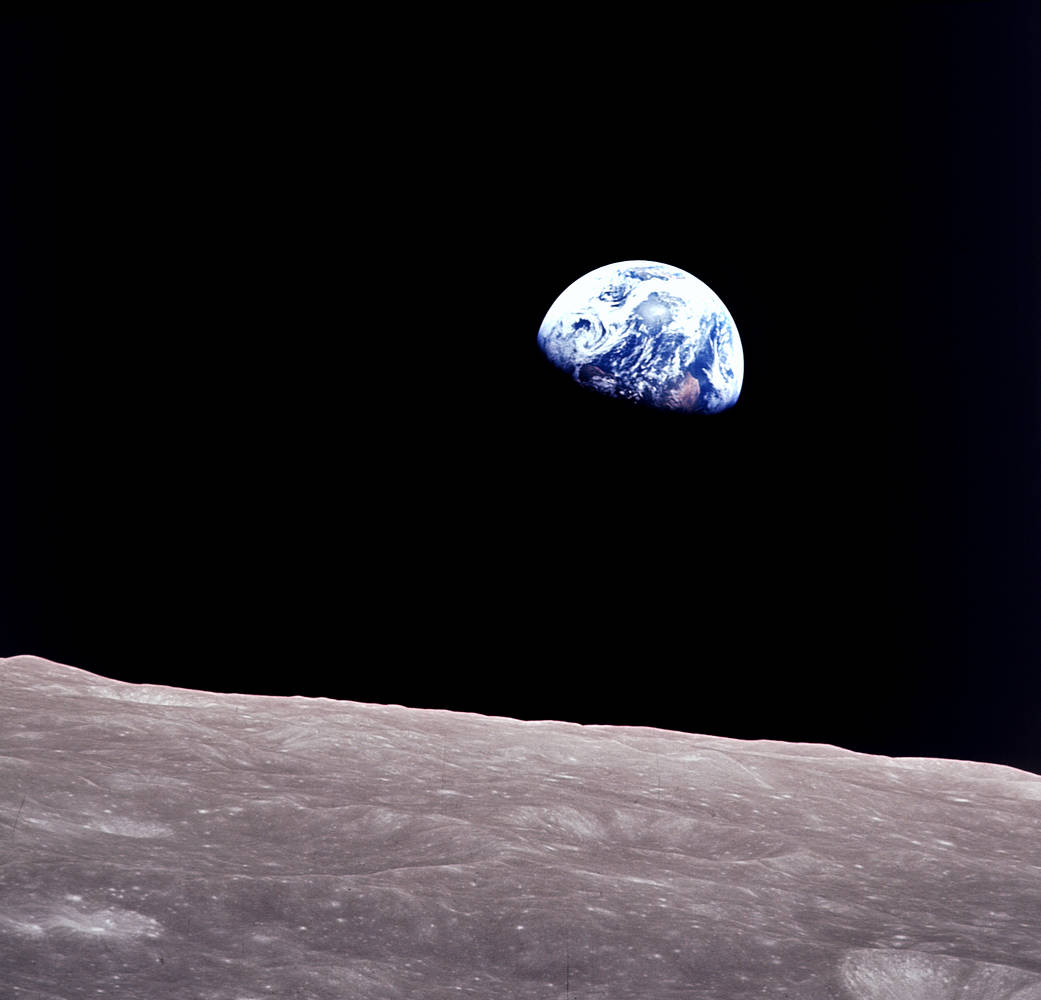
Taken aboard Apollo 8 by Bill Anders, this iconic picture shows Earth peeking out from beyond the lunar surface as the first crewed spacecraft circumnavigated the Moon, with astronauts Anders, Frank Borman, and Jim Lovell aboard.
Image Credit: NASA Last Updated: Dec 23, 2020
Editor: Yvette Smith

The 2021 United Nations Climate Change Conference was held in Glasgow, Scotland, UK, from 31st October to 13th November 2021. It was called COP26 because it was the 26th UN Climate Change Conference to be held. It was opened by the Prince of Wales, now King Charles III.

The Prince warned: “Time has quite literally run out.”

It is us!

The UN’s Intergovernmental Panel on Climate Change (IPCC) kicked off its 2021 report with the following statement: “It is unequivocal that human influence has warmed the atmosphere, ocean and land.

The article also says: It took a while, but climate modelling is now refined enough to predict how things would go without human influence, within a margin of error. What we are observing today, however, is beyond that margin of error, therefore proving that we have driven the change.

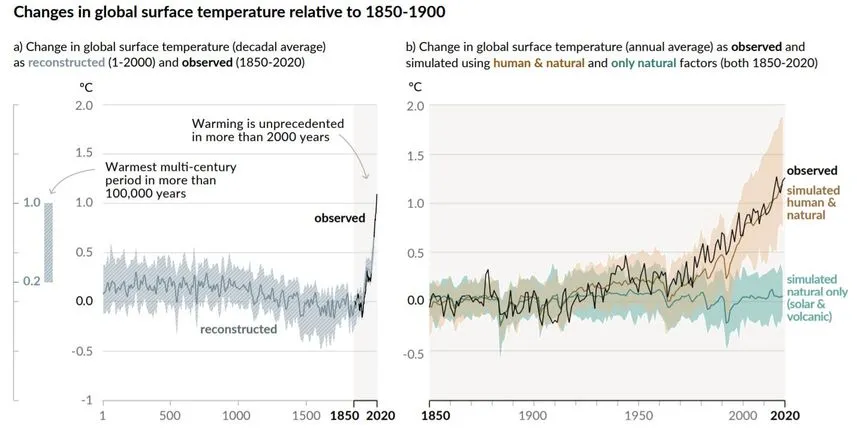
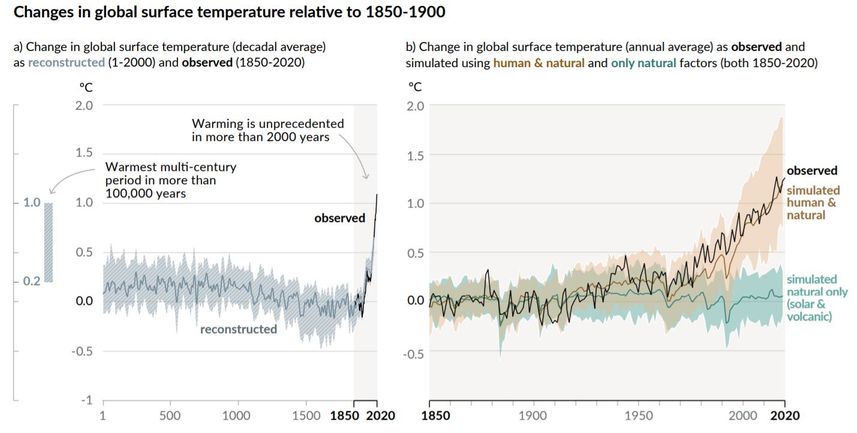
It is getting hot

The last decade was the hottest in 125,000 years.
The oceans

We live on a water world. The facts are that 71% of the Earth’s surface is water-covered and the oceans hold about 96.5% of all Earth’s water. A 2019 study found that oceans had sucked up 90% of the heat gained by the planet between 1971 and 2010. Another found that it absorbed 20 sextillion joules of heat in 2020  – equivalent to two Hiroshima bombs per second. A (chiefly British) definition of a sextillion: It is the cardinal number equal to 1036. Sextillion is a number equal to a 1 followed by 21 zeros. 1,000,000,000,000,000,000,000 is an example of a sextillion.

Carbon-dioxide

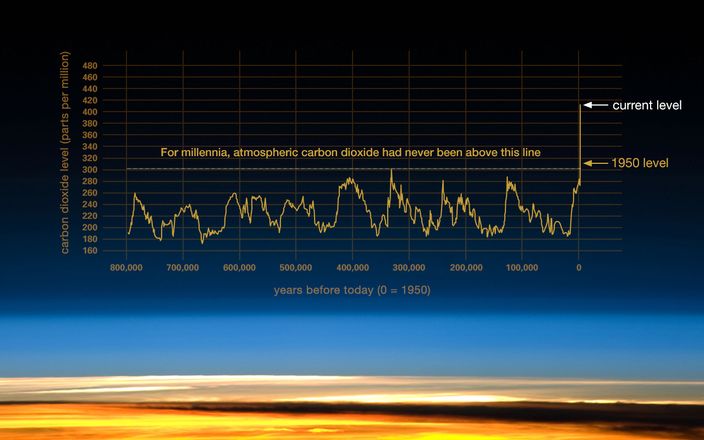
In fact CO2 levels are now the highest that they have been in 2 million years. Today, they stand at close to 420 parts per million (ppm). To put that into context pre-industrial levels, say before 1750, had CO2 levels around 280 parts per million.
We are losing ice big time

Paul can do no better than to quote from Earth.org“Since the mid-1990s, we’ve lost around 28 trillion tons of ice, with today’s melt rate standing at 1.2 trillion tons a year. To help put that into perspective, the combined weight of all human-made things is 1.1 trillion tons. That’s about the same weight as all living things on earth.”

To repeat that: Every single year we are losing 1.2 trillion tons of ice! (1,200,000,000,000).

Extreme weather

We can now attribute natural disasters to human-driven climate change with certainty. We can now say with precision how much likelier we made things like the North American summer 2021 heatwave, which the World Weather Attribution says was “virtually impossible” without climate change. Then there is the Indian heatwave that experts believe was made 30 times more likely because of climate change.

Climate change mitigation

There is a long and comprehensive article on the above subject on WikiPedia. I will quote from the paragraph Needed emissions cuts.

If emissions remain on the current level of 42 GtCO2, the carbon budget for 1.5°C (2.7°F) will be exhausted in 2028. (That’s 42 gigatons, as in 1 gigaton is a unit of explosive force equal to one billion (109) tons of trinitrotoluene (TNT).

In 2022, the Intergovernmental Panel on Climate Change (IPCC) released its Sixth Assessment Report on climate change, warning that greenhouse gas emissions must peak before 2025 at the latest and decline 43% by 2030, in order to likely limit global warming to 1.5°C (2.7°F).

Secretary-general of the United Nations António Guterres clarified that for this to happen “Main emitters must drastically cut emissions starting this year”.

WikiPedia also reports that: The United Nations Framework Convention on Climate Change, the UNFCCC, aims to stabilise greenhouse gas (GHG) concentrations in the atmosphere at a level where ecosystems can adapt naturally to climate change, food production is not threatened, and economic development can proceed in a sustainable fashion. Currently human activities are adding CO2 to the atmosphere faster than natural processes can remove it.

We need to act now, otherwise…

… it will be too late for billions of us.
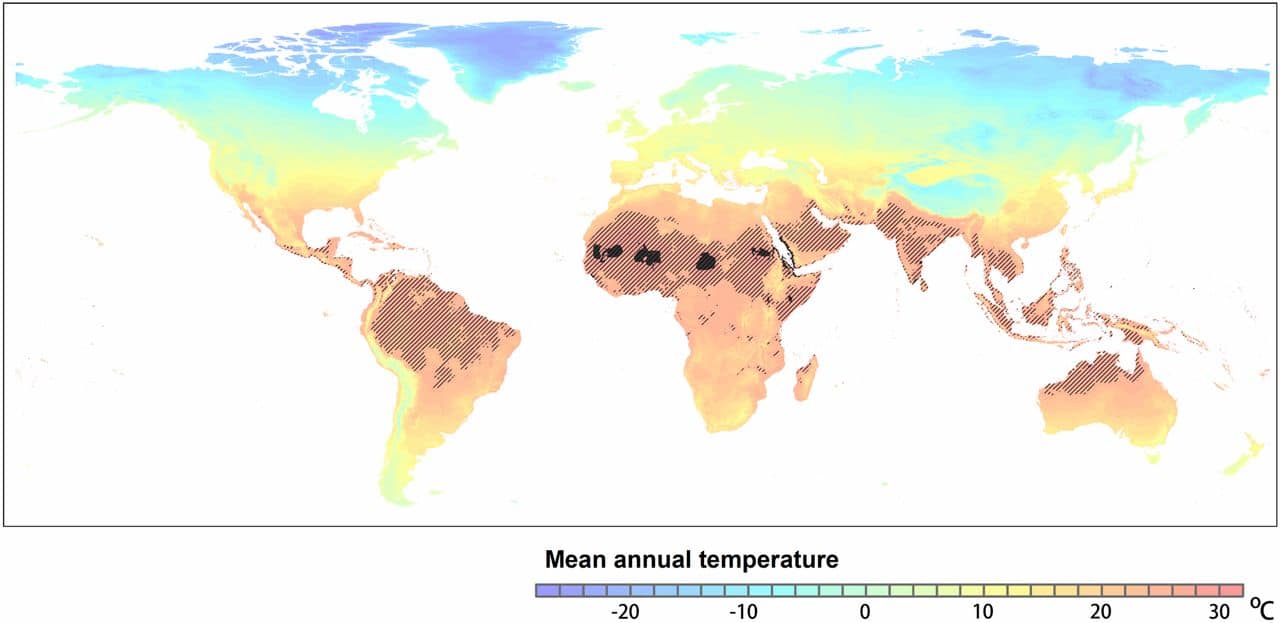
This may be the most catastrophic of our climate change facts. As of now, only 0.8% of the planet’s land surface has mean annual temperatures above 29°C (84.2°F) mostly in the Sahara desert and Saudi Arabia (solid black in the map).

study by Xu et al. (2020) called “Future of the Human Niche” found that by 2070, under a high emissions scenario, these unbearable temperatures could expand to affect up to 3 billion people (dark brown areas in the map).

Doing nothing is much worse than doing something

On the current path, climate change could end up costing us 11 to 14% of the global GDP by mid-century. Regression into a high emissions scenario would mean an 18% loss, while staying below 2°C would reduce the damage to only 4%. 

It has been proposed that ending climate change would take between $300 billion and $50 trillion over the next two decades. Even if $50 trillion is the price tag, that comes down to $2.5 trillion a year, or just over 3% of the global GDP. 

These are the facts. There is no disputing them. Paul and Jean, Paul’s wife, are relatively immune from the effects, because of their ages, but not entirely so. The last few weeks of summer (2022) with the imminent risk of their property being damaged by wildfires is one example. The last three winters being below average rainfall is another (and the prediction that next year will continue with below average rainfall). But it is the youngsters Paul fears most for. On a personal note, his daughter and husband have a son, Morten, and he is presently 12. What sort of world is Morten growing up in?
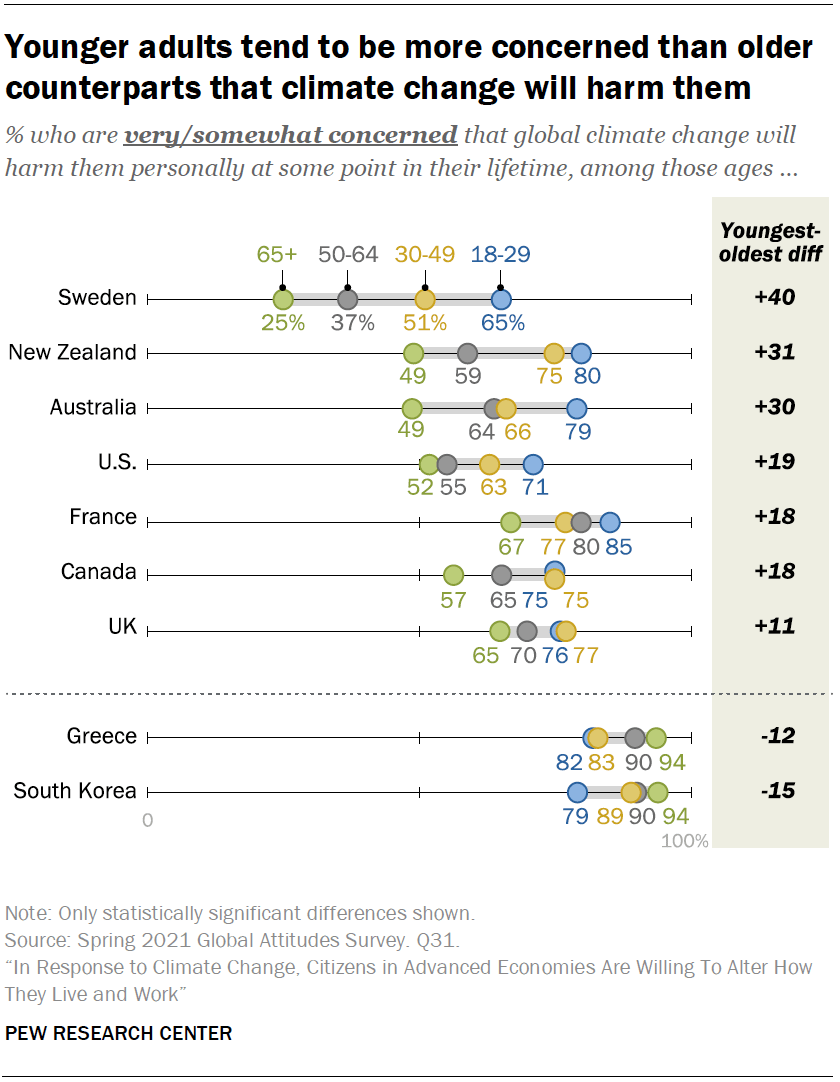
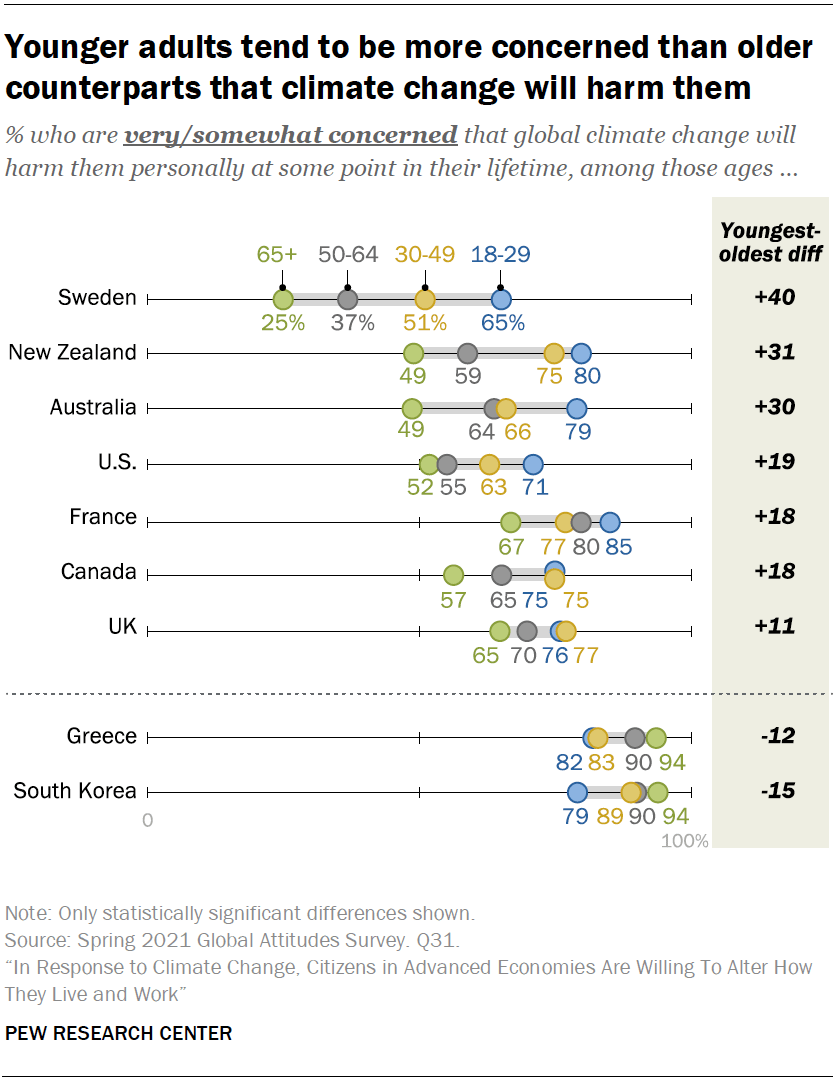
What about global attitudes to climate change?

Here is another chart setting out those concerns.
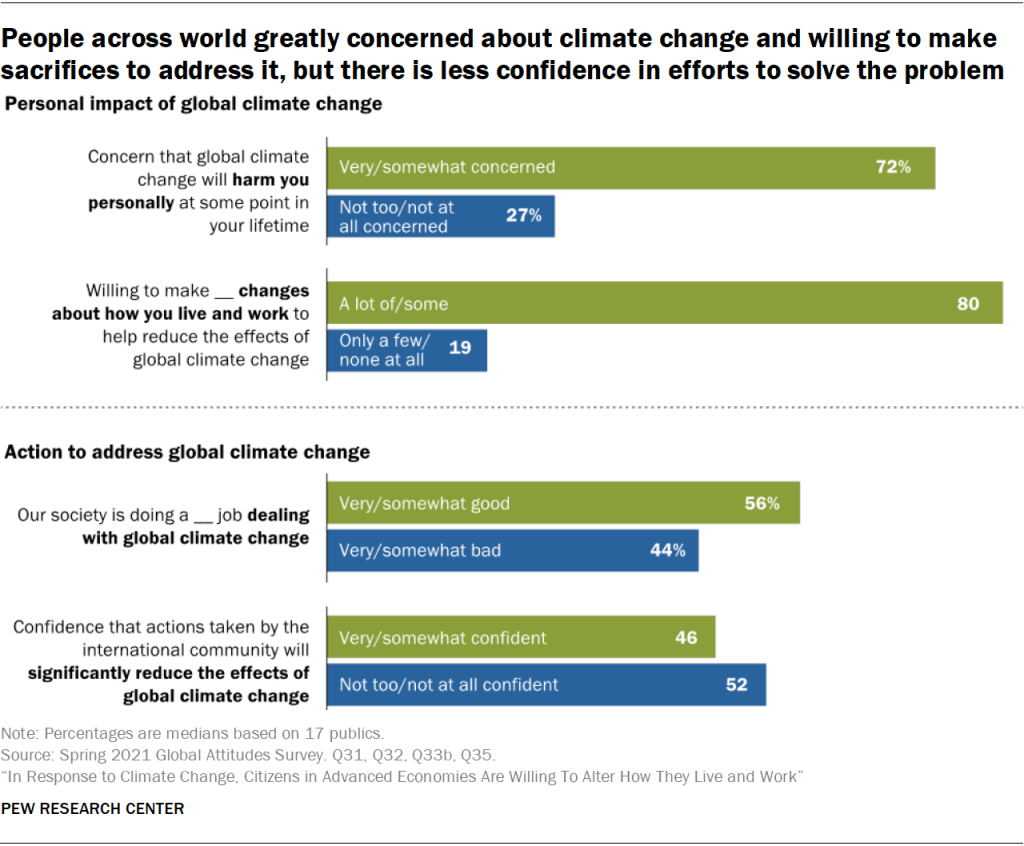
Paul is not a political animal. However he recognises that it is our leaders, globally, but especially in the top 10 countries in the world, who have to be leaders!

Here are the top 10 countries with areas of their country in square kilometres:

Russia. 17,098,242,

Canada. 9,984,670,

United States. 9,826,675,

China. 9,596,961,

Brazil. 8,514,877,

Australia. 7,741,220,

India. 3,287,263,

Argentina. 2,780,400,

Kazakhstan. 2,724,400, and

Algeria, 2,381,741.

But these are the top ten countries based on land size. That is not helpful. We have to examine the top countries in terms of CO2 emissions. Here are the top five countries, as in the top five worst, (readings from 2020):

  1. USA, 416,738 metric tons,
  2. China, 235,527 tons,
  3. Russia, 115,335 tons,
  4. Germany, 92,636 tons, and,
  5. UK, 78,161 metric tons.

This puts the USA as the top worst country, some 77% ahead of China.

So focussing on the USA, again in 2020, the split of greenhouse gas emissions, was:

  1. Transportation, 27%,
  2. Electric Power, 25%,
  3. Industry, 24%,
  4. Commercial and Residential, 13%,
  5. Agriculture, 11%.

So back again to all five countries we say, please, dear leader, make this the number one priority for your country, and for the world.

The end.
Picture Parade Four Hundred and Fifty-One

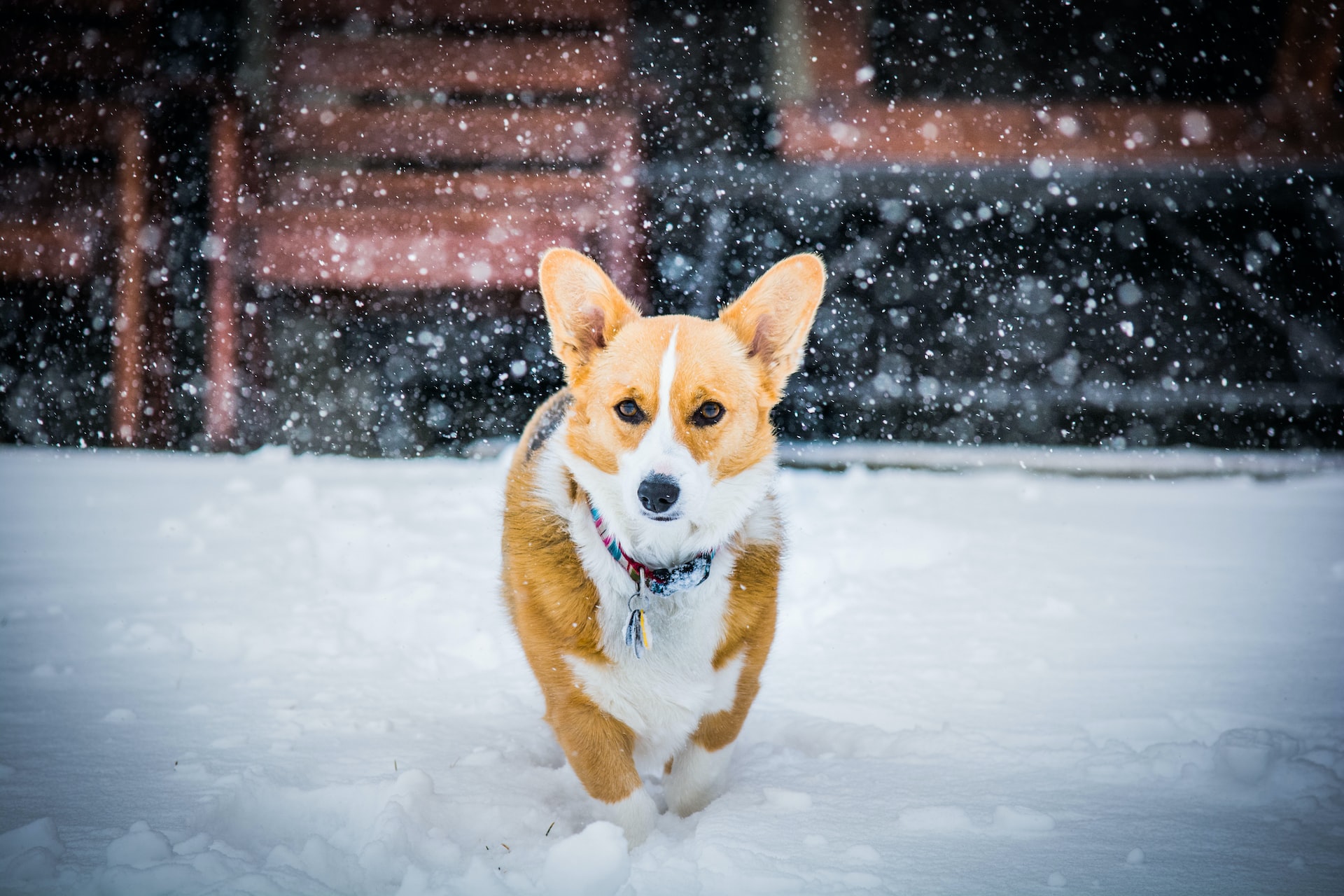
A selection of Corgis!

It seemed appropriate to share these with you today. Again, from Unsplash.

oooo

oooo

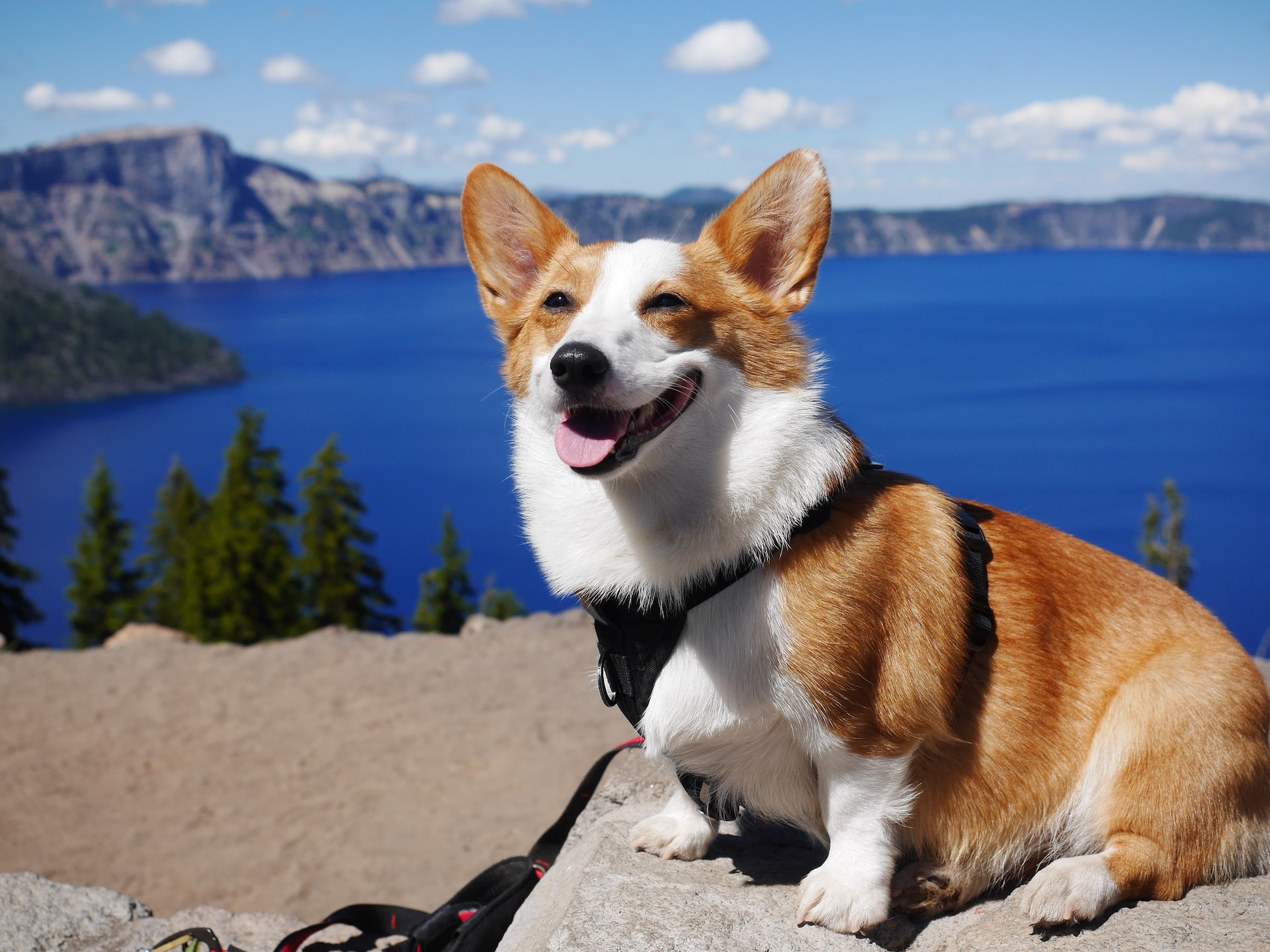
This Corgi is next to Crater Lake in Oregon!

oooo

oooo

oooo

oooo

Beautiful!

Remembering the Queen and her Corgis

It seems fitting to share this!

Until Her Majesty is laid to rest next Monday it is impossible just to come up with a topic that has nothing to do with her. That’s my feeling (and I am sticking to it)! 😉

Voice of America is a website that I recently came across and they appear to allow the republication of their stories. On September 12th, they published an article about the the Queen and her Corgis and it is shared with you all.

ooOOoo

A Queen and Her Corgis: Elizabeth Loved Breed Since Childhood

Britain’s Queen Elizabeth II, left, looks at a Corgi dog as British television presenter Paul O’Grady, second right, looks on during a visit to Battersea Dogs and Cats Home in London on March 17, 2015.

LONDON — 

For many people around the world, the word corgi is forever linked to Queen Elizabeth II. 

Princess Diana once called them a “moving carpet” always by her mother-in-law’s side. Stubby, fluffy little dogs with a high-pitched bark, corgis were the late queen’s constant companions since she was a child. She owned nearly 30 throughout her life, and they enjoyed a life of privilege fit for a royal pet. 

Elizabeth’s death last week has raised public concerns over who will care for her beloved dogs. But Sky News reported Sunday, according to a palace spokesman, the corgis will live with Prince Andrew and his ex-wife Sarah Ferguson. 

“One of the intriguing things people are wondering about at the funeral is whether a corgi is going to be present,” said Robert Lacey, royal historian and author of “Majesty: Elizabeth II and the House of Windsor.” “The queen’s best friends were corgis, these short-legged, ill-tempered beasts with a yap that doesn’t appeal to many people in Britain but was absolutely crucial to the Queen.” 

Puppy love

Elizabeth’s love for corgis began in 1933 when her father, King George VI, brought home a Pembroke Welsh corgi they named Dookie. Images of a young Elizabeth walking the dog outside their lavish London home would be the first among many to come over the decades. 

When she was 18 she was given another and named it Susan, the first in a long line of corgis to come. Later there were dorgis — a dachshund and corgi crossbreed — owned by the queen. Eventually they came to accompany her in public appearances and became part of her persona. 

Throughout Elizabeth’s 70 years on the throne, the corgis were by her side, accompanying her on official tours, reportedly sleeping in their own room at Buckingham Palace with daily sheet changes, and occasionally nipping the ankles of the odd visitor or royal family member. 

Three of them even appeared alongside the queen as she climbed into James Bond’s waiting helicopter in the spoof video that opened the 2012 Summer Olympics in London. 

Royal treatment

British author Penny Junor documented the dogs’ feisty lives in a 2018 biography “All the Queen’s Corgis.” 

She writes that Elizabeth walked and fed the dogs, chose their names, and when they died, buried them with individual plaques. Care for the corgis had fallen largely on the queen’s trusted dressmaker and assistant Angela Kelly and her page Paul Whybrew. 

The corgis were also present when the queen welcomed visitors at the palace, including distinguished statesmen and officials. When the conversation lulled, Elizabeth would often turn her attention to her dogs to fill the silence. 

“She was also concerned about what would happen to her dogs when she is no longer around,” Junor wrote, noting that some royal family members did not share her fondness for the corgis. 

After the death of her corgi Willow in 2018, it was reported that the queen would not be getting any more dogs. 

But that changed during the illness of her late husband, Prince Philip, who died in 2021 at age 99. She turned once again to her beloved corgis for comfort. On what would have been Philip’s 100th birthday last year, the queen was given another dog. 

In addition to her human family, Elizabeth is survived by two corgis, a dorgi, and a cocker spaniel.

ooOOo

It is clear from all the news and tributes presented following Her Majesty’s death on September 8th that she had a very special affection for her Corgis. As does Jean for all our dogs!

We are getting close to it being too late!

As in we humans living on this planet.

Next Saturday I am giving a talk to our local Freethinkers and Humanists group on climate change. As a result of this I was doing some research on the subject and I thought that I would share what I found with you.

But first may I say that the new King of the United Kingdom, King Charles III, may not have ages and ages on the throne but he is a committed environmentalist. In a recent VoA article the Prince of Wales, as he was then, reported that when Charles opened the COP26 climate summit, held in Scotland last year, and gave the opening speech, urging world leaders seated in front of him to redouble their efforts to confront global warming, he warned: “Time has quite literally run out.”

It is us!

The UN’s Intergovernmental Panel on Climate Change (IPCC) kicked off its 2021 report with the following statement: “It is unequivocal that human influence has warmed the atmosphere, ocean and land.

A little later the article says: It took a while, but climate modelling is now refined enough to predict how things would go without human influence, within a margin of error. What we are observing today, however, is beyond that margin of error, therefore proving that we have driven the change.

It is getting hot

The last decade was the hottest in 125,000 years. There are a number of graphs to support this. Here is one:

The oceans

One of the facts of having a water world, 71% of the Earth’s surface is water-covered, and the oceans hold about 96.5% of all Earth’s water, is that a 2019 study found that oceans had sucked up 90% of the heat gained by the planet between 1971 and 2010. Another found that it absorbed 20 sextillion joules of heat in 2020  – equivalent to two Hiroshima bombs per second.

Carbon-dioxide

In fact CO2 levels are now the highest that they have been in 2 million years. Today, they stand at close to 420 parts per million (ppm). To put that into context pre-industrial levels, before 1750, had CO2 levels around 280 parts per million.

We are losing ice big time

I can do no better than to quote from Earth.org: Since the mid-1990s, we’ve lost around 28 trillion tons of ice, with today’s melt rate standing at 1.2 trillion tons a year. To help put that into perspective, the combined weight of all human-made things is 1.1 trillion tons. That’s about the same weight as all living things on earth.

I repeat: Every single year we are losing 1,200,000,000,000 tons of ice!

Extreme weather

We can now attribute natural disasters to human-driven climate change with certainty. We can now say with precision how much likelier we made things like the North American summer 2021 heatwave, which the World Weather Attribution says was “virtually impossible” without climate change as well as the Indian heatwave, which experts believe it was made 30 times more likely because of climate change.

Climate change mitigation

There is a long and comprehensive article on the above subject on WikiPedia. I will quote from the paragraph Needed emissions cuts.

If emissions remain on the current level of 42 GtCO2, the carbon budget for 1.5 °C could be exhausted in 2028. (That’s 42 gigatones, as in 1 gigaton is a unit of explosive force equal to one billion (109) tons of trinitrotoluene (TNT).

In 2022, the Intergovernmental Panel on Climate Change (IPCC) released its Sixth Assessment Report on climate change, warning that greenhouse gas emissions must peak before 2025 at the latest and decline 43% by 2030, in order to likely limit global warming to 1.5°C (2.7°F). Secretary-general of the United Nations, António Guterres, clarified that for this “Main emitters must drastically cut emissions starting this year”.

Then just before that paragraph WikiPedia reports that: The UNFCCC aims to stabilize greenhouse gas (GHG) concentrations in the atmosphere at a level where ecosystems can adapt naturally to climate change, food production is not threatened, and economic development can proceed in a sustainable fashion. Currently human activities are adding CO2 to the atmosphere faster than natural processes can remove it.

We need to act now, otherwise…

… it will be too late for billions of us.

This may be the most catastrophic of our climate change facts. As of now, only 0.8% of the planet’s land surface has mean annual temperatures above 29°C, mostly in the Sahara desert and Saudi Arabia (solid black in the map below).

study by Xu et al. (2020) called “Future of the Human Niche” found that by 2070, under a high emissions scenario, these unbearable temperatures could expand to affect up to 3 billion people (dark brown areas).

Doing nothing is much worse than doing something

On the current path, climate change could end up costing us 11 to 14% of the global GDP by mid-century. Regression into a high emissions scenario would mean an 18% loss, while staying below 2°C would reduce the damage to only 4%. 

It has been proposed that ending climate change would take between $300 billion and $50 trillion over the next two decades. Even if $50 trillion is the price tag, that comes down to $2.5 trillion a year, or just over 3% of the global GDP. 

Climate change is an incredibly complex phenomenon, and there are many other things happening that were not covered above.

These are the facts. There is no disputing them. Jean and I are relatively immune from the effects, because of our ages, but not entirely so. The last few weeks with the imminent risk of our property being damaged by wildfires is one example. The last three winters being below average rainfall is another. But it is the youngsters I fear most for. On a personal note, my daughter and husband have a son and he is now 12. What sort of world is he growing up in?

So here is a view of the global population of young people.

Just before I close let me show you my final chart. It goes to show our attitudes.

I am not a political animal. However I recognise that it is our leaders, globally, but especially in the top 10 countries in the world, who have to be leaders! Here are the top 10 countries.

So, please, dear leader, make this the number one priority for your country and for the world (areas of their country in square kilometres): Russia. 17,098,242, Canada. 9,984,670, United States. 9,826,675, China. 9,596,961, Brazil. 8,514,877, Australia. 7,741,220, India. 3,287,263 and Argentina. 2,780,400.