Once again, the pictures are selected by me and duplications cannot be ruled out. Thanks to Mr. P for showing me how to download smaller versions of the photographs! It was easy once I had my eyes opened!
In many ways this has been a strange month in a somewhat strange year! No, more than that! We are at last seeing climate change come to the fore in terms of topics. Yves Smith, who produces Naked Capitalism (and it’s a great blog) had an item on climate change recently. Here’s an extract:
Yves here. As many of you know, I am considerably frustrated with Green New Deal advocates, because I see them as selling hopium. They act as if we can preserve modern lifestyles as long as we throw money, some elbow grease, and a lot of new development (using current dirty infrastructure to build it) at it. We’re already nearing the point where very bad outcomes, like widespread famines and mass migrations due to flooding, are baked in. And even that take charitably assumes that a rump of what we consider to be civilization survives.
There were many replies from a variety of people; I loved this one from Tom Stone:
A rational response to this crisis is not politically or societally feasible.
And the crisis is here, now.
The changes are not linear, a concept many of the people I talk to about climate change have difficulty accepting.
Large parts of the SF Bay Area are going to be heavily impacted (It’s my stomping ground, so I’m familiar with it) by salt water intrusion, levee failure, lack of water to to changing precipitation patterns in the Sierra’s…
A lot of Bay Area Housing is built on fill or in low lying areas, those homes will start to be abandoned within a decade if current trends continue.
Add the devastation from the inevitable Earthquake on the Hayward Fault which our local and State Governments are totally incapable of dealing with and it is going to be a godawful mess.
I looked at the Disaster planning for a quake on the Hayward Fault some years ago and all of the assumptions are for a “Best Case” scenario.
The quake won’t come in October during a drought and a high wind event, it won’t come at the wrong time of day, it won’t come in the spring during a high water period when Levee’s are stressed…
The Bay areas disaster response center was built in the 1950’s to withstand a nuclear attack, it is underground and was built smack dab in the middle of the Hayward Fault.
Have I mentioned that 20 years after 9/11 the various emergency responders do not have a commonality in their communications gear?
The more people that read this and other article the better.
Plus I am going to include my reply:
Your piece, Yves, that you published from Rolf was excellent and so was Tom Stone’s comment above. The scale of the issue is immense but at least climate change has now become a mainstream topic, and rightly so. National Geographic magazine published a special edition in May, 2020 to commemorate the anniversary of the fiftieth Earth Day. I think it was 1962 when Rachel Carson published Silent Spring. So we can’t complain that this isn’t a new issue. But whether or not we make it to the one hundred anniversary of that first Earth Day depends on the myriad of actions that we, as in all of us, including especially our leaders and politicians, make NOW! Let me spell it out. NOW means within the next 5 years at the latest. I am 76 and a passionate advocate of a change in mass behaviors. For I have a single grandson, Morten, living with his parents back in England who is 10. I fear for his future and for the future of all of his age.
Anyway, to get back to the article about dogs that I wanted to share with you. It is from Treehugger.
ooOOoo
This 13-Year-Old Dog Has a Home Again
It’s heartbreaking when senior pets lose their families.
This weekend, my husband and I were the last step in a transport to get a dog to her new home.
Typically, when we have a new dog in the backseat, it’s a raucous foster puppy (or two) in a crate. There’s usually barking and tumbling and playing until the motion of the car lulls them to sleep.
But this passenger was a much different story.
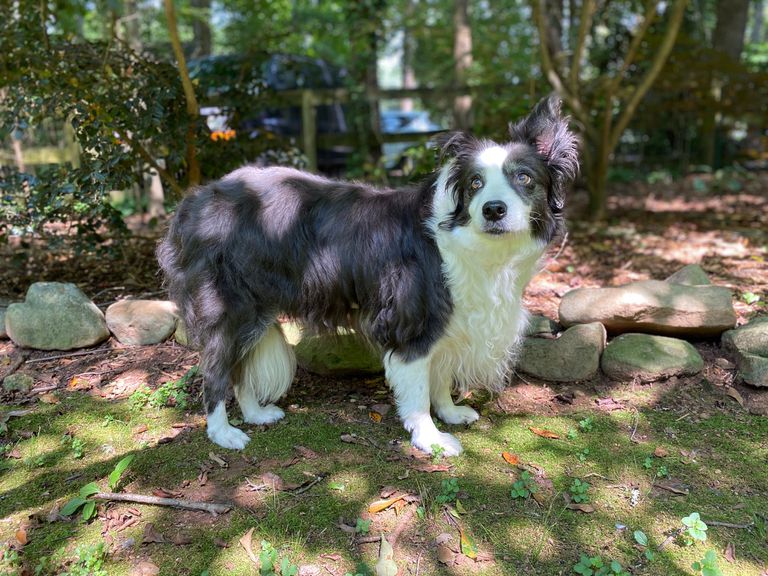
Magdalen is a 13-year-old border collie. Her owner gave her up temporarily when he was sick, but when he fully recuperated a few months later, he said he didn’t want her back. He had her since she was a puppy but now had no place for her.
The family who had given her a temporary home had children and other dogs and was unable to give her a permanent home. When Speak St. Louis, the rescue I work with, was contacted about the border collie, they offered to take her in.
She went to the groomer for her very matted coat and to the vet for a basic health check.
The spa visit made her look (and no doubt, feel) much better. But the vet didn’t have great news. She had to have surgery for mammary masses and her mouth was swollen with all sorts of dental issues. One surgery later and she had six masses removed. Two teeth fell out during cleaning and 11 more had to be extracted.
Fortunately, the growths were benign and she slowly began to recover.
Stressed and Resigned
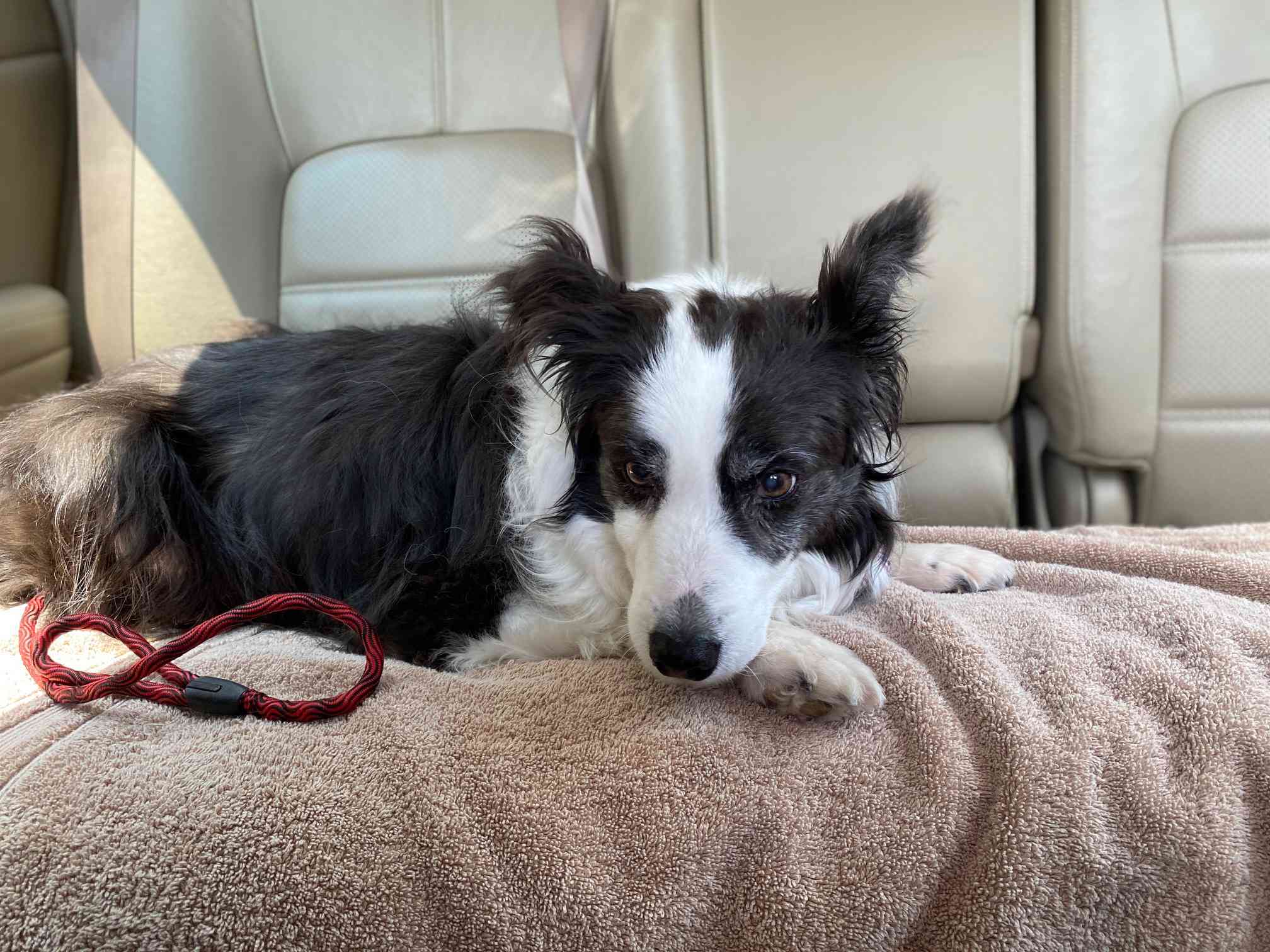
Magdalen barely moved on the ride to her new home. Mary Jo DiLonardo
On the trip home, the sweet senior looked so resigned in our backseat. The last kind transporter gently lifted her from her car and placed her in ours, where she barely moved as she re-settled herself.
She had just spent several weeks in the care of a wonderful foster parent where she recuperated from her surgery and from being left by her family.
I’m sure at this point she was just shut down and stressed and quietly rolling with whatever happened to her. She took the pieces of kibble we offered but her tail didn’t wag because it was tucked mostly between her legs.
It was heartbreaking to know that not so long ago she was someone’s pet and she was discarded.
It’s understandable that her owner needed some temporary help when he was sick and overwhelmed. But I can’t imagine why he wouldn’t have wanted her back now. I think of my own dog and dogs we’ve lost to old age in the past. They’re family and they stay that way forever.
Senior pets often end up in shelters and with rescues when their owners die and no one in the family is able to take them in.
Or some people give them up when they become harder to care for. Seniors can have more health problems and often people can’t afford the costs. They also aren’t as fun as their younger counterparts, and sometimes get cranky or snippy around children.
For rescues and shelters, it’s much easier to get a cute, bouncy puppy adopted than a less active senior that might come with health baggage and who might only be with the family for a few years.
A survey by PetFinder found that “less adoptable” pets like seniors or special needs animals spend nearly four times as long on the adoption site before they find a home.1
But older dogs have lots of benefits. Unlike puppies, they usually arrive housebroken. Sure, there are the occasional accidents as they figure things out, but they mostly know they are supposed to potty outside.
Senior dogs won’t chew your furniture or your fingers. They don’t bounce off the walls and wake you up in the middle of the night to go outside. They don’t need as much exercise as younger dogs but will revel in all the attention you want to give them.
Mary Jo DiLonardo
As for Magdalen, she is coming out of her shell in her new home. She was adopted by a good friend of mine who is a dog trainer. She has a soft heart for seniors and a passion for brainy border collies.
Because the pup is very driven by food, her new mom is going to try nosework with her. That’s an activity where she can sniff out treats in all sorts of hidden places. That will give her a job and a hobby—and lots of food!
Magdalen doesn’t have her tail between her legs anymore and the resident dogs are figuring out that she’s here to stay. But the key is for her to understand that this is now her forever home and no one will ever leave her again.
ooOOoo
Of the six dogs we have here at home three are old. But they still remain happy and carefree which is a little different to yours truly who, as much as he tries very hard not to do so, worries about the big things in life and, frankly, the biggest of them all is climate change.
I was browsing the internet yesterday and came across, quite by chance, the website PetMD. It looks like a great resource and I want to publish some of their introductory text:
About PetMD
PetMD is the online authority for all things pet health. Our goal is to provide the most accurate, reliable, up-to-date pet health information to help you navigate the everyday ups and downs of pet parenting. As a pet parent, you deserve to have access to the tools, tips, and insights you need to keep your pets healthy. With PetMD, you’ll find answers you can trust from qualified veterinarians. By working closely with veterinarians since 2008, PetMD has become the go-to resource for pet health and care.
Vet Team
PetMD collaborates with pet experts that know the most about pet health and care—veterinarians. Our network of credible veterinarians is essential in our mission to bring you the most detailed and current information. Meet some of the trusted veterinarians that we partner with to bring you the most up-to-date information.
What I was looking for is a reason why dogs love having their tummy’s rubbed.
This was a great article and I am pretty sure that republishing it is within the rules of PetMD.
ooOOoo
Why Do Dogs Like Belly Rubs?
PetMD Editorial
Updated: June 28, 2017, Published: April 07, 2017
By Chris Illuminati
Some dogs love belly rubs almost as much as playing fetch or chewing on a really good bone, yet others could go without the show of human affection. So why do dogs like belly rubs? And is it weird if some dogs don’t?
“Belly rubbing is a comforting action,” explains Dr. Peter Brown, chief medical officer of Wagly, a veterinary-based pet service provider with campuses in California and Washington. “It’s an opportunity for bonding and part of our relationship with our dogs.”
Christine Case, an anthrozoology instructor at Beacon College in Leesburg, Florida, offers another idea about the origin of belly rubs for dogs. Case, a member of the Association of Professional Humane Educators and the International Society for Anthrozoology, feels that humans have modified canine behavior over the last thousand years due to domestication.
“Rolling on their backs is a submissive behavior that dogs exhibit toward humans.” Case explains. “I think it would be difficult to determine whether dogs truly like this activity or if they have been trained to do so. The context of the situation should be evaluated.”
Michael Schaier, a certified professional dog trainer and author of “Wag That Tail: A Trainer’s Guide To A Happy Dog,” concurs with Case’s assessment, but adds that affection is one of the greatest training tools a human can use on a canine.
“A dog rolling on his back is a submissive action and puts the canine in a vulnerable position,” says Schaier, “but dogs have been bred for 10,000 years to be social animals and coexist with humans.”
Studying Back Rolling Behavior in Dogs
A dog rolling over on his back doesn’t always mean the animal is being playful, submissive, or looking for a belly rub, especially in instances when other dogs are close by. In 2015, two teams of researchers from the University of Lethbridge in Alberta and the University of South Africa set out to investigate the meaning and function of dogs rolling over during play with other dogs. The researchers wanted to know if a dog rolling over onto the back is really an act of submission that serves to stop aggression or a tactic executed for combat purposes.
The researchers examined videos showing dogs playing together and staged play sessions with a medium-sized female dog paired with 33 dogs of different breeds and sizes. Then, they sat back and observed.
The researchers concluded that while dogs may roll when playing, the move might also be used to gain an advantage in fighting. Of rollovers observed, none of the dogs rolled over in a submissive response to aggressive behavior by another dog. Researchers noted that dogs rolling on their backs in front of other dogs used their position to block playful bites and launch attacks on the aggressor.
Should You Rub Your Dog’s Belly?
If pets are comfortable with belly rubs, pet owners should feel free to pet away. But Brown warns that a dog who suddenly doesn’t enjoy a good tummy scratching might be conveying a different message. “If your dog normally likes belly rubs, and then stops, that can be a sign of a sore belly or possibly an issue where their back is causing pain.”
There are, however, some dogs who can survive without the constant stomach rubbing.
“Past experience could affect the dog’s like or dislike for the activity,” Case remarks. “If a dog does not like to have its belly rubbed, it does not mean there is anything wrong—perhaps it’s just [the dog’s] preference. It’s up to the individual animal”
But most experts agree that when dogs ask for belly rubs or petting of any kind, it shows how comfortable they feel as part of the family.
“The greatest reward you can give your dog,” adds Schaier, “is the touch of your hand.”
ooOOoo
Those last two paragraphs say it all and it comes down to touch. Even a brief touch of the hand on the head of your dog is bliss. For both the human and the dog but especially for the dog.
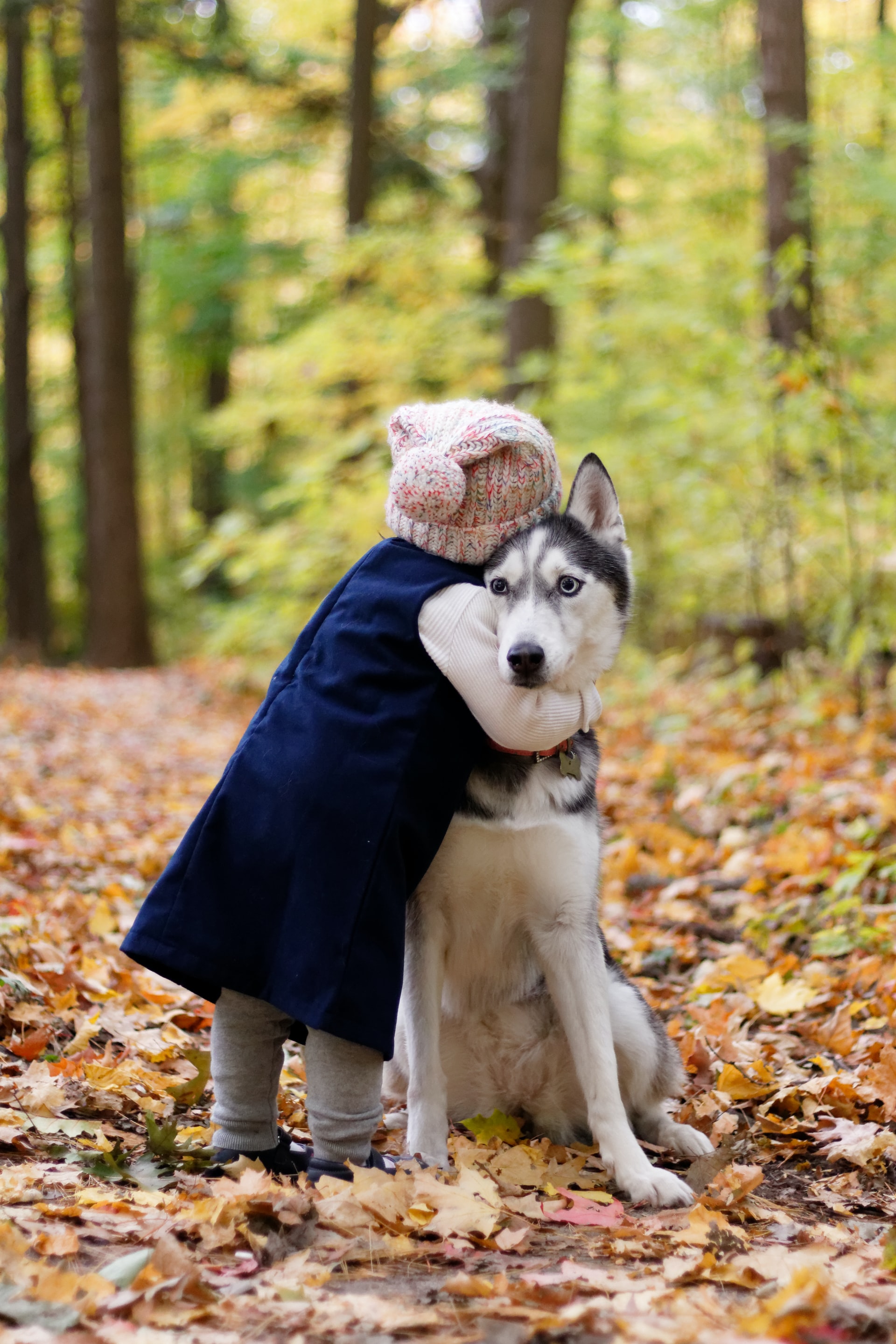
Capturing the moment of my daughter hugging her best friend, Oreo, in the woods. Photo from Unsplash.
I am a bit stuck for time so forgive me for just posting this video.
The information that came with this video is posted first:
Are you worried your dog is looking a little down? Or do you just want to do everything you can to make your dog the happiest in the world? Any responsible owner will want their dog to be as happy as can be, so this AnimalWised videos brings you 10 essential tips on how to make your DOG HAPPIER. A happy dog will not only need their basic care needs met, but they will require a considerate and thoughtful human companion to go beyond the basics. We need to pay attention to what it is they are trying to communicate to us through their behavior and body language. We also need to ensure the way we behave towards the dog is making them happy and we do all we can to strengthen our bond together. It is also imperative to know that a healthy dog is a happy dog.
On AnimalWised you’ll discover a high quality channel that’s exclusively devoted to the Animal Kingdom. You’ll find all sorts of content: from training, diet or beauty and everything that can be useful for you as a pet owner or animal lover. Want to become AnimalWised? Take a look and have fun with us!
In fairness it does look like a decent video and website.
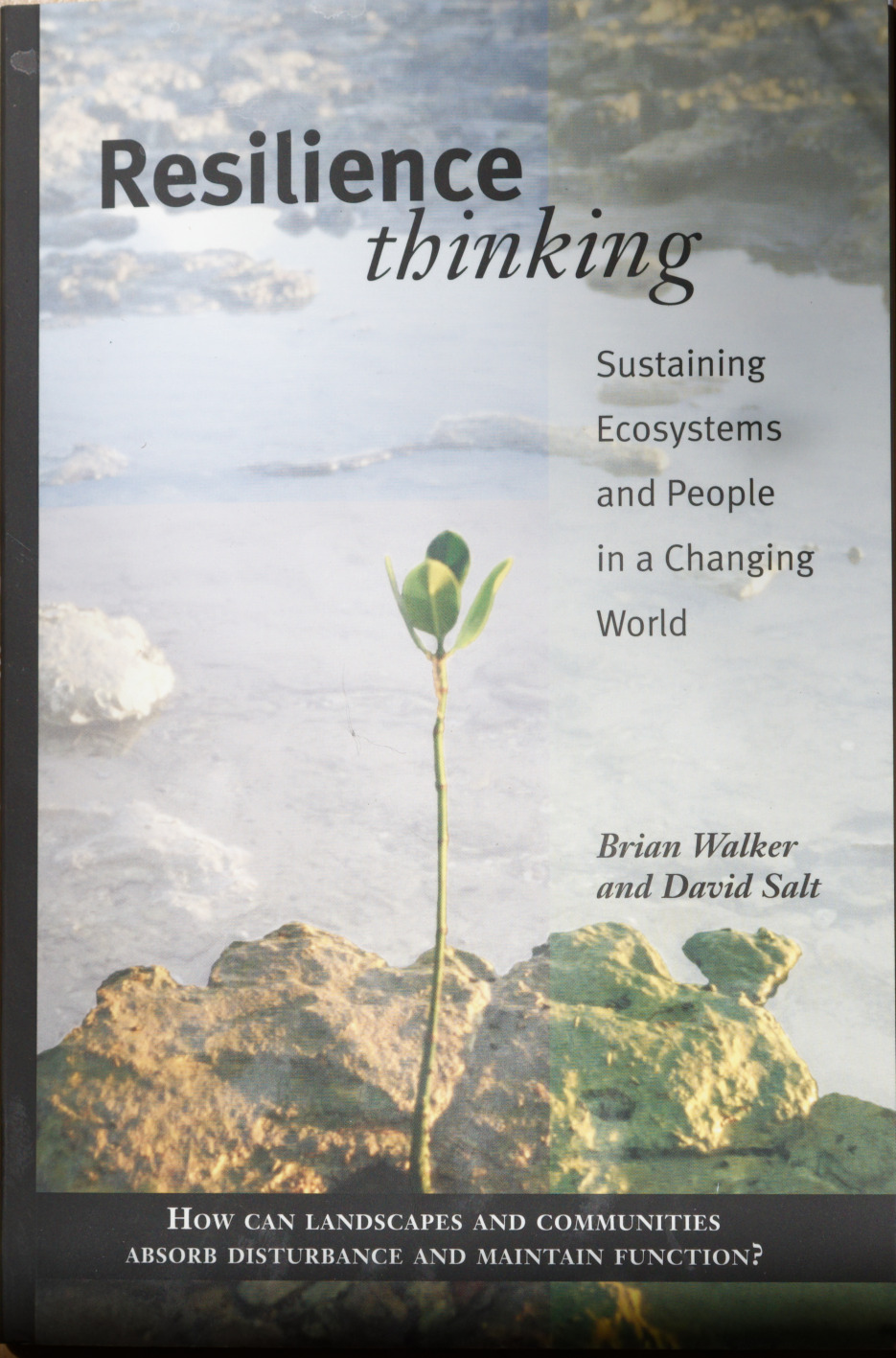
Let me make myself absolutely clear about this book, indeed I can do no better than to publish part of an email that I sent to the authors last Saturday:
To say that I was inspired by what you wrote is an understatement. More accurately it has changed my whole understanding of this planet, of the natural order of things, of the politics of the Western world, of vast numbers of us humans, and how precarious is our world just now. It has opened my eyes radically, and I thought before that I was fairly in touch with things.
Resilience is a simple idea but in its application has proved to be anything such. On page 2 the authors set out as they saw it The Drivers of Unsustainable Development. Here’s how that section develops:
Our world is facing a broad range of serious and growing resource issues. Human-induced soil degradation has been getting worse since the 1950s. About 85 percent of agriculture land contains areas degraded by erosion, rising salt, soil compaction, and various other factors. It has been estimated (Wood et al. 2000) that soil degradation has already reduced global agricultural productivity by around 15 percent in the last fifty years. In the last three hundred years, topsoil has been lost at a rate of 200 million tons per year; in the last fifty years it has more than doubled to 760 million tons per year.
As we move deeper into the twenty-first century we cannot afford to lose more of our resource base. The global population is now expanding by about 75 million people each year. Population growth rates are declining, but the world’s population will still be expanding by almost 60 million per year in 2030. The United Nations projections put the global population at nearly 8 billion in 2025. In addition, if current water consumption patterns continue unabated, half the world’s population will live in water-stressed river basins by 2025.
The Food and Agriculture Organization of the United Nations (FAO) 2004 Annual Hunger Report estimates that over 850 million people suffer from chronic hunger. Hunger kills 5 million children every year.
It goes on ….!
Now I want to quote from the end of the book, from their section on Resilience Thinking.
In our opening chapter we observed that there were many pathways into resilience thinking and suggested readers not worry too much if the finer details of a resilience framework are a bit obscure. We emphasized that what is of much more importance is an appreciation of the broader themes that underpin such a framework. Those broader themes revolve around humans existing within linked social and ecological systems. These are complex adaptive systems, and attempts to control or optimize parts of such systems without consideration of the responses that this creates in the broader system are fraught with risk. Much of this book has been spent on attempting to explore the consequences of such an approach.
In the broadest sense, optimizing and controlling components of a system in isolation of the broader system results in a decline in resilience, a reduction in options, and the shrinkage of the space in which we can safely operate. Resilience thinking moves us the other way.
It is our hope that readers who are persuaded of this basic premise will be encouraged to explore the inevitable consequences of such thinking. Even if you are not completely clear on the basins of attractions, thresholds, and adaptive cycles, if the concepts of ecological resilience and dynamic social-ecological systems have any resonance then you are in a better position to appreciate what is happening to the world around you.
The phrase complex adaptive system was new to me but intuitively I got what the authors meant. As they state on page 35: The three requirements for a complex adaptive system are:
That it has components that are independent and interacting,
There is some selection process at work on those components (and on the results of local interactions),
Variation and novelty are constantly being added to the system (through components changing over time or new ones coming in),
This was my eye-opener. It was now obvious that many processes, especially in nature, that I had hitherto regarded as constant were changing albeit usually on a timescale of many decades sometimes centuries.
And the other conclusion that was inescapable was that we humans were largely responsible for those changes because we couldn’t see the longterm consequences of what we were doing.
David writes that firstly carbon dioxide is not like other pollutants, for example like air particulants. Then later goes on to say:
The second difference is that climate change is irreversible.
As Joe Romm notes in a recent post, New York Times columnist Joe Nocera slipped up in his latest column and referred to technology that would “help reverse climate change.” I don’t know whether that reflects Nocera’s ignorance or just a slip of the pen, but I do think it captures the way many people subconsciously think about climate change. If we heat the planet up too much, we’ll just fix it! We’ll turn the temperature back down. We’ll get around to it once the market has delivered economically ideal solutions.
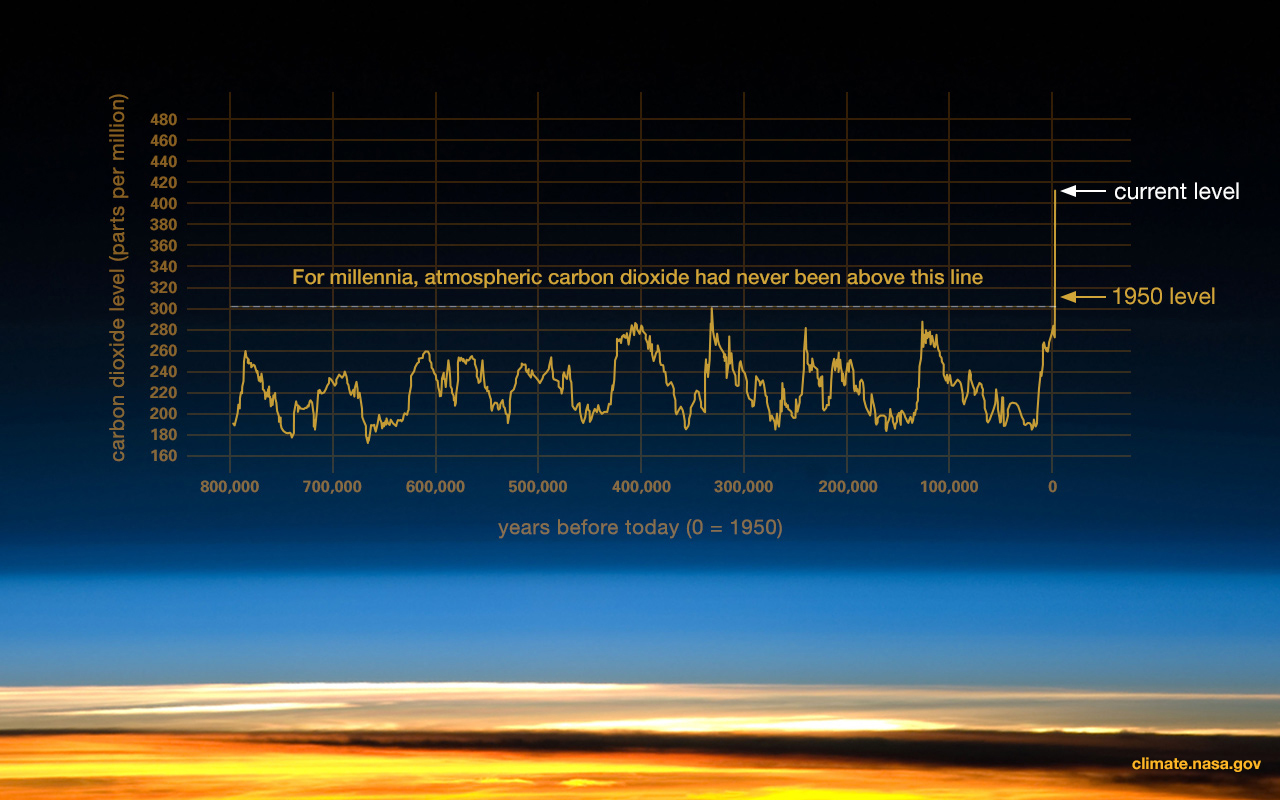
This paper shows that the climate change that takes place due to increases in carbon dioxide concentration is largely irreversible for 1,000 years after emissions stop. Following cessation of emissions, removal of atmospheric carbon dioxide decreases radiative forcing, but is largely compensated by slower loss of heat to the ocean, so that atmospheric temperatures do not drop significantly for at least 1,000 years. [my emphasis]
My last piece in this review is to republish a graph that is shown on the NASA Global Climate Changewebsite:
For all our sakes, dogs and humans and many other species, let us all please change our behaviours! Soon!
Back to the book: It is a remarkable book!
I will close with quoting one of the praises shown on the back cover. This one by Thomas Homer-Dixon, professor of political science, University of Toronto, and director of the Trudeau Centre for Peace and Conflict Studies.
Resilience Thinking is an essential guidebook to a powerful new way of understanding our world – and of living resiliently with it – developed in recent decades by an international team of ecologists. With five clear and compelling case studies drawn from regions as diverse as Florida, Sweden, and Australia, this book shows how all highly adaptive systems – from ecologies to economics – go through regular cycles of growth, reorganization, and renewal and how our failures to understand the basic principles of resilience have often led to disaster. Resilience Thinking gives us the conceptual tools to help us cope with the bewildering surprises and challenges of our new century.
This came in yesterday and I thought for some time that I wouldn’t be able to publish it quickly owing to me getting my knickers in a twist.
But all was resolved and therefore I am delighted to republish it.
ooOOoo
Donate to fund the dogs saving elephants
Ever heard of dogs saving elephants?
In the Serengeti, a small, specially trained team of rescue dogs sniff out poachers and sound the alarm. Just 4 dogs have helped arrest hundreds of poachers, saving countless elephants being murdered for their ivory.
Almost a quarter of the elephants in the park now live in the tiny area they protect — but poaching is on the rise everywhere else and there are thousands more elephants that still need protection.
That’s why the team behind this amazing project are asking for your help to train up more of these sniffer dogs — and save double the number of elephants.
With 96 of these gentle giants killed each day, every moment counts.
Can you chip in to help?
ooOOoo
Whatever you can spare please contribute to the donation request.



:max_bytes(150000):strip_icc()/MaryJoDiLonardo-bw-treehugger-6d5044d7d4ae44298fb31df11a3d5a66.jpg)


 Learning from Dogs