More incredibly beautiful photographs of dogs.
Once more from Nimbushopper.

oooo

oooo

oooo

oooo

oooo

oooo

I’m struggling to find something new to say about these gorgeous dog photographs so will just leave it at priceless!
Dogs are animals of integrity. We have much to learn from them.
Year: 2021
More incredibly beautiful photographs of dogs.
Once more from Nimbushopper.
oooo
oooo
oooo
oooo
oooo
oooo
I’m struggling to find something new to say about these gorgeous dog photographs so will just leave it at priceless!
A fabulous achievement.
This is the company that my daughter helps to run. She is Maija and together with Polly and Chloe they run Sound UK. This is what Maija said in her recent email:
ooOOoo

We hope the New Year finds you and your family well.
2021 is special for Sound UK as we celebrate 20 years of bringing you extraordinary music. We’re marking this milestone throughout the year. This includes 20 Artists for 20 Years, which shines a spotlight on key artists in Sound UK’s life. First up is the incredible Elaine Mitchener later this month…
To kick off our 20th birthday celebrations, we hope you enjoy this 60 second film about our work. You can watch it on the link below.
Keep well,
Polly, Maija and Chloe
20 years of extraordinary music. sounduk.net
Music credit: Landing – Collectress
Film edit by: Lee Matthews, iconic image
ooOOoo
I find it a brilliant short video and I hope some of you out there will also watch it.
Apologies for a purely personal post.
For as long as I live I will never stop marvelling at dogs.
Dogs are many things. In a sense they have as many likes and dislikes as us humans. But the one thing that is unique to these beautiful animals is their unconditionality. That, especially, shows through in the way that they care and love the humans and dogs around them.
This story on The Dodo emphasised that special way they care for their fellow dogs. Read it and you will see what I mean.
ooOOoo
“As he’s dragging it he’s looking at Roman almost to say, ‘This is for you’”
By Caitlin Jill Anders
Published on 6/18/2020
From the moment they became brothers, Spanky has always adored and looked up to his big brother Roman. He follows Roman everywhere he goes, and is always happiest whenever they’re together.
“Roman is definitely Spanky’s security blanket,” Jackie Rogers, Roman and Spanky’s aunt, told The Dodo. “Spanky will do nothing without Roman and always makes sure he is close to him and if he’s not he gets up and goes near him.”

About two weeks ago, Roman’s ear started looking a little puffy and infected, so his mom took him to the vet and discovered he has a hematoma on his ear. They scheduled a surgery to take care of it, but unfortunately, while he waited for the surgery, his ear kept getting worse and poor Roman got more and more uncomfortable.
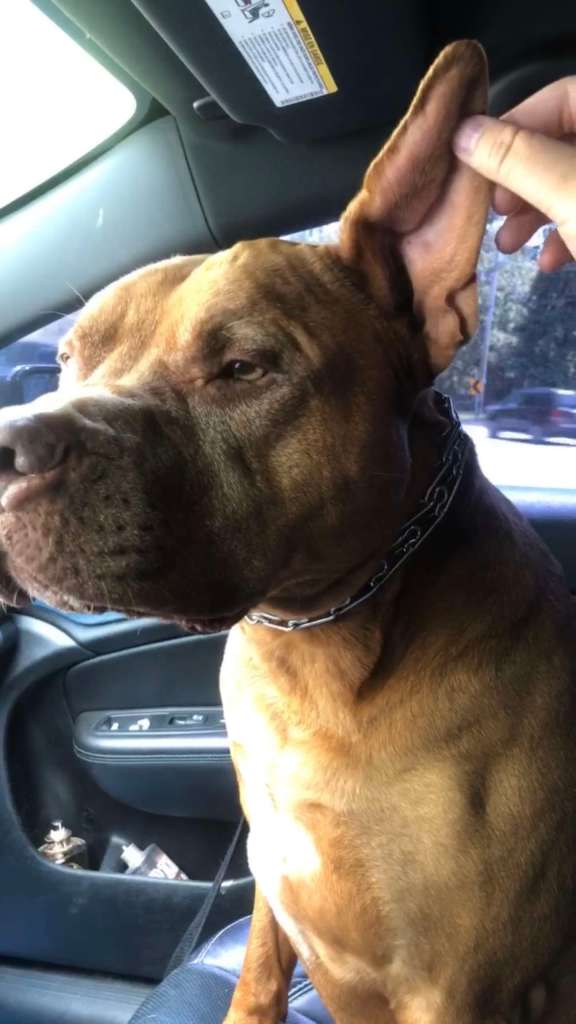
At first, Spanky didn’t notice anything was different, but as Roman’s ear got worse, everyone noticed that Spanky was much more gentle and concerned about his best friend.
“We had to take him back to the vet to confirm he could wait five more days for surgery and I brought Spanky along for the ride, but due to COVID we couldn’t go inside with Roman and for 20 minutes Spanky sat in the car crying/whining/barking until Roman got back,” Rogers said.

With the surgery set, all the family could do for Roman was to let him rest. During the day while everyone is at work, the family has a Ring camera set up so they can check in on the dogs, which is especially important now so they can make sure Roman is OK. Rogers was checking the camera recently when she noticed Spanky watching his brother lying on the floor, looking very concerned — and then he did the cutest thing.
“I see Spanky pacing for a minute while looking at Roman and then the bed and then I see him dragging the bed to Roman and as he’s dragging it he’s looking at Roman almost to say, ‘This is for you,’ and then the next clip is them snuggling,” Rogers said. “I had to re-watch it multiple times, I was in disbelief that he did that!”
Spanky was worried about his brother and wanted him to be as comfortable as possible, so he brought his bed to him so he wouldn’t have to move — because that’s how much he loves his big brother.

Spanky brought the bed over to Roman around 10 a.m., and when Rogers got home that evening, they were still snuggled up there together. Spanky knows his brother isn’t feeling well, and he’s determined to stay by his side until he’s feeling better — and will do anything he can to make sure he’s safe and comfortable in the meantime.
ooOOoo
There’s no real way that words can explain that. It’s beautiful, loving and caring and just goes to show how the loving bond works in practice.
Fabulous creatures!
A continuation from yesterday!
I wasn’t going to post anything today but then in response to Val Boyco’s comment: “Good stuff Paul. Thank you! Please do more research and share here 💛 My gut will thank you!” I did do some more research and quickly came upon another article that was published recently and is worth of a read!
ooOOoo
December 20, 2020
By

Senior Lecturer, Edith Cowan University
Disclosure statement
Claus T. Christophersen receives funding from NHMRC and WA Department of Health. He is a co-author of The Gut Feeling Cookbook linked in this article – all proceeds from sales of this cookbook go directly back into supporting our research, no personal financial interest.It’s that time of year again, with Christmas parties, end-of-year get-togethers and holiday catch-ups on the horizon for many of us — all COVID-safe, of course. All that party food and takeaway, however, can have consequences for your gut health.
Gut health matters. Your gut is a crucial part your immune system. In fact, 70% of your entire immune system sits around your gut, and an important part of that is what’s known as the gut-associated lymphoid tissue (GALT), which houses a host of immune cells in your gut.
Good gut health means looking after your gut microbiome — the bacteria, fungi, viruses and tiny organisms that live inside you and help break down your food — but also the cells and function of your gastrointestinal system.
We know gut health can affect mood, thanks to what’s known as the gut-brain axis. But there’s also a gut-lung axis and a gut-liver axis, meaning what happens in your gut can affect your respiratory system or liver, too.
Here’s what you can do to bolster your gut microbiome in the coming weeks and months.
Read more: Gut health: does exercise change your microbiome?
How do silly season indulgences affect our gut health?
You can change your gut microbiome within a couple of days by changing your diet. And over a longer period of time, such as the Christmas-New Year season, your diet pattern can change significantly, often without you really noticing.
That means we may be changing the organisms that make up our microbiome during this time. Whatever you put in will favour certain bacteria in your microbiome over others.
We know fatty, sugary foods promote bacteria that are not as beneficial for gut health. And if you indulge over days or weeks, you are pushing your microbiome towards an imbalance.

Is there anything I can do to prepare my gut health for the coming onslaught?
Yes! If your gut is healthy to begin with, it will take more to knock it out of whack. Prepare yourself now by making choices that feed the beneficial organisms in your gut microbiome and enhance gut health.
That means:
For inspiration on how to increase resistant starch in your diet for improved gut health, you might consider checking out a cookbook I coauthored (all proceeds fund research and I have no personal interest).

What can I do to limit the damage?
If Christmas and New Year means a higher intake of red meat or processed meat for you, remember some studies have shown that diets higher in red meat can introduce DNA damage in the colon, which makes you more susceptible to colorectal cancer.
The good news is other research suggests if you include a certain amount of resistant starch in a higher red meat diet, you can reduce or even eliminate that damage. So consider a helping of cold potato salad along with a steak or sausage from the barbie.
Don’t forget to exercise over your Christmas break. Even going for a brisk walk can get things moving and keep your bowel movements regular, which helps improve your gut health.
Have a look at the Australian Guide to Healthy Eating and remember what foods are in the “sometimes” category. Try to keep track of whether you really are only having these foods “sometimes” or if you have slipped into a habit of having them much more frequently.
The best and easiest way to check your gut health is to use the Bristol stool chart. If you’re hitting around a 4, you should be good.

Remember, there are no quick fixes. Your gut health is like a garden or an ecosystem. If you want the good plants to grow, you need to tend to them — otherwise, the weeds can take over.
I know you’re probably sick of hearing the basics — eat fruits and vegetables, exercise and don’t make the treats too frequent — but the fact is good gut health is hard won and easily lost. It’s worth putting in the effort.
A preventative mindset helps. If you do the right thing most of the time and indulge just now and then, your gut health will be OK in the end.
ooOOoo
That book that Claus refers to, the one on the gut Gut feeling: Mindful menus for the microbiome is here. It looks a very good book.
Well Val (and many others), did you find this interesting? It was a rhetorical question because I know that you did.
I will continue to republish these posts and, especially, the one on exercise. Because as I have often said: Diet and exercise are key!
Onwards and upwards!
This is a key article!
Now this has nothing to do with dogs. Well not directly but the longer we humans live the longer we can have dogs as pets.
I was having an email ‘conversation’ with Jon over in England and he pointed me to Professor Tim Spector. Prof. Spector writes on his website that he:
Tim Spector is a Professor of Genetic Epidemiology and Director of the TwinsUK Registry at Kings College, London and has recently been elected to the prestigious Fellowship of the Academy of Medical Sciences. He trained originally in rheumatology and epidemiology.
In 1992 he moved into genetic epidemiology and founded the UK Twins Registry, of 13,000 twins, which is the richest collection of genotypic and phenotypic information worldwide. He is past President of the International Society of Twin Studies, directs the European Twin Registry Consortium (Discotwin) and collaborates with over 120 centres worldwide.
He has demonstrated the genetic basis of a wide range of common complex traits, many previously thought to be mainly due to ageing and environment. Through genetic association studies (GWAS), his group have found over 500 novel gene loci in over 50 disease areas. He has published over 800 research articles and is ranked as being in the top 1% of the world’s most cited scientists by Thomson-Reuters.
He held a prestigious European Research Council senior investigator award in epigenetics and is a NIHR Senior Investigator. His current work focuses on omics and the microbiome and directs the crowdfunded British Gut microbiome project.
Together with an international team of leading scientists including researchers from King’s College London, Massachusetts General Hospital, Tufts University, Stanford University and nutritional science company ZOE he is conducting the largest scientific nutrition research project, showing that individual responses to the same foods are unique, even between identical twins.
You can find more on https://joinzoe.com/ He is a prolific writer with several popular science books and a regular blog, focusing on genetics, epigenetics and most recently microbiome and diet (The Diet Myth). He is in demand as a public speaker and features regularly in the media.
That is quite a CV!
Then I came across an essay on The Conversation website about being healthier in one’s old age.
Read it!
ooOOoo
Clinical Senior Lecturer, King’s College London
Professor of Genetic Epidemiology, King’s College London
January 29, 2016
The world’s oldest man, Yasutaro Koide recently died at the age of 112. Commentators as usual, focused on his reported “secret to longevity”: not smoking, drinking or overdoing it. No surprises there. But speculation on the basis of one individual is not necessarily the most helpful way of addressing this human quest for the Philosopher’s Stone.
The “very old” do spark our interest – but is our search for a secret to longevity actually misguided? Wouldn’t you rather live healthier than live longer in poor health? Surely, what we really want to know is how do we live well in old age.
Clearly as scientists we try to illuminate these questions using populations of people not just odd individuals. Many previous attempts have approached this question by looking for differences between young and old people, but this approach is often biased by the many social and cultural developments that happen between generations, including diet changes. Time itself should not be the focus – at least, in part, because time is one thing we are unlikely to be able to stop.

The real question behind our interest in people who survive into old age is how some manage to stay robust and fit while others become debilitated and dependent. To this end, recent scientific interest has turned to investigating the predictors of frailty within populations of roughly the same age. Frailty is a measure of how physically and mentally healthy an individual is. Studies show frailer older adults have an increased levels of low grade inflammation – so-called “inflammaging”.
New research published in Genome Medicine by Matt Jackson, from our group at King’s College London, investigated this question in an unlikely place – poo. Recent evidence indicates that our immune and inflammatory systems are trained and educated in our gut, through key interactions with gut bacteria. So we asked if changes in our gut bacteria could be part of the process of inflammation driving frailty.
Our recent work found that the frailer an individual, the lower the diversity of gut bacteria they have. We looked at stool samples from more than 700 healthy British twins and found that a group of bacteria belonging to the species with a tricky and slightly unpleasant name, Faecalibacterium prausnitzii, were found in higher amounts in the healthier twins. This is a particularly interesting microbe as it has been linked with good health in many other diseases such as inflammatory bowel disease and is believed to reduce inflammation of the gut. Could this bug help protect against frailty?
There were other microbes seen in increased amounts within the frailer twins. One was Eubacterium dolichum, which has been seen to increase in unhealthy Western diets. We found the same picture when comparing frailer, more elderly, individuals from the ELDERMET study, by the University of Cork. This suggests that dietary changes might be an easy way to encourage healthy ageing.
Our study does not yet clarify whether the changes to the gut bacteria are a cause of poor ageing itself or are just a consequence of frailty – longitudinal studies that follow people over several years will be needed to sort this out. But these results are exciting for researchers in the ageing field and suggest that if you want to age well you should perhaps do fewer crosswords and spend more time looking after your microbial garden, for example by eating plenty of plant fibre, for example in a Mediterranean-type diet.
ooOOoo
Well this essay was published nearly 5 years ago and one wonders if more information has come to light.
Certainly Jeannie and me are heavily into a plant-based diet with a small selection of fish from time to time.
I will do more research and see if there are any updates that may be published.
In the meantime stay as healthy and as happy as you can be!


 Learning from Dogs