Intelligent and highly social, wolves fascinate us as the untamed predecessors to Man’s Best Friend. But the relationship between humans and wolves has not always been so reverential, especially in the United States.
Through the early 1900s, populations of Canis lupus, the gray wolf, shrank from estimated historical highs of 2 million to near-extinction in the lower 48 states, largely a result of expanded human settlement in the western U.S. and large-scale poisonings meant to protect livestock.
In 1973, the gray wolf was classified as endangered under the Endangered Species Act, and after decades of conservation efforts, wolves are doing well in the U.S. Current estimates peg the gray wolf population in the lower 48 at around 5,500—with at least 7,000 more in Alaska. In fact, a pack of wolves recently planted roots in Siskiyou County, California, the first wolfpack in modern Californian history.
“The gray wolf is in no danger of being endangered, biologically,” says Dave Mech, a senior research scientist with the U.S. Geological Survey.
But controversy still swirls around the gray wolf’s conservation status. In 2013, the U.S. Fish and Wildlife Service proposed removing the gray wolf from the federal list of endangered species, a move it says reflects the wolves’ rebound. But animal rights groups and environmental organizations have decried the very thought, unsuccessfully petitioning the Service to maintain national protections for the gray wolf. Meanwhile, ranchers in the northwestern United States have pushed for rollbacks to state-level wolf protections.
In fact, the U.S. Fish and Wildlife Service declined to comment about the gray wolf, due to ongoing litigation with conservationists over the Mexican gray wolf, a rare subspecies. And given the wolf’s status as both a possible scourge to ranchers and an ecological marvel to environmentalists, the debate is “always going to be contentious,” says Mech.
Yet the allure of the wolf will endure, as it always has in the public’s imagination. “I think there’s a certain aesthetic beauty to [wolves],” says Mech, that defines “their charismatic nature.”
In honor of National Wolf Awareness Week, which begins October 11, we take a closer look at the fascinating ways in which wolves around the world eke out a living.
oooo
oooo
oooo
oooo
oooo
oooo
There are another six photographs that I will offer you in next Sunday’s Picture Parade.
Tonight (Friday): A 30 percent chance of rain after 11pm. Mostly cloudy, with a low around 53. West wind around 6 mph becoming calm after midnight.
Saturday: Rain before 11am, then showers likely after 11am. High near 71. Calm wind becoming west southwest around 5 mph. Chance of precipitation is 80%. New precipitation amounts between a tenth and quarter of an inch possible.
Saturday Night: A 20 percent chance of showers before 11pm. Partly cloudy, with a low around 50. West wind around 6 mph becoming calm in the evening.
As the crow flies, here in Merlin we are a tad over 10 miles to the North-West of the centre of Grants Pass. So we are holding our breath that we receive a decent wetting over this coming weekend.
All of which creates a wonderful lead-in to a recent item published over on Mother Nature News, that I am delighted to share with you.
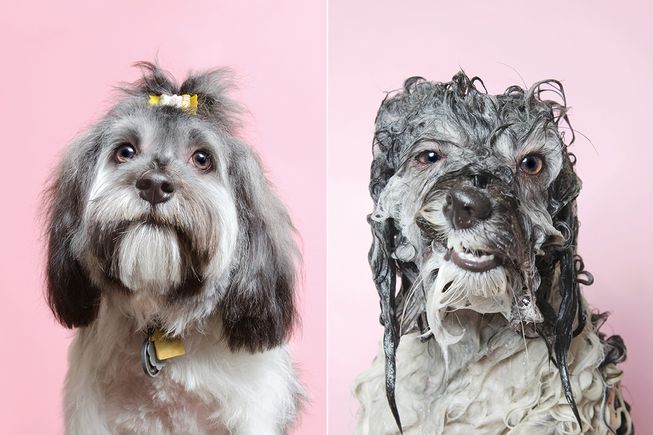
Bath time may not be a pup’s favorite activity, but if these comical “Wet Dog”‘ portraits are any indication, there may be a silver lining to this necessary evil.
The dog lover behind this endearing series is Sophie Gamand, a New York-based photographer who regularly focuses her lens on canines to examine the relationship they have with humans.
“Wet Dog is a series of dogs captured at the groomer during their least favorite activity: Bath time,” Gamand writes on her website. “I chose this activity because it is a very unnatural one for the dogs, yet it is a direct consequence of their cohabitation with humans.”
Seeing our best friends in such a vulnerable state can be comical and heart-wrenching — especially because canine facial expressions possess an uncanny resemblance to our own.
Gamand began photographing soggy doggies a while back, but after some of the images went viral, she felt compelled to put together a complete “Wet Dog” photo book.
(Photo: Sophie Gamand)
The comical coffee table book, which is now available for purchase, is filled with 120 photos of these soaked doggies — each sporting his own unique post-bath expression.
Continue below for a look at just a few of the images featured in the book.
Benji (Photo: Sophie Gamand)Marnie (Photo: Sophie Gamand)Wanda (Photo: Sophie Gamand)
The title to today’s post is an old British expression that harks back to the days when “queer” meant strange. This blog has published no shortage of posts giving many examples of how “queer” we humans can be at times.
So the latest essay from Mr Monbiot is rather refreshing. I’ll say no more, apart from confirming that Monbiot’s post is republished with his kind permission.
ooOOoo
Human Kind
14th October 2015
Fascinating new lines of research suggest that we are good people, tolerating bad things.
By George Monbiot, published in the Guardian 14th October 2015
Do you find yourself thrashing against the tide of human indifference and selfishness? Are you oppressed by the sense that while you care, others don’t? That because of humankind’s callousness, civilisation and the rest of life on earth are basically stuffed? If so, you are not alone. But neither are you right.
A study by the Common Cause Foundation, due to be published next month, reveals two transformative findings. The first is that a large majority of the 1000 people they surveyed – 74% – identify more strongly with unselfish values than with selfish values. This means that they are more interested in helpfulness, honesty, forgiveness and justice than in money, fame, status and power. The second is that a similar majority – 78% – believes others to be more selfish than they really are. In other words, we have made a terrible mistake about other people’s minds.
The revelation that humanity’s dominant characteristic is, er, humanity will come as no surprise to those who have followed recent developments in behavioural and social sciences. People, these findings suggest, are basically and inherently nice.
A review article in the journal Frontiers in Psychology points out that our behaviour towards unrelated members of our species is “spectacularly unusual when compared to other animals”. While chimpanzees might share food with members of their own group, though usually only after being plagued by aggressive begging, they tend to react violently towards strangers. Chimpanzees, the authors note, behave more like the Homo economicus of neoliberal mythology than people do.
Humans, by contrast, are ultra-social: possessed of an enhanced capacity for empathy, an unparalleled sensitivity to the needs of others, a unique level of concern about their welfare and an ability to create moral norms that generalise and enforce these tendencies.
Such traits emerge so early in our lives that they appear to be innate. In other words, it seems that we have evolved to be this way. By the age of 14 months, children begin to help each other, for example by handing over objects another child can’t reach. By the time they are two, they start sharing things they value. By the age of three, they start to protest against other people’s violation of moral norms.
A fascinating paper in the journal Infancy reveals that reward has nothing to do with it. Three to five-year-olds are less likely to help someone a second time if they have been rewarded for doing it the first time. In other words, extrinsic rewards appear to undermine the intrinsic desire to help. (Parents, economists and government ministers, please note). The study also discovered that children of this age are more inclined to help people if they perceive them to be suffering, and that they want to see someone helped whether or not they do it themselves. This suggests that they are motivated by a genuine concern for other people’s welfare, rather than by a desire to look good. And it seems to be baked in.
Why? How would the hard logic of evolution produce such outcomes? This is the subject of heated debate. One school of thought contends that altruism is a logical response to living in small groups of closely related people, and evolution has failed to catch up with the fact that we now live in large groups, mostly composed of strangers. Another argues that large groups containing high numbers of altruists will outcompete large groups which contain high numbers of selfish people. A third hypothesis insists that a tendency towards collaboration enhances your own survival, regardless of the group in which you might find yourself. Whatever the mechanism might be, the outcome should be a cause of celebration.
So why do we retain such a dim view of human nature? Partly, perhaps, for historical reasons. Philosophers from Hobbes to Rousseau, Malthus to Schopenhauer, whose understanding of human evolution was limited to the Book of Genesis, produced persuasive, influential and catastrophically mistaken accounts of “the state of nature” (our innate, ancestral characteristics). Their speculations on this subject should long ago have been parked on a high shelf marked “historical curiosities”. But somehow they still seem to exert a grip on our minds.
Another problem is that – almost by definition – many of those who dominate public life have a peculiar fixation on fame, money and power. Their extreme self-centredness places them in a small minority, but, because we see them everywhere, we assume that they are representative of humanity.
The media worships wealth and power, and sometimes launches furious attacks on people who behave altruistically. In the Daily Mail last month, Richard Littlejohn described Yvette Cooper’s decision to open her home to refugees as proof that “noisy emoting has replaced quiet intelligence” (quiet intelligence being one of his defining qualities). “It’s all about political opportunism and humanitarian posturing,” he theorised, before boasting that he doesn’t “give a damn” about the suffering of people fleeing Syria. I note with interest the platform given to people who speak and write as if they are psychopaths.
The consequences of an undue pessimism about human nature are momentous. As the Common Cause Foundation’s survey and interviews reveal, those who have the bleakest view of humanity are the least likely to vote. What’s the point, they reason, if everyone else votes only in their own selfish interests? Interestingly, and alarmingly for people of my political persuasion, it also discovered that liberals tend to possess a dimmer view of other people than conservatives do. Do you want to grow the electorate? Do you want progressive politics to flourish? Then spread the word that other people are broadly well-intentioned.
Misanthropy grants a free pass to the grasping, power-mad minority who tend to dominate our political systems. If only we knew how unusual they are, we might be more inclined to shun them and seek better leaders. It contributes to the real danger we confront: not a general selfishness, but a general passivity. Billions of decent people tut and shake their heads as the world burns, immobilised by the conviction that no one else cares.
You are not alone. The world is with you, even if it has not found its voice.
The vastness of the seas and the immensity of their influence over all of us.
This is an introduction, a rather long one I’m warning, to a republication of a recent post by Patrice Ayme. An introduction that offers a deeply personal memory of the Atlantic ocean.
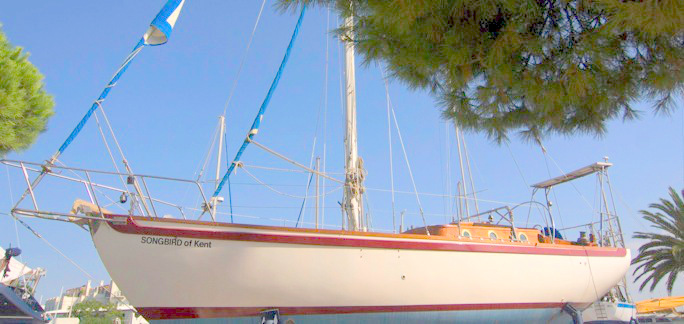
Many years ago, I spent 5 years living on a boat; a wonderful heavy-displacement ocean-going yacht of a type known as a Tradewind 33.
My home for five years – Tradewind 33: Songbird of Kent.
There is a place in my mind to which I can so easily travel; a memory of a dark night out in the Atlantic ocean one time in the Autumn of 1969. But first let me set the scene from almost fifty years ago.
The call of the open ocean
Those first few hours were utterly absorbing as I went through the whole business of clearing the yacht harbour at Gibraltar and heading out to the South-West hugging this unfamiliar coastline of Southern Spain. It was tempting to move out to deeper waters but the almost constant flow of large ships through the Straights of Gibraltar soon quashed that idea. Thankfully, the coastal winds were favourable for me and my single-masted sailing yacht.
After such a long time sailing in the relatively confined waters of the Mediterranean, it was difficult for me to imagine that in a few hours time the southern-most point of Spain would pass me by and the vastness of the Atlantic ocean would be my home for the next few weeks.
Soon the city of Tarifa was past my starboard beam and the Spanish coastline was rapidly disappearing away to the North-West. The horizon ahead of me was already approaching 180 degrees of raw, open ocean. There was just a flicker of a thought that whispered across my mind: “Oh Paul, what have you gone and done” as slowly but persistently the coastlines of Spain to the North and of Africa to the South became more and more distant and fuzzy. It was at 15:30 that I made an entry in my yacht’s log: “No land in sight in any direction!”
Now was the time to make sure that my bunk was made up, flashlights to hand, and my alarm clock ready and set. Alarm clock? Set to go off every twenty minutes during the night! For this was the only way to protect me and my yacht from being hit by one of those gigantic container ships that seemed to be everywhere. It took at least twenty minutes from the moment a ship’s steaming lights appeared above the horizon to crossing one’s path!
It was in the early hours of my first morning alone at sea, when once again the alarm clock had woken me and I was looking around an ocean without a single ship’s light to be seen that more of Les’ words (see footnote) came to me. I remembered asking Les: “What’s the appeal of sailing?” Les replied without a moment’s hesitation: “It’s the solitude. When you’re out at sea on your own, there’s no government or bankers to worry about. You’re not responsible to anyone but yourself.”
Yes, I could sense the solitude that was all around me but it was an intellectual sense not an emotional one. That would come later. Inside, I was still afraid of what I had let myself in for.
Remarkably quickly however, the pattern of solo life aboard a thirty-three-foot yacht became my world. Frankly, it staggered me as to how busy were my days. Feeding myself, navigating, trying to forecast the winds, staying in touch with other yachties via the short-wave radio, keeping the boat tidy and a zillion other tasks meant the first few days and nights just slipped by.
But it was a sight on my fourth night at sea that created the memory that would turn out to remain with me for all my life. The memory that I can go to anytime in my mind.
That fourth night I was already well into the routine of waking to the alarm clock, clipping on my harness as I climbed up the three steps that took me from my cabin into the cockpit, scanning the horizon with my eyes, checking that the self-steering had the boat at the correct angle to the wind and then, if no ships’ lights had been seen, slipping back down into my bunk and sleeping for another twenty minutes. Remarkably, I was not suffering from any long-term tiredness during the day.
It was a little after 3am that fourth night when the alarm clock had me back up in the cockpit once again. Then it struck me.
Songbird was sailing beautifully. There was a steady wind of around ten knots from the south-east, almost a swell-free ocean, and everything set perfectly. Not a sign of any ship in any direction.
Then I lifted my eyes upwards. There was not a cloud in the night sky, not a single wisp of mist to dim a single one of the million or more stars that were above my head. For on this dark, moonless night, so far removed from any shore-based light pollution, the vastness, yet closeness of the heavens above was simply breath-taking. I was transfixed. Utterly unable to make any rational sense of this night splendour that glittered in every direction in which I gazed. This dome that represented a vastness beyond any meaning other than a reminder of the magic of the universe.
This magic of the heavens above me that came down to touch the horizon in all directions. Such a rare sight to see the twinkling of stars almost touching the starkness of the ocean’s horizon at night. A total marriage of this one planet with the vastness of outer space.
I heard the alarm clock go off again and again next to my bunk down below. But I remained transfixed until there was a very soft lightening of the skyline to the east that announced that another dawn was on its way.
I would never again look up at the stars in a night sky without being transported back to that wonderful night and the memory of a lonely sea and sky.
I did warn you it would be a long introduction!
ooOOoo
Non-Linear Cold Blob Rising Over North Atlantic
The reason life survived on Earth for so long, and blossomed into animals, and now mind, is that the planet is equipped with homeostatic mechanisms (homeo means similar in Greek, and stasis, standing still). However, those mechanisms tend to be geological.
Human civilization is now having an impact on the biosphere of a violence probably never seen before. The changes are faster than what geology, or even life, can accommodate.
Some will brandish the impact of the Yucatan asteroid, and claim that was worse; however that’s just a theory: the biosphere was clearly under stress at the time from the Deccan Traps eruptions, and had been under that stress for hundreds of thousands of years, if not millions. At its worst, the Asteroid was just the straw which broke the Camel’s back.
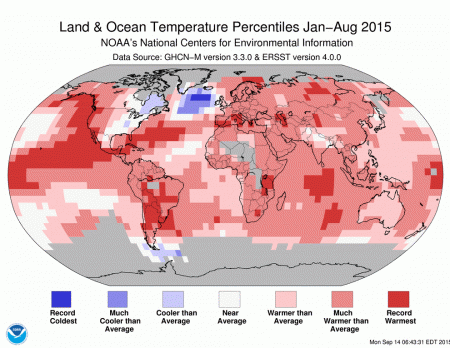
2015 will be the warmest year since the end of the Eemian, 115,000 years ago. So why are record low temperatures appearing just south of Iceland? Yes, record lows, lower than ever recorded.
While The Rest Of Planet Is At Record Warmth, Off Iceland, Record Colds Are Achieved!
That was fully expected, and a demonstration of Non-Linearity of the incipient global warming. A phenomenon is linear when it looks like a line. Global warming is not going up like a line, as some places are warming at a rate ten times higher than the average, and some regions are cooling (and some are cooling spectacularly, off Iceland and some seas around Antarctica, for reasons related to warming).
The Dryas events were extremely fast and pronounced cooling events which happened several times during the period 10,000 years to 15,000 Before Present. Some lasted around a millennium, others, just a century. They vanished as fast as they came. They are named after a tundra flower, the Dryas. In Scandinavia forests were replaced by tundra graced with Dryas (hence the name). In Britain, average temperature collapsed to minus 5 degree Celsius, and glaciers formed at elevation.
These spastic events of drastic cooling, while, overall, de-glaciation was going on, long remained a mystery. Overall, the great glaciation which had brought glaciers down to New York, was on its way out, the planet was globally, irresistibly warming. So why would temperatures collapse in some places around Greenland by 15 degrees Celsius? The solution to the Dryas events’ spastic glaciation riddle? The same as always! Warming is non-linear.
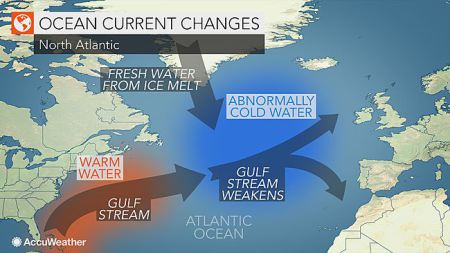
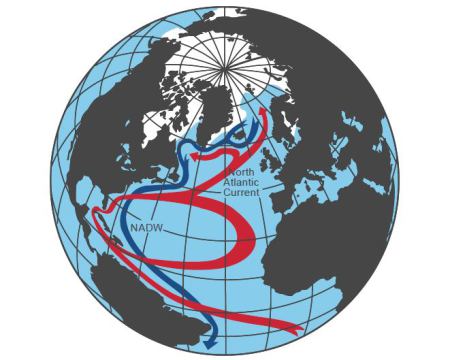
What’s the theory? The details are uncertain, but we know that the Gulf Stream (aka the North Atlantic “Conveyor”) shorted, literally: analyses of deep sea sediments have shown this. The conveyor sends an enormous current of warm tropical waters northward.
When the warm tropical waters become very cold between Iceland and Spitzbergen, they sink to the bottom of the sea, and head south. This sinking, plus the pushing by trade winds in the tropics, is what provides the energy of the Gulf Stream.
However, if the warm tropical waters are capped by a very cold, but light sweet(er) water lid, they will get cold early, and sink before Iceland. This is what happened in the Dryas events.
And It Is Happening Again, Albeit On A Smaller Scale.
Was it in response to a sudden influx of fresh water from Lake Agassiz and deglaciation in North America, and Greenland? Sudden freezing there would have removed the freshwater lid, hence the brutal switchback to warming after the brutal cooling. By the way, the sea level rising speed responded quickly, by a factor of three. After the typical Dryas cooling, oceanic rise rebounded to 18 millimeter per year right away (this shows that those who expect a slow rise of sea level rise are deluding themselves, or, more to the point, are trying to delude us!)
Nowadays a Dryas-like mechanism would have to rest on the melting of Greenland alone (that’s the only place with significant ice). This is, of course, insufficient, but summer 2015, cool and rainy over the northern North Atlantic is evidence that the effect is on. Scientific analysis confirms it. See: “Exceptional Twentieth Century Slow Down of Atlantic Ocean Overturning Circulation” (Nature, 23 March, 2015).
The exact nature of what is going on at this point is a matter of debate among experts. What is sure is that something is going on.
The Atlantic Conveyor Is A Subtle Thing, Yet Dominates Glaciation In The Arctic.
A similar situation beckons in Antarctica, where ice shield melting creates a freshwater lid all around which in turn freeze, extending the ice cap in the Austral winter.
When considering nonlinearity, subtlety and surprises are of the essence. This is true in physics, as it is in psychology, history, or politics.
And the morality in all this? The USA has played god. The European Union made a honest to goodness effort to reduce CO2 emission, while the USA, paying lip service to the opposite of what it was doing went right ahead, with its factory, the Plutocratic Republic of China, to use and abuse fossil fuels as never before.
So now what? Is god still American, as usual? At first it seems so: the USA started to frack massively and massive amounts of fossil fuels were extracted from the USA’s generous soil. When American companies tried the same in Poland, it failed: the underground god (Pluto?) did not cooperate: Polish soil is adverse to fracking.
Here comes the punchline: sea level has been rising fast along the Eastern seashore of the USA. Actually, three to four times faster than the world average. That’s more than one centimeter per year.
Why? Imagine a traffic jam. Or rather a crash ahead: things come to a halt, cars, water piles up behind. Maybe the Washington politicians will soon have to learn to swim, and not just against the tide of world public opinion.
The USA is going to be punished with its own instruments. Meanwhile 20 countries formed the V20, a group of twenty countries whose existence is immediately threatened by global warming, although they caused it not.
Footnote: The Les referred to is Les Powells, the yachtsman who sailed solo three times around the world. He and I became good friends when we met up at Larnaca Marina in Cyprus.
Last Monday, Jean and I had been living here in Merlin, Oregon for three years.
Why I am explaining this is because my day yesterday ended up being so busy that I ran out of time to focus on writing a fresh new post for you good people.
Thus, I decided to repost something that I published that first week we moved in to our Merlin home. Namely, a post published on the 16th October, 2012 under the heading of The death of the USA?.
So my apologies for you dear readers that recall this from three years ago, and welcome to the many new followers of this place that have signed up since then.
ooOOoo
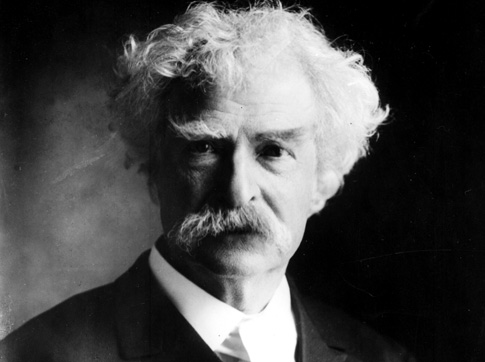
“The reports of my death are greatly exaggerated!”Mark Twain.
Mark Twain
The Mark Twain quotation after hearing that his obituary had been published in the New York Journal.
Mistaken publications of obituaries aren’t as rare as you might expect. A recent example is of Dave Swarbrick, the British folk/rock violinist, who was killed off mistakenly by the Daily Telegraph in April 1999 when they reported that his visit to hospital in Coventry had resulted in his death. He did at least get the opportunity to read a rather favourable account of his life, not something we all get to do, and to deliver the gag “It’s not the first time I have died in Coventry”.
So why have I opened with this quote from Mark Twain? Read on and I hope all will be clear.
A little under a week ago, I published a couple of posts that proposed that the United States of America is an empire in decline. The first was What goes up? and the second Might just come down! As a Brit, I well know that aspect of British history!
However a recent conversation with a friend of many years back in England, who has also been a shrewd and wise entrepreneur for longer than I care to remember, argued that the evidence for the ‘end of the USA’ could be challenged.
He cited five reasons why he thought the USA would remain, more or less, in its dominant position. They were:
Spirit of innovation
Relaxed labour laws
The importance of Mexico
The uncertainty of China in terms of the next ’empire’
The likely energy self-sufficiency for the USA in the near-term.
So let me expand on each of those points.
Spirit of innovation
Let me quote from an article in TIME Magazine of the 5th June, 2011,
Innovation is as American as apple pie. It seems to accord with so many elements of our national character — ingenuity, freedom, flexibility, the willingness to question conventional wisdom and defy authority. But politicians are pinning their hopes on innovation for more urgent reasons. America’s future growth will have to come from new industries that create new products and processes. Older industries are under tremendous pressure. Technological change is making factories and offices far more efficient. The rise of low-wage manufacturing in China and low-wage services in India is moving jobs overseas. The only durable strength we have — the only one that can withstand these gale winds — is innovation.
Now there are plenty who would argue both ways in terms of the future innovation potential for the USA, as a recent article in The Atlantic does, see American Innovation: It’s the Best of Times and the Worst of Times. But the spirit of innovation will, nonetheless, be a powerful economic potential for the USA for many years to come.
Relaxed labour laws.
Definitely an area that I have little knowledge of except for the subjective notion that compared to many other nations, the laws in the USA are much less of a restraint on economic productivity than elsewhere.
The importance of Mexico.
The importance in the context of providing the USA with a source of cheaper manufacturing facilities. My English friend thought that this was a significant competitive advantage for the USA. Now, as it happens, we had a couple staying with us over the week-end of the 6th/7th October. The husband is a senior manager of Horst Engineering, an American firm based in Guaymas, Sonora County, Mexico. Here’s a picture from their website,
We are a contract manufacturer of precision machined components and assemblies for aerospace, medical, and other high technology industries. Our core processes include Swiss screw machining, turning, milling, thread rolling, centerless grinding, and assembly. Our extensive supply chain offers our customers a full service logistics solution for managing their precision product requirements. We are ISO9001:2008 and AS9100 registered and proud of our 66 year, three-generation legacy of quality and performance.
I was told that many American and British firms were using Mexico rather than China for a number of reasons. Not least because Chinese suppliers require full payment before shipment. Plus that taking into account that financial aspect together with shipping costs and other logistical issues, China wasn’t as ‘cheap’ over all. Here’s a recent announcement from Rolls Royce,
Rolls-Royce plans new Sonora hub
The burgeoning aerospace industry in Guaymas had its efforts validated recently when the venerable Rolls-Royce chose it as the site for its newest global purchasing office.
Surrounded by several of its aerospace manufacturing suppliers, London-based Rolls-Royce will move into a Guaymas industrial park owned by Tucson-based The Offshore Group to develop a supply hub for commercial jets and military aircraft around the globe.
“Rolls-Royce has very robust booking orders for the next 10 years,” said Joel Reuter, director of communications for Rolls-Royce in North America. “We need to double our production.”
Because a number of Rolls-Royce suppliers already operate in Guaymas, the city was a logical choice, Reuter said.
The uncertainty of China in terms of the next ’empire’
The point made in terms of China taking over ’empire’ status from the USA, as Simon Johnson argues over at Baseline Scenario, is countered by the fact that politically China is an unknown quantity. Until China endorses some form of democratic process, that unknowingness is not going to disappear.
The likely energy self-sufficiency for the USA in the near-term.
I can’t do better than to ask you to watch this video! Just 27-minutes long, it is a very interesting review of the energy future of the USA.
As the TED website suggests in terms of why you should listen to Amory Lovins,
Amory Lovins was worried (and writing) about energy long before global warming was making the front — or even back — page of newspapers. Since studying at Harvard and Oxford in the 1960s, he’s written dozens of books, and initiated ambitious projects — cofounding the influential, environment-focused Rocky Mountain Institute; prototyping the ultra-efficient Hypercar — to focus the world’s attention on alternative approaches to energy and transportation.
His critical thinking has driven people around the globe — from world leaders to the average Joe — to think differently about energy and its role in some of our biggest problems: climate change, oil dependency, national security, economic health, and depletion of natural resources.
So, don’t know about you, but I found those five points deeply convincing. How about you? Are the reports of the death of the USA greatly exaggerated? Do leave a comment.
ooOOoo
Now some three years later on, these five factors still seem to be valid.
Last week, on the 9th to be exact, I published a post under the title of What a funny lot we all are! The thrust of that post was the republication of a recent Tom Dispatch essay by Michael Klare: Tipping Points and the Question of Civilizational Survival. Professor Michael T. Klare is professor of peace and world security studies at Hampshire College and the author, most recently, of The Race for What’s Left. Those who read his essay will have found it a gloomy report on the future of mankind on this planet.
Back to my sub-title.
One of the golden pieces of advice for all of us who succumb to a fear of the future is to live in the present. Living in the now, in the present, is what our dogs do so very well, and it is a fabulous example for us humans. Because there is such a volume of news about so many things going wrong in our world, that it is easy to become overly negative, possibly to the point of causing us ill health, for there is strong link between mind and body.
When circumstances actually do change then dogs are incredibly quick to adapt to those changed times. Dogs, however, do not worry about the future.
All of which is my preamble to an essay that was published under The Conversation header on Sunday. It was an essay by Melanie Randle, and the link goes to a page that offers:
Melanie is an Associate Professor of Marketing in the School of Management, Operations and Marketing in the Faculty of Business at the University of Wollongong. Her primary research areas are social and non-profit marketing, particularly in the areas of volunteering and foster care. Other research interests include marketing to children, obesity and gambling.
That profile doesn’t give much of a heads-up to the theme of her essay. That theme, to my way of thinking, is that right now change is underway. A change in the awareness of people that change has to take place.
Which is why I chose part of a saying attributed to Plato for the title to this post. The full saying being:
“We can easily forgive a child who is afraid of the dark; the real tragedy of life is when men are afraid of the light.“
So to Melanie’s essay.
ooOOoo
Many fear the worst for humanity, so how do we avoid surrendering to an apocalyptic fate?
Melanie Randle, October 11, 2015
A new, four-nation study has found people rate the risks of global threats to humanity surprisingly high. These perceptions are likely to be important, socially and politically, in shaping how humanity responds to the threats.
The study, of more than 2000 people in the US, UK, Canada and Australia, found:
54% of people surveyed rated the risk of our way of life ending within the next 100 years at 50% or greater;
almost one in four (24%) rated the risk of humans being wiped out within a century at 50% or greater;
almost three in four (73%) believe there is a 30% or greater risk of our way of life ending (30% said that the risk is 70% or more); and
almost four in ten (39%) believe there is a 30% or greater danger of humanity being wiped out (10% said the risk is 70% or more).
Perceptions of risks to way of life and humanity by country
Percentage support for propositions that existing way of life and humanity have a 50% or more chance of ending in a century. University of Wollongong, Author provided
The study also asked people about different responses to the threats. These responses were categorised as nihilism (the loss of belief in a social or moral order; decadence rules), fundamentalism (the retreat to certain belief; dogma rules), or activism (the transformation of belief; hope rules). It found:
a large majority (78%) agreed “we need to transform our worldview and way of life if we are to create a better future for the world” (activism);
about one in two (48%) agreed that “the world’s future looks grim so we have to focus on looking after ourselves and those we love” (nihilism); and
more than one in three (36%) said “we are facing a final conflict between good and evil in the world” (fundamentalism).
Findings were similar across countries, age, sex and other demographic groups, although some interesting differences emerged. For example, more Americans (30%) believed the risk of humans being wiped out was high and that humanity faces a final conflict between good and evil (47%). This presumably reflects the strength in the US of Christian fundamentalism and its belief in the “end time”, a coming Apocalypse.
Perceptions of risk to way of life and humanity by generation
Percentage support for propositions that existing way of life and humanity have a 50% or more chance of ending in a century. University of Wollongong, Author provided
A world of threats coming to a head
There is mounting scientific evidence and concern that humanity faces a defining moment in history – a time when it must address growing adversities or suffer grave consequences. Reputable journals are canvassing the possibilities; the new study will be published in a special issue of Futures on “Confronting catastrophic threats to humanity”.
Most focus today is on climate change and its many, potentially catastrophic, impacts. Other threats include depletion and degradation of natural resources and ecosystems; continuing world population growth; disease pandemics; global economic collapse; nuclear and biological war and terrorism; and runaway technological change.
Many of these threats are not new. Scientists and other experts have warned of the dangers for decades. Nevertheless, the evidence is growing stronger, especially about climate change, and never before have actual events, including natural disasters and calamities, and their sustained and graphic media coverage so powerfully reinforced the possible impacts.
Not surprisingly, then, surveys reveal widespread public pessimism about the future of the world, at least in Western countries. This includes a common perception of declining quality of life, or that future generations will be worse off.
However, there appears to have been little research into people’s perceptions of how dire humanity’s predicament is, including the risk of collapse of civilisation or human extinction. These perceptions have a significant bearing on how societies, and humanity as a whole, deal with potentially catastrophic futures.
How does loss of faith in the future affect us?
People’s responses in our study do not necessarily represent considered assessments of the specific risks. Rather, they are likely to be an expression of a more general uncertainty and fear, a loss of faith in a future constructed around notions of material progress, economic growth and scientific and technological fixes to the challenges we face.
This loss of faith is important, yet hardly registers in current debate and discussion. We have yet to understand its full implications.
At best, the high perception of risk and the strong endorsement of an activist response could drive a much greater effort to confront global threats. At worst, with a loss of hope, fear of a catastrophic future erodes people’s faith in society, affecting their roles and responsibilities, and their relationship to social institutions, especially government.
It can deny us a social ideal to believe in – something to convince us to subordinate our own individual interests to a higher social purpose.
There is a deeply mythic dimension to this situation. Humans have always been susceptible to apocalyptic visions, especially in times of rapid change; we need utopian ideals to inspire us.
Our visions of the future are woven into the stories we create to make sense and meaning of our lives, to link us to a broader social or collective narrative. Historians and futurists have emphasised the importance of confidence and optimism to the health of civilisations and, conversely, the dangers of cynicism and disillusion.
Despite increasing political action on specific issues like climate change, globally the scale of our response falls far short of matching the magnitude of the threats. Closing this gap requires a deeper understanding of how people perceive the risks and how they might respond.
This article was co-authored by Richard Eckersley, founding director of Australia21.
ooOOoo
Now there’s nothing in the essay from Randle and Eckersley to say that these are not critically important times for all of humanity. Yet, I detect that among the many people one meets on a day-to-day basis there is a growing understanding that we can’t just lie down and let the future ride on over us. That living in the present and responding to the world around us here and now is the healthiest way to be, and the most effective. No more powerfully expressed than by Thich Nhat Hanh
“Fear keeps us focused on the past or worried about the future. If we can acknowledge our fear, we can realize that right now we are okay. Right now, today, we are still alive, and our bodies are working marvelously. Our eyes can still see the beautiful sky. Our ears can still hear the voices of our loved ones.”
Exploring the range of emotions felt and displayed by our dogs.
Like so many bloggers, I subscribe to the writings of many others. Indeed, it’s a rare day when I don’t read something that touches me, stirring up emotions across the whole range of feelings that we funny humans are capable of.
Such was the case with a recent essay published on Mother Nature Network. It was about dogs and whether they are capable of complex emotions. Better than that, MNN allow their essays to be republished elsewhere so long as they are fully and properly credited.
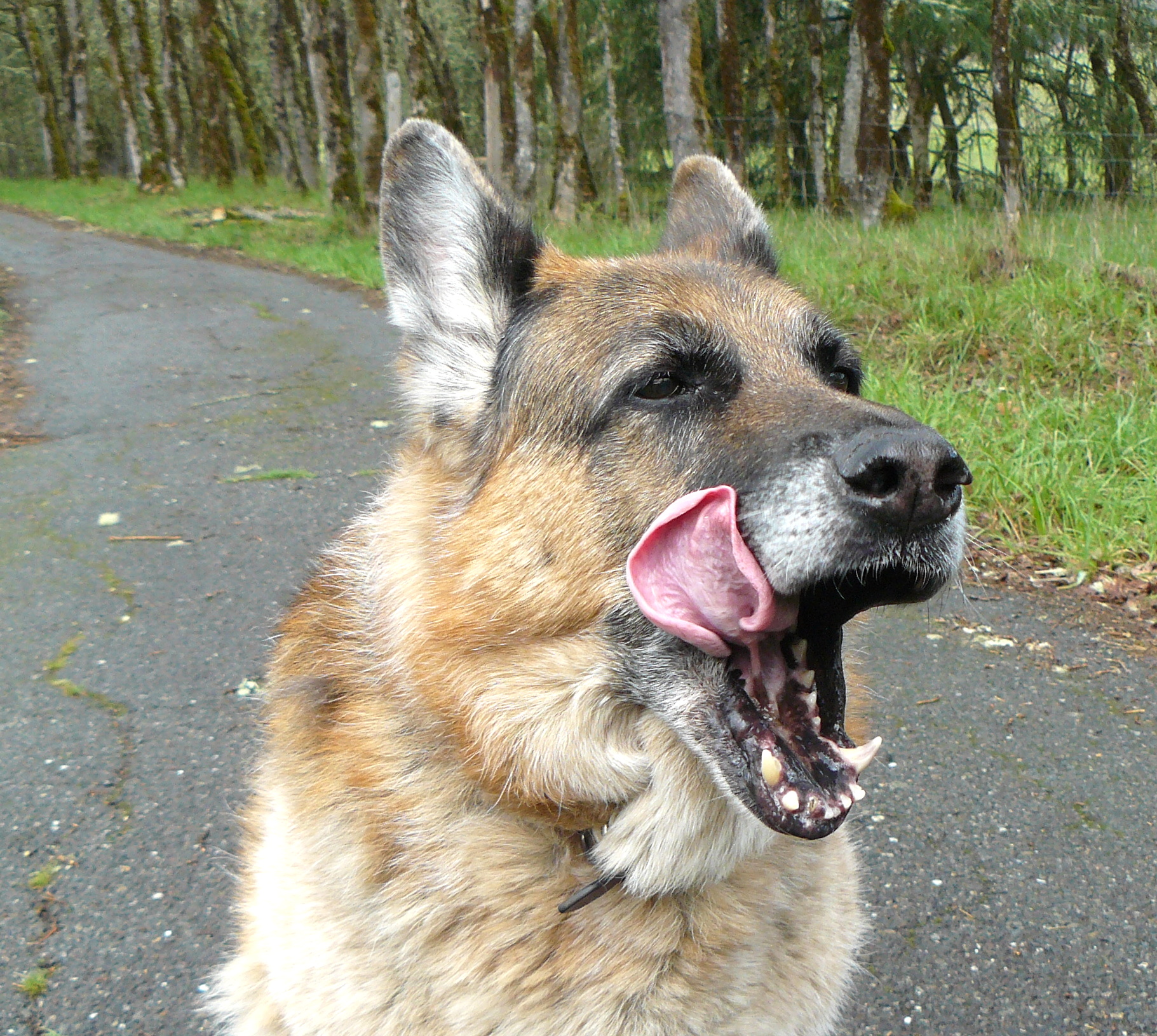
Exactly what emotions do dogs feel, and are they capable of all the same emotions as humans? (Photo: Pressmaster/Shutterstock)
Joy, fear, surprise, disgust, sadness. These are the basic emotions dogs feel that are also easy enough for humans to identify. But what about more complex emotions?
Many dog owners are convinced their dogs feel guilty when they’re caught misbehaving. In the same way, many owners are sure their dogs feel pride at having a new toy or bone. But it gets tricky when you assign these sorts of emotions to a dog. These are definitely emotions felt by humans, but are they also felt by dogs?
(see footnote)
Why we question the presence of complex emotions is wrapped up in the way we get to those emotions. The American Psychological Association explains, “Embarrassment is what’s known as a self-conscious emotion. While basic emotions such as anger, surprise or fear tend to happen automatically, without much cognitive processing, the self-conscious emotions, including shame, guilt and pride, are more complex. They require self-reflection and self-evaluation.”
Essentially we’re comparing our behavior or situation to a social expectation. For instance, guilt comes when we reflect on the fact that we’ve violated a social rule. We need to be aware of the rule and what it means to break it. So, can dogs feel guilt? Well, exactly how self-reflective and self-evaluative are dogs?
Among humans, children begin to experience empathy and what are called secondary emotions when they are around 2 years old. Researchers estimate that the mental ability of a dog is roughly equal to that of an 18-month-old human. “This conclusion holds for most mental abilities as well as emotions,” says Stanley Coren in an article in Modern Dog Magazine. “Thus, we can look to the human research to see what we might expect of our dogs. Just like a two-year-old child, our dogs clearly have emotions, but many fewer kinds of emotions than found in adult humans.”
In other words, if 18-month-old children can’t yet experience these emotions, and dogs are roughly equal to them in cognitive and emotional ability, then dogs can’t feel these self-reflective emotions either. At least, that’s what researchers have concluded so far.
Is that guilt or fear?
This little puppy might feel guilty for chewing on clothes, or he could just be worried about getting in trouble. The two aren’t the same emotion. (Photo: InBetweentheBlinks/Shutterstock)
The evidence for primary emotions like love and happiness in dogs abounds, but empirical evidence for secondary emotions like jealousy and guilt is sparse. And this is partially because it’s difficult to create tests that provide clear-cut answers. When it comes to guilt, does a dog act guilty because she knows she did something wrong, or because she’s expecting a scolding? The same expression can come across as guilt or fear. How do we know which it is?
“In wolves, it is thought that guilt-related behaviors serve to reinforce social bonds, as in primates, by reducing conflict and eliciting tolerance from other members of the social group. The same could be true of dogs, though their social groups would primarily include humans. The problem is that the display of the associated behaviors of guilt are not, themselves, evidence of the capacity to emotionally experience guilt… It may still be some time before we can know for certain whether dogs can experience guilt, or whether people can determine if a dog has violated a rule prior to finding concrete evidence of it.”
Guilt, and other secondary emotions, are complicated. That’s exactly why cognitive awareness and emotional capacity in dogs is still a topic under study. In fact, it’s an area that has grown significantly in recent years. We may discover that dogs have a more complex range of emotions than we’re aware of today.
Dogs are highly social animals, and social animals are required to navigate a range of emotions in themselves and those around them to maintain social bonds. It wasn’t so long ago that scientists thought that dogs (and other non-human animals) didn’t have any feelings at all. Perhaps our understanding of dog emotions is simply limited by the types of tests we’ve devised to understand their emotions. After all, we’re trying to detect a sophisticated emotional state in a species that doesn’t speak the same language.
There’s a lot we don’t know
Dogs experience a range of emotions, but researchers are still trying to figure out exactly what those emotions are. (Photo: Hysteria/Shutterstock)
Marc Bekoff makes the argument for leaving the possibility open. In an article in Psychology Today he writes, “[B]ecause it’s been claimed that other mammals with whom dogs share the same neural bases for emotions do experience guilt, pride, and shame and other complex emotions, there’s no reason why dogs cannot.”
Keeping the possibility open is more than just an emotional animal rights issue. There is a scientific basis for continuing the research. A recent study showed that the brains of dogs and humans function in a more similar way than we previously thought.
Scientific American reports that “dog brains have voice-sensitive regions and that these neurological areas resemble those of humans. Sharing similar locations in both species, they process voices and emotions of other individuals similarly. Both groups respond with greater neural activity when they listen to voices reflecting positive emotions such as laughing than to negative sounds that include crying or whining. Dogs and people, however, respond more strongly to the sounds made by their own species.”
Until recently, we had no idea of the similar ways human and dog brains process social information.
So do dogs feel shame, guilt and pride? Maybe. Possibly. It’s still controversial, but for now, there seems to be no harm in assuming they do unless proven otherwise.
ooOOoo
Footnote: At this point in the MNN article there was a link to a series of gorgeous photographs of dogs. If you dear readers can wait, then I will publish them this coming Sunday. If you can’t wait, then go here!













 Learning from Dogs