On Monday and Tuesday of the week I posted Legitimate Anger and Legitimate Hope. (And please see the footnote to today’s post)
Patrice Ayme left the following comment to the Legitimate Hope post:
It’s hard to live with elephants, especially in poor, crowded conditions. I remember bathing in Africa as a child with a bull elephant 200 meters away, on the other side of a stream, and being extremely worried, with all in attendance.
Europe used to have elephants, and North America, two species. Time to reintroduce them, and live according to our discourse.
Rewilding Euramerica can be done, and should be done, for the deepest philosophical and emotional reasons, and will create new, very productive jobs.
PA
Then on Friday came an email from reader and blogger Martin Lack:
It was but a moment to go across to The Conversation website (rather liked what I saw, by the way) and find the article that Martin linked to. It is republished here within the terms of The Conversation site.
ooOOoo
Restore large carnivores to save struggling ecosystems
By William Ripple, Oregon State University
We are losing our large carnivores. In ecosystems around the world, the decline of large predators such as lions, bears, dingoes, wolves, and otters is changing landscapes, from the tropics to the Arctic. Habitat loss, persecution by humans and loss of prey have combined to inflict great losses on these populations.
In fact more than 75% of the 31 largest carnivore species are declining, and 17 species now occupy less than half their former ranges. Southeast Asia, southern and East Africa, and the Amazon are among areas in which multiple large carnivore species are declining. And with only a few exceptions, large carnivores have already been exterminated from much of the developed world, including areas of Western Europe, and the eastern United States.
Top dogs keep ecosystems in order
Many of these large carnivore species are endangered and some are at risk of extinction, either in specific regions or entirely. Ironically, they are vanishing just as we are learning about their important ecological effects, which is what led us to write a new paper in the journal Science to document their role.
From a review of published reports, we singled out seven species that have been studied for their important ecological role and widespread effects, known as trophic cascades. These are the African lion, leopard, Eurasian lynx, cougar, gray wolf, sea otter and dingo.
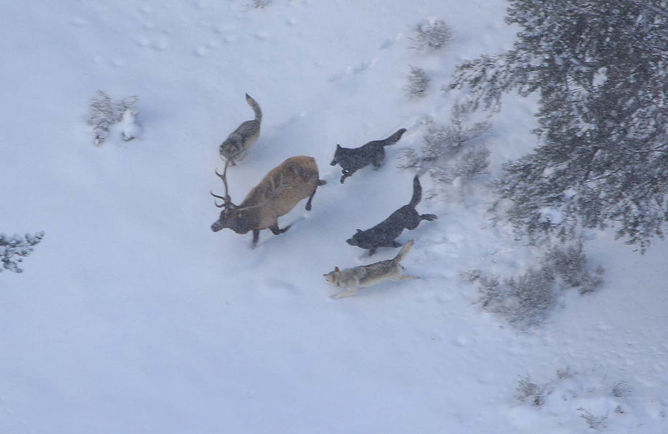
Based on field research, my Oregon State University co-author Robert Beschta and I documented the impact of cougars and wolves on the regeneration of forest tree stands and riverside vegetation in Yellowstone and other national parks in western North America. Fewer predators, we found, lead to an increase in browsing animals such as deer and elk. More browsing disrupts vegetation, reduces birds and some mammals and changes other parts of the ecosystem. From the actions of the top predator, widespread impacts cascade down the food chain.
Similar effects were found in studies of Eurasian lynx, dingoes, lions and sea otters. For example in Europe, absence of lynx has been closely tied to the abundance of roe deer, red fox and hare. In Australia, the construction of a 3,400-mile dingo-proof fence has enabled scientists to study ecosystems with and without dingoes which are closely related to gray wolves. They found that dingoes control populations of herbivores and exotic red foxes. The suppression of these species by dingoes reduces predation pressure, benefiting plants and smaller native prey.
In some parts of Africa, the decrease of lions and leopards has coincided with a dramatic increase in olive baboons, which threaten crops and livestock. In the waters off southeast Alaska, a decline in sea otters through killer whale predation has led to a rise in sea urchins and loss of kelp beds.
Predators are integral, not expendable
We are now obtaining a deeper appreciation of the impact of large carnivores on ecosystems, a view that can be traced back to the work of landmark ecologist Aldo Leopold. The perception that predators are harmful and deplete fish and wildlife is outdated. Many scientists and wildlife managers now recognise the growing evidence of carnivores’ complex role in ecosystems, and their social and economic benefits. Leopold recognised these relationships, but his observations were ignored for decades after his death in 1948.
Top carnivores, at work keeping things in check. Doug Smith
Human tolerance of these species is the major issue. Most would agree these animals have an intrinsic right to exist, but additionally they provide economic and ecological services that people value. Among the services documented in other studies are carbon sequestration, restoration of riverside ecosystems, biodiversity and disease control. For example, wolves may limit large herbivore populations, thus decreasing browsing on young trees that sequester carbon when they escape browsing and grow taller. Where large carnivore populations have been restored – such as wolves in Yellowstone or Eurasian lynx in Finland – ecosystems appear to be bouncing back.
I am impressed with how resilient the Yellowstone ecosystem is, and while ecosystem restoration isn’t happening quickly everywhere in this park, it has started. In some cases where vegetation loss has led to soil erosion, for example, full restoration may not be possible in the near term. What is certain is that ecosystems and the elements of them are highly interconnected. The work at Yellowstone and other places shows how species affect each another through different pathways. It’s humbling as a scientist to witness this interconnectedness of nature.
My co-authors and I have called for an international initiative to conserve large carnivores in co-existence with people. This effort could be modelled after a couple of other successful efforts including the Large Carnivore Initiative for Europe, a non-profit scientific group affiliated with the International Union for the Conservation of Nature, and the Global Tiger Initiative which involves all 13 of the tiger-range countries. With more tolerance by humans, we might be able to avoid extinctions. The world would be a scary place without these predators.
William Ripple does not work for, consult to, own shares in or receive funding from any company or organisation that would benefit from this article, and has no relevant affiliations.
In 2011, more African elephants were killed than any other year in history. The figures for 2012 and 2013 are not yet known, but are likely to be even higher. At current rates, in twelve years, there will be none left.
It is a familiar cause, but it has never been more urgent. Poaching has turned industrial. Armed militia fly in helicopters over jungle clearings, machine gunning down entire herds. Their tusks are then sold to fund war and terrorism throughout the continent and the wider world. Ivory is still illegal, but as China booms, it is more popular than ever.
This campaign will raise money to support rangers on the ground to protect Kenya’s elephants from armed poachers, together with Space for Giants’ longer term work to create new wildlife sanctuaries where elephants will be safe, forever. More can be found about the charity at Space for Giants
The article above includes two videos. A shorter one that can be viewed on the paper’s campaign website. Then there is a longer, five-minute, video also on YouTube and included below.
Jean and I wanted to make a donation but found that without a UK bank account/UK Visa card it wasn’t possible. We contacted Space for Giants and received the following email from Amy.
Hi Paul
Sorry for the difficulties and thank you for your perseverance!
You can donate in USD through our CrowdRise page at www.crowdrise.com/spaceforgiants1. These funds are sent to TUSK USA who will then allocate them to us.
Alternatively, you can make out a cheque to ‘TUSK USA’ and send to TUSK USA, 40 East 94th Street, Apt 3A, New York, NY 10128 – please attach a covering note confirming that you would like your donation to be used to support the work of Space for Giants.
Many thanks,
Amy.
So if there’s anyone else out there not in the UK who would like to donate, here’s another option.
Please, for all our sakes, help these beautiful creatures.
“There IS very intelligent life, but somehow it can’t seem to achieve dominance over the other kind.” Chris Snuggs.
In yesterday’s Part One, I offered three independent essays, about the USA, the UK and Europe, that contained a common message. A message of “the abject failure of modern nation-state democracy — not only in Europe, but across the globe.“ (In the words of one of the essayists: Don Quijones.)
As with Part One, Part Two brings together disconnected commentators offering an interconnected theme.
One of the commentators was Chris Snuggs who writes the blog Nemo Insula Est. It was his post about the slaughter of elephants for their tusks that I featured last Tuesday: Legitimate anger. Chris and I recently exchanged emails on the curious issue of why those who are charged with governing our democratic societies so often fail to do so in a fair and balanced manner; to put it mildly.
Here’s some of that exchange from Chris:
My theory is that intelligent people are too nice. Take you, for example – someone so intelligent, informed and civilised should be in government, but you are not ruthless, nasty and/or ambitious enough!!!
Another way to put it is that people like you – and I on a more modest, brutish and disorganised level – are doing their bit to spread civility in general, but we have NO POWER because we are too nice.
A related theory is that most people are in fact basically nice but that the rest have a disproportionate influence, both because a greater proportion of them have power and because of the “rotten apple” theory – one apple rots the barrel eventually.
I should open a school to teach nice and intelligent people how to be more nasty to nasty people! ………. Indeed, it is our duty to be more ruthless to stand up to the bad guys.
Moving swiftly over the flattery of yours truly, there is a strong message from Chris. The message that nice people are not being sufficiently active in registering their disgust over what is being done in the supposed name of the people.
The next item, as part of this theme, was a recent article on Permaculture News. The article was called Majority Voting is Inadequate and was based around an interview with Peter Emerson. I hadn’t heard of Mr. Emerson before but very quickly established that Peter Emerson is the director of the de Borda Institute in Belfast, Northern Ireland. He is a leading authority on voting systems for use in both decision-making and elections.
Here is a flavour of that interview.
Marcin Gerwin (Poland): There are many divisions and even hostility in the Polish parliament. The ruling coalition currently has 232 votes in a parliament with 460 seats. This slight majority allows them to run all the ministries, and they can pass almost any bill they want. Do you think that creating an all-inclusive government, where all parties have their representatives, could help to tone down the atmosphere and create a more cooperative environment?
Peter Emerson
Peter Emerson: In a word – yes. However, I think I should argue the other point first. There is no justification for majority rule. When I was in Russia, it was quite interesting, because when Gorbachev started perestroika, all sorts of experts rushed over to Moscow, to tell him what to do to be democratic. They advised the system that we have here in Northern Ireland and that you now have in Poland and pretty well everyone else has as well – and that is that you elect your parliament by one of many electoral systems, apparently they all are democratic, even though some are bad and some are worse. But when it comes to what happens in parliament, nearly every parliament in the world debates things and then takes a majority vote.
These experts talked in Russia about majority rule but Mikhail Sergeyevich doesn’t speak English, so they had to use the Russian word. And the Russian word for majoritarianism is bolshevism. It comes from the Russian word for majority which is bolshinstvo, so the member of the majority was a bolshevik and a member of the minority was a menshevik. The decision to split into bolsheviks and mensheviks was taken in 1903 in London by the mathematical accident of just one vote. The whole thing was nonsense. But God, such a dangerous one.
MG: If not a majority vote, what are the other ways that decisions can be made?
PE: There are lots of voting methodologies – Borda count, Condorcet…. One of these could be used. And in fact Dublin City Council recently took a vote by means of a Borda count, which is brilliant. It was partly because they had more than two options on the agenda, so you almost have to move beyond majority voting.
And when you look at it, the majority vote is actually the most inaccurate measure of collective opinion ever invented. It’s over two thousand years old, it was used by the Greeks and the Chinese. But there is no justification to for its use today because it’s so inaccurate.
You did register what Peter said in that last paragraph? “the majority vote is actually the most inaccurate measure of collective opinion ever invented.”
If you have only the slightest curiosity about better methods of voting then do read the interview in full. For the interview contains links to other voting systems, most of which I hadn’t heard of before. There is the Borda count, the Condorcet method, the Ranked voting system (otherwise known as Preferential voting), and the proportional voting process known as the Matrix vote.
Moving on.
The final coincidence was John Hurlburt sending me the following essay, that is published with his permission.
ooOOoo
Apocalypse and Epiphany
Apocalypse, n. [Gr. apokalypsis, from apokalypto, to disclose and to discover.] Revelation; discovery; disclosure. (The New Webster Encyclopedic Dictionary)
Apocalypse is a word which describes a human awakening to change. Change is a constant. Our species has been living through apocalypse for fourteen million years. Conservative groups deny change. For example financial interests spent 14 million dollars to refute the scientific reality of climate change during 2013. We are in the midst of worldwide financial wars, energy wars, cultural wars, and political wars. Has there been progress in emerging human species intelligence?
Perhaps more importantly, has there been progress in human morality? We’ve been around as a species for roughly 14 million years. Have we truly learned anything in the process? For the last two hundred years we’ve been industrially poisoning the environment which sustains our existence at a steadily increasing rate.
We’re needlessly killing ourselves and a significant portion of the life on our shared garden planet in the pursuit of artificial symbols of trust we call money. No one knows for sure how deep and how devastating an impending economic, cultural, political and geophysical collapse may become.
We’ve reached a critical tipping point between species survival and a severely diminished quality of human life. We’re in the process of falling off the edge. The good news is that we know what needs to be done and we know how to do it. So why don’t we do what we know needs to be done?
There are a variety of reasons. The seven deadly sins are a starting point for systemic corruption. The seven deadly sins are pride, greed, lust, anger, gluttony, envy and sloth. Add ignorance, denial and indifference. Serve bread and circuses for dessert. In terms of action, compete more than cooperate. Rush ever faster without reflection, contemplation or meditation. As a final touch, become consumed by “now” without regard for the future.
Epiphany, n. [Gr. epiphaneia, appearance; from epiphanio, to appear] an appearance or a becoming manifest. (The New Webster Encyclopedic Dictionary) Epiphany provides us a way to deal with apocalypse. As what’s going on is revealed, we realize that something needs to be done about it and that we are capable of creating and implementing solutions in concert with Nature.
To paraphrase Shakespeare’s “Hamlet”, “The fault, Dear Brutus, lies not in our stars but in ourselves.” What do we need to personally change both spiritually and practically? Today is the tomorrow – we imagined yesterday.
Considering our steadily increasing demographic and our systemic global failure, it’s half past time to clean house. We begin with our “self”. We take inventory. We honestly look at our thoughts and actions. What do we personally have to offer that’s useful and productive in terms of a resilient tomorrow? What’s standing in our way today?
We accept that we are a very young consciously aware species on a fragile garden planet that’s 14 Billion years old in a universe that’s roughly 33 billion years old. We accept that we are a species component of the matter and energy of Creation. We accept responsibility for sustaining our being and by extension responsibility for the being of life on earth.
We realize our purpose as stewards of Creation.
an old lamplighter
ooOOoo
So put those three perspectives together and the message is clear. This is a period of significant change and, as with previous periods in history, change only comes along when there is dissatisfaction with the present. Ergo, there is widespread acceptance that the present way of life is not working for millions and millions around the world.
Reinforced only this morning (Thursday) by a recent announcement from Gallup regarding the voting intentions of Americans.
January 8, 2014
Record-High 42% of Americans Identify as Independents
Republican identification lowest in at least 25 years
by Jeffrey M. Jones
PRINCETON, NJ — Forty-two percent of Americans, on average, identified as political independents in 2013, the highest Gallup has measured since it began conducting interviews by telephone 25 years ago. Meanwhile, Republican identification fell to 25%, the lowest over that time span. At 31%, Democratic identification is unchanged from the last four years but down from 36% in 2008.
Let me include this section:
Fourth Quarter Surge in Independence
The percentage of Americans identifying as independents grew over the course of 2013, surging to 46% in the fourth quarter. That coincided with the partial government shutdown in October and the problematic rollout of major provisions of the healthcare law, commonly known as “Obamacare.”
The 46% independent identification in the fourth quarter is a full three percentage points higher than Gallup has measured in any quarter during its telephone polling era.
Taking everything into consideration, from yesterday’s evidence and what is presented today, it’s hardly surprising to read in that Gallup report [my italics]:
The increased independence adds a greater level of unpredictability to this year’s congressional midterm elections. Because U.S. voters are less anchored to the parties than ever before, it’s not clear what kind of appeals may be most effective to winning votes. But with Americans increasingly eschewing party labels for themselves, candidates who are less closely aligned to their party or its prevailing doctrine may benefit.
Fascinating times! Thank goodness there’s always a dog to remind us of how to cope!
A collection of essays and ideas that unite in a common theme.
Back in those times before dogs became the domesticated friends of man, the leader of the pack, the alpha female, had two key pack roles. One of them was having first pick of the males, for mating purposes, and the other was knowing when their territory was no longer conducive to her pack’s interests. When that happened the ‘boss lady’ was the one to signal that the pack had to find another, more beneficial, homestead.
While mankind is in desperate need of learning so many of the qualities of dogs the one example that is beyond us is finding a new homestead. This planet is the only homestead we have.
This basic and fundamental concept seems to be missing from the minds of leaders and power-brokers. Missing big time!
Coincidentally, over recent days there have been three essays from three different authors that scream out the madness, to put it nicely, of the way of our world just now. Let me dip into those three essays.
First, to a recent essay from Tom Engelhardt over at TomDispatch.
American Jihad 2014 The New Fundamentalists
By Tom Engelhardt
In a 1950s civics textbook of mine, I can remember a Martian landing on Main Street, U.S.A., to be instructed in the glories of our political system. You know, our tripartite government, checks and balances, miraculous set of rights, and vibrant democracy. There was, Americans then thought, much to be proud of, and so for that generation of children, many Martians were instructed in the American way of life. These days, I suspect, not so many.
Still, I wondered just what lessons might be offered to such a Martian crash-landing in Washington as 2014 begins. Certainly checks, balances, rights, and democracy wouldn’t top any New Year’s list. Since my childhood, in fact, that tripartite government has grown a fourth part, a national security state that is remarkably unchecked and unbalanced. In recent times, that labyrinthine structure of intelligence agencies morphing into war-fighting outfits, the U.S. military (with its own secret military, the special operations forces, gestating inside it), and the Department of Homeland Security, a monster conglomeration of agencies that is an actual “defense department,” as well as a vast contingent of weapons makers, contractors, and profiteers bolstered by an army of lobbyists, has never stopped growing. It has won the undying fealty of Congress, embraced the power of the presidency, made itself into a jobs program for the American people, and been largely free to do as it pleased with almost unlimited taxpayer dollars.
The expansion of Washington’s national security state — let’s call it the NSS — to gargantuan proportions has historically met little opposition. In the wake of the Edward Snowdenrevelations, however, some resistance has arisen, especially when it comes to the “right” of one part of the NSS to turn the world into a listening post and gather, in particular, American communications of every sort. The debate about this — invariably framed within the boundaries of whether or not we should have more security or more privacy and how exactly to balance the two — has been reasonably vigorous. The problem is: it doesn’t begin to get at the real nature of the NSS or the problems it poses.
If I were to instruct that stray Martian lost in the nation’s capital, I might choose another framework entirely for my lesson. After all, the focus of the NSS, which has like an incubus grown to monumental proportions inside the body of the political system, would seem distinctly monomaniacal, if only we could step outside our normal way of thinking for a moment. At a cost of nearly a trillion dollars a year, its main global enemy consists of thousands of lightly armed jihadis and wannabe jihadis scattered mainly across the backlands of the planet. They are capable of causing genuine damage — though far less to the United States than numerous other countries — but not of shaking our way of life. And yet for the leaders, bureaucrats, corporate cronies, rank and file, and acolytes of the NSS, it’s a focus that can never be intense enough on behalf of a system that can never grow large enough or be well funded enough.
It’s a long, deeply thoughtful essay that deserves your full read. This is how it closes:
After 12 long years in Afghanistan and an Obama era surge in that country, the latest grim National Intelligence Estimate from the U.S. intelligence community suggests that no matter what Washington now does, the likelihood is that things there will only go from bad enough to far worse. Years of a drone campaign against al-Qaeda in the Arabian Peninsula hasstrengthened that organization; an air intervention in Libya led to chaos, a dead ambassador, and a growing al-Qaeda movement in northern Africa — and so it repetitively goes.
Similarly, intelligence officials brag of terrorist plots — 54 of them! — that have been broken up thanks in whole or in part to the National Security Agency’s metadata sweeps of U.S. phone calls; it also claims that, given the need of secrecy, only four of them can be made public. (The claims of success on even those four, when examined by journalists, have proved less than impressive.) Meanwhile, the presidential task force charged with reviewing the NSA revelations, which had access to a far wider range of insider information, came to aneven more startling conclusion: not one instance could be found in which that metadata the NSA was storing in bulk had thwarted a terrorist plot. “Our review,” the panel wrote, “suggests that the information contributed to terrorist investigations by the use of section 215 telephony meta-data was not essential to preventing attacks.” (And keep in mind that, based on what we do know about such terror plots, a surprising number of them were planned or sparked or made possible by FBI-inspired plants.)
In fact, claims of success against such plots couldn’t be more faith-based, relying as they generally do on the word of intelligence officials who have proven themselves untrustworthy or on the impossible-to-prove-or-disprove claim that if such a system didn’t exist, far worse would have happened. That version of a success story is well summarized in the claim that “we didn’t have another 9/11.”
In other words, in bang-for-the-buck practical terms, Washington’s national security state should be viewed as a remarkable failure. And yet, in faith-based terms, it couldn’t be a greater success. Its false gods are largely accepted by acclamation and regularly worshiped in Washington and beyond. As the funding continues to pour in, the NSS has transformed itself into something like a shadow government in that city, while precluding from all serious discussion the possibility of its own future dismantlement or of what could replace it. It has made other options ephemeral and more immediate dangers than terrorism to the health and wellbeing of Americans seem, at best, secondary. It has pumped fear into the American soul. It is a religion of state power.
Now let’s move from the USA to the UK. George Monbiot penned an essay on the 6th January about the growing loss of freedoms in my old home country. He opens:
Dead Zone
January 6, 2014
A shocking new bill threatens to make this country feel like a giant shopping mall.
By George Monbiot, published in the Guardian 7th January 2014
Until the late 19th Century, much of our city space was owned by private landlords. Squares were gated, streets were controlled by turnpikes. The great unwashed, many of whom had been expelled from the countryside by acts of enclosure, were also excluded from desirable parts of town.
Social reformers and democratic movements tore down the barriers, and public space became a right, not a privilege. But social exclusion follows inequality as night follows day, and now, with little public debate, our city centres are again being privatised or semi-privatised. They are being turned by the companies that run them into soulless, cheerless, pasteurised piazzas, in which plastic policemen harry anyone loitering without intent to shop.
Streetlife in these places is reduced to a trance-world of consumerism, of conformity and atomisation, in which nothing unpredictable or disconcerting happens, a world made safe for selling mountains of pointless junk to tranquilised shoppers. Spontaneous gatherings of any other kind – unruly, exuberant, open-ended, oppositional – are banned. Young, homeless and eccentric people are, in the eyes of those upholding this dead-eyed, sanitised version of public order, guilty until proven innocent.
Then a few paragraphs later, the essay continues:
The existing rules are bad enough. Introduced by the 1998 Crime and Disorder Act, anti-social behavour orders (Asbos) have criminalised an apparently endless range of activities, subjecting thousands – mostly young and poor – to bespoke laws. They have been used to enforce a kind of caste prohibition: personalised rules which prevent the untouchables from intruding into the lives of others.
You get an Asbo for behaving in a manner deemed by a magistrate as likely to cause harassment, alarm or distress to other people. Under this injunction, the proscribed behaviour becomes a criminal offence. Asbos have been granted which forbid the carrying of condoms by a prostitute, homeless alcoholics from possessing alcohol in a public place, a soup kitchen from giving food to the poor, a young man from walking down any road other than his own, children from playing football in the street. They were used to ban peaceful protests against the Olympic clearances.
Inevitably, over half the people subject to Asbos break them. As Liberty says, these injunctions “set the young, vulnerable or mentally ill up to fail”, and fast-track them into the criminal justice system. They allow the courts to imprison people for offences which are not otherwise imprisonable. One homeless young man was sentenced to five years in jail for begging: an offence for which no custodial sentence exists. Asbos permit the police and courts to create their own laws and their own penal codes.
All this is about to get much worse. Tomorrow the Anti-social Behaviour, Crime and Policing Bill reaches its report stage (close to the end of the process) in the House of Lords. It is remarkable how little fuss has been made about it, and how little we know of what is about to hit us.
The bill would permit injunctions against anyone of 10 or above who “has engaged or threatens to engage in conduct capable of causing nuisance or annoyance to any person.” It would replace Asbos with Ipnas (Injunctions to Prevent Nuisance and Annoyance), which would not only forbid certain forms of behaviour, but also force the recipient to discharge positive obligations. In other words, they can impose a kind of community service on people who have committed no crime, which could, the law proposes, remain in force for the rest of their lives.
The bill also introduces Public Space Protection Orders, which can prevent either everybody or particular kinds of people from doing certain things in certain places. It creates new dispersal powers, which can be used by the police to exclude people from an area (there is no size limit), whether or not they have done anything wrong.
Please read the original essay in full as well as refer to background links that were included in that original. I will offer the closing paragraphs.
The Home Office minister, Norman Baker, once a defender of civil liberties, now the architect of the most oppressive bill pushed through any recent parliament, claims that the amendments he offered in December will “reassure people that basic liberties will not be affected”(11). But Liberty describes them as “a little bit of window-dressing: nothing substantial has changed.”(12)
The new injunctions and the new dispersal orders create a system in which the authorities can prevent anyone from doing more or less anything. But they won’t be deployed against anyone. Advertisers, who cause plenty of nuisance and annoyance, have nothing to fear; nor do opera lovers hogging the pavements of Covent Garden. Annoyance and nuisance are what young people cause; they are inflicted by oddballs, the underclass, those who dispute the claims of power.
These laws will be used to stamp out plurality and difference, to douse the exuberance of youth, to pursue children for the crime of being young and together in a public place, to help turn this nation into a money-making monoculture, controlled, homogenised, lifeless, strifeless and bland. For a government which represents the old and the rich, that must sound like paradise.
The last of the three essays was about Europe, being an essay on Naked Capitalism two days ago.
Written by Don Quijones, a freelance writer and translator based in Barcelona, Spain who also publishes the blog Raging Bull-Shit, the essay was originally posted at Testosterone Pit.
Death By A Thousand Cuts: The Silent Assassination Of European Democracy
As is gradually dawning on more and more people across the old continent, the European Union is riddled with fatal flaws and defects. Chief among them is the single currency which, rather than serving as the Union’s springboard to global dominance, could well be its ultimate undoing.
Another huge problem with the EU is its acute lack of transparency. Staggering as it may seem, in the last 20 years the Union has not passed a single audit. Indeed, so opaque is the state of its finances that in 2002 Marta Andreasen, the first ever professional accountant to serve as the Commission’s Chief Accountant, refused to sign off the organization’s 2001 accounts, citing concerns that the EU’s accounting system was “open to fraud.” After taking her concerns public, Andreasen was suspended and then later sacked by the Commission.
However, by far the EU’s greatest — and certainly most dangerous — structural flaw is its gaping democratic deficit. To paraphrase Nigel Farage, the stridently anti-EU British MEP, not only is the EU undemocratic, it is fundamentally anti-democratic.
Yet again, the essay must be read in full. As with the others, I will include the closing paragraphs:
Of course none of this would be possible if it weren’t for the abject failure of modern nation-state democracy — not only in Europe, but across the globe. As Mair wrote in the first paragraph of his book, although the political parties themselves remain, “they have become so disconnected from the wider society, and pursue a form of competition that is so lacking in meaning, that they no longer seem capable of sustaining democracy in its present form.”
The European elites have masterfully exploited this crisis of representative democracy and the resultant voter disaffection and apathy to enshrine a new system of rule by bureaucrats, bankers, technocrats and lobbyists (as I reported in Full Steam Ahead For the EU Gravy Train, Brussels is home to the second biggest lobby industry in the world, just behind Washington). If anything, we can expect this trend to accelerate in 2014 as the Eurocrats seek to consolidate their power grab through the imposition of EU-wide banking and fiscal union. Once that’s done, the quest for the holy grail of full-blown political union will begin in earnest.
Whether the EU is able to pull of this ultimate coup de grace in its decades-long coup d’état will depend on two vital factors: its ability to continue preventing economic reality from impacting the financial markets; and the willingness of hundreds of millions of European people to be herded and corralled into a new age of technocracy.
oooo
“the abject failure of modern nation-state democracy — not only in Europe, but across the globe.”
Don Quijones wrote that with a focus on Europe. But also a recognition that right across the world the rights and safeguards of everyday citizens are being dangerously undermined. I will return tomorrow with Part Two and an insight into the growing power of those everyday citizens.
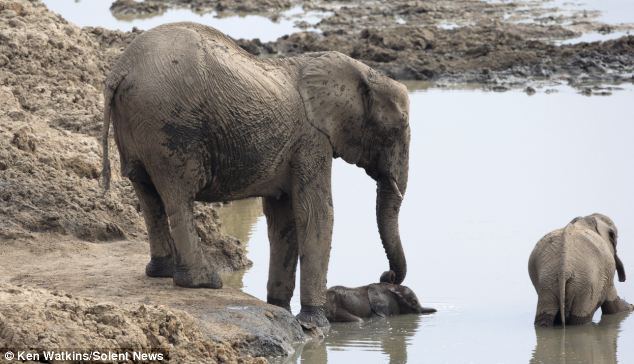
Many will have read yesterday’s post about the slaughter of elephants by ivory poachers and felt, as I did, a feeling of despair in the pit of one’s soul. We seem to be living in such challenging times with so much madness about us. It’s incredibly easy to feel as if this is some sort of ‘end of times’ period.
Today’s post tells us that there is always hope.
Let’s remind ourselves that elephants are very intelligent animals. As I wrote last November in a post with the title of Smart Animals:
There was a fascinating article on the BBC news website a few weeks ago that went on to explain:
10 October 2013
Elephants ‘understand human gesture’
By Victoria GillScience reporter, BBC News
African elephants have demonstrated what appears to be an instinctive understanding of human gestures, according to UK scientists. In a series of tests, researcher Ann Smet, of the University of St Andrews, offered the animals a choice between two identical buckets, then pointed at the one containing a hidden treat.
From the first trial, the elephants chose the correct bucket.
In 2011, more African elephants were killed than any other year in history. The figures for 2012 and 2013 are not yet known, but are likely to be even higher. At current rates, in twelve years, there will be none left.
It is a familiar cause, but it has never been more urgent. Poaching has turned industrial. Armed militia fly in helicopters over jungle clearings, machine gunning down entire herds. Their tusks are then sold to fund war and terrorism throughout the continent and the wider world. Ivory is still illegal, but as China booms, it is more popular than ever.
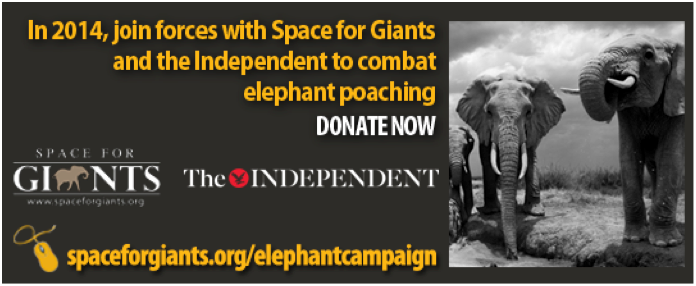
This campaign will raise money to support rangers on the ground to protect Kenya’s elephants from armed poachers, together with Space for Giants’ longer term work to create new wildlife sanctuaries where elephants will be safe, forever. More can be found about the charity at Space for Giants
The article above includes two videos. A shorter one that can be viewed on the paper’s campaign website. Then there is a longer, five-minute, video also on YouTube and included below.
Then there is the David Sheldrick Wildlife Trust helping animals in Africa. And, finally, the campaign over at Bloody Ivory where one can sign a petition and donate towards stopping elephant poaching.
Thus, like so many aspects of life, never give up trying to help those less fortunate.
What a greedy, selfish race of people we can be at times!
I’m writing about the subject of elephants. Or, to put it more precisely and distastefully, the murder of elephants. For the ivory in their tusks.
The post was prompted by a recent item over on Chris Snuggs’ blog Nemo Insula Est. Chris and I have known each other for quite a few years now; since the time that he was Head of Studies at the French college, ISUGA, in Quimper, France and where I attended as a visiting teacher running a class on Sales & Marketing.
Chris has allowed me to republish the piece in full. Please read today’s post and then come back tomorrow to see in what ways we can all help.
ooOOoo
The Human Shame in Northern Kenya
03JAN
One of my NYRs was to stop reading bad news, but that lasted about 6 hours ….. there is of course so much of it, and so much that is utterly depressing. One of the first of 2014 was an article in “The Independent”:
Elephant Appeal: Few are willing to say just how bad the poaching crisis is – the elephant population may easily fall into terminal decline
Tragic, to the extreme!
You can get all the details from the article – which is pretty harrowing, with surviving elephants described as being “stricken with grief” as they cluster round their slaughtered brethren – but basically, elephants in the Tsavo East National Park in Northern Kenya are under threat of extinction from poachers from Somalia. This provoked a number of reactions on my part:
DEMAND
The price of ivory depends on the demand and supply. The former is very strong and apparently rising, especially in China. For extraordinarily moronic and selfish reasons, ivory is considered artistic and – for example – tiger and rhinoceros parts medicinal and/or possessing aphrodysiac properties.
Can China really do NOTHING to stop this cultural abomination? People in the west for the most part stopped acquiring ivory years ago.
If China – and other Asia nations – cannot or will not do anything, should the west not apply more pressure? Same applies of course to China’s support of North Korea. YES, sanctions are painful, but nothing NON-painful is likely to work.
THE POACHERS
They are execrable, of course …… and yet, many may be extremely poor, and indeed ignorant. There is no excuse in the strictest sense, but it may to some extent be understandable if they see a chance to make several years’ normal income in a single day. This is no different from City bankers, or indeed the Enron directors and many others: greed is sadly rampant on our planet.
There are insufficient funds to patrol the parks properly. Kenya is just one more corrupt African state where politicians earn a fortune while basic needs and services are severely underfunded.
MORALITY
So, there is a lack of funds to prevent the poacher-killers. Yet a few hundred miles away, vast sums of money are squandered on obscene luxuries.
I always wonder what if anything goes through the minds of those who spend these obscene sums on frippery and personal self-glorification. Do they ever think that their money could do immense good elsewhere? Would WE be just the same in their shoes?
Is there any solution to this greed?
ooOOoo
Chris wrote his post motivated by the article in The Independent UK newspaper. But that newspaper was not alone in promulgating the despicable killings of these smart and magnificent creatures. Here’s a story that was in the UK Daily Telegraph newspaper a year ago.
Horror as entire family of elephants slaughtered for ivory
Armed wildlife rangers on Tuesday night fanned out across eastern Kenya in pursuit of ivory poachers who killed an entire family of 12 elephants in the country’s worst single such slaughter since the 1980s.
Eleven adults and one infant calf died in a “targeted and efficient” attack highlighting the growing professionalism of poachers bankrolled by international criminals supplying soaring demand for ivory in the Far East.
Six of the animals lay in one heap, their tusks hacked out with machetes.
None of the family group managed to flee further than 300 yards before they were gunned down and their ivory removed.
The calf, less than a year old, is believed to have been crushed by its dying mother as she fell to the ground.
“It is unimaginable, a heinous, heinous crime,” said Paul Udoto, spokesman for the KenyaWildlife Service (KWS).
“We have not seen such an incident in recent memory, it’s the worst single loss that we have on record, and our records go back almost 30 years.
“These were professional killers. The attack was targeted and efficient.”
The poachers, armed with automatic rifles, had already fled but there were hopes last night that a massive search involving foot patrols, a dozen vehicles and three aircraft could still find them.
“Every possible resource is being deployed to track down these criminals,” Mr Udoto said. “They will feel the full force of the law.”
But the area where the elephants were killed, in the north of Kenya’s largest wildlife reserve, Tsavo East National Park, is sparsely populated, has few roads, and lies close to Kenya’s border with Somalia.
Privately, conservationists said they feared the poachers and their haul of 22 tusks, worth an estimated GBP175,000 on the Asian market, would already have escaped.
The attack was the latest in a surge of elephant deaths that has seen the number of the animals killed for their ivory in Kenya increase sevenfold in five years, from fewer than 50 in 2007 to 360 in 2012, according to KWS figures.
The increase has led many wildlife experts to declare the current situation a crisis worse even than the mass slaughter of Africa’s elephants in the 1970s and 1980s, which led to a global ivory trade ban in 1989.
I don’t have permission to republish the article so please go here and read the full piece and view a couple of harrowing photographs.
Then come back tomorrow and explore how you and I can do something to help. Please.
Yesterday, our internet connection was down for much of the morning and then slow and intermittent for some time later. It robbed me of the time to write a new post for today.
Hence the repeat. Prompted by a recent email from Martin Lack, he of Lack of Environment, it was a copy of something that was published on Learning from Dogs back on the 1st December, 2009; over four years ago (I must get out more!).
So here’s the repeat.
ooOOoo
Thanks to Daniel Caride for pointing us to this poem from an unknown author.
It is called Inner Peace.
If you can start the day without caffeine,
If you can always be cheerful, ignoring aches and pains,
If you can resist complaining and boring people with your troubles,
If you can eat the same food every day and be grateful for it,
If you can understand when your loved ones are too busy to give you any time,
If you can take criticism and blame without resentment,
If you can conquer tension without medical help,
If you can relax without liquor,
If you can sleep without the aid of drugs,
You are probably the family dog!
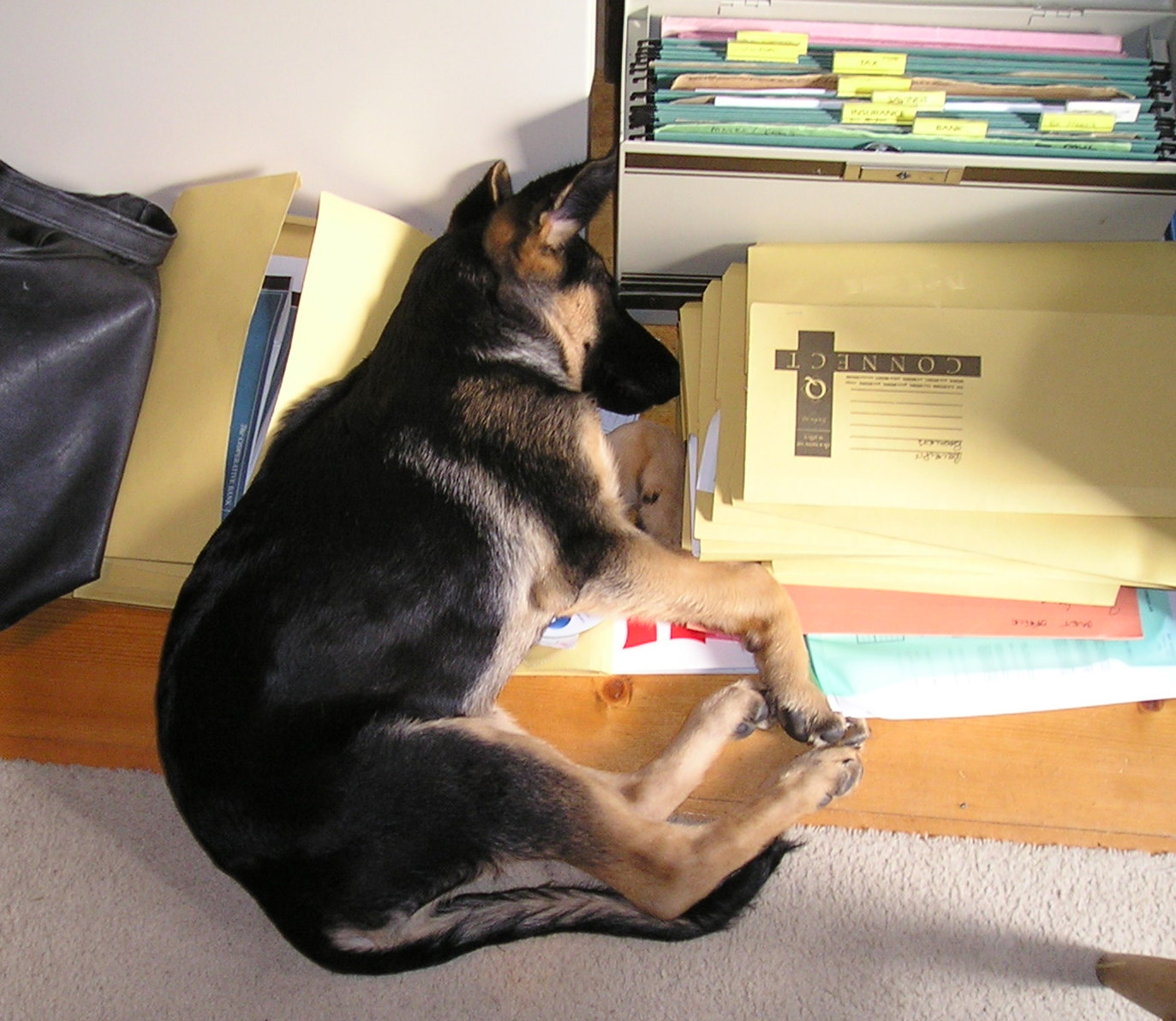
Pharaoh in 2003, aged 3 months, asleep and oblivious to the world!
Yes, we certainly have much to learn from dogs!
By Paul Handover
ooOOoo
However, in Martin’s recent email he included a different dog picture and a closing remark.
Here they are.
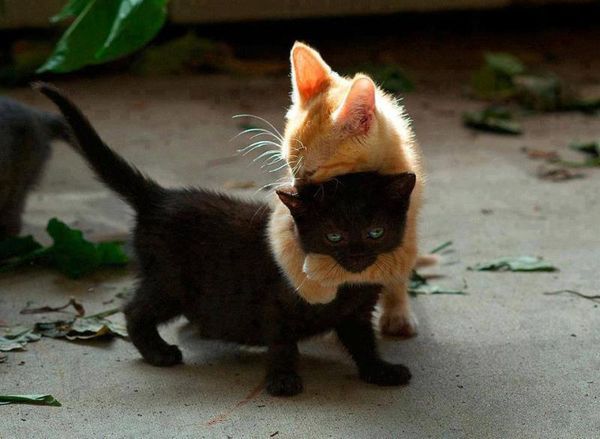
And you thought I was going to get all spiritual …










 Learning from Dogs