Year: 2013

Picture parade twenty-three.

A bit of a compilation for today.

First, a few more of those ‘senior moment’ cartoons continuing from last Sunday.

Sen10

oooo

Sen11

oooo

Sen12

oooo

Now two pictures taken on Christmas Day of a young deer feeding on cob that we put out daily.

P1140161

oooo

P1140162

oooo

Then animal greetings to you all …

Birthday girl30001

oooo

Finally, enjoy this short video sent to me by Dan Gomez.

These boots aren’t made for walking.

A Winter’s Tale.

No, not the Shakespeare version!

Shakespeare wrote The Winter’s Tale in 1623.  The title came to my mind following another tale written slightly more recently; just five days ago to be exact.

It’s a story published by George Monbiot that has a wonderful shape.  When I read it on Christmas Eve it seemed yet another story that Learning from Dogs readers would enjoy.  So, as ever, grateful for Mr. Monbiot’s permission to republish it.  His story is called Unearthed.

ooOOoo

Unearthed

December 23, 2013

A winter’s tale of guns, gold and greed.
By George Monbiot, published in the Guardian 24th December 2013.

Perhaps I should have been more careful. Last year I decided that every Christmas I would tell a winter’s tale or two(1). Through a long history of doing stupid things, I’ve accumulated a stock of ripping yarns. But I failed to explain myself. Some people interpreted the tale I told last Christmas as making a political point about Travellers I had no intention of suggesting; a point that is in fact the opposite of what I believe(2). So please read what follows as a story and no more: true to the best of my knowledge and memory but without a polemical purpose.

I was told this tale by a gold prospector in the garimpos of Roraima: the illegal mines exacavated among the river gravels in the forests of northern Brazil. He and his friends swore it was true. Though parts of the story must have been filled in later, in the light of what I had seen I found it easy to believe.

To say that the mines were lawless is not quite correct. They stood outside the laws of the state, but had established their own codes, which were informed by power and honour and greed and lust. Every week, thieves were taken into the forest to be shot. Duels were fought on the airstrips, in which men took ten paces, turned and fired: the miners circulated Wild West comics and acted out scenes that might once have been mythical, but there became horribly real.

To illustrate the point, before we get to the tale itself: one evening João, a remarkable man from the north-east of Brazil, who, after leaving home at 14 then spending ten years crossing and recrossing the Amazon on foot, had found work as a minder for two prostitutes, took me and his charges to a bar at the end of the airstrip village in which I was staying. The bar and the strip of dirt were owned by Zé, a man who spent some of his vast earnings on causing trouble: roaming around with his band of pistoleiros, starting fights and roughing people up. Zé, in whose house I was staying (by his choice, not mine) was said to have killed five men, starting with his business partner: by this means he had acquired control of the airstrip, and the extortionate fees for landing and leaving.

The bar was a flimsy shack in which a ghetto blaster was turned up so high that you could scarcely hear the music. Ragged men swayed and lurched and sprawled across the more sober prostitutes. On every table there was a bottle or two of white rum and a revolver. The men who had stayed in their seats drummed their fingers nervously on the tabletops, halfway between their drinks and their guns. The door was shoved open, and Zé and his thugs walked in.

His was at all times an arresting presence: charming, mercurial and terrifying. A machete scar ran from one cheek, over his nose and across the other cheek. He wore a sawn-off denim jacket and two revolvers on his belt. He opened his arms and announced, in a voice loud enough to carry above the music, that he would buy drinks for everyone. Zé moved through the bar, slapping backs and shaking hands, flashing his gold teeth. João’s eyes darted around, watching people’s hands. Bottles of cachaça were passed down from the bar.

Suddenly João shoved me so hard that I almost fell off my chair. He grabbed my arm, managing at the same time to seize the two prostitutes, and propelled us towards the door. As we hurtled out of the bar it erupted in gunfire. Amazingly, only one man was killed: he was dragged onto the airstrip with a hole the size of an apple in his chest. He was one of an estimated 1,700 people murdered, in a community of 40,000, in just six months.

So here’s the story. Two men established a small stake in the mines, in a remote valley some distance from the nearest airstrip. They cut down the trees and began to excavate. They found the digging and hosing and sifting of the gravel exceedingly hard and, though they had discovered very little, they decided to hire two other men to do it for them. They agreed to split any findings equally with the workers. The two hired men dug for four months without success: with high pressure hoses they scoured great pits into which the trees collapsed; they turned the clear waters of the forest stream they excavated red with clay and tailings; they winnowed the gravel through meshed boxes; they dissolved the residues in mercury and burnt it off; but they produced almost nothing. Then they hit one of the richest deposits ever discovered in Roraima: in one day they extracted four kilos.

If you find a lot of gold in the garimpos you keep quiet – very quiet. A single shout of triumph can amount to suicide. You gather it up, hide it in your bag and explain to anyone who asks on your way out that months of work have brought you nothing but disease and misery. But first it must be divided.

The two men who owned the stake began to comprehend, for the first time, the implications of the deal they had done. “We risked our lives to establish this stake. We spent every cent we had – and plenty we didn’t – travelling here, buying the equipment and the diesel, hacking out a clearing in the forest, hiring these men. And now we have to split the gold equally with people who are no more than manual labourers, who would normally be paid a few dollars a day.” They told the two workers that they wanted a special meal that night, and sent them to the nearest airstrip to buy the ingredients.

As the two workers walked they began to ruminate. “We’ve nearly killed ourselves in that pit. We’ve been up before dawn every day and have worked until dusk. We’ve had malaria, foot rot, screw worm, sunstroke, while those two bastards have done nothing but lie in their hammocks shouting instructions. Now we’re expected to give them an equal share of the gold that we and we alone found.” When they reached the store, they bought cachaça, rice, beans, a packet of seasoning and a box of rat poison. They mixed the poison into the seasoning and set off back to the camp. Before they reached it, they were ambushed by the two owners and shot. The owners then picked up the bags and went back to the camp to celebrate over the first hot dinner they had had in weeks.

Some time later a party of men moving through the forest to look for new stakes walked into the camp. They found two skeletons over which vines were already beginning to creep. And four kilos of gold.

www.monbiot. com

References:

1. http://www.theguardian.com/commentisfree/2012/dec/26/my-inner-anarchist-lost-out-bourgeois

2. http://www.monbiot.com/2013/01/10/as-it-happened/

ooOOoo

gold

The trials of Steve Marsh

This is worthy of support.

Some seven days ago, there was an item on Permaculture News about Steve Marsh’s fight with Monsanto.  Here is that article in full.  I strongly recommend watching the longer video at the end of the post.  It’s an incredibly important issue for all lovers of healthy food.

ooOOoo

Help This Farmer Stop Monsanto’s GM Canola

Posted December 20, 2013 by  & filed under GMOs.

You might not have heard of Steve Marsh yet but this man could lose everything to protect your right to eat GM-free food.

Who is Steve Marsh?

Steve Marsh is an Australian farmer who lost his organic certification when Monsanto’s genetically modified (GM) canola blew onto his farm from a neighbouring property in 2010. Since then, Steve lost most of his income and has been struggling to get his organic certification back.

Monsanto has a no liability agreement with GM farmers that prevent them from being sued. The only avenue Steve had to protect his livelihood was to take his neighbour to court. It is due to start on the 10th February 2014 in the Western Australian Supreme Court and is scheduled to run for three weeks.

Donate Now to Support Steve!

A landmark case for a GM-free future

This is the world’s first case of an organic farmer using the courts to recover loss and damages from a GM farmer. This case has been described as a landmark case to determine who should take responsibility in case of GM contamination. If Steve wins it will set a precedent to guide the application of common law to GM contamination and will be of interest to lawmakers worldwide.

We don’t want to be part of the global GM experiment underway with barely tested, unlabeled and uncontrolled GM foods infiltrating our food supplies. When people like Steve stand up for their rights in spite of what he may lose, it gives us a chance to stand alongside him.

Take action!

Steve’s neighbour is well supported and well funded by a pro-GM organization and we are helping to raise funds and awareness for Steve’s case.

Have a look at the short video above explaining his story and share it with friends, family and work colleagues. Please make a donation to support this landmark case and protect the future of GM-free food.

Donate Now to Support Steve!

ooOOoo

Jean and I have made a donation.  We hope you can find your way to supporting this campaign.

This is the longer version of that video above.

Animal rights.

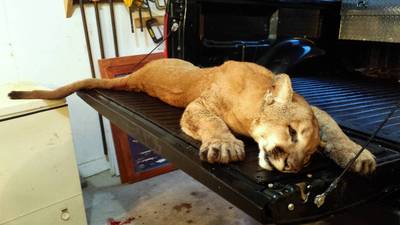
This cougar was looking for love.

I forget how I came across this editorial in the Chicago Tribune but it was published a month ago, to the day.  What is more to the point is that the editorial was inspiring and I vowed to republish it.  With the absence of any formal permission to republish the editorial I thought it best to leave it for a few weeks.  When you read it you will realise just why it needed to be shared with you.

ooOOoo

Editorial: The cougar killed in Illinois was looking for love

ILLINOIS DEPARTMENT OF NATURAL RESOURCESThis cougar was shot last week by a state conservation officer in Whiteside County. The animal needn’t really have been killed.
ILLINOIS DEPARTMENT OF NATURAL RESOURCES.
This cougar was shot last week by a state conservation officer in Whiteside County. The animal needn’t really have been killed.

He was lean, athletic and had traveled hundreds of miles, most likely from the Black Hills of southwestern South Dakota. He had attacked no one as he passed hundreds of towns and many more farms, each of them a lethal threat to his mission. Yet for lack of a better wildlife management plan in Illinois, the young cougar couldn’t get past a conservation officer armed with a state-issued rifle.

The necropsy says the cougar killed last week as he hid near Morrison, 130 miles west of Chicago, died of gunfire. In truth he died of official neglect: Even though more cougars and possibly wolves likely will be visiting Illinois, state lawmakers and the Department of Natural Resources haven’t forged policies that could allow the tranquilization, capture and survival of animals whose ancestors blissfully roamed the Midwest long before humans intruded on their turf.

Given his hunting skills, the young male could have homesteaded anywhere in the Upper Midwest and dined on the bountiful deer population for the rest of his life. Instead, his four huge paws carried out the imperative that drove him: With larger, older males driving him away from the females on their home ranges, this cougar came looking for love.

A farmer called authorities to report a large cat running from a cornfield toward his farmstead and, sure enough, a responding conservation officer found the cat under a corncrib, probably hiding until darkness would allow it to flee.

We won’t second-guess the officer, who consulted with law enforcement and wildlife personnel before killing the cougar. That said, this was an outcome that didn’t have to be. A magnificent creature might well be headed back to South Dakota if Illinois had learned lessons after Chicago police shot and killed a cornered cougar in the Roscoe Village neighborhood five years ago.

What all of us, legislators included, have to understand is that the return of feline or canine predators to their traditional realms doesn’t mean the animals want to hurt anyone. Even as this episode unfolded, millions of National Geographic readers were receiving the magazine’s December issue, with an 18-page spread: “Ghost Cats … Cougars are quietly reclaiming lost ground.” The relevant passage: “Cougars have attacked humans on about 145 occasions in the U.S. and Canada since 1890. Just over 20 of those assaults — an average of one every six years — proved fatal.”

Yet in this case, with an animal that had threatened no one while bypassing thousands of Midwesterners, a DNR spokesman rationalized that, “Public safety is what we’ll make the decision on every time.” The rest of DNR’s explanation is similarly lame: The department otherwise would have had to find someone to capture and move the animal. This officer thought the situation too unsafe to call a veterinarian to tranquilize the cat. Conservation officers don’t carry tranquilizer guns. That thinking led the DNR to the specious excuse that if the officer had shot the cougar with the wrong dosage of tranquilizer, the animal could have been harmed or killed accidentally. That excuse evokes the February 1968 explanation from a U.S. major to an Associated Press correspondent about the Vietnamese provincial city of Ben Tre: “It became necessary to destroy the town to save it.”

We were struck by sensible comments last week from Bruce Patterson, curator of mammals at Chicago’s Field Museum, who wonders why this animal had to be shot when it evidently was hiding during daylight and hadn’t threatened anyone: “It’s possible to manage wildlife while still keeping it around.”

When we editorialize about humans slaying wild predators, some readers say our concern should be — as it constantly is — directed instead to the needless killings of young people, and not toward one lost, probably frightened animal.

Fair enough, although it’s possible to think about both. Just as we know there will be more homicides, we know that more big predators likely are coming to Illinois. So we’ll look back to what we expressed after the 2008 killing of the cougar in Roscoe Village: We hope Illinois comes away from last week’s episode with more than one dead cougar and a communal sadness. Illinois should develop a reliable protocol that errs on the side of trying to preserve the life of the lost animal — not of making the ad hoc decision to kill it and then resolving the ambiguities in favor of that decision.

That’s what happened here. A logical first step now: Give cougars protection under the Illinois Wildlife Code; they lack that protection now only because there is no known breeding population in this state. But with trail cameras capturing photos of one or more cougars in Jo Daviess, Morgan, Pike and Calhoun counties last fall, the animals evidently are re-establishing themselves in a state where they haven’t been known to live since 1870. In recent years, wolves have dipped into Jo Daviess, the state’s northwest corner. A black bear even visited there, evidently for a few days.

Lawmakers, DNR officials, you can do better. So can the rest of us, first by using sites such as cougarnet.org to offset our visceral fear with scientific knowledge.

Wild animals roam this state. Always have and, we hope, always will. As we urged here in 2008: The same Illinois that was unprepared for the last cougar had better get ready for the next. He’s probably en route.

ooOOoo

As you contemplate your New Year resolutions for 2014 please resolve to protect our animals.

Be happy – be more dog!

OK, it is an advert but it’s still a great message for us all.

(With thanks to Jon Lavin for sending this to me.)

Not your Sunday afternoon drive!

From today until the end of the year, while there will still be a post each day, I will be leaning more towards republishing items that have been sent to me or that, otherwise, have caught my eye.  Nothing heavy.

The Gentleman’s Guide to Racing.

Dan Gomez sent me the link to this video a couple of months ago.  The description of the YouTube video is thus:

In November of 2011 two amateurs decided their first professional race ever would be one of the worlds toughest- the Score BAJA 1000. The infamous illegal street racer Alex Roy and Skiny begin a journey that will take them around the world to test themselves against some of the worlds most challenging races and hangovers.

There is also a website that includes the video below but also, more usefully, much background information, for example:

DAY 1: THE BEGINNING

Today starts a journey of a lifetime.  The decision has been made to turn my forty year-old life over to the pursuit of racing for the next three years, and hopefully inspire some people along the way to take leave of all that is important to seek out the thing that thrills them most. My hope is that the journey will be interesting enough to fill the pages of a book – aptly titled the Gentleman’s Guide to Racing – and to make some friendships along the way with people I already know but just haven’t met.

Transient

I wanted to start writing today so as to retain a snapshot of this adventure in its seedling stage.  As of right now I have nothing.  No money, no car, and no sponsors.  But I do have determination, and getting to the race is often the most interesting half of the battle.
Today I commit to sharing my exploits with whomever is interested in the trials and triumphs of a lone man seeking to test himself on some of the world’s toughest and most grueling races.
Steve McQueen famously said “Racing is life, anything that happens before or after is just waiting.”

Here’s the video.