First published on 1st November, 2009.
Time for bed

Thanks to Dan Gomez for forwarding it. Classic!
Dogs are animals of integrity. We have much to learn from them.
Year: 2012
First published on 1st November, 2009.
Time for bed
Thanks to Dan Gomez for forwarding it. Classic!
The widely reported story of a dog saving the life of a baby.
Although this story came into prominence a week ago, this is the first opportunity for inserting it on Learning from Dogs. That doesn’t detract one little bit from the power of the tale, so watch this video!
A republication of a post first shown on 28th October, 2009 which still seems relevant as British Summer Time is due to end in a couple of days time.
oooOOOooo
An ancient idea may have run it’s course?
What is the purpose of “Daylight Saving”? [Interesting history of Daylight Saving on Wikipedia. Ed.]
 This week we are in a particularly interesting situation as we are in the middle of a one week separation between the dates when Europe and US change their clocks back to “normal” winter time. I.e. Europe changed their clocks back at 2am last Sunday and most, but not all, US States change their clocks back at 2am this coming Sunday.
This is even more confusing than normal. But why are we doing this at all?
Is it to save fuel, to save lives, to save time or to save something else?
In my humble opinion it is all nonsense!
“Time management” is a myth
Time is time! People say that they do not have enough time to do this or that, as if they have ways to make some more; and, of course, there is much talk about “time management”. Yet we all have the same amount of time and no amount of management will change that!
We are certainly able to manage the things that we try to fit into the available time. That is, we can manage tasks, effort and so on. But, in everyday (Newtonian rather than Einsteinian) regimes, time is an inelastic independent variable. Fiddling about with the clocks and trying to “manage time” have no effect on the stuff whatsoever. Let it be!
There must be a better way!
Yes, I know! Some people make claims of wasted daylight or of the dangers to schoolchildren walking to or from school in the dark. These are valid areas of concern. If adjusting the times of business operations or schooling helps to deal with them, then by all means do so. But, for goodness, let’s not pretend the time is different.
This first published on the 4th November, 2009 when we were living in Mexico.
Here in San Carlos, Mexico, we have good sunrises most mornings. But this one made me grab my camera. The picture is unedited. Very simple things can provide a huge amount of pleasure.
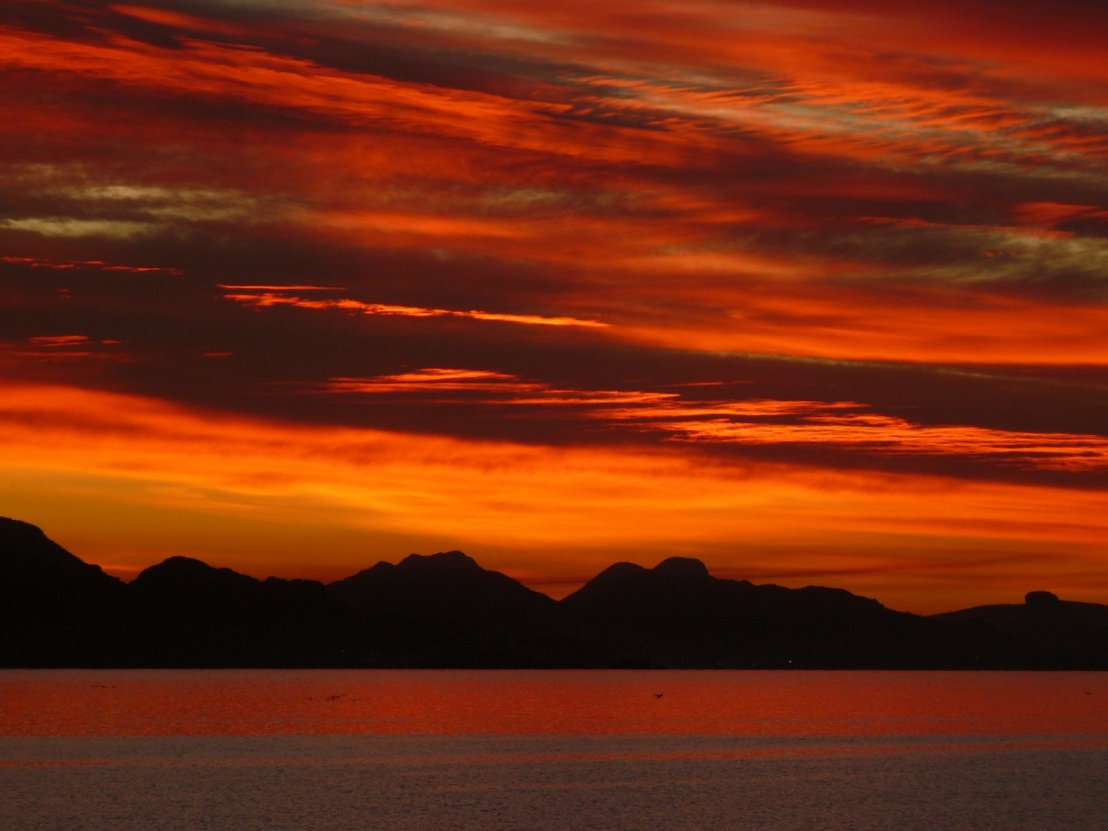
Taken at 06:15 local time (GMT -7hrs) Camera is a Panasonic Lumix DMC-FZ8
This post appeared first on Lack of Environment on Monday; and is re-published here today with the permission (and active editorial co-operation!) of Martin Lack. If you have not signed the Avaaz petition already, you will find links to it embedded in the email message at the end of this post (from Hollywood megastar Leonardo diCaprio).
————-
I must admit that I thought the Antarctic Treaty System protected the species living in the Great Southern Ocean – by virtue of the 1982 Convention for the Conservation of Antarctic Marine Living Resources (CCMLR). However, it would seem that, in the same way that the Convention on International Trade in Endangered Species (CITES) has not eliminated trade in ivory (etc), it may be that the CCMLR is failing to protect endangered species in the Antarctic. The key to this paradox may therefore be in the word “Conservation”. If so, what the Antarctic Ocean would need is an equivalent to the Protocol on Environmental Protection to the Antarctic Treaty (1991). However, looking at that Protocol it already appears to include the entire Southern Ocean above a Latitude of 60 Degrees South. If so, then you might conclude that 1991 Protocol is not working or not being enforced effectively. Sadly, it would appear to be more sinister than that.
Some of the parties to the existing CCMLR are clearly trying to subvert it!
Following receipt of an email from Leonardo diCaprio (writing on behalf of Avaaz) – appended below – I have retrieved the information below from the website of the Antarctic Ocean Alliance, which provides some useful background…

1. This beautiful, icy ocean environment is home to almost 10,000 species, many of which can be found nowhere else on the planet.
2. Adelié and emperor penguins, Antarctic petrels and minke whales, Ross Sea killer whales, colossal squid and Weddell seals all thrive in this inhospitable climate.
3. While many other marine ecosystems in other parts of the world have been devastated by development, pollution, mining, oil drilling and overfishing, Antarctica’s Ross Sea remains the most intact marine ecosystem on the planet.
4. About 70% of our earth’s surface is ocean, yet less than 1% of it is fully protected from human development.
5. 85% of the world’s fisheries are classified as over exploited, fully exploited, depleted or recovering from depletion, so commercial fishing vessels are moving to remote waters such as Antarctica’s in search of fish (according to the UN’s Food and Agriculture Organisation).
6. Antarctica’s species are now under increasing pressure from commercial fishing for the slow-growing and long-lived Antarctic and Patagonian toothfish, (also known in parts of the world as the Chilean sea bass). These toothfish have become an expensive delicacy, sold in high-end restaurants as well as speciality seafood markets, primarily in the United States, Japan and Europe.
7. Fishing by illegal, unregulated and unreported (IUU) vessels, often using “flags of convenience” is on the rise. In some parts of the Southern Ocean, unsustainable fishing methods such as deep sea gillnets are in use in some areas. These gillnets can reach more than 100 kilometres in length and are a threat to almost all marine life, including marine mammals and non-targeted fish species such as rays.
8. Then there’s krill – an essential part of the food chain that supports the region’s whales, penguins, seals, fish and birdlife. Growing demand for krill as a health supplement and as food for fish farms has put it at risk. Climate change has already been linked to a significant decline in krill numbers – up to 80% in one region around the Scotia Sea (Atkinson et al 2004).
9. Poor management and the large-scale removal of toothfish and species like krill would threaten the very balance of Antarctica’s unique and fragile ocean ecosystems.
10. In 1991, the international community made a courageous decision to protect the Antarctic region as a natural reserve for peace and science. This included a ban on mining but this protection does not extend to Antarctica’s magnificent marine environment, leaving it at risk.
———–

I shall leave it to Leonardo diCaprio to explain the whole story:
Dear friends,
I’m writing to ask for your help. Within days, governments could begin turning wide stretches of the Antarctic ocean into the world’s largest marine sanctuary, saving the habitat of whales, penguins, and thousands of other polar species from industrial fishing fleets. But they won’t act unless we speak out now.
Most countries support the sanctuary, but Russia, South Korea and a few others are threatening to vote it down so they can plunder these seas now that others have been fished to death. This week, a small group of negotiators will meet behind closed doors to make a decision. A massive people-powered surge could break open the talks, isolate those attempting to block the sanctuary, and secure a deal to protect over 6 million square kilometers of the precious Antarctic ocean.
The whales and penguins can’t speak for themselves, so it’s up to us to defend them. Let’s change negotiators’ minds with a massive wave of public pressure — Avaaz will surround the meeting with hard-hitting ads, and together we’ll deliver our message to delegates via a deafening cry on social networks. Sign this urgent petition and share it with everyone you know:
http://www.avaaz.org/en/save_the_southern_ocean_5/?bSkdncb&v=18906
More than 10,000 species call these remote Antarctic waters their home, including blue whales, leopard seals, and emperor penguins, and many are found nowhere else on Earth. Climate change has already taken a cruel toll on their fragile habitat, but they will come under further threat from the industrial fishing fleet’s mile-long nets cast over these precious waters. Only a marine sanctuary will increase their odds for survival.
The 25-member governing body that regulates the Antarctic oceans has already committed to creating these marine protected areas. But the two plans being negotiated — one to protect part of the fragile Ross Sea and one for East Antarctica — are at risk of dilution or delay. Shockingly, the talks have been off the media’s radar and countries like Russia and South Korea are betting their opposition will go unnoticed, but if we cast a public spotlight on the talks we can force them to back off, and encourage champions like the US and EU to push for even stronger protections.
The future of the Southern ocean is in our hands. Let’s unleash a massive surge of global pressure and ensure governments don’t put profits before our planet. Please sign and share this petition with everyone you know:
http://www.avaaz.org/en/save_the_southern_ocean_5/?bSkdncb&v=18906
The Avaaz community has come together time and time again to protect our oceans. We’ve already helped win two of the largest marine reserves in the world. But the threats to our oceans continue, and one by one species are coming closer to the brink. Join me in saving the Antarctic ocean before it’s too late.
With hope,
Leonardo DiCaprio, with the Avaaz team.
Just had to share this with you all.
Neil Kelly lives in the small South Devon village of Littlehempston. When I was living in Devon, just a few miles away in the village of Harberton, I got to know Neil well and enjoyed his creative talents including cartoons. A few days ago Neil emailed me the cartoon below, which Jean and I just had to share.
Thanks Neil.
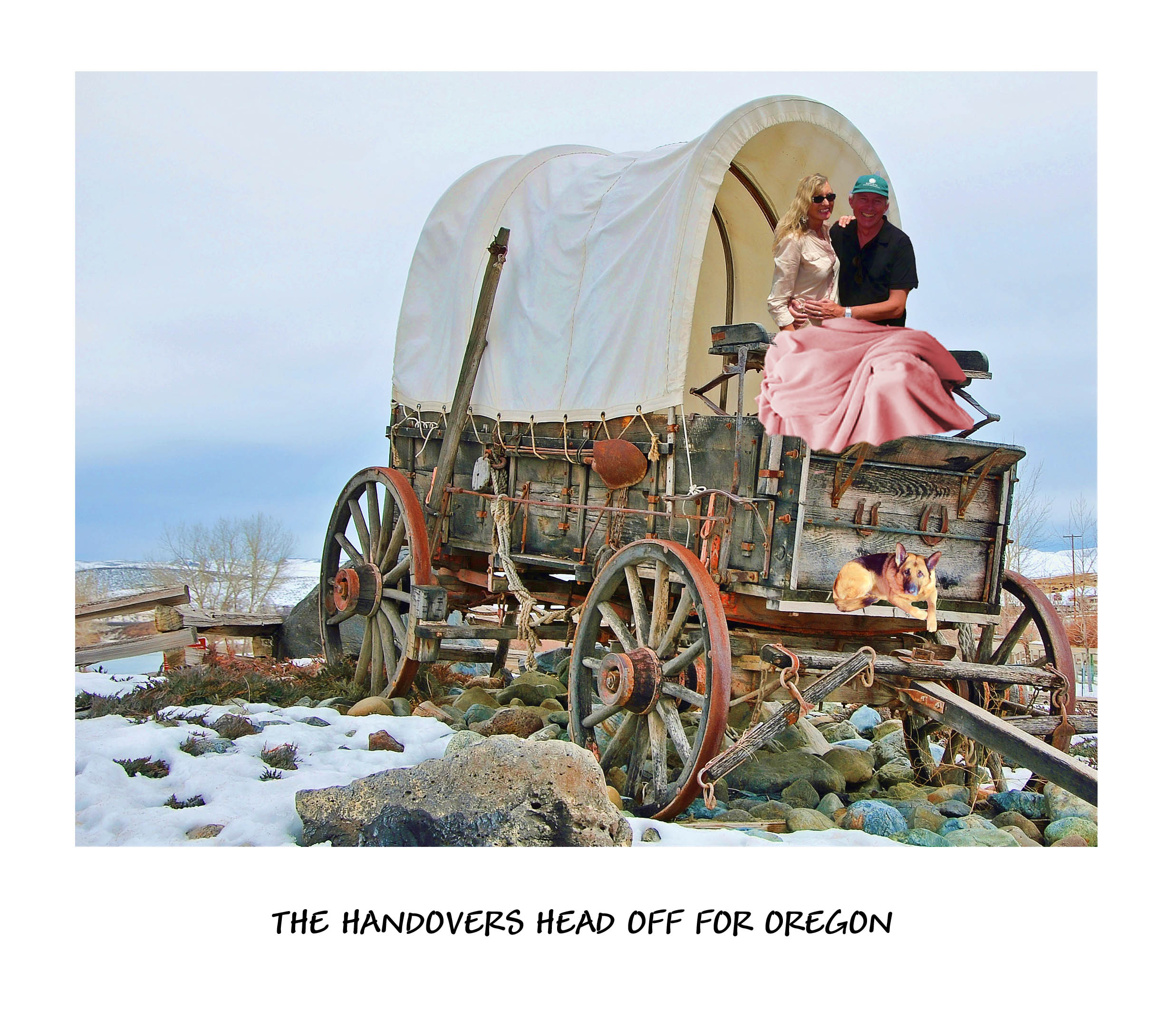
The end of a treasured time in Payson, Arizona.
Today, Jean and I together with our 11 dogs and 5 cats start the 1,200 mile journey to Merlin, Oregon. While we have only lived in Payson since February, 2010, it has been a time of fantastic experiences. I had to work through the long process of getting a fiancee visa from the American Embassy in London. Until that was issued my ‘residence’ in Payson was that of a British tourist with me having to leave the USA every 90 days.
The visa was issued in October, 2010 and I flew immediately to Arizona. On the 8th November, 2010 Jean and I were issued with a Marriage License Certificate and we were married on the 20th November at St. Paul’s Episcopal Church in Payson.

We have made many very dear friends here in Payson but Oregon feels like the start of our home in every sense of the word, not just because it is the first home that Jean and I have bought jointly.
One of those dear friends here in Payson has been John Hurlburt, a devoutly spiritual man. A little over a week ago, he sent me a very thoughtful essay and I wanted to include it today as a guest post in recognition of the way that John and many, many others have embraced these couple of Brits over the last 32 months. Thank you all.
oooOOOooo
Everything fits together
The species of animals we know as human beings is a part of everything that exists. We are a very young consciously-aware species that does not begin to know all the answers. What little we do know has a Natural pattern. It would seem that there’s a lamplighter and a navigator in all of us. The lamplighter is our fundamental awareness of being and provides nature’s guidance along life’s pathways.
Our natural navigator is designed for evolutionary competition. There’s a biological survival kit in our DNA. Extreme demand for limited resources generates deadly combat; both within and between species. As a result of competition taken to wretched excess, our global economy is leveraged 22 times beyond any earthly foundation. The unspoken intent to destroy each other over what remains of our planet is becoming increasingly evident.
The human species is engaged in a global war over money, ideals and disappearing finite resources. Ninety-seven percent of the world scientific community has confirmed that the natural effects of heat and discharges generated by human machines and related human activities are the primary cause of recent rapid climate change.
These dedicated scientists are opposed in the media by three percent of their corporate energy-financed peers. An oppressive worldwide network of often offensive politicians is similarly supported and managed accordingly. Nature couldn’t care less about politics, emotions or idealistic arguments.
Human squabbles mean very little in the totality of universal life. The drumbeat of local natural disasters increases steadily. There are no two ways about it. No amount of human ifs or buts can or will change reality. Our human species is in deep serious trouble.
It has been six million years since the first humanoids emerged and two million years since the rise of human civilization. What a sorrow it is to realize what we have done to the earth in just the past two hundred and fifty years. We’ve reached the moon and are exploring Mars. It’s well past time to clean house and re-grow our local garden.
As an old navigator, there’s a sense of urgency regarding the course life on earth has taken. For those who continue to care about facts, the prognosis is not encouraging. We have the know-how for an alternative. We can avoid the perfect storm of going over the edge of an economic cliff and the crush of an environmental crisis in the midst of a war-fuelled, profit-driven, global, corporate fight to the end. The alternative is that we have the know-how to transition rapidly to a reality-based economy and a way of living that’s gentle to the earth. The solution is global, it’s industrial, it’s natural and it’s our best hope. It may well be our only hope. It’s time to light some lamps.
Conscious human awareness emerges as we relax, contemplate, meditate, and communicate openly. These are levels of awareness beyond the limits of our daily human musings. The wisdom which flows from enlightened awareness embraces humility, experience, knowledge, understanding, and faith. Life has never been easy. We’re fragile biological beings. Our mutual growth is the result of sustained efforts over millions of years.
Yet despite attaining a higher level of conscious awareness our human culture continues to operate on a material basis rather than a moral basis. We have become confused by our own importance or the apparent lack thereof. We all too often retreat into a rut, furnish it and turn on the electronics.
By definition, natural processes support species growth in harmony with all natural life. Those natural processes are indistinguishable from the planetary support systems within which all life interacts. Human interaction is local. We spend much of our lives unaware that we are unaware; initially as infants and throughout our lives in deep sleep. When caught up in the pressures of our daily lives, it’s easy to be unaware of being unaware.
It’s time to wake up. Cosmology is an eternal spring from which the waters of the earth still flow. When we turn ourselves inside-out and achieve higher awareness, we discover who, what and where we really and truly are. In a trinity of spirituality, nature and science, we’re cosmically energized beings; spiritual beings sharing a transitory human existence.
Ninety-eight percent of the human population believes in a power beyond species and self. The simplest understanding of this belief is that we humans did not originally create ourselves. All human wisdom and understanding leads to the conclusion that human beings don’t own the earth. We’re caretakers and we’re only passing through. Given that we have a systemic crisis, what do we have to work with?
We have a species that’s squabbling over diminishing resources, an environment and an infrastructure which both desperately require attention, a sustaining objective of equitable global employment, a world economy that’s about to collapse for lack of any real foundation, a burgeoning population which further strains the system and the clear need for a unifying purpose.
Put it all together and what do we have? The navigator is our guide to growth. The navigator shares our wholeness. The lamplighter is our guide to unity. Everything fits together. Each of us is a part of the unity of life. Unity has a natural purpose. It’s time to build a life boat.
John Hurlburt is a former U.S. Navy aviator and successful corporate executive who presently serves as a senior Christian educator and a founding member of an international Transition Town in Payson, Arizona.
oooOOOooo
Don’t know about you, dear reader, but I find those incredibly powerful words. Words that provide the truth. A truth the whole world needs. John set out in a personal email to me the three simple fundamentals of our lives. Just a few more words to sum up the truth.
“There’s an environmental crisis. There’s an inevitable global economic abyss touching us all on a daily basis. The need for a green economic transformation is obvious.“
Thank you, John.
A fascinating item recently published by Yale University.
Apologies, time pressure allows me little more than to repeat this in full. But still no less interesting.
oooOOOooo

October 11, 2012
New research led by Yale University scientists suggests that a rocky planet twice Earth’s size orbiting a nearby star is a diamond planet.
“This is our first glimpse of a rocky world with a fundamentally different chemistry from Earth,” said lead researcher Nikku Madhusudhan, a Yale postdoctoral researcher in physics and astronomy. “The surface of this planet is likely covered in graphite and diamond rather than water and granite.”
The paper reporting the findings has been accepted for publication in the journal Astrophysical Journal Letters.
The planet — called 55 Cancri e — has a radius twice Earth’s, and a mass eight times greater, making it a “super-Earth.” It is one of five planets orbiting a sun-like star, 55 Cancri, that is located 40 light years from Earth yet visible to the naked eye in the constellation of Cancer.
The planet orbits at hyper speed — its year lasts just 18 hours, in contrast to Earth’s 365 days. It is also blazingly hot, with a temperature of about 3,900 degrees Fahrenheit, researchers said, a far cry from a habitable world.
The planet was first observed transiting its star last year, allowing astronomers to measure its radius for the first time. This new information, combined with the most recent estimate of its mass, allowed Madhusudhan and colleagues to infer its chemical composition using models of its interior and by computing all possible combinations of elements and compounds that would yield those specific characteristics.
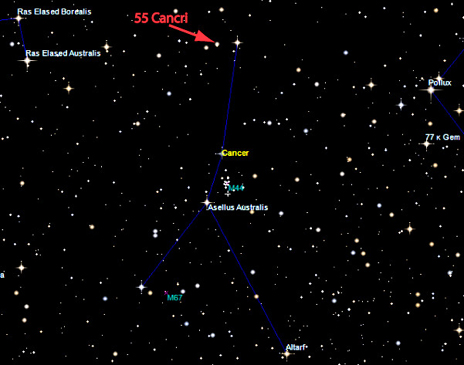
Astronomers had previously reported that the host star has more carbon than oxygen, and Madhusudhan and colleagues confirmed that substantial amounts of carbon and silicon carbide, and a negligible amount of water ice, were available during the planet’s formation.
Astronomers also thought 55 Cancri e contained a substantial amount of super-heated water, based on the assumption that its chemical makeup was similar to Earth’s, Madhusudhan said. But the new research suggests the planet has no water at all, and appears to be composed primarily of carbon (as graphite and diamond), iron, silicon carbide, and, possibly, some silicates. The study estimates that at least a third of the planet’s mass — the equivalent of about three Earth masses — could be diamond.
“By contrast, Earth’s interior is rich in oxygen, but extremely poor in carbon — less than a part in thousand by mass,” says co-author and Yale geophysicist Kanani Lee.
The identification of a carbon-rich super-Earth means that distant rocky planets can no longer be assumed to have chemical constituents, interiors, atmospheres, or biologies similar to those of Earth, Madhusudhan said. The discovery also opens new avenues for the study of geochemistry and geophysical processes in Earth-sized alien planets. A carbon-rich composition could influence the planet’s thermal evolution and plate tectonics, for example, with implications for volcanism, seismic activity, and mountain formation.
“Stars are simple — given a star’s mass and age, you know its basic structure and history,” said David Spergel, professor of astronomy and chair of astrophysical sciences at Princeton University, who is not a co-author of the study. “Planets are much more complex. This ‘diamond-rich super-Earth’ is likely just one example of the rich sets of discoveries that await us as we begin to explore planets around nearby stars.”
In 2011, Madhusudhan led the first discovery of a carbon-rich atmosphere in a distant gas giant planet, opening the possibility of long-theorized carbon-rich rocky planets (or “diamond planets”). The new research represents the first time that astronomers have identified a likely diamond planet around a sun-like star and specified its chemical make-up. Follow-up observations of the planet’s atmosphere and additional estimates of the stellar composition would strengthen the findings about the planet’s chemical composition.
The authors of the paper are Madhusudhan, Lee, and Olivier Mousis, a planetary scientist at the Institut de Recherche en Astrophysique et Planetologie in Toulose, France.
The paper is titled “A Possible Carbon-rich Interior in Super-Earth 55 Cancri e.”
The research was supported by the Yale Center for Astronomy and Astrophysics (YCAA) in the Yale Department of Physics through Madhusudhan’s YCAA postdoctoral prize fellowship.
oooOOOooo
Dead easy to know how to finish this post off!
 Learning from Dogs