Ironically, we are away this day but here are the ‘stats’ from yesterday, the 14th:
594,721 individual viewings
449 subscribers
An average of 1,300 readers a day (and still growing!)
3,705 comments in this period
Nearly 1,372 posts since the start
It seems a rather trite thing to say but, trust me, this is said from the bottom of my heart. All of you who come to Learning from Dogs, whether just a couple of times or most days, have made this a wonderfully creative three years for me.
THANK YOU ALL!
And now here’s a republication of that very first post back on July 15th, 2009.
Parenting lessons from Dogs
Much too late to make me realise the inadequacies of my own parenting skills, I learnt an important lesson when training my GSD (who is called Pharaoh, by the way). That is that putting more emphasis into praise and reward for getting it right ‘trains’ the dog much quicker than telling it off. The classic example is scolding a dog for running off when it should be lots of hugs and praise for returning home. The scolding simply teaches the dog that returning home isn’t pleasant whereas praise reinforces that home is the place to be. Like so many things in life, very obvious once understood!
Absolutely certain that it works with youngsters just the same way.
Despite being a very dominant dog, Pharaoh showed his teaching ability when working with other dogs. In the UK there is an amazing woman, Angela Stockdale, who has proved that dogs (and horses) learn most effectively when being taught by other dogs (and horses). Pharaoh was revealed to be a Beta Dog, (i.e. second in status below the Alpha Dog) and, therefore, was able to use his natural pack instinct to teach puppy dogs their social skills and to break up squabbles within a pack.
When you think about it, don’t kids learn much more (often to our chagrin!) from other kids than they do from their parents. Still focusing on giving more praise than punishment seems like a much more effective strategy.
As was read somewhere, Catch them in the act of doing Right!
Like many people I had been aware of the hunt for this strange particle, the Higgs boson. Like many people as well, I suspect, I really didn’t comprehend what it was all about.
Then in The Economist print edition of the July 7th the newspaper’s primary story and leader were about the discovery of the Higgs announced on the 4th July. The leader, in particular, was both clear and compelling. I held my breath and asked for permission to republish that leader in Learning from Dogs.
Well the good people from the relevant department at The Economist promptly gave written permission for their leader to be available here for a period of one year. Thanks team!
oooOOOooo
The Higgs boson
Science’s great leap forward
After decades of searching, physicists have solved one of the mysteries of the universe
Jul 7th 2012 | from the print edition
HISTORICAL events recede in importance with every passing decade. Crises, political and financial, can be seen for the blips on the path of progress that they usually are. Even the horrors of war acquire a patina of unreality. The laws of physics, though, are eternal and universal. Elucidating them is one of the triumphs of mankind. And this week has seen just such a triumphant elucidation.
On July 4th physicists working in Geneva at CERN, the world’s biggest particle-physics laboratory, announced that they had found the Higgs boson. Broadly, particle physics is to the universe what DNA is to life: the hidden principle underlying so much else. Like the uncovering of DNA’s structure by Francis Crick and James Watson in 1953, the discovery of the Higgs makes sense of what would otherwise be incomprehensible. Its significance is massive. Literally. Without the Higgs there would be no mass. And without mass, there would be no stars, no planets and no atoms. And certainly no human beings. Indeed, there would be no history. Massless particles are doomed by Einstein’s theory of relativity to travel at the speed of light. That means, for them, that the past, the present and the future are the same thing.
Deus et CERN
Such power to affect the whole universe has led some to dub the Higgs “the God particle”. That, it is not. It does not explain creation itself. But it is nevertheless the most fundamental discovery in physics for decades.
Unlike the structure of DNA, which came as a surprise, the Higgs is a long-expected guest. It was predicted in 1964 by Peter Higgs, a British physicist who was trying to fix a niggle in quantum theory, and independently, in various guises, by five other researchers. And if the Higgs—or something similar—did not exist, then a lot of what physicists think they know about the universe would be wrong.
Physics has two working models of reality. One is Einstein’s general relativity, which deals with space, time and gravity. This is an elegant assembly of interlocking equations that poured out of a single mind a century ago. The other, known as the Standard Model, deals with everything else more messily.
The Standard Model, a product of many minds, incorporates the three fundamental forces that are not gravity (electromagnetism, and the strong and weak nuclear forces), and also a menagerie of apparently indivisible particles: quarks, of which protons and neutrons, and thus atomic nuclei, are made; electrons that orbit those nuclei; and more rarefied beasts such as muons and neutrinos. Without the Higgs, the maths which holds this edifice together would disintegrate.
Finding the Higgs, though, made looking for needles in haystacks seem simple. The discovery eventually came about using the Large Hadron Collider (LHC), a machine at CERN that sends bunches of protons round a ring 27km in circumference, in opposite directions, at close to the speed of light, so that they collide head on. The faster the protons are moving, the more energy they have. When they collide, this energy is converted into other particles (Einstein’s E=mc2), which then decay into yet more particles. What these decay particles are depends on what was created in the original collision, but unfortunately there is no unique pattern that shouts “Higgs!” The search, therefore, has been for small deviations from what would be seen if there were no Higgs. That is one reason it took so long.
Another was that no one knew how much the Higgs would weigh, and therefore how fast the protons needed to be travelling to make it. Finding the Higgs was thus a question of looking at lots of different energy levels, and ruling each out in turn until the seekers found what they were looking for.
Queerer than we can suppose?
For physicists, the Higgs is merely the LHC’s aperitif. They hope the machine will now produce other particles—ones that the Standard Model does not predict, and which might account for some strange stuff called “dark matter”.
Astronomers know dark matter abounds in the universe, but cannot yet explain it. Both theory and observation suggest that “normal” matter (the atom-making particles described by the Standard Model) is only about 4% of the total stuff of creation. Almost three-quarters of the universe is something completely obscure, dubbed “dark energy”. The rest, 22% or so, is matter of some sort, but a sort that can be detected only from its gravity. It forms a giant lattice that permeates space and controls the position of galaxies made of visible matter (see article). It also stops those galaxies spinning themselves apart. Physicists hope that it is the product of one of the post-Standard Model theories they have dreamed up while waiting for the Higgs. Now, they will be able to find out.
For non-physicists, the importance of finding the Higgs belongs to the realm of understanding rather than utility. It adds to the sum of human knowledge—but it may never change lives as DNA or relativity have. Within 40 years, Einstein’s theories paved the way for the Manhattan Project and the scourge of nuclear weapons. The deciphering of DNA has led directly to many of the benefits of modern medicine and agriculture. The last really useful subatomic particle to be discovered, though, was the neutron in 1932. Particles found subsequently are too hard to make, and too short-lived to be useful.
This helps explain why, even at this moment of triumph, particle physics is a fragile endeavour. Gone are the days when physicists, having given politicians the atom bomb, strode confidently around the corridors of power. Today they are supplicants in a world where money is tight. The LHC, sustained by a consortium that was originally European but is now global, cost about $10 billion to build.
That is still a relatively small amount, though, to pay for knowing how things really work, and no form of science reaches deeper into reality than particle physics. As J.B.S. Haldane, a polymathic British scientist, once put it, the universe may be not only queerer than we suppose, but queerer than we can suppose. Yet given the chance, particle physicists will give it a run for its money.
Before signing off on this very important step forward for physics, here are a couple of footnotes.
First, here’s a video of the announcement that was widely shown on the 4th.
Secondly, the BBC News website had a really good piece on the 12th July written by their science correspondent, Quentin Cooper, called Higgs: What was left unsaid.Here’s a flavour taken from the early part of the article,
So that’s it, search over, Higgs boson found. Almost 50 years after physicist Peter Higgs first theorised it was out there, public elementary number one has finally been captured in the data from two detectors at the Large Hadron Collider at Cern. Case closed. Champagne popped. Boson nova danced.
If only. That handily simplified and heavily fictionalised telling of the tale has helped transform a spectacular scientific success story into one that is also global front page news. Without it the 4 July announcement might not have generated such a frenzy of coverage and so many claims about it being a historic milestone for our species. One particle physicist only half jokingly told me that in future the date may come to be celebrated as Higgs Day, rather than anything to do with American independence.
Don’t get me wrong. What has happened at Cern represents a magnificent accomplishment; big science at its biggest and boldest. And it’s fantastic that it has been perceived and received as being of such importance. It’s just that there is more to the story from the very beginning right through to the, probably false, ending.
For starters, as Peter Higgs himself acknowledges, he was just one of several scientists who came up with the mechanism which predicted the particle which bears his name, but the others rarely get a mention*. As to the finish – well, as small children are fond of saying, are we there yet? There is very strong evidence that the LHC teams have found a new elementary particle, but while this is exciting it is far less clear that what they’ve detected is the fabled Higgs. If it is, it seems curiously lighter than expected and more work is needed to explain away the discrepancy. If it’s not, then the experimentalists and theorists are going to be even busier trying to see if it can be shoehorned into the current Standard Model of particle physics. Either way, it’s not exactly conclusive.
Do take the simple step of clicking here and read the BBC piece in full.
Well done, Mr. Peter Higgs and all those very persistent scientists associated with the Large Hadron Collider; I suspect we haven’t heard the last of this!
(A republication of a post first shown on the 8th August, 2009, still seems pretty relevant)
We live in a world where finance and money play a hugely more important role in our everyday lives than, say, 25 years ago. Well that’s how it seems. Our energy costs don’t seem to be connected to supply and demand but more in the hands of the speculators. Our house values have been greatly influenced, perhaps misaligned is a better word, by the availability of too easy money, resulting from exotic financial leveraging. Commodities are, like energy, traded for their own sake rather than to provide an efficient process of linking the grower with the consumer. And more.
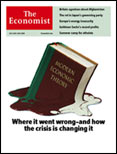
So it comes as a bit of a shock to read in a recent copy of The Economist that most of the theories and economic models are being ‘re-examined’ in the light of the current global crisis. These theories and models are not esoteric ideas kept
The Economist July 18th 2009
within the scholarly walls of universities but used by Governments, investment institutions and banks so they affect you and I in the real world, big time!
They ought to work a great deal better than they do because they have the capability to harm, as millions have found out in the last 2 years.
Anyway, The Economist, July 18th-July 24th has a lengthy briefing: The state of economics, comprised of two articles. To me it makes very sobering reading. Unless you have a subscription there is no web access to the articles so here are a few extracts to give you a flavour. The first article is about turmoil among macro-economists.
In the last of his Lionel Robbins lectures at the LSE on June 10th, Mr Krugman [Paul Krugman of Princeton and the New York Times] feared that most macroeconomics of the past 30 years was “spectacularly useless at best, and positively harmful at worst”.
These internal critics argue that economists missed the origins of the crisis; failed to appreciate its worst symptoms; and cannot now agree about the cure. In other words, economists misread the economy on the way up, misread it on the way down and now mistake the right way out.
Nor can economists now agree on the best way to resolve the crisis. They mostly overestimated the power of routine monetary policy (ie, central-bank purchases of government bills) to restore prosperity. Some now dismiss the power of fiscal policy (ie, government sales of its securities) to do the same.
Towards the end of this first article in the Briefing, there is this:
In the first months of the crisis, macroeconomists reposed great faith in the powers of the Fed and other central banks. In the summer of 2007, a few weeks after the August liquidity crisis began, Frederic Mishkin, a distinguished academic economist and then a governor of the Fed, gave a reassuring talk at the
Frederick Mishkin
Federal Reserve Bank of Kansas City’s annual symposium in Jackson Hole, Wyoming. He presented the results of simulations from the Fed’s FRB/US model. Even if house prices fell by a fifth in the next two years, the slump would knock only 0.25% off GDP, according to his benchmark model, and add only a tenth of a percentage point to the unemployment rate. The reason was that the Fed would respond “aggressively”, by which he meant a cut in the federal funds rate of just one percentage point. He concluded that the central bank had the tools to contain the damage at a “manageable level”.
Since his presentation, the Fed has cut its key rate by five percentage points to a mere 0-0.25%. Its conventional weapons have proved insufficient to the task. This has shaken economists’ faith in monetary policy. Unfortunately, they are also horribly divided about what comes next.
The second article explores the way that the efficient-markets hypothesis has underpinned many of the financial industry models.
IN 1978 Michael Jensen, an American economist, boldly declared that “there is no other proposition in economics which has more solid empirical evidence supporting it than the efficient-markets hypothesis”
Michael Jensen
(EMH).
Eugene Fama, of the University of Chicago, defined its essence: that the price of a financial asset reflects all available information that is relevant to its value.
Eugene Fama
Even as financial engineers were designing all sorts of clever products on the assumption that markets were efficient, academic economists were focusing more on how markets fall short. Even before the 1987 stockmarket crash gave them their first real-world reminder of markets’ capriciousness, some of them were examining the flaws in the theory.
However, a second branch of financial economics is far more sceptical about markets’ inherent rationality. Behavioural economics, which applies the insights of psychology to finance, has boomed in the past decade.
Behavioural economists were among the first to sound the alarm about trouble in the markets. Notably, Robert Shiller of Yale gave an early warning that America’s housing market was dangerously overvalued. This was his second prescient call. In the 1990s his concerns about the bubbliness of the stockmarket had prompted Alan Greenspan, then chairman of the Federal Reserve, to wonder if the heady share prices of the day were the result of investors’ “irrational exuberance”.
One task, also of interest to macroeconomists, is to work out what central bankers should do about bubbles—now that it is plain that they do occur and can cause great damage when they burst.
Another priority is to get a better understanding of systemic risk, which Messrs Scholes [Myron Scholes]
Myron ScholesRichard Thaler
and Thaler [Richard Thaler of the University of Chicago] agree has been seriously underestimated.
Several countries now expect to introduce a systemic-risk regulator. Financial economists may have useful advice to offer.
Financial economists also need better theories of why liquid markets suddenly become illiquid and of how to manage the risk of “moral hazard”—the danger that the existence of government regulation and safety nets encourages market participants to take bigger risks than they might otherwise have done. The sorry consequences of letting Lehman Brothers fail, which was intended to discourage moral hazard, showed that the middle of a crisis is not the time to get tough. But when is?
Mr Lo [Andrew Lo of the Massachusetts Institute of Technology] has a novel idea for future crises: creating a financial equivalent of the National Transport Safety Board, which investigates every civil-aviation crash in America. He would like similar independent, after-the-fact scrutiny of every financial
Andew Lo
failure, to see what caused it and what lessons could be learned. Not the least of the difficulties in the continuing crisis is working out exactly what went wrong and why—and who, including financial economists, should take the blame.
Mr Lo’s idea of treating financial failures in the same way as civil aviation accidents might be a brilliant idea. After all economics is a behavioural science just like the ‘science’ of air traffic controllers and air crew. Seems to me that keeping my money as safe as my body in a civil airliner isn’t a bad goal.
If you can, do get hold of a copy of the briefing, if only to arrive at the same conclusion as me. In terms of future personal financial planning, a pair of dice may be just as accurate as economists.
We expect to be away for about the next 10 or 11 days.
While there are a number of new posts that will come out during this period, rather than have quiet days with nothing being posted, some days I will be republishing posts from the last three years; hopefully most of them new to your eyes.
Inevitably, responding promptly to comments will be tough.
Which is why I am so grateful to Martin Lack of Lack of Environment who graciously agreed to keep an eye on things while we are away.
The Guardian jumps the gun on record June sea ice melt
29 Jun 2012, 11:15 – Verity Payne
The Guardian this week reports that recent rapid melting of Arctic sea ice has seen levels reach a “record low for June”. But it’s premature to be heralding June 2012 as having record low Arctic sea ice extent before the month is even over, particularly as sea ice extent is not currently tracking at record low levels.
The Guardian article says Arctic sea ice “has melted faster this year than ever recorded before”, under the online headline “Arctic sea-ice levels at record low for June”.
This headline could be read in two ways. The first interpretation is that Arctic sea ice extent for the month of June is at a record low. But can we know that before the month is out? The second is that at some point in June Arctic sea ice was at a record low. But does highlighting a few days of sea ice behaviour best illustrate what’s happening to the sea ice?
The piece also appeared in the print version of the Guardian yesterday with the headline “Arctic sea ice has melted faster than ever, say scientists”.
Melt season
The Arctic sea ice is in long-term decline due to man made climate change, but it’s not a uniform decline – sea ice cover changes with the seasons, and the weather in the region affects how far the sea ice extends, particularly as it melts towards the ice minimum in late September.
During melt season, Arctic sea ice seems to get a lot of media attention, often with rather confusing results. This Guardian article was prompted by analysis from the US National Snow and Ice Data Center (NSIDC), who provide daily updates and regular analysis of Arctic sea ice conditions.
The mention of that Guardian Newspaper article is worth clicking through to, if only to enjoy the fabulous photograph, as below:
Scientists say Arctic sea ice has plummeted to its lowest levels ever this year. Photgraph: Steven J Kazlowski/Alamy
Back to that embedded link in the Carbon Brief posting to the US National Snow and Ice Data Center. It reveals a wealth of important information. Try this …
Rapid sea ice retreat in June
Arctic sea ice extent declined quickly in June, setting record daily lows for a brief period in the middle of the month. Strong ice loss in the Kara, Bering, and Beaufort seas, and Hudson and Baffin bays, led the overall retreat. Northern Hemisphere snow extent was unusually low in May and June, continuing a pattern of rapid spring snow melt seen in the past six years.
Overview of conditions
Arctic sea ice extent for June 2012 averaged 10.97 million square kilometers (4.24 million square miles). This was 1.18 million square kilometers (456,000 square miles) below the 1979 to 2000 average extent. The last three Junes (2010-2012) are the three lowest in the satellite record. June 2012 ice extent was 140,000 square kilometers (54,000 square miles) above the 2010 record low. Ice losses were notable in the Kara Sea, and in the Beaufort Sea, where a large polynya has formed. Retreat of ice in the Hudson and Baffin bays also contributed to the low June 2012 extent. The only area of the Arctic where sea ice extent is currently above average is along the eastern Greenland coast.
Get your mind around this image that comes from the latest NSIDC report.
Arctic sea ice extent for June 2012 was 10.97 million square kilometers (4.24 million square miles). The magenta line shows the 1979 to 2000 median extent for that month. The black cross indicates the geographic North Pole. Sea Ice Index data. About the data
That old saying that I opened with, the one about There are those that do, etc.
No question in my mind that firmly in the camp of those that do is Mother Nature! Anyone prepared?
A guest post from Martin Lack points to the crux of the issue of denying man-caused climate change.
Introduction
I saw this post on Martin’s Blog Lack of Environment the day after I wrote a piece called In praise of fairness. In my piece I mentioned the sad case of Mr. Bob Diamond and Martin continued with the theme in such a manner that I wanted to republish his article in full. Here it is.
oooOOOooo
Are you negligent, incompetent or complicit?
This was a question posed to former Barclays CEO Bob Diamond this week, when he appeared before a Parliamentary Select Committee of MPs on Wednesday. It is a question that I would like to ask Dr Richard Lindzen… In fact, I have asked the question and – just as Bob Diamond did – he has refused to answer it… Here is the evidence on which you should decide for yourself:
Many readers will recall that, following my visit to London to hear Lindzen speak to a room full of fake sceptics in the Palace of Westminster on 22 February this year, I attempted to get some answers to questions. Unfortunately, I failed. I have been particularly frustrated by one thing; possibly the most misleading aspect of Lindzen’s entire presentation – a combination of graphs of recent atmospheric CO2 and temperature data that was mysteriously omitted from the PDF of the presentation that was initially posted on the Internet. Although Lindzen never answered any of my questions, he did insert this slide into the PDF of his presentation despite my pointing out to him – MIT and the AGU – that it was essentially meaningless (as the y-axes could be stretched to show either correlation or no correlation as preferred by the speaker).
Here is a screenshot of the misleading graph from the video of the presentation:
Steeply inclined Keeling curve versus apparently non-correlating temperature – if you stretched the temperature axis enough it would appear to correlate quite well. Therefore slide neither proves not disproves anything.
This bears more than a passing resemblance to the World Climate Widget – a very similar-looking combination of graphs (i.e. manipulated to suggest that there is no correlation between recent atmospheric CO2 and temperature data) – that can be downloaded as a widget from Anthony Watts’ Watts Up With That? (WUWT) misinformation blog.
If you go to the WUWT widget page, you will find the two graphs in both of these images (above and right) are there presented separately. However, to prove my point – that anyone using these graphs to try and prove there is no correlation between long-term CO2 and temperature changes – just look at what happens when you take the graph of University of Alabama at Huntsville (UAH) global lower atmosphere data as used by WUWT (i.e. cooler than surface temperature data) and stretch it:
Clearing the fog of data misrepresentation created by Lindzen et al. – Note the clear upward trend in the temperature graph on the left (it was there all the time).
Therefore, for anyone – including Lindzen – to try and use the original combination of graphs to suggest there is no correlation between CO2 and temperature, this suggests that they are either negligent, incompetent, or deliberately trying to mislead people. For many people who are not scientists to be fooled by this is understandable but, for a prominent scientist like Lindzen to make this mistake – and not apologise for doing so – is unforgivable. Furthermore, it would seem that, no matter how many times he is criticised, he just keeps repeating the same old mistakes: Skeptical Science: Lindzen and Choi 2011 – Party Like It’s 2009
It would appear that, despite the best efforts of the majority of prominent climate scientists, Lindzen’s London Illusions are still fooling a lot of people. If you follow that last link, it will take you to the website of what I prefer to call The Global Wonky Policy Foundation, where it is reported that only 43% of the British adult population felt able to agree with the following statement: “Global warming is a fact and is mostly caused by emissions from vehicles and industrial facilities”.
It has been suggested to me that this question is carefully phrased to deter people from saying “yes” (i.e. they might agree that warming is occurring and/or that humans are the primary cause; but they might not agree that vehicles and factories are the primary source of emissions). However, this is ‘clutching at straws’ in my opinion; and leaves me wondering what percentage of the population would feel able to agree with this statement:
“The sunrise is a fact and is mostly caused by the Earth not being flat and spinning once a day whilst orbiting the Sun”…?
oooOOOooo
I’m very grateful to Martin for allowing me to republish this.





 Learning from Dogs