Year: 2011

The USA as leader of a new society.

Not quite as strange as one might think.

In Paul Gilding’s book, The Great Disruption, there is a chapter called When the Dam of Denial Breaks. On page 121 Paul Gilding writes this,

To argue we are naturally greedy and competitive and can’t change is like arguing that we engage naturally in murder and infanticide as our forebears the chimps do and therefore as we did.  We have certain tendencies in our genes, but unlike other creatures we have the proven capacity to make conscious decisions to overcome them and also the proven ability to build a society with laws and values to enshrine and, critically, to enforce such changes when these tendencies come to the surface.

So don’t underestimate how profoundly we can change.  We are still capable of evolution, including conscious evolution.  This coming crisis is perhaps the greatest opportunity in millennia for a step change in human society.

The United States of America gets a lot of stick, rightly so, for it’s greedy consumption of energy, especially the use of coal.  According to the World Coal Association, the USA in 2010 produced 932 million tons of hard coal, second in the world to China that produced 3,162 million tons.
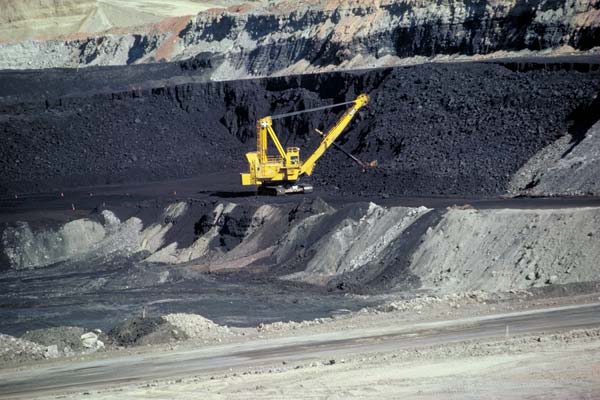
Coal mine in Wyoming

But the one thing that the USA has shown time and time again is that it has the capacity to change very quickly, especially when the country, from its leaders to its entrepreneurs, senses a global leadership opportunity.  With that in mind, read the latest release from the Earth Policy Institute, reproduced below,

AUGUST 10, 2011
A Fifty Million Dollar Tipping Point?
Lester R. Brown

At a press conference on July 21, New York City Mayor Michael Bloomberg announced that he was contributing $50 million to the Sierra Club’s Beyond Coal Campaign. Michael Brune, head of the Sierra Club, called it a “game changer”. It is that, but it also could push the United States, and indeed the world, to a tipping point on the climate issue.

It is one thing for Michael Brune to say coal has to go, but quite another when Michael Bloomberg says so. Few outside the environmental community know who Michael Brune is, but every business person knows Michael Bloomberg as one of the most successful business entrepreneurs of his generation.

The Sierra Club’s Beyond Coal Campaign has two main goals. The first is to prevent the permitting and construction of new coal-fired power plants. So far 153 proposed power plants have been taken off the board. The second goal is to close the 492 existing plants. The Sierra Club lists 71 plants already scheduled for total or partial closure, most of them by 2016.

The efforts to stabilize climate will be won or lost with coal, the world’s largest source of carbon emissions. The effort to phase out coal is now well under way in the United States, the world’s second ranking coal user after China.

There are likely to be many ripple effects from the Bloomberg grant. To begin with, it may encourage other philanthropists to invest in climate stabilization.

The prospect for investment in coal, already deteriorating, will weaken even faster. In August 2010, the Rainforest Action Network (RAN) announced that several leading U.S. investment banks, including Bank of America and J.P. Morgan, had ceased lending to companies involved in mountaintop removal coal mining. Now with Bloomberg’s opposition, investors will be even more wary of coal.

The Bloomberg-Sierra initiative again focuses attention on the 13,200 lives lost each year in the United States due to air pollution from burning coal. If deaths from black lung disease among coal miners are included the number climbs even higher. The number of coal-related deaths in one year dwarfs total U.S. fatalities in the Iraq and Afghanistan wars. We invest heavily in protecting the lives of our troops in the Middle East, and rightly so. Bloomberg is saying let’s do the same for our people at home.

In addition, this initiative brings attention to the health care costs to society of burning coal. These are currently estimated at more than $100 billion per year, roughly $300 for every person in the United States or $1,200 for a family of four. These costs are real, but it is the American people, not the coal companies, who shoulder the burden.

Further reinforcing the urgency of phasing out coal are the more extreme weather events that climate scientists have been warning about for decades. During the first half of 2011 we watched TV news channels become weather channels. First it was a record number of tornadoes in one month, including the one that demolished Tuscaloosa, Alabama. Then, a few weeks later, an even more powerful tornado demolished Joplin, Missouri. As drought and heat sparked record or near-record wildfires in Arizona, New Mexico, and Texas, the lower Mississippi Basin was flooding. Searing heat waves scorched the southern Great Plains, the Midwest, and the East Coast. Intense heat has continued to break records across the country as Texas suffers its most severe one-year drought on record.

For coal, the handwriting is on the wall. Between 2007 and 2010, coal use in the United States dropped 8 percent. (See data.) Meanwhile, more than 300 new wind farms came online, totaling over 23,000 megawatts of generating capacity—the electricity output equivalent of 23 coal-fired power plants.

When people were asked in a national poll where they would like to get their electricity from, only 3 percent opted for coal. Despite the coal industry’s heavy expenditures to promote “clean coal,” it is still a loser in the public mind.

In addition to the Sierra Club, RAN, and a talented team of Earthjustice lawyers, the anti-coal movement also has allies in Friends of the Earth and Greenpeace, the latter with its highly developed capacity to focus public attention on environmental issues. This was evident in May when a Greenpeace team of eight daring activists scaled the 450-foot Fisk coal plant smokestack located in Chicago and painted “Quit Coal” on it. They were drawing public attention to the deadly air pollution in the city coming from the plant.

As the United States closes its coal-fired power plants, it sends a message to the world. With Michael Bloomberg’s grant bolstering the Sierra Club’s well-organized program to phase out coal, we can now imagine a coal-free United States on the horizon. The United States could again become a world leader, this time in stabilizing climate.

Copyright © 2011 Earth Policy Institute

The United States could again become a world leader, this time in stabilizing climate.”  That would be a dream come true, a dream of unimaginable consequences.

Return of the voyager

My fellow author, Jon, returns from a long journey into the interior!

Fellow author, Jon.

If you look at the right-hand margin of Learning from Dogs, you will see that under the label Founding Authors there are two names!  Over the past months Jon, as many of you may have noticed, has been absent.  Indeed, Jon’s last Post on this Blog was on the 2nd January.

Jon’s absence has simply been the result of the total focus that was required to complete his Masters degree in Core Process Psychotherapy, thus adding another string to an already very professional bow.  That focus included the writing of an extremely challenging thesis, all 16,000 words, then the total re-write of that thesis!  That is now all behind Jon!

So from next week, Jon will be participating again on Learning from Dogs with his unique blend of professional and personal experiences.  Indeed, one might argue that the challenges that face our global society need, more than ever, the insight and wisdom of such people.  Am I biased?  Yes, deeply so!

In the early part of 2007 I drew heavily on Jon’s expertise as I tried to make sense of what, at the time, was a deeply traumatic period.  The testament to that relationship with Jon was a greater self-awareness and contentment than I had ever known and, subsequently in December 2007, me meeting Jeannie in Mexico and our ultimate marriage and new home in Payson, Arizona.  As outcomes go, it doesn’t get better than that!

Back to that last article from Jon.  In it he wrote,

Plus I did want to expand, just a touch, on what Paul wrote yesterday, more or less reflecting on an article by Leo Babauta.  In that post, Paul quoted Leo writing:

The thing I’ve learned, and it’s not some new truth but an old one that took me much too long to learn, is that if you learn to be content with who you are and where you are in life, it changes everything.

In a very real sense what Leo is saying is that if you don’t love yourself you can’t possibly ‘love’ the world around you.  Now this is incredibly easy to consider, too easy in fact, because the truth of loving oneself first is, for the vast majority of people, a complex, confusing and unclear journey, as in ‘self-journey’.  Read that quote from Leo again and see how he writes, ‘an old one [as in truth] that took me much too long to learn‘.

I’m sure when Leo writes ‘too long to learn‘ he is, in effect, acknowledging the very individual circumstances that lead to a person developing the awareness that is expressed in that quote ‘if you learn to be content with who you are and where you are in life, it changes everything‘.

So if 2011 is going to be a challenging year then hang on to the only rock in your life – yourself!  Embrace the reality that you, like all of us, do your best.  Be good and kind to you.

So if 2011 is going to be a challenging year then hang on to the only rock in your life – yourself!  Embrace the reality that you, like all of us, do your best.  Be good and kind to you.

So to each and every one of you reading this, be good and kind to you!

Welcome back Jon.

Back of every creation, supporting it like an arch, is faith. Enthusiasm is nothing: it comes and goes.

But if one believes, then miracles occur. Henry Miller

Spirituality and activism

A look at the film Fierce Light

For a number of reasons, both private and public, I have not been feeling as creative as normal these last 24 hours.  What I am conscious of is that events of this week, from the riots in the UK, the chaos of financial markets, right through to the death of our dog Tess have all contributed to a mental heaviness.

So I am taking a small creative short-cut, as it were, by writing about a film that we watched on Monday night; Fierce Light.

There is a trailer on YouTube.  This is how it is presented,

A Feature Documentary By Velcrow Ripper

From the Director of Scared Sacred & The Producer of The Corporation

“Fierce Light” is a feature documentary that captures the exciting movement of Spiritual Activism that is exploding around the planet, and the powerful personalities that are igniting it.

Fueled by the belief that “another world is possible,” the film portrays stories of what Martin Luther King called “Love in Action,” and Gandhi called “Soul Force”; what Ripper is calling “Fierce Light.” Acclaimed filmmaker Velcrow Ripper (Scared Sacred) takes an insightful look at change motivated by love, featuring interviews with spiritual activists Thich Nhat Hanh, Desmond Tutu, Daryl Hannah, Julia Butterfly Hill, and more.

If you would like to sink a little deeper into the film and what the motivations are behind the making of it, then do go to the web site Fierce Light.

Jean and I found the film inspiring and beautifully presented.  It came over as a film that seriously approached the topic of human consciousness and gave plenty of opportunity to reflect on some of the many forces within our societies at this present time.

Then you may like to watch this talk by the Director, Velcrow Ripper (actually born Steve Ripper in 1963), broken into two parts as follows,

The film and this talk by Mr. Ripper both date back to 2009 so, in the light of where we are in August 2011, they are proving to be extremely relevant.

Tess, be in peace

The sad loss of our dog, Tess.

Over a couple of months ago, Tess was diagnosed with bone cancer, in the shoulder joint of her right front leg.  The vet thought that she might have only a very few weeks to live, this particular form of cancer being aggressive.

As it happened, Tess kept going for much, much longer.  But this morning (Wednesday at the time of writing) Jean made the agonising decision to end the pain for Tess.  Despite a daily dose of strong pain-killer tablets, this morning Tess was breathing more laboriously and showing clear signs of tiring.  It was time.

For me it was the first time that I had been with a loved animal that had to be euthanised and it was hard.

A few pictures to keep her memory alive.

Tess, far left (next to the plant pot), and friends
Jean & Tess, a few moments before leaving.
Dear Tess, you are out of pain and at peace.

Let me close with the same poem that was published when we lost our little Poppy,

“There is one best place to bury a dog.
“If you bury him in this spot, he will
come to you when you call – come to you
over the grim, dim frontier of death,
and down the well-remembered path,
and to your side again.

“And though you call a dozen living
dogs to heel, they shall not growl at
him, nor resent his coming,
for he belongs there.

“People may scoff at you, who see
no lightest blade of grass bent by his
footfall, who hear no whimper, people
who may never really have had a dog.
Smile at them, for you shall know
something that is hidden from them,
and which is well worth the knowing.

“The one best place to bury a good
dog is in the heart of his master.”

Ben Hur Lampman —
from the Portland Oregonian Sept. 11, 1925

Dogs, humans and hope

A new book about dogs by John Bradshaw offers a theme for today.

Yesterday, I mentioned an article from the current issue of The Economist.  Also in that issue was a review of a new book from John Bradshaw, called Dog Sense: How the New Science of Dog Behaviour Can Make You a Better Friend to Your Pet.  You can read the review here. But in terms of the theme of today’s post, read this paragraph from that review,

Dogs are not like nicely brought-up wolves, says the author, nor are they much like people despite their extraordinary ability to enter our lives and our hearts. This is not to deny that some dogs are very clever or that they are capable of feeling emotion deeply. But their intelligence is different from ours. The idea that some dogs can understand as many words as a two-year-old child is simply wrong and an inappropriate way of trying to measure canine intellect. Rather, their emotional range is more limited than ours, partly because, with little sense of time, they are trapped almost entirely in the present. Dogs can experience joy, anxiety and anger. But emotions that demand a capacity for self-reflection, such as guilt or jealousy, are almost certainly beyond them, contrary to the convictions of many dog owners.

That last sentence is key, “But emotions that demand a capacity for self-reflection, such as guilt or jealousy, are almost certainly beyond them, contrary to the convictions of many dog owners.

So in yesterday’s post, when I wrote about the terrible uncertainty that millions and millions of humans must be experiencing, there is no useful metaphor available to link this human idea to how the dogs feel; as John Bradshaw writes, this level of reflection is just beyond them.

We hug a dog (or any animal) to escape from matters complex.  As Sue Miller wrote so beautifully, “I was taken up by them [pets] and their life and energy, by what they needed and asked of me.  I let go of everything difficult or complex in my life.  As I was driving home, I thought of all this, and it seemed to me that I’d chosen work which offered me daily the presence of pure innocence, a forgiveness for all my human flaws.”

So accept the gift of pure innocence that our pets give us.

But what ‘gift’ can we humans accept that relates to the very complex world that we humans see all around us?

What about hope?  Let’s accept the gift of hope.  As I wrote recently in an email to a friend (before the London riots burst upon our consciousness),

‘Hope’ is going to be the key message over the coming weeks and months because the feeling that the ‘end of the world is nigh’ is incredibly strong, well it is to me!

Of course, the ‘end of the world’ feeling is, as you well know from me, really the end of an era.  But an era where for decades money has equalled power; ergo money has equalled control.

Now the speed of change must be terrifying to millions across the world.  So out of that terror must come a new order, a new way of understanding that how we have treated our planet is a busted model and that it is time, indeed the 11th hour as it were, to find that new order, of love and sustainability with our planet, both in earthly and spiritual ways.

We must have faith in the hope that we are living through the chaotic transition from an era of greed and destruction to one where we have a future that goes on for thousands of years.

A self-affirmation
For today, I am in charge of my life.
Today, I choose my thoughts.
Today, I choose my attitudes.
Today, I choose my actions and behaviours.
With these, I create my life and my destiny.

Future shock

“Everyone thinks of changing the world, but no one thinks of changing himself.” Leo Tolstoy

I am going to refer to some ideas before explaining from whom they came, and when.

Try this: the term “future shock” is defined as a certain psychological state of individuals and entire societies. The shortest definition for the term is a personal perception of “too much change in too short a period of time”.

Or try this: society is undergoing an enormous structural change, a revolution from an industrial society to a “super-industrial society”. This change will overwhelm people, the accelerated rate of technological and social change leaving them disconnected and suffering from “shattering stress and disorientation” – future shocked. It was stated that the majority of social problems were symptoms of the future shock.

Stay with me a little longer as I pose a few questions.  How do you feel at the moment?  Slightly unsure of where the world is going right now? Feeling a little unsettled?

Why those questions?  With the Dow Jones index heading down through 11,130 (at the time of writing on the 8th) and ‘chaos across markets’ headlines all over the place these are very unsettling times

Last week’s edition of The Economist had five pages about the present uncertain times in the USA.

August 6th, 2011

Here’s a quote from an article entitled,

Six years into a lost decade

The numbers keep being revised inexorably downwards

The rough news did not end there. The Bureau of Economic Analysis (BEA) revised its numbers back through the recession, revealing a downturn more serious than previously understood. The BEA’s first estimate of output in the fourth quarter of 2008, published in January of 2009, showed a contraction of 3.8%, later revised to a 6.8% drop. The new numbers change the figure yet again, to a shocking 8.9% fall in GDP. For 2009 as a whole, the American economy shrank by 3.5% rather than the previously reported 2.6%. American output has yet to reattain its 2007 peak. On a per-person basis, inflation-adjusted GDP stands at virtually the same level as in the second quarter of 2005. America is six years into a lost decade. [my emphasis]

So back to those comments about  ‘future shock’.  They come from a gentleman known across the world for his writings as a futurist, Alvin Toffler.  His website is here and there is a good review of the man and his works on Wikipedia.

Alvin Toffler, born 1928

Toffler’s book, Future Shock, from 1970 was prescient in forecasting …. well here’s how it is written on Wikipedia,

Toffler argues that society is undergoing an enormous structural change, a revolution from an industrial society to a “super-industrial society“. This change will overwhelm people, the accelerated rate of technological and social change leaving them disconnected and suffering from “shattering stress and disorientation” – future shocked. Toffler stated that the majority of social problems were symptoms of the future shock. In his discussion of the components of such shock, he also popularized the term “information overload.”

But there’s an aspect that wasn’t even on the horizon when Toffler was writing that book in the late 60s – the end of growth.  That is creating a whole new level of change and ‘information overload’, in my opinion.

Just a few days ago, I reviewed the Paul Gilding book The Great Disruption.  I quoted this extract from the very start of the book,

This means things are going to change.  Not because we will choose change out of philosophical or political preference, but because if we don’t transform our society and economy, we risk social and economic collapse and the descent into chaos.  The science on this is now clear and accepted by any rational observer.  While an initial look at the public debate may suggest controversy, any serious examination of the peer-reviewed conclusions of leading science bodies shows the core direction we are heading in is now clear.  Things do not look good.

These challenges and the facts  behind them are well-known by experts and leaders around the world, and have been for decades.  But despite this understanding, that we would at some point pass the limits to growth, it has been continually filed away to the back of our mind and the back of our drawers, with the label “Interesting – For Consideration Later” prominently attached.  Well, later has arrived.

Indeed, ‘later’ has arrived.  The ‘future’ is now here!

Watch the first 10 minutes of the Future Shock film made back in 1972 and ponder.

The following four parts are easily found on YouTube.

God grant me the serenity to accept the things I cannot change, the courage to change the things I can, and the wisdom to know the difference. Reinhold Niebuhr

Why we have cats and dogs!

Author Sue Miller perfectly articulates our relationship with dogs and cats.

As a rest to the number of non-fiction books that I have been reading over the past few months, Jean recommended a novel she recently finished, While I Was Gone, by Sue Miller.  It’s featured on Oprah’s Book Club, from which I quote,

About the Book

A decade ago she put a face on every mother’s worst nightmare with her phenomenal best-seller The Good Mother. Now, Sue Miller delivers a spellbinding novel of love and betrayal that explores what it means to be a good wife.

In the summer of 1968, Jo Becker ran out on the marriage and the life her parents wanted for her, and escaped–for one beautiful, idyllic year–into a life that was bohemian and romantic, living under an assumed name in a rambling group house in Cambridge. It was a time of limitless possibility, but it ended in a single instant when Jo returned home one night to find her best friend lying dead in a pool of blood on the living room floor.

Now Jo has everything she’s ever wanted: a veterinary practice she loves, a devoted husband, three grown daughters, a beautiful Massachusetts farmhouse. And if occasionally she feels a stranger to herself and wonders what happened to the freedom she once felt, or how she came to be the wife, mother, and doctor her neighbors know and trust–if at times she feels as if her whole life is vanishing behind her as she’s living it–she need only look at her daughters or her husband, Daniel, to recall the satisfactions of family and community and marriage.

But when an old housemate settles in her small town, the fabric of Jo’s life begins to unravel: seduced again by the enticing possibility of another self and another life, she begins a dangerous flirtation that returns her to the darkest moment of her past and imperils all she loves.

While I Was Gone is an exquisitely suspenseful novel about how quickly and casually a marriage can be destroyed, how a good wife can find herself placing all she holds dear at risk. In expert strokes, Sue Miller captures the precariousness of even the strongest ties, the ease with which we abandon each other, and our need to be forgiven. An extraordinary book, her best, from a beloved American writer.

Have to say that even though there’s an obvious gender difference between me, the heroine and the author, I found the book tough reading , as in emotional, from time to time.  Especially, the euthanasia of Arthur the dog towards the end of Chapter 7 – Jo is a vet.  A few paragraphs I just couldn’t read .  But then on page 137 in Chapter 8, comes this,

Pure bliss.

I stood in the center of the yard for a moment and tilted my head back to let the soft snow touch my face.  The dogs pranced and rolled for pure joy in the pale, gray-brown light.  They chased each other wildly.  I made snowballs and threw them; the dogs leapt and bit at where they’d disappeared.  As they played, their muzzles whitened, their paws pilled up.

I left them reluctantly and came back in.  Watson trailed me around as I did my chores, watching me soberly.  I shut him out of the cat room, where we had only two boarders.  I let one of them out to roam and use the litter pan while I checked its cage.  I put more food down.  Then I went back out and worked my way through the dogs’ cages.  Two of them had had accidents, so I cleaned up and changed their bedding.  Several of them had their own food, in cans – those dishes needed to be washed.  Water refreshed, kibbles set out for the others.

I went to the cat room, put the first cat back and let the other one out.  Then I called the reluctant dogs in.  Watson greeted each one like a tiny worried mother, licking at their snow, fussing about how they smelled.  Slowly I recaged them.  I released Lucky and let him go outside for his solitary run while I refilled his food and water dishes.  Three dogs needed medications.  I put the last cat back in, called Lucky inside, locked up.

And while I did all this, I thought only of them, of the dogs and cats, of their requests for affection, of their comical or passionate relationships to one another, of the performance of their bodily functions.  I was taken up by them and their life and energy, by what they needed and asked of me.  I let go of everything difficult or complex in my life.

It reminded me of my days at Dr. Moran’s, caring for the dogs and cats he boarded and treated.  It reminded me of what a comfort it had been to me, even just physical escape into the lives of animals.  As I was driving home, I thought of all this, and it seemed to me that I’d chosen work which offered me daily the presence of pure innocence, a forgiveness for all my human flaws.

the presence of pure innocence, a forgiveness for all my human flaws Impossible to add anything; so I won’t!