The almost surreal area where aircraft are ‘laid to rest’.
The Mojave Desert is one of the places in the world where aircraft, both military and civil, are placed when they are at the end of their life, whatever that means.
Anyway, came across some nice material and wanted to share it.
In an earlier copy of Mental Floss Magazine (seriously) there’s a very good article about this area. Fabulous pictures, by the way. (Both pics in this Post are from that article.)
Next this is a YouTube video using Google Earth in flyover mode:
This has been circulating on the Internet, but you may not have seen it …..
Indian Chief ‘Two Eagles’ was asked by a white U.S. government official, ‘You have observed the white man for 90 years. You’ve seen his wars and his technological advances. You’ve seen his progress, and the damage he’s done.’The Chief nodded in agreement.
The official continued, ‘Considering all these events, in your opinion, where did the white man go wrong?’
The Chief stared at the government official for over a minute and then calmly replied, ‘When white man find land, Indians running it, no taxes, no debt, plenty buffalo, plenty beaver, clean water. Women did all the work, Medicine man free. Indian man spend all day hunting and fishing; all night having sex. Only white man dumb enough to think he could improve system like that.’
For a long time, it has seemed to me that we confuse crimes and accidents.
This is such a substantial issue that more posts might flow from this, depending on the level of interest. Also, I should point out that I am no lawyer, so this is a personal, not a professional, view.
In both directions
When crimes are treated as accidents, criminal behaviour is appeased and no deterrent effect generated. Attempts to learn lessons are likely to be fruitless. So behaviour does not change and the crimes continue.
When accidents are treated as crimes, blame is allocated inappropriately and lessons are not learned. Innocent participants are punished for no purpose. So behaviour does not change and the accidents continue.
Issues
There are issues of causation, intent, blame and so on.
There are so many examples of this, that I am not sure where to begin. So, I won’t … yet!
Oh Dear! Not even XMAS is safe from the dreaded H&SE, the British Health and Safety Executive and the mentality that we must be protected from every eventuality, but how on earth can you get any Christmas spirit from a giant plastic H&SE tree?
Apparently, the authorities think it is safer than a real tree which “might fall on someone”. But has anyone ever heard of death by XMAS tree? It would make a good title for an Agatha Christie of course ….
But REAL Christmas trees are “good for us”, aren’t they? They grow and are cut down (providing jobs), but then of course new ones are planted, all good for the environment …. But above all, they are REAL. Will everything eventually be replaced by digits and images? How long will it be before we get just a giant wall poster of a Christmas tree? Surely that would be even safer for the plebs?
Recently there was an event at which Bill Gates and Warren Buffett answered questions from students of the Columbia Business School in New York. I referred to the event recently when writing about Warren Buffett.
So why were these students interested in Messrs Gates and Buffett? It is, of course, because they are successful.
While different people define success in many different ways, we can be reasonably sure that, in the context of a business school, most of those business students would categorise Gates and Buffett as being among the most successful people alive.
So what did the students ask about? Well, of course, they asked about success! The questions were of two main types.
A small challenge to a Nobel prize winner in Economics!
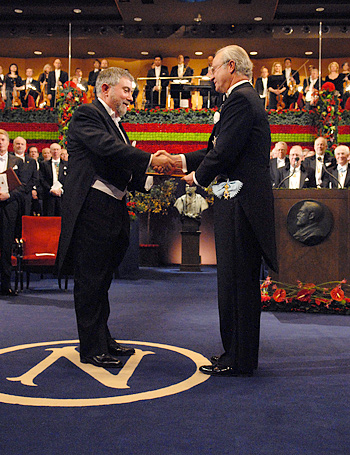
In a recent New York Times op-ed, Paul Krugman continues his boundless quest to become the “it” guy in the world of economics. I have taken issue with his command of basic economic facts in the past — a gutsy, if not insane thing to do given the man was awarded a Nobel Prize in Economics.
Krugman accepting the Nobel Prize
This post is more about ego than economics, however.
In this op-ed, Mr. Krugman says (and I kid you not),
…But after the debacle of the past two years, there’s broad agreement — I’m tempted to say, agreement on the part of almost everyone not on the financial industry’s payroll — with Mr. Turner’s assertion that a lot of what Wall Street and the City do is “socially useless.” And a transactions tax could generate substantial revenue, helping alleviate fears about government deficits. What’s not to like?
Well, I disagree with the idea that what Wall Street does is socially useless. And I am not on the financial industry’s payroll.
Nope, I’m just a simple economist, using my head, training, and experience to consider this idea, map out the pros and cons, and analyze the logical end-game of such a tax. I conclude that it is a really bad idea.
Why? There are lots of reasons, but I will mention only two.
One, raising taxes reduces private economic activity, which will curtail growth, reduce tax revenues and increase the deficit.
Two, taxes distort the price signal between suppliers and demanders of goods and services, including financial capital, reducing economic efficiency.
His reasons? Other than citing one academic study (while ignoring the many others that reach a different conclusion), he gives no economic reasons for his views. Instead, he make claims. He claims, for example, that “socially damaging behavior … caused our current crisis.” He says that the financial services industry is “bloated” and needs to be cut down to size. He says that the new tax is okay because it raises revenues for the government which, he claims, should make us all feel better about the deficit and, apparently, the size and nature of government spending under Obama. And, the lamest of all, for no other reason than to hide behind their skirt, he claims the existence of some phantom majority, apparently to create the impression that anyone with a different view is clearly in the minority. A tactic that should be beneath a Noble Prize winner, but one that runs through his work with increasing frequency over time.
But, Mr. Krugman, I so disagree with you. And even in an op-ed piece — perhaps especially in an op-ed piece – I believe that one needs to reign in an ego that would parade claims as facts, especially when each of those claims is disputed by your fellow economists, none of whom stooped so low as to imply that you were paid for your views.
Communicating effectively means being totally mentally connected.
I have been working with a client recently through a very tough performance improvement plan.
As part of the plan, my client had to be videoed working with people in his workplace. I had to observe the video and then give feedback on it.
He seemed very efficient and made notes whilst he worked with each person. Occasionally though, something didn’t seem to be quite right. When I watched more closely I realised what was wrong. He wasn’t present. He wasn’t really connecting with the people he was working with.
It made me reflect on how much more effective he would have been if he had been able to connect with these people? I wondered if he was even able to understood about being present and what that meant?
A summary of the different collections is listed here, many of them wartime photographs that bring a multitude of emotions to the surface: incredible bravery of the pilots; photographic standards of 70 years ago, man’s inhumanity to man; and so on.
I pondered a bit about writing this Post because, well ….. well…, see what you make of it!
Author's Mum
Being born in England in the early part of November, 1944, World War 2 still resonates within me.
Early home in an industrial part of West London meant that my mother and father had a ring-side view of the German V1 and V2 rockets that were being visited on London at that time.
My mother, 90, still recounts her enormous sense of relief when VE Day was announced (May 8th, 1945) because she then thought that her son’s future life was more or less assured.
So back to these aerial photographs held in those collections.
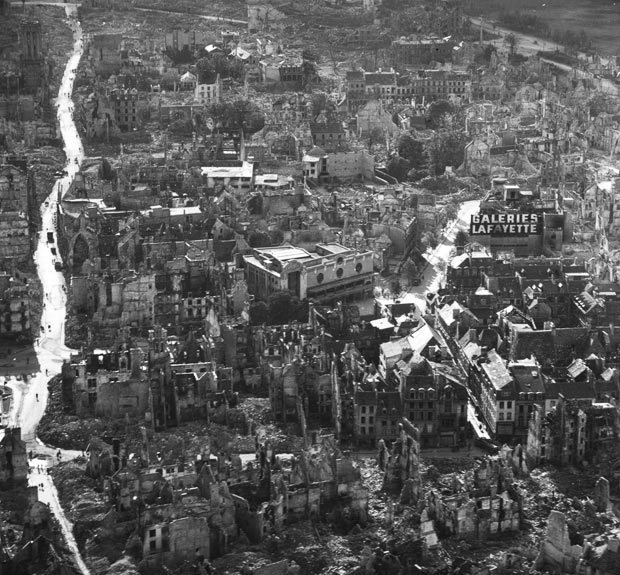
Here’s a picture of the visitation of war on the beautiful French town of Caen.
Linger a while and look at the damage, mostly to private homes. The photograph was taken just slightly more than a month before I was born.
These are very strange times: thank goodness for Blogs.
Learning from Dogs is a relatively young Blog (first Post was July 15th, 2009) but already it has opened the eyes of all the authors to the power of plain speaking. All of us involved in bringing you a dozen Posts a week find inspiration for our creative juices from the corners, far and wide, of the virtual world of digital communications, the World Wide Web.
Because we are in the midst of huge turmoil it’s very difficult to see the underlying trends of change at work. But see them we must if we are to be smart and work out, for the best, what needs to be done at the scale of the individual and the family.
So with that theme in mind, go to the Blog called Jesse’s Café Américain and read a recent Post about the behaviour of the price of gold. But also read beyond the subject of gold and reflect on the deeper message.





 Learning from Dogs