Perfect dog pictures courtesy of Jess.
(And I’m sorry for the duplicates.)

oooo

oooo

oooo

I have repeated these pictures as, for whatever reason, I did not receive a new batch from Jess.
Dogs are animals of integrity. We have much to learn from them.
Year: 2024
Perfect dog pictures courtesy of Jess.
(And I’m sorry for the duplicates.)
oooo
oooo
oooo
I have repeated these pictures as, for whatever reason, I did not receive a new batch from Jess.
All of them were white puppies, and …
This was a story that recently was shown on The Dodo site.
Too many dogs, and cats, are abandoned on a regular basis. But read on and see why this rescue was extra special.
ooOOoo
Rescue Finds A Box Of Puppies Abandoned On Their Property — And Then They Realize Why.
By Caitlin Jill Anders, Published on Aug 15, 2024
When staff members and volunteers at Saving Hope Rescue noticed a box had been dumped on their property, their hearts sank. As they got closer, they saw the box had “puppies her” written on the side of it and had a feeling they knew who was inside.

When they opened the box, the rescuers came face-to-face with a whole pile of all-white puppies. Even though their rescue was already at capacity, they knew they couldn’t turn their backs on the sweet little family. They put out a call for help to the community in order to get some support and began to get the pups settled in.

As everyone at the rescue started getting to know the abandoned puppies, they realized that the pups had been hiding something: Apparently, they were all visually and hearing impaired to some degree.
“At first, they were all deemed blind and deaf,” Lauren Anton of Saving Hope Rescue told The Dodo. “Eventually, as time went by and they developed some more, we discovered that some puppies are more impaired than others.”

It’s possible that this was the reason the puppies were abandoned in the first place, but it’s hard to know for sure. Either way, it didn’t change anything for the puppies’ rescuers. Even if they might need a little extra help, they were still members of the Saving Hope family.
As the puppies grew, their unique personalities began to shine through, and their rescuers were also able to start getting an accurate picture of their different abilities.

“Mate is a good example of the slightly impaired puppies,” Anton said. “We don’t know how much she can see and hear, for sure, but we do know that she can hear being called, knows when we shake the food bag, and will approach people when called to come over … Koala, on the other hand, is much more impaired … We aren’t sure how much he can see. Maybe just shadows.”
Everyone is doing their best to get to know the puppies and their individual needs so they’ll know how to best help them as they grow. One thing is for sure though, the puppies are happy and thriving.

“Over the last few weeks, they’ve gone from sleepy babies to rambunctious puppies,” Anton said. “They’re constantly playing and wrestling with each other. They’ve learned that human pets and snuggles feel nice, and they love to sleep in our arms.”
These puppies may have been abandoned, but now they’re getting the second chance they deserve.
ooOOoo
That is a beautiful story. Lauren and the staff are to be congratulated on doing what they did, and that was giving these puppies a new lease of life.
We are in an era of unknown weather, across the world!

ooOOoo
Simon H. Lee, University of St Andrews; Hayley J. Fowler, Newcastle University, and Paul Davies, Newcastle University
Published: July 30, 2024
Extreme weather is by definition rare on our planet. Ferocious storms, searing heatwaves and biting cold snaps illustrate what the climate is capable of at its worst. However, since Earth’s climate is rapidly warming, predominantly due to fossil fuel burning, the range of possible weather conditions, including extremes, is changing.
Scientists define “climate” as the distribution of possible weather events observed over a length of time, such as the range of temperatures, rainfall totals or hours of sunshine. From this they construct statistical measures, such as the average (or normal) temperature. Weather varies on several timescales – from seconds to decades – so the longer the period over which the climate is analysed, the more accurately these analyses capture the infinite range of possible configurations of the atmosphere.
Typically, meteorologists and climate scientists use a 30-year period to represent the climate, which is updated every ten years. The most recent climate period is 1991-2020. The difference between each successive 30-year climate period serves as a very literal record of climate change.
This way of thinking about the climate falls short when the climate itself is rapidly changing. Global average temperatures have increased at around 0.2°C per decade over the past 30 years, meaning that the global climate of 1991 was around 0.6°C cooler than that in 2020 (when accounting for other year-to-year fluctuations), and even more so than the present day.
If the climate is a range of possible weather events, then this rapid change has two implications. First, it means that part of the distribution of weather events comprising a 30-year climate period occurred in a very different background global climate: for example, northerly winds in the 1990s were much colder than those in the 2020s in north-west Europe, thanks to the Arctic warming nearly four times faster than the global average. Statistics from three decades ago no longer represent what is possible in the present day.
Second, the rapidly changing climate means we have not necessarily experienced the extremes that modern-day atmospheric and oceanic warmth can produce. In a stable climate, scientists would have multiple decades for the atmosphere to get into its various configurations and drive extreme events, such as heatwaves, floods or droughts. We could then use these observations to build up an understanding of what the climate is capable of. But in our rapidly changing climate, we effectively have only a few years – not enough to experience everything the climate has to offer.
Extreme weather events require what meteorologists might call a “perfect storm”. For example, extreme heat in the UK typically requires the northward movement of an air mass from Africa combined with clear skies, dry soils and a stable atmosphere to prevent thunderstorms forming which tend to dissipate heat.
Such “perfect” conditions are intrinsically unlikely, and many years can pass without them occurring – all while the climate continues to change in the background. Based on an understanding of observations alone, this can leave us woefully underprepared for what the climate can now do, should the right weather conditions all come together at once.
Startling recent examples include the extreme heatwave in the Pacific north-west of North America in 2021, in which temperatures exceeded the previous Canadian record maximum by 4.6°C. Another is the occurrence of 40°C in the UK in summer 2022, which exceeded the previous UK record maximum set only three years earlier by 1.6°C. This is part of the reason why the true impact of a fixed amount of global warming is only evident after several decades, but of course – since the climate is changing rapidly – we cannot use this method anymore.
To better understand these extremes, scientists can use ensembles: many runs of the same weather or climate model that each slightly differ to show a range of plausible outcomes. Ensembles are routinely used in weather prediction, but can also be used to assess extreme events which could happen even if they do not actually happen at the time.
When 40°C first appeared in ensemble forecasts for the UK before the July 2022 heatwave, it revealed the kind of extreme weather that is possible in the current climate. Even if it had not come to fruition, its mere appearance in the models showed that the previously unthinkable was now possible. In the event, several naturally occurring atmospheric factors combined with background climate warming to generate the record-shattering heat on July 19 that year.
The highest observed temperature each year in the UK, from 1900 to 2023
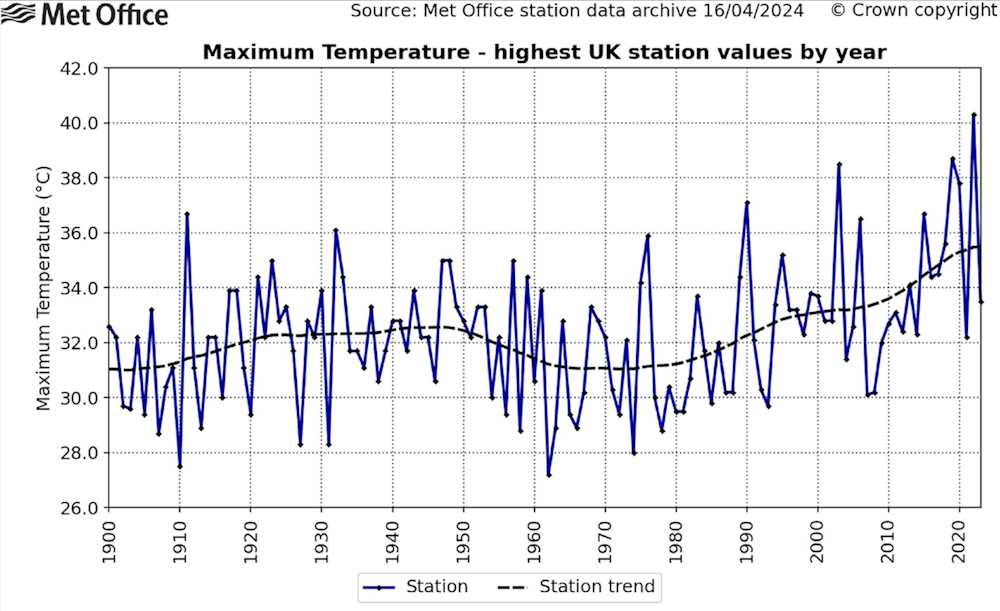
Later in summer 2022, after the first occurrence of 40°C, some ensemble weather forecasts for the UK showed a situation in which 40°C could be reached on multiple consecutive days. This would have posed an unprecedented threat to public health and infrastructure in the UK. Unlike the previous month, this event did not come to pass, and was quickly forgotten – but it shouldn’t have been.
It is not certain whether these model simulations correctly represent the processes involved in producing extreme heat. Even so, we must heed the warning signs.
Despite a record-warm planet, summer 2024 in the UK has been relatively cool so far. The past two years have seen global temperatures far above anything previously observed, and so potential extremes have probably shifted even further from what we have so far experienced.
Just as was the case in August 2022, we’ve got away with it for now – but we might not be so lucky next time.
Simon H. Lee, Lecturer in Atmospheric Science, University of St Andrews; Hayley J. Fowler, Professor of Climate Change Impacts, Newcastle University, and Paul Davies, Chief Meteorologist, Met Office and Visiting Professor, Newcastle University
This article is republished from The Conversation under a Creative Commons license. Read the original article.
ooOOoo
That last sentence says it all: “Just as was the case in August 2022, we’ve got away with it for now – but we might not be so lucky next time.”
I am giving a talk, The Next Ten Years, next Saturday to our local Freethinkers group in Grants Pass. Close to the start of the presentation I say: “The Global Temperature anomaly, as of last year, 2023, is 1.17 C, 2.11 F, above the long-term average from 1951 to 1980. The 10 most recent years are the warmest years on record.“
Finally, I am getting on in age and part of me wants to die, hopefully naturally, before more climate extremes are reached, but then another part of me would like to experience it!
 Learning from Dogs