Recently, staff at the Wyandotte Animal Shelter in Michigan took in a dog whose condition was described as among the worst they’d ever seen. Pixie, as the dog is named, had fur so overgrown and matted that she could hardly move.
Gazing upon Pixie, one might never guess that an adorable dog existed beneath it.
Wyandotte Animal Shelter
According to staff at the shelter, Pixie was surrendered by her owner, who, regrettably, had neglected to give her the care and attention she needed — leading to her severely unkempt condition. Ultimately, though, his decision to surrender her is what Pixie needed most.
“He had a hard time letting her go but surrendered her to us so we could ensure she would go to someone who could give her the life she deserved,” the shelter wrote.
With that, Pixie’s world was about to change forever — and it would have to start with a much-needed haircut.
Wyandotte Animal Shelter
Staff at the shelter reached out to The Downriver Grooming Co. for what would be an emergency grooming session to help Pixie escape from her matted prison.
“[They got] her in within minutes of our call, and for [three] hours they spent freeing her from that matted fur,” the shelter wrote.
Wyandotte Animal Shelter
After all was said and done, the real Pixie had emerged.
She was totally unrecognizable from her former self.
Wyandotte Animal Shelter
“This little girl was only 5.5 pounds, but she seemed twice her size due to the matted fur,” the shelter wrote, adding that she was in remarkably good health, despite her ordeal beneath that overgrown coat.
Pixie’s world had changed for the better — but it wouldn’t be long until it improved even more.
Wyandotte Animal Shelter
Within days of Pixie’s transformation, thanks to the kindness of those who’d helped her, the little dog got the second chance she so desperately needed.
“Pixie was adopted,” a spokesperson for the Wyandotte Animal Shelter told The Dodo. “Her new family reports that she is doing very well in her new home.”
ooOOoo
We all need second chances from time to time, humans and dogs.
Although I was born in London in 1944, as a result of an affair between my father and mother, my father had two daughters with his wife, Maud, and Rhona and Corinne, for they were their names, took me under their wing. In the 50s Maud, Rhona and Corinne all moved to Devon and I started going regularly to Totnes. When I started driving I usually stopped for a break close by Stonehenge so the site has a special interest to me.
So when I saw this article in The Conversation it had to be shared.
ooOOoo
Stonehenge may have aligned with the Moon as well as the Sun
When it comes to its connection to the sky, Stonehenge is best known for its solar alignments. Every midsummer’s night tens of thousands of people gather at Stonehenge to celebrate and witness the rising Sun in alignment with the Heel stone standing outside of the circle. Six months later a smaller crowd congregates around the Heel stone to witness the midwinter Sun setting within the stone circle.
But a hypothesis has been around for 60 years that part of Stonehenge also aligns with moonrise and moonset at what is called a major lunar standstill. Although a correlation between the layout of certain stones and the major lunar standstill has been known about for several decades, no one has systematically observed and recorded the phenomenon at Stonehenge.
This is what we are aiming to do in a project bringing together archaeologists, astronomers and photographers from English Heritage, Oxford, Leicester and Bournemouth universities as well as the Royal Astronomical Society.
There is now an abundance of archaeological evidence that indicates the solar alignment was part of the architectural design of Stonehenge. Around 2500 BC, the people who put up the large stones and dug an avenue into the chalk seemed to want to cement the solstice axis into the architecture of Stonehenge.
Archaeological evidence from nearby Durrington Walls, the place where scientists believe the ancient people who visited Stonehenge stayed, indicates that of the two solstices it was the midwinter one that drew the largest crowd.
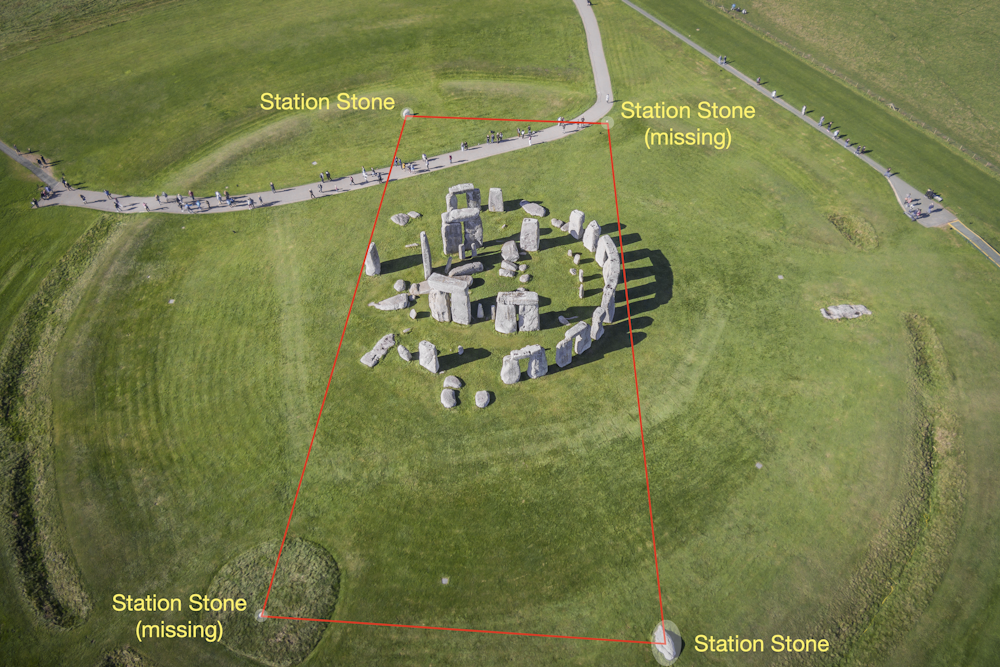
But Stonehenge includes other elements, such as 56 pits arranged in a circle, an earthwork bank and ditch, and other smaller features such as the four station stones. These are four sarsen stones, a form of silicified sandstone common in Wiltshire, that were carefully placed to form an almost exact rectangle encompassing the stone circle.
Only two of these stones are still there, and they pale in comparison to their larger counterparts as they are only a few feet high. So what could their purpose be?
Only two of the station stones are still there. Drone Explorer/Shutterstock
Lunar standstill
The rectangle that they form is not just any rectangle. The shorter sides are parallel to the main axis of the stone circle and this may be a clue as to their purpose. The longer sides of the rectangle skirt the outside of the stone circle.
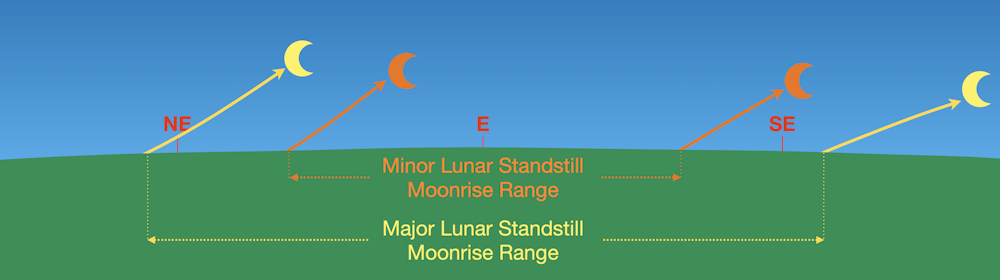
It is these longer sides that are thought to align with the major lunar standstill. If you marked the position of moonrise (or set) over the course of a month you would see that it moves between two points on the horizon. These southern and northern limits of moonrise (or set) change on a cycle of 18.6 years between a minimum and a maximum range – the so-called minor and major lunar standstills, respectively.
The major lunar standstill is a period of about one and a half to two years when the northernmost and southernmost moonrises (or sets) are furthest apart. When this happens the Moon rises (and sets) outside the range of sunrises and sets, which may have imbued this celestial phenomenon with meaning and significance.
The range of Moonrise positions on the horizon during minor and major lunar standstills. Fabio Silva, CC BY-NC
The strongest evidence we have for people marking the major lunar standstill comes from the US southwest. The Great House of Chimney Rock, a multi-level complex built by the ancestral Pueblo people in the San Juan National Forest, Colorado, more than 1,000 years ago.
It lies on a ridge that ends at a natural formation of twin rock pillars – an area that has cultural significance to more than 26 native American tribal nations. From the vantage point of the Great House, the Sun will never rise in the gap between the pillars.
However, during a major standstill the Moon does rise between them in awe-inspiring fashion. Excavations unearthed preserved wood that meant researchers could date to the year episodes of construction of the Great House.
Of six cutting dates, four correspond to major lunar standstill years between the years AD1018 and AD1093, indicating that the site was renewed, maintained or expanded on consecutive major standstills.
Returning to southern England, archaeologists think there is a connection between the major lunar standstill and the earliest construction phase of Stonehenge (3000-2500 BC), before the sarsen stones were brought in.
Several sets of cremated human remains from this phase of construction were found in the southeastern part of the monument in the general direction of the southernmost major standstill moonrise, where three timber posts were also set into the bank. It is possible that there was an early connection between the site of Stonehenge and the Moon, which was later emphasised when the station stone rectangle was built.
The major lunar standstill hypothesis, however, raises more questions than it answers. We don’t know if the lunar alignments of the station stones were symbolic or whether people were meant to observe the Moon through them. Neither do we know which phases of the Moon would be more dramatic to witness.
A search for answers
In our upcoming work, we will be trying to answer the questions the major lunar standstill hypothesis raises. It’s unclear whether the Moon would have been strong enough to cast shadows and how they would have interacted with the other stones. We will also need to check whether the alignments can still be seen today or if they are blocked by woods, traffic and other features.
The Moon will align with the station stone rectangle twice a month from about February 2024 to November 2025, giving us plenty of opportunities to observe this phenomenon in different seasons and phases of the Moon.
To bring our research to life, English Heritage will livestream the southernmost Moonrise in June 2024, and host a series of events throughout the year, including talks, a pop-up planetarium, stargazing and storytelling sessions.
Across the Atlantic, our partners at the US Forest Service are developing educational materials about the major lunar standstill at Chimney Rock National Monument. This collaboration will result in events showcasing and debating the lunar alignments at both Stonehenge and at Chimney Rock.










 Learning from Dogs