Year: 2023

Picture Parade Four Hundred and Nine

The last Sunday in November but still with Unsplash.

Photo by Hannah Lim on Unsplash

oooo

Photo by Ash on Unsplash

oooo

Photo by James Barker on Unsplash

oooo

Photo by Jamie Street on Unsplash

oooo

Photo by Anoir Chafik on Unsplash

oooo

Photo by Richard Brutyo on Unsplash

oooo

Photo by Bruce Warrington on Unsplash

There you are! More beautiful dogs and, again, the most beautiful photographs.

A new website found

Well it was new to me!

But first of all I should pass on a Very Happy Thanksgiving to you all. I apologise for forgetting to write this yesterday when I was preparing this post.

I came across the Dog Training Academy site the other day and found it full of tips. I trust that with the link in place in this post I can republish articles that are found on it.

For example, on July 14th, 2023 Laura Brown published a post on the philosophy of dog training. Here is the article.

ooOOoo

Developing a Effective Dog Training Philosophy: Techniques and Strategies

Dog training philosophy refers to the underlying principles and beliefs that guide how dog owners train and interact with their furry companions. Different dog owners have different philosophies when it comes to training their dogs, and each approach can have a significant impact on the dog’s behavior and well-being.

In this article, we’ll explore the different dog training philosophies and the benefits and drawbacks of each approach.

Positive Reinforcement

Positive reinforcement is a popular dog training philosophy that involves rewarding desired behaviors with treats, praise, or other positive stimuli. The idea is to encourage dogs to repeat behaviors that lead to positive outcomes while discouraging behaviors that lead to negative outcomes.

Positive reinforcement is a humane and effective way to train dogs. It builds trust and strengthens the bond between the owner and the dog. It’s also an enjoyable and rewarding experience for both the dog and the owner.

One potential drawback of positive reinforcement is that it can be time-consuming. Owners must be patient and consistent in rewarding desired behaviors, and it may take longer for some dogs to learn new behaviors than others.

Punishment-Based Training

Punishment-based training is a dog training philosophy that involves punishing undesirable behaviors with negative stimuli, such as physical correction or verbal scolding. The idea is to discourage dogs from repeating behaviors that lead to negative outcomes while encouraging behaviors that lead to positive outcomes.

Punishment-based training can be effective in stopping unwanted behaviors quickly. However, it can also have negative consequences for the dog’s emotional well-being. Dogs that are punished frequently may become fearful or aggressive, and their trust in their owners may be damaged.

Moreover, punishment-based training can result in a negative relationship between the owner and the dog. Dogs may learn to fear their owners, which can lead to a breakdown in communication and a lack of trust.

Dominance-Based Training

Dominance-based training is a dog training philosophy that is based on the belief that dogs are pack animals that instinctively seek to establish a social hierarchy. The idea is to assert dominance over the dog and establish the owner as the pack leader.

Dominance-based training can be effective in certain situations, such as when dealing with aggressive dogs. However, it can also be harmful to the dog’s emotional well-being. Dogs that are subjected to dominance-based training may become fearful, anxious, or aggressive, and their trust in their owners may be damaged.

Moreover, the concept of dominance in dog behavior has been debunked by many dog behaviorists and trainers. While dogs do live in social groups and establish hierarchies, the idea that dogs constantly seek to establish dominance over their owners is not supported by scientific evidence.

Relationship-Based Training

Relationship-based training is a dog training philosophy that is based on the belief that dogs are social animals that thrive on positive interactions with their owners. The idea is to build a strong, positive relationship between the owner and the dog, which will lead to a well-behaved and happy dog.

Relationship-based training is a humane and effective way to train dogs. It emphasizes positive reinforcement and building a strong bond between the owner and the dog. It also encourages owners to understand their dog’s behavior and to communicate effectively with their furry companion.

One potential drawback of relationship-based training is that it can be time-consuming. It requires a significant amount of effort and dedication on the part of the owner to build a strong relationship with their dog. Moreover, some dogs may require more time and effort to establish a strong bond with their owner.

Balanced Training

Balanced training is a dog training philosophy that combines elements of positive reinforcement, punishment-based training, and dominance-based training. The idea is to use a variety of training methods to achieve the desired behavior in the dog.

Balanced training can be effective in certain situations, such as when dealing with complex behavior issues. However, it can also be confusing and overwhelming for dogs. They may not understand what behavior is being rewarded or punished, and their trust in their owner may be compromised.

Moreover, balanced training can lead to a lack of consistency in the training approach, which can confuse the dog and make it difficult for them to learn new behaviors.

Conclusion

In conclusion, there are different dog training philosophies, and each approach can have a significant impact on the dog’s behavior and well-being. Positive reinforcement and relationship-based training are generally considered to be the most humane and effective ways to train dogs. Punishment-based and dominance-based training can have negative consequences for the dog’s emotional well-being and may damage the relationship between the owner and the dog.

Balanced training can be effective in certain situations, but it requires a significant amount of skill and knowledge to implement properly. Moreover, it can be confusing and overwhelming for dogs, and their trust in their owner may be compromised.

As a dog owner, it’s essential to understand the different dog training philosophies and choose the approach that best suits your dog’s needs and personality. It’s also essential to seek the advice of a professional dog trainer or behaviorist if you’re experiencing issues with your dog’s behavior. A trained professional can help you identify the underlying causes of your dog’s behavior and develop a training plan that will address those issues effectively.

In the end, the goal of dog training should be to build a strong, positive relationship between the owner and the dog. When dogs are well-trained, happy, and healthy, they make wonderful companions and enrich our lives in countless ways. By choosing the right dog training philosophy and approach, you can help your furry friend become the best possible version of themselves.

ooOOoo

As I said at the beginning, I hope republishing this text is alright. Because I think it is a very good article from a very useful website.


The expansion of the Universe

I am reproducing a recent article published by The Conversation.

It is a reflection of the latest research undertaken by NASA, it is beyond fascinating!

ooOOoo

The universe is expanding faster than theory predicts – physicists are searching for new ideas that might explain the mismatch

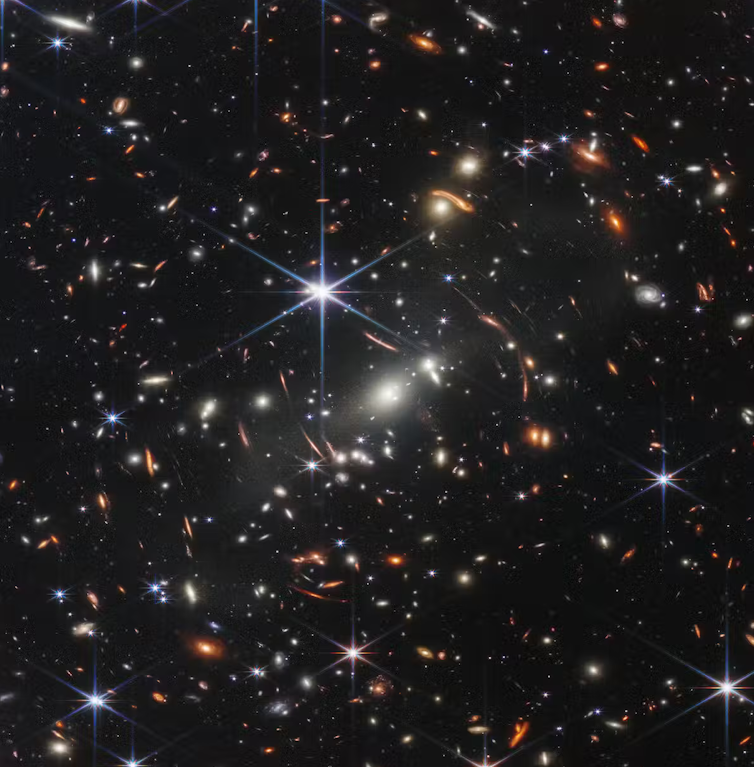
The James Webb Space Telescope’s deep field image shows a universe full of sparkling galaxies. NASA/STScI

Ryan Keeley, University of California, Merced

Astronomers have known for decades that the universe is expanding. When they use telescopes to observe faraway galaxies, they see that these galaxies are moving away from Earth.

To astronomers, the wavelength of light a galaxy emits is longer the faster the galaxy is moving away from us. The farther away the galaxy is, the more its light has shifted toward the longer wavelengths on the red side of the spectrum – so the higher the “redshift.”

Because the speed of light is finite, fast, but not infinitely fast, seeing something far away means we’re looking at the thing how it looked in the past. With distant, high-redshift galaxies, we’re seeing the galaxy when the universe was in a younger state. So “high redshift” corresponds to the early times in the universe, and “low redshift” corresponds to the late times in the universe.

But as astronomers have studied these distances, they’ve learned that the universe is not just expanding – its rate of expansion is accelerating. And that expansion rate is even faster than the leading theory predicts it should be, leaving cosmologists like me puzzled and looking for new explanations.

Dark energy and a cosmological constant

Scientists call the source of this acceleration dark energy. We’re not quite sure what drives dark energy or how it works, but we think its behavior could be explained by a cosmological constant, which is a property of spacetime that contributes to the expansion of the universe.

Albert Einstein originally came up with this constant – he marked it with a lambda in his theory of general relativity. With a cosmological constant, as the universe expands, the energy density of the cosmological constant stays the same.

Imagine a box full of particles. If the volume of the box increases, the density of particles would decrease as they spread out to take up all the space in the box. Now imagine the same box, but as the volume increases, the density of the particles stays the same.

It doesn’t seem intuitive, right? That the energy density of the cosmological constant does not decrease as the universe expands is, of course, very weird, but this property helps explain the accelerating universe.

A standard model of cosmology

Right now, the leading theory, or standard model, of cosmology is called “Lambda CDM.” Lambda denotes the cosmological constant describing dark energy, and CDM stands for cold dark matter. This model describes both the acceleration of the universe in its late stages as well as the expansion rate in its early days.

Specifically, the Lambda CDM explains observations of the cosmic microwave background, which is the afterglow of microwave radiation from when the universe was in a “hot, dense state” about 300,000 years after the Big Bang. Observations using the Planck satellite, which measures the cosmic microwave background, led scientists to create the Lambda CDM model.

Fitting the Lambda CDM model to the cosmic microwave background allows physicists to predict the value of the Hubble constant, which isn’t actually a constant but a measurement describing the universe’s current expansion rate.

But the Lambda CDM model isn’t perfect. The expansion rate scientists have calculated by measuring distances to galaxies, and the expansion rate as described in Lambda CDM using observations of the cosmic microwave background, don’t line up. Astrophysicists call that disagreement the Hubble tension.

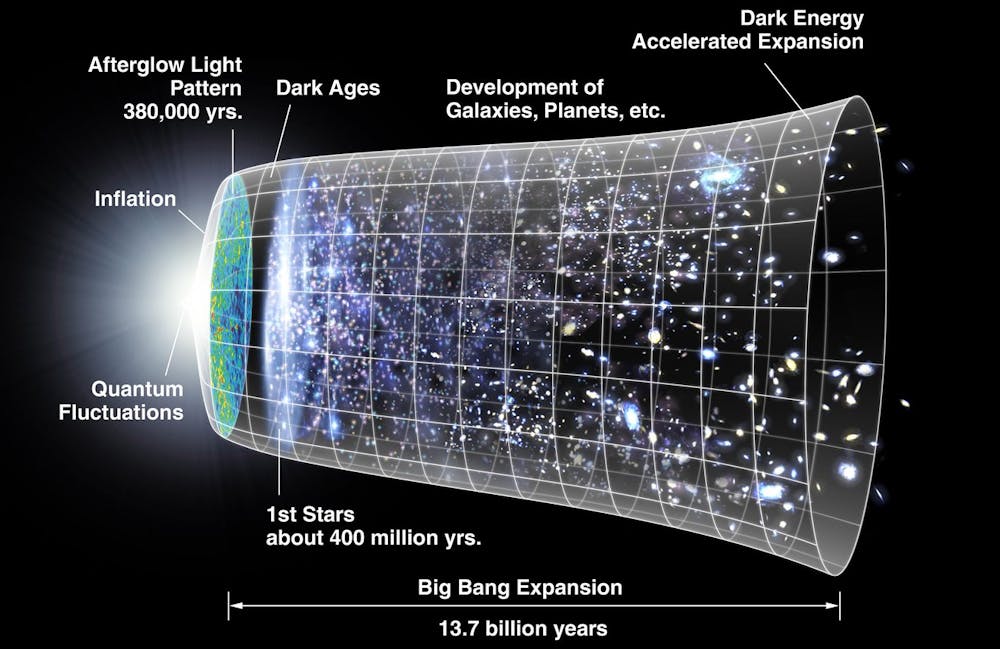
An illustration showing the progression of the Universe's expansion after the Big Bang. The Universe is depicted as a cylindrical funnel with labels along the bottom showing the first stars, the development of planets, and now the dark energy acceleration
The universe is expanding faster than predicted by popular models in cosmology. NASA

The Hubble tension

Over the past few years, I’ve been researching ways to explain this Hubble tension. The tension may be indicating that the Lambda CDM model is incomplete and physicists should modify their model, or it could indicate that it’s time for researchers to come up with new ideas about how the universe works. And new ideas are always the most exciting things for a physicist.

One way to explain the Hubble tension is to modify the Lambda CDM model by changing the expansion rate at low redshift, at late times in the universe. Modifying the model like this can help physicists predict what sort of physical phenomena might be causing the Hubble tension.

For instance, maybe dark energy is not a cosmological constant but instead the result of gravity working in new ways. If this is the case, dark energy would evolve as the universe expands – and the cosmic microwave background, which shows what the universe looked like only a few years after its creation, would have a different prediction for the Hubble constant.

But, my team’s latest research has found that physicists can’t explain the Hubble tension just by changing the expansion rate in the late universe – this whole class of solutions falls short.

Developing new models

To study what types of solutions could explain the Hubble tension, we developed statistical tools that enabled us to test the viability of the entire class of models that change the expansion rate in the late universe. These statistical tools are very flexible, and we used them to match or mimic different models that could potentially fit observations of the universe’s expansion rate and might offer a solution to the Hubble tension.

The models we tested include evolving dark energy models, where dark energy acts differently at different times in the universe. We also tested interacting dark energy-dark matter models, where dark energy interacts with dark matter, and modified gravity models, where gravity acts differently at different times in the universe.

But none of these could fully explain the Hubble tension. These results suggest that physicists should study the early universe to understand the source of the tension.

Ryan Keeley, Postdoctoral Scholar in Physics, University of California, Merced

This article is republished from The Conversation under a Creative Commons license. Read the original article.

ooOOoo

Ryan Keeley explains it above. Hopefully most of you who read this understand the physics involved. Ryan has a website here.

As I said at the start it is beyond fascinating! In the truest sense, out of this world!