The last set from Dan Gomez.

oooo

oooo

oooo

oooo

oooo

oooo

That’s it, folks!
On to next Sunday and who knows what!
Dogs are animals of integrity. We have much to learn from them.
Year: 2019
The last set from Dan Gomez.
oooo
oooo
oooo
oooo
oooo
oooo
That’s it, folks!
On to next Sunday and who knows what!
Dogs and humans go back a long, long way!
We like to think of our relationship with dogs as a moderately recent affair. Not the time since dogs and humans have mixed together, that was a very long time ago, but having a dog as a pet.
But even that view needs to be updated.
Try 4,000 years ago!
ooOOoo
Analysis of the remains of 26 dogs found near Barcelona suggest the dogs had a close relationship with ancient humans

SMITHSONIAN.COM
FEBRUARY 14, 2019
Humans have enjoyed a long history of canine companions. Even if it’s unclear exactly when dogs were first domesticated (and it may have happened more than once), archaeology offers some clues as to the nature of their relationship with humans.
The latest clue suggests that humans living in Southern Europe between 3,600 to 4,200 years ago cared for dogs enough to regularly share their gravesites with them. Barcelona-based researchers studied the remains of 26 dogs from four different archaeological sites on the northeastern Iberian Peninsula.
The dogs ranged in age from one month to six years old. Nearly all were buried in graves with or nearby humans. “The fact that these were buried near humans suggests there was an intention and a direct relation with death and the funerary ritual”, says lead author Silvia Albizuri, a zooarchaeologist with the University of Barcelona, in a press release.
To better understand the dogs’ relationship with the humans they joined in the grave, Albizuri and her colleagues analyzed isotopes in the bones. Studying isotopes—variants of the same chemical element with different numbers of neutrons, one of the building blocks of atoms—can reveal clues about diet because molecules from plants and animals come with different ratios of various isotopes. The analysis showed that very few of the dogs ate primarily meat-based diets. Most enjoyed a diet similar to humans, consuming grains like wheat as well as animal protein. Only in two puppies and two adult dogs did the samples suggest the diet was mainly vegetarian.
This indicates that the dogs lived on food fed to them by humans, the team reports in the Journal of Archaeological Science. “These data show a close coexistence between dogs and humans, and probably, a specific preparation of their nutrition, which is clear in the cases of a diet based on vegetables,” says study co-author Eulàlia Subirà, a biological anthropologist at the Autonomous University of Barcelona.
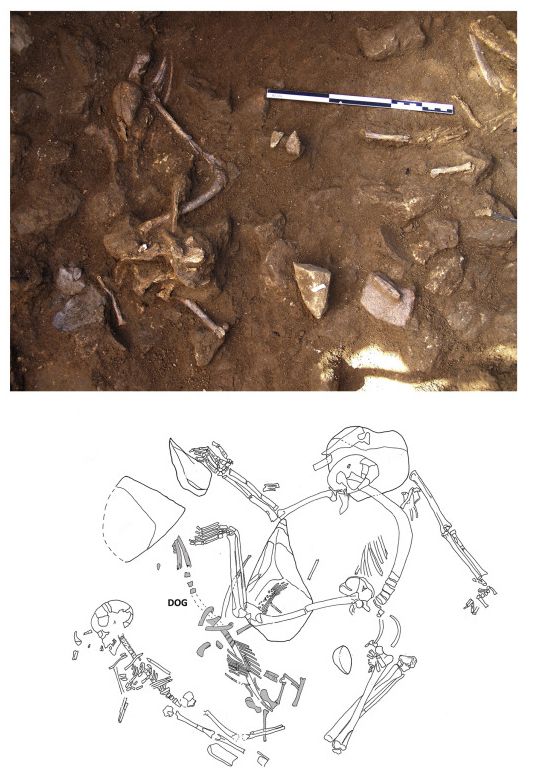
The archaeological sites all belong to people of the Yamnaya Culture, or Pit Grave Culture. These nomadic people swept into Europe from the steppes north of the Black and Caspian Seas. They kept cattle for milk production and sheep and spoke a language that linguists suspect gave rise to most of the languages spoken today in Europe and Asia as far as northern India.
The buried dogs aren’t the oldest found in a human grave. That distinction belongs to a puppy found in a 14,000-year-old grave in modern-day Germany. The care given to that puppy to nurse it through illness was particularly intriguing to the researchers who discovered it. “At least some Paleolithic humans regarded some of their dogs not merely materialistically, in terms of their utilitarian value, but already had a strong emotional bond with these animals,” Liane Giemsch, co-author on a paper about the discovery and curator at the Archäologisches Museum Frankfurt, told Mary Bates at National Geographic in 2018.
The fact that the researchers in the new study found so many dogs in the region they studied indicates that the practice of burying dogs with humans was common at the time, the late Copper Age through the early Bronze Age. Perhaps the canine companions helped herd or guard livestock. What is certain is that ancient humans found the animals to be important enough to stay close to even in death.
ooOOoo
That last sentence is precious. “What is certain is that ancient humans found the animals to be important enough to stay close to even in death.”
As far back as 14,000 years!
Please take note.
ooOOoo
Recall Updated 5/22/2019
March 20, 2019 — Hill’s Pet Nutrition is expanding its voluntary recall of canned dog food products due to elevated levels of vitamin D.
This recall expansion relates to the same vitamin premix that led to the January 31 voluntary recall previously announced on The Dog Food Advisor website.
Update: Additional expansion announced by the FDA May 20, 2019.
Vitamin D, when consumed at very high levels, can lead to serious health issues in dogs including kidney dysfunction.
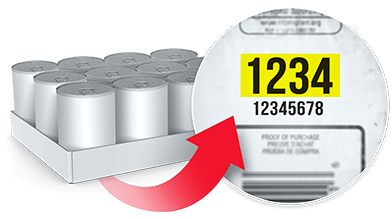
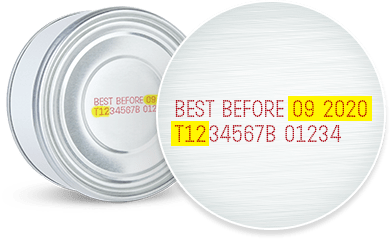
The following products and lot numbers are affected by the recall.
Items marked with * are new product SKUs that were added to the list on March 20, 2019. The item marked with ** is one additional lot code of recalled product updated on May 15, 2019.

Click here to view a text-based follow-up bulletin posted by the U.S. F.D.A. at a later date.
About Excessive Levels of Vitamin D
While vitamin D is an essential nutrient for dogs, ingestion of elevated levels can lead to potential health issues depending on the level of vitamin D and the length of exposure.
Dogs may exhibit symptoms such as vomiting, loss of appetite, increased thirst, increased urination, excessive drooling, and weight loss.
Pet parents with dogs who have consumed any of the products listed and are exhibiting any of these signs should contact their veterinarian.
In most cases, complete recovery is expected after discontinuation of feeding.
For More Complete Information
On March 21, 2019, the U.S. Food and Drug Administration published an announcement containing more complete information about this recall.
What to Do?
If your SKU, Date and Lot codes are found in the list above, you have an affected product.
You should stop feeding it and should return to the place of purchase for a full refund.
If you have questions, you may contact Hill’s Consumer Affairs at 800-445-5777.
U.S. citizens can report complaints about FDA-regulated pet food products by calling the consumer complaint coordinator in your area.
Or go to https://www.fda.gov/petfoodcomplaints.
Canadians can report any health or safety incidents related to the use of this product by filling out the Consumer Product Incident Report Form.
Get Dog Food Recall Alerts by Email
Get free dog food recall alerts sent to you by email. Subscribe to The Dog Food Advisor’s emergency recall notification system.
ooOOoo
Please, please read this and share it with your friends and colleagues who have dogs.
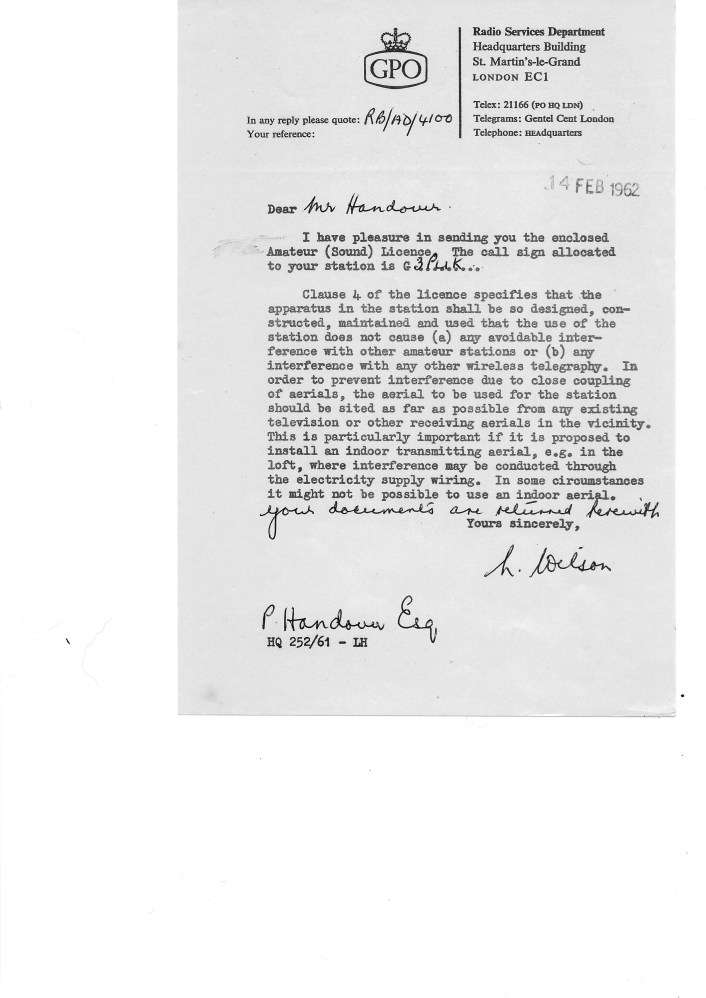
The story of me gaining my radio amateur licence.
As I spoke about yesterday in my introduction, when my mother remarried my sister and I had a new man about the house, so to speak. He was Richard Mills.
I was 13 or thereabouts and already struggling with my school work (the result of my father’s sudden death). And ‘Dad’ as we called him was finding his feet in the strange world of going from having no children to instantly having two step children!
Anyway, Dad found a theme with me that I enjoyed: building a shortwave radio receiver. It was full of learning for me and over the years I became hooked on listening to radio stations both near and far transmitting in morse code. I also joined the Harrow Radio Society and went across to their weekly meetings by tube and bus. (Despite the Society no longer being at the Harrow address it is amazing that they are still going strong.)
It was also a time when there was a great deal of ‘radio surplus’ equipment going for next to nothing and I ‘upgraded’ to an R-1152 receiver.

In time I became sufficiently old to take driving lessons and pass my driving licence. I then got a secondhand car. It helped because then I could drive up to Bushey and spend Sunday mornings at the house of Ron Ray. Ron was a keen amateur. On Sunday mornings Ron had a small group of people who wanted to pass the morse code test and apply for a licence.
I was already a member of the RSGB, the Radio Society of Great Britain, and that surely encouraged me further to study for my amateur licence.
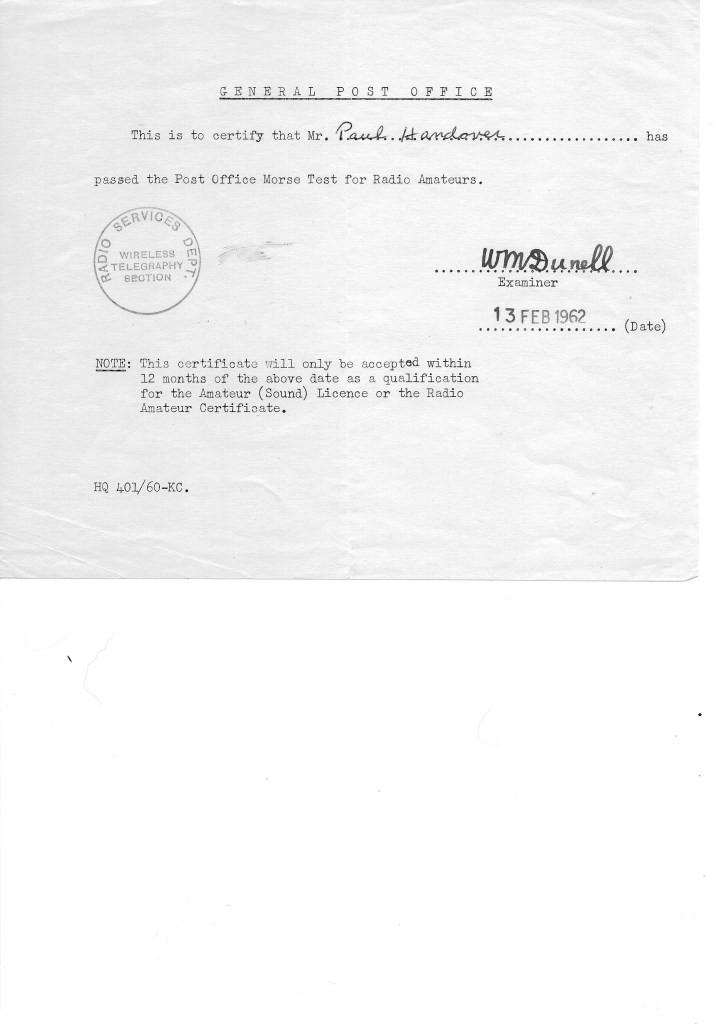
In time, I sat the exam and much to my amazement passed!
oooo
oooo
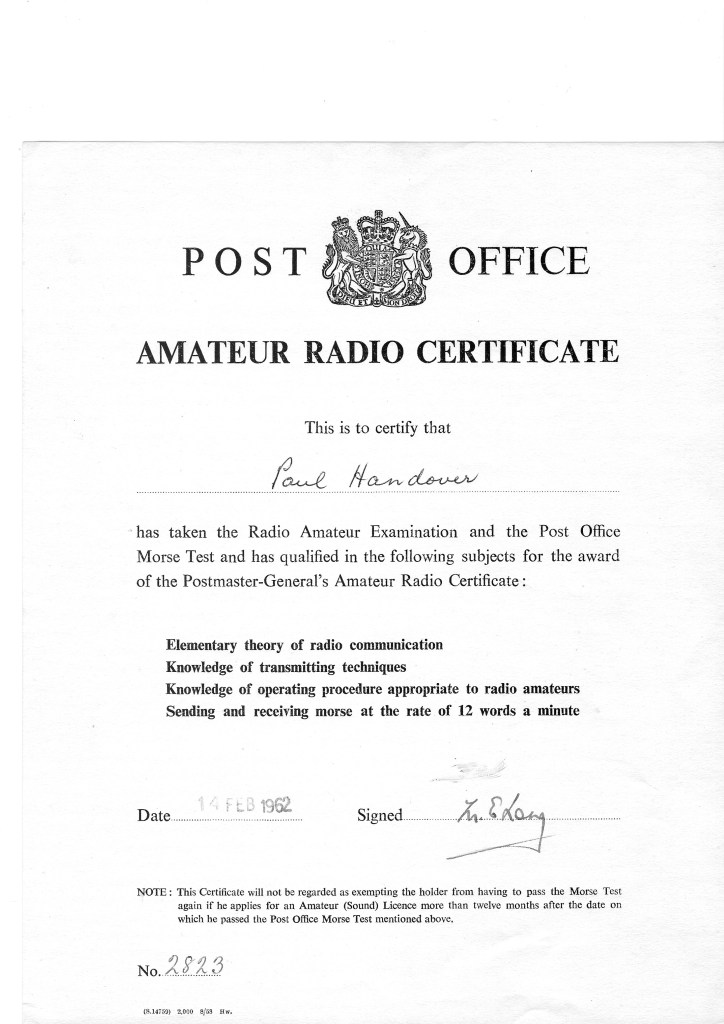
So that is the story of me and amateur radio.
Well, almost the full story.
In 1963 I volunteered for the Royal Naval Reserve, London Division. In time I was accepted and chose the join the radio branch, my G3PUK status coming in useful, because I reckoned that when we went to sea, on flat-bottomed minesweepers, it was better to be sick into a bucket between the knees than be sick on deck!
So there you are – G3PUK!
Two days of nostalgia follow! (You have been warned!)
As many of you already know, my father died fairly suddenly on December 20th, 1956. I had turned 12 some six weeks previously.
After about a year my mother remarried. His name was Richard Mills. Richard came to live at the house in Toley Avenue and had the unenviable task of taking on a new ‘son’ and ‘daughter’. (My sister, Elizabeth, some four years younger than I.)
Richard was a technical author in the newly-arrived electronics industry and one day he asked me if I would like to build a short-wave receiver. He coached me in the strange art of soldering wires and radio valves and other components and in the end I had a working receiver. That led, in turn, to me studying for an amateur radio licence. More of that tomorrow.
But the point of the introduction is to relay that The Morse Code is 175 years old on the 24th May.
Read more:
ooOOoo
The elegantly simple code works whether flashing a spotlight or blinking your eyes—or even tapping on a smartphone touchscreen

By
Ph.D. Student in Electrical Engineering, University of South Carolina
May 21st, 2019
The first message sent by Morse code’s dots and dashes across a long distance traveled from Washington, D.C., to Baltimore on Friday, May 24, 1844 – 175 years ago. It signaled the first time in human history that complex thoughts could be communicated at long distances almost instantaneously. Until then, people had to have face-to-face conversations; send coded messages through drums, smoke signals and semaphore systems; or read printed words.
Thanks to Samuel F.B. Morse, communication changed rapidly, and has been changing ever faster since. He invented the electric telegraph in 1832. It took six more years for him to standardize a code for communicating over telegraph wires. In 1843, Congress gave him US$30,000 to string wires between the nation’s capital and nearby Baltimore. When the line was completed, he conducted a public demonstration of long-distance communication.
Morse wasn’t the only one working to develop a means of communicating over the telegraph, but his is the one that has survived. The wires, magnets and keys used in the initial demonstration have given way to smartphones’ on-screen keyboards, but Morse code has remained fundamentally the same, and is still – perhaps surprisingly – relevant in the 21st century. Although I have learned, and relearned, it many times as a Boy Scout, an amateur radio operator and a pilot, I continue to admire it and strive to master it.

Easy sending
Morse’s key insight in constructing the code was considering how frequently each letter is used in English. The most commonly used letters have shorter symbols: “E,” which appears most often, is signified by a single “dot.” By contrast, “Z,” the least used letter in English, was signified by the much longer and more complex “dot-dot-dot (pause) dot.”
In 1865, the International Telecommunications Union changed the code to account for different character frequencies in other languages. There have been other tweaks since, but “E” is still “dot,” though “Z” is now “dash-dash-dot-dot.”
The reference to letter frequency makes for extremely efficient communications: Simple words with common letters can be transmitted very quickly. Longer words can still be sent, but they take more time.
Going wireless
The communications system that Morse code was designed for – analogue connections over metal wires that carried a lot of interference and needed a clear on-off type signal to be heard – has evolved significantly.
The first big change came just a few decades after Morse’s demonstration. In the late 19th century, Guglielmo Marconi invented radio-telegraph equipment, which could send Morse code over radio waves, rather than wires.
The shipping industry loved this new way to communicate with ships at sea, either from ship to ship or to shore-based stations. By 1910, U.S. law required many passenger ships in U.S. waters to carry wireless sets for sending and receiving messages.
After the Titanic sank in 1912, an international agreement required some ships to assign a person to listen for radio distress signals at all times. That same agreement designated “SOS” – “dot-dot-dot dash-dash-dash dot-dot-dot” – as the international distress signal, not as an abbreviation for anything but because it was a simple pattern that was easy to remember and transmit. The Coast Guard discontinued monitoring in 1995. The requirement that ships monitor for distress signals was removed in 1999, though the U.S. Navy still teaches at least some sailors to read, send and receive Morse code.
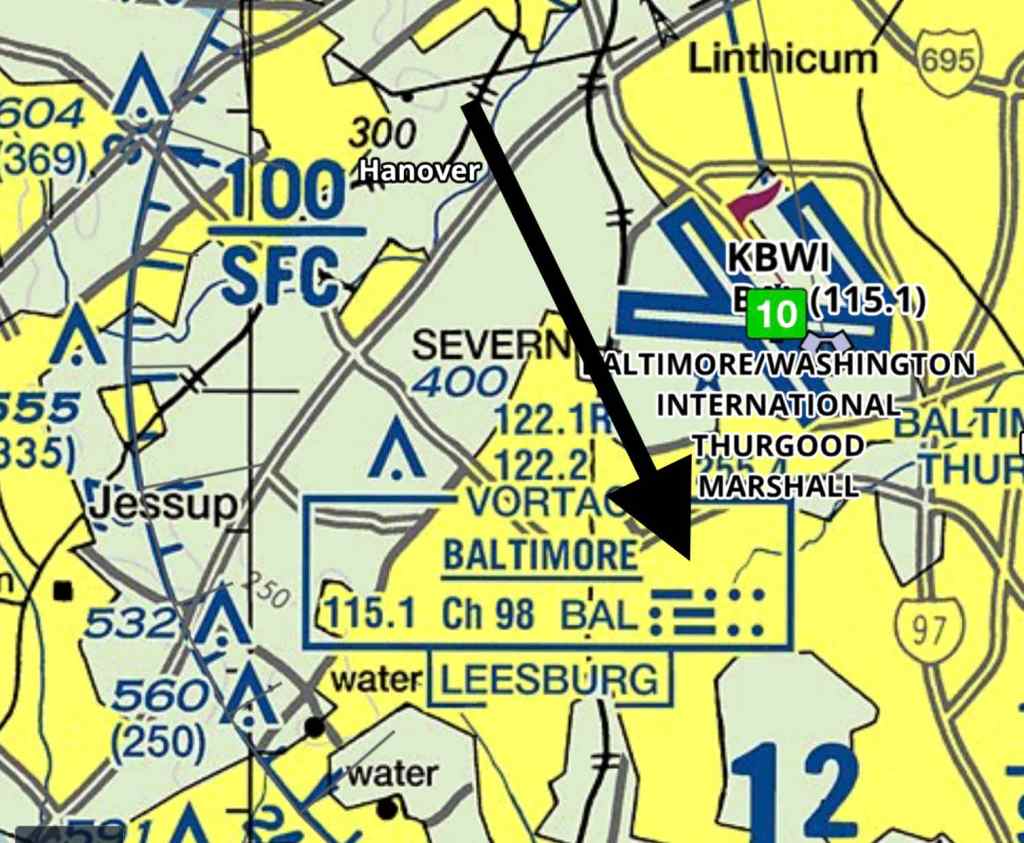
Aviators also use Morse code to identify automated navigational aids. These are radio beacons that help pilots follow routes, traveling from one transmitter to the next on aeronautical charts. They transmit their identifiers – such as “BAL” for Baltimore – in Morse code. Pilots often learn to recognize familiar-sounding patterns of beacons in areas they fly frequently.
There is a thriving community of amateur radio operators who treasure Morse code, too. Among amateur radio operators, Morse code is a cherished tradition tracing back to the earliest days of radio. Some of them may have begun in the Boy Scouts, which has made learning Morse variably optional or required over the years. The Federal Communications Commission used to require all licensed amateur radio operators to demonstrate proficiency in Morse code, but that ended in 2007. The FCC does still issue commercial licenses that require Morse proficiency, but no jobs require it anymore.
Blinking Morse
Because its signals are so simple – on or off, long or short – Morse code can also be used by flashing lights. Many navies around the world use blinker lights to communicate from ship to ship when they don’t want to use radios or when radio equipment breaks down. The U.S. Navy is actually testing a system that would let a user type words and convert it to blinker light. A receiver would read the flashes and convert it back to text.
Skills learned in the military helped an injured man communicate with his wife across a rocky beach using only his flashlight in 2017.
Other Morse messages
Perhaps the most notable modern use of Morse code was by Navy pilot Jeremiah Denton, while he was a prisoner of war in Vietnam. In 1966, about one year into a nearly eight-year imprisonment, Denton was forced by his North Vietnamese captors to participate in a video interview about his treatment. While the camera focused on his face, he blinked the Morse code symbols for “torture,” confirming for the first time U.S. fears about the treatment of service members held captive in North Vietnam.
Navy pilot Jeremiah Denton, a prisoner of war, blinks Morse code spelling out ‘torture’ during a forced interview with his captors.
Blinking Morse code is slow, but has also helped people with medical conditions that prevent them from speaking or communicating in other ways. A number of devices – including iPhones and Android smartphones – can be set up to accept Morse code input from people with limited motor skills.
There are still many ways people can learn Morse code, and practice using it, even online. In emergency situations, it can be the only mode of communications that will get through. Beyond that, there is an art to Morse code, a rhythmic, musical fluidity to the sound. Sending and receiving it can have a soothing or meditative feeling, too, as the person focuses on the flow of individual characters, words and sentences. Overall, sometimes the simplest tool is all that’s needed to accomplish the task.
ooOOoo
I do hope you read this article in full because it contains much interesting information. Many people will not have a clue about The Morse Code and, as you can see above, it is still relevant.
Finally, I can still remember the The Morse Code after all these years!
The dog does a wonderful act of discovery!
There was an item on BBC News recently that shows the devotion of dogs towards humans. Yet the story also shows how cruel a young mother can be towards her own baby.
Here it is:
ooOOoo

A dog in northern Thailand has rescued a newborn baby after it was buried alive, allegedly by its teenage mother.
The baby boy is said to have been abandoned by his mother, 15, to hide her pregnancy from her parents.
Ping Pong the dog was barking and digging in a field in Ban Nong Kham village. Its owner says he then noticed a baby’s leg sticking out of the earth.
Locals rushed the baby to hospital where doctors cleaned him up and declared he was healthy.
Ping Pong’s owner, Usa Nisaikha, says it lost the use of one of its legs after being hit by a car.
He told Khaosod Newspaper: “I kept him because he’s so loyal and obedient, and always helps me out when I go to the fields to tend to my cattle. He’s loved by the entire village. It’s amazing.”

The newborn’s mother has been charged with child abandonment and attempted murder.
Panuwat Puttakam, an officer at Chum Phuang police station, told the Bangkok Post she was now in the care of her parents and a psychologist.
He said that she regrets her actions.
The girl’s parents have decided to raise the baby.
ooOOoo
There’s no pardoning a woman who buries alive her baby. I don’t care what age she was; the mother that is. If she is old enough to become pregnant she is old enough to know better.
In stark contrast is Ping Pong, the dog, who despite having only three legs worked furiously to unearth the baby and did so without harming the infant.
This article should be shared!
I wasn’t going to post a blog for today but in going through my emails found this from April 15th.
It’s nothing to do with dogs but everything to do with staying healthy.
ooOOoo

By Jason Daley
smithsonian.com, April 15, 2019,
Dietary supplements, including daily vitamins, have been a part of life in the United States for decades. In fact, people spend $30 billion per year on various pills, powders, gummies and tinctures to help improve their health, boost their brain, lose weight, build muscle and strengthen their immune system.
But a new extensive study suggests many people may be better off spending all that disposable income at the farmer’s market or grocery store produce section to buy spinach, tomatoes and other vitamin-packed veggies instead, according to a paper published this week in the journal Annals of Internal Medicine.
Researchers analyzed data from 27,725 participants in the Centers for Disease Control’s National Health and Nutrition Examination Survey (NHANES). Each volunteer, all over the age of 20, logged what they ate for 24 hours and what supplements they took in the previous 30 days. The data was collected between 1999 and 2010.
Linda Carroll at NBC News reports that during the study’s six-year follow-up period, 3,613 participants died, including 945 from cardiovascular disease and 805 from cancer. Using that data, the study team found that getting enough vitamin K—found in leafy greens—and magnesium—found in legumes, nuts, whole grains, fish and meat—were associated with a lower mortality rate. Getting the recommended dose of vitamin K, zinc and vitamin A was linked to lower mortality rates associated with cardiovascular disease.
And it turned out that taking 1,000 milligrams of calcium per day in supplement form was associated with increased cancer risk, while getting excess calcium from food did not seem to increase those risks.
“Our results support the idea that, while supplement use contributes to an increased level of total nutrient intake, there are beneficial associations with nutrients from foods that aren’t seen with supplements,” Fang Fang Zhang of Tufts University, the study’s senior author, says in a statement. “This study also confirms the importance of identifying the nutrient source when evaluating mortality outcomes.”
At first glance, the data suggested that supplement users might have better outcomes than non-vitamin takers. But Beth Mole at Ars Technica reports that supplement users tend to be wealthier and more educated than non-users, smoke less, exercise more, and have an overall healthier diet. When those factors were accounted for, the benefits of supplements disappeared. (It’s possible that supplements are helpful for portions of the population that suffer from certain nutritional deficiencies.)
The study has some limitations. Mole reports that the NHANES data relies on participants self-reporting what they eat and what supplements they take, which means the data might not be entirely accurate. The study is observational, meaning any relationship between nutrients in food and certain diseases is merely an association and does not imply causation.
Still, the study’s overall message is that supplements are not a silver bullet for health.
“I don’t think you can undo the effect of a bad diet by taking supplements,” Rekha Kumar, an endocrinologist at NewYork-Presbyterian and Weill Cornell Medicine, who was not involved in the study tells NBC’s Carroll.
This isn’t the first study to question the power of nutritional supplements. A paper last year in the Journal of the American College of Cardiology found that using multivitamins did not provide any apparent benefits but did not cause any harm either.
In a 2017 paper, data from the Nurses’ Health Study, one of the longest and most comprehensive health studies conducted, suggested that multivitamin use did not decrease incidents of stroke.
In fact, taking some supplements have negative consequences. A 2011 study found that taking vitamin E, which was hypothesized to help prevent prostate cancer, actually increased the chances of developing the disease in men instead.
Zhang and her colleagues say that much more research needs to be undertaken to confirm and understand these findings since there are so many other factors that play a role in overall health.
ooOOoo
H’mmm. It would be a braver person than I to come off the range of supplements that I take. And we are vegan as well!
But very much not in the fountain of youth!
 Learning from Dogs