Sent along by Suzann.

oooo

oooo
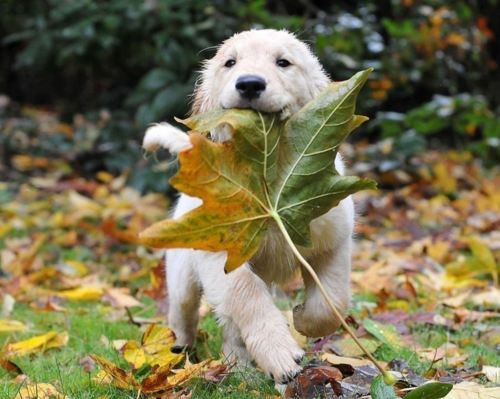
oooo

oooo
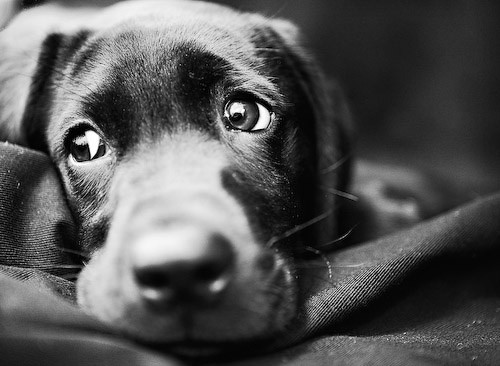
oooo

oooo

oooo

oooo

oooo

Just perfect!
Thank you, Su!
Dogs are animals of integrity. We have much to learn from them.
Year: 2018
Sent along by Suzann.
oooo
oooo
oooo
oooo
oooo
oooo
oooo
oooo
oooo
Just perfect!
Thank you, Su!
A sigh of relief!
Jeannie and me reacting to the last report on the Oregon Department of Forestry (ODF) Southwest website:
Hugo Road Fire FINAL Update 09/06/18
Quick Facts:
Incident Start Date: 09/02/2018
Incident Start Time: Approx. 7:15 p.m.
Incident Type: Wildfire
Cause: Under Investigation
Incident Location: Hugo, which is roughly ten miles north-northwest of Grants Pass in Josephine County, Oregon
Land Threat: Private
Command Agency: ODF
Fire Size: 199 acres
Containment: 86%Current Situation:This will be the final update for the Hugo Road Fire unless conditions significantly change.
Firefighters continue to boost containment on the Hugo Road Fire, now reaching 86 percent. The fire remains at 199 acres.Overnight, crews were able to mop up 300 feet from the fire’s edge, adjacent to roadways, and surrounding the perimeter of homes. Within the mop up area, very few hot spots were found. All residences are at a Level 1 “Be Ready” evacuation notice, and will remain at such until Fire Season 2018 comes to a close, per the Josephine County Sheriff’s Office.
Local fire personnel will continue gridding the landscape for interior hot spots and conducting suppression repair throughout the next few days. It is normal to see light smoke during this process, but it is now well within the interior of the fire’s footprint which does not pose a threat to our community. There will still be fire apparatus present until the final mop up stages are complete. We encourage everyone to continue to use caution while traveling through the area.
Thank you again to every single partner agency and community member for the assistance and support throughout this firefight. It is an honor to serve and live in this community.
Evacuations:
Due to progress made by firefighters on the Hugo Road Fire all current evacuation levels are being downgraded to a Level 1 “BE READY” notice. Level 1’s will remain in effect until the end of the fire season.
For information regarding information, please contact the Josephine County Sheriff’s Office, or follow the Josephine County Emergency Management Facebook page as evacuation levels are anticipated to change shortly.
Assigned Resources:
Engines: 10
Water Tenders: 4
Helicopters: As needed
Hand Crews: 8
Dozers: 4
Total Personnel: 211
Air Tankers: As neededCooperating Agencies:
ODF Southwest Oregon District, Rural Metro Fire – Josephine County, Grants Pass Department of Public Safety, Josephine County Emergency Management, Josephine County Sheriff’s Office.
The fire was listed late Monday as 30 percent contained, but not before it destroyed two houses, 13 outbuildings two recreational vehicles and 11 vehicles, according to the Oregon Department of Forestry. Fire also damaged three other residences, two out-buildings and a vehicle, according to ODF.
This should be available to you wherever you are in the world!
I am indebted to Neil back in Devon who gave me the ‘heads up’ to the latest episode from the BBC Natural Histories Unit.
The link to the programme, that was broadcast by the Radio 4 station at 11:00 UK time yesterday, is here: https://www.bbc.co.uk/programmes/b0bgq6f4
When you go to that link you will see this:
Dog
Dogs have changed us and we’ve changed them. Brett Westwood visits Battersea to meet the animals whose history is most inextricably linked with our own. And in the process very nearly loses a furry microphone cover to an enthusiastic lurcher named Trevor (pictured above)… As the first domestic animals, dogs made it possible for humans to spread into the areas of the world that they did, to eat more protein and to take up activities from hunting to sledding. But it was only in the Victorian period that the dogs we know today were “invented”, by breeding. And throughout all of this dogs have also been changing human lives as companions.
Producer Beth O’Dea
Taking part:
Professor Greger Larson, Director Palaeogenomics & Bio-Archaeology Research Network, School of Archaeology, University of Oxford
Dr John Bradshaw, anthrozoologist and author of In Defence of Dogs and The Animals Among Us
Susan McHugh, Professor of English at the University of New England
Naomi Sykes, Lawrence Professor of Archaeology at the University of Exeter
Julie-Marie Strange, Professor of British History at the University of Manchester
Dr Krithika Srinivasan, Lecturer in Human Geography, University of Edinburgh.
The item is 28 minutes long and for all dog lovers is precious listening!
So click on the ‘Listen Now’ button!
Trust me, you will be surprised at some of the findings covered in this most interesting programme.
Many thanks, Neil!
UPDATE 3pm (PDT) on the 5th.
I am going to leave this post up for the rest of this week. Firstly, because I would like as many of you as possible to listen to it and, lastly, until our local Hugo Road fire is 100% contained I can’t really focus on blogging stuff.
A post that involves dogs but not what I had in mind!
Last Saturday I published a post The burning of our forests! that included a photograph of the nearby Klondike fire.
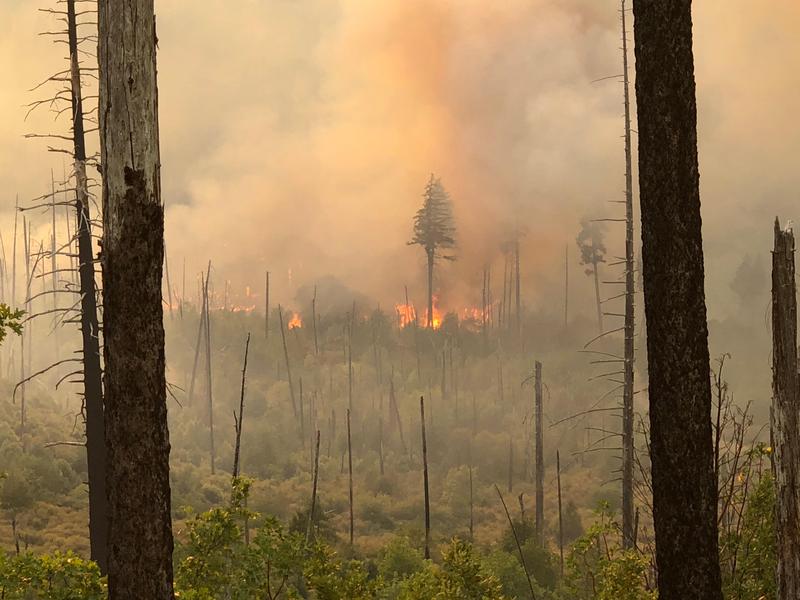
Then last Sunday I was speaking to Maija, my daughter back in England, and she was asking how the fires were and I distinctly recall saying: “Sweetheart, I think we are over the worst!”
That same Sunday evening, around 9:45pm, in other words two evenings ago, one of our neighbours, Margo, who lives on 60 acres adjacent to the west of us, called with real alarm in her voice:
Paul, have you seen the fire that is burning just to the North-East of us?
I replied that I had not but immediately went to our deck that runs the whole Eastern length of our house. Mount Sexton is just a few miles to the North-East of us.
This is what I saw!

Apparently, a short while previously the wind had blown down a tree that had fallen across some high-voltage power lines causing sparking that had, in turn, ignited the extremely dry grassland.
The fire was between Oxyoke Road and Three Pines Road and roughly 2 miles from us line of sight.
That explained why some thirty minutes before, in the last of the light of the setting sun, there had been a number of helicopter flights come across us en route to dropping fire retardant close by. It hadn’t occurred to me that it was an incident so close to us.
Many of us living nearby then called each other to spread the word.
Jeannie and I, in turn, drew up an evacuation checklist and started getting things ready. More importantly, getting ourselves psychologically prepared to have to vacate the property at very short notice: Jeannie and me: six dogs; two horses; two parakeets; three cats; two chickens!
Thankfully an order to evacuate did not come during the night.
So yesterday morning I grabbed my bike and rode to Oxyoke Road. On the way I stopped to photograph the smoke in the air.
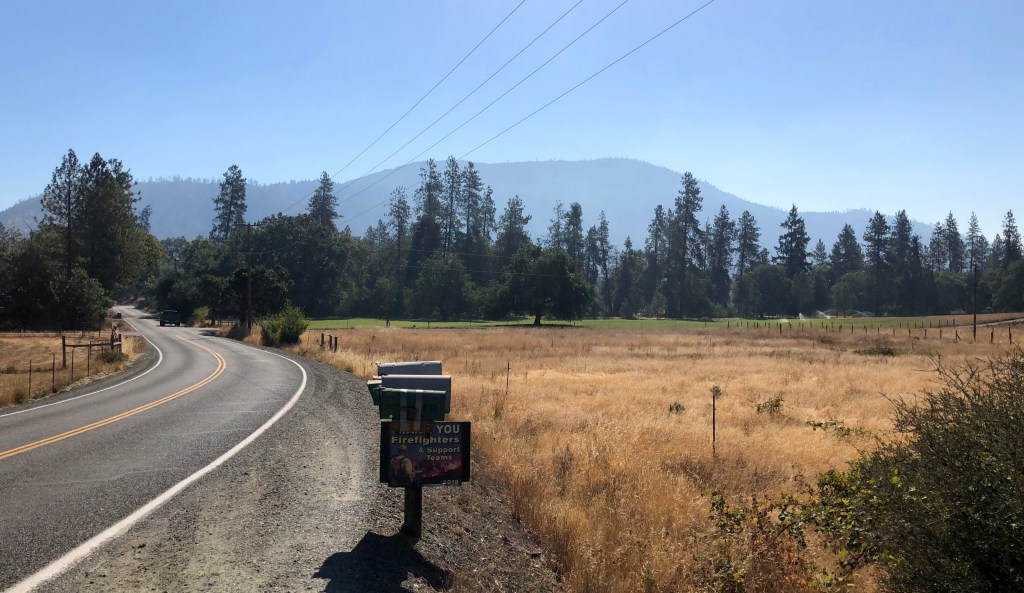
Once at Oxyoke Road I chatted to a search and rescue volunteer on duty controlling the traffic.

His report, as of 11:30 on September 3rd, was that the fire was just 15% contained, was “pretty active”, and that they were keeping an eye on the winds that were expected to be rather gusty later on that afternoon. I am writing this at 13:40 on the 3rd and the present winds are 6 mph, gusting 12 mph, from the North-West.
I rode back home to brief Jeannie and found her working her way through an idea for evacuating the dogs!

H’mmm! I am not sure Pedy is getting the message!

But a few words from Sweeny seemed to sort things out.
So there you are my good people, a post about dogs! Sort of!
Fingers crossed we will speak again tomorrow!
Assuming we don’t have a repeat of last night’s spectacular sights!!

At least this rural living keeps one fit!
The Grave Creek Covered Bridge
Jeannie and I decided to take a few hours away from the house and go and do some local exploring.
Just 10 miles North of us, indeed the next exit (71) from Highway I-5, is the famous Grave Creek Covered Bridge.
We parked up and soaked it all in.
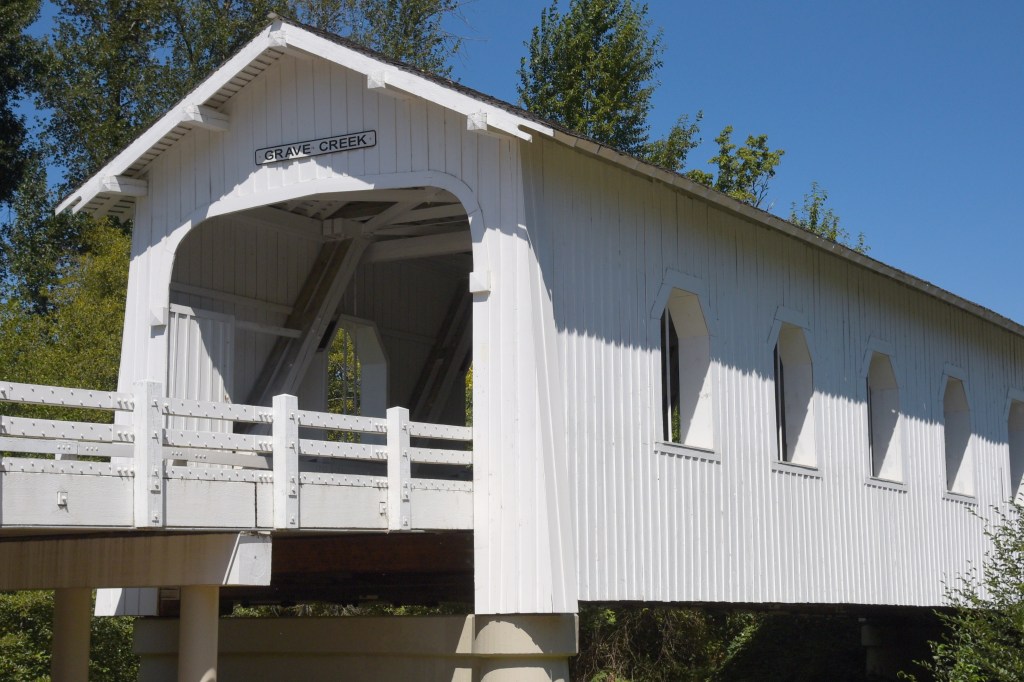
While there was an information board next to the bridge it was very easy to find the details online  on the Southern Oregon travel site.
The Grave Creek Covered Bridge is one of the few covered bridges that remain in southern Oregon. From Vancouver B.C. to the Mexican border, it is the only one visible from the I-5 freeway. Be sure to visit the Applegate Trail Interpretive Center while in Sunny Valley. It provides a first hand look into the local area, history, fabulous displays, theatre & more.
In the fall of 1846, the first emigrant train from Fort Hall, Idaho, to travel the southern route to the Willamette Valley camped on the north side of this creek, then Woodpile Creek. Martha Leland Crowley, 16 years old died of typhoid fever during this encampment and was buried 150 feet north of the creek on the east side or a white oak tree that was later removed for the present roadway, Thus the name “Grave Creek”.
When James H. Twogood laid out his land claim in the fall of 1851 and filed it on May 1st 1852, he named it the Grave Creek Ranch in memory of that unfortunate incident.
McDonough Harkness, his partner, was the first postmaster of Josephine County in the newly named town of Leland on March 28,1855. Harkness was killed by the Indians in April 1856 while riding dispatch for the Army during the second Indian War of southern Oregon which started in October of 1855.
The bridge was built in 1920 and is 105 feet long.
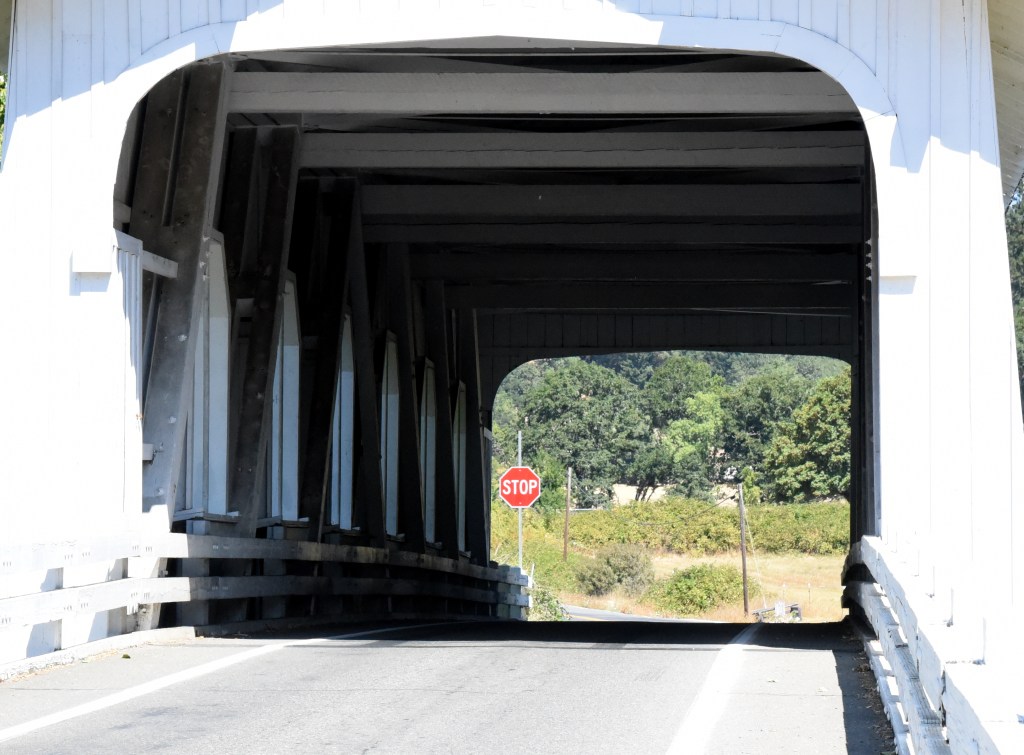
Unsurprisingly, the creek had very little water in it.
But that didn’t diminish in the slightest the magic of this place out in the vast Oregon countryside.
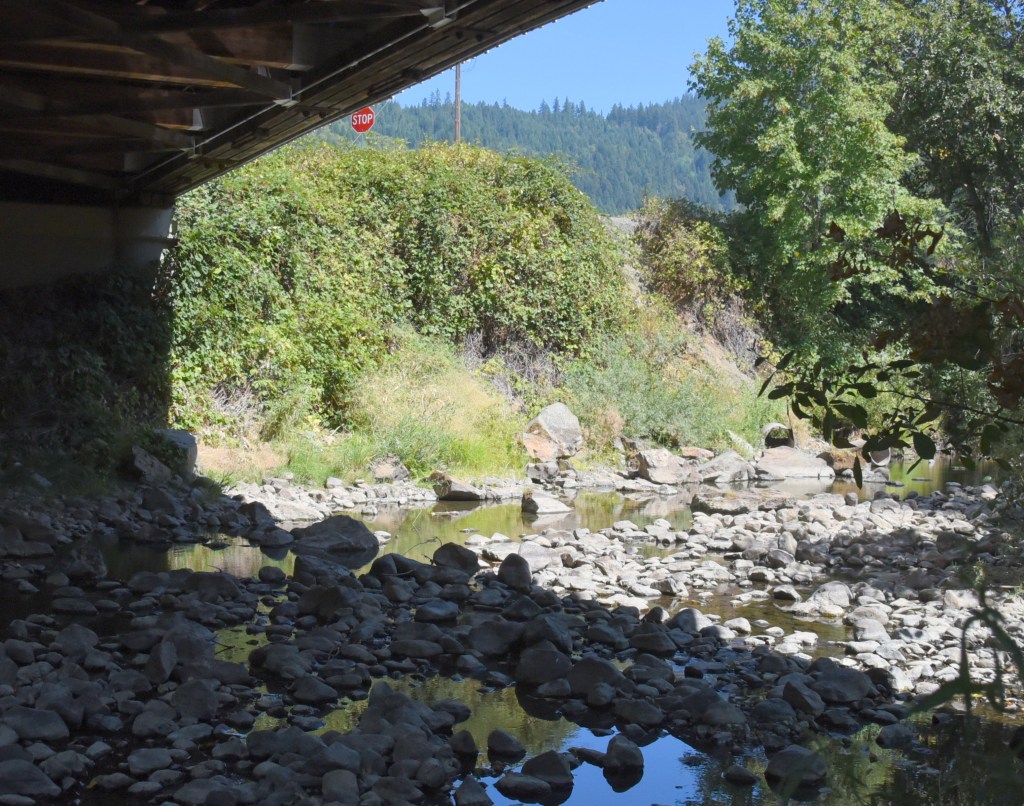
WikiPedia has a nice entry explaining the rationale behind building a covered bridge.
A covered bridge is a timber-truss bridge with a roof and siding which, in most covered bridges, create an almost complete enclosure. The purpose of the covering is to protect the wooden structural members from the weather. Uncovered wooden bridges typically have a lifespan of only 10 to 15 years because of the effects of rain and sun. The brief moment of relative privacy while crossing the bridges earned them the name “Kissing Bridges”.
Back to dogs tomorrow!


 Learning from Dogs