Sometimes applause seems just … oh, I don’t know …. just so inadequate!
If you, like me, was entranced by the music then thanks to a comment left by one Eugene Karry on the YouTube website, all is explained.
Eugene explained that the instrument is called the Armenian Duduk and that Armenian Duduk music is recognized by UNESCO.
It was only a quick search on the UNESCO website to find this:
The duduk, the Armenian oboe, is a single or double reed wind instrument made of the wood of the apricot tree and has a warm, soft, slightly nasal timbre. The duduk or tsiranapokh, which is also called the apricot tree pipe, belongs to the organological category of areophones, which also includes the balaban played in Azerbaijan and Iran, the duduki common in Georgia and the ney in Turkey. The soft wood is the ideal material to carve the body of the instrument. The reed, called ghamish or yegheg, is a local plant growing alongside the Arax river.
The roots of Armenian duduk music go back to the times of the Armenian king Tigran the Great (95-55 BC). The instrument is depicted in numerous Armenian manuscripts of the Middle Ages. The duduk accompanies popular Armenian traditional songs and dances of the various regions and is played at social events, such as weddings and funerals. Although there are also famous duduk soloists, among them Gevorg Dabaghyan and Vache Sharafyan, the duduk is mainly played by two musicians. One player creates the musical environment for the lead melody by playing a continual drone that is held by circular breathing, while the other player develops complex melodies and improvisations.
There are four major types of duduk, varying in length from 28 to 40 cm and in sound, ranging from one to fourth or third octaves. Therefore, the sound of the duduk can express various moods depending on the content of the piece and the playing context. The 40-cm long duduk, for example, is regarded as most appropriate for love songs, whereas the smaller one usually accompanies dances. Today, duduk craftsmen continue to create and experiment with different forms of duduks. Many Armenians consider the duduk as the instrument that most eloquently expresses warmth, joy and the history of their community.
Over recent decades, the popularity of Armenian duduk music has decreased, in particular in the rural areas where it originated. At present, most duduk players are concentrated in Yerevan. The duduk instrument is played less and less in social festivities, but more often by professionals as a staged performance. Duduk music risks losing its viability and traditional character and becoming just another facet of “high culture”.
Back to Eugene, who went on to write that Jivan Gasparyan and Gevorg Dabaghyan are famous duduk players among many others. The musical pieces played on the duduk are mostly armenian folk or spiritual tunes; many of them sad songs. Nowadays the duduk is very often played during funerals among Armenians but there are some dance songs as well.
Finally, Eugene offered these further hauntingly beautiful pieces of music.
Time is not on the side of the wolves and for all those who care for them.
It’s unusual for me to publish a post at this time of the day. However, following my recent post I cry for the wolves I wanted to circulate two recent emails received from the Center for Biological Diversity. Here they are in their original format.
Feel free to forward this post as far and wide as you would like to.
Thank you,
Paul and Jean.
oooOOOOoo
Dear Paul,
Last week the Obama administration issued a sweeping delisting plan to remove protections for wolves across the lower 48 states. The plan only maintains protections for the small population of Mexican gray wolves in Arizona and New Mexico.
If finalized this proposal will mean the premature end of decades of work to restore wolves to the American landscape — even though wolves currently occupy a mere 5 percent of their historic range.
The proposal also means that states will hold the reins of wolf management across most of the country. We’ve already seen what state management entails for wolves in the northern Rocky Mountains and Great Lakes, where protections were removed in the past two years — in short, aggressive trapping and hunting seasons designed to drastically reduce populations, resulting in at least 1,600 wolves killed.
Please take action now to halt this delisting plan before it’s too late: Tell the U.S. Fish and Wildlife Service not to turn its back on America’s wolves.
The future of America’s wolves is at stake right now: The Obama administration just announced its plans to strip Endangered Species Act protections from nearly all wolves in the lower 48 states.
This announcement means the U.S. Fish and Wildlife Service is gutting 40 years of wolf conservation and recovery.
And when wolves lose federal protections, they die. Too often they’re hunted, trapped and ruthlessly persecuted with the same vicious attitude that nearly drove them extinct a century ago.
It also means that wolves — absent today from 95 percent of their historic habitat in the continental United States — are virtually guaranteed never to fully recover in places like the Northeast, California, and most of the Rocky Mountains and Pacific Northwest.
The Center for Biological Diversity’s expert legal team is already working to get into court right away to stop this terrible plan.
The Center has an amazing track record of saving wolves. We’ve overturned illegal wolf-killing decisions in Idaho, Montana, Wyoming, Minnesota and Wisconsin. Wolves in Oregon today are protected by a court injunction won by the Center. But this will be the biggest wolf case yet, and we need your help to win it.
The entire U.S. wolf recovery program hangs in the balance.
If this decision stands, wolves will never be reintroduced to California, the Northeast or the southern Rocky Mountains. Killing of the small population in Oregon and Washington will ramp up, preventing it from ever recovering. Make no mistake: Despite the government’s warm and fuzzy PR spin, this decision is about ending wolf recovery in the United States once and for all.
Our team of scientists, lawyers and activists has been preparing for this terrible decision, and now — with your help — they’ll begin the biggest legal battle of the decade.
This has been very widely reported but nevertheless it’s a great story about the devotion of dogs to humans, and in return, the way that so many people recognised the need for help for the badly injured dog.
Readers will recall that the dog, Kabang, suffered massive injuries back in December 2011 when she jumped into the path of a motorcycle, stopping it from running over her owner’s daughter and niece in Zamboanga, a city in the Southern Philippines.
Here’s a video that was published back in October last year that explores the circumstances of the dog’s actions and the public’s response.
“A dog who became an international cause celebre after her snout was sliced off saving two young girls in the Philippines was examined by veterinarians Thursday at UC Davis, a milestone event in a remarkable humanitarian effort to help a canine heroine.
The mixed-breed dog, named Kabang, became an unlikely star in the Philippines after she reportedly threw herself into the path of a speeding motorcycle just as it was about to hit two young girls crossing a roadway in Zamboanga City.
The lunge, by all accounts, saved the lives of the daughter and niece of Kabang’s owner, but cost the dog her snout and upper jaw, which was sheared off when she got tangled in the motorcycle’s spokes. The gruesome injury puts her in grave danger of developing an infection. At minimum, the gaping wound must be closed, a delicate procedure that is beyond the capability of veterinarians in the Philippines.”* Would you prolong your dog’s life even if it were that costly? Ana Kasparian, John Iadarola, and Jayar Jackson break it down.
DAVIS (CBS13) – Kabang, the Philippine dog that suffered a severely injured snout and upper-jaw while saving two girls from being hit by a motorcycle, has been released from the hospital.
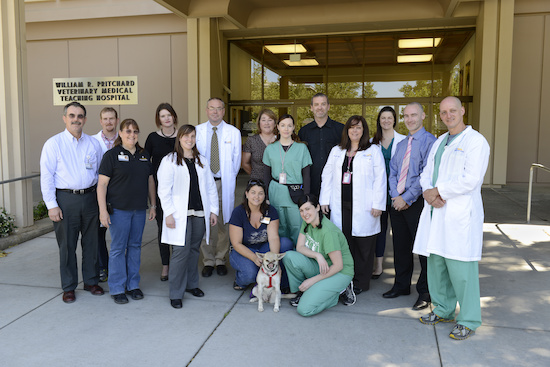
The dog was brought to the veterinary medicine teaching hospital at UC Davis in October 2012 to be treated for the injury that left her with a gaping wound where her snout had been. But veterinarians found she had heartworm disease and a type of infectious cancer. A team of UC Davis veterinarians specializing in oncology; infectious diseases; dental, oral and soft-tissue surgery; internal medicine; and outpatient care was assembled to treat Kabang, according to the UC Davis News Service.
“We were able to treat all of the complications that arose with the best specialists available,” Verstraete said Professor Frank Verstraete, chief of the hospital’s dentistry and oral surgery service.
I read a recent article posted by Rob Hopkins on the Transition Culture blogsite, a blog that I subscribe to. Those who are unfamiliar with Rob, the Transition Culture site has his background, from which I quote this snippet:
Rob Hopkins, with a familiar Totnes building in the background.
“Rob Hopkins brings humour, imagination and vision to the great challenges of our time, and argues that what is needed, above all else, at this time in history, is “engaged optimism”. The rapidly-spreading Transition movement which he was pivotal in establishing, is an embodiment of that. Nicholas Crane, presenter of BBC2’s recent ‘Town’ series, recently referred to Transition as “the biggest urban brainwave of the century”.
Anyway, back to the article. It struck me as so absurd that I tried my hand at asking Rob for permission to republish. Back, almost immediately, came his positive reply. Thank you, Rob.
Oh, and before going to Rob’s article, for those that, like me, are a bit rusty on the composition of the G8, here’s a Wikipedia extract:
The Group of Eight (G8) is a forum for the governments of the world’s eight wealthiest countries. The forum originated with a 1975 summit hosted by France that brought together representatives of six governments: France, West Germany, Italy, Japan, the United Kingdom, and the United States, thus leading to the name Group of Six or G6. The summit became known as the Group of Seven or G7 the following year with the addition of Canada. The G7, that is active even after the creation of the G8, is composed by 7 of 8 of the wealthiest countries on Earth (as net wealth and not GDP). In 1997, Russia was added to the group which then became known as the G8. The European Union is represented within the G8 but cannot host or chair summits.
Now without any further ado, here is that article.
oooOOOooo
12 Jun 2013
Why even the G8 prefer vibrant, diverse local economies really …
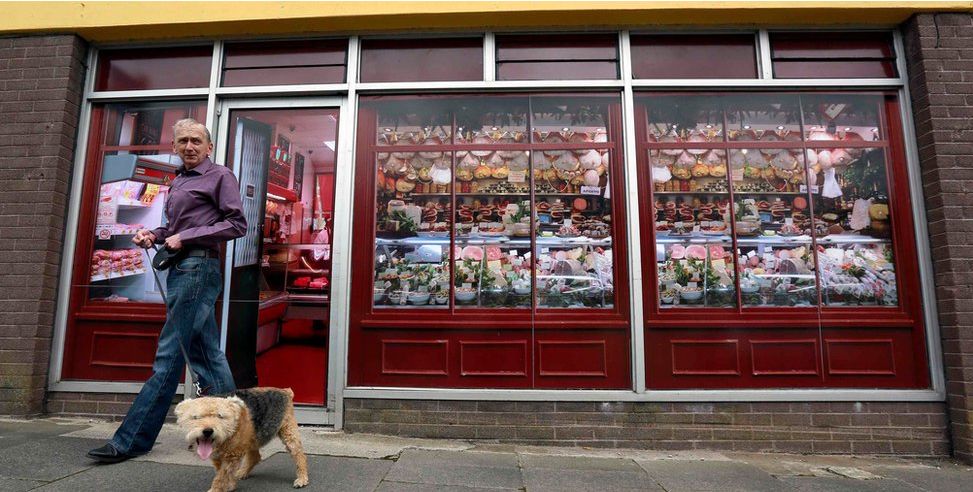
If there was one picture that captured the times we are living through it is this. It appeared on the BBC website recently with the following caption:
Kevin McGuire walks his dog past a vacant shop in Belcoo, Northern Ireland. The empty shop is one of a number that have had graphics placed on the windows to make them look like working shops ahead of the G8 summit which takes place nearby later this month.
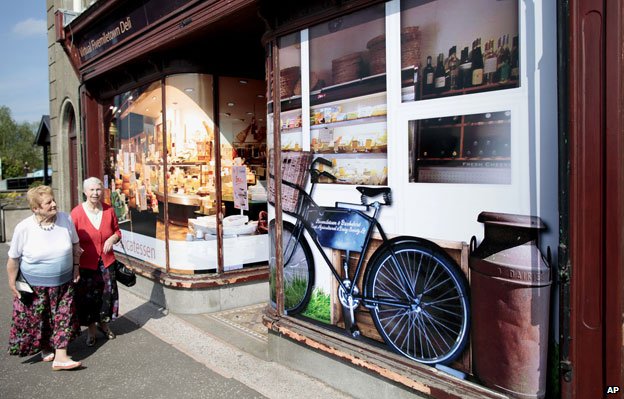
Let’s take that a bit more slowly. Here is a shop, one of many that has gone out of business due, among other things, to the growth-fixated policies of the G8, situated in a place G8 ministers will be driven past en route to their summit. Rather than their being able to see how things are actually unfolding in the real world, the division and misery being caused by their approach to the economy, the windows have been plastered with stickers that present it as a fully-stocked, thriving shop. As singer/comic Mitch Benn put it on BBC Radio 4′s The Now Show on Friday, ”the last thing you’d want would be for a bunch of people meeting to fix the economy to see how bad the economy’s got”.
County Fermanagh’s district council sanctioned the fake retail units as part of a £1m makeover before it hosts the G8 summit. The event takes place on 17 and 18 June at the Lough Erne golf resort near Enniskillen. The chief executive of Fermanagh District Council has defended the optical illusion.
“It was aimed at undeveloped sites at the entrance to the town and then right throughout the county in terms of the other towns and villages, looking at those vacant properties and really just trying to make them look better and more aesthetically pleasing,” says Brendan Hegarty
Here’s the thing that fascinated me most though. It’s the kind of shop they chose to portray it as. They didn’t print up large stickers that would present the shop as being a Tesco Metro, a Sainsbury’s Local, an Aldi perhaps, or even branch of one of the banks that contributed significantly to our getting into this mess in the first place. They didn’t make one huge sticker, one false façade, that showed a new shopping precinct, glittering with all the usual chain stores that dominate every such precinct. Or a Travelodge perhaps. Rather they set out deliberately and in considerable detail to portray the kind of vibrant, local, independent business that has either become extinct, or which survives in spite of, rather than because of, the policies of the G8. Here’s another one…
The windows are hung with delicious-looking hams, the display features meats and a whole range of delicious local produce, beautifully arranged. Although the cut-and-paste nature of the graphic design rather gives the game away (the same arrangements of hams appear two or three times), what they are trying to portray here is that most endangered of species, the local, independent butcher.
In the mid-1990s there were 22,000 butchers in the UK, by 2010 there were just 6,553. The independent butcher is making something of a spirited fightback though, although certainly not aided, in any sense, by the G8. The butcher that would have occupied that shop no longer exists, most likely because a supermarket opened nearby and completely shifted the balance of the Belcoo economy (any readers from Belcoo who might like to write in and tell us what led to this shop’s demise would be most welcome).
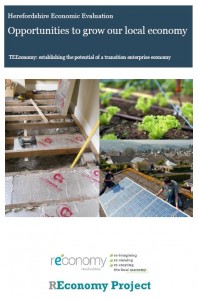
The other day I spoke to Nick Sherwood of REconomy Herefordshire, who has co-ordinated the Herefordshire Economic Evaluation (the second such piece of work, the Totnes one already being published, and Brixton’s coming soon). Our conversation will be published here soon, but one of the things that really struck me was the following:
We estimate that the top five major supermarkets in Herefordshire account for between 71% – 83% of all household expenditure on ‘brought home’ food and drink, or up to £180m annually. In addition, around £30m per year is spent in the smaller ‘chain’ supermarkets.
Their conclusion is that the true ‘local spend’ figure, i.e through local, independent businesses in Herefordshire, could be around 16% of the total. In terms of a national version of that figure, the best I can find is the figure from the Portas Review that states that 8,000 supermarkets now account for over 97% of all UK grocery sales. Although clearly other smaller supermarkets account for some of the remaining sales, let’s assume, for argument’s sake, that nationally, 3% of what we spend on groceries goes out through local and independent businesses.
I would imagine that everyone seeks an economy that is able to provide jobs, economic activity, stronger and happier communities and community resilience, while also skilfully reducing its carbon emissions on the scale required. The question of our times though, as far as I’m concerned, is whether that is best achieved by expanding the 97% of our economy currently dominated by huge supermarkets, the kinds of enterprise that the UK government and the G8 see as leading the push for growth, or protecting and enhancing the 3%?
It’s a vital question, because at the moment the push to eradicate the 3% altogether, or at least squeeze it a lot harder, continues apace. Yet that 3% is better suited to meeting those core needs of ours. As the recent report by Localise West Midlands on ‘community economic development’ states:
Our research has found strong evidence that local economies with higher levels of SMEs and local ownership perform better in terms of employment growth (especially disadvantaged and peripheral areas), the local multiplier effect, social and economic inclusion, income redistribution, health, civic engagement and well-being than places heavily reliant on inward investment where there are fewer, larger, remotely owned employers.
A study focusing on New Orleans compared 179,000 square feet of retail space that is home to 100 independent businesses to the same-sized space that is home to a single supermarket. The former generated $105 million in sales with $34 million staying in the local economy, while the latter generated $50 million in sales with just $8 million staying locally, and necessitated 300,000 square feet of parking space (see graphic below).
Santander’s ‘Market of Hope’ which I wrote about here last year is a great example of how a city can be fed by looking at large retail spaces in such a way that they boost and support the local independent economy rather than undermine it. When Sir Terry Leahy, CEO of Tesco, was asked whether there was any alternative to supermarkets, replied:
“… queueing at one store than trudging down Watford High Street in the rain to another shop … is this what people actually want to go back to?”
But no, it’s not about “going back”, rather about going forward in a way that meets our needs rather than those of the City of London. What we now know is that even G8 ministers would rather pass through High Streets populated with small, independent butchers, bakers, grocers, would rather see shop windows overflowing with delicious food, trusting that the relationship they have built up with the shopkeeper over many years will mean that he/she stocks the best produce they can find. It feels right. It’s human scale. It makes sense. It’s an economy that is ours, it belongs to local people, to the local economy. Even G8 ministers would now appear to prefer a shopping experience that actually involves interacting with other human beings rather than wandering anonymously around a superstore and then cashing yourself out at the end.
The core argument of The Power of Just Doing Stuff, published on Friday, is that if we really want to achieve our goals of jobs, economic activity, stronger and happier communities and community resilience, while also skilfully reducing our carbon emissions on the scale required, we’d be better off focusing on growing the 3% rather than the 97%. It’s a pretty simple idea, and, to me at least, a blindingly obvious one, but that doesn’t mean it’s easy.
However, the experience is that this fightback has already begun. The explosion of new bakeries, pop-up shops, community renewable energy projects, craft breweries, independent record shops, complementary currencies and communities acquiring their own assets is already happening around us, but it needs us to get behind it, to put our shoulders, our spending power, our sheer bloody will, to making it 10%, 30% 70%. If we want a stable climate, reduced energy vulnerability, economic stability, and a healthy human culture, we really have no choice. As Maria van der Hoeven of the IEA said recently at the launch of a World Energy OutlookSpecial Report, Redrawing the Energy-Climate Map, ”the path we are currently on is more likely to result in a temperature increase of between 3.6 °C and 5.3 °C”.
Fortunately, it’s a push that is life-enhancing, thrill-generating and in which we discover a resourcefulness, a kindness and a passion in ourselves that we may have forgotten was there. I’ll leave you with a quote from the book, from Helen Cunningham of DE4 Food, a social enterprise food hub in Derbyshire that grew out of Transition Matlock. The project grew from helping a local farmer with lambing and has grown into an innovative new business:
“Never in my life did I imagine that I’d be able to bring lambs into the world! It wasn’t a skill I ever expected to have. It was such a different thing from what we were doing in the rest of our lives, and I think from then we’ve all thought “OK, we can learn these new skills, we can learn how to lamb, we can learn how to grow vegetables and learn how to do Excel Profit and Loss sheets and whatever.” I think we all just really wanted to change the way we live, and change our own personal lives and to change things and live different lives ourselves as well as a different life in our community”.
You can pre-order your copy of The Power of Just Doing Stuff here.
oooOOOooo
As has been said before, and undoubtedly will be said many times more, it really is a very strange world we live in!
Reinforcing my long-time respect for Prince Charles.
HRH The Prince of Wales, more familiarly known as Prince Charles, is a man I have longed admired and respected.
Many years ago, I worked as a volunteer teacher/mentor with what was then known as The Prince’s Youth Business Trust (PYBT). Later, it became incorporated into The Prince’s Trust. The PYBT enjoyed passionate and active support from HRH, and with good cause. Essentially, the PYBT offered socially-disadvantaged youngsters, who had very little chance of getting a job, the opportunity to be mentored on the skills of being an entrepreneur. Many of those youngsters went on to get decent jobs and many others started their own businesses, some with considerable success. Simply because thinking like an entrepreneur is impossible if you don’t have faith in your own abilities. That self-confidence shows in so many walks of life, especially when one is going through a job interview!
The Prince has also long been known for his concerns over the way we treat our planet, going right back to the days when it was regarded rather quaint by the mainstream media. But as Wikipedia reveals, “He has long championed organic farming and sought to raise world awareness of the dangers facing the natural environment, such as climate change. As an environmentalist, he has received numerous awards and recognition from environmental groups around the world.”
So it was lovely, but no great surprise, to see how well a recent speech was received on the subject of Regional Food Security given at Langenburg Castle in Baden-Wurttenberg, Germany. The full text is available on The Prince of Wales website. Let me give you a taste (whoops, pun unintended!) of what The Prince said,
Ladies and Gentlemen, if I may say so, this is a very important conference. I am sure what you have heard so far about the problems we face and the obstacles to tackling them has given you a clear context in which to be able to consider what comes next this afternoon.
The aim here is to think through how we might create a much more local model of food production and distribution. But also, how that might fit with producing healthy food using far more sustainable methods and how we might do all of this without damaging business. Indeed, how this could improve business.
As you have heard, the urgency for this comes from the fact that there is not sufficient resilience in the system as it currently stands. It may appear that things are well. Big global corporations may appear to be prospering out of operating on a global monocultural scale but, as I hope you have seen, if you drill down into what is actually happening, things are not so healthy. Our present approach is rapidly mining resilience out of our food system and threatening to leave it ever more vulnerable to the various external shocks that are becoming more varied, extreme and frequent.
So see the relevance of The Prince’s speech as he continued:
The drive to make food cheaper for consumers and to earn companies bigger profits is sucking real value out of the food production system – value that is critical to its sustainability. I am talking here about obvious things like the vitality of the soil and local eco-systems, the quality and availability of fresh water and so on, but also about less obvious things, like local employment and people’s health. It is, as I fear you know only too well, a complex business.
The aggressive search for cheaper food has been described as a “drive to the bottom”, which I am afraid is taking the farmers with it. They are being driven into the ground by the prices they are forced to expect for their produce and this has led to some very worrying short cuts. The recent horsemeat scandals are surely just one example, revealing a disturbing situation where even the biggest retailers seem not to know where their supplies are coming from. And it has also led to a very destructive effect on farming. We are losing farmers fast. Young people do not want to go into such an unrewarding profession. In the U.K., I have been warning of this for some time and recently set up apprenticeship schemes to try to alleviate the problem; but the fact remains that at the moment the average age of British farmers is fifty-eight, and rising.
One more extract from the speech:
In the U.K., as elsewhere – but particularly I think in the U.S. – the consequences of this are ever more apparent in the deteriorating state of our public health. We all know that Type 2 Diabetes and other obesity-related conditions are rapidly on the increase. The public bill for dealing with these is already massive and I am told it could become completely unaffordable if we do not see a shift in emphasis. And, of course, it will be cities that carry the heaviest part of that burden. It is a peculiar trend.
Am I alone, ladies and gentlemen, in wondering how it is that those who are farming according to organic, or agro-ecological principles – in other words, sustainably, for the long-term, by operating in a way that reduces pollution and contamination of the natural environment to a minimum and maximizes the health of soil, biodiverse ecosystems and humanity – are then penalized? They find that their produce is considered too expensive and too “niche market” to be available to everyone. How is it, then, that systems of farming which do precisely the opposite – with increasingly dire and damaging effects on both the terrestrial and marine environments, not to mention long-term human health – are able to sell their products in mass markets at prices that in no way reflect the immense and damaging cost to the environment and human health? A cost that then has to be paid for over and over again elsewhere – chiefly, in all probability, by our unfortunate children and grandchildren, whose welfare I happen to care about. Surely this is a truly perverse situation which, you would have thought, could be turned on its head to make genuinely sustainably-produced food accessible to everyone, and the polluter to pay the real costs for the side effects of industrialized food? It is to be wondered at how this state of affairs persists – and yet to suggest standing it on its head and transforming the situation is to invite the predictable chorus of vitriolic accusations that you are anti-science, anti-progress, out of touch with commercial pressures and not living in the “real world.”
Yesterday, I wrote a post I cry for the wolves. A comment from Jeremy Nathan Marks included this:
I have learned slowly that being an adult means learning to face and acknowledge the many horrors of our world. It also means -for me, anyway- recognizing that love is the one saving grace, the one remaining hope, the one promise that might be kept. And I mean love in the hear and now and not in any afterlife. Love is what animates beauty for me -a beauty that is about more than aesthetics.
Some people would perhaps think I am ridiculous for saying that I feel that wolves are my kin. But they are. To be kin doesn’t mean we have to think the same thoughts, speak the same spoken language, or even move through the world in precisely the same way. Being kin to me means that we recognize the life lived in one another. I see that life and its light and love in wolves, just as you have beautifully described. And I know people who have lived and worked with wolves have seen that mutuality in their encounters and interactions with wolves and their packs.
That is such a profound reflection.
Unwittingly, before I read that comment from Jeremy, I had added this comment:
Around 7am I went down to our pond just to enjoy the world Jean and I live in and there was a young deer grazing the field grass near the water. Slowly, I moved towards a bench seat by the edge of the pond and sat down. The deer strolled away, perhaps some 30 feet, and continued to graze. Thanks to Dordie and Bill this young, beautiful creature was perfectly comfortable with my presence.
I sat there and my mind wander back to some far-off time when a curious young wolf might have let curiousity compell it to come a little closer to a human, perhaps nibble at the bone that the human threw in its direction.
There’s a theme here. “Love in the here and now ..” from Jeremy and me being lost watching that deer; the love of that moment.
A couple of evenings ago, Jean and I watched a truly wonderful and inspiring film. The film was called What about me? 1 Giant Leap The embedded link takes you to the website for the film.
Here’s the trailer.
Following the success of their first double Grammy nominated film & album, What About Me? is the latest offering from 1 Giant Leap. This visionary project took Jamie Catto and Duncan Bridgeman to over 50 locations as they explore through music, the complexities of human nature on a global scale, and aims to reveal how we are all connected through our creativity and beliefs, but most of all through our madness.
Through music and film, “1 Giant Leap” explores the universal complexities of human nature. Jamie Catto (Faithless co-founder) and Duncan Bridgeman set out on their journey recording musical jewels and words of wisdom with the cream of the world’s thinkers, writers and entertainers along the way. The duo traveled to the farthest corners of the planet, to ensure immense cultural diversity in this time capsule of humanity at its most inspirational.
Covering universal topics such as God, Sex, Death and Money, What About Me? features an incredibly diverse collection of collaborators from Noam Chomsky to Will Young, Maxi Jazz to Tim Robbins, Billy Connolly to Michael Stipe, Eckhart Tolle to Baaba Mal, among many others.
Encompassing a TV series, film and album, this is a poignant, emotional and entertaining time capsule of humanity at its most inspirational.
I can’t recommend too strongly that you watch the full-length film – I doubt that you will watch it and remain unchanged.
Like thousands of others I have been supporting the efforts to ensure that the US Government did not proceed with the proposal to remove wolves from endangered species protection.
Wolves are the animals that enabled early man to ‘progress’ from hunter-gatherer to the life of farming, and thence to our modern world. As I write elsewhere on Learning from Dogs,
There is no hard evidence about when dogs and man came together but dogs were certainly around when man developed speech and set out from Africa, about 50,000 years ago.
So it utterly breaks my heart to republish a recent post on The Sand County, Jeremy Nathan Marks wonderful and evocative blog. Here it is, republished with Jeremy’s kind permission.
oooOOOooo
I used to believe
As some of you may have heard, late last week the Obama Administration officially delisted gray wolves from endangered species protection. This means that 40 years of wolf recovery efforts have come to an end. Wolves only occupy a tiny fraction of their former habitat and with anti-wolf governments occupying the state houses in the few places that still have wolf populations, states like Montana, Wyoming, Idaho and Wisconsin, it is hard to imagine that wolves have a bright future in the lower 48 states.
I am deeply, profoundly saddened by this decision. I have learned over time how wolves -like so many other species- just don’t register on the list of national concerns and priorities. A great many people oppose the delisting, in fact one gets the impression that the effort to remove these protections has consistently been guided by political pressures and a political agenda and not by a true commitment to a sustainable and enduring wolf recovery. I know that I am hardly alone in registering my disappointment and voice of protest.
I cannot let this sad milestone pass without acknowledging it here on this blog. If you do not like wolves -if you feel hatred or resentment towards them or are pleased at what has recently transpired, I respectfully request that you refrain from sharing your feelings here. I seldom offer any “directives” like this, but if you are a reader of this blog then you know how strongly I feel about this issue. I am sharing these thoughts because I want to not only draw attention to what has happened, but also because I feel the need to mourn it. I tremble at the thought of a United States -or a North America- without wolves. Defenders of the administration and the Department of Interior’s position will say that the United States Government is committed to protecting wolves and ensuring their future but I am afraid I see things quite differently. This is not a partisan political issue: Democratic and Republican administrations alike are behind this stance towards wolves.
I would like to share a poem which I feel is very incomplete and does not begin to adequately draw upon the well of feelings, concerns and thoughts I have on this subject. But I would be remiss I think if I did not mark what has just happened.
I used to believe
I used to believe that one day
I might live carefully, cooperatively
beside the wolves
I would go to them but respect their
space; wait for their return and tend
my garden with local mind, open my windows
When they moved off I would wait
and make a space; I would lock my guns
in bolted cabinets to honor and not to intrude
I used to believe that there was a chance
of this because there were others who saw
in wolves the same uncertainties and histories
And we, a new community, would redraw
the map, eradicate “the frontier” and perhaps
expunge that word altogether from our plans
It is ironic really how a word, a concept,
one invisible line can have more tendrils
and seeds than a weed, more pups than a pack.
–Jeremy Nathan Marks
oooOOOooo
The Center for Biological Diversity has been incredibly active in fighting for the continued protection of the wolf. The Press Release about the loss of protection is here. Do read it and do everything you can to help. PLEASE!
Let me share some of my special feelings about wolves.
Luna, the wild wolf, with Tim and Tim’s dog; taken in 2006.
Then in February this year, I wrote about Oregon and the wolf. The following picture was in that Post.
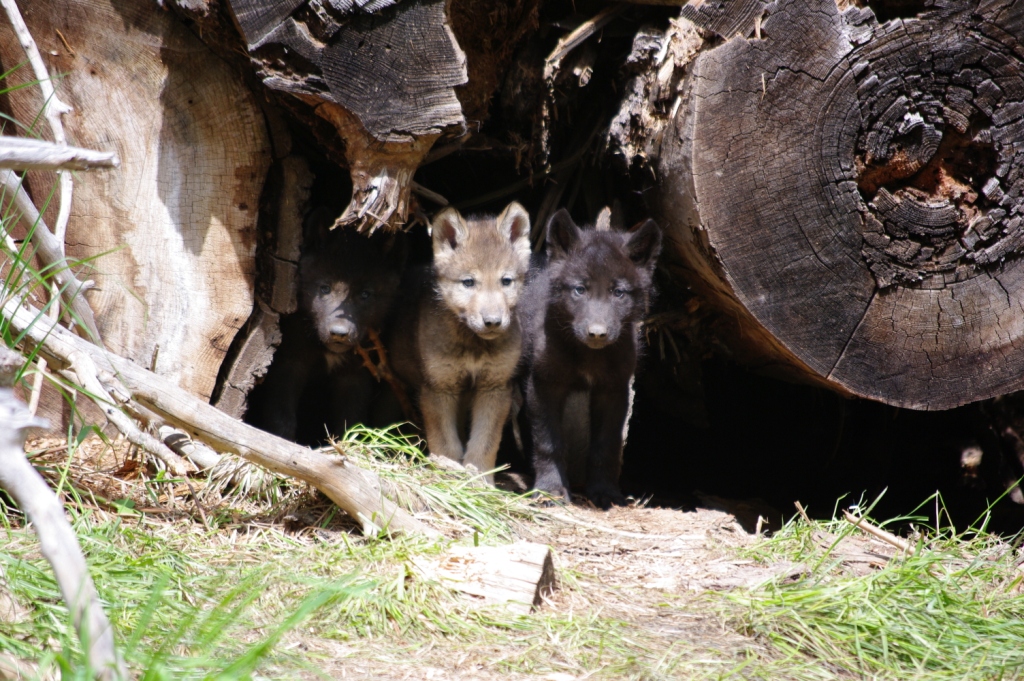
These wolf pups born to the Wenaha Pack in 2012 helped get recovery back on track. But their future remains tenuous (photo courtesy ODFW)
Please now listen to this:
So you can see that I have written frequently about wolves; indeed just a few days ago did so and included this photograph.
Wolf greets man.
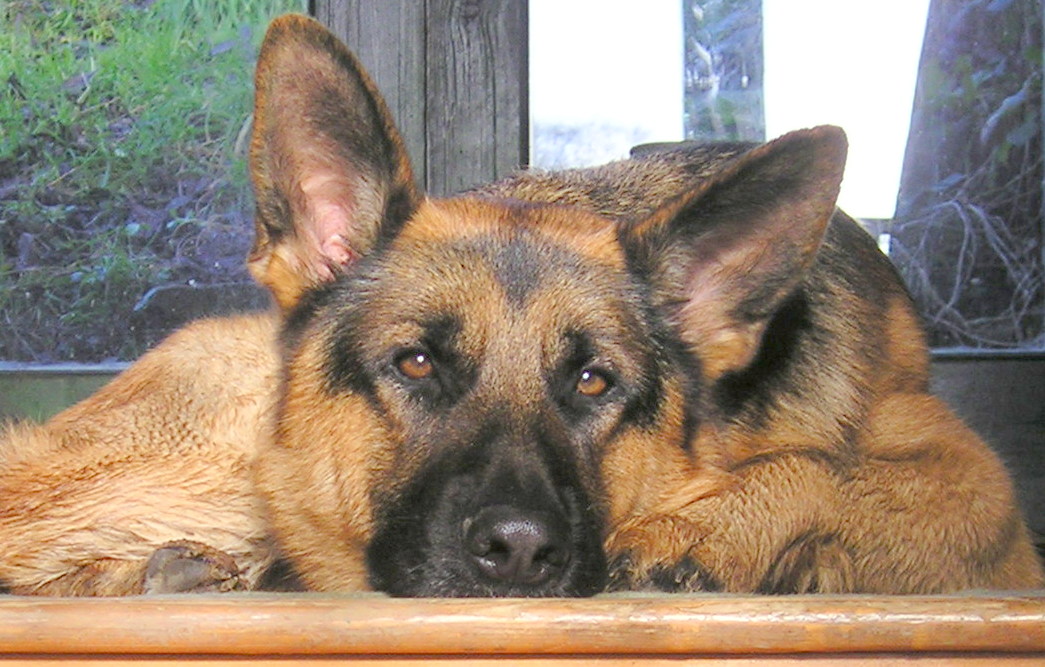
Now just look at those eyes of the Grey Wolf above and compare them to the eyes of the German Shepherd dog below and tell me that wolves aren’t as close to man as dogs.
Finally, feel free to share this post as far and wide as you can. Learning from Dogs is published under a Creative Commons License. This link covers how to share my material.
Please do something to help these ancient animals who, more than any other creature, helped put mankind ‘on the map’.
That post celebrated the arrival into the Handover household of three Koi.
However, since that day the three Koi have not been seen; not even a tremor on the surface of the water. We doubt that they have survived.
Jean found a rather fancy bird cage in a secondhand store the other day and a couple of days ago the cage became home to Mr. Blu and Mr. Green, a pair of Parakeets, or Budgerigars in English speak. I know many feel uncomfortable about having birds in cages but as the store assistant pointed out, these birds had been breed in captivity and wouldn’t survive a moment if released.
Mr. Green and Mr. Blu!
I have not a single jot of doubt that Jeannie will love them as she loves all our animals – with total devotion.


 Their conclusion is that the true ‘local spend’ figure, i.e through local, independent businesses in Herefordshire, could be around 16% of the total. In terms of a national version of that figure, the best I can find is the figure from the Portas Review that states that 8,000 supermarkets now account for over 97% of all UK grocery sales. Although clearly other smaller supermarkets account for some of the remaining sales, let’s assume, for argument’s sake, that nationally, 3% of what we spend on groceries goes out through local and independent businesses.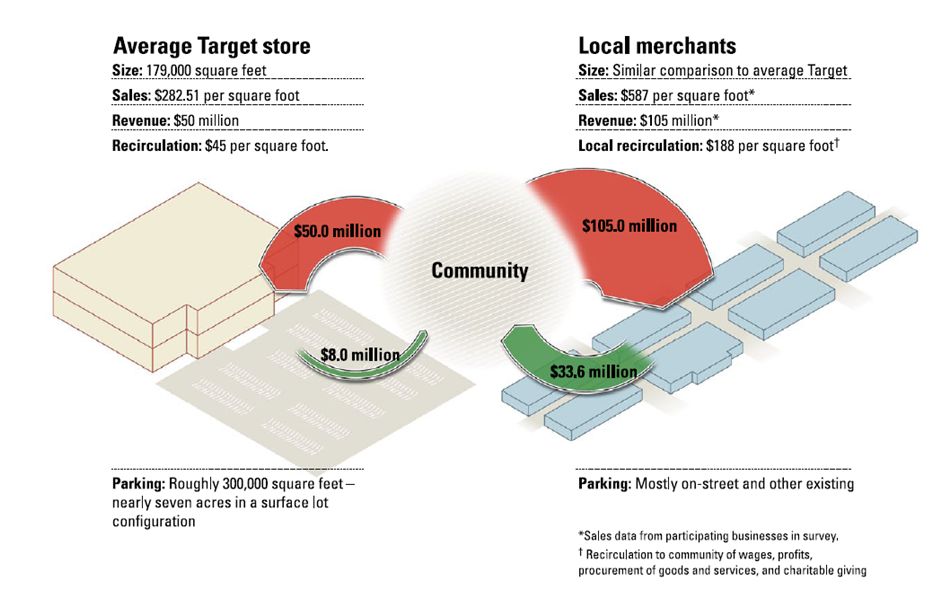






 Learning from Dogs
Eugene explained that the instrument is called the Armenian Duduk and that Armenian Duduk music is recognized by UNESCO.
It was only a quick search on the UNESCO website to find this:
Back to Eugene, who went on to write that Jivan Gasparyan and Gevorg Dabaghyan are famous duduk players among many others. The musical pieces played on the duduk are mostly armenian folk or spiritual tunes; many of them sad songs. Nowadays the duduk is very often played during funerals among Armenians but there are some dance songs as well.
Finally, Eugene offered these further hauntingly beautiful pieces of music.
——-
——-
——–
oooOOOooo
Just beautiful.