Have a wonderful Sunday and be reminded of how valuable dogs are.
On the 2nd March, the BBC published a news story about the life of a small girl being saved by a dog. Here’s how that story ran:
Dog ‘saved life’ of missing Polish girl
Julia was found lying in marshland
Firefighters in Poland say a small dog probably saved the life of a three-year-old who went missing from her home overnight in freezing temperatures.
The child, Julia, vanished on Friday and was found lying in marshes several kilometres from her house on Saturday morning, with the dog by her side.
She is now in hospital in western Poland, suffering from frostbite after temperatures fell to -5C (23F).
Firefighter Grzegorz Szymanski said the dog kept the child warm enough to live.
“For the whole night the animal was with the girl, it never left her. Remember, it was 5 degrees below zero and the child was wet,” he said, adding that the animal was the most important factor in the girl’s survival.
Firefighters said the animal stayed with the child throughout the night
More than 200 people had searched for the child overnight. It is thought she spent hours wandering through the forest near her home in the village of Pierzwin.
Her parents had last seen the three-year-old playing in the backyard with the small black mongrel.
She was eventually discovered by firefighters after she was heard crying for her mother.
Having had the internet service down for three days, I’m offering you this lovely dog story as a quick post for today.
The Jobseeker
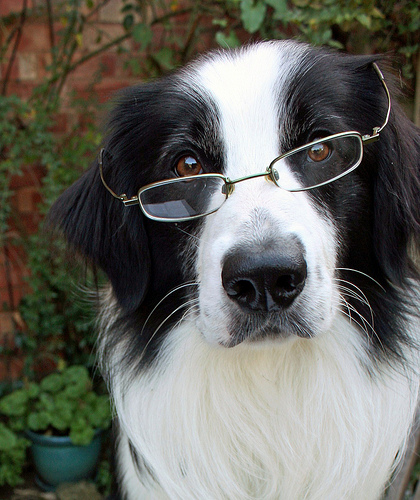
Thanks to Flickr
A local business looking for office help put a sign in the window saying: “HELP WANTED. Must be able to type, must be good with a computer and must be bilingual. We are an Equal Opportunity Employer.”
One day a dog trotted up to the window, saw the sign and went inside. He looked at the receptionist and wagged his tail, then walked over to the sign, looked at it and whined. Sensing the dog’s idea, the receptionist fetched the office manager. The office manager looked at the dog and was surprised, to say the least. However, since the dog looked determined, he led him into the office.
Once in the office, the dog jumped up and sat on the chair staring at the manager. The manager said, “I can’t hire you. You have to be able to type.”
The dog jumped down from the chair, went across to a typewriter and typed out a letter. He took out the page and trotted over to the manager, gave the letter to him and then jumped back on the chair. The letter was typed perfectly; the manager was stunned. He then turned to the dog and said, “The sign says you have to be good with a computer.”
The dog again jumped down and went to a computer. He demonstrated his expertise with various programs, producing a sample spreadsheet and database which he presented to the manager.
The manager was totally dumbfounded! He looked at the dog and said, “I realize that you are a very intelligent dog and have some interesting abilities. However, I still can’t give you the job.”
The dog jumped down and went to the sign in the window. He put his paw on the part about being an Equal Opportunity Employer.
“Yes,” the manager said, “but the sign also says that you have to be bilingual.”
The dog looked him straight in the face, and said, “Meeow.“
After a number of days of intermittent service, the relay unit on a nearby mast that feeds the internet service to our house finally failed around noon, US Pacific Time, last Tuesday.
There is a temporary fix in place and tomorrow a new voltage transformer will be installed; that being the unit that failed, closely followed by the failure of the back-up unit.
Inevitably, it is going to take me 24 hours to get back into the swing of Learning from Dogs but at least you know why it was so quiet.
The full copy of an email received yesterday from 350.org
Support the Cause
Breaking news about a good friend
Dear friends,
Big news has just emerged: Dr. James Hansen, the planet’s premier climate scientist, announced his retirement as head of NASA’s Goddard Institute of Space Studies, where he began his career in 1967.
If 350.org has a patron saint, it’s Jim. It was his 2008 paper that gave us our name, identifying 350 parts per million CO2 as the safe upper limit for carbon in the atmosphere.
But as much as for his science, we respect him for his courage. He’s always been willing to speak the truth bluntly, from the day in 1988 when he told Congress that the time had come “to stop waffling so much and say the planet was warming,” to all he’s done to bring attention to damaging projects like Keystone XL — even to the point of risking arrest to do so. I have no doubt he’ll go on doing science, and speaking plainly — indeed, he told the New York Times that one reason he’s leaving the federal payroll is so he can take on the government more directly.
But this is a big moment, and we need to mark it. Here’s what I hope you’ll do: honor Jim’s lifetime of work by making a public comment to the State Department about Keystone XL and tell them to reject the pipeline. In this case, speaking out is simple — click the link below to go to the page to submit from. There’s a list of ten arguments to choose from – you can mix and match or put it in your own words and just speak from the heart.
Sending a message to the State Department might not seem like much, but I think it’s actually quite fitting tribute.
One reason we’re fighting the pipeline is because Jim Hansen did the math to show that if we combusted the tar sands on top of all else we burn, it would be “game over for the climate.” So far that message hasn’t gotten through: the State Department hired a bunch of compromised oil industry analysts to ‘review’ KXL, and unsurprisingly they decided it would have ‘minimal’ environmental impact. We need to get them to take reality seriously, and change that assessment.
Maybe — just maybe — with a truly overwhelming flood of comments, we can break through. Together with our friends across the movement, we’re aiming for an ambitious target of 1 million comments to the State Department to stop the pipeline.
Beginning this comment push is all the more timely after the disasterous tar sands pipeline spill in Arkansas, where thousands of gallons of toxic oil ran freely through the streets of a suburban community.
Jim Hansen has been to jail twice to try and block KXL. When I saw him in handcuffs, I cringed. I don’t mind going myself, but it seems crazy that we have to send our best climate scientist off in handcuffs; in a sane world he’d never have to leave the lab. And in a sane world we’d just be toasting his retirement from NASA with well-deserved champagne.
But it’s a crazy world, heating fast, and so we need to mark this historic day in a way that really counts. Please do take a couple minutes to submit a comment on the Keystone XL Pipeline.
P.S. please submit your comment re the Keystone XL Pipeline; for all our sakes. This is the acknowledgement you will receive from 350.org.
Hey,
Thanks for submitting your comment. We’ve set the ambitious goal of 1,000,000 comments to the State Department because our best defense against the big money behind this project is overwhelming numbers — in short, people power.
Submitting a comment is just the first step — to hit that big goal, we each need to get our friends, family and maybe a few new people to join us. The next step is to share this with your social networks. You can click below to easily share with Facebook and Twitter:
I’m not sure that I should admit that my dearest Jeannie is my 4th wife! Long story that goes back to when I had just turned 12 years-old, back in 1956. I suffered an event that I interpreted as emotional rejection and promptly buried that deep into my subconscious where it stayed for over 50 years.
Then brought to the surface in 2007 (thanks Jon) after the failure of marriage number 3. I met Jean some 6 months later, in December 2007, and we were married in Payson, AZ in November, 2010. Being with Jean has been the happiest days of my life!
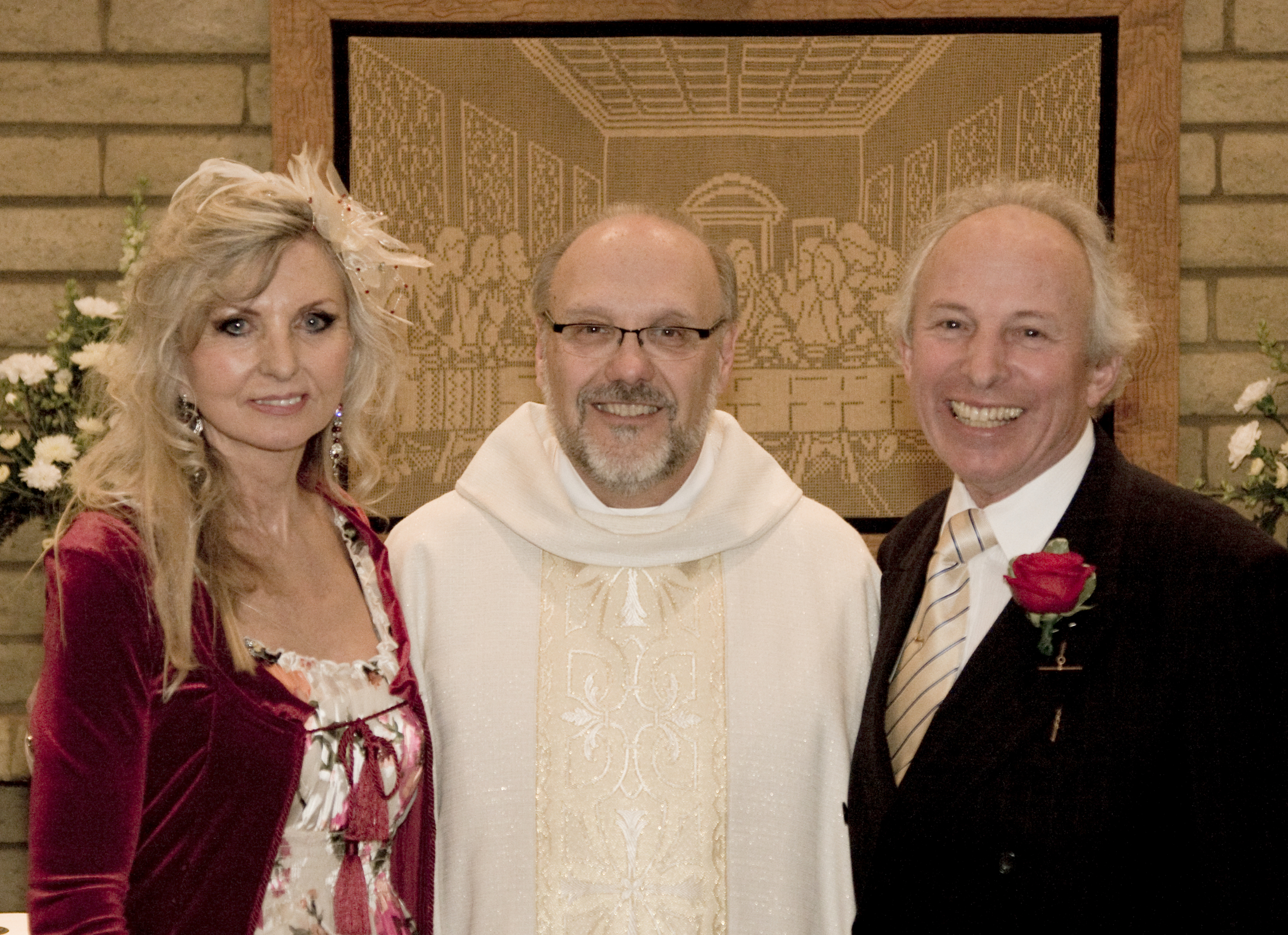
Jean, Father Dan and yours truly. St Paul’s Episcopal Church, Payson, AZ. November 20th, 2010.
Inevitably, while being married to Jean seems such a natural relationship, one is curious about what makes for a happy, lifelong relationship. Let’s face it, divorce is not uncommon. In fact, the Divorce Rate website reveals that in 2012, the divorce rate was 3.4 couples per 1,000 population in the USA; the sixth highest in the world.
So it was fascinating to listen to a recent radio programme broadcast under the BBC’s Point of View series. Just 10 minutes long, this particular programme was a talk by Adam Gopnik: The secret of a happy marriage 29th March 2013. (Adam Gopnik is an American commentator and writes for The New Yorker.)
You should be able to listen to the programme by going here. Or you can download the programme by going here, and following the instructions. (Not sure how long the programme will be available to listen/download, so don’t delay.)
The programme was also featured on the BBC News Magazine Website. From which I quote:
A Point of View: Is there a secret to a happy marriage?
Nobody can explain the secret to a happy marriage, says Adam Gopnik, but it doesn’t stop people trying.
Anyone who tells you their rules for a happy marriage doesn’t have one. There’s a truth universally acknowledged, or one that ought to be anyway.
Just as the people who write books about good sex are never people you would want to sleep with, and the academics who write articles about the disappearance of civility always sound ferociously angry, the people who write about the way to sustain a good marriage are usually on their third.
Nonetheless (you knew there was a nonetheless on its way) although I don’t have rules, I do have an observation after many years of marriage (I’ve promised not to say exactly how many, though the name “Jimmy Carter” might hold a clue).
Later, Adam Gopnik speaks about Charles Darwin whose marriage to Emma he describes “as something close to an ideal marriage.”
So what is it we learn from dogs?
So, marriages are made of lust, laughter and loyalty – but the three have to be kept in constant passage, transitively, back and forth, so that as one subsides for a time, the others rise.
Now Adam writes about the special form of loyalty that dogs offer us:
Be lit by lust, enlightened by laughter, settle into loyalty, and if loyalty seems too mired, return to lust by way of laughter.
I have had this formula worked out – and repeated it, waggishly, to friends, producing for some reason an ever more one-sided smile on the face of my beautiful wife.
Until, not long ago, I realised that there was a flaw in this idea. And that was that I had underestimated the reason that loyalty had such magnetic power, drawing all else towards it.
For I had been describing loyalty in marriage as though it were a neutral passive state – a kind of rest state, a final, fixed state at the end of the road of life.
And then, against our better wishes, and our own inner version of our marriage vows, at our daughter’s insistence we got a dog. And this is what changed my view.
“The expense and anxiety of children” indeed. Our daughter’s small Havanese dog, Butterscotch, has instructed us on many things, but above all on the energy that being loyal really implies.
Dogs teach us many things – but above all they teach us how frisky a state loyalty can be.
Dogs, after all – particularly spayed city dogs that have been denied their lusts – have loyalty as an overriding emotion. Ours will wait for hours for one of its family, and then patiently sit right alongside while there is work to be done.
Loyalty is what a dog provides. The ancient joke-name for a dog, Fido, is in truth the most perfect of all dog names – I am faithful. I am loyal. I remain.
Dogs are there to remind us that loyalty is a jumpy, fizzy emotion. Loyalty leaps up at the door and barks with joy at your return – and then immediately goes to sleep at your side. Simple fidelity is the youngest emotion we possess.
A trip down memory lane with the BBC That’s Life programme.
Sent to me by Neil Kelly from South Hams in Devon.
That’s Life was a BBC television programme that ran for over 20 years. Difficult to attach a precise lable to the format but this is how the programme is described on WikiPedia.
That’s Life! was a magazine-style television series on BBC1 between 26 May 1973 and 19 June 1994, presented by Esther Rantzen throughout the entire run, with various changes of co-presenters. The show was generally recorded about an hour prior to transmission, which was originally on Saturday nights for many years and then on Sunday nights. In its latter days, in an attempt to win back falling ratings, it was moved back to Saturday nights.
Anyway, the following video from That’s Life goes back to 1986 and involves three German Shepherd dogs and a soda syphon. The video was ‘borrowed’ from a Dutch TV show called ‘Zomergasten’, hence the Dutch sub-titles.
If you ever find yourself in Castle Cary, Somerset, then do drop in to the George Hotel; it’s still going strong.






 Learning from Dogs