Year: 2012

Ten didn’t last for long! Welcome Cleo.

The arrival of Cleo brings us back to eleven dogs.

Way back in 2003 when I became the proud ‘Dad’ of Pharaoh, my German Shepherd dog that you see on the home page of Learning from Dogs, Sandra Tucker who ran the GSD Breeders Jutone, where Pharaoh was born, gave me some advice.  Sandra said that when Pharaoh was getting on in life, then bring in a German Shepherd puppy.  Apparently, there were two solid reasons why this made sense.  The first was that Pharaoh would teach the new puppy many of the skills and disciplines that Pharaoh had learnt as a young dog and, secondly, the puppy would keep Pharaoh active.

Now we know this to be true because years later when Pharaoh had his own mini pack here in Payson, we introduced a new ‘rescue’ puppy called Sweeny.  Pharaoh took an instant like to him and became very tolerant to Sweeny’s ‘games’.

Hi! I'm Pharaoh, going to be my buddy? (February, 2011)

But as adorable as Sweeny is, Jean understood the deep reasons why I always wanted a German Shepherd in our lives.  So when a chance encounter in Payson Feed Store between Jean and Brendon S. revealed that Brendon had a litter of German Shepherd puppies for sale, just a couple of miles outside Payson, the temptation was irresistible!

Thus a few days ago, Jean and I went round to Brendon’s home and spent a couple of hours mingling with the puppies and their GSD mother.  They all looked excellent dogs and a review of their blood lines showed that their genetic background included German stock not too far back.  It was difficult to select any one pup as they were all wonderful animals.  But one youngster seemed to catch Jean’s eye.

Little bit of bonding going on!

Then the next test was to introduce Pharaoh to the puppies.  That took place last Friday and it was wonderful to see how well he coped with the onslaught of puppies!

More puppies that one could shake a stick at!

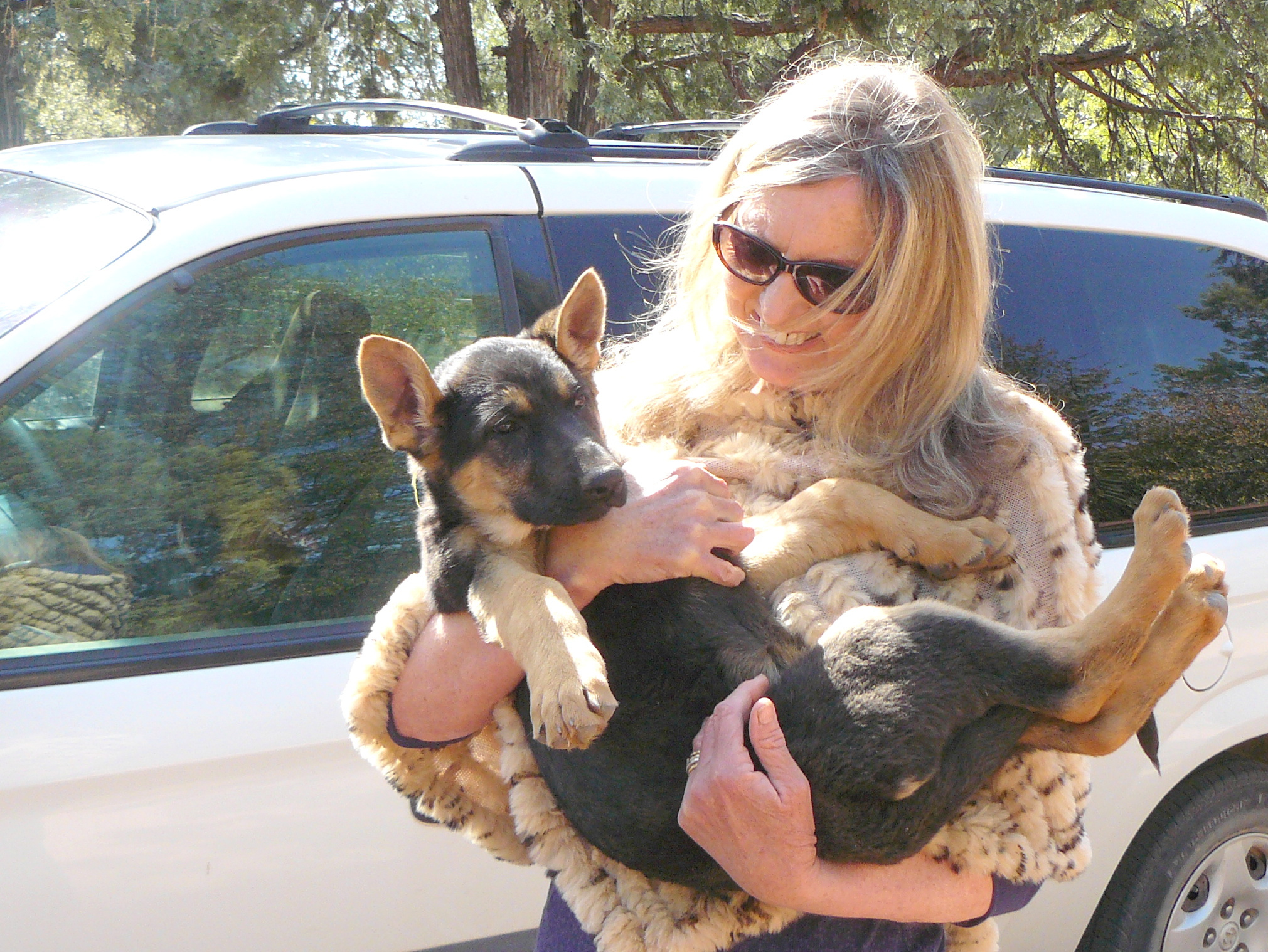
In the end, we ran out of reasons not to follow Sandra’s advice from all those years ago and we agreed terms on a young female GSD that, inevitably, was christened Cleopatra (Cleo) by Jean!

Cleo meet your new Mum!

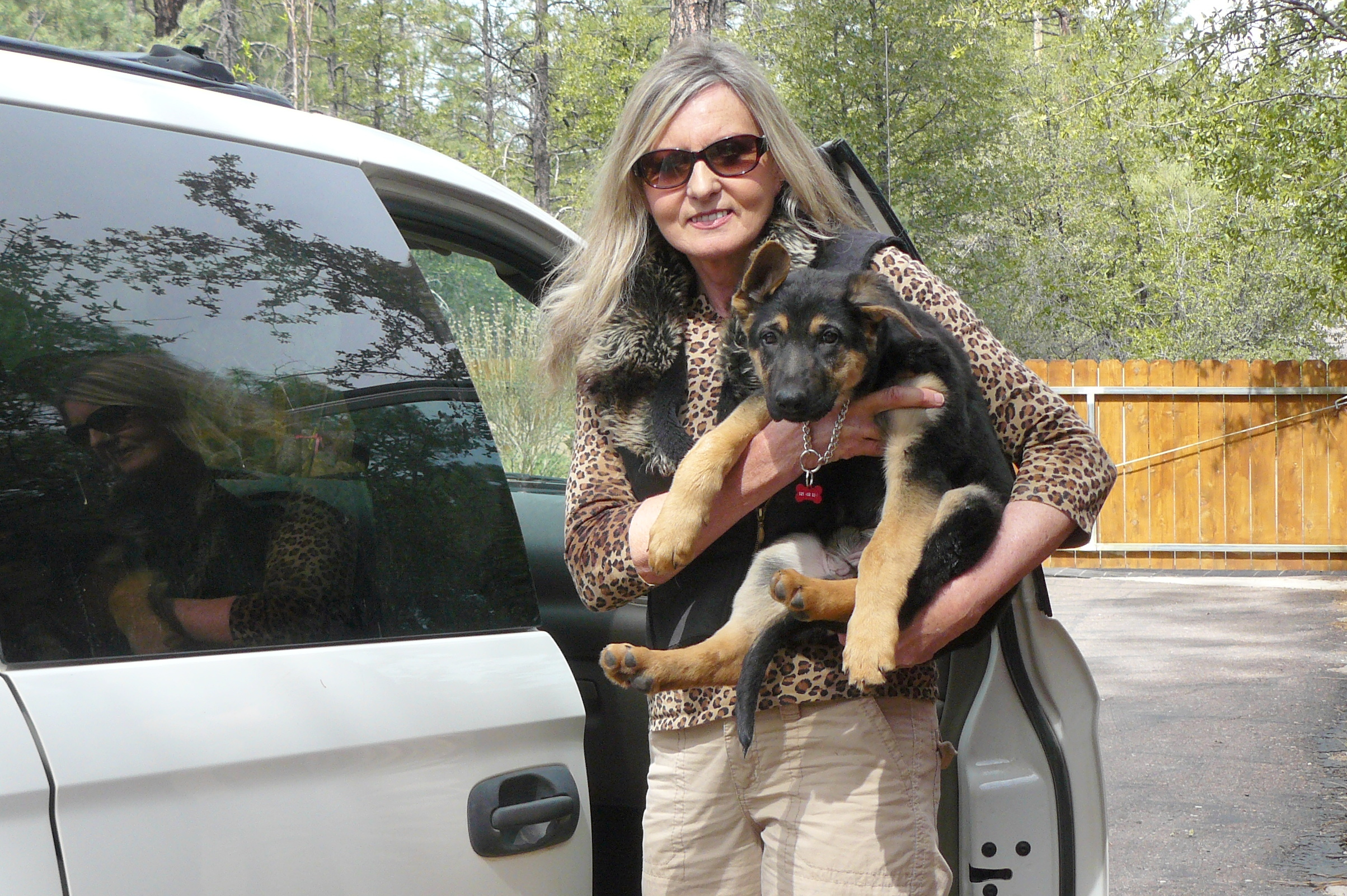
Then yesterday, Saturday, we went back round to collect young Cleo, meeting Brendan’s wife Ebony in the process.  The following photographs record some of the key moments.

Homeward bound to a new life!
Next step is to meet the gang!
Welcome, young lady. I'm the boss around here!
It's my pool but you can use it!
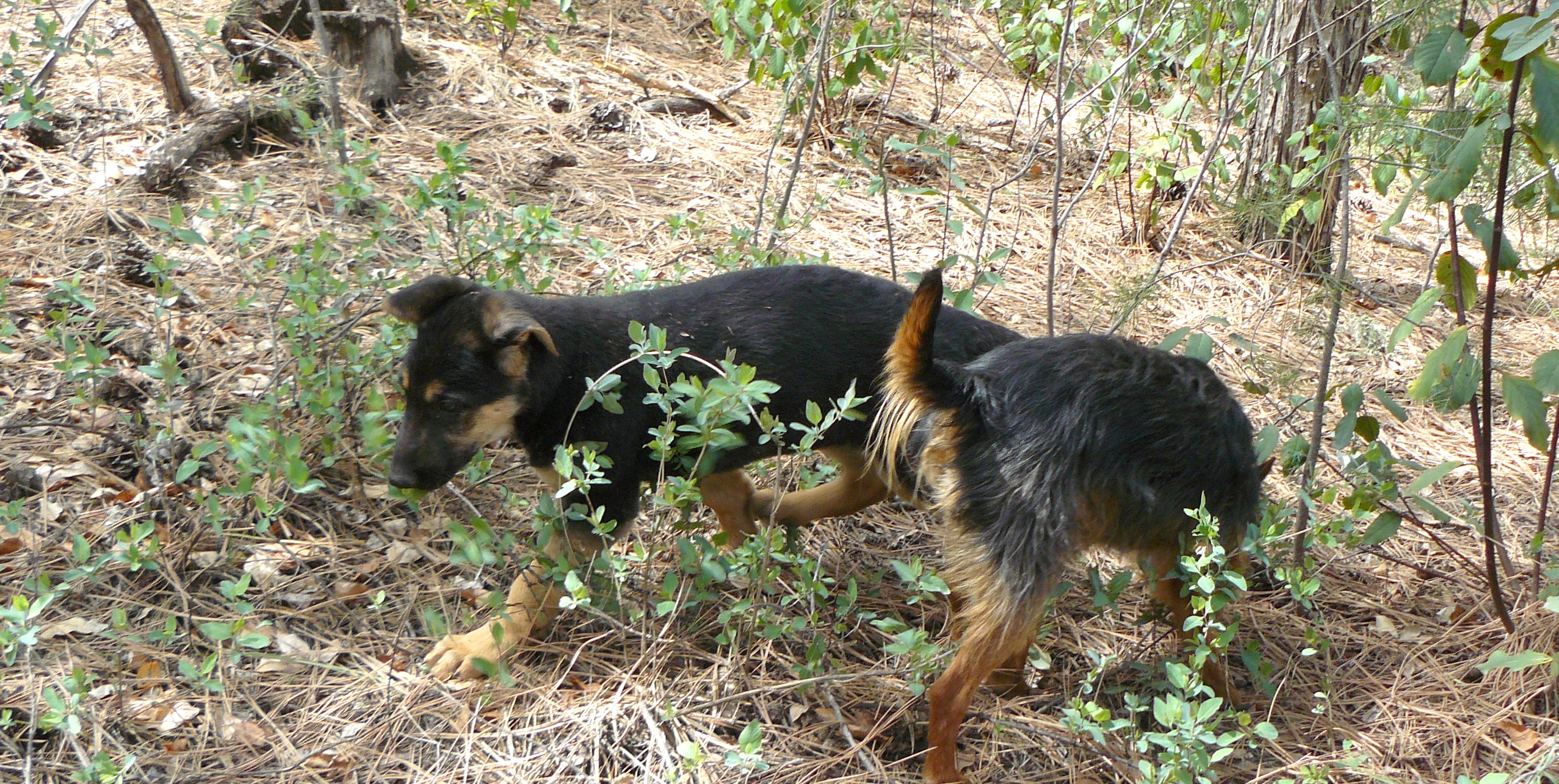
Hey Sweeny, fancy having one's own woods to play in!
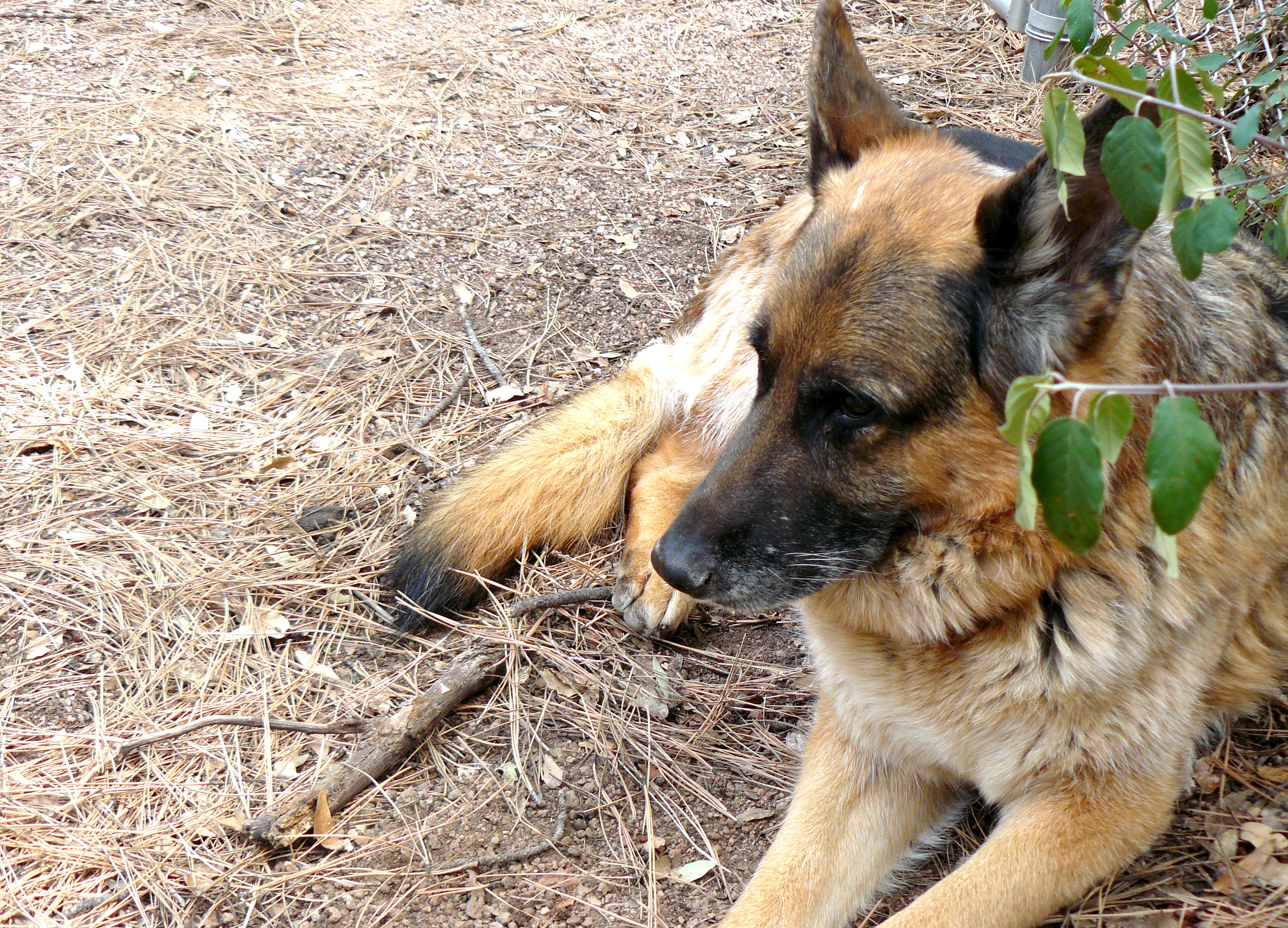
She'll do! Nice addition to my family!

So there we are.  Back up to eleven dogs, five chickens, six cats, and a fish!

Finally, a big thanks to Sandra of Jutone for her guidance in the last few days.

Coping with traffic jams!

With thanks to Dan Gomez for sending me the YouTube link.

It’s a crazy old world but sometimes that craziness provides a relief from the ‘serious’ side to life.

This week the Dutch company PAL-V announced the first flights of its prototype “flying car”.
This unique vehicle is called the PAL-V One, or the ‘Personal Air and Land Vehicle’, and It marks the start of a new era.

On the ground the vehicle drives like a sports car. Within minutes its rotor is unfolded and its tail is extended: then it is ready to take off thanks to the advanced gyrocopter technology.

With these successful test results it is proven that it is not only possible to build a flying car but also that it can be done within existing international rules for both flying and driving.

Having passed this important milestone the company is now inviting investors to join them in creating the future.

The next step will be the design of the first commercial production model of the PAL-V, and first deliveries are expected in 2014.

For 100 years people have dreamed of a flying car, and many attempts have been made to realize this dream, but now it has truly become a reality.

www.PAL-V.com

Having the dog of a day!

Maybe there’s a new twist to that rather derogatory phrase!

For the life of me, I can’t remember how this story came to my ‘in-box’ but most likely it was from my Big Think subscription.  But I do know that the story has spread like wild-fire (poor choice of simile for Arizona!) and not without good reason.

Here’s how it was promoted on Science Daily,

Benefits of Taking Your Dog to Work May Not Be Far-Fetched

Man’s best friend may make a positive difference in the workplace by reducing stress and making the job more satisfying for other employees, according to a Virginia Commonwealth University study.

Stress is a major contributor to employee absenteeism, morale and burnout and results in significant loss of productivity and resources. But a preliminary study, published in the March issue of the International Journal of Workplace Health Management, found that dogs in the workplace may buffer the impact of stress during the workday for their owners and make the job more satisfying for those with whom they come into contact.

The VCU researchers compared employees who bring their dogs to work, employees who do not bring their dogs to work and employees without pets in the areas of stress, job satisfaction, organizational commitment and support.

Then over at the New York Daily News, it was presented thus,

Bring your dog to work to lower stress; Companies that allow pooches have happier workers

Amazon, Ben & Jerry’s and Zynga all have pup-friendly policies

A new study supports the stress-reducing benefits of bringing your pooch to work — to play with, look at, and pet while working.

According to a Virginia Commonwealth University study, having a dog at work not only reduces the owners’ stress level but also increased the level of job satisfaction for other employees as well. The study, announced Thursday, was published in the International Journal of Workplace Health Management.

“Dogs in the workplace can make a positive difference,” said head researcher Randolph T. Barker. “The differences in perceived stress between days the dog was present and absent were significant. The employees as a whole had higher job satisfaction than industry norms.”

Here’s a great example.  The photograph below,

One hand for the desk and one for the dog!

comes from the website of Interior Design Hound (seriously) where the by-line is Good Design with a Canine Twist! (No, I’m not making it up!)

Anyway, back to that NY Daily News item,

The study took place at Replacements Ltd, a service-manufacturing-retail company located in North Carolina, which employs approximately 550 people. The company has a dog friendly policy, similar to other  companies such as Amazon, Ben & Jerry’s and Zynga, according to CBS News, with around 20 to 30 dogs romping through the office every day. The study took place over a period of one work week, and subjects completing both surveys and saliva samples to measure stress levels.

According to The Humane Society of the United States, there are numerous benefits to having dogs at work, including improved staff morale, worker productivity, and camaraderie among employees.

Numerous studies have shown that having a pet is a good investment for your health. One study found that having a pet lowered your risk factors for heart disease, and another found that dogs encourage more consistent walking and exercise.

Seems pretty obvious to me.

Another tough day at the office!

Mind you, going back to the metaphorical ‘having a dog of a day‘ here’s one woman who probably wished she hadn’t got out of bed that morning,

Woman has a dog of a day in court

Sydney – If you have a phobia about dogs and hurt yourself running away from one, is it your own fault or should the owner of the dog pay compensation?

An Australian judge on Wednesday ruled against a woman who had put that case to him and ordered her to pay substantial legal costs.

Mileva Novakovic took her brother, Michael Stekovic, and his wife to the New South Wales Court of Appeal to try to overturn a lower court verdict that found they were not liable for injuries she sustained at his house in 2008.

Novakovic slipped and fell in a panic over finding a dog in their lounge room. She admitted to a fear of dogs and said she was compelled to run despite Cougar, a mastiff, showing no aggression towards her.


Very scary!

Turning corners, en route to Plan B.

Nothing stays the same for very long!

I wanted to call this post Change out of hope but that title was used on March 17th so opted for Turning corners instead!

Either way, this Post is prompted by a recent item published on the Earth Policy Institute website.  While Lester Brown’s book World on the Edge is a tough read, Lester is President of the Earth Policy Institute, it’s all too easy to think that the future for humanity is wall-to-wall gloom.  So here’s the article that was recently published, reproduced here under the copyright terms of the Earth Policy Institute.

Hope turning on the wind!

Wind Tops 10 Percent Share of Electricity in Five U.S. States

by J. Matthew Roney

A new picture is emerging in the U.S. power sector. In 2007, electricity generation from coal peaked, dropping by close to 4 percent annually between 2007 and 2011. Over the same time period, nuclear generation fell slightly, while natural gas-fired electricity grew by some 3 percent annually and hydropower by 7 percent. Meanwhile, wind-generated electricity grew by a whopping 36 percent each year. Multiple factors underlie this nascent shift in U.S. electricity production, including the global recession, increasing energy efficiency, and more economically recoverable domestic natural gas. But ultimately it is the increasing attractiveness of wind as an energy source that will drive it into prominence.

Wind power accounted for just 2.9 percent of total electricity generation in the United States in 2011. In five U.S. states, however, 10 percent or more of electricity generation came from wind. South Dakota leads the states, with wind power making up 22 percent of its electricity generation in 2011, up from 14 percent in 2010. In 2011, Iowa generated 19 percent of its electricity with wind energy. And in North Dakota, wind’s share was 15 percent.

The two most populous U.S. states are also harnessing more of their wind resources. While adding more than 900 megawatts of new wind farms in 2011 to its existing 3,000-megawatt wind capacity, California was able to increase its wind electricity share from 3 to 4 percent. Texas has the most wind installations of all the states, with 10,400 megawatts. In fact, if Texas were a country, it would rank sixth in the world for total wind capacity. Figures from the Electric Reliability Council of Texas (ERCOT), the independent service operator that delivers 85 percent of the state’s electricity, show that wind’s share of electricity in the ERCOT region jumped from 2.9 percent in 2007 to 8.5 percent in 2011.

Even though the cost of generating electricity from the wind has fallen substantially, certain policies have been needed to help it compete with the longtime support and lack of full-cost accounting for fossil fuels. Through so-called renewable portfolio standards (RPS), 29 states now require a percentage of utilities’ electricity to come from renewables by a certain date. This includes 8 of the top 10 states in total installed wind power capacity. For example, California’s RPS requires one third of the state’s electricity to come from renewable sources by 2020. But the biggest policy driver of U.S. wind power growth thus far has been the federal production tax credit (PTC) for each kilowatt-hour of electricity a wind turbine generates. When Congress has allowed the PTC to expire, as it is scheduled to do again at the end of 2012, wind installations in the following year have plummeted.

In the short term, extending the PTC will be critical for the U.S. wind industry, which boasts more than 400 turbine component manufacturers and employs some 75,000 people. Ultimately, moving away from the recurring boom-bust threat by establishing a national RPS or a carbon tax would encourage even greater manufacturing growth and wind installations.

In a country where wind resources could power the entire economy, there is still great potential to be realized. Four states in northern Germany have set the mark, with each getting more than 40 percent of their electricity from the wind. Which U.S. state will get there first?

For more information and data on wind energy in the United States and around the world, see Earth Policy Institute’s Wind Indicator, “World Wind Power Climbs to New Record in 2011,” at http://www.earth-policy.org.

Copyright © 2012 Earth Policy Institute

This video is well worth watching as well as going to that link at the end of the essay above.

Lester Brown, Thomas Friedman, and Paul Krugman discuss the need for a carbon tax in order to price carbon emissions at their true cost.

The “Journey to Planet Earth” series continues with a special program, hosted by Matt Damon, which features environmental visionary Lester Brown and author of “Plan B.” This documentary delivers a clear and unflinching message — either confront the realities of climate change or suffer the consequences of lost civilizations and failed political states.

I will see how much material there is available online with regard to that programme hosted by Matt Damon and, maybe, present some of it on Learning from Dogs.

Finally, the picture of the wind turbine at the head of this Post came from a website called www.windgeneratorblog.com.  Fancy a home wind generator?

Nature’s voice.

A republication of a recent Post from Kate of Climate Sight.

Introduction

My apologies for a second republication of another’s Post in two days, but a number of things today (Tuesday) have robbed me of the time I usually have for writing for Learning from Dogs.  So the Post from ClimateSight that I had planned to bring to you on Thursday has been brought forward.

To Kate’s Post on ClimateSight but first a little of Kate’s background,

Kate is a B.Sc. student and aspiring climatologist from the Canadian Prairies.

She became interested in climate science several years ago, and increasingly began to notice the discrepancies between scientific and public knowledge on climate change. She started writing this blog when she was sixteen years old, simply to keep herself sane, but she hopes she’ll be able to spread accurate information far and wide while she does so.

Kate is getting into climate modelling, and presented the results of her first research project at the 2011 AGU Fall Meeting.

I subscribe to ClimateSight and, thus, on the 1st April, I received the following.  I republish it in full with Kate’s written permission.

March Migration Data

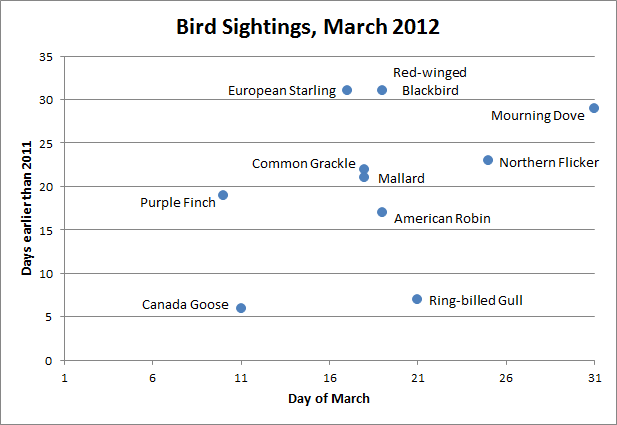
In my life outside of climate science, I am an avid fan of birdwatching, and am always eager to connect the two. Today I’m going to share some citizen science data I collected.

Last year, I started taking notes during the spring migration. Every time I saw a species for the first time that year, I made a note of the date. I planned to repeat this process year after year, mainly so I would know when to expect new arrivals at our bird feeders, but also in an attempt to track changes in migration. Of course, this process is imperfect (it simply provides an upper bound for when the species arrives, because it’s unlikely that I witness the very first arrival in the city) but it’s better than nothing.

Like much of the Prairies and American Midwest, we’ve just had our warmest March on record, a whopping 8 C above normal. Additionally, every single bird arrival I recorded in March was earlier than last year, sometimes by over 30 days.

I don’t think this is a coincidence. I haven’t been any more observant than last year – I’ve spent roughly the same amount of time outside in roughly the same places. It also seems unlikely for such a systemic change to be a product of chance, although I would need much more data to figure that out for sure. Also, some birds migrate based on hours of daylight rather than temperature. However, I find it very interesting that, so far, not a single species has been late.

Because I feel compelled to graph everything, I typed all this data into Excel and made a little scatterplot. The mean arrival date was 20.6 days earlier than last year, with a standard deviation of 8.9 days.

Back to me.

What is equally interesting as Kate’s Post above are some of the comments.  Like this one,

Roger

Doesn’t always work…

Here in central Illinois the robins depart in the fall and arrive in the spring; that’s the way it’s always been and that’s the way it should be, right?

Not anymore. Some years recently we’ve seen robins nearly the entire winter, if we can still call it that.

Our Canadian Geese have forgotten how to migrate.

and these two from ‘Climatehawk1’.

climatehawk1

Thanks, interesting info. I heard a mourning dove here (Vermont) Feb. 6, which is extraordinary. Some other items on birds:

Link to Boreal ducks said hurt by global warming

Link to Climate change plays major role in decline of blackbird species

climatehawk1

And also, specifically relating to recent migration patterns:

Link to In an Unusual Winter–Where and Why Birds Traveled

Thank you Kate for that interesting article.

More wisdom!

Further reflections on where next for US Energy policy.

Pumping our way to extinction!

On the 28th March, I republished a powerful essay from Patrice Ayme under my Post title of Questions are never stupid.  In fact, Patrice’s essay was called Energy Question For The USA and concluded thus:

Total oil sales, per day are about 100 million barrels (in truth the cap is lower, see graph above), at, say $100, so ten billion dollars a day, 3.6 trillion a year. The USA uses about 25% of that. Some have incorporated the price of the part of the gigantic American war machine and (what are truly) bribes to feudal warlords insuring Western access to the oil fields, and found a much higher cost up to $11 a gallon.

Ultimately, and pretty soon, in 2016, specialists expect oil prices to explode up, from the exhaustion of the existing oil fields. Then what?

Moreover, in 2016, the dependence upon OPEC, or, more exactly Arab regimes, is going to become much greater than now. What’s the plan of the USA? Extend ever more the security state, and go occupy the Middle East with a one million men army? To occupy, or not to occupy, that is the question.

Is it time for a better plan? And yes, any better plan will require consumers to pay higher energy prices. As consumers apparently want the army to procure the oil, they ought to pay for it.

So when Michael Klare published an essay just two days ago on TomDispatch entitled, Welcome to the New Third World of Energy, the U.S. it seemed highly relevant to have that follow-on from Patrice’s essay.  Again I am very grateful to Tom Engelhardt for giving me permission to republish.  Readers may like to know a little of Michael Klare’s background, from here:

Michael T. Klare is a professor of peace and world security studies at Hampshire College and the author of Resource Wars and Blood and Oil. Consider this essay a preview of his newest book, Rising Powers, Shrinking Planet: The New Geopolitics of Energy, which has just been published by Metropolitan Books. A brief video of Klare discussing key subjects in his new book can be viewed by clicking here.

So here is that essay.  I’m going to include Tom’s introduction because it’s fair to so do!

Tomgram: Michael Klare, Welcome to the New Third World of Energy, the U.S.

[Note for TomDispatch Readers:With today’s Michael Klare piece, you get your last chance to receive a signed, personalized copy of his new book, The Race for What’s Left: The Global Scramble for the World’s Last Resources, in return for a contribution of $100 or more to this website.  (Visit our donation page to check it out.)  The offer will end later this week.  Many thanks to those of you who have already given.  Klare’s book is little short of prophetic and the dollars you so generously send in really do help keep TomDispatch afloat! Tom]

Here’s a simple rule of thumb when it comes to energy disasters: if it’s the nuclear industry and something begins to go wrong — from Three Mile Island in Pennsylvania in 1979 to Fukushima, Japan, after the 2011 tsunami — whatever news is first released, always relatively reassuring, will be a lie, pure and simple.  And as the disaster unrolls, it’s not likely to get much better.  The nuclear industry is incapable of telling the truth about the harm it does.  So when the early stories appear about the next nuclear plant in trouble, whatever you hear or read, just assume that you don’t know the half, not even the quarter, of it.

When it comes to the oil and gas industry and disasters, a similar rule of thumb follows: however bad it first sounds, the odds are it’s going to sound a lot worse before it’s over.  (See BP, Deepwater Horizon.)  So when you first hear about an oil leak from a Chevron well off the coast of Brazil or from a natural gas well in the North Sea operated by the French oil giant Total and you getthose expectable reassurances, they, too, are likely to be nothing but gas.

And here’s the sad thing, you’re going to get all too many chances to test out these simple rules when it comes to bad energy news.  After all, as Michael Klare has been writing at this site for years, we’re entering the “tough energy” era.  The big energy companies are going to be extracting hydrocarbons in ever more hazardous, difficult-to-reach places like the Arctic and they’re going to be using ever uglier methods to do so.

It’s a guarantee that, however bad the environmental damage we’ve seen so far, it’s only going to get worse as the energy industry despoils various regions to give us our fossil-fuel fix and theirmega-profits.  As Klare points out, one of those regions is slated to be not in distant Africa, the Persian Gulf, or the Caspian Sea, but right here in the U.S.  Klare has been ahead of the energy curve ever since, in the late 1990s, he suggested that we would soon be on a planet embroiled in“resource wars.”  His new book, The Race for What’s Left: The Global Scramble for the World’s Last Resources, catches the nightmarish nature of the planet’s last energy boom in a way no one else has.  And don’t be surprised if that nightmare lands squarely in your backyard. Tom

A New Energy Third World in North America?
How the Big Energy Companies Plan to Turn the United States into a Third-World Petro-State 

By Michael T. Klare

The “curse” of oil wealth is a well-known phenomenon in Third World petro-states where millions of lives are wasted in poverty and the environment is ravaged, while tiny elites rake in the energy dollars and corruption rules the land.  Recently, North America has been repeatedly hailed as the planet’s twenty-first-century “new Saudi Arabia” for “tough energy” — deep-sea oil, Canadian tar sands, and fracked oil and natural gas.  But here’s a question no one considers: Will the oil curse become as familiar on this continent in the wake of a new American energy rush as it is in Africa and elsewhere?  Will North America, that is, become not just the next boom continent for energy bonanzas, but a new energy Third World?

Once upon a time, the giant U.S. oil companies — Chevron, Exxon, Mobil, and Texaco — got their start in North America, launching an oil boom that lasted a century and made the U.S. the planet’s dominant energy producer.  But most of those companies have long since turned elsewhere for new sources of oil.

Eager to escape ever-stronger environmental restrictions and dying oil fields at home, the energy giants were naturally drawn to the economically and environmentally wide-open producing areas of the Middle East, Africa, and Latin America — the Third World — where oil deposits were plentiful, governments compliant, and environmental regulations few or nonexistent.

Here, then, is the energy surprise of the twenty-first century: with operating conditions growing increasingly difficult in the global South, the major firms are now flocking back to North America. To exploit previously neglected reserves on this continent, however, Big Oil will have to overcome a host of regulatory and environmental obstacles.  It will, in other words, have to use its version of deep-pocket persuasion to convert the United States into the functional equivalent of a Third World petro-state.

Knowledgeable observers are already noting the first telltale signs of the oil industry’s “Third-Worldification” of the United States.  Wilderness areas from which the oil companies were once barred are being opened to energy exploitation and other restraints on invasive drilling operations are being dismantled.  Expectations are that, in the wake of the 2012 election season, environmental regulations will be rolled back even further and other protected areas made available for development.  In the process, as has so often been the case with Third World petro-states, the rights and wellbeing of local citizens will be trampled underfoot.

Welcome to the Third World of Energy

Up until 1950, the United States was the world’s leading oil producer, the Saudi Arabia of its day. In that year, the U.S. produced approximately 270 million metric tons of oil, or about 55% of the world’s entire output. But with a postwar recovery then in full swing, the world needed a lot more energy while America’s most accessible oil fields — though still capable of growth — were approaching their maximum sustainable production levels.  Net U.S. crude oil output reached a peakof about 9.2 million barrels per day in 1970 and then went into decline (until very recently).

This prompted the giant oil firms, which had already developed significant footholds in Indonesia, Iran, Saudi Arabia, and Venezuela, to scour the global South in search of new reserves to exploit — a saga told with great gusto in Daniel Yergin’s epic history of the oil industry, The Prize. Particular attention was devoted to the Persian Gulf region, where in 1948 a consortium of American companies — Chevron, Exxon, Mobil, and Texaco — discovered the world’s largest oil field, Ghawar, in Saudi Arabia.  By 1975, Third World countries were producing 58% of the world’s oil supply, while the U.S. share had dropped to 18%.

Environmental concerns also drove this search for new reserves in the global South. On January 28, 1969, a blowout at Platform A of a Union Oil Company offshore field in California’s Santa Barbara Channel produced a massive oil leak that covered much of the area and laid waste to local wildlife. Coming at a time of growing environmental consciousness, the spill provoked an outpouring of public outrage, helping to inspire the establishment of Earth Day, first observed one year later. Equally important, it helped spur passage of various legislative restraints on drilling activities, including the National Environmental Policy Act of 1970, theClean Water Act of 1972, and the Safe Drinking Water Act of 1974. In addition, Congress banned new drilling in waters off the Atlantic and Pacific coasts and in the eastern Gulf of Mexico near Florida.

During these years, Washington also expanded areas designated as wilderness or wildlife preserves, protecting them from resource extraction. In 1952, for example, President Eisenhower established the Arctic National Wildlife Range and, in 1980, this remote area of northeastern Alaska was redesignated by Congress as theArctic National Wildlife Refuge (ANWR). Ever since the discovery of oil in the adjacent Prudhoe Bay area, energy firms have been clamoring for the right to drill in ANWR, only to be blocked by one or another president or house of Congress.

For the most part, production in Third World countries posed no such complications. The Nigerian government, for example, has long welcomed foreign investment in its onshore and offshore oil fields, while showing little concern over the despoliation of its southern coastline, where oil company operations have produced a massive environmental disaster. As Adam Nossiter of the New York Timesdescribed the resulting situation, “The Niger Delta, where the [petroleum] wealth underground is out of all proportion with the poverty on the surface, has endured the equivalent of the Exxon Valdez spill every year for 50 years by some estimates.”

As vividly laid out by Peter Maass in Crude World, a similar pattern is evident in many other Third World petro-states where anything goes as compliant government officials — often the recipients of hefty bribes or other oil-company favors — regularly look the other way. The companies, in turn, don’t trouble themselves over the human rights abuses perpetrated by their foreign government “partners” — many of them dictators, warlords, or feudal potentates.

But times change.  The Third World increasingly isn’t what it used to be.  Many countries in the global South are becoming more protective of their environments, ever more inclined to take ever larger cuts of the oil wealth of their own countries, and ever more inclined to punish foreign companies that abuse their laws. In February 2011, for example, a judge in the Ecuadorean Amazon town of Lago Agrio ordered Chevron to pay $9 billion in damages for environmental harm caused to the region in the 1970s by Texaco (which the company later acquired).  Although the Ecuadorians are unlikely to collect a single dollar from Chevron, the case is indicative of the tougher regulatory climate now facing these companies in the developing world.  More recently, in a case resulting from an oil spill at an offshore field, a judge in Brazil hasseized the passports of 17 employees of Chevron and U.S. drilling-rig operator Transocean, preventing them from leaving the country.

In addition, production is on the decline in some developing countries like Indonesia and Gabon, while others have nationalized their oil fields or narrowed the space in which private international firms can operate. During Hugo Chávez’s presidency, for example, Venezuela has forced all foreign firms to award a majority stake in their operations to the state oil company, Petróleos de Venezuela S.A.  Similarly, the Brazilian government, under former President Luiz Inácio Lula da Silva, instituted a rule that all drilling operations in the new “pre-salt” fields in the Atlantic Ocean — widely believed to be the biggest oil discovery of the twenty-first century — be managed by the state-controlled firm, Petróleo de Brasil (Petrobras).

Fracking Our Way to a Toxic Planet

Such pressures in the Third World have forced the major U.S. and European firms — BP, Chevron, ConocoPhillips, ExxonMobil, Royal Dutch Shell, and Total of France — to look elsewhere for new sources of oil and natural gas.  Unfortunately for them, there aren’t many places left in the world that possess promising hydrocarbon reserves and also welcome investment by private energy giants. That’s why some of the most attractive new energy markets now lie in Canada and the United States, or in the waters off their shores.  As a result, both are experiencing a remarkable uptick in fresh investment from the major international firms.

Both countries still possess substantial oil and gas deposits, but not of the “easy” variety (deposits close to the surface, close to shore, or easily accessible for extraction).  All that remains are “tough” energy reserves (deep underground, far offshore, hard to extract and process). To exploit these, the energy companies must deploy aggressive technologies likely to cause extensive damage to the environment and in many cases human health as well.  They must also find ways to gain government approval to enter environmentally protected areas now off limits.

The formula for making Canada and the U.S. the “Saudi Arabia” of the twenty-first century is grim but relatively simple: environmental protections will have to be eviscerated and those who stand in the way of intensified drilling, from landowners to local environmental protection groups, bulldozed out of the way.  Put another way, North America will have to be Third-Worldified.

Consider the extraction of shale oil and gas, widely considered the most crucial aspect of Big Oil’s current push back into the North American market. Shale formations in Canada and the U.S. are believed to house massive quantities of oil and natural gas, and their accelerated extraction is already helping reduce the region’s reliance on imported petroleum.

Both energy sources, however, can only be extracted through a process known as hydraulic fracturing (“hydro-fracking,” or just plain “fracking”) that uses powerful jets of water in massive quantities to shatter underground shale formations, creating fissures through which the hydrocarbons can escape. In addition, to widen these fissures and ease the escape of the oil and gas they hold, the fracking water has to be mixed with a variety of often poisonous solvents and acids. This technique produces massive quantities of toxic wastewater, which can neither be returned to the environment without endangering drinking water supplies nor easily stored and decontaminated.

The rapid expansion of hydro-fracking would be problematic under the best of circumstances, which these aren’t.  Many of the richest sources of shale oil and gas, for instance, are located in populated areas of Texas, Arkansas, Ohio, Pennsylvania, and New York. In fact, one of the most promising sites, the Marcellus formation, abuts New York City’s upstate watershed area.  Under such circumstances, concern over the safety of drinking water should be paramount, and federal legislation, especially the Safe Drinking Water Act of 1974, should theoretically give the Environmental Protection Agency (EPA) the power to oversee (and potentially ban) any procedures that endanger water supplies.

However, oil companies seeking to increase profits by maximizing the utilization of hydro-fracking banded together, put pressure on Congress, and managed to get itself exempted from the 1974 law’s provisions. In 2005, under heavy lobbying from then Vice President Dick Cheney — formerly the CEO of oil services contractor Halliburton — Congress passed the Energy Policy Act, which prohibited the EPA from regulating hydro-fracking via the Safe Drinking Water Act, thereby eliminating a significant impediment to wider use of the technique.

Third Worldification

Since then, there has been a virtual stampede to the shale regions by the major oil companies, which have in many cases devoured smaller firms that pioneered the development of hydro-fracking. (In 2009, for example, ExxonMobil paid $31 billion to acquire XTO Energy, one of the leading producers of shale gas.)   As the extraction of shale oil and gas has accelerated, the industry has faced other problems. To successfully exploit promising shale formations, for instance, energy firms must insert many wells, since each fracking operation can only extend several hundred feet in any direction, requiring the establishment of noisy, polluting, and potentially hazardous drilling operations in well-populated rural and suburban areas.

While drilling has been welcomed by some of these communities as a source of added income, many have vigorously opposed the invasion, seeing it as an assault on neighborhood peace, health, and safety. In an effort to protect their quality of life, some Pennsylvania communities, for example, have adopted zoning laws that ban fracking in their midst. Viewing this as yet another intolerable obstacle, the industry has put intense pressure on friendly members of the state legislature to adopt a law depriving most local jurisdictions of the right to exclude fracking operations. “We have been sold out to the gas industry, plain and simple,” saidTodd Miller, a town commissioner in South Fayette Township who opposed the legislation.

If the energy industry has its way in North America, there will be many more Todd Millers complaining about the way their lives and worlds have been “sold out” to the energy barons.  Similar battles are already being fought elsewhere in North America, as energy firms seek to overcome resistance to expanded drilling in areas once protected from such activity.

In Alaska, for example, the industry is fighting in the courts and in Congress to allow drilling in coastal areas, despite opposition from Native American communities which worry that vulnerable marine animals and their traditional way of life will be put at risk. This summer, Royal Dutch Shell is expected to begin test drilling in the Chukchi Sea, an area important to several such communities.

And this is just the beginning. To gain access to additional stores of oil and gas, the industry is seeking to eliminate virtually all environmental restraints imposed since the 1960s and open vast tracts of coastal and wilderness areas, including ANWR, to intensive drilling. It also seeks the construction of the much disputed Keystone XL pipeline, which is to transport synthetic crude oil made from Canadian tar sands — a particularly “dirty” and environmentally devastating form of energy which has attracted substantial U.S. investment — to Texas and Louisiana for further processing. According to Jack Gerard, president of the American Petroleum Institute (API), the preferred U.S. energy strategy “would include greater access to areas that are currently off limits, a regulatory and permitting process that supported reasonable timelines for development, and immediate approval of the Keystone XL pipeline.”

To achieve these objectives, the API, which claims to represent more than 490 oil and natural gas companies, has launched a multimillion-dollar campaign to sway the 2012 elections, dubbed “Vote 4 Energy.” While describing itself as nonpartisan, the API-financed campaign seeks to discredit and marginalize any candidate, including President Obama, who opposes even the mildest version of its drill-anywhere agenda.

“There [are] two paths that we can take” on energy policy, the Vote 4 Energy Web site proclaims. “One path leads to more jobs, higher government revenues and greater U.S. energy security — which can be achieved by increasing oil and natural gas development right here at home. The other path would put jobs, revenues and our energy security at risk.” This message will be broadcast with increasing frequency as Election Day nears.

According to the energy industry, we are at a fork in the road and can either chose a path leading to greater energy independence or to ever more perilous energy insecurity. But there is another way to characterize that “choice”: on one path, the United States will increasingly come to resemble a Third World petro-state, with compliant government leaders, an increasingly money-ridden and corrupt political system, and negligible environmental and health safeguards; on the other, which would also involve far greater investment in the development of renewable alternative energies, it would remain a First World nation with strong health and environmental regulations and robust democratic institutions.

How we characterize our energy predicament in the coming decades and what path we ultimately select will in large measure determine the fate of this nation.

Michael T. Klare is a professor of peace and world security studies at Hampshire College, a TomDispatch regular, and the author of The Race for What’s Left: The Global Scramble for the World’s Last Resourcesjust published by Metropolitan Books.  To listen to Timothy MacBain’s Tomcast audio interview in which Klare discusses his new book and what it means to rely on extreme energy, click here, or download it to your iPod here.  Klare can be followed on Facebook.

Follow TomDispatch on Twitter @TomDispatch and join us on Facebook.

Copyright 2012 Michael T. Klare
Fascinating times indeed!

I am your dog!

A story about the bond between a dog and a human.

Introduction

I was clearing my desk yesterday (yet again) and came across an article that I wrote in 2007.  It’s a message of love; the love of a dog for a human.  But before going to that article, look at the photo below.  It’s a wonderful example of the joy of having Pharaoh in my life.  It was taken in July 2006 at the airfield in Devon, SW England, where a group of us shared a Piper Super Cub, about which I wrote in Learning from Dogs in August 2009.

If you think Pharaoh is smiling, I’m not going to argue with you.  First time in the Cub, first time strapped in to the rear seat, everything utterly strange and Pharaoh is clearly more joyful than the pilot!

Happiness is sharing life with your dog!

Anyway, to the article.  I wrote it in September, 2007, based on something that was sent to me from an unknown author, and modified to reflect the special relationship that I had, and still have, with my then four-year-old German Shepherd, Pharaoh.

I am your dog and have something I would love to whisper in your ear.

I am your dog and have something I would love to whisper in your ear.

I know that you humans lead busy lives. Some have to work, some have children to raise, some have to do this alone.  It always seems like you are running here and there, often much too fast, often never noticing the truly grand things in life.

Look down at me now. See the way my dark brown eyes look at yours.

You smile at me.  I see love in your eyes.  What do you see in mine?  Do you see a spirit? A soul inside, who loves you as no other could in the world? A spirit that would forgive all trespasses of prior wrongdoing for just a simple moment of your time?

That is all I ask. To slow down, if even for a few minutes, and be with me.

So many times, you have been saddened by others of my kind, passing on.  Sometimes we die young and oh so quickly, so suddenly it wrenches your heart out of your throat.  Sometimes, we age so slowly before your eyes that you may not even seem to know until the very end, when we look at you with grizzled muzzles and cataract-clouded eyes.  Still the love is always there, even when we must take that last long sleep dreaming of running free in a distant, open land.

I may not be here tomorrow.  I may not be here next week.  Someday you will shed the water from your eyes, that humans have when grief fills their souls, and you will mourn the loss of just ‘one more day’ with me.  Because I love you so, this future sorrow even now touches my spirit and grieves me. I read you in so many ways that you cannot even start to contemplate.

We have now together.  So come and sit next to me here on the floor and look deep into my eyes. Do you see how if you look deeply at me we can talk, you and I, heart to heart. Come not to me as my owner but as a living soul.  Stroke my fur and let us look deep into the other’s eyes and talk with our hearts.

I may tell you something about the fun of working the scents in the woods where you and I go.  Or I may tell you something profound about myself or how we dogs see life in general.  I know you decided to have me in your life because you wanted a soul to share things with.  I know how much you have cared for me and always stood up for me even when others have been against me.  I know how hard you have worked to help me to be the teacher that I was born to be.  That gift from you has been very precious to me.  I know too that you have been through troubled times and I have been there to guard you, to protect you, to be there for you always.

I am very different to you but here I am.  I am a dog but just as alive as you.

I feel emotion.  I feel physical senses.  I can revel in the differences of our spirits and souls. I do not think of you as a dog on two feet; I know what you are. You are human, in all of your quirkiness, and I love you still.

So come sit with me on the floor. Enter my world and let time slow down if only for a few minutes.  Look deep into my eyes and whisper in my ears. Speak with your heart and I will know your true self.

We may not have tomorrow but we do have now.

Postscript.

Just three months after writing the above, on December 17th, 2007, I flew in to Hemosillo Airport in Mexico to spend Christmas with Suzann, sister of dear friend Dan Gomez, and her husband Don down in the coastal town of San Carlos.  That’s when I met Jean, leading to me and Jean falling in love.  Jean then came to England and I came back to Mexico in June, 2008.  In September, 2008 Pharaoh and I left England permanently and travelled out to San Carlos to be with Jean and her dogs.  In February, 2010, Jean and I, Pharaoh and twelve other dogs, and six cats all moved to Payson, Arizona.

In November, 2010 Jean and I were married.  So the miracle for me and Pharaoh is that when I wrote that piece back in 2007 this most beautiful future was yet to unfold.    I never miss a day when I don’t, “… come sit with me on the floor. Enter my world and let time slow down if only for a few minutes.  Look deep into my eyes and whisper in my ears. Speak with your heart and I will know your true self.”  Now not just with Pharaoh but with Hazel, Dhalia, Sweeny, Casey, Loopy, Lilly, Ruby, and all the other beautiful dog souls.

Jean and me, Yecora, Sonora, Mexico. June 2008