Yesterday, I included Parts One and Two of a recent BBC television programme put out under the Horizon banner that had found their way onto YouTube.
Nothing more to say in this Post than to let you watch the concluding parts. As I wrote yesterday, this may change forever the way you look at everything!
There’s that wonderful quote from American comedian, Woody Allen, “What if everything is an illusion and nothing exists? In that case, I definitely overpaid for my carpet.”
But that quote may not be as silly as it first appears if I made sense of a programme that we watched recently. That was a documentary broadcast by the BBC under their fabulous science series known as Horizon. As an aside, the range of programmes covered over the years under the Horizon banner is fantastic as this web page from March 2008 demonstrates. An in-depth history of this BBC series is available on WikiPedia and the ‘Home’ page of the current Horizon website is here.
Anyway, back to this particular programme, What is Reality? Rather than me natter on about a subject that I don’t understand, despite being captivated by it, let me allow you to watch the programme courtesy of YouTube! Here is the first half of the programme split into two YouTube videos; the last half will be posted tomorrow.
Do yourself a favour and settle down to watch them undisturbed – as the programme says you may never look at the world around you in quite the same way again!
When I posted my introductory piece on Joseph Campbell on the 14th February, I was tight on time. So it was pretty brief, as a piece.
But I was amazed at the number of people who read that Post; clearly this man Campbell has reached out to many across the world. Plus there was this comment from Michelle, better known as Dogkisses.
What a wonderful man! My hero. I cried when he passed on. He is the first person who reached me in my mid-twenties.
A friend of mine introduced me to “The Power of Myth,” and gave me a video series, which is so old now the VHS won’t play. Bill Moyers (I think I have that name right) interviewed him in the series.
The last book I had about him was, “Radio Interviews with Joseph Campbell.” I gave it to my teenage son. He loved it so much, but his girlfriend said reading that book made him act differently. I laughed and said thank goodness. He said the book disappeared. I wondered how. She said it made him not want to work full time. He was only barely seventeen, and I was trying to get him to take a different path in life.
The world would be a better place if everyone could appreciate what Joseph Campbell said and for the great work he did in his life.
Thank you. A very nice way to start a hectic Monday.
And in reply to me thanking DK for her comment and offering her the chance to guest post on Learning from Dogs, this further comment,
I certainly look forward to the future posts.
I’m having a hard time with my memory and mental fatigue lately. I would have to re-read myself to be able to write about what I learned from Joseph Campbell, which actually might help me and I know I would enjoy it.
I’ve been turning back for the past few months, looking back to when I stood on more solid ground spiritually. Hearing Joseph Campbell again would certainly help me remember that time in my life, because I was reading his work. I have daily quotes from him that come to my Google reader.
Thank you for the invitation and I am truly honored that you ask. I can do some reading and see if my brain gives me anything to share.
Obviously only relevant to all those that are within reach of Payson, AZ. Apologies to my other readers.
Terry Hershey
Nationally Known Speaker and Writer will offer Free Seminars on March 14
Terry Hershey will visit Payson on Monday, March 14, to speak at Saint Paul’s Episcopal Church beginning at 2:00 p.m. and at the First Church of the Nazarene beginning at 7:00 p.m.
Mr. Hershey is an inspirational speaker, humorist and author who has been featured on The Hallmark Channel, CNN, and PBS. He holds a mirror up to our fast-forward, disconnected lives, and invites us to share the wisdom of taking an intentional moment to help regain our personal and spiritual balance.
Terry lives, writes and teaches with passion, purpose, heart and grace. He captivates his audience with the motto: “Do less, live more”. He creates an environment where we are given permission to become involved in the world around us, to want what we already have, to be embraced by moments of grace, to allow the child in us to play under a wide sky, to understand that laughter is a type of prayer and to take delight in our friends.
Terry Hershey is the author of ten books. The one that will be the focus of his inspirational presentation in Payson is “Soul Gardening”; winner of a “Book of the Year” award in 2010. Terry’s stories will nurture your soul and renew your sense of what it means to live fully alive. To hear Terry speak is a life-affirming experience. Everywhere he appears, the feedback has been unanimously positive. For example:
Terry Hershey was truly humorous, enlightening and inspiring to one and all. He gave us permission to be embraced by grace.
He was truly the highlight of our year!
Terry’s lectures and books inspire one to see that happiness is already inside.
Terry Hershey will be speaking as follows:
Monday afternoon, March 14:
From 2 p.m. to 4 p.m. at Saint Paul’s Episcopal Church parish hall, located at 1000 N. Easy Street, in Payson at the corner of Sherwood Drive. Note that seating and parking at St Paul’s is limited to about 50 people. If you plan to attend the afternoon session, please call 474-3834 to leave a message reserving a space.
Monday evening, March 14:
From 7 p.m. to 9 p.m. at the First Church of the Nazarene, 200 East Tyler Parkway, located at the northeast corner of Beeline Highway in northern Payson across from the Home Depot. The parish hall will comfortably accommodate up to 200 people. Please call 474-5890 to leave a message reserving a space.
These events are open to everyone at no charge. Refreshments will be available at both sessions. Please plan to bring a friend with you.
A good friend of Jeannie and me in Payson is John H. John has stimulated much wonderful thinking and reflection through conversation and the sharing of books and DVDs. It was John H. who introduced us to Joseph Campbell about whom I wrote on the 14th February.
Well the other day, John handed us a DVD of Peter Russell giving three talks. We watched it on Sunday evening. An amazing and inspiring experience. But first some information about Peter Russell from, of course, his own website! Peter describes himself as follows:
At Cambridge University (UK), he studied mathematics and theoretical physics. Then, as he became increasingly fascinated by the mysteries of the human mind he changed to experimental psychology. Pursuing this interest, he traveled to India to study meditation and eastern philosophy, and on his return took up the first research post ever offered in Britain on the psychology of meditation.
As one of the more revolutionary futurists Peter Russell has been a keynote speaker at many international conferences, in Europe, Japan and the USA. His multi-image shows and videos, The Global Brain and The White Hole in Time have won praise and prizes from around the world. In 1993 the environmental magazine Buzzworm voted Peter Russell “Eco-Philosopher Extraordinaire” of the year.
Now in terms of the video that we watched, it contained three films: The Global Brain; The White Whole in Time; From Science to God. In a very generous act the talk entitled The Global Brain is available to watch online – just click here. (Haven’t been over the website in detail but I suspect more of Peter’s material is available online.) That online version is the full talk of 35 minutes but you will get lost in time as you watch it!
But if, for now, you want a feel for Peter’s approach then here are a couple of YouTube videos. But a health warning, you may never look at the world around you in quite the same way!
and here are the first two parts of Waking up in Time (just over 6 minutes in total)
This Blog started on July 15th, 2009. At first there were a group of authors all committed to the vision but for various reasons they all were unable to maintain the very real challenges of writing a daily article and they amended the relationship to that of occasional guest author. My fellow founding author, Jon Lavin, has just completed a very demanding Master’s Degree which, for very valid reasons, has kept his nose to a different grinding wheel for the last 3 years. My greatest wish is that Jon can return to writing for this Blog simply because the original idea about dogs having much to teach us came from Jon.
The vision of why so many hours are spent managing and writing on Learning from Dogs is encapsulated here. One of the ideas expressed there is, “Our children require a world that understands the importance of faith, integrity and honesty“. This aspect has become more and more important in my mind. Within less than a month of this Post, I will have my first grandchild (the gender is a closely guarded secret!) When I look at some of the scenarios that could face that grandchild over the next four decades, it’s easy to feel pretty nervous. So being able to use the power of this electronically connected world to ramble on is my way to trying to do something!
This is leading me to the point of this Post. If it wasn’t for the growing number of readers, now several hundred a day, and the graciousness of those readers to find the time to comment, I think this Blog would have rolled over and gone back to sleep in front of the fire as Pharaoh is wont to do!
The comments have been fabulous and even selecting a couple seems unfair on the rest. But nonetheless that is what this article is going to include.
I feel quite positive about technology, including the Internet, but I also wish we could keep things like public libraries and continue to learn skills such as handwriting.
My nephew, an A student in college, recently had to take a handwriting course. My sis was embarrassed ’til she arrived finding many Mothers she knew there for the same reason. Many college students didn’t know how to write.
I volunteered once at a “Center for Independent Living.” One of the main services they offered was free Internet access to people with disabilities. I have since learned how important this is for people who are either bed-ridden or as with Chronic Fatigue Syndrome, stay home much of the time. It is a connection to the world. People can have a sense of community. This is a good thing.
I also love how quickly I can learn little things, such as words and how that might take me somewhere else to learn about something different. Pretty cool.
Maybe some people who have control in certain arenas are afraid that The People who are being controlled will, via the Internet, be heard and all too clearly.
Then last Friday, another reader, Steven Law, added an insightful comment to a Guest Post written by Patrice Ayme last December 10th., the Essence of the Civilizational Crisis, a very profound piece. This is what Steven wrote:
“To create public money, the money everybody uses (be it cash, electronic transfers, swaps, whatever) we use a private system, with proprietary money creating devices inside (say subprime, or derivatives). Civilization has never worked this way before, as the state previously was careful to stay the one and only money creator.”
What Patrice ignores here is that the State “creates” nothing. And I do not support “private” monopoly of money either.What I would like to entertain is the ability for a true free market (one in which we do not have) to explore competitive money, and yes, privately issued by competing banks. But that these banks would not operate on fractional reserve. They would largely operate their monies on a commodities basket reserve system. Not just precious metals, but multiple commodities as well.
At any rate you can learn more on this by reading F.A. Hayek’s “Good Money”pts. 1 & 2. Also I recommend spending some time at The Von Mises Institute online, great insights and education from an Austrian perspective on these matters.
I like your post, but find a few flaws in the argument. My main point here is that civilization has failed throughout history to keep the State under control and not allow state controlled money monopoly. Fiat currencies have failed miserably throughout history and are doing so again. We have some serious learning lessons coming our way…again.
Just want to expand on what I said about the State not creating anything. How can they create when the monies the receive are largely from coercion as well as monopoly? Therefore any “creation” by the State is at the expense of industry and freedom. Hence the need for a limited government.
I also recommend watching “Corporation Nation” on youtube. It’s pretty long and supports with verifiable evidence the depths our government has reached into fascism.
So there we are! Writing this Blog is a labour of love and having both readers and readers willing to comment keeps the love affair going! Thank you all, every one of you.
Finally, Steven mentions that YouTube video Corporation Nation. The whole series of videos is long but if you fancy starting in at the beginning, here it is.
Just try reading this without laughing till you cry!!!
Pocket taser Stun Gun, a great gift for the wife.
A guy who purchased his lovely wife a pocket Taser for their anniversary submitted this:
Last weekend I saw something at Larry’s Pistol & Pawn Shop that sparked my interest. The occasion was our 15th anniversary and I was looking for a little something extra for my wife Julie. What I came across was a 100,000-volt, pocket/purse-sized Taser.
The effects of the Taser were supposed to be short lived, with no long term adverse affect on your assailant, allowing her adequate time to retreat to safety…??
WAY TOO COOL! Long story short, I bought the device and brought it home… I loaded two AAA batteries in the darn thing and pushed the button. Nothing! I was disappointed. I learned, however, that if I pushed the button and pressed it against a metal surface at the same time, I’d get the blue arc of electricity darting back and forth between the prongs.
AWESOME!!! Unfortunately, I have yet to explain to Julie what that burn spot is on the face of her microwave.
Okay, so I was home alone with this new toy, thinking to myself that it couldn’t be all that bad with only two AAA batteries, right?
There I sat in my recliner, my cat Gracie looking on intently (trusting little soul) while I was reading the directions and thinking that I really needed to try this thing out on a flesh & blood moving target.
I must admit I thought about zapping Gracie (for a fraction of a second) and then thought better of it. She is such a sweet cat. But, if I was going to give this thing to my wife to protect herself against a mugger, I did want some assurance that it would work as advertised.
Am I wrong?
So, there I sat in a pair of shorts and a tank top with my reading glasses perched delicately on the bridge of my nose, directions in one hand, and Taser in another.
The directions said that:
a one-second burst would shock and disorient your assailant;
a two-second burst was supposed to cause muscle spasms and a major loss of bodily control; and
a three-second burst would purportedly make your assailant flop on the ground like a fish out of water.
Any burst longer than three seconds would be wasting the batteries.
All the while I’m looking at this little device measuring about 5″ long, less than 3/4 inch in circumference (loaded with two itsy, bitsy AAA batteries); pretty cute really, and thinking to myself, ‘no possible way!’
What happened next is almost beyond description, but I’ll do my best.
I’m sitting there alone, Gracie looking on with her head cocked to one side so as to say, ‘Don’t do it stupid,’ reasoning that a one second burst from such a tiny lil ole thing couldn’t hurt all that bad.. I decided to give myself a one second burst just for heck of it..
I touched the prongs to my naked thigh, pushed the button, and…
HOLY MOTHER OF GOD. WEAPONS OF MASS DESTRUCTION. WHAT THE… !!!
I’m pretty sure Hulk Hogan ran in through the side door, picked me up in the recliner, then body slammed us both on the carpet, over and over and over again. I vaguely recall waking up on my side in the fetal position, with tears in my eyes, body soaking wet, both nipples on fire, testicles nowhere to be found, with my left arm tucked under my body in the oddest position, and tingling in my legs!
The cat was making meowing sounds I had never heard before, clinging to a picture frame hanging above the fireplace, obviously in an attempt to avoid getting slammed by my body flopping all over the living room..
Note:
If you ever feel compelled to ‘mug’ yourself with a Taser,
one note of caution:
There is NO such thing as a one second burst when you zap yourself!
You will not let go of that thing until it is dislodged from your hand by a violent thrashing about on the floor! A three second burst would be considered conservative!
A minute or so later (I can’t be sure, as time was a relative thing at that point), I collected my wits (what little I had left), sat up and surveyed the landscape.
My bent reading glasses were on the mantel of the fireplace.
The recliner was upside down and about 8 feet or so from where it originally was.
My triceps, right thigh and both nipples were still twitching.
My face felt like it had been shot up with Novocain, and my bottom lip weighed 88 lbs.
I had no control over the drooling.
Apparently I had crapped in my shorts, but was too numb to know for sure, and my sense of smell was gone.
I saw a faint smoke cloud above my head, which I believe came from my hair.
I’m still looking for my testicles and I’m offering a significant reward for their safe return!
PS: My wife can’t stop laughing about my experience, loved the gift and now regularly threatens me with it!
If you think education is difficult, try being stupid!!!!
A very thoughtful article from an interesting website.
By definition, everyone reading this article will be doing it as a result of the incredible advances in digital communications. Thus it was that from today’s issue of Naked Capitalism there was reference to an article on a website called The Scholarly Kitchen, a site that I hadn’t come across before. I won’t reproduce the article in full – that doesn’t seem right. But I will present extracts to give you an idea of the thrust of the article.
The article is called The Battle for Control – What People who worry about the Internet are really worried about. Here’s how it starts:
Over the past few years, we’ve been witness to a parade of partisans in the debate over whether the Internet is making us smarter and more capable or turning us into shallow and superficial information parasites.
Nicholas Carr carries the most water for this argument, but others have joined in. Usually, their arguments that we’re going too far, becoming too fragmented, or becoming distracted are positioned to seem as if they have our best interests at heart — concern for our minds, our families, our communities, our culture.
. . . the Never-Betters, the Better-Nevers, and the Ever-Wasers. The Never-Betters believe that we’re on the brink of a new utopia, where information will be free and democratic. . . . The Better-Nevers think that we would have been better off if the whole thing had never happened, that . . . books and magazines create private space for minds in ways that twenty-second bursts of information don’t. The Ever-Wasers insist that at any moment in modernity something like this is going on, and that a new way of organizing data and connecting users is always thrilling to some and chilling to others.
And isn’t really their fear . . . that they are being replaced? Control in culture is shifting. We triumphalists — I don’t think I am one but, what the hell, I’ll don the uniform — argue that these tools unlock some potential in us, help us do what we want to do and better. The catastrophists are saying that we can be easily led astray to do stupid things and become stupid. One is an argument of enablement. One is an argument of enslavement. Which reveals more respect for humanity? That is the real dividing line. I start with faith in my fellow man and woman. The catastrophists start with little or none.
Throughout history, this fear of losing control has been consistently masked as concerns for higher, even altruistic interests. Jarvis quotes Erasmus (via Elizabeth Eisenstein’s new book, “Divine Art, Infernal Machine“), who said during the proliferation of books:
To what corner of the world do they not fly, these swarms of new books? . . . the very multitude of them is hurting scholarship, because it creates a glut, and even in good things satiety is most harmful. [The minds of men,] flighty and curious of anything new [are lured] away from the study of old authors.
Erasmus was worried about losing control over a world he’d mastered through his knowledge of old authors and stable cultural touchstones, and Carr is worried about losing control over a way of studying and thinking and processing information he’s become adept with. These are not the political leaders of the Middle East who are concerned about destabilization at an entirely different level (but for some of the same basic reasons, and from some of the same fundamental causes). Control has a softer side than anything we’d associate with authoritarianism.
Control can be channeled from competence and tradition. Change threatens both of these.
Do cut across and read the full article – it really is worth reading. It concludes thus:
It’s not that one is all good and one is all bad. There is a trade-off, an elusive balance, a mix of benefits and traits. In writing that seems prescient to both the pros and cons of humanity’s continuing exploration of its boundaries, Sigmund Freud once wrote:
Man has, as it were, become a kind of prosthetic god. When he puts on all his auxiliary organs he is truly magnificent; but those organs have not grown on to him and they still give him much trouble at times.
We may argue again and again whether the Internet is changing our brains, elevating us, lowering us, making us smarter, or making us stupid. But at the end of the day, it seems the real argument is about control — who has it, who shares it, and who wants it.
So, despite all the partisans, sophistry, and essays about our brains, our culture, our souls, it’s important to remember that what we’re really arguing about is control.
More musings on how this present civilisation is going to change, as change it must.
I have a sense that this article is going to spread across a number of posts. Regular readers of Learning from Dogs will be aware that I am summarising Lester Brown’s excellent book, World on the Edge. If you have missed those summaries, the last one, Part 4, was here. (Part 3 here, Part 2 here, Part 1 here.)
Details of this excellent book are on the Earth Policy Institute website including the opportunity to download the book for free.
OK, back to the theme of this article, very much connected with the mission of the EPI.
Jean and I watched a video last night from the website Top Documentary Films; great site by the way. It was called 2210: The Collapse. This was how the film was described on that website.
Imagine if hundreds of years from now, scientists excavated the abandoned ruins of some of our largest cities, what conclusions would they come to?
It happened to the Romans, the Anasazi, and the Mayans and, inevitably, one day our own modern civilization will also fall. In this two hour special discover how a future civilization might be baffled as to why the population of these once-great cities would suddenly abandon their technology and architecture, and turn their homes into ghost towns.
Some experts believe that there is a very real risk this could happen, and the collapse of the world as we know it is closer than we think.
Examining the parallels between cultures separated by hundreds of years, explore whether the key to preventing such a global collapse today could lie in finding renewable alternatives to our dwindling energy supplies and sustainable resources. Can we learn from the mistakes of the past before it’s too late?
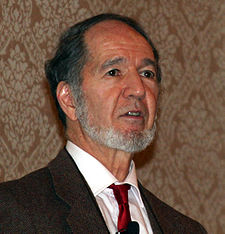
Jared Diamond
In some ways the film didn’t cover any new ground despite it being an interesting way of approaching the subject of the future of our present civilisation. But what was really worthwhile were the clips from three experts in their various fields. They were the author Jared Diamond, Daniel Gilbert who is Professor of Psychology at Havard, and Joseph Tainter also an author. There is much material around from these three gentlemen.
So I am going to start with Jared Diamond. WikiPedia has Jared’s details. The following is a video going back to 2003 which is no less relevant in terms of where we are in 2011. (If you want more of Jared’s ideas, just let me know and they will be included in a future Post.)
“I’ve set myself the modest task of trying to explain the broad pattern of human history, on all the continents, for the last 13,000 years. Why did history take such different evolutionary courses for peoples of different continents? This problem has fascinated me for a long time, but it’s now ripe for a new synthesis because of recent advances in many fields seemingly remote from history, including molecular biology, plant and animal genetics and biogeography, archaeology, and linguistics.”
JARED DIAMOND is Professor of Geography at the University of California, Los Angeles. Until recently he was Professor of Physiology at the UCLA School of Medicine. He is the author of the recently published Collapse: How Societies Choose to Fail or Succeed, and the Pulitzer Prize-winning author of the widely acclaimed Guns, Germs, and Steel: the Fates of Human Societies, which also is the winner of Britain’s 1998 Rhone-Poulenc Science Book Prize. (From here)

 Learning from Dogs