Except to thank Neil K. for passing it on.
Note: almost certainly this image is copyright protected, see here.
Dogs are animals of integrity. We have much to learn from them.
Year: 2011
Except to thank Neil K. for passing it on.

Note: almost certainly this image is copyright protected, see here.
The wonderful combination of paragliding and flying with hawks.
Thanks to Dan Gomez for passing me a short video about this amazing activity. It was a matter of moments to find out the background. But first a picture.

There’s a full description of the history of parahawking, as it is called, on WikiPedia.
Parahawking is a unique activity combining paragliding with elements of falconry. Birds of prey are trained to fly with paragliders, guiding them to thermals for in-flight rewards and performing aerobatic maneouvres.
Parahawking was developed by British falconer Scott Mason in 2001. Mason began a round-the-world trip in Pokhara, Nepal, where many birds of prey – such as the griffon vulture, steppe eagle andblack kite – can be found. While taking a tandem paragliding flight with British paraglider Adam Hill, he had the opportunity to see raptors in flight, and realized that combining the sport of paragliding with his skills as a falconer could offer others the same experience. He has been based in Pokhara ever since, training and flying birds during the dry season between September and March.
The team started by training two black kites, but have since added an Egyptian vulture and a Mountain hawk-eagle to the team. Only rescued birds are used – none of the birds has been taken from the wild.
There’s an interesting website for those that want to take a closer including more details about Scott Mason and his team here.
Now watch this!
Just some wonderful pictures of people and their pet dogs!
It’s 2pm Mountain Time on the 28th. I wanted to get a deeper post written for tomorrow (today as you are reading this!) but somehow too many things have been happening today.
So I’m ‘cheating’ and using a recent email sent to me by Cynthia Gomez, Dan’s lovely wife, that was called When your dog is your best friend. It contained some fabulous photographs of people and their pet dogs. A quick Google search showed that they came from a website devoted to finding homes for pets, Just One More Pet. Enjoy the pics.


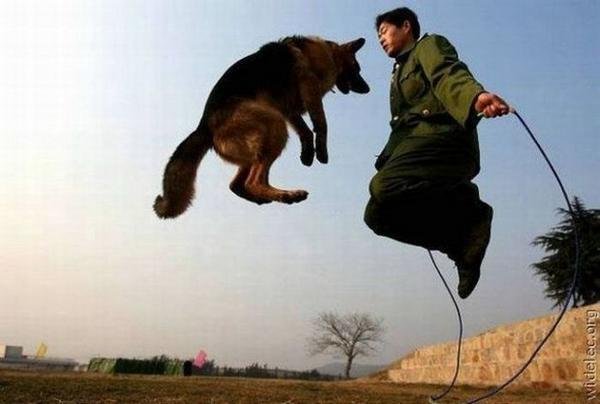
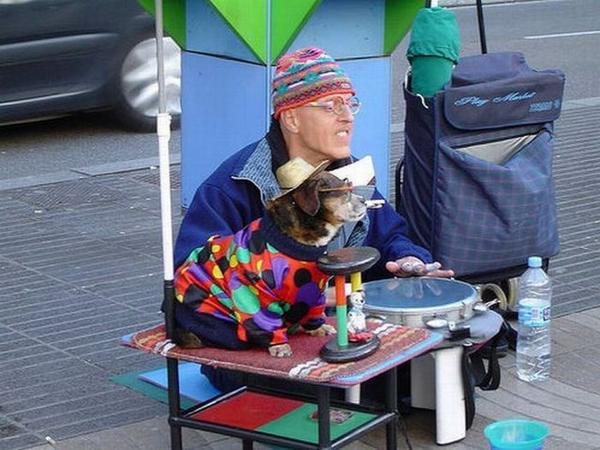
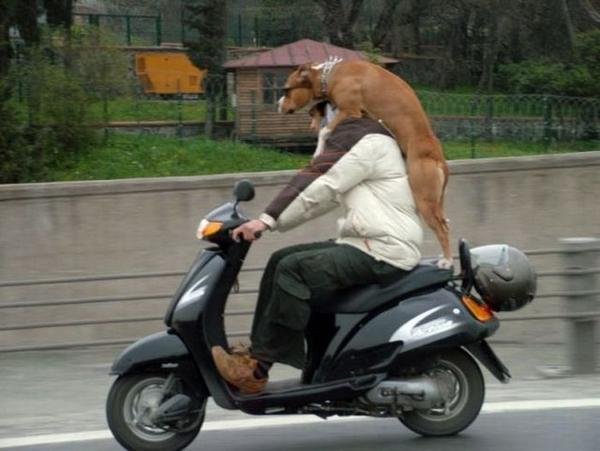
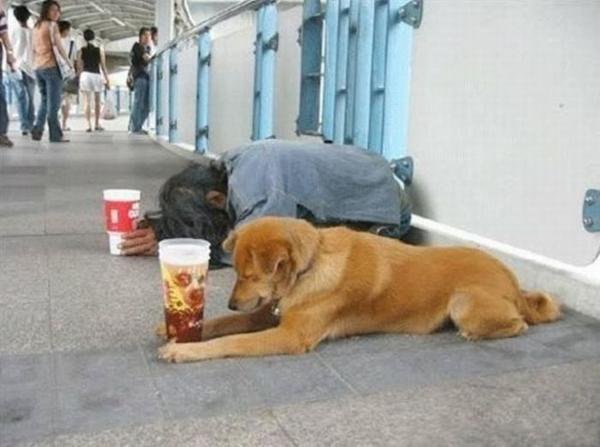
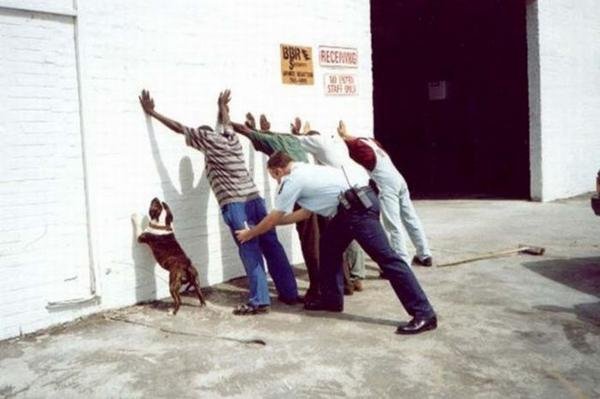
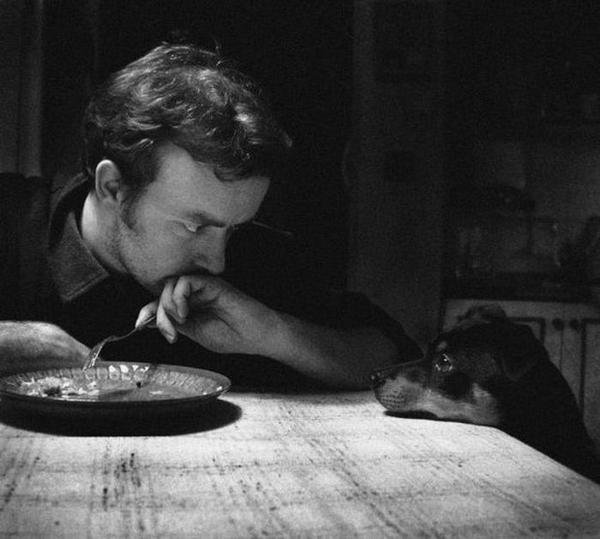
Thanks Cynthia for sharing those – heart-melting stuff!
Just a bit more science about that sixth sense.
Yesterday, I wrote about how science was coming up with some pretty strong evidence that humans do have the ability to communicate in a way that might be called ‘telepathic’.
If (and that’s a big ‘if’) I have any understanding of the science, I believe it has much to do with quantum physics. So I thought it fun to take a small diversion in today’s Post and give you some material on this very strange world of the very, very small.
From A Lazyman’s Guide to Quantum Physics,
What is Quantum Physics?
That’s an easy one: it’s the science of things so small that the quantum nature of reality has an effect. Quantum means ‘discrete amount’ or ‘portion’. Max Planck discovered in 1900 that you couldn’t get smaller than a certain minimum amount of anything. This minimum amount is now called the Planck unit.
Why is it weird?
Niels Bohr, the father of the orthodox ‘Copenhagen Interpretation’ of quantum physics once said, “Anyone who is not shocked by quantum theory has not understood it“.
To understand the weirdness completely, you just need to know about three experiments: Light Bulb, Two Slits, Schroedinger’s Cat.
Two Slits
The simplest experiment to demonstrate quantum weirdness involves shining a light through two parallel slits and looking at the screen. It can be shown that a single photon (particle of light) can interfere with itself, as if it travelled through both slits at once.
Light Bulb
Imagine a light bulb filament gives out a photon, seemingly in a random direction. Erwin Schroedinger came up with a nine-letter-long equation that correctly predicts the chances of finding that photon at any given point. He envisaged a kind of wave, like a ripple from a pebble dropped into a pond, spreading out from the filament. Once you look at the photon, this ‘wavefunction’ collapses into the single point at which the photon really is.
Schroedinger’s Cat
In this experiment, we take your pet cat and put it in a box with a bottle of cyanide. We rig it up so that a detector looks at an isolated electron and determines whether it is ‘spin up’ or ‘spin down’ (it can have either characteristic, seemingly at random). If it is ‘spin up’, then the bottle is opened and the cat gets it. Ten minutes later we open the box and see if the cat is alive or dead. The question is: what state is the cat in between the detector being activated and you opening the box. Nobody has actually done this experiment (to my knowledge) but it does show up a paradox that arises in certain interpretations.
To conclude I will offer this quotation reputed to be from the great master himself, Albert Einstein,
The more success the quantum theory has, the sillier it looks.
Science is catching up with dogs!
Those of you who have come across Rupert Sheldrake and, in particular his book Dogs That Know When Their Owners Are Coming Home will really not be surprised at what is coming, in terms of the rest of this Post. Because most dog owners know, from countless observations, that dogs have an uncanny ability to see the world around them in a more deeper and intuitive manner than we can explain.
I wrote of Sheldrake’s book on the 1st June including touching on a report of Mason, a small terrier mix …
On April 27th, Mason was hiding in his garage in North Smithfield when the storm picked him up and blew him away. His owners couldn’t find him and had about given up when they came back Monday to sift through the debris, and found Mason waiting for them on the porch.
A few evenings ago, we watched a documentary from the website Top Documentary Films from the series Through The Wormhole. This particular documentary was entitled Is There a Sixth Sense? Here’s how that film was introduced,
Sight, hearing, smell, taste and touch are the tools most of us depend on to perceive the world. But some people say they also can perceive things that are outside the range of the conventional senses, through some other channel for which there is no anatomical or neurological explanation. Scientific researchers who study such abilities call them extrasensory perception (ESP), but lay people often refer to them as the sixth sense.
Either term really is a catch-all for a variety of different purported abilities that vary from person to person. Some people claim the power of telepathy – that is, the ability to perceive others’ thoughts, without having them communicated verbally or in writing. Others claim to have the power of clairvoyance, which is the ability to perceive events and objects that are hidden from view because of barriers or distance. Still others claim to be gifted with precognition, which enables them to look into the future and glimpse what hasn’t yet occurred.
The belief in ESP or the sixth sense dates back thousands of years. The Greek historian Herodotus wrote that Croesus, who ruled a kingdom in what is now Turkey in the sixth century B.C., consulted oracles – that is, groups of priests claimed to be able to predict the future — before he went to war. In ancient India, Hindu holy men were believed to possess the power to see and hear at a distance, and to communicate through telepathy.
In the late 1700s, the Viennese physician Franz Mesmer claimed that he could give people ESP powers by hypnotizing them. Just before his assassination in 1865, President Abraham Lincoln told friends that he’d dreamed of his own body lying in state in the White House. In the 20th century, Edgar Cayce and Jean Dixon attracted wide followings by claiming that they could foresee future events. During the Cold War, U.S. military and intelligence agencies, spurred by reports that the Soviets had psychics at their disposal, even tried to utilize clairvoyants who claimed remote-viewing powers for espionage purposes.
As well as watching it directly from the Top Documentary Films website, it is also available from YouTube. Here are the four links. It is a most fascinating review of the scientific findings in this area. If you have a dog with you when you watch the videos, don’t be surprised if he or she fall asleep! Nothing new for dogs in all this!
A focus on Tim Bennett’s movie, What a Way To Go: Life at the end of Empire
We first came across this film, made by independent film-maker Tim Bennett, on the Top Documentary Films website, see here. The title to this article comes from that introduction, from which is quoted,
Tim Bennett, middle-class white guy, started waking up to the global environmental nightmare in the mid-1980s. But life was so busy with raising kids and pursuing the American dream that he never got around to acting on his concerns. Until now…
Bennett journeys from complacency to consciousness in his feature-length documentary, What a Way To Go: Life at the End of Empire. He reviews his Midwestern roots, ruthlessly examines the stories he was raised with, and then details the grim realities humans now face: escalating climate change, resource shortages, degraded ecosystems, an exploding global population and teetering global economies.
Now to be honest, this is a film that is both captivating and, in parts, pretty grim. A couple of trailers and other background material were posted on Learning from Dogs back in February.
The film also has an excellent web site What a Way To Go Movie which contains much background material including the opportunity to watch the film for free, click here. Or a quick YouTube search will bring you to here.
My own view is that this is a ‘must see’ film. Not because I want all of you to wallow in doom and gloom, far from it, but because, as Paul Gilding writes in his book, The Great Disruption, the quicker that mankind recognises the massive levels of denial presently in place, the quicker that mankind will commit to the scale of change that is required. That’s where Paul Gilding’s approach differs from the movie, The End of Empire. Gilding is optimistic that man will bring about change simply because fairly soon, in just a few years, it will be obvious at all levels in our societies that there simply is no choice!
A retrospective muse about the present global challenges.
A few days back I posted an article by Tom Engelhardt called The Great American Carbon Bomb. It attracted a number of comments including a couple from Learning from Dogs supporter, Patrice Ayme. Here is one of those comments,
Dear Paul: There is a gentleman leading the Tour de France, right now. He was not given a chance, especially in the mountains. However, he has been going day by day, and has now worn the Yellow Jersey for more than a week, supported by his inferior, but dedicated team. His philosophy: humility, and do the job day by day, trying his best, although he strongly doubts that he is up to the task.
We, as humankind, or, rather, our hubristic leaders are doing the exact opposite. We are not doing our best, and it’s precisely because those leaders are not humble and not honest, and so very sure we are going to pull out OK, because that’s what we do best, and have always done, and thus will always do.
Verily all indicators are that of an unfolding catastrophe. All signals are loud and clear that way. So it’s really not the moment to say:”Oh, BTW, we are very resilient and totally great, so it’s just a matter of time before we put it all together OK. So now let’s all pull together, and it’s fine.”
In truth we are on the verge of an irreversible situation, as the CO2 poisoning will turn, within a decade or so, into a political, and then military issue.
PA
Patrice is an angry man (not a criticism by the way – so many of us are angry!) and anger is a great reason to find someone, something, anything, to blame! I suspect, wearing my cloak of an amateur psychologist, that a core reason why we feel anger is that, so often, the causes of our anger are our own errors. Anger at one’s self is much more difficult to deal with!
Anyway, back to the plot.
Like Patrice I also feel badly let down by our ‘leaders’. Especially with regard to the nightmare of economic and ecological issues fast approaching.
Then I read this in Paul Gilding’s book, The Great Disruption, that has been featured on this Blog a couple of times.
Our addiction to growth is a complex phenomenon, one that can’t be blamed on a single economic model or philosophy. It is not the fault of capitalism or Western democracy, and it is not a conspiracy of the global corporate sector or of the rich. It is not a bad idea that emerged in economics, and it is not the result of free market fundamentalism that emerged in the 1980s with globalization. While each of those factors is involved, it is too simple and convenient to blame any of them as the main driver. Growth goes to the core of the society we have built because it is the result of who we are and what we have decided to value. [Chapter 5, Addicted to Growth, p66]
That last half of that last sentence – ‘it is the result of who we are and what we have decided to value.‘ That strikes me as the core truth. It is the reason why Patrice, and me, and countless thousands of others across the globe, are so angry. At heart we all know that the circumstances we find ourselves in are, in great part and before we ‘saw the light’, the result of earlier personal values which we now know were not compatible with a sustainable relationship with the planet we all live on.
It is very good news. That anger is fuelling change. As Malcolm Gladwell writes in his book The Tipping Point societies change when something of the order of 18% of individuals emotionally commit to change.
Another one of those ‘cute’ moments.
I subscribe to Naked Capitalism, as many of you will be aware, and in their 20th July release were the following photos,
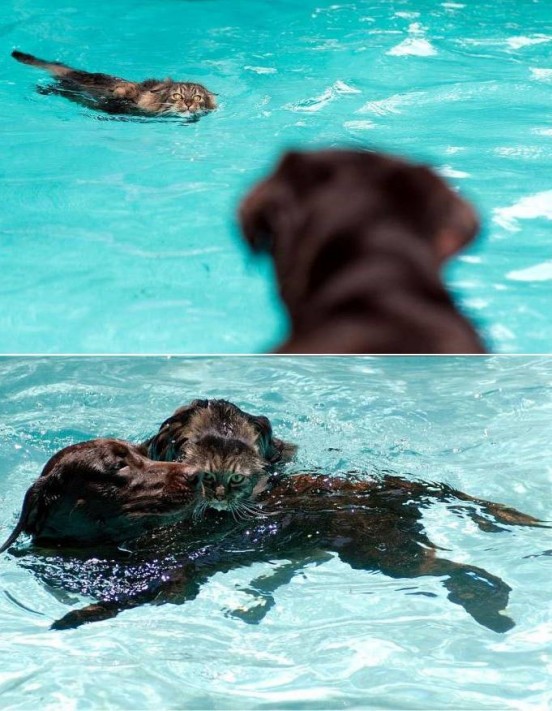
In fact, a quick Google search reveals that the photographs have been widely circulated over recent years and in all probability the source and original story are long lost by now.
Enjoy the rest of the day!
A book review

While being born an Englishman in 1944 has me slightly ahead of the so-called Baby Boomer period, which in American terms, ergo the U.S. Census Bureau, is defined as those born between January 1st, 1946 and December 31st, 1964, American and British people born in those ‘boomer’ years after WWII share many attitudes.
However, there is one stark difference between the UK and the USA regarding that period; the Vietnam War.
U.S. military advisors arrived beginning in 1950 and that U.S. involvement escalated in the early 1960s, with U.S. troop levels tripling in 1961 and tripling again in 1962.
Many good young Americans paid the ultimate price for that involvement (58,220 U.S. service members died in the conflict).
Why do I mention this? Because just as so many Americans have no idea of the scale of enemy bombing that England suffered during WWII, just as many Brits have no idea of the scale of the ‘draft’ (i.e. conscription) that was employed by the U.S. Government as the Vietnam involvement grew.
Now keep that in mind as a means of adding context to what follows.
Until Tuesday is a book of many extremes. It is a powerful book, a disturbing book, and a book about the beauty, dignity and, sadly, the madness of man.
I have been talking to a good friend of my life-long Californian pal, Dan Gomez. Let me just call him Tom. Tom saw service in Vietnam. This is how Tom describes his early experiences.
I was young and keen for some adventure. I had watched many war movies so I knew exactly what war was all about. So I enlisted as a soldier and was shipped out to Vietnam. After 60 days, I had experienced sufficient to know that things were not as they were portrayed by the media and the reality of Vietnam was very different to those movies. I had seen enough and was ready to come home.
Except that it didn’t work that way. I was there for a full tour of duty.
It became increasingly apparent by our behavior that we were not there to liberate the masses. We were there because some politicians had a theory and because of it didn’t want the locals to have a democratic election. So good people were put into harm’s way, died or were severely injured for no other reason than some politicians had a theory – that proved to be false in the end.
Through it all, the biggest pain that I suffered was to see my Government operating under false pretences, with no integrity and no dignity. It left me with a deep anger and mistrust of government that is still deep inside me.
Tom’s very personal and intimate sharing of his experiences of Vietnam resonates powerfully with what Captain Montalvan experienced in Iraq. Here’s an extract from the book,
I am an American soldier. I am an expert and I am a professional.
But at the same time, I was coming unmoored, my mind dwelling on the hand-to-hand struggle for my life, the Syrian ambush, the sandstorms, the riots, and Ali, Emad and Maher, the men left behind.
I am a guardian of freedom and the American way of life.
The wife of one of my best men from Al-Waleed had become pregnant during his midtour leave. The foetus was fatally deformed, but Tricare, the army’s health service, doesn’t provide abortions under any circumstances, and she was forced to carry the child to term. I will never accept defeat. Little Layla was born without a nose and several internal organs. Her parents had no financial resources on a soldier’s pay to provide her comfort. I emailed everyone I knew for help – hundreds of dollars were sent to the sergeant and his family. Nevertheless, it was heartbreaking, absolutely heartbreaking, to hold Layla in my hands. I will never quit. She lived eight weeks, and the difficulty of her life, and the inhumanity of forcing that existence not only from her but her parents too – I will never leave a fallen comrade – fuelled my downwards drive.
I was angry with the army. Not on the surface, but underneath, in the depth of my mind. Why did Layla and her parents have to endure that pain, especially after everything they had already endured? Why were they forcing our regiment back to Iraq just ten months after our return? Why weren’t they helping us cope with our pain? We were badly banged up. We were undermanned and underequipped. The army didn’t care. They were churning us through. They cared more about getting us back to Iraq and making the numbers than they did about our health and survival.
It was the summer of 2004. Victory was slipping away. Everyone could see that, but the media kept pounding the message: ‘The generals say there are enough men. The generals say there is enough equipment. The generals say everything is going well.’ It was a lie. The soldiers on the line knew it because we were the ones suffering. We were the ones who endured days of enemy mortar fire when we arrived in Iraq without weapons or ammunition, as my eighty troopers had in Balad in 2003; we were the ones going back in 2005 without adequate recovery time or armour for our Humvees. And that is the ultimate betrayal: when the commanding officers care more about the media and the bosses than about their soldiers on the ground. [Chapter 5, An American Soldier, pps 88-89]
So the first thing that most definitely comes out of the pages of Until Tuesday is the depth of disconnect between Montalvan as an active soldier in the front line and his nation. Just like Tom in Vietnam!
It’s not until Chapter 8, The Thought of Dogs, that the author moves on from his obsessiveness about his military experiences to his future world. Please realise that when I use the word ‘obsessiveness’, in no way is it used as a derogatory term. One of the symptoms of mental insecurity is the ease with which we can obsess on things in our lives.
Here’s how Chapter 8 starts,
I can’t tell you how much my life changed when I read the email on 1 July 2008. (A Tuesday, I just realised. I’ll have to add that to my list of fake reasons for Tuesday’s name.) The Wounded Warrior Project, the veteran service organisation I went with to the Bruce Springsteen concert, forwarded the message. They forwarded messages every day, actually, but I usually didn’t read them. This tagline intrigued me: ‘WWP and Puppies Behind Bars’. Puppies behind bars?
The message was almost as simple: ‘Dear Warriors, please note below. Puppies Behind Bars has 30 dogs a year to place, free of charge, with veterans from Iraq or Afghanistan who are suffering from PTSD, traumatic brain injuries or physical injuries. I’ve attached the Dog Tags brochure which explains the programme, as well as the Dog Tags application.’
As soon as I read the attached description, I knew the programme was for me. I suffered from debilitating social anxiety, and the dogs were trained to understand and soothe emotional distress. I suffered from vertigo and frequent falls, and a dog could keep me stable. Because of my back I could barely tie my own shoes, and a dog could retrieve and pick things up for me. I was the perfect candidate. I was down, but I was working towards a future. I was a leader, so I would never give up. And I was lonely. Terribly, terribly lonely.
From this point onwards the remaining 189 pages of Until Tuesday are about Luis Montalvan’s recovery built upon the foundation of his beautiful relationship with Tuesday, his service dog.
Of course there are ups and downs, as there are in all our lives, but the overall message is clear. A dog loves a human in the most beautiful and purest fashion of all. That unconditional, undemanding love for the humans in that dog’s life unlock even the most damaged souls. Tuesday unlocked the private hell that Captain Montalvan endured for so long.
In the privacy of a deep hug of your dog lays release. From that release comes peace, understanding and the desire to re-connect with the larger world. There is no greater gift than that.
So standing back in terms of reviewing this book (I reviewed the UK edition) here are my thoughts.
Perhaps I should close by saying this. I didn’t have to pay for the book, it was sent to me on a complimentary basis once I had agreed to do the review. In the UK Until Tuesday is published by Headline Publishing. However, having read the book I realise that to have missed the opportunity of reading it would have left my life a little poorer.
Footnote
A note for all those that have been good enough to read to the end! This post published today is the 1,000th post since Learning from Dogs first saw the light of day on July 15th, 2009. That it has reached this point is a direct result of the number of readers and the support that so many of you give to this rather crazy enterprise! Thank you all!
 Learning from Dogs