Year: 2011

And more on consciousness!

Two recent videos highlight the mystery and fascination of determining what, exactly, is consciousness.

Before I get started, it crossed my mind that some readers on Learning from Dogs might struggle finding any link between the the title of the Blog and such esoteric topics as consciousness.  Let me try and explain.  On the home page of this Blog is written,

But 10,000 years of farming the planet’s plant and mineral resources have brought mankind to the edge of extinction, literally as well as metaphorically.

Dogs know better!  Time again for man to learn from dogs!

Here’s a recent comment I made to an article on Naked Capitalism,

In a much broader sense, it feels to me as though we have been partying on the edge of a global volcano for years and years. Greece is surely a metaphor for the craziness of so many countries.

Continuing that broader sense, the period that we are in, from political, economical, societal, environmental and ethical perspectives, seems bust. Good will eventually come out of this transition, of that I have no doubt, but what a fascinating period in which to be alive!

I firmly believe that the period we are presently living through is a transition between the last, say 30 years (in a sense, many more decades than that) and a more aware, sensitive period where mankind embraces a deeper, sustainable, relationship with the planet that is home and life to all of us.  Frankly, there is no choice!

Thus the nature of consciousness, our awareness of self, is a crucial element of the future.  The greater our self-awareness, the greater our self-understanding and from that better self-understanding comes all hope of recognising our attitudes and knowing that it is our attitudes that drive our behaviours.

So here follow two videos.  Settle back and be entranced!

The first is the last episode in a brilliant BBC series broadcast in 2007, probably one of the best TV series on psychology and neuroscience ever produced.  The full series is on Top Documentary Films but the last episode called The Final Mystery is all about consciousness.  Beware you are going to never see the world in quite the same way!

Here it is, The Final Mystery presented by neuroscientist Susan Greenfield.

The second video is from Season Two of the Through the Wormhole series.  It is called Is there Life after Death? and also explores the deeper aspects of consciousness.  As the introduction to the video says,

In the premiere episode of the second season of Through the Wormhole, Morgan Freeman dives deep into this provocative question that has mystified humans since the beginning of time.

Modern physics and neuroscience are venturing into this once hallowed ground, and radically changing our ideas of life after death.

Freeman serves as host to this polarized debate, where scientists and spiritualist attempt to define what is consciousness, while cutting edge quantum mechanics could provide the answer to what happens when we die.

Here’s the film; same health warning applies!  You are going to see the world differently after watching this!

Finally, do you have a dog at home?  If you do, ponder on how their conscious world engages them.  If science can’t explain human consciousness then all we have is our own intuition with regard to animals.  Not sure about you but when one is feeling a little low and a dog comes up and lays a head across you I feel a very strong conscious connection.

Space, where to now?

A rather poignant moment as the last NASA Space Shuttle is programmed to launch today.

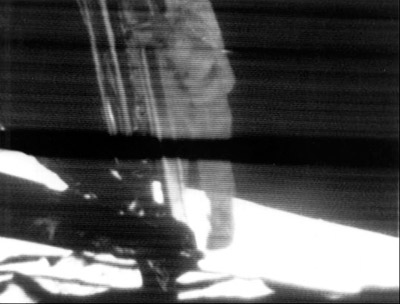
Many of my age will have been fascinated by man’s progress in exploring space, from the Russian Sputnik 1 launched into earth orbit in October, 1957 (I was 12!) through to man first putting a foot on the surface of the moon on 20th July, 1969 on the US Apollo 11 Mission.

Still frame from the video transmission of Neil Armstrong stepping onto the surface of the Moon at 02:56 UTC on 21 July 1969.

Today, the end of an era is being played out.  Today, the last Space Shuttle, Atlantis, is due to be launched.  From the NASA website,

Date: July 8 
Mission: STS-135
Launch Vehicle: Space Shuttle Atlantis
Launch Site: Kennedy Space Center – Launch Pad 39A
Launch Time: 11:26 a.m. EDT
Description: Space shuttle Atlantis will carry the Raffaello multipurpose logistics module to deliver supplies, logistics and spare parts to the International Space Station. Atlantis also will fly a system to investigate the potential for robotically refueling existing spacecraft and return a failed ammonia pump module.

The BBC recently had an interesting news item where all six crew members of Shuttle Discovery were interviewed after that last flight, more details including a video of the interview here.

Astronauts of shuttle Discovery describe ‘amazing’ craft

At almost 27 years old, and with more than 143 million miles on the clock, the space shuttle Discovery returned from her final mission in March.

The crew of Discovery’s final mission, Commander Steve Lindsey, astronauts Eric Boe, Stephen Bowen, Alvin Drew, Michael Barratt and Nicole Stott, spoke to Breakfast News about what it was like to fly the shuttle for the last time.

So where does it go from here?

The current edition of The Economist has a quite a lot to say about that.  A leader starts with raising the question of how big the Earth is?

HOW big is the Earth? Any encyclopedia will give you an answer: its equatorial diameter is 12,756km, or, for those who prefer to think that way, 7,926 miles. Ah, but then there is the atmosphere. Should that count? Perhaps the planet’s true diameter is actually nearer 13,000km, including all its air. But even that may no longer be an adequate measure. For the Earth now reaches farther still. The vacuum surrounding it buzzes with artificial satellites, forming a sort of technosphere beyond the atmosphere. Most of these satellites circle only a few hundred kilometres above the planet’s solid surface. Many, though, form a ring like Saturn’s at a distance of 36,000km, the place at which an object takes 24 hours to orbit the Earth and thus hovers continuously over the same point of the planet.

Later, this leader speculates,

The reason for that second objective is also the reason for thinking 2011 might, in the history books of the future, be seen as the year when the space cadets’ dream finally died. It marks the end of America’s space-shuttle programme, whose last mission is planned to launch on July 8th (see articlearticle). The shuttle was supposed to be a reusable truck that would make the business of putting people into orbit quotidian. Instead, it has been nothing but trouble. Twice, it has killed its crew. If it had been seen as the experimental vehicle it actually is, that would not have been a particular cause for concern; test pilots are killed all the time. But the pretence was maintained that the shuttle was a workaday craft. The technical term used by NASA, “Space Transportation System”, says it all.

But the shuttle is now over. The ISS is due to be de-orbited, in the inelegant jargon of the field, in 2020. Once that happens, the game will be up. There is no appetite to return to the moon, let alone push on to Mars, El Dorado of space exploration. The technology could be there, but the passion has gone—at least in the traditional spacefaring powers, America and Russia.

From STS-1  launched on 12 April 1981 through to today’s planned launch of STS-135, it indeed has been an era for science, for exploration and for adventure.

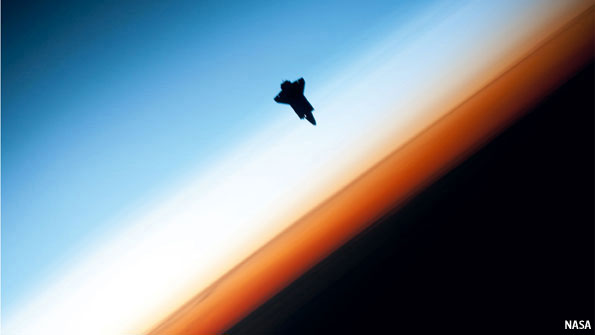
Iconic view of man's urge to explore

UPDATE 10:30 am Mountain Time

Up and safely away!

Still awe-inspiring after all these years.  Live BBC feed is here. Travel safely guys!

What is freedom? Part Two

The Trap – 2 – The Lonely Robot

Part One of The Trap is available to watch in my Post of the 4th, US Independence Day.  It also provides some background thoughts.  It really is a most powerful set of programmes so, if you haven’t already done so, best to watch Part One first.

This is Part 2 of the brilliant Adam Curtis documentary originally produced for the BBC. It talks about the modern political realities, where the policies came from and the massive failures of those ideals and how they have ended up exactly where they did not want to be. This episode focuses on the 1990’s and how the politicians decided to apply the model of a free market economy to the rest of society and consequences of these actions being felt all over the world in western democracies.

When is a review not a review?

When it’s written without integrity!

Wow, this seems an odd-ball topic for Learning from Dogs.  But, as all you regular readers know, Learning from Dogs is about understanding the importance, the critical importance of integrity, and having dogs, who are integrous, act as an example and metaphor for humankind.

OK, to the point of the article.

Somewhere (probably Naked Capitalism but not sure) I came across a link to a piece in PC Mag entitled, Are Amazon Reviews Corrupt?  Here’s a flavour of the article written by John Dvorak.

It’s a known fact that PR agencies and corporations have been burrowing into the community of online, “public” reviewers and obscure bloggers and easily corrupting them with trinkets. It’s like a lost tribe being bribed with a pretty necklace of cheap polished rocks. Now there is some proof that there is a problem.

I received a press release titled, “Buyer beware: study reveals hidden motives behind Amazon reviews.” Here is the gist in a nutshell:

In the first academic study of its kind, Trevor Pinch, Cornell University professor of sociology and of science and technology studies, independently surveyed 166 of Amazon’s top 1,000 reviewers, examining everything from demographics to motives. What he discovered was 85 percent of those surveyed had been approached with free merchandise from authors, agents or publishers.

Pinch, who also found the median age range of the reviewers he surveyed was 51 to 60, a surprise said Pinch, because the image of the internet is more of a young person’s thing. Amazon is encouraging reviewers to receive free products through Amazon Vine, an invitation-only program in which the top 1,000 reviewers are offered a catalog of free products to review.

John later linked to the website set up by Trevor Pinch, called Freelunch, where the full details of what is going on are contained in a report, available for all to download and read.  The web page from where the report may be downloaded is here, and below is what you will read if you go to that weblink.

They tell us what to buy, but who are Amazon’s elite product reviewers and why do they do it?

They are the familiar faces of the world’s largest online retailer, the voices of reason we rely upon to make sense of everything from Shakespeare to sleeping bags.

But who are Amazon’s top reviewers, why do they invest the massive effort required to review tens of thousands of products, and how are changes at Amazon changing the way these reviewers help us decide what to buy?

In the first academic study of its kind, we examine the elite class of top-thousand Amazon reviewers by conducting a detailed survey with a subset of 166 of these top reviewers. The study, examines everything from age, gender and education (typically middle-aged, male and master’s degree), to the motives and concerns of this volunteer corps who’ve helped drive Amazon’s growth from quaint virtual bookstore to the planet’s most valuable retail brand.

The study was carried out just as Amazon introduced a new way of ranking its reviewers causing much consternation as some fell dramatically in the rankings. We ask why it is that Amazon has changed its ranking system at this time and we elicit the top reviewers responses to this change.

Our study holds an assumption and asks a question: the assumption is that there are no free lunches. So how come Amazon has managed to persuade so many people to give them the morsels from which they have built one of the biggest free lunches ever? That is the question.

Speaking as someone who probably spends a couple of hundred dollars a year with Amazon, particular on books, and who does get tipped into buying an unknown book by the reviews, this report is not without consequence.

Hyman Minsky

Indeed, as you read this there will be winging it’s way to me two books ordered last week.  The first was Hyman Minsky’s book, Stabilizing an Unstable Economy, cost $21.14 and a book that I had no doubts about wanting to read.

But the second, The Great Disruption by Paul Gilding, was bought a) to take me over $25 and provide me with free shipping and b) because it looked like a book I would enjoy and all six reviews were strong recommendations!

Well done PC Mag and all concerned.

H’mm, another lesson from the school of life!

The Power of the Dog

An incredible moving account of man’s special relationship with the dog.

(Reproduced in full with the very kind written permission of the author, Laban T. where it was first published on UK Commentators.)

The Power of the Dog

Ross’s dog is gravely ill.

 I suppose if you don’t have a dog it is hard to understand why anyone would be so upset (that isn’t an insult or a judgement just a statement of fact) and if you do there isn’t much need to explain.

 As so often he’s spot-on. I remember in my teens a girlfriend walking through the door one Saturday morning and bursting into floods of tears – and it wasn’t the state of my room.

What’s the matter ?

They’ve taken her to the vet to be put down!” – ‘her’ being the companion of her childhood, a thousand walks and a hundred days out in the country with parents. But I didn’t think like that at the time – I was properly sympathetic and held her till my shoulders were soaked in tears – but it was only a dog, a nice enough dog, but still a dog. At this distance memory fails, but I probably assumed it was just a girl thing, what with being more emotionally open and all that.

The same blindness afflicted me with regard to the effect of children, although I think I wasn’t alone in this. Our single lives were so endlessly fascinating, what friends were doing, who was with whom, the places to go, the people, the parties, that we looked on people who’d got children slightly pityingly, as if they’d been afflicted with a crippling disease (and it IS crippling to a wild social life, although I know a few exceptional people and couples who have just carried on – I’m just not exceptional) which not only curtailed their social life but made them talk about children an awful lot – as if that topic was of any interest at all compared to the important things.

You live and learn. Hopefully. Now I feel more that becoming a parent is gaining access to the secret heart of life and the long chain of familial links down the generations. Not that it doesn’t have its many, many drawbacks. Susan and I looked at each other one day after #2 had arrived and said “whatever did we do with all that time we had?”.

I digress. So I finally learned about why parents are interested in kids, but still didn’t get the dog thing. Our neighbours were childless but treated their dogs like their children – they slept upstairs and their doings were part of our everyday chats. Most odd, we thought.

Dog lovers …

I’d taken my firstborn up to visit his grandpa, and grandpa and I were out walking with grandpa’s dog and the pushchair plus baby. I loved that new dad bit, with bonny boy getting cooed over by all and sundry … the checkout queue turning into a little love fest … and he WAS a beautiful baby – he’s 21 now and six foot.

Lady approaching on the pavement, breaks into happy smile :

Oh, what a beautiful …

(Dad smiles modestly… he’s getting used to this …)

Dog!”

(Smile vanishes instantly)

Then our youngest went off to Big School, and it left a bit of a gap in Susan’s life. Suddenly there were no babies to care for – and she likes caring for things. One day she went off and returned with this chap (and promptly had him snipped, to my horror). Apparently Labradors were very even tempered, good with children and an all round ideal first dog for a family with no dog-owning history on either side, at least since our great-grandparents were on the farm. What’s impressive is that AFAIK, apparently all dogs are descended from domesticated wolves. Just shows what breeding will do.

The dog.

The kids were thrilled, promised to walk him etc., etc., – didn’t last and soon Mum and Dad were doing most of the walks. But the exercise is great – he and we usually get about three miles a day in – it’s good for an ageing chap with a desk job. I’ve learned most of the footpaths and circular routes round the house.

Labradors seem to eat anything – three week old bird carcases, stones, deer poo, sheep poo, horse poo – and they roll in fox poo, which is not a nice smell and means an hour shampooing him in the garden (then a shower and complete change of clothes). On the good side they love apples, blackberries, plums, the farmer’s turnips – healthy eaters.

He once found a rotting, rank dead rabbit inside a plastic bag, scoffed it, then sat in his crate in the kitchen and disgorged the lot some hours later. Not a nice clean-up job – the smell at close quarters was truly evil.

They’re meant to have more acid in their stomachs than humans to enable digestion of bad food – but ours pushes that way beyond the limits. The Muslims are right enough when they consider dogs unclean. They’re filthy, dirty creatures.

But they have a way of wrapping themselves round the heart. Always pleased to have human company, playful, cheery.  All the family quickly grew to love him – even grandma, very much a non-dog person, has a soft spot.

October last year, grandma is round for Sunday tea/dinner, I’m just out in the garden using the last of the light at ten to six.

Can he stay out here with you? ”

OK

The call for tea. I call him – he’s not anywhere in the garden. Round the house – no sign.

Has he come in?”

No

He’s not in the garden

Poor grandma. She was left alone in the house while everyone emptied into the darkening garden, calling, then after a quick conference and grabbing of mobiles, two cars head slowly in opposite directions, and the boys are in the local wood with torches. Daughter and I take the car across rough farm tracks, along the routes of his favourite walks, stopping, scanning the gloomy fields, calling him, on again, repeat.

Forty minutes later it’s pitch black and the cars are back. The boys have been right through the woods to the fields on the other side, which we’ve also scanned from the cars as best we could, then back again. Up and down the village – again – half expecting to see a limp form in the headlights. Not a sight or sound.

Tea at seven in almost total silence. The only thing I can compare it with was the first family Christmas without my grandmother.

Eight o’clock. He’s been gone two hours. We’ve been out in the garden and around the house again. Nothing. The feeling that he’s gone for good starts to solidify.

Nine o’clock. My daughter’s standing at the back door, calling his name. Nothing. I feel she’s wasting her time, but in solidarity I go to the side door to call. Open it – he’s standing on the step.

God knows where he’d been. One moment of tremendous pleasure – calling my daughter into the kitchen, without telling her who was there, then watching the ecstatic reunion – the boys hearing the noise and tumbling in, happy uproar. “For he was lost, and is found“.

Once again Mr Kipling has the words :

There is sorrow enough in the natural way
From men and women to fill our day;
And when we are certain of sorrow in store,
Why do we always arrange for more?
Brothers and sisters, I bid you beware
Of giving your heart to a dog to tear.

Buy a pup and your money will buy
Love unflinching that cannot lie
Perfect passion and worship fed
By a kick in the ribs or a pat on the head.
Nevertheless it is hardly fair
To risk your heart to a dog to tear.

When the fourteen years which Nature permits
Are closing in asthma, or tumour, or fits,
And the vet’s unspoken prescription runs
To lethal chambers or loaded guns,
Then you will find – it’s your own affair
But … you’ve given your heart to a dog to tear.

When the body that lived at your single will,
With its whimper of welcome, is stilled (how still!)
When the spirit that answered your every mood
Is gone – wherever it goes – for good,
You will discover how much you care,
And will give your heart to a dog to tear.

We’ve sorrow enough in the natural way,
When it comes to burying Christian clay.
Our loves are not given, but only lent,
At compound interest of cent per cent.
Though it is not always the case, I believe,
That the longer we’ve kept ’em, the more do we grieve:
For, when debts are payable, right or wrong,
A short-term loan is as bad as a long
So why in Heaven (before we are there)
Should we give our hearts to a dog to tear?
What is freedom?

As a US resident since just mid-April, perhaps no better day than July 4th to pose this question.

As a British citizen, born in London towards the end of WWII, I am well aware that Britain has had a long tradition of ‘owning’ colonies.  In 1770 explorer James Cook charted the East coast of Australia and returned to Britain recommending colonisation in the area that became known as Botany Bay, now part of Sydney.  Britain’s response was to set up a penal colony in 1778.

In 1617 the British East India Company was given permission by an Indian rajah to trade in India.  Via lots of convolutions that I don’t understand, that led to the British Crown taking over in 1857.

So far as America is concerned, the British ended up with 13 colonies along the Eastern seaboard during the period 1607 to 1733.  Then we had the British West Indies and Canada and …… well, you get the message!

Wikipedia has a summary of the US independence timetable,

During the American Revolution, the legal separation of the Thirteen Colonies from Great Britain occurred on July 2, 1776, when the Second Continental Congress voted to approve a resolution of independence that had been proposed in June by Richard Henry Lee of Virginia.  After voting for independence, Congress turned its attention to the Declaration of Independence, a statement explaining this decision, which had been prepared by a Committee of Five, with Thomas Jefferson as its principal author. Congress debated and revised the Declaration, finally approving it on July 4. A day earlier, John Adams had written to his wife Abigail:

The second day of July, 1776, will be the most memorable epoch in the history of America. I am apt to believe that it will be celebrated by succeeding generations as the great anniversary festival. It ought to be commemorated as the day of deliverance, by solemn acts of devotion to God Almighty. It ought to be solemnized with pomp and parade, with shows, games, sports, guns, bells, bonfires, and illuminations, from one end of this continent to the other, from this time forward forever more.

Adams’s prediction was off by two days. From the outset, Americans celebrated independence on July 4, the date shown on the much-publicized Declaration of Independence, rather than on July 2, the date the resolution of independence was approved in a closed session of Congress.

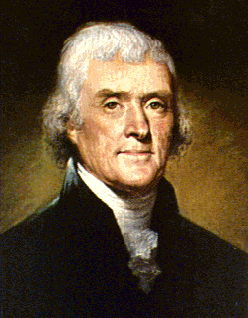
Thomas Jefferson April 13, 1743 – July 4, 1826

Thomas Jefferson became the third President of the United States of America.  As one of the founding fathers, Jefferson envisioned America as an “Empire of Liberty”.

So it came to pass that Independence Day is annually celebrated on July 4.   The celebrations have deep roots in the American tradition of political freedom.

Reflect then on that notion of liberty and freedom as you watch the first episode from a most compelling series from Adam Curtis that was broadcast by the BBC in 2007. The series is called The Trap, the first programme entitled “F**k You Buddy” (11 March 2007)

Individual freedom is the dream of our age. It’s what our leaders promise to give us, it defines how we think of ourselves and, repeatedly, we have gone to war to impose freedom around the world. But if you step back and look at what freedom actually means for us today, it’s a strange and limited kind of freedom.

Politicians promised to liberate us from the old dead hand of bureaucracy, but they have created an evermore controlling system of social management, driven by targets and numbers. Governments committed to freedom of choice have presided over a rise in inequality and a dramatic collapse in social mobility. And abroad, in Iraq and Afghanistan, the attempt to enforce freedom has led to bloody mayhem and the rise of an authoritarian anti-democratic Islamism. This, in turn, has helped inspire terrorist attacks in Britain. In response, the Government has dismantled long-standing laws designed to protect our freedom.

The Trap is a series of three films by Bafta-winning producer Adam Curtis that explains the origins of our contemporary, narrow idea of freedom. It shows how a simplistic model of human beings as self-seeking, almost robotic, creatures led to today’s idea of freedom. This model was derived from ideas and techniques developed by nuclear strategists during the Cold War to control the behavior of the Soviet enemy.

Part Two of this article is being published on the 7th, next Thursday, and Part Three next Monday, the 11th.