Year: 2010

Sullenberger and US Airways Flight 1549

Not forgetting First Officer Jeffrey Skiles

There has been much written and published about these two heros who enabled the stricken Airbus A-320 to ditch on the Hudson River with no loss of life.  That was Flight 1549 on the 15th January, 2009.

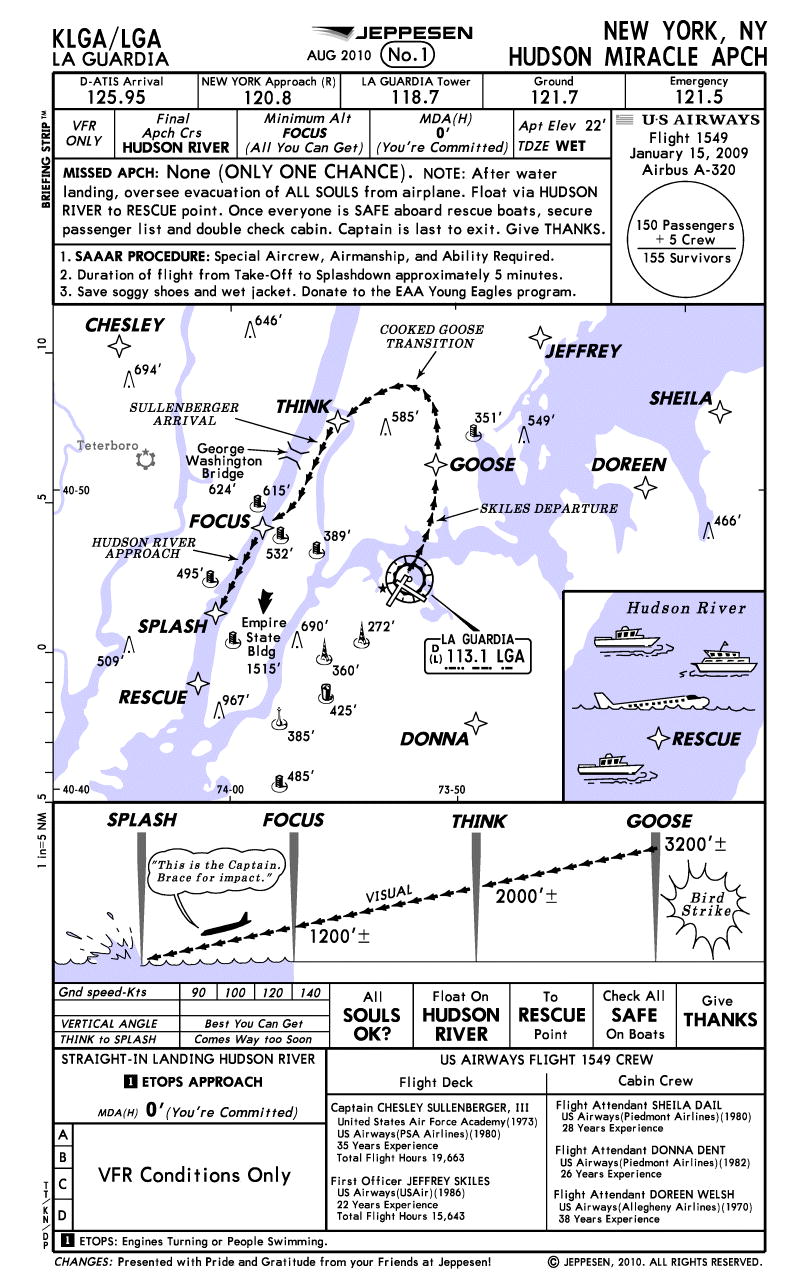
However, at this year’s Oshkosh, Sullenberger and Skiles were presented with a wonderful memento from Jeppesen who publish among other products instrument approach charts for aircraft.  They did something very creative in producing the following.

Hudson miracle approach chart

Here’s what was said by Jeppesen:

Englewood, Colo. | 27 Aug 2010

Jeppesen, known in the aviation industry as the worldwide leader in navigation and charting services, recently presented “Miracle on the Hudson” pilots captain Chesley Sullenberger and first-officer Jeffrey Skiles with a specially designed approach chart and engraved Jeppesen chart binders to commemorate the remarkable ditching of US Airways flight 1549 in the Hudson River in New York in January 2009.

Entitled “Hudson Miracle APCH,” the one-of-a-kind chart includes several light-hearted notations that honor the famous water landing that saved the lives of 155 passengers and crew on board the flight disabled by bird strikes.  In the “briefing strip” section of the chart, instructions include: “After water landing, oversee evacuation of ALL SOULS from airplane. Float via HUDSON RIVER to RESCUE point. Once everyone is SAFE aboard rescue boats, secure passenger list and double check cabin. Captain is last to exit. Give THANKS.”

The chart documents the historic five minute flight with a unique graphic, beginning with departure from LaGuardia Airport, followed by a “Cooked Goose Transition” point and “Hudson River Approach,” which is then followed by “Splash” and “Rescue” points on the water.  The humorous chart also salutes the career achievements of the crew of flight 1549, including Sullenberger, Skiles, and veteran flight attendants Sheila Dail, Donna Dent and Doreen Welsh.

Along with the commemorative chart, the pilots were presented with a special Jeppesen chart binder, engraved with the famous fortune cookie advice kept in Sullenberger’s flight bag: “A delay is better than a disaster.”  The items were presented by Mark Van Tine, Jeppesen president and CEO, during the 2010 Gathering of Eagles fundraiser dinner and auction held during the EAA AirVenture fly-in and air show in Oshkosh, Wisc.  The EAA Young Eagles event raises funds and awareness for youth involvement in aviation.

To view the commemorative US Airways flight 1549 chart, please visit this page.

A fellow pilot, Martin Thorpe, sent me the chart shortly after the Oshkosh event but it seemed appropriate to let some water flow under the bridge, so to speak, before I mentioned it on Learning from Dogs.

By Paul Handover

Being in love

Science explains what our hearts feel

Love for all!

Yesterday, I posted an article based on a lecture given by Dr Helen Fisher presented to the TED Conference in 2006.  It included some fascinating evidence about the nature of love and why it is such a powerful human emotion.

Then in 2008, Dr Fisher gave a second lecture, again at the TED Conference, that continued to reveal more amazing findings about how the brain functions when in love.  As the presentation summary says:

Why do we crave love so much, even to the point that we would die for it? To learn more about our very real, very physical need for romantic love, Helen Fisher and her research team took MRIs of people in love — and people who had just been dumped.

Included in the lecture is something that I had wondered about and was delighted to see confirmed – animals fall in love as well.  Here’s the extract from that part of the presentation (min:sec 50:50):

I would also like to tell the world that animals love. There’s not an animal on this planet that will copulate with anything that comes along. Too old, too young, too scruffy, too stupid, and they won’t do it. Unless you’re stuck in a laboratory cage –and you know, if you spend your entire life in a little box,you’re not going to be as picky about who you have sex with –but I’ve looked in a hundred species,and everywhere in the wild, animals have favorites.

As a matter of fact ethologists know this. There’s over eight words for what they call animal favoritism:  selective proceptivity, mate choice, female choice, sexual choice. And indeed, there are three academic articlesin which they’ve looked at this attraction, which may only last for a second, but it’s a definite attraction, and either this same brain region, this reward system, or the chemicals of that reward system are involved. In fact, I think animal attraction can be instant — you can see an elephant instantly go for another elephant. And I think that this is really the origins of what you and I call, “love at first sight.”

Do watch it.

And a quote to conclude this post.

True happiness and a fullness of joy can be found only in the tender and intimate relationships of the family. However earnestly we may seek success and happiness outside the home through work, leisure activities, or large bank accounts, we will never be fully satisfied emotionally until we develop deep and loving relationships.
~ by James J. Jones Ph.D. ~

By Paul Handover

Guys, beware of rickshaw drivers!

Watch the video to the end to make sense of the title!

The digitally connected world that is now so much a part of our lives brings lots of new issues, dangers and irritations.  But it also brings us a great number of tremendous opportunities.  TED is one of them.

For those that haven’t come across the TED website it offers a wonderful range of “Riveting talks by remarkable people, free to the world” as summarised here.

Dr Fisher

Thus it was via the TED website that I came across a fascinating talk by Dr Helen Fisher who is a Biological Anthropologist who has specialised on romantic love and connected areas.

Anyway, without any more waffle from me, if you want to be surprised by a number of Dr Fisher’s findings then do watch the TED video that may be found here.

And the reference to the rickshaw driver?  Watch the video to the end (23 minutes) to find out.

P.S. since writing the above, I found a YouTube copy of the TED video, which is below.  I haven’t watched it to the end to see if the reference to the rickshaw is in it, but I suspect it is.

By Paul Handover

Friendship – alpaca style

Yet another beauty from Naked Capitalism

Regular readers will have run out of counting the number of times that I applaud Yves Smith and her amazing blog, Naked Capitalism.  Not only is it a fantastic source of many stories of real public concern, her daily antidote du jour is often delightful.  Here’s the one that came from her Blog posting of the 19th September.

Clarence and Cindy

Cattle dog Clarence plays with an alpaca named Cindy in “Alpaca Land” in Goeming, Austria. The two have lived together on the farm since they were 3 months old. Eighty-seven alpacas, the largest flock in Austria, live on the farm.

By Paul Handover

Weep for this fish

And maybe weep for the planet

The New York Times recently published a thought-provoking article on the development of farming for the Atlantic bluefin, the world’s largest tuna.

Bluefin Tuna

This is a magnificent fish, as a National Geographic website details:

The Atlantic bluefin tuna is one of the largest, fastest, and most gorgeously colored of all the world’s fishes. Their torpedo-shaped, streamlined bodies are built for speed and endurance. Their coloring—metallic blue on top and shimmering silver-white on the bottom—helps camouflage them from above and below. And their voracious appetite and varied diet pushes their average size to a whopping 6.5 feet (2 meters) in length and 550 pounds (250 kilograms), although much larger specimens are not uncommon.

The NYT article was written by Paul Greenberg who is the author of “Four Fish: The Future of the Last Wild Food.”  See his website.

Here’s some of what was written in that NYT article:

IN the wide expanse of the wild ocean, there is perhaps nothing more wild than the world’s largest tuna — the giant Atlantic bluefin. Equipped with a kind of natural GPS system that biologists have yet to decode, the bluefin can cross and recross the Atlantic’s breadth multiple times in the course of its life. Its furious metabolism enables the fish to sprint at more than 40 miles an hour, heat its muscles 20 degrees above ambient, and hunt relentlessly at frigid depths in excess of 1,500 feet.

I didn’t realise that these fish are warm-blooded, a rare trait among fish, but the more important fact is that a bluefin tuna is likely to eat between 5 lbs (2 kg) and 15 lbs (6 kg) of wildfish for every pound of body.  Thus a fully grown bluefin of around 550 lbs (250 kg) represents a diet of anywhere between 2,750 and 8,250 lbs (340 -3,750 kgs) of wildfish. Back to the Greenberg article:

The Stanford economist Rosamond Naylor pointed out in a recent paper in The Proceedings of the National Academy of Sciences, that there was not too much room for adding species to the world’s aquaculture portfolio.

“Most forage fisheries,” Ms. Naylor wrote “are either fully exploited to overexploited or are in the process of recovering from overexploitation.”

If she is right — and if bluefin tuna farming is ramped up to the level of salmon farming, which produces more than two billion pounds a year — the effect on forage fish, the foundation of the oceanic food chain, could be devastating. A worldwide overharvest of forage fish could damage not just bluefin tuna populations but other important commercial species that also rely on these fish for sustenance.

In other words Rosamond Naylor is warning us, all of us that eat fish, that we could put at risk the entire ocean’s food chain.  And what scares me is that humans have shown a real propensity to put their short-term needs totally above any long-term protection of the planet we all live on.  How crazy is that!

The NYT article closes thus:

If Atlantic bluefin is not farmed, it will most likely become an even more scarce luxury item. Global fishing moratoriums on the species have been proposed (and then rejected by the many nations that catch bluefin). But other options being discussed include drastically reducing fishing quotas in the next few years and closing spawning grounds in the Mediterranean and the Gulf of Mexico to fishing entirely.

Perhaps, in the end, this is what the Atlantic bluefin tuna might really need. Not human intervention to make them spawn in captivity. But rather human restraint, to allow them to spawn in the wild, in peace.

Amen to that.

By Paul Handover

Chilean mine rescue – update

At last some recent news.

One of the problems of our modern media is that there is so much competition for news that old stories frequently just seem to disappear.

So it was delightful to find in last Saturday’s Daily Telegraph news that the rescue shaft had achieved a very important milestone – the pilot shaft, 12 inches in diameter, had broken through to the chamber where the miners patiently wait for their rescue.

Rescuers working to release 33 trapped Chilean miners have achieved a pivotal breakthrough by drilling an escape shaft through to the underground chamber occupied by the men.

Anyway, full story is here

And, of course, life does go on as this video clip happily illustrates.

By Paul Handover

Dogma, Lies and Truth ….

Humans are often both so funny and tragic at the same time  that one does not know whether to laugh or cry on hearing a particular news item. Thus it was for me when reading about Cuba’s apparent ideological U-turn.

The Cuban dogma of the last 50 years has been “State good; private bad.” This is familiar “Communist” territory, so Cubans have been born, grown up and died while being told that “capitalism” was evil, private ownership was bad and that the state was best suited to running everything.

This then was “the truth” for 50 years. But suddenly, amazingly, it seems that this was NOT the truth after all, since now entrepreneurship is to be encouraged in a bid to breathe life into the dinosauric Cuban economy. So, for 50 years Cuba was living a lie? And if so, will those responsible take the blame for these lies?

Errrrmmmm … the heirs and cronies of the apparent lie of over 50 years are the very same people (apart from the conveniently-sidelined Fidel himself, who can of course take the blame whether explicitly or implicitly) who are now proclaiming a new “truth”. So are they admitting their lie, or to be charitable – since XMAS is approaching – their total wrongness?

This is of course the big problem for those enforcing dogma. If there comes a time when the dogma is so manifestly absurd that it has to be changed then the long-time enforcers of the ridiculous are clearly seen to have been wrong for as long as the dogma has been enforced. And of course, the LONGER the dogma has gone on the MORE wrong the enforcers of same are seen to be. So for the dogma-enforcers there is every incentive to NEVER admit the nonsensicality of the dogma, whatever the evidence. Hence the ossification of dogma, when in the end enforcing the dogma is seen as more important than the actual dogma itself.

This is also one reason for the extraordinary conservatism that Humans are often “guilty” of. “Why do we do it that way?” -> “Errrmmmm … we’ve ALWAYS done it that way …”

Well, some credit has to go to the Cuban regime for admitting – tacitly or otherwise – that the last 50 years’ dogma was wrong. Kind as I am,  I do not use the word “idiotic”, though some would say that would be more appropriate …… Kind? Am I too kind in giving them any credit at all? After all, in a dictatorship, the only true definition of “truth” is “that which the leadership says is true.”

I haven’t worked out yet whether they are using the common ploy of dogma-changers, the only one in fact that gets them off the hook. This is to say: “Yes, we’ve always believed A was good and B was evil and now we believe the opposite. This is because CIRCUMSTANCES HAVE CHANGED.” Has anyone worked that out yet? The problem with the “Circumstances have changed” argument is of course that circumstances are ALWAYS changing and so dogma PER SE would seem to be a ludicrous way to manage our lives.

Well whatever, the latest pronouncements could have been made by the British centre-right Coalition Party rather than the old-style Cuban Communist Party:

“Our state cannot and should not continue maintaining companies, productive entities, services and budgeted sectors with bloated payrolls [and] losses that hurt the economy,” said the official Cuban labour federation, which announced the news.

George Osbourne, rightist British Chancellor of the Exchequer, would have been quite proud of that newsbite.

One has to wonder how this redefining of “the truth” will go down with the Cuban people. As has been argued, the main problem with changing the dogma is that you have to admit being wrong before, and often massively and for many years. And the longer-term ticking time-bomb is that once you allow questioning of the dogma then you open a door to the questioning of everything. This is why people who enforce dogma don’t really like any sort of questioning whatsoever. Encouraging it is like opening Pandora’s box; where will it all end? And the most hideous question of all of course is: “Don’t we deserve more say in our own government.” or – in the case of a “world-religion”, “Is the whole basis of our “beliefs” (for which we are prepared to kill people for) plain WRONG? Have we been living a LIE for over 1500 years? ” This question is a terrible one for individuals to face, so terrible that their leaders will do ANYTHING to prevent them ever facing it, including of course kill them if the questioning becomes too loud.

This is the real reason why dictatorships don’t like questioning of any kind; mindless sheep would be their preferred populace. A populace that asks too many questions is – frankly – to be avoided like the plague. They are currently plagued in Iran by sheep with very much a mind of their own, which is why oppression is great and increasing of course.

Anyway, I for one rejoice at the Cuban change of direction, even though one has often seen leaders tempted to open Pandora’s box only to violently slam it shut again when they see what starts to happen.

I always admired the Cuban revolution; chucking out a nauseating “Capitalist” mafiosi-style American-backed regime. The problem has been the extreme ossification of Cuban political and economic thought and development since the day Castro took over. Are better days ahead and will Cuba one day end up as a role-model for South America, much as Scandinavia is for the world in general?

The comic in all this? Listening to previous apologists for the former “lie” having to find linguistic justifications for their previous wrongness. This is marvellous for lovers of language as the arts of spin are brought fully into play justifying the previously unjustifiable.

The tragic? Knowing that the livers of the previous lie suffered both from living a lie and from the practical consequences of it, in Cuba’s case a quite unnecessarily high level of poverty in many areas even if there were some compensating factors. As Cuban apologists often say (said?) “The people may be poor but they are happy.” We might say (I assume): “Better to be much better-off and also happy ….”

PS Is the Pope watching all this (and the Islamic hierarchy come to that?) There is plenty of room for dogma change in the Vatican and Mecca …..

By Chris Snuggs
I salute this guy!

Karl Denninger of Market Ticker is brilliant

Karl D

I say that not because I have sufficient financial knowledge to evaluate his writings from a technical point of view but because he puts in huge effort, I mean hundreds of hours a month, to support his perspective.

Anyway, do bookmark his website/blog – it’s here.

An article published on the 10th demonstrates both Denninger’s commitment to his audience and some very specific dangers potentially coming out of Europe.  Called “A Round-Up Of Current Idiocy” it includes this conclusion:

Since we keep drinking more as an economy (debt and deficits) the violence and incidence of these “undesirable outcomes” is going to continue to increase.  We had one nasty in 2000, and then again in 2007.  From the so-called “recovery” (2003) to the onset of the last mess was about four years.  We’re now about two years in from the so-called “bottom” of this latest train wreck (Lehman), and if we keep on-path, and we are as the below chart shows, our fuse should go inside the box for this next mess somewhere between now and the end of 2011.

I hope you’re ready, because this next one, coming with no real recovery having taken place in employment or private economic activity, may be the one that takes us well beyond the misery we suffered in the 1930s.

And if it does, it will be our – that’s right – our – fault, since we simply will not accept that there is no such thing as a free lunch.

Note the copyright please.

Despite it being quite a technical piece with some aspects that weren’t clear to me, no surprise!, it’s still got many important messages for all those concerned about our savings and assets.  Do read it.

Well done, Karl.

By Paul Handover

It’s all Irish!

But this time it’s NOT Irish humour.

Brits will be well aware that the Irish have been the source of many funny stories and ‘Irish’ humour is still a favourite with the English.

But this piece from Baseline Scenario is very troubling, and that’s putting it mildly.

The excellent article, as they all are from Baseline, is here.

I stole a small extract to underline the import of what BS are writing about.

However, let’s be clear: Europe’s headache remains large, and this should concern all of us – just look at Ireland to see how misunderstood and immediate the remaining dangers are. Ireland’s difficulties arose because of a massive property boom financed by cheap credit from Irish banks. Ireland’s three main banks built up loans and investments by 2008 that were three times the size of the national economy; these big banks (relative to the economy) pushed the frontier in terms of reckless lending. The banks got the upside, and then came the global crash in fall 2008: property prices fell more than 50 percent, construction and development stopped, and people stopped repaying loans. Today roughly one-third of the loans on the balance sheets of major banks are nonperforming or “under surveillance”; that’s an astonishing 100 percent of gross national product, in terms of potentially bad debts.

(That’s my italics, by the way.)

Anyway, do read it in full – it’s got important implications.

And then give yourself a proper laugh at the wonderful sense of humour that comes across from the Irish Sea ….

By Paul Handover

What next!

A dog playing pool in the USA!

(This week is a tough one for me with no internet access until the 18th.  So I’m quickly offering items from elsewhere that have caught my eye.)

Nothing to add!

By Paul Handover