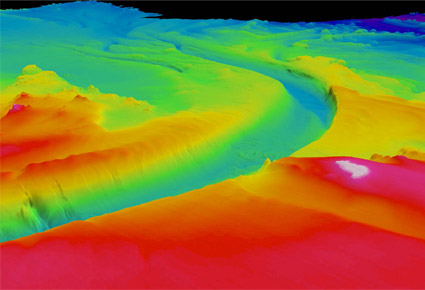
Researchers working in the Black Sea have found currents of water 350 times greater than the River Thames flowing along the sea bed, carving out channels much like a river on the land.
The undersea river, which is up to 115ft deep in places, even has rapids and waterfalls much like its terrestrial equivalents.
If found on land, scientists estimate it would be the world’s sixth largest river in terms of the amount of water flowing through it.
These channels are the main transport pathway for sediments to the deep sea where they form sedimentary deposits. These deposits ultimately hold not only untapped reserves of gas and oil, they also house important secrets – from clues on past climate change to the ways in which mountains were formed.
Now the team, led by Dr Dan Parsons and Dr Jeff Peakall from the University of Leeds, has been able to study the detailed flow within these channels. Dr Parsons, said: “The channel complex and the density flow provide the ideal natural laboratory for investigating and detailing the structure of the flow field through the channel.
Humans understand, if we stop and think about it, that the most powerful force in the world is …. love!
As the American psychiatrist, David Viscott put it, “To love and be loved is to feel the sun from both sides.”
That’s one reason why dogs are so special to humans. Dogs naturally and easily demonstrate unconditional love which is the highest form of love. Even dogs that have been terribly treated in previous times, if given sufficient space and patience, will let their instinct to love come to the fore.
We have 13 dogs here at home and one of them, Loopy, is a great example of that. Loopy was a Mexican rescue dog that took weeks and weeks before she would even allow one of us to touch her. Food had to be left at a distance. It took nearly a year before I could cuddle her and even longer before we trusted each other sufficient for me to put my face up against the side of her jaw.
Compare that to my German Shepherd, Pharaoh, whom I bought out from England in 2008, who has been loved by me since he was 6 weeks old. He and I trust each other so deeply that we can get up to all sorts of fun things.
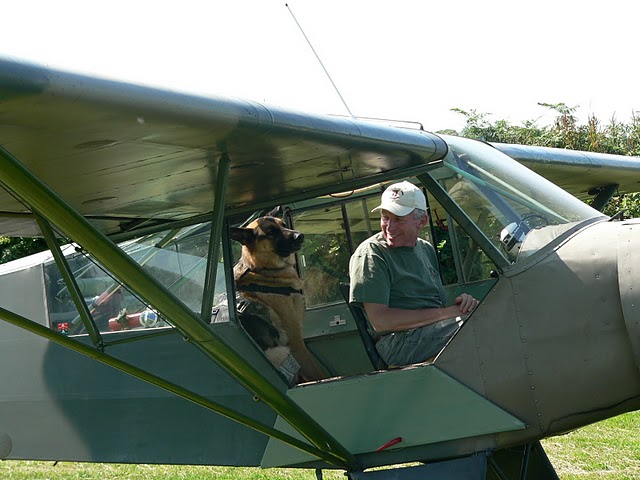
For example, a few years ago I was at the private airstrip where I used to keep my Piper Super Cub. It’s a large grass airstrip and while I was pottering around the aircraft, Pharaoh was enjoying the wide open spaces and all the great smells. The plan was to go off for a short flight on this wonderful spring day.
I walked back to the hangar to fetch something just prior to putting Pharaoh in the car for 30 minutes while I did my flight.
Pharaoh, as is his way, must have worked out that he was due to be shut in the car because as I came out of the hangar, Pharaoh was running towards the open cockpit and with one bound had jumped up into the rear passenger seat. Miraculously, as he leapt up, he had placed his feet on the hard wooden edge to the fuselage and not punched a hole through the fabric!
I turned back and grabbed his body harness from the car, walked up to the Super Cub and proceeded to strap him tightly into the rear seat.
There was no way that it would have been safe to fly with him but I was interested to see how he would react to me taxiing around the grass airfield. That’s when his trust towards me paid off.
I started the engine – no reaction at all. Even to the powerful draft coming off the propeller through the open door.
Then I taxied slowly – again no reaction at all. Unless one can count what looked suspiciously like a grin on a dog’s face!
Smiles from ear to ear!
Then I taxied quickly – same result.
Then I lined up at the start of the runway, closed the door, put on full power and let the aircraft accelerate until we just lifted clear of the grass. Almost immediately I closed the throttle, we touched down and slowed to a walking pace and we returned to the hangar. There was no question of us flying even though it looked like it would have been a non-event!
That was one of the many highlights of being Pharaoh’s friend, companion and protector – just as he is towards me. That sort of closeness would have been impossible without huge trust from Pharaoh that I would never do anything to hurt him.
So the moral of this message? That is, that when we love everyone and everything around us, it is reflected back to us – every moment of the day. This allows us to live in a world of mutual trust and reap the rewards of closeness.
I was a client for many years but had to terminate that client relationship when residence in the USA became highly likely! Very happy with the service and advice provided – extremely so! (I have no relationship at any level with that firm now!).
Anyway, David publishes what he calls Contrary View from time to time. His latest is reproduced with his permission.
No. 074 9th August 2010 A statistical impression
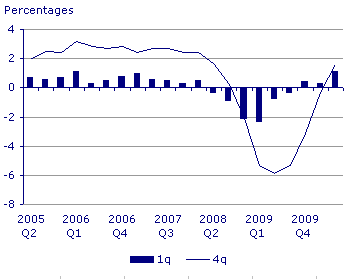
Over the last few weeks a number of graphs have appeared showing how the economy has apparently picked up to where it was before the credit crunch started. Such graphs invariably show a ‘U’ shaped curve demonstrating perfect recovery. This is the impression easily formed by a glance at such a graph, but it is the wrong assumption to make.
National Statistics reports Gross Domestic Product (GDP) as two different measures, both estimates showing a decline in GDP. Here are the latest figures (estimated), taken from their website last week:
3rd Qtr 2008 Index 102.6
2nd Qtr 2010 Index 99.0
This GDP index shows a permanent loss of output.
Detailed figures are also available (Table 1.02 of the UK economic accounts) and on the same estimating basis, seasonally adjusted, report:
3rd Qtr 2008 GDP £340,780 million
2nd Qtr 2010 GDP £328,766 million
No matter how you look at these figures, there has been a permanent loss of output of just over 3.5% in this period.
This loss of output means less work, so debts are more difficult to service. Why do the press produce graphs showing an apparently perfect recovery? The answer is that the graphs are taken from the National Statistics press release, for example on 23rd July 2010. The graph that is offered is a rate of change, not the level of output, and may simply have been copied without consideration of the impression formed.
WARNING: The firm can only be responsible for action taken on our advice given personally and specifically to be suitable for each individual. Statements on this site do not, on their own, constitute advice. Please note that UK regulatory requirements prevent us commenting on your existing investments or giving specific advice, unless you first sign one of our portfolio service agreements.
As I mentioned in a comment to a regular reader of Learning from Dogs:
To me, sufficiently old to have watched Governments for some decades now, the most striking thing about the present circumstances is the terrible decline in political integrity.
It’s almost unimaginable that Planet Earth could go the same way. Then again, anyone over the age of, say 60, would find where we are today, in terms of mankind’s long-term survival, equally unimaginable from how the world looked 40 years ago.
THERE are plenty of studies which show that dogs act as social catalysts, helping their owners forge intimate, long-term relationships with other people. But does that apply in the workplace? Christopher Honts and his colleagues at Central Michigan University in Mount Pleasant were surprised to find that there was not much research on this question, and decided to put that right.
And the article concludes:
Mr Honts found that those who had had a dog to slobber and pounce on them ranked their team-mates more highly on measures of trust, team cohesion and intimacy than those who had not.
But do read the article in full because the conclusions are quite significant. Once again, the link is below:
Again, apologies for a ‘thin’ posting – here’s why.
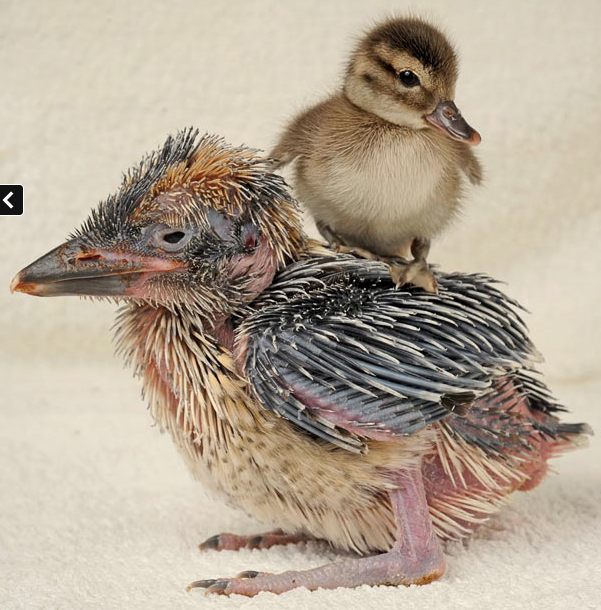
I first saw this in Naked Capitalism but the picture came from the UK’s Daily Telegraph newspaper 6th August, 2010.
Trust!
The accompanying text:
This baby six-week old kookaburra called Kookie and a tiny duckling have struck up a friendship at the Seaview Wildlife Encounter, near Ryde in the Isle of Wight. Kookie was saved by staff after they feared his parents would kill him. And the duckling was rescued from one of the park’s aviaries because he was thought too small to defend himself against larger birds. Keepers took a chance and decided to see what would happen if they were put together. The duckling instantly cuddled up under Kookie’s protective wing, thinking he was his mum and Kookie didn’t seem to mind playing the caring parent
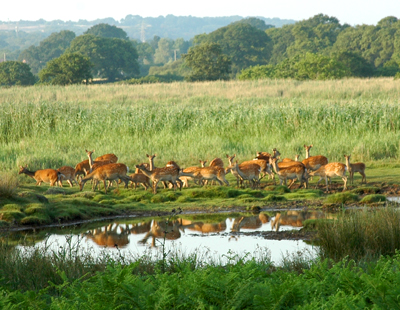
Julie has gone on ahead, but returns to tell me that the sika deer are feeding in the reed beds ahead of us. (These are one of two types of deer found at Holton Lee.) She offers to stay with Genie while I go and photograph them, so that Genie won’t frighten them off. They see me, but continue feeding whilst remaining alert.
It really is a magical sight – I am quite converted from my original anxiety about deer leaping out in front of the car!
There is something extremely primeval about deer, which is probably not surprising as their bodies have provided everything from meat and clothing to fish hooks and sinews for many indigenous people, while still remaining wild. It is hard to see why anyone would hunt them simply for sport, though, and I fear that Walt Disney has spoilt me for enjoying venison – ancient, organic, sustainable, non-farmed food source or not, it would be like eating Bambi!
Sometimes looking down the other end of the telescope reveals more, much more!
Afghanistan - where is it leading?
Now that coalition forces have just recently suffered their deadliest month yet in the conflict in Afghanistan, it now has become more crucial than ever to rethink the strategy of the United States and its allies in the region. Currently, the cornerstone of this strategy rests upon two key factors – winning over the local peoples of the region, and training local forces to carry the burden when, and if, coalition forces leave the region.
At least on the exterior, these goals in Afghanistan do make some sense. The only possible way to succeed via a continued military occupation of Afghanistan is to attain and bank on the support of the local peoples. Also, if western powers are ever to withdraw from the region, local forces will have to be able to maintain whatever structure these forces leave in their wake.
However, while this strategy is not completely outlandish and does show some merit on the part of military strategists in that they are leaning more towards localized models that entail comprehension of diverse local factors, the question still must be asked – is this strategy actually possible to carry out and have the sought-after effects in the region? Can the United States and its allies actually win over the peoples of Afghanistan and western Pakistan, and can these same powers possibly train forces that will remain peacekeepers in the years to come?
Despite the fact that I admire the intentions of the military’s current strategy in this region, I do not think that their plan is in fact possible. It seems to me that rather we are fighting an unwinnable war to win over a people that we do not and cannot understand, and that by funding the Afghani security forces of today, we are inevitably funding our enemy of tomorrow, just as our nation has mistakenly done so many times in the past in this very region.
I cannot foretell the future. Nor can anyone else. However, I can comment on what is likely to occur. And, in constructing such a model, two of the most important subjects to understand are history and praxeology, or human behavior.
An attempt by the United States to make Afghanistan a stable, western-friendly state is by no means a new happening. The date of the beginnings of our intervention in the region could be debated, but a decent starting point is the late 1970’s when President Carter put forth the Carter Doctrine, which stated that the United States would defend its interests in the Middle East.
This doctrine just barely preceded the Soviet invasion of Afghanistan, and it was this invasion that saw the beginnings of American forces, at this point being mostly CIA and other such agencies, which were attempting to hamper the Soviet forces by funding the Afghani resistance.
Now, there is no room here for a history of American involvement in Afghanistan. However, what must be noted is that during the 1980’s and 1990’s, a pattern developed in the Middle East – the United States would fund a group in the hope of combating some common enemy, and then in later years the group funded with American taxpayer money would inevitably end up turning against the United States.
A few prominent examples of this are Al Qaeda, who received $6 billion from the United States from 1989 to 1992, the Afghani Taliban, who was receiving US foreign aid up to the very minute American forces entered their country (and continues to receive US foreign aid through Pakistani backchannels) and Saddam Hussein, who received chemical weapons from the US during the Iraq-Iran War of the 1980’s, weapons he later used to kill American soldiers.
This, though briefly put, is the history, or the “what.” So now must come an examination of the “why,” or the element of praxeology. For obviously, our attempts to forge friendships in the region in the past have failed. Our friends have become our enemies, in fact our worst enemies.
There are several possible explanations for why this occurs. However, mine is quite simple – we do not understand these people, we do not understand this region, we do not understand Islamic culture, and, to be quite blunt, we never will. It is not a wrongdoing by the West to look at the Middle East through Western eyes. Rather, it is the only way that a westerner possibly can look at the Middle East.
On top of this extremely problematic misunderstanding of the Middle East by Western peoples then comes another layer of problems, these being the base problems of intervention in any context, amplified by the extreme foreignness and instability of the Middle East as a whole. The consequences of intervention in any scenario are so unpredictable, so many, and so far-reaching that no one can possibly intervene and successfully fulfil their objectives without in the process creating a dozen new problems. This is seen with the federal government intervening in states in their own country – how much greater then are the problems when intervening in a region like the Middle East?
All this now brings us back to the point on considering the future. As I mentioned previously, I cannot say what the future holds. However, I can make an educated guess. And, based on analyses of both history and human behavior, it is safe to say that by both indirectly and directly funding the training of a new military force in Afghanistan, we very likely are creating our enemy of tomorrow. For when these people that we are now training realize that the United States is not leaving, that they are not in fact a free state, that they have become a part of the American empire, and that if they want to live culturally independent of western influence they will have to forcibly remove Western elements within their borders, it seems extremely probable that they will do exactly that.
To say that we are creating a force that will do what we expect it to do in the future is a wish at best. The reality is that we do not and cannot understand what is truly a foreign mindset, and our best course of action would be to distance ourselves from what is and will be for many years of region of perpetual conflict.
I don’t know Ms. Romer personally but I certainly know her work both in and out of the White House. I can only hope that the inconsistency between her work as a truth-seeking academic and as an Obama apologist finally got to her and is, at least in part, one of the reasons she resigned as chair of the White House Council of Economic Advisers.
It will be very interesting to see how her writings progress from here.
Jon Lavin wrote a Post on the 13th June, 2010 entitled, “Dealing with the fear of the known.” I’ve been thinking about that in recent weeks including the comment to Jon’s article from Per. Here’s how Jon closed that article:
If more of us got used to coming out of the mind before making an important decision, and simply sat with the question for a while, the answer would probably present itself.
This will probably raise more questions than it answers but that’s not a bad thing.<!–
And here’s the recent comment from Per:Great advice… but how do we remove the fear of what is known?
Presumably Per was implying that we shouldn’t fear the known. However, I beg to differ here; it is actually fear of the UNKNOWN that is rather pointless (I am not afraid of aliens), while fear of the KNOWN is CRUCIAL to our survival.
But like anything else, you can have too little or too much. Too little, and you survive a very short time. Too much, and you sit cowering in your cellar afraid to go out. As with EVERYTHING in life it is a question of BALANCE.
How do we know how much fear to deploy? Instinct, intelligence, knowledge and experience. If any of these are deficient, we may apply an inappropriate fear quotient.
Let’s take “Global Warming”! How afraid of it should I be? What are my marks out of 10 for the four fear-factors above?
Instinct = 8 – I instinctively fear a situation when my environment is getting hotter, as I don’t know what that will imply. Intelligence = 8 – I am (just) intelligent enough to appreciate the dangers of a rise in temperature. Knowledge = 4 – I have no real idea exactly what is going on or how far it will go; the messages are mixed and I see no real panic among governments. Experience = 0
So, a score of just 20 out of 40, which means IGNORANCE and DOUBT and these add up to FEAR ….. so I am quite afraid.
Home grown vegetables
More apparently, than my leaders seem to be, who can’t even ban flying across the Atlantic at a cost of 60,000 tons of CO2 per day. The question is, will this considerable amount of fear push me into actually DOING something about GW? What is my inertia level and what is my tipping point? What would it take to get me to dig up my garden and plant potatoes? To sell my car and buy a horse? Sadly, humans are in general pretty inert …… it is much easier to do nothing or too little until it is (almost) too late.
So, “fear” is absolutely essential to our survival. If you’re a driver who doesn’t fear accidents then please keep out my my way until you very soon die in one.
Fear is also what pushes me to drive very carefully. People who greedily lent money to Madoff had no fear they would lose it, having lost all control of whatever ration of commonsense and/or logic they might once have had. Perhaps now people will fear rather more about losing their money and therefore invest it more wisely.
To take another topical example, any company in the future (is there one?) drilling for oil in the Gulf of Mexico will fear the lash of Obama’s tongue and stick and this fear will push them to be a bloody sight more careful and to have an effective contingency plan. Actually, why more people don’t have a lot more fear is a mystery to me.
Right, having dealt with fear, we come to our response to it, which is of course the interesting bit. The world is changing so fast that almost all of us have limited control. Even the US President has limited control. This is not comfortable.
How then can we gain more control and become more comfortable? Jon has pointed the way; we must become more self-reliant. Jon will presumably now have much less fear of starving to death, since he is producing a proportion of his own grub. Anyone installing solar-panelled heating will be much less fearful about their electricity being cut off.
I would go further. Anyone owning a horse will or would have much less fear about running out of fuel and being immobile – or more to the point, of being unable to plough and sow his fields, without which we really are stuck. (Incidentally, I am predicting a big comeback for work horses. They are slower, yes, but you can’t breed a tractor (or indeed talk to it) or produce your own fuel, which is where the horse wins out. We’ll have to move more slowly, but then speed is vastly overrated.)
Now Jon with his chickens is a special case. Is there, I wonder, a small element of “fear” in his decision to keep chickens? Humans are complex …. Another major factor pushing Jon down this road could be (and in his case probably is) social responsibility.
It seems pretty clear that if EVERYONE became more self-reliant then vast, expensive, high-consuming centres of production would be scaled down. Unfortunately, social responsibility is not exactly fasionable in today’s consumer world (or we wouldn’t use plastic bags for a start, just to take one small example). Like the vegetarians of 30 years ago, Jon might be seen as an exception if not crank; until of course the fear factor becomes higher and then everyone will try to grow their own potatoes.
So, fear of powerlessness drives us to take initiatives that will help to remove at least some of this fear; a circular but inevitable process. Nothing new about it; the only sad thing is that humans seem to need to travel quite a long way down the path of doom before they really start to react.
This of course is why we did nothing when Hitler invaded the Rheinland in 1936; wait and see seemed easier at the time. It’s also why America totally ignored Jimmy Carter’s ideas of some decades ago about reducing America’s dependence on Arab oil. It was much easier to deride him and do the easy (but totally wrong) thing, especially of course as the oil companies have loads of money and can buy off people who otherwise might see the light.
Well, we’re well past “Wait-and-see” now …… we are now entering the “Do-it-or-else ….” period. And where Jon is of course achieving a double-whammy is that his increasing self-reliance is also GOOD FOR SOCIETY. If everyone were more self-reliant in every way a vast saving in energy and everything else could be achieved. Flying exotic fruits into Britain from South Africa is insane, yet so normal that it seems … errrmmmm … normal.
All this was obvious years if not millennia ago, but the current state of the world has increased the fear factor and is pushing people like Jon down this road. But it is an interesting road. Being self-reliant has multiple advantages, though it will be pretty hard on the rich, who may have to learn how to do things they usually pay underlings to do.
But Jon is in the vanguard of this movement; there is VAST scope for increasing self-reliance. It could and should be an adventure, though it will involve enormous change. The latter of course can also be stressful, but less so when it is clearly a change for the better, as I believe it will be.




 Learning from Dogs