Each summer, high in the night skies of the far northern and southern hemispheres a unique phenonmenon occurs – noctilucent clouds. Little is known about them, but now an amateur astronomer from north Wales is trying to predict when they are likely to appear.
Here, John Rowlands, one of four finalists in the BBC’s search for the Amateur Scientist of the Year So You Want To Be A Scientist? – and his mentor, Professor Nick Mitchell from the University of Bath – take a closer look at these mysterious silver and blue waves at the edge of space.
John has his own Facebook page here with plenty more information.
And a quick Google images search found this:
Noctilucent clouds
And there’s still more. This delightful video on YouTube, courtesy of NASA.
Described thus:
The Aeronomy of Ice in the Mesosphere (AIM) mission will provide the first detailed exploration of Earth’s unique and elusive noctilucent or night shining clouds that are found literally on the “edge of space.” Located near the top of the Earth’s mesosphere (the region just above the stratosphere), very little is known about how these polar mesospheric clouds form or why they vary. They are being seen at lower latitudes than ever before and have been growing brighter and more frequent, leading some scientists to suggest that this recent increase may be the direct result of human-induced climate change. The mission is led by Dr. James Russell of the Center for Atmospheric Sciences at Hampton University.
By Paul Handover
(with thanks to the UK Flyer List for bringing this to my attention.)
“We can’t solve problems by using the same kind of thinking we used when we created them.” Albert Einstein
A few days ago, I published an article setting out the place of the Four Divine States in our daily lives.
A regular follower of Learning from Dogs, Patrice Ayme, posted a comment on the article. This is what Patrice wrote.
No empathy survives contact with the enemy. This is the problem with the business of goodness, and how it ties up with evil.
The problem with goodness, or lack thereof, is that it is not how hatred and war are generated. More goodness does not a peace make. All it can very well do is reinforce the tribal instinct.
Understanding may start with the heart, but it survives only through the facts. Most humans have known and experienced love. To teach them love is to teach them water: the height of emotional arrogance. The truly good, instead, will teach the facts.
This is my attempt to shed more light on my approach, for followers of truth on the same path.
With great respect to Patrice, who is clearly a great thinker, I shall avoid justifying what I wrote previously or engaging in debate as the truth is non negotiable.
Take a look at the following chart. (Note: We inadvertently published the chart without the written permission of Veritas Publishing and upon being advised, immediately removed it. The map of consciousness may be viewed on the Veritas Publishing web site and purchased for the small sum of $6.00.)
This ‘Map’ was developed by Dr David R Hawkins to show the logarithmic levels of human consciousness. Here is how it is described on David Hawkins’ web site:
Over 250,000 kinesiological calibrations spanning 30 years of multiple research studies conducted by The Institute for Spiritual Research, Inc., have defined a range of values corresponding to well-recognized attitudes and emotions.
Important areas to look at occur at level 200, the doorway at which integrity is possible, and 500, where information is processed differently and we move out of a factual world, controlled by the intellect. The 400s is the world of science and the intellect, the 500’s, the beginning of the world of the non linear.
Patrice’s, or anybody else’s, great level of intellect is being used to explain something on a higher level – it just can’t be done! The Buddha, Christ and Krishna were all what the world calls avatars, i.e. on levels of 1000 or greater.
The Brahma Viharas where developed by the Buddha, a divine being at level 1000 or over.
“Fear paralyzes; curiosity empowers. Be more interested than afraid.” — Patricia Alexander, American educational psychologist.
This dropped into my email in-box the other day so I grabbed it to set this Post off on the right theme.
There is much around that can generate fear, touched on in my Post a couple of days ago where I quoted Richard Branson.
Prof. Lovelock
For an example of fear, many will have listened to the recent interview of Professor James Lovelock on the BBC Today programme and wondered just where we are all heading. ( The interview may be listened to here. – it’s 7 minutes long but listen to it!)
Here’s a YouTube video of Lovelock being interviewed in 2009. (Also worthy of watching for the full 13 minutes and note the connection between Lovelock and Branson.)
So if you listened and watched these two interviews then one could argue that there is more than enough to be fearful of our future.
Now go back to the opening quotation: “Fear paralyzes; curiosity empowers. Be more interested than afraid.”
Being fearful is not the answer – even if no alternative appears to be a rational way of mentally processing something.
Here’s a piece from Wayne Dyer’s book, There’s a Spiritual Solution to every Problem.
We are subjected to many illusions in our daily life. The greatest one is the one that keeps us trapped in giving our energy to what always has been.
The past is behind us. Predicting the future accurately, even by eminent scientists such as James Lovelock, is very, very unreliable. Thus all we have is today. So do not be afraid, be curious.
A route to be free of hate and ill-will and a guarantee of happiness – read on:
The Brahma Viharas are also known as the Four Divine Emotions or The Four Divine Abodes. They are the meditative states, thoughts, and actions to be cultivated in Buddhist meditation. They are the positive emotions and states that are productive and helpful to anyone of any religion or even to the one with no religion.
The result will be a good person, free from hate and ill-will. Those who cultivate the brahma viharas are guaranteed to happiness. Those who further cultivate equanimity, may reach insightful states and wisdom of enlightenment experiences.
The Four Divine Emotions
1. Loving-kindness (Pali: Metta)
2. Compassion (Pali:Karuna)
3. Joy with others (Pali: Mudita)
4. Equanimity (Pali: Upekkha)
The Four Divine Emotions are known in Pali (Pali is a literary and liturgical language only) as the Brahma-viharas and are also known as the divine abidings or the divine abodes. They are emotional states to be strived for. By practising and developing the divine emotions, we will have a peaceful and patient daily life practice.
Joy
Loving-kindness is a soft, affection and care for others and yourself.It is not a hard, romantic type of love and not a love that includes extreme attachment or controlling feelings.
Compassion is like an open heart that cares for everyone. It includes empathy, being able to see the other person’s position and caring for and about them.
Joy with others, sometimes is called sympathetic joy or appreciative joy. It is the ability to be happy when you see others happy. Their joy becomes your joy as you welcome less suffering and happiness of others.
Equanimity is the balanced state of mind. It is the middle way state of mind that is neither clinging nor pushing away.
The above was an excerpt from the best selling book The Complete Book of Buddha’s Lists — Explained, by David N. Snyder, Ph.D., with a Foreword by the Venerable Madewela Punnaji. The full version can be downloaded for free from here.
The greatest realisation that the last year has produced for me is that, in the end, it is our attitude to everything around us (that really means our attitude to everything within us) that is the most important thing in the world.
Yes, that’s a grand statement – everything in the world comes down to attitude.
Why? Because our attitude drives our thoughts and behaviours. Our attitudes are the manifestation of our internal energy. Think about it! Your attitude to something fuels the energy that goes into that belief. And, as so many of the great teachers in life say, “We get more of what we think about most“!
Here’s Wayne Dyer in his book, There’s A Spiritual Solution To Every Problem:
Our institutions are built and organized around the idea of facilitating, regulating, and guiding human behavior. You cannot go to schools, businesses, governments, or even churches, mosques, or synagogues to negotiate the presence of energy. These institutions exist to deal with the material world and to keep human beings in line. They vibrate to the lower energies of the material world and often are the source of, rather than the solution to, your problems.
Eventually, enough people will reach a higher state of spiritual vibration and form a critical mass. Then you will see institutions emerge that are not designed to regulate, facilitate, or guide human behavior, but to access, implement, and teach a spiritual approach to life. In short, the purpose of our institutions will shift from controlling to promoting bliss.
We can go back much further and see the same message. Here’s an extract from Galatians 5:1:
Live by the Spirit, I say, and do not gratify the desires of the flesh. For what the flesh desires is opposed to the Spirit, and what the Spirit desires is opposed to the flesh; for these are opposed to each other, to prevent you from doing what you want. But if you are led by the Spirit, you are not subject to the law.
Now the works of the flesh are obvious: fornication, impurity, licentiousness, idolatry, sorcery, enmities, strife, jealousy, anger, quarrels, dissensions, factions, envy, drunkenness, carousing, and things like these. I am warning you, as I warned you before: those who do such things will not inherit the kingdom of God.
By contrast, the fruit of the Spirit is love, joy, peace, patience, kindness, generosity, faithfulness, gentleness, and self-control. There is no law against such things.
One can explore the writings of many other great thinkers and see the same message coming over time after time.
The peoples and creatures upon the face of Planet Earth are involved in one of the greatest experiments of all time. How will we survive the next couple of hundred years?
We all truly know that our ‘institutions’ are not the answer, indeed they are part of the problem. Conversely, we also know that mankind has the ability, literally, to move mountains. The last year has shown, on a personal level, that a fundamental change in attitudes can also move emotional mountains.
It’s been an honour to publish Learning from Dogs for the last year – and I am very moved that so many of you have chosen to call by. Thank you.
It’s been a partly exhilarating and very scary 12 months since the launch of Learning from Dogs. I can’t remember a time when there has been so much change and uncertainty that hits right down to the foundations of everyone.
Twelve months ago these changes were merely hinted at, and then only to a few in the upper strata of the finance world, from my point of view anyway. How everything seems to have changed now!
Where lies ahead?
Warnings abound about our use of our worlds’ resources. Our seeming need to procreate without self imposed limit is leading us to a place that coupled with climate change, we will be unable to sustain the current world’s population, let alone the projected increase within 20 years or so. Water is becoming scarce in many parts of the world and so is food.
For those who are awakening from a media-induced slumber which distorts and bends reality to suit who can apply the greatest financial influence and weighting, the reality of the situation we are facing as a planet, is rapidly catching us up.
We still have choices – all is not lost and they will require a highly integrous group of people and thinkers to guide us through the next hundred years or so. In other words, in our children’s or children’s, children’s lifetimes. People who are not driven by the ego, but to serve the highest good.
So what can we do as individuals? Enjoy what we have, perhaps? I think, work on ourselves through awareness and expose ourselves to everything positive and integrous.
Most of our problems lie within, from that thing called an ego, that would rather drive us to death, rather than admit it might be wrong. The world would be an even more positive place if we worked on ourselves and our awareness rather than looking for all the answers ‘out there’, with somebody or something else.
So, how do we work with that? Well, no surprises there really – by bringing in awareness and coming out of the dream state, or nightmare state, depending on how you see things at the moment, and into the Present or Now, as some writers have called it.
How do we do that? It can simply begin by remembering to breath! So by bringing our awareness to the breath, we come back into our bodies and out of the trance going on in the mind. Approximately 95% of our time is spent in this self-induced trance-like state, by the way.
Think you can’t survive without ‘your mind’ or ‘your thoughts’. There’s no such thing really. By coming out of the mind and back into the body, slowly, with practice and awareness, the noise gently starts to subside and we become aware of spaces of silence or no thought. That is where the answers lie, not in thinking.
The intellect and what we have learned kicks in after the quiet, to allow us to put into action what has come up through the silence.
Most of us have such a huge investment in ‘our thoughts’ or ‘our ideas’. If we could just make the time to sit still, in peace and quiet, so much more would be revealed to us.
So in this brave, new world going forward, to badly quote Einstein, we must aspire to move onto a higher level than the one that triggered this road we are relentlessly pursuing. We need to start becoming aware of the interconnectedness of all beings and focus on activities that are for the highest good, that benefit everyone, rather for the benefit of the few, to the detriment of the many.
On July 15th, 2009 a post called Parenting lessons from Dogs started what has now become a bit of a ‘habit’. But more reflections tomorrow.
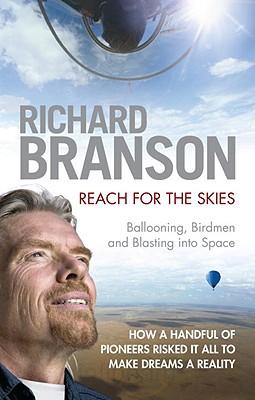
Reach for the Skies
Today I want to voice something that has been running around my mind for some time. It is whether we give in to the mounting doom and gloom at so many levels in our societies (and it can be a very compelling draw) or whether we see this as a painful but necessary period where slowly but surely the desires of ordinary people; for a fairer, more truthful, more integrous world are gaining power.
And I’m going to use Richard Branson to voice it for me!
(Now this is an unusually long Post so I’ve inserted the Read More divider to prevent the Post visually swamping your browser.)
It is probably a bit non-PC [PC = politically correct, Ed] to say anything negative about the World Cup, but I sense that the importance of being PC is beginning to wane; not that it ever bothered me anyway.
Let’s look at the positives, since almost everything has some positives somewhere; Stalin, Hitler, Pol Pot and the North Korean regime being obvious exceptions.
They built world-class stadia on time.
The foreign visitors who were there generally got to venues on time and the matches all started on time.
Inside the stadia (despite the obvious occasional sillinesses for which we can blame FIFA), everything went tickety-boo. According to some pundits, the atmosphere was “the best ever”, despite (or because of?) the hideous vuvuzela.
There was no major crime wave, no terrorism, no significant disasters of any kind.
The South Africans were reportedly very hospitable.
Opposing fans celebrated together; the England fans totally restored their reputations; reports of drunken English mobs were distinguishable by their absence. (they probably couldn’t afford to get there.)
South Africa took pride in its ability to put on the World Cup, which many had suspected it incapable of.
For a month the nation forgot all its problems; most people had a big party, even if the South African team (and Africa in general) was made to realize the enduring gulf between its standard of football and that of the other continents.
So, all’s well that ends well, then? Unfortunately not ….
The country paid around 10 billion rand to put the event on, three times more than original estimates. Where did all the money go?
The country is left with giant stadia that may never again be filled, the so-called “white-elephants” typical of almost all these major events. Apparently even the wondrous “Birds-nest” stadium in Beijing used for the opening ceremony of the Olympics has only been used once since 2008.
Only half the number of expected foreign tourists came, as the organisers over-priced everything. Organisers claim the extra income generated will pay for the costs, but nobody believes them …..
Preparations for the World Cup provided jobs, but those workers are now back on the street. The ordinary people of South Africa benefited little from the event, except in terms of “national pride”.
And there of course is an interesting animal; “national pride”. In a grown-up world, you’d have hoped that national pride would be best achieved through one of the following:
the building of suitable housing for the population
the setting-up of an affordable and accessible national health system (fat chance, even the USA hasn’t got that!!)
the diminution and ending of corruption
the creation of a fair society
the development of the economy to provide jobs and create wealth to allow ordinary people to live decently and comfortably
Any of these and other things could be seen as deserving of “national pride”, but the ability to put on at vast expense a four-week jamboree that mostly benefited the political elite, other nations, FIFA and the international television networks is a dubious contender for “pride”.
But of course it depends which side of the coin you are looking at. For some, all the expense justifies the “putting of South Africa on the map.” The politicians as usual will have been the most happy; four weeks in the spotlight strutting about on the world stage, loads of media coverage, hundreds of journalists hanging on their every word …
As for the real ethos behind the World Cup, the bits that don’t hit the glitzy headlines, two in particular struck me as symbolic of Man’s capacity for self-delusion; Africa’s attitude to its poor and the obscene power of international non-governmental monopolies such as FIFA.
These have been variously described in excellent articles written by proper journalists. The first example is from Globalpost. I find it pretty depressing.
Green Point Stadium, Cape Town: In Cape Town, Green Point Stadium is covered in a sheath of woven fiberglass so that it glows at night like a floating bowl. But its location on six city blocks in a prime real estate area has also created controversy. In 2006, the city’s government published a study that found the stadium’s location offered the least amount of economic gain to Cape Town’s resident. In fact, repairs to several older stadiums in the surrounding area could have led to savings that could have paid for 250,000 new homes for the city’s poor, according to researchers.
But FIFA wanted a stadium that would sit between South Africa’s iconic Table Mountain and Robben Island, according to reports, causing the football federation’s president, Sepp Blatter, to come under fire.
“I really think that we’re going into Green Point because Sepp Blatter says: ‘I like Green Point,’ not because it is the best thing for South Africans,” Cape Town’s then-mayor, Helen Zille, said in 2006.
Sepp Blatter will take his $2 BILLION profit away with him to some lush office somewhere, while the ordinary residents of Cape Town pick up their lives as before. How long “national pride” will sustain them is a moot point.
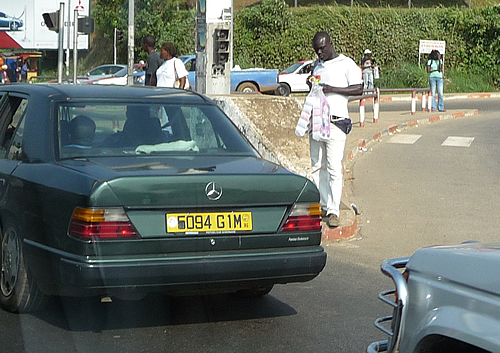
Roadside waterseller in Gabon, West Africa
The Marketing Bonanza:If you’ve been to Africa and driven around a bit, you’ll know that there are street traders everywhere. These are desperately poor people who will try to flog you anything and everything. They wander up and down lines of cars carrying their pathetic wares. In the ferocious midday heat women often carry large heavy buckets full of water bottles on their heads. Many do this all day every day to earn a pittance.
But of course, like beggars in the big city, they don’t really create the right “image” and “ambiance” for a major international event with its glitz and invasion of well-off foreigners. So, as reported in “The Guardian” they were simply banned whenever the authorities considered it appropriate. So much for the World Cup “improving the lives of ordinary Africans”.
But not just anyone will be allowed to participate in what President Jacob Zuma calls “the greatest marketing opportunity of our time“. Informal traders – a significant part of the working poor – are subject to a verbatim “exclusion zone” from the bonanza in the fan parks, fan walks and stadiums. For them, the World Cup may as well be happening on another continent.
I have personal experience of something similar in Gabon. When the wife of President Bongo died, the whole country was ordered to do a week’s mourning. Street trading was banned. This of course did not affect the elite, but for many of the rest it meant the difference between eating and going hungry. When a few daring and desperate people dared to try to sell their pitiful produce in some locations the police confiscated it and trashed their stands.
And FIFA? It is reported to have made $2 BILLION in tax-free profits. Who controls this money? Why is it tax-free? How will it be spent? To whom is FIFA really accountable? Ah, to national Football Associations? You mean like the British one, which pays £6 million per annum to a failed manager, which is three times more than the German Coach gets?
These vast sums swilling about leave a nasty taste in the mouth. Of course, any organisation’s primary concern is usually to its own self-aggrandizement, so nothing new there. Even the European Union refuses to get its accounts signed off properly, so what faith the common man can have in the honesty of these vast international organisations is questionable.
Well, the World Cup has come and gone and it provided much entertainment for those watching the games. The long-term legacy for the ordinary people of South Africa (43% of whom live on less than $2 per day) is another matter, so forgive me if my rejoicing is muted.
PS The Vuvuzuela …. nothing to me more clearly illustrates Man’s stupidity. The sound output of this instrument is 113db, which can apparently become harmful to the hearing after only 90 seconds. Those in the stadia (including the players, by the way – did anyone ask THEM what they felt?) were subject to nearly TWO HOURS of continuous multiple vuvuzuelae. Many of those people will have had their hearing IRREPARABLY DAMAGED. This will only become clearer to them in LATER YEARS.
For me it is a symbol of our stupidity. All the above health risks are clear and known. Did FIFA ban the damned thing? OF COURSE NOT!! That would have diminished the “local colour” so vital for the international media, which gives Blatter his $2 billion profit. Who gives a damn about ordinary people’s hearing? I doubt whether Sepp Blatter exposed himself overmuch to the bloody things, though he seems pretty deaf already.Once again, for a transient thrill or benefit we do ourselves lasting damage, no different from the way we often treat the planet of course.
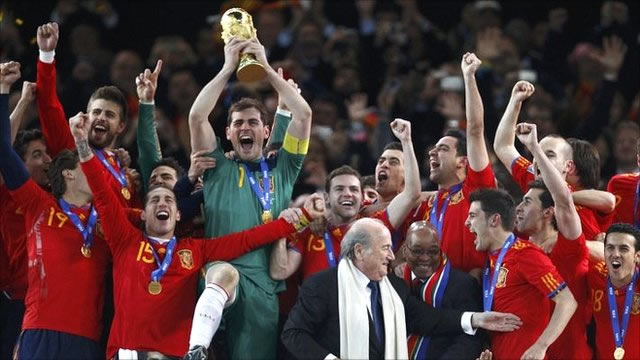
SPAIN AT LAST - AND DESERVEDLY - WIN THE WORLD CUP!!
Background: People of my generation were doubly spoilt in the 60s to 80s; it was a golden age of both popular music and football. As for the latter, we thrilled at the Brazilian and Argentinian magic, the famous German “efficiency” – and occasional touch of magic of their own – and of course the Dutch sides of 1974 and 1978. Their “total football” and tremendous skills made them exhilarating to watch. The names still linger in the memory; Cruyff, Krol, Neeskens, Hahn, Rep, Rensenbrinck, van Hanegem, van de Kerkhof …
But they never quite made it to the summit. This was not through any lack of quality, but they didn’t have – for me – that little bit of luck at the right time that you almost always need at this level. Could this latest Dutch team possibly do what the astounding Cruyff team hadn’t quite managed to pull off?
Setting the Scene: Unfortunately, the omens for the final weren’t that great. The Dutch coach had made noises about it “not being pretty” and that he didn’t mind how they won as long as they did. There was in fact to be no romantic looking back to the magic of the Dutch sides of 1974 and 1978; this Dutch side was pragmatic. They were going to make up for the past. They were NOT going to be the third Dutch team to lose in the final ……
In truth, they had done well to make the final, in particular stunning the much-fancied Brazil; you had to take them seriously after that. But they were efficient rather than slinky-skilled like the Spanish. With only one real star, the mercurial Arjen Robben, they were hard and “pragmatic”, which unfortunately – and as it once again proved in the final – often means “rough and brutal”.
The Spanish had shown great footballing skills, particularly in their mastery of the midfield, where they choked the life-blood out of the Germans in the semi-final. Pundits had agreed that the Germans had shown them “too much respect” and “allowed them to play their own game.” This, however, was one mistake the Dutch were NOT going to repeat. They were unlikely to be able to out-football the Spanish, so another strategy had to be found.
The Referee: What an honour to referee the World Cup Final! What excitement Howard Webb and his team must have felt as the kick-off approached. But it’s a fantastic “one-off”; you can never turn back the clock. Mistakes are fixed in time and unerasable, and there were to be several to scar the memory of his special day; which is a personal tragedy in itself.
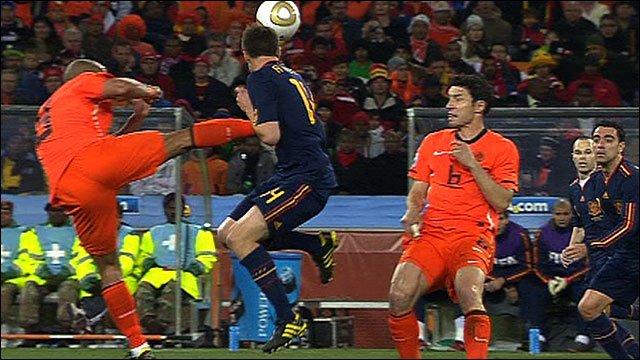
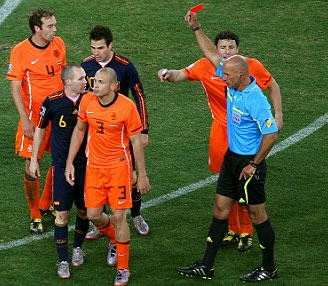
The Game: Let’s not beat about the bush; the first half was a disgrace. The Dutch game-plan seemed to be to kick the Spain out of their rhythm and indeed even off the field. Some of the tackling was appalling. Feet were smashing in left, right and centre with no hope of getting the ball. Webb was forced to issue yellow after yellow, yet seemed so stunned by and unprepared for the ferocity of what was going on that in fact, he was over-lenient despite the number of bookings (14 yellows and one red, easily a record for the final). The Dutch were lucky to reach the interval with 11 players. Van Bommel could well have gone with a straight red; how de Joong didn’t get a straight red is a total mystery to everyone I’ve talked or listened to.
It was appalling, and not just in terms of what was actually happening, it being quite sickening to see players smashed recklessly to the ground. After all, a single clumsy, violent and of course illegal challenge can end a player’s career. No, the deeper tragedy was in the realization that in their desperation to win, the Dutch had cast aside sportsmanship and in essence betrayed the memories of their magical predecessors. I have no idea what their coach said before, but the brutality of much of the tackling seemed so widespread that one felt it could only be part of a game plan and not just “World Cup nerves”. After some time, the Spanish (somewhat naturally) began to respond in kind so that the yellow cards began to mount up on both sides, and then, mercifully, came half time.
The second half was a bit better; had the players had a bollocking in the dressing room? Of course, for almost half the Dutch side they now HAD to be more careful, since a second booking meant they were off and their team one man down. As it happens, they survived till extra time before they had a man sent off; how is a mystery, and sadly, the referee has to take the blame. Yes, it is a showpiece. Yes, in one sense a sending-off would “spoil the game”, but the spoiling would have been self-inflicted by the Dutch, not the referee’s fault.
The Result? Non-partisan before the game, I was now rooting for Spain. Despite my nostalgia for Dutch teams of the past, their cynical approach could not prevail, could it? But the Spanish were doing everything possible to gift them the game. They simply could not find the goal, despite their usual domination of the midfield. The funny thing is that despite their being “the best side of the tournament”, they won it by scoring the fewest goals in World Cup history – only EIGHT, and winning ALL the knock-out stages just 1-0. As time went on, it seemed they would never score, with shot after shot whizzing miles over the bar or left or right of an untroubled goalkeeper, while the Dutch lurked and waited and should have won with Robben’s one-on-one with the Spanish goalkeeper after a magnificent through-ball on the counter-attack. Mysteriously – and tragically for the Dutch – Robben could not lift the ball a couple of feet and thus surely over Cepillas’ desperately-sliding legs.
And so we went into extra time, the Dutch seeming to play for a draw until finally their misdeeds caught up with them and Heitinga was sent off. With Dutch legs flagging Spain launched wave after wave of attacks and finally found the target with 10 minutes to go. This spared us the agony of a penalty shoot-out, which I would have backed the pragmatic Dutch to win.
But thank God they didn’t and that their brutality of the first half was not rewarded. I asked myself whether a Dutchman could have been proud of this side. Surely nationalism and pride should not prevail over sportsmanship? I am waiting to see what the great Cruyff has to say about it all. (see below)
Agreed, the ref had a very poor game (though the players must take much of the blame for this.) Apart from all the brutality, he missed an obvious corner to the Dutch just before the latter scored their goal. But had the Dutch won, I suspect there would have been an absolute furore in the media, and a legacy of much bitterness.
But in the end, they had nothing to complain about (which didn’t stop them looking). The better – and MORE IMPORTANTLY – more sporting side won, but the post-mortem will continue. And the final questions are:
Is winning really worth losing your honour? If it is, then I’ll stop watching professional football; it’s already going that way to some extent as we saw on Sunday.
Will FIFA one day get its act together and sort out the constant gamesmanship and brutality that scar the game? Video evidence seems essential here, INCLUDING its use AFTER games to retrospectively punish bad and unsporting play, which too many players get away with.
Why is FIFA so CONSERVATIVE? Why not as in rugby a SIN-BIN for players booked? Knowing that a yellow card would mean 10 or 15 minutes off the pitch would seriously concentrate the minds one thinks. I hate punishment on a philosophical level, but if it IS felt necessary then it HAS TO BE EFFECTIVE. It is not for nothing that I have nicknamed the FIFA President Sepp Blabber, or even Blather – either seems appropriate.
By Chris Snuggs
PS I found out about Cruyff – as I had hoped and suspected he would, he has severely criticised his own national team, showing the same admirable qualities as a man that he did as a player. His countrymen have to take a long, hard look at themselves after all this, not just at the way the team played but at how some people in Holland have reacted to the defeat.




 Learning from Dogs